
Why do most habit-building attempts fail before they start?
You downloaded the habit tracker app. You wrote out your ambitious morning routine. You told yourself this time would be different. Then three days later, you hit snooze, skipped the meditation, forgot the journaling, and felt like a failure before breakfast.
Sound familiar? The problem was not your willpower or motivation. Trying to build multiple new habits at once stretches your cognitive resources past the breaking point. A 2024 meta-analysis of 20 habit-formation studies found that successful habit formation depends on frequency, consistency, and simplicity of the target behavior, with simpler actions forming stronger habits [8]. The gap between intention and execution is widespread — a Gallup study found that while 70 percent of adults set goals, only about half create specific action plans to reach them [7]. Habit stacking addresses this exact gap. Habit stacking for beginners works differently than what most productivity advice suggests. Instead of overhauling your entire life, you attach one small new behavior to something you already do without thinking. This article shows you exactly how to do that using the Minimum Viable Stack method.
Habit stacking
Habit stacking is a behavior change technique that links a new habit to an existing automatic routine using the formula: “After I [current habit], I will [new habit].” S.J. Scott coined the term in his 2014 book Habit Stacking, and James Clear later popularized it in Atomic Habits as an implementation intention strategy — a concept originally developed by psychologist Peter Gollwitzer — pairing a situational cue with a behavioral response [5]. Habit stacking works because established neural pathways for the anchor habit reduce the cognitive effort required to remember and perform the new behavior.
What you will learn
- What makes a good anchor habit – the four qualities to look for
- The Minimum Viable Stack – the beginner framework that prevents overwhelm
- 5 common beginner mistakes – and how to fix each one
- 15 beginner-friendly habit stack examples – for morning, workday, and evening
- When to add your second stack – the 2-week rule and signs of readiness
- What to do when your stack breaks – recovery strategies for real life
Key takeaways
- Start with one anchor habit plus one new habit – this is the Minimum Viable Stack
- Good anchor habits happen daily, require no willpower, and occur at consistent times
- Practice one stack for 2 weeks before adding anything else
- The “After I, I will” habit stacking formula creates a clear trigger for your new behavior
- Missing one day does not reset your progress – resume the next occurrence [1]
- Habits take 18 to 254 days to become automatic, with 66 days as the average [1]
- When life disrupts your stack, shrink the new habit to its smallest form rather than abandoning the chain
What makes a good anchor habit for stacking?
Not every existing habit works as an anchor. Wendy Wood and colleagues found through two diary studies that roughly 43 percent of participants’ daily actions qualified as habitual, and about 45 percent of behaviors were repeated in the same location daily [2].
But for habit stacking to work, your anchor needs specific qualities. The wrong anchor will sabotage your stack before you build any momentum.
“About 45 percent of everyday behaviors tended to be repeated in the same location almost every day.” – Wendy Wood and colleagues [2]
Anchor habit
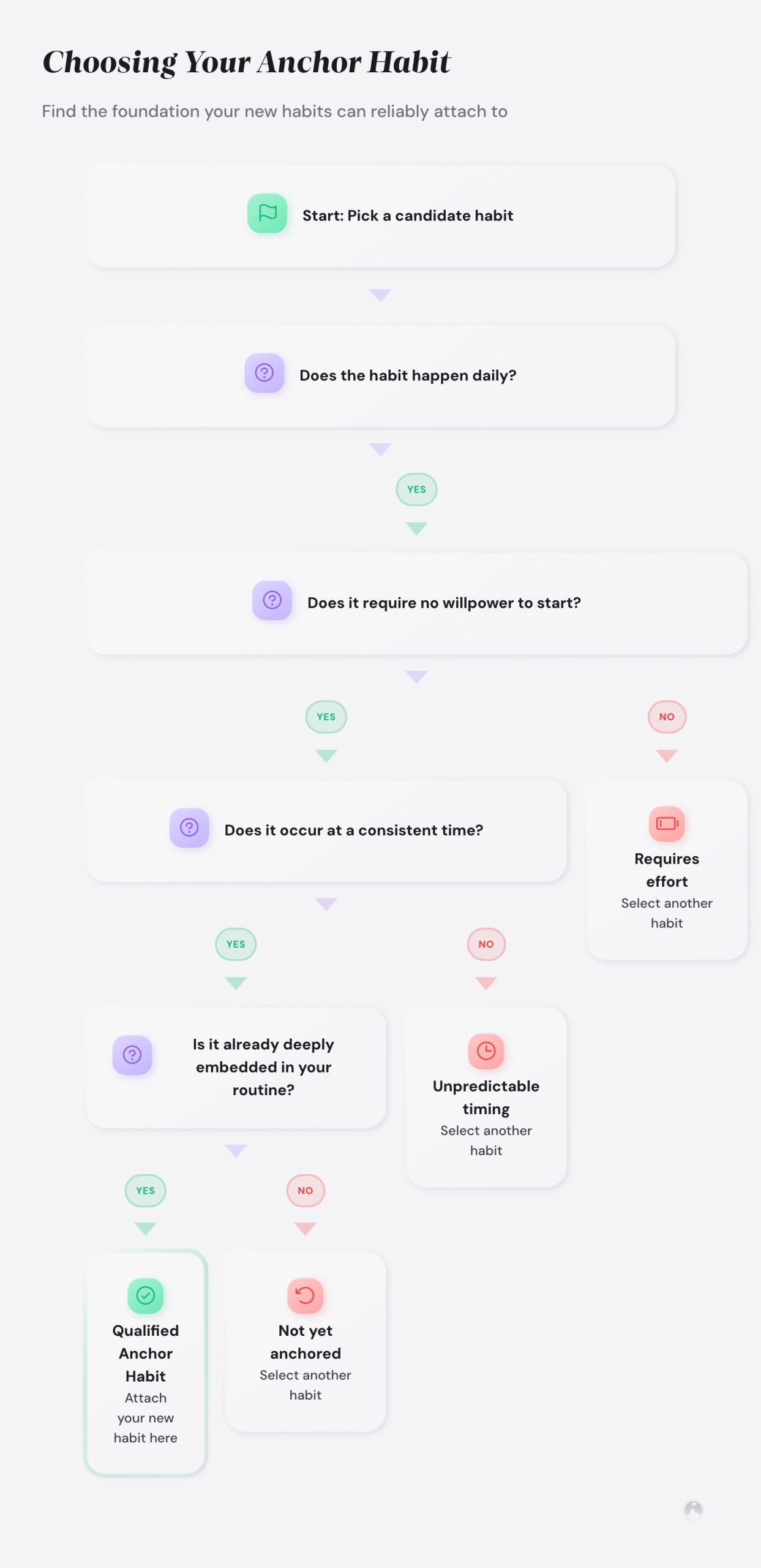
An anchor habit is an existing automatic behavior that requires zero willpower, occurs daily at a consistent time, and acts as the trigger for attaching a new habit using the habit stacking formula. Unlike time-based cues (“at 9am”), anchor habits use routine-based cues (“after I brush my teeth”), which research shows are effective for habit formation and don’t require clock-watching [3].
The four qualities of a strong anchor habit
A strong anchor habit meets four criteria. First, it happens daily without fail. Brushing your teeth qualifies. Going to the gym three times a week does not.
Second, it requires zero willpower – you do it on autopilot regardless of mood or energy. Third, it occurs at a consistent time each day. Keller and colleagues found in a randomized controlled trial that routine-based habit cues are at least as effective as time-based cues for habit formation, while offering the advantage of not requiring clock-watching [3]. Fourth, it has a clear endpoint that signals completion.
| Quality | Good anchor example | Poor anchor example |
|---|---|---|
| Daily occurrence | Making morning coffee | Weekly team meeting |
| Zero willpower required | Brushing teeth before bed | Evening workout |
| Consistent timing | Sitting down for lunch | Checking email (varies) |
| Clear endpoint | Finishing shower | Scrolling social media |
A habit stack is only as reliable as the anchor habit it is built upon. For a deeper look at how habit stacking works and why these anchor qualities matter, see the complete guide to habit formation.
What is the Minimum Viable Stack for habit stacking beginners?
Minimum Viable Stack
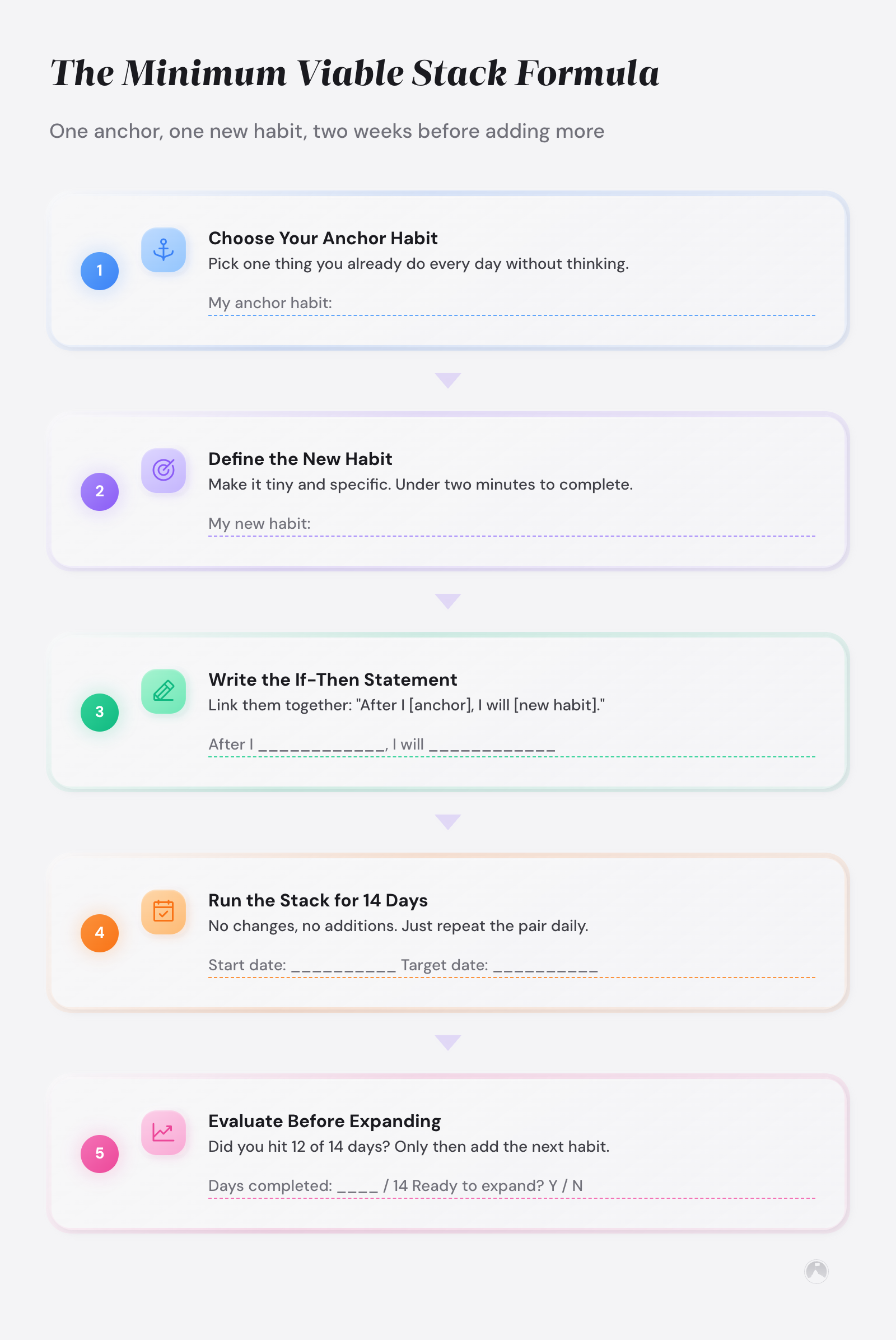
The Minimum Viable Stack is a habit stacking framework for beginners that limits initial practice to one anchor habit paired with one new behavior for 14 days before adding additional stacks, preventing cognitive overload during habit formation. It builds on James Clear’s implementation intention model from Atomic Habits [5] with added restraint for new habit stackers.
The Minimum Viable Stack works because your brain treats new behaviors as cognitive work. Research by Ann Graybiel at MIT shows that as behaviors become routine, the basal ganglia – the brain region governing automatic behavior – shows increased activation while prefrontal cortex involvement decreases [4]. This transfer from deliberate to automatic processing takes time. Attempting to form multiple new neural patterns simultaneously causes cognitive overload that looks a lot like laziness.
Here is the part most habit advice gets wrong: beginners don’t need elaborate systems. They need one thing that works. This simple habit stacking approach builds on Clear’s habit stacking concept with added restraint — a framework we developed specifically for new habit stackers who need a simpler entry point than most habit stacking guides provide. Choose one rock-solid anchor habit, pair it with one small new habit, and practice for 2 weeks before adding anything else.
For example, if your anchor is pouring morning coffee, your Minimum Viable Stack might be: “After I pour my coffee, I will write one sentence about my top priority.” For 14 days, that is the only stack you practice. On day 15, if it feels automatic, you add a second stack to a different anchor.
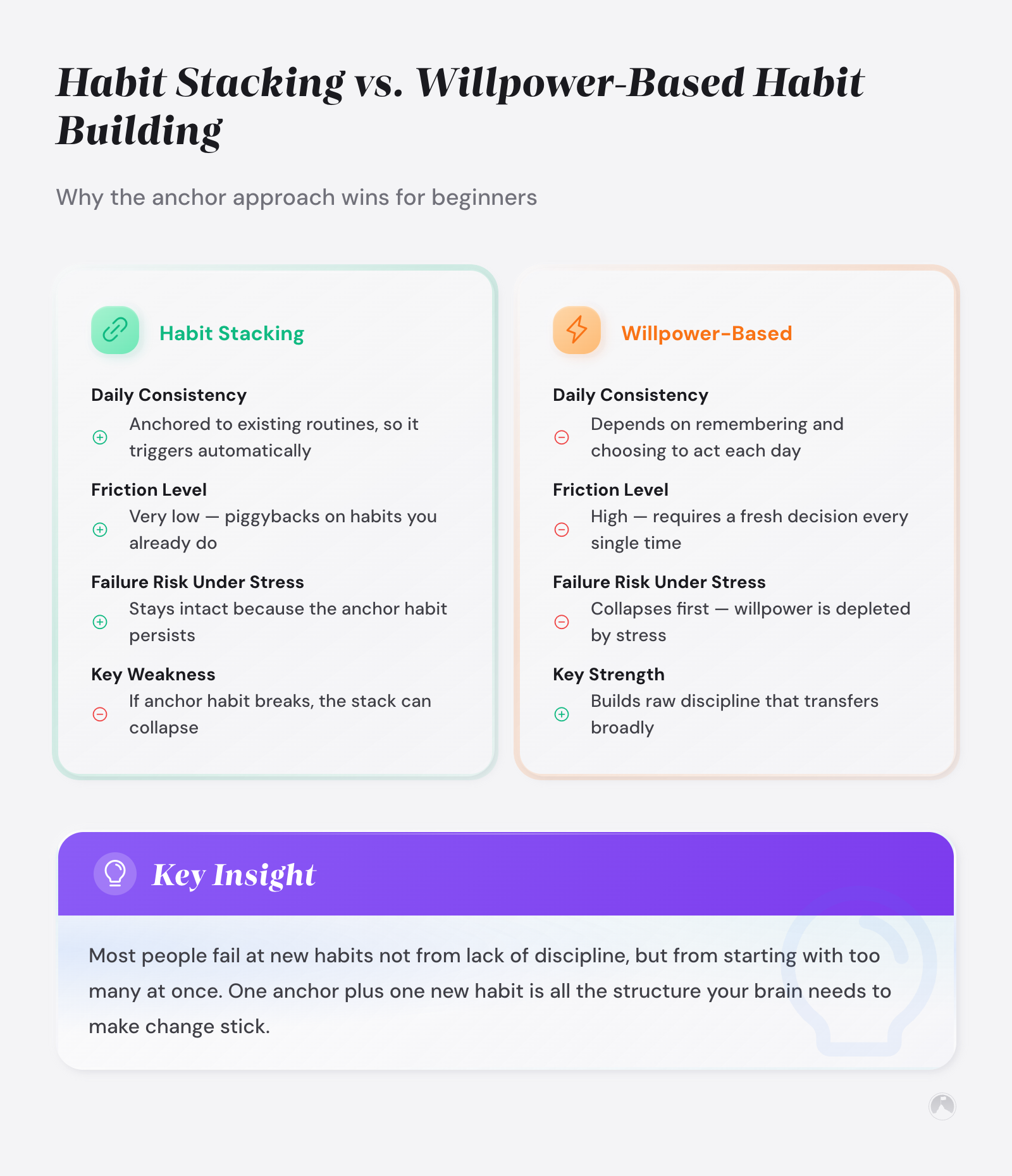
Research shows habit stacking works best when beginners limit themselves to one new behavior at a time, since habit formation takes a median of 66 days and adding simultaneous behaviors extends that timeline [8][1].
Place physical reminders where your anchor habit happens. If your anchor is pouring coffee, put a sticky note on the coffee maker with your stack formula. If your anchor is sitting at your desk, set your journal open before you leave the night before. Environment design takes the remembering burden off your brain.
Why does the Minimum Viable Stack limit you to one stack for two weeks?
Chunking
Chunking is a neurological process where the basal ganglia consolidates a sequence of actions into a single automatic unit, reducing the cognitive effort required to perform the sequence over time. Chunking explains why established morning routines feel effortless while new multi-step habits feel exhausting.
Your brain handles habit formation through chunking – consolidating multiple steps into a single automatic unit over time [4]. Think of how you drive to work — what started as dozens of conscious decisions (check mirror, signal, turn wheel) became a single fluid action. That consolidation is chunking, and it happens with habit stacks too. But chunking takes time. When you stack multiple new habits at once, you force your brain to manage several incomplete chunks simultaneously. Research on behavior change shows that this kind of cognitive depletion manifests as apparent lack of motivation but is actually a resource limitation [9]. What looks like laziness is often your brain running out of bandwidth for new routines.
“On average, it takes more than 2 months before a new behavior becomes automatic – 66 days to be exact. And how long it takes a new habit to form can vary widely depending on the behavior, the person, and the circumstances.” – Phillippa Lally and colleagues [1]
The Minimum Viable Stack is not about perfection. The two-week practice period lets the anchor-to-habit connection strengthen before you add more behaviors to the system.
The habit stacking formula for beginners
Use this exact structure: “After I [anchor habit], I will [new habit for under 2 minutes].”
[Diagram: Habit Stacking Formula]
Anchor Habit (existing, automatic) → Trigger → New Habit (under 2 minutes)
“After I [anchor habit], I will [new habit].”
Examples:
- After I pour my morning coffee, I will write one sentence in my journal.
- After I sit down at my desk, I will take three deep breaths.
- After I brush my teeth at night, I will set out my clothes for tomorrow.
The “under 2 minutes” constraint is not arbitrary. BJ Fogg’s research on behavior design at the Stanford Behavior Design Lab shows that starting with tiny habits reduces internal resistance [6]. You can always expand the behavior later. Right now, you are building the connection, not the full habit. The size of the habit matters less than the strength of the trigger.
What are the 5 biggest habit stacking mistakes beginners make?
Knowing what not to do matters as much as knowing the technique. These habit stacking tips address the five mistakes that show up repeatedly for beginners.
Mistake 1: stacking too many habits at once
The excitement of a new system makes this tempting. You imagine yourself doing five linked habits in a seamless morning flow. Reality intervenes. One habit takes longer than expected, another gets skipped, and the entire chain tends to collapse [9]. The fix: stick to the Minimum Viable Stack. One anchor, one new habit, two weeks.
Mistake 2: using vague cues instead of specific anchor habits
“After I wake up” is too vague. Do you mean the moment your eyes open? After you use the bathroom? Once you are dressed? Vague cues create decision points that require conscious effort, increasing the mental load of performing the habit. The fix: specify the exact moment. “After I turn off my alarm” or “After I sit up in bed” leaves no ambiguity.
Mistake 3: choosing weak anchors
If your anchor habit is inconsistent, your new habit inherits that inconsistency. Anchoring a meditation habit to “after my workout” fails on rest days. The fix: audit your anchor against the four qualities above before committing. For more on understanding why habits break down, see our guide on why habits fail.
Mistake 4: skipping days and feeling defeated
Missing a day feels like failure. But Lally and colleagues’ research on habit formation shows that missing one opportunity does not materially affect long-term habit strength [1]. The danger is the story you tell yourself. “I already broke the streak” becomes permission to quit. The fix: treat missed days as data, not verdicts. Resume at the next anchor occurrence without drama.
Mistake 5: setting unrealistic habit stacking expectations
Habit stacking works well for small behaviors. It struggles with habits requiring significant time or effort. Stacking “read for 30 minutes” after brushing your teeth sounds logical but creates friction.
That said, there is a better way: use habit stacking to start the behavior, then let momentum carry you. “After I brush my teeth, I will read one page” works. One page often becomes ten. Start the smallest version of the habit, and momentum carries you further than motivation would.
What are the best habit stacking examples for beginners?
These habit stacking routine examples follow the Minimum Viable Stack principle: small new habits attached to reliable anchors. Pick one that fits your life and practice it for two weeks.
![SMART habit stacking template showing how to write an if-then statement: 'After I [current habit], I will [new habit].' Example included.](https://goalsandprogress.com/wp-content/uploads/2026/04/SMART-habit-stacking-template-showing-how-to-write-an-if-then-statement-After-I-current-habit-I-will-new-habit.-Example-included.png "Habit stacking for beginners: how to build new habits that actually stick 3")
Morning habit stacking examples
Morning anchors tend to be stronger because daily routines are typically more consistent and predictable early in the day, before external demands fragment your schedule. This makes morning anchors ideal for beginners.
- After I turn off my alarm, I will drink the glass of water on my nightstand.
- After I start the coffee maker, I will do five squats while it brews.
- After I pour my coffee, I will write my top priority for the day.
- After I finish breakfast, I will take my vitamins.
- After I brush my teeth, I will floss one tooth (yes, just one to start).
For a complete morning system, see the morning routine for habit building.
Workday habit stacking examples
Work anchors are reliable but require intentional placement. The transition points – arriving, lunch, leaving – work best.
- After I sit down at my desk, I will review my calendar for 30 seconds.
- After I close my laptop for lunch, I will stand and stretch for 30 seconds.
- After I return from lunch, I will clear one item from my inbox.
- After I finish a video call, I will write one action item before starting anything else.
- After I shut down my computer for the day, I will write tomorrow’s top three tasks.
Workday stacks pair well with energy management strategies covered in habit pairing for energy management.
Evening habit stacking examples
Evening habits face more variability but can anchor to dinner or bedtime preparation.
- After I finish dinner, I will load one dish into the dishwasher.
- After I put on my pajamas, I will set out clothes for tomorrow.
- After I plug in my phone to charge, I will write one thing I am grateful for.
- After I get into bed, I will read one page of a book.
- After I turn off the bedroom light, I will take three slow breaths.
Your copy-pasteable habit stacking template
Use this template to build your own Minimum Viable Stack. Fill in the blanks and put it somewhere you will see it tomorrow:
My Minimum Viable Stack:
- My anchor habit: “After I _______________”
- My new habit (under 2 minutes): “I will _______________”
- Where I will put this reminder: _______________
- Start date: _______________
- 2-week checkpoint date: _______________
Tracking (simple yes/no):
Day 1: ___ Day 2: ___ Day 3: ___ Day 4: ___ Day 5: ___ Day 6: ___ Day 7: ___
Day 8: ___ Day 9: ___ Day 10: ___ Day 11: ___ Day 12: ___ Day 13: ___ Day 14: ___
Simple yes/no tracking is all beginners need — just a record of whether you did the new habit after the anchor.
When should you add your second habit stack?
The Minimum Viable Stack recommends two weeks of practice before expansion. But time alone does not determine readiness. Watch for these three signs:
- Automatic trigger recognition. You notice yourself thinking of the new habit the moment the anchor completes, without deliberate effort.
- Low resistance. The new habit no longer feels like work. It feels like “what comes next.”
- Recovery without effort. When you miss a day, you resume automatically at the next occurrence without needing to recommit.
If all three signs are present after two weeks, you can add a second stack. If not, continue with your current stack until they appear. Patience during the first two weeks of habit stacking prevents collapse from premature expansion.
Once your first stack feels automatic, you might explore how to master habit stacking for more advanced techniques including multi-stack management.
How do you fix a broken habit stack?
Travel, illness, schedule changes, new babies – life disrupts routines. When your stack breaks, you have three options.
Option 1: shrink the new habit
When disruption is temporary, shrink your new habit to its smallest possible version. If you were doing five minutes of stretching, do 30 seconds. If you were journaling a paragraph, write one word. The goal is maintaining the anchor-to-habit connection, not the full behavior. Shrinking a habit to its smallest possible version aligns with what BJ Fogg calls “scaling back to the starter step” — keeping the behavioral pathway active even when conditions are imperfect [6].
Option 2: find a temporary anchor
When your usual anchor disappears (hotel travel eliminates your home coffee routine), find a substitute anchor that exists in the new context. “After I order coffee at the hotel” can temporarily replace “After I pour my morning coffee.”
Option 3: pause and restart
When disruption is significant – major illness, relocation – pause without guilt. Your neural pathways don’t disappear. Graybiel’s research shows that basal ganglia patterns for habitual behaviors persist even during extended breaks [4]. When stability returns, restart your Minimum Viable Stack from scratch. The second time builds faster than the first.
The best habit recovery strategy is the one that keeps the connection alive, even if the behavior shrinks to almost nothing.
Ramon’s take
Pick the anchor habit that already feels automatic for you, not the one that sounds impressive. That’s the whole game. If you’re stuck, your morning coffee is probably a better anchor than your ‘morning routine.’
Conclusion
Habit stacking for beginners comes down to restraint. One anchor, one new habit, two weeks of practice before adding anything else. The Minimum Viable Stack prevents the overwhelm that derails most habit-building attempts. One stack, practiced daily for two weeks, will teach you more about how you actually change than any book about habits ever could.
In the next 10 minutes
Write down three things you do every single day without thinking – brushing teeth, making coffee, sitting down for lunch. Pick one. Pair it with one small new habit using the formula: “After I [anchor], I will [new habit under 2 minutes].” Write that sentence down where you will see it tomorrow morning.
This week
Practice your Minimum Viable Stack every day for 7 days. Track with a simple yes or no – did you do the new habit after the anchor? That is the only metric that matters this week. No apps, no elaborate tracking. Just yes or no.
There is more to explore
Habit stacking is one technique within a larger system of behavior change. Once your Minimum Viable Stack feels automatic, where you go next depends on where you are. If your first stack is working and you want to expand, start with mastering habit stacking. If you want to understand the science behind why this works, the neuroscience of habit formation goes deeper.
- Habit stacking for productivity and creativity – how to apply stacking to knowledge work outputs like writing, problem-solving, and creative sessions
- The science behind habit formation – covers the full science of how habits form, stick, and break down
- The neuroscience of habit formation – a deeper look at basal ganglia chunking and why your brain automates repeated behaviors
Related articles in this guide
Frequently asked questions
How many habits can you stack at once as a beginner?
Start with one. The Minimum Viable Stack approach pairs one anchor habit with one new habit for two weeks before adding anything else. A 2024 meta-analysis found that adding multiple new behaviors simultaneously increases failure rates by stretching cognitive resources [8]. After your first stack feels automatic, add a second – but never more than two active stacks at once during your first three months.
Does the habit stacking method work for big habits like exercising?
Habit stacking works best for small habits under two minutes. For bigger habits like exercising, use stacking to start the behavior – after I put on my workout clothes, I will do one squat – then let momentum carry you into the full workout. BJ Fogg calls this the starter step approach: make the initial action so small that skipping it feels harder than doing it [6].
What if you miss a day of your habit stack?
Missing one day has no measurable effect on long-term habit formation [1]. The real risk is the what-the-hell effect — where one missed day becomes permission to quit. Counter this by setting a rule in advance: if you miss a day, your only job is to do the habit at the very next anchor occurrence, even in a reduced form. Some habit stackers find it helpful to anticipate their most likely miss scenario (late nights, travel, illness) and pre-plan a micro-version for those days.
How long does it take for a habit stack to become automatic?
Lally and colleagues found a range of 18 to 254 days, with a median of 66 days [1]. For habit stacking specifically, the timeline depends on stack complexity. Simple stacks (drinking water after coffee) tend toward the shorter end because both the anchor and new habit are low-effort. Stacks involving cognitive effort (journaling after coffee) take longer. Track your subjective sense of automaticity rather than counting days — when you notice yourself starting the new habit without consciously remembering, you are close.
Can you habit stack at work?
Yes. Workday habit stacks work well when anchored to reliable transitions: arriving at your desk, returning from lunch, shutting down your computer. The key is choosing anchors that happen consistently regardless of meeting schedules or project demands. Work-based stacks are particularly effective because office routines tend to be highly contextually stable [3].
What is the difference between habit stacking and habit chaining?
Habit stacking links a new habit to an existing automatic behavior using the After I, I will formula. Habit chaining connects multiple new habits in sequence where each new habit triggers the next. Stacking is safer for beginners because it relies on established neural pathways rather than building an entirely new chain from scratch. For more on chaining techniques, see our guide on mastering habit stacking.
Is habit stacking backed by research?
Yes. Habit stacking builds on two well-established research areas: implementation intentions (specific if-then plans that increase follow-through rates) popularized by James Clear [5], and habit formation research showing that contextual cues like existing routines create stronger automatic behaviors than time-based triggers [3]. The neuroscience of basal ganglia chunking also explains why attaching new behaviors to existing routines works [4].
References
- Lally, P., van Jaarsveld, C. H., Potts, H. W., and Wardle, J. (2010). “How are habits formed: Modelling habit formation in the real world.” European Journal of Social Psychology, 40(6), 998-1009. DOI
- Wood, W., Quinn, J. M., and Kashy, D. A. (2002). “Habits in everyday life: Thought, emotion, and action.” Journal of Personality and Social Psychology, 83(6), 1281-1297. DOI
- Keller, J., Kwasnicka, D., Klaiber, P., Sichert, L., Lally, P., and Fleig, L. (2021). “Habit formation following routine-based versus time-based cue planning: A randomized controlled trial.” British Journal of Health Psychology, 26(3), 807-824. DOI
- Graybiel, A. M. (2008). “Habits, rituals, and the evaluative brain.” Annual Review of Neuroscience, 31, 359-387. DOI
- Clear, J. (2018). Atomic Habits: An Easy and Proven Way to Build Good Habits and Break Bad Ones. Avery.
- Fogg, B. J. (2019). Tiny Habits: The Small Changes That Change Everything. Houghton Mifflin Harcourt.
- Gallup. (2023). “Seven in 10 Americans likely to set goals for 2023.” Gallup Poll Results. Link
- Singh, B., Murphy, A., Maher, C., and Smith, A. E. (2024). “Time to form a habit: A systematic review and meta-analysis of health behaviour habit formation and its determinants.” Healthcare, 12(23), 2488. DOI
- Lally, P., and Gardner, B. (2013). “Promoting habit formation.” Health Psychology Review, 7(sup1), S137-S158. DOI