
The GROW model works because it stops you from skipping the hard part
You sit down with a goal and thirty minutes later you’re drowning in ideas you’ll never act on. A 2014 meta-analysis by Theeboom, Beersma, and van Vianen found that structured coaching produces significant positive effects on performance, skill development, and well-being across organizational settings [1].
But here’s what most people miss: they jump from “What do I want?” straight to “Here’s what I’ll do” and wonder why nothing sticks. The missing piece isn’t willpower. It’s the uncomfortable middle steps that force you to confront reality before you race toward solutions.
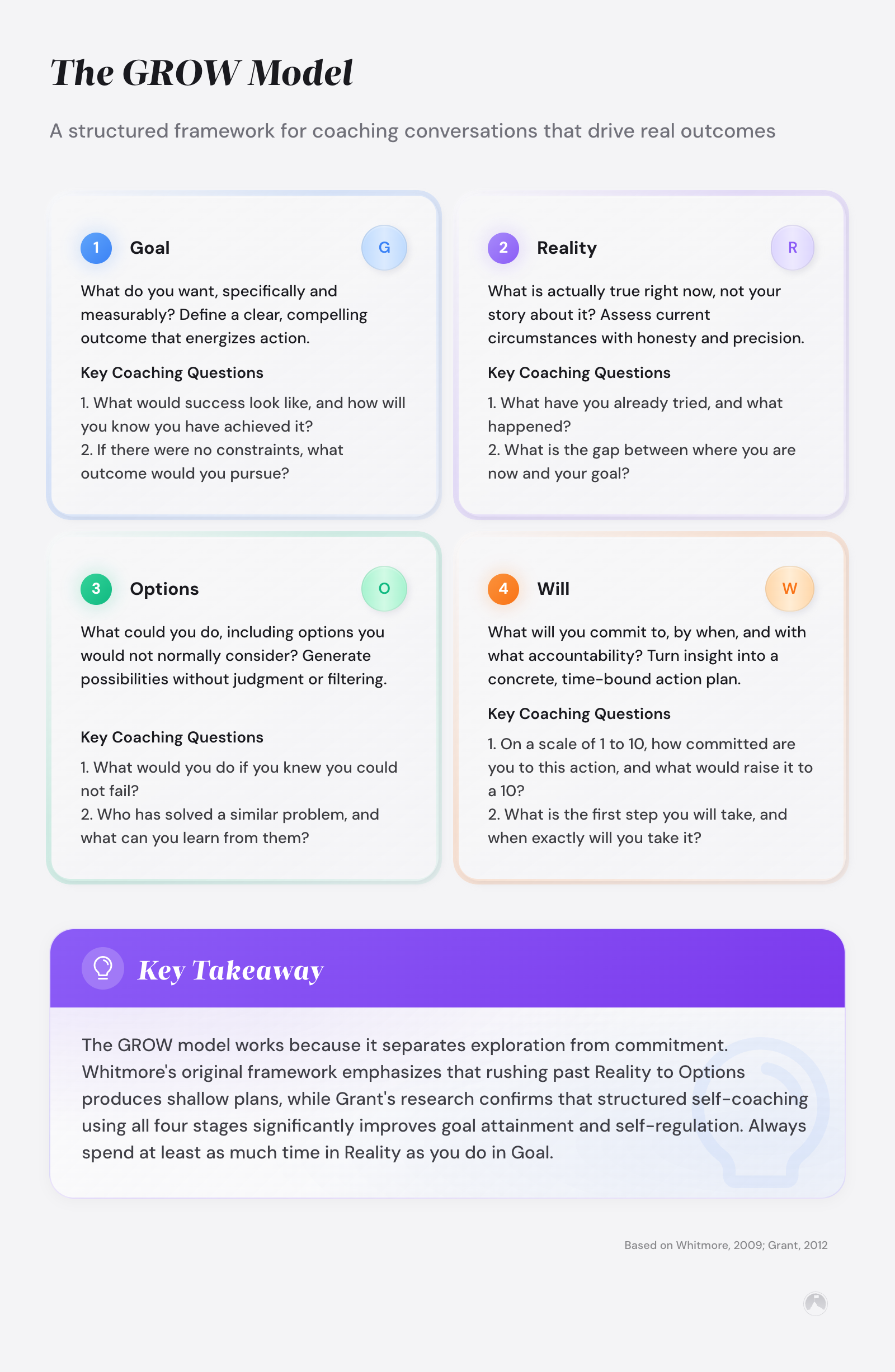
The GROW Framework is a four-stage coaching model – Goal, Reality, Options, Will – that moves a person from goal clarification through honest reality assessment, creative option generation, and committed action planning. Sir John Whitmore and colleagues developed the model in the 1980s on the principle that knowing where you actually stand matters as much as knowing where you want to go.
GROW stands for Goal, Reality, Options, and Will – four stages that move you from defining a clear target through honest assessment of your current position, creative brainstorming of possible paths, and commitment to specific actions. Developed for coaching in the 1980s, the model works equally well for self-directed goal pursuit.
What you will learn
- How the four GROW stages function as an integrated self-coaching system
- A complete worked example walking through all four stages with a real goal
- The core coaching questions for each stage (adapted for self-coaching)
- The biggest mistakes people make with GROW and how to avoid them
- How GROW compares to SMART goals, WOOP, and other planning frameworks
Key takeaways
- GROW has four stages: Goal, Reality, Options, Will. Each one matters equally.
- Structured coaching produces significant gains in performance and goal attainment across organizational settings [1].
- The Reality stage is where most people rush, and it’s where most value lives.
- Self-coaching with GROW works because the questions force honest gap analysis between current position and target.
- A full worked example and stage-by-stage coaching questions are provided below to make GROW immediately actionable.
- GROW pairs well with time blocking for the Will stage and weekly progress reviews for tracking Reality changes over time.
- Each stage has specific questions that prevent common failure modes in goal pursuit.
- Writing down your GROW answers forces more specificity than thinking through them mentally.
What are the four stages of the GROW goal setting framework?
Sir John Whitmore introduced the GROW model in his 1992 book “Coaching for Performance,” though the framework had been used in coaching circles since the late 1980s [2]. The acronym stands for Goal, Reality, Options, and Will. Each stage builds on the previous one, and skipping a stage is the fastest way to derail the process.
The GROW goal setting framework works because it mirrors how effective problem-solving naturally occurs: define the target, assess the gap, generate possibilities, then commit to specific action. Most people don’t fail because they lack ambition. They fail because they jump from “I want to get promoted” straight to “I’ll work harder,” bypassing the honest reality check that would reveal the actual obstacles.
Goal means defining what you want clearly enough that both success and failure are obvious – a standard stricter than most goal-setting approaches require. “Get healthier” doesn’t qualify. “Run a 5K by September without stopping” does. You’d know whether you hit it.
Reality means assessing where you stand right now. What have you already tried? What resources do you have? What’s actually blocking you? This stage requires the honesty most people skip.
Options means brainstorming every possible path forward without judging feasibility. Option generation is creative divergence, not decision-making. The wider you cast the net, the better your eventual choice.
Will means selecting your path and committing to named actions with deadlines and accountability – the stage that separates GROW from frameworks that stop at planning. This isn’t wishful thinking. It’s a concrete plan with accountability.
The GROW Model: Four Stages of Self-Coaching
Each stage builds on the previous one. Skipping a stage – especially Reality – is the fastest way to derail the process.
| Stage | Core question | Common mistake |
|---|---|---|
| Goal | What do I want to achieve? | Goal too vague to measure |
| Reality | Where am I right now? | Skipping this stage entirely |
| Options | What could I do? | Judging options too early |
| Will | What will I do? | No specific next action or deadline |
The GROW Framework works because it forces the kind of honest self-reflection that unstructured goal-setting avoids. Most goal-setting systems focus on the destination. GROW equally weights the starting point and the path between here and there.
GROW framework worked example: from vague goal to action plan
Theory matters. Application matters more. Let’s walk through all four stages with a goal many readers recognize: moving into product management while working full-time. If you’re navigating a career transition like this, our guide on mindset shifts for career changers covers the mental framework that makes these transitions stick.
Stage 1: goal
Start with the raw desire: “I want to move into product management.” That’s a direction, not a goal. Push it further. After self-coaching, a better version might be: “Secure a product management role at a mid-size tech company within 12 months, earning at least my current salary.”
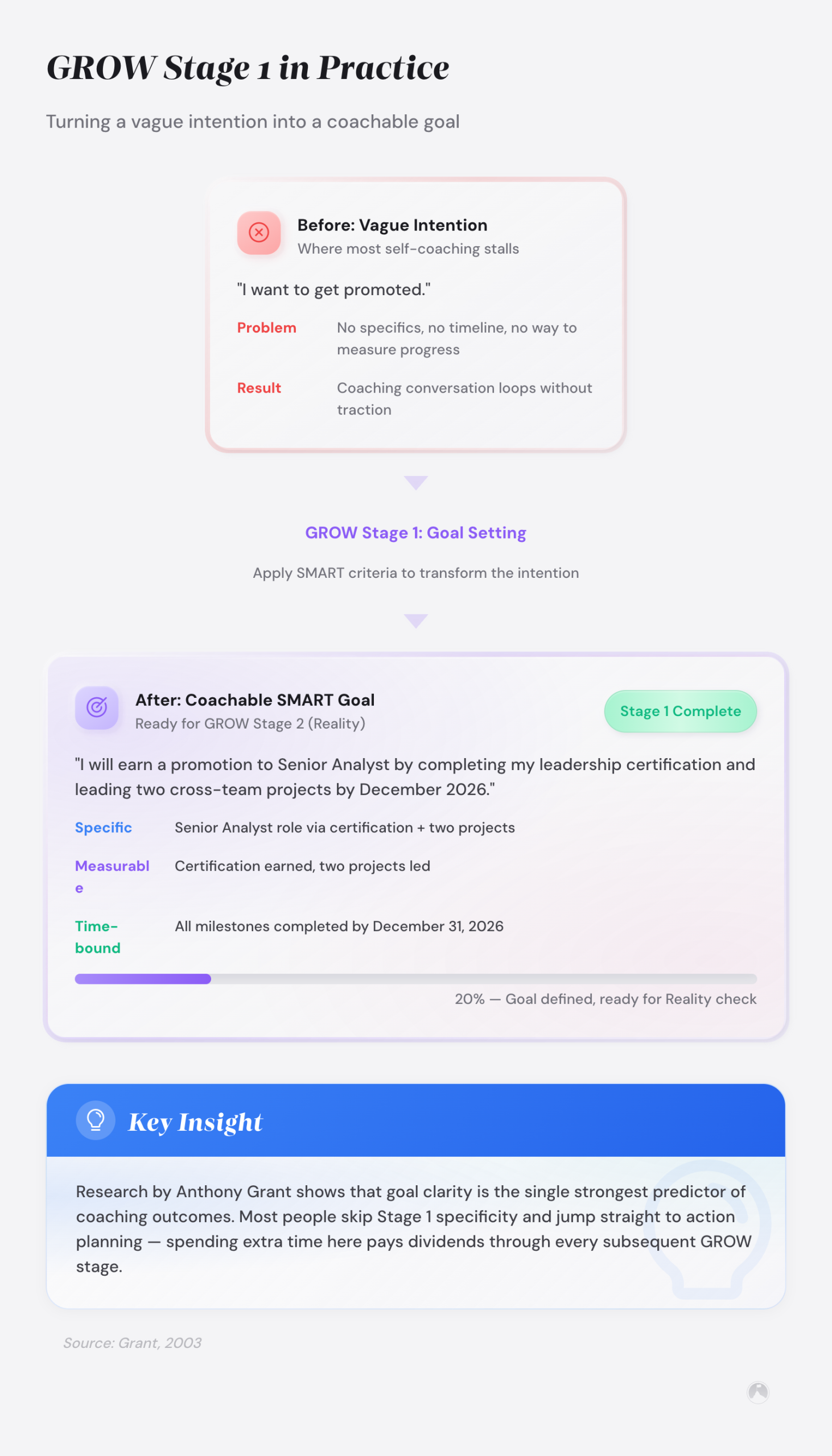
The key questions here are: What exactly do you want? When do you want it by? How will you know you’ve achieved it? A well-formed goal is specific enough that both success and failure are obvious, with no room for self-deception. Notice the difference: “move into product management” leaves room to endlessly prepare without ever committing to a timeline.
Stage 2: reality
This is the stage people rush through. And it’s the stage that matters most. Where are you right now relative to that product management goal? Be specific.
An honest reality check might reveal: “I’ve managed cross-functional projects for three years. I understand user research basics but haven’t run a formal product discovery process. I have no product management certifications. My network in tech is thin. I have maybe 5-7 hours per week available for career development.”
Theeboom, Beersma, and van Vianen’s 2014 meta-analysis found that structured coaching produced effect sizes of 0.74 for goal-directed self-regulation and 0.46 for well-being across 18 studies [1].
The Reality stage is where that self-regulation develops – you can’t regulate progress toward a goal you haven’t honestly assessed.
The Reality stage reveals the actual gap between aspiration and current position. Without an honest Reality assessment, you’re guessing at solutions for problems you haven’t identified. Grant (2003) found that structured self-reflection in coaching contexts improved goal attainment and reduced anxiety in a small exploratory study [3]. The Reality stage is where that reflection lives.
Stage 3: options
Now brainstorm without filtering. Given the reality you just mapped, what could you do? List everything from the obvious to the unconventional:
- Complete a product management certification (Google, Pragmatic Institute, Product School)
- Volunteer for product-adjacent work at your current company
- Build a side project that demonstrates product thinking
- Attend product management meetups and conferences
- Request an internal transfer or job shadow
- Start publishing product analysis case studies on LinkedIn
- Hire a career coach specializing in PM transitions
The rule during Options is simple: generate first, judge later. Whitmore emphasized in “Coaching for Performance” that premature judgment shuts down creative problem-solving [2]. If you dismiss ideas as they come up, you’ll default to the most obvious path – which might not be the best one.
Stage 4: will
Now commit. Looking at the options against your reality constraints (5-7 hours per week, full-time job, thin network), a realistic action plan might look like:
| Timeframe | Action | Success metric |
|---|---|---|
| Month 1-2 | Complete Google PM Certificate (3-4 hrs/week) | Certificate earned |
| Month 1-3 | Attend one local PM meetup per month | Three new PM contacts |
| Month 3-6 | Volunteer for product discovery work at current job | One completed project |
| Month 6-9 | Publish two PM case studies on LinkedIn | Published and shared |
| Month 9-12 | Apply to 3-5 PM roles per week | Interviews scheduled |
The Will stage answers three non-negotiable questions: What will you do? When will you do it? How will you know it worked? A GROW session without specific, time-bound commitments is a conversation, not a coaching session [2].
What are the best GROW model coaching questions for self-coaching?
The quality of your self-coaching depends entirely on the quality of the questions you ask. Weak questions get vague answers. Sharp questions force clarity. Self-coaching is the practice of applying structured coaching questions to yourself rather than relying on a professional coach – using frameworks like GROW to guide your own goal-setting, obstacle identification, and action planning. Here are the strongest questions for each stage, adapted for self-discovery and self-assessment rather than traditional coach-to-client format.
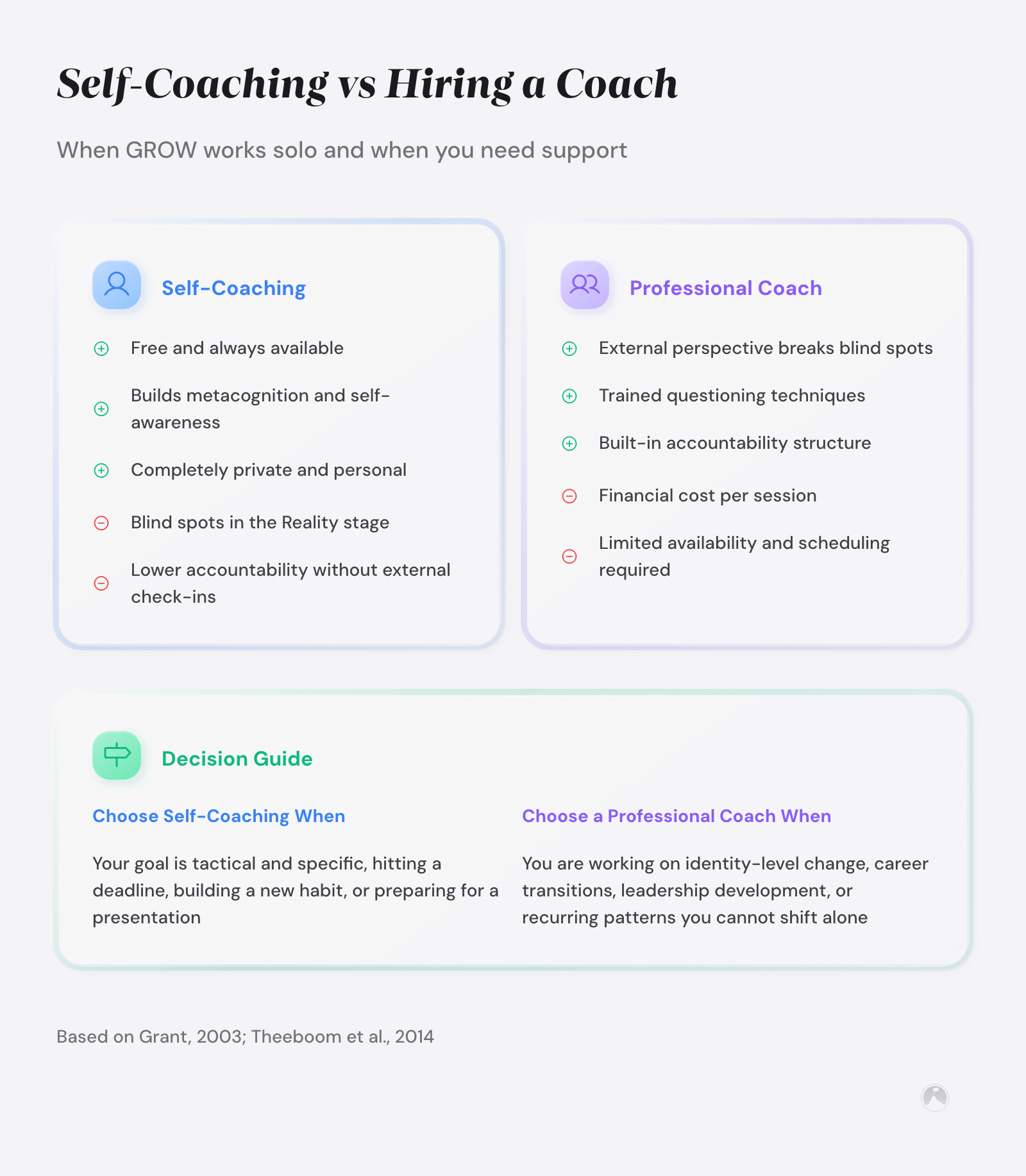
Goal questions
- What exactly do I want to achieve?
- How will I know when I’ve reached it?
- Why does this matter to me right now, not just in theory?
- On a scale of 1-10, how committed am I to this goal? If less than 8, what would make it an 8?
Reality questions
- What have I already tried, and what actually happened?
- What resources (time, money, skills, people) do I currently have?
- What’s genuinely blocking me, not what I assume is blocking me?
- If a friend described my situation, what would I tell them?
Options questions
- If I couldn’t fail, what would I try?
- What would someone I admire do in this situation?
- What could I stop doing that would free up capacity?
- What’s the simplest possible next step?
Will questions
- What exact action will I take in the next 48 hours?
- On a scale of 1-10, how confident am I that I’ll follow through? If below 7, what needs to change?
- Who will I tell about this commitment?
- When will I review my progress?
Self-coaching with GROW works when the questions are honest enough to surface uncomfortable truths. If every answer feels comfortable, you’re not digging deep enough. The point isn’t to feel good. It’s to get clear.
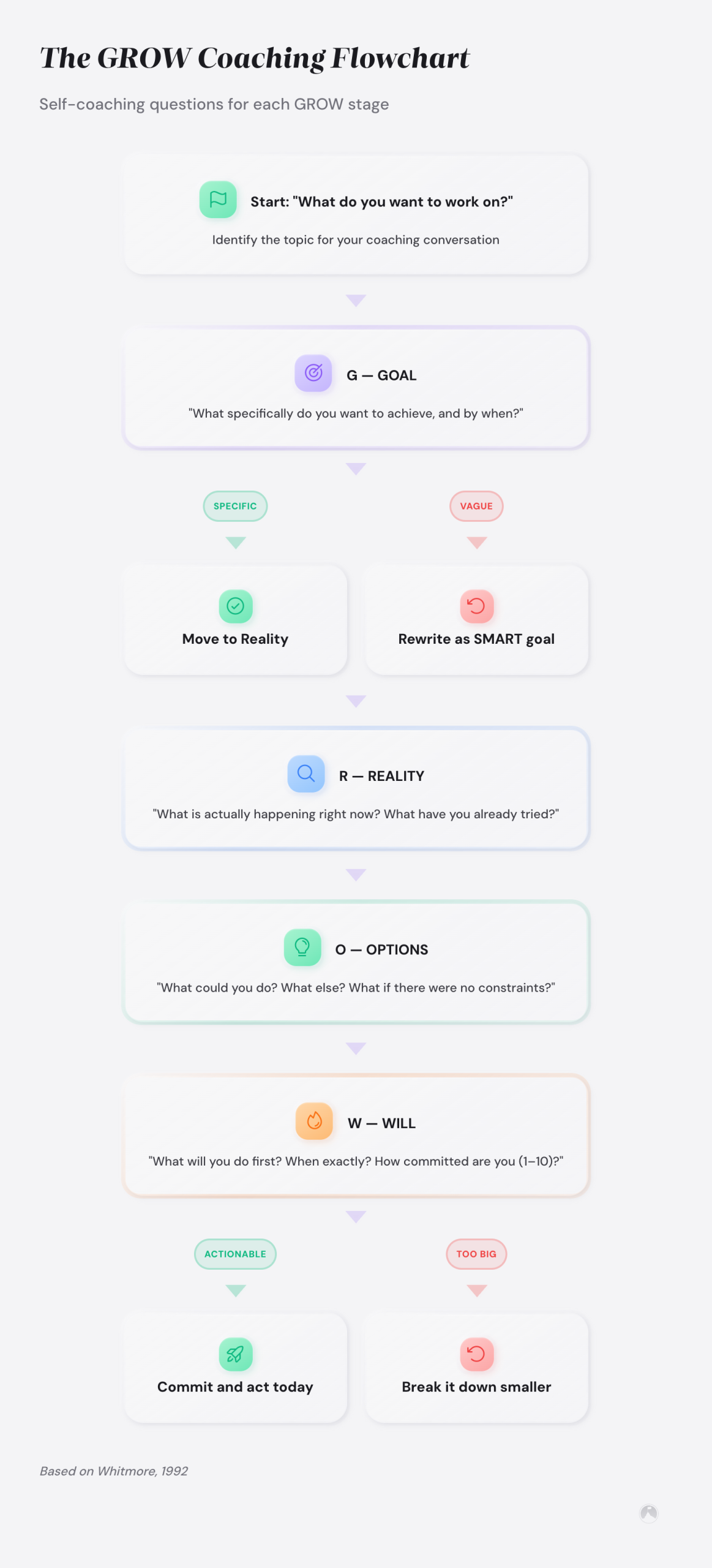
GROW self-coaching quick reference
G – Goal: What do I want? (Make it specific and measurable)
R – Reality: Where am I now? (Be brutally honest)
O – Options: What could I do? (List at least 5 paths, don’t judge yet)
W – Will: What will I do? (Pick one, set a deadline, tell someone)
What are the biggest GROW Framework mistakes to avoid?
After studying this model and using it for personal goal-setting, the same mistakes keep showing up. Here are the ones that sink the process most often.
Mistake 1: Skipping Reality. This is the number one failure mode. People set a goal, get excited, jump to brainstorming solutions, and never honestly assess their starting point. The coaching research consistently shows that structured approaches produce measurable improvements in goal attainment and performance [1][5]. And the coaching process that drives those outcomes starts with honest assessment – not with solutions.
Mistake 2: Vague goals that can’t be measured. “Be more productive” or “get better at communication” aren’t goals. They’re directions. A goal needs to be specific enough that you can clearly say “done” or “not done.” If your goal can’t fail, it can’t succeed either.
Mistake 3: Judging options too early. The Options stage is about quantity, not quality. When you judge ideas as they come up, your brain shuts down creative thinking and defaults to safe, obvious choices. The most valuable options often appear toward the end of brainstorming, after the obvious ideas are exhausted.
Mistake 4: Ending without specific commitments. “I’ll try to work on it” is not a Will statement. “I’ll spend 45 minutes on Tuesday and Thursday evenings on my certification, starting this week” is a Will statement. A GROW session without a concrete action plan and a review date is just a thinking exercise with no teeth.
How does the GROW coaching model compare to other goal-setting frameworks?
GROW doesn’t exist in isolation. You might wonder where it fits relative to other systems like SMART goals, WOOP, or strategic planning frameworks. The short answer: it complements almost everything.
| Framework | Best for | How GROW complements it |
|---|---|---|
| SMART Goals | Defining clear, measurable objectives | Use SMART within GROW’s Goal stage to sharpen vague targets |
| WOOP | Mental contrasting and obstacle planning | GROW expands option-generation and adds a structured action-planning stage |
| BSQ Framework | Big-picture thinking then small steps | GROW’s Reality stage fills the missing honest assessment step |
| OKRs | Team alignment and tracking | GROW adds the coaching conversation that makes OKRs personal |
Jones, Woods, and Guillaume’s 2016 meta-analysis found that structured coaching interventions produced an overall effect size of 0.36 for organizational outcomes and 1.24 for individual-level results [5].
The gap between those two numbers suggests coaching’s biggest payoff is personal, not institutional – which is exactly where a self-coaching tool like GROW fits best.
The GROW Framework’s unique strength is the structured conversation it creates between your aspirational self and your honest self. SMART goals tell you what a good goal looks like. WOOP helps you plan for obstacles. But GROW is the only framework that systematically walks you through the full process from aspiration to action.
For practical goal-setting, GROW pairs particularly well with SMART at the Goal stage and with WOOP at the Reality and Options stages. You don’t need to choose one framework forever. Use what fits the situation. If you’re comparing self-assessment tools more broadly, GROW holds up well against the alternatives because of that Reality stage most other frameworks skip.
Why does the GROW method actually work? The research behind it
GROW isn’t just a clever acronym. The framework rests on decades of research in coaching effectiveness, goal-setting theory, and self-regulation.
Theeboom, Beersma, and van Vianen (2014) examined coaching across organizational settings and found significant positive effects on goal-directed self-regulation (g = 0.74, meaning a moderate-to-large practical difference), performance (g = 0.60), and well-being (g = 0.46) [1]. The effects were particularly strong when coaching followed a structured model rather than informal conversation.
Jones, Woods, and Guillaume (2016) found that structured coaching interventions produced meaningful improvements in performance, skills development, coping, work attitudes, and goal-directed self-regulation [5]. Structured coaching frameworks like GROW produce measurable gains because they prevent the common failure modes that sink unstructured goal pursuit.
Grant (2003) found that life coaching using structured models improved goal attainment, metacognition, and mental health in an exploratory study of 20 adults [3]. Participants didn’t just achieve more. They developed better awareness of their own thinking patterns – what psychologists call metacognition, or the ability to observe and adjust your own reasoning process.
The pattern across these studies is consistent: structure matters. Not because rigid frameworks are inherently better, but because they prevent common failure modes like skipping honest self-assessment, defaulting to the first obvious solution, and failing to commit to specific actions. If you’re working on building a more resilient mindset alongside your goal-setting practice, the Reality stage of GROW is where that resilience gets tested.
Ramon’s take
Skip the coach, skip the retreat. Just write down those four questions on a sticky note and answer them honestly the next time you’re stuck. That’s it. The structure does the work once you stop trying to do it perfectly.
The Reality stage is uncomfortable because it forces you to say things like “I don’t actually have the skills for this yet” or “I’ve been avoiding this for six months.” The discomfort of honest self-assessment is the point. The Reality stage is the only part of GROW that can’t be faked, and the Reality stage is what makes the other three stages honest. If your GROW session feels comfortable the whole way through, the Reality stage probably needs more honesty.
Conclusion
The GROW Framework doesn’t require a professional coach, a weekend retreat, or complex planning. It requires one thing: the willingness to sit with four honest questions about where you’re going, where you are, what you could do, and what you will do. Research consistently shows that structured self-reflection produces better outcomes than unstructured goal pursuit [1][3][5]. And GROW is one of the most accessible ways to make that structure a habit.
The best self-coaching tool is the one you’ll actually use. Four questions fit any schedule.
Next 10 minutes
- Pick one goal you’ve been stuck on and write it in one specific, measurable sentence
- Answer the four Reality questions from this article honestly, in writing (not in your head)
- List at least five options without judging any of them
This week
- Complete a full GROW self-coaching session for your most important goal using the question lists above
- Share your Will commitment with one person who can hold you accountable
- Schedule a 15-minute review for next week to check progress against your action plan
There is more to explore
The GROW model sits inside a broader toolkit for personal growth and honest self-assessment. For a complete guide to developing a growth mindset and learning how belief patterns shape your ability to pursue goals, start with the parent guide. If you’re wondering whether you need a mindset shift before your goals will stick, our guide on signs you need a mindset shift can help you diagnose the underlying pattern.
For readers interested in the neuroscience behind why some people adapt to setbacks better than others, our piece on fixed vs. growth mindset neuroscience covers what brain imaging research actually shows. And if limiting beliefs keep surfacing during your Reality stage, our guide on overcoming limiting beliefs offers research-backed techniques for working through them.
Take the next step
Ready to apply the GROW Framework across all areas of your life? The Life Goals Workbook provides structured worksheets for running GROW self-coaching sessions on your career, health, relationships, and personal development goals.
Related articles in this guide
Frequently asked questions
Can you use the GROW Framework for self-coaching without a professional coach?
Yes. GROW was originally designed for coach-to-client conversations but adapts well to self-coaching. The key is writing down your answers rather than thinking through them mentally. Written self-coaching forces specificity and prevents the vague optimism that derails internal goal-setting conversations. Grant (2003) found that structured self-reflection produces measurable improvements in goal attainment even without a professional coach present [3].
What is the difference between GROW and SMART goals?
SMART is a goal-formatting tool that makes objectives specific, measurable, achievable, relevant, and time-bound. GROW is a complete coaching process that includes goal-setting as just one of four stages. You can use SMART within the Goal stage of GROW to sharpen your target, then continue through Reality, Options, and Will for the full action-planning process. They complement each other rather than competing.
How long should a GROW coaching session take?
A focused self-coaching session typically takes 20-30 minutes for a well-defined goal. Complex goals with multiple obstacles may require 45-60 minutes for the initial session. The Will stage should produce commitments you can review in 5-10 minutes during weekly check-ins. Spending more than an hour usually signals you are overthinking the Options stage rather than committing to action.
What is the T-GROW model and how does it differ from standard GROW?
T-GROW adds a Topic stage before Goal, where you identify the broad subject area before narrowing to a specific objective. This helps when someone has multiple competing priorities and needs to choose which area to focus on first. For self-coaching on a goal you have already identified, standard GROW is sufficient.
Does the GROW model work for team goals or only individual ones?
GROW works for teams when adapted slightly. The Goal stage requires shared agreement on what the team is pursuing. The Reality stage benefits from multiple perspectives on current obstacles. Options generation often improves with group brainstorming. The Will stage must assign specific actions to specific people with deadlines. Team sessions need a facilitator to prevent the conversation from stalling.
What should you do when a GROW action plan stops working halfway through?
Return to the Reality stage and reassess. Circumstances change, and an action plan built on outdated assumptions will fail. Run through the Reality questions again with your current situation, then generate new Options if needed. GROW is designed to be iterative, not linear. The coaching research consistently supports treating goal pursuit as an ongoing cycle rather than a one-time planning event [1][5].
References
[1] Theeboom, T., Beersma, B., and van Vianen, A. E. M. “Does coaching work? A meta-analysis on the effects of coaching on individual level outcomes in an organizational context.” The Journal of Positive Psychology, 2014. DOI
[2] Whitmore, J. Coaching for Performance: The Principles and Practice of Coaching and Leadership. Nicholas Brealey Publishing, 1992 (5th edition 2017). ISBN: 9781857885348.
[3] Grant, A. M. “The impact of life coaching on goal attainment, metacognition and mental health.” Social Behavior and Personality, 2003. DOI
[4] International Coaching Federation. “ICF Global Coaching Study.” ICF Research, 2023. Link
[5] Jones, R. J., Woods, S. A., and Guillaume, Y. R. F. “The effectiveness of workplace coaching: A meta-analysis of learning and performance outcomes from coaching.” Journal of Occupational and Organizational Psychology, 2016. DOI