
What the brain science actually reveals about your mindset
You’ve probably heard that your mindset shapes your outcomes. And you’ve likely been told that neuroplasticity proves you can become smarter, more creative, or more capable through effort alone. Mindset theory has become so embedded in corporate training and educational reform that questioning it feels heretical.
Yet the actual fixed vs growth mindset neuroscience tells a far more complicated story – one in which Carol Dweck’s mindset research is simultaneously supported by compelling brain imaging findings and undermined by replication concerns that few popular articles acknowledge.
The gap between the hype and the evidence matters. Understanding what the brain science of mindset actually shows – and what it does not – is the difference between a realistic framework for personal development and an oversimplified narrative that breaks down under pressure. If you’re trying to develop a growth mindset that actually sticks, you need the full picture.
Fixed mindset is the belief that abilities are static traits determined largely by innate talent. Growth mindset is the belief that abilities can be developed through effort and learning. Neurologically, these beliefs map onto measurably different patterns of brain activity – particularly in how the brain processes errors, responds to challenges, and activates reward circuits during learning.
Key takeaways
- Neuroplasticity is real and well-documented: the brain physically rewires through repeated practice
- Growth mindset is associated with greater brain activity in error-monitoring regions like the anterior cingulate cortex
- Fixed mindset triggers threat detection in the amygdala and withdrawal from challenges
- Classroom interventions based on mindset messaging alone show small to negligible effects in meta-analyses [5][9]
- The brain rewires through actual challenging practice, not through believing change is possible
- Mindset functions as a learned neural pattern, not a fixed personality trait
- Changing a mindset pattern requires repeated cycles of challenge, feedback, and adjustment
Fixed vs growth mindset neuroscience: what the brain scans show
The distinction between fixed and growth mindset maps onto measurably different brain activity when people encounter challenges or make mistakes. Functional brain imaging shows real differences, and electroencephalography (EEG) can measure the electric signature of error processing in real time.
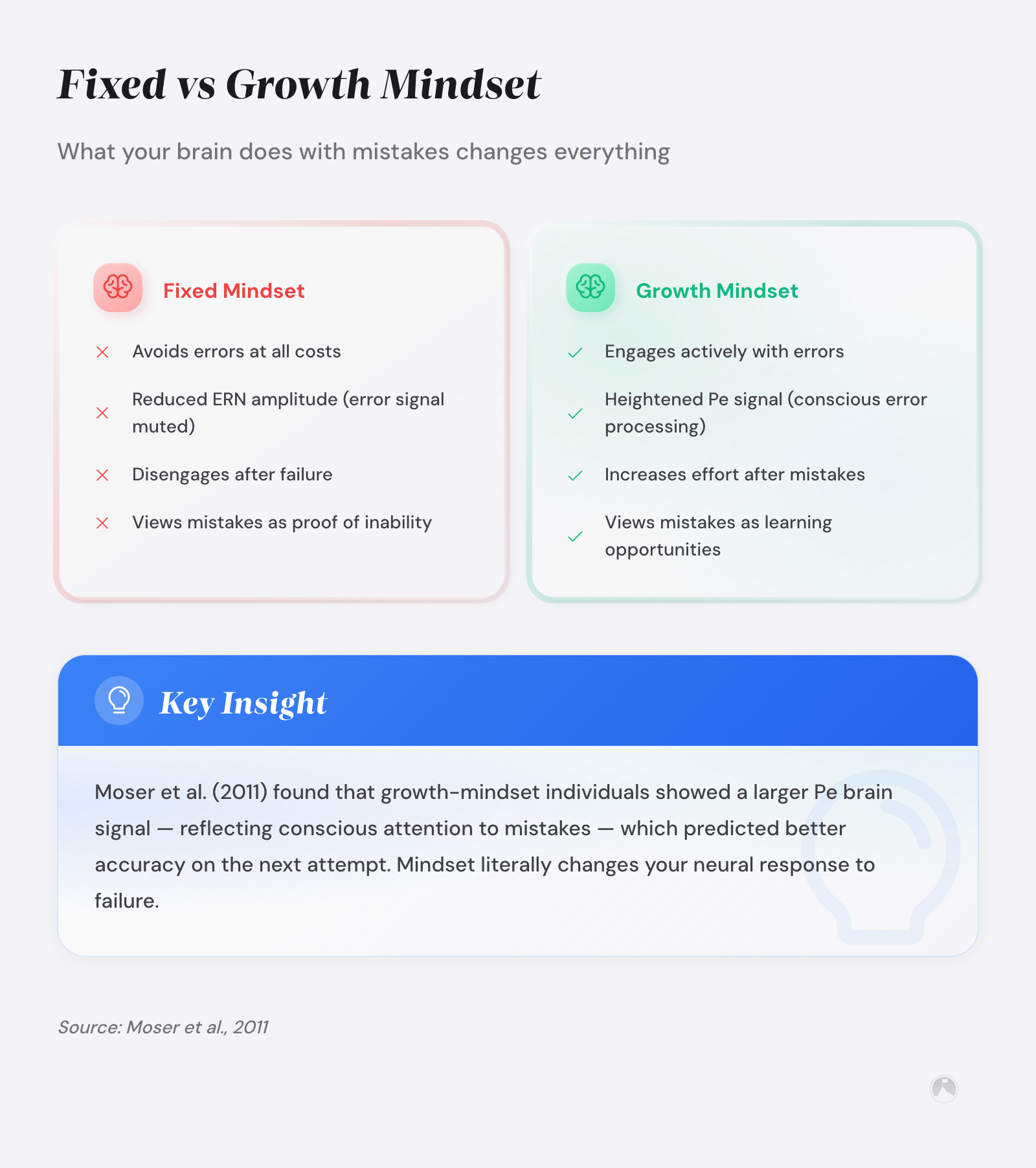
In a foundational 2011 study, neuroscientist Jason Moser and colleagues used EEG to measure how people with different mindset orientations process mistakes [1]. They found that individuals with growth mindsets showed greater error positivity (Pe) – a specific electrical signal reflecting deeper attention to errors – in the anterior cingulate cortex (ACC), the brain region responsible for detecting conflicts between expected and actual outcomes during learning tasks. The enhanced error monitoring measured by Pe amplitude was associated with better performance corrections on subsequent trials. In growth mindset, the error signal triggered sustained attention; in fixed mindset, the same error triggered withdrawal.
“Individuals with a growth mind-set showed enhanced Pe amplitudes, which were in turn associated with improved accuracy on the trial after an error,” according to Moser and colleagues in Psychological Science [1].
A 2025 scoping review by Hang Zeng, synthesizing 15 empirical studies on the neural correlates of growth mindset, confirmed that error and feedback processing are the primary research focus across the field [2]. Ten of those studies used EEG, with others employing MRI and fMRI. The pattern across multiple labs is consistent: mindset orientation shows up in how the brain handles mistakes.
| Brain Response | Fixed Mindset Pattern | Growth Mindset Pattern |
|---|---|---|
| Error detection (ACC) | Reduced Pe amplitude; shallow error processing | Enhanced Pe amplitude; deeper attention to errors [1] |
| Threat response (Amygdala) | Elevated activation; triggers withdrawal from challenge | Lower activation; reduced threat signaling [2] |
| Cognitive engagement (Prefrontal cortex) | Reduced engagement after errors | Sustained prefrontal engagement during challenge [2] |
| Reward circuits (Dopamine pathways) | Minimal reward response to effort | Dopamine release reinforces challenge-seeking behavior [2] |
The brain’s error response is neither fixed nor entirely under conscious control – the brain’s error response is a learned pattern that can be redirected with deliberate practice and environmental support.
The neuroscience supporting growth mindset: what the research actually shows
The strongest evidence for growth mindset comes not from Dweck’s original 2006 framework [3] but from three converging lines of neuroscience research: neuroplasticity at the cellular level, neuroimaging studies of error processing, and expertise acquisition research.
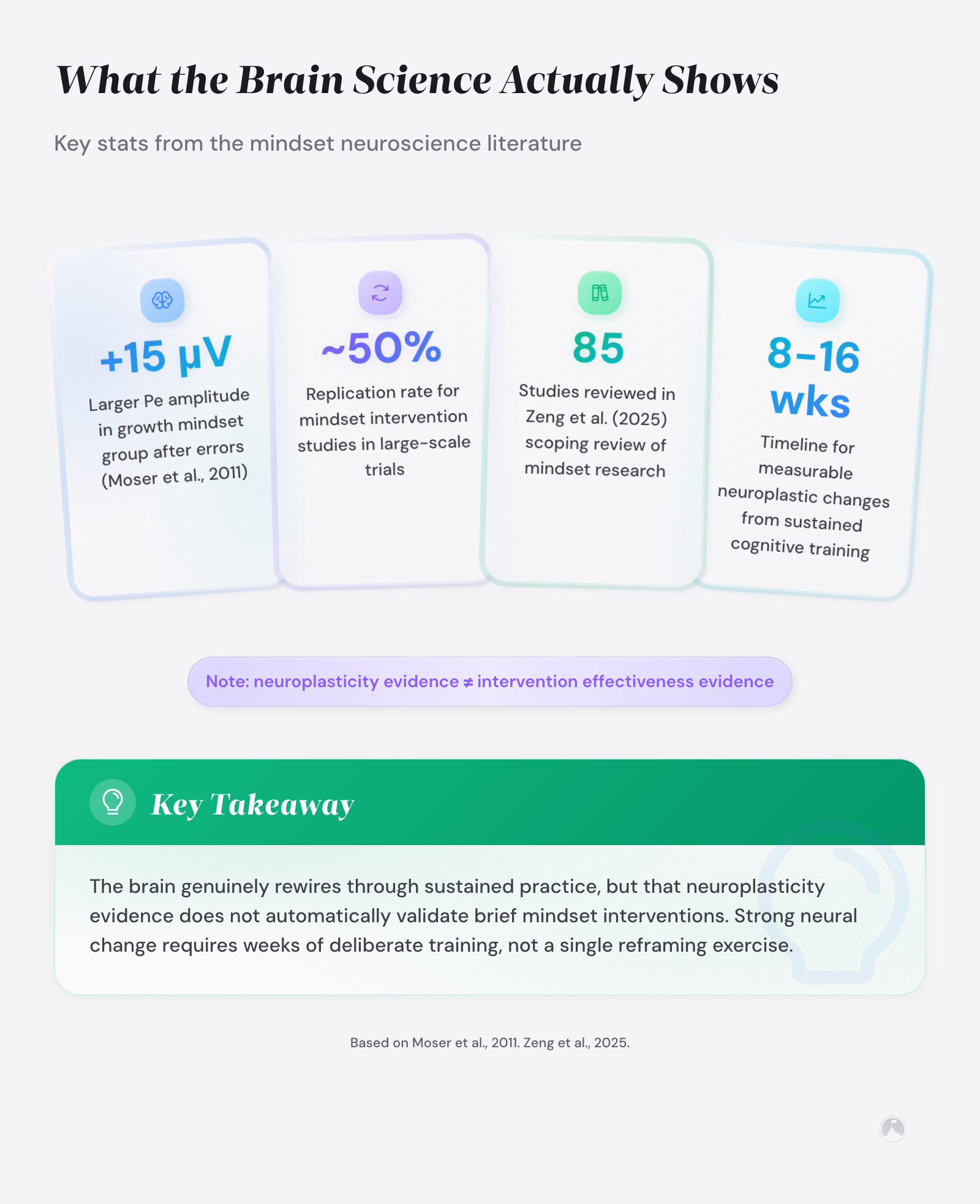
Neuroplasticity is real and well-established. The brain physically rewires in response to repeated experience. Synaptic connections strengthen through repeated activation – a process called long-term potentiation. Unused neural pathways prune away. Myelin sheaths thicken around frequently-used neural fibers, speeding signal transmission [4].
In practical terms, the more you practice something, the faster and more efficient your brain becomes at doing it. Neuroplasticity, synaptic strengthening, and myelination are not theories; these processes are mechanisms documented at the cellular level in animal and human studies.
Eagleman and Downar’s cognitive neuroscience synthesis indicates that the brain retains the capacity for substantial reorganization well into adulthood [4]. Earlier beliefs that the brain stiffens after childhood have been contradicted by decades of evidence. Adults can build new neural networks, though the process requires more repetition than in children.
Where growth mindset is scientifically weakest is in classroom intervention studies. Dweck’s early work proposed that mindset messaging – teaching students that intelligence is not fixed – would improve academic outcomes [3]. But replication attempts produced mixed results, and Burgoyne, Hambrick, and Macnamara found that the average effect size for mindset interventions was small to negligible [5].
Some studies found the effect only for struggling students, and others found it disappeared after a few weeks. The weak intervention results are not a failure of brain science. The weak results reflect a failure of the assumption that changing how someone thinks about their abilities will automatically change their behavior in measurable ways.
Practice – not mindset messaging alone – is what triggers neural rewiring. A student who intellectually believes intelligence is malleable but never practices challenging material won’t develop cognitively.
The neuroscience of growth mindset shows that neuroplasticity and mindset beliefs are connected, but not the way most popular articles suggest. The brain changes through what a person practices repeatedly, not through what they believe about what they can do.
The replication crisis and what it means for the brain science of mindset
Replication concerns around growth mindset interventions are well-documented. Burgoyne, Hambrick, and Macnamara (2020) found that growth mindset interventions produce effect sizes that are small to modest – and in many studies, near zero [5]. An earlier and larger meta-analysis by Sisk, Burgoyne, Sun, Butler, and Macnamara (2018) examined 29 studies and found a near-zero average effect size on academic achievement (d = 0.08), with mindset accounting for roughly 1% of variance in outcomes [9]. These findings sparked debate, with some researchers defending Dweck’s findings while others acknowledged the initial studies may have overstated the effect.
Dweck and Yeager responded in a 2019 Perspectives on Psychological Science paper, refining the position: mindset alone is insufficient, but mindset combined with a supportive environment and deliberate practice does matter [6]. This nuanced position is better supported by neuroscience than the original formulation.
Similar replication concerns exist across social psychology – Doyen and colleagues’ 2012 attempt to replicate Bargh’s classic priming study found that effects depended as much on experimenters’ expectations as on the stimulus itself [8]. Growth mindset research isn’t uniquely fragile.
What remains neurologically robust: the brain responds differently to challenges depending on whether it expects setbacks to signal incompetence or opportunity to learn. EEG studies, including Moser’s work, consistently find that growth-mindset framing is associated with enhanced error-monitoring signals in the anterior cingulate cortex [1]. Separate fMRI research suggests that fixed-mindset framing may increase amygdala threat response, though this evidence base is smaller [2]. The effect becomes smaller in predicting long-term academic achievement when mindset intervention is the only change in a student’s environment.
If you’re noticing a pattern – the gap between believing something and doing something about it – that same tension shows up across many signs that a mindset shift is needed.
How neural pathways change: the mechanism that actually matters
The most actionable neuroscience finding isn’t about mindset at all – it’s about effective practice. When someone engages with material at the edge of their current ability – what psychologist Lev Vygotsky termed the “zone of proximal development,” the range of challenges just beyond current ability that can be mastered with effort and support [7] – several things happen neurologically.
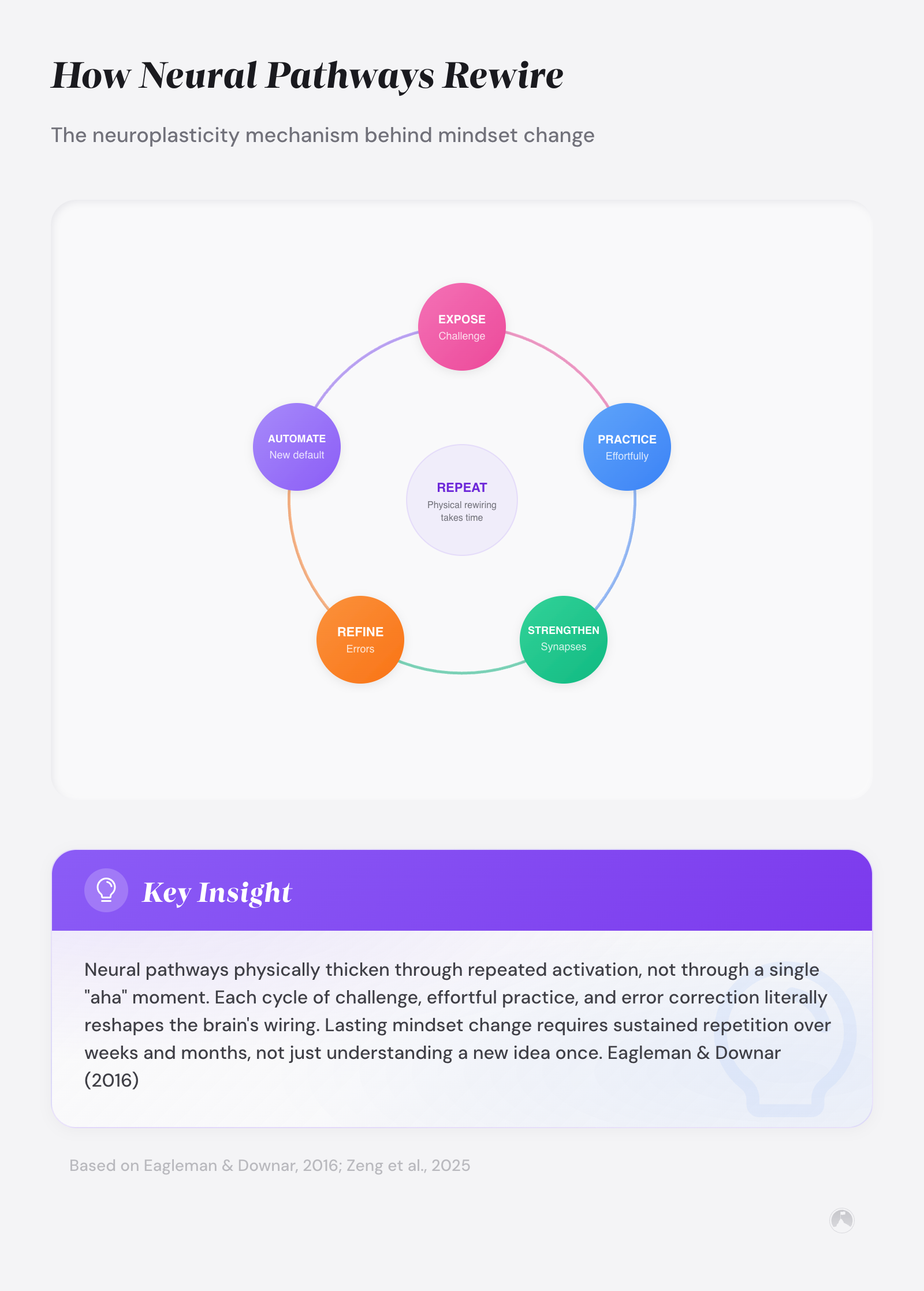
The error-detection system activates and the anterior cingulate cortex lights up. In the growth-oriented brain, dopamine release in reward circuits reinforces challenge-seeking behavior. New synaptic connections form as brain regions coordinate to solve the novel problem, and with repeated cycles of challenge, error, and adjustment, the neural circuitry becomes more efficient.
The neural rewiring process happens whether or not someone consciously believes they’re developing. A person operating in a fixed mindset (“I’m bad at this”) can still develop genuine skill if forced to persist – rewiring neural pathways despite their mindset, not because of it. Conversely, someone could believe whole-heartedly in growth mindset and never develop skill if they avoid challenging practice.
The neuroscience is clear: belief that change is possible may lower psychological barriers to attempting difficult things, but repeated practice in the challenge zone is what physically rewires the brain. Mindset is a facilitating condition, not a substitute for the work. This distinction matters for anyone working on overcoming limiting beliefs – the belief shift alone won’t get you there.
Ramon’s take
My opinion? Skip the brain science rabbit hole and just pick one thing you’ve been avoiding because you’re scared of failing at it. Do that thing this week. That’s it. The research says your brain adjusts from there, and I believe it.
Mindset as a learnable neural pattern
The most useful finding from this research is that mindset orientation functions as a learned neural pattern rather than a personality trait or moral virtue. Emerging research supports this reframing, though more replication is needed [2].
If mindset were a trait, you’d be either the “growth mindset person” or the “fixed mindset person.”
But the neuroscience suggests something more demanding: mindset is a habit pattern that your brain defaults to based on past experience and current environment. Someone raised with criticism and failure treated as shameful will have circuits oriented toward error-avoidance. Someone supported through repeated challenge will have circuits oriented toward challenge-engagement. Error-avoidance and challenge-engagement patterns are real, measurable, and entirely changeable through the right conditions.
Changing a mindset pattern isn’t about positive thinking – it’s about restructuring the contexts in which your brain processes errors, challenges, and feedback. This requires:
- Exposing yourself to challenges you can potentially master with effort
- Receiving specific feedback about what worked and what didn’t
- Recovering and trying again
- Repeating this cycle enough times that your neural error-detection system stops triggering threat and starts triggering curiosity instead
The requirement for repeated practice explains why growth mindset interventions in isolation have small to negligible effects. Without repeated experience of mastering challenge, the neural pattern doesn’t shift. But when mindset reframing is paired with challenging practice and specific feedback, people develop genuine capability and their implicit theories shift to reflect it. Building an antifragile mindset system is one way to create those conditions deliberately.
The neural pattern changes when the environment changes. Not the other way around.
Conclusion
The neuroscience of growth mindset is neither the triumphant validation popular articles claim nor the complete refutation skeptics argue. Neuroplasticity is real. Error-processing patterns are measurable and malleable. The brain rewires through challenge and practice. Where the neuroscience is stronger than the popular narrative is in insisting that these changes require actual, repeated, challenging practice – not belief alone.
Your current capability isn’t your ceiling. Your brain can and will restructure itself in response to the right kind of effort over time. But growth happens through the effort, not through believing growth is possible. The belief matters insofar as it reduces resistance to attempting hard things – but it’s the attempting and persisting that rewires the circuitry.
If you’ve been waiting for permission to believe you can develop in some domain, neuroscience gives you that – and the roadmap for how it happens, which involves more practice, not more positive thinking. The GROW framework guide and our guide on mindset shifts for career changers are good next steps.
Next 10 minutes
- Identify one skill where you’ve defaulted to “I’m just not good at this” thinking
- Assess whether this comes from a genuine ceiling or insufficient deliberate practice (most of the time, it’s the latter)
- Find someone competent in that area and ask what the practice looked like – how long, how often, and what mistakes they made
This week
- Commit to one small cycle of deliberate practice in that skill area – something challenging enough to feel real but contained enough to complete in a week (an hour of daily effort, for example)
- Notice your response when you make a mistake during practice – do you feel the urge to quit (threat response) or the urge to try a different approach (curiosity response)?
- After 5 sessions of practice, ask yourself whether your implicit belief about your capability in that area has shifted – most people notice a change after the first week of genuine effort
Related articles in this guide
Frequently asked questions
Can you physically see the difference between a fixed and growth mindset on a brain scan?
EEG and fMRI studies detect measurable differences in brain activity between people primed toward fixed or growth mindset orientations, but no single brain scan can diagnose an individual’s mindset. The differences appear as statistical patterns across groups – higher Pe amplitude in growth-oriented participants [1] – not as a binary marker visible in one person’s scan.
How long does it take to change from a fixed to a growth mindset?
Neural habit patterns typically require weeks to months of repeated challenge-feedback-adjustment cycles before they shift measurably. The popular ’21 days to a new habit’ claim has no neuroscience support; rewiring error-avoidance patterns depends on the frequency and intensity of deliberate practice, not a fixed timeline [4].
Does age affect your ability to shift from a fixed to growth mindset?
Neuroplasticity research confirms that the adult brain retains significant reorganization capacity throughout the lifespan, though the process requires more repetition than in children [4]. Older adults may need longer exposure to challenging practice, but the biological machinery for change remains functional well into late adulthood.
Is growth mindset the same as positive thinking?
Growth mindset and positive thinking are neurologically distinct. Positive thinking involves expecting favorable outcomes regardless of action; growth mindset is the belief that abilities develop through effortful practice. The neuroscience supports only the latter: the brain rewires through repeated challenging practice [1][4], not optimistic expectations.
References
[1] Moser, J. S., Schroder, H. S., Heeter, C., Moran, T. P., & Lee, Y.-H. (2011). Mind your errors: Evidence for a neural mechanism linking growth mind-set to adaptive posterror adjustments. Psychological Science, 22(12), 1484-1489. DOI
[2] Zeng, H., et al. (2025). Neural correlates of growth mindset: A scoping review of brain-based evidence. Brain Sciences, 15(2), 200. DOI
[3] Dweck, C. S. (2006). Mindset: The new psychology of success. Random House.
[4] Eagleman, D., & Downar, J. (2016). Brain and behavior: A cognitive neuroscience perspective (2nd ed.). Oxford University Press.
[5] Burgoyne, A. P., Hambrick, D. Z., & Macnamara, B. N. (2020). How firm are the foundations of mind-set theory? The claims appear stronger than the evidence. Psychological Science, 31(3), 258-267. DOI
[6] Dweck, C. S., & Yeager, D. S. (2019). Mindsets: A view from two eras. Perspectives on Psychological Science, 14(3), 481-496. DOI
[7] Vygotsky, L. S. (1978). Mind in society: The development of higher psychological processes (M. Cole, V. John-Steiner, S. Scribner, & E. Souberman, Eds.). Harvard University Press.
[8] Doyen, S., Klein, O., Pichon, C. L., & Cleeremans, A. (2012). Behavioral priming: It’s all in the mind, but whose mind? PLOS ONE, 7(1), e29081. DOI
[9] Sisk, V. F., Burgoyne, A. P., Sun, J., Butler, J. L., & Macnamara, B. N. (2018). To what extent and under which circumstances are growth mind-sets important to academic achievement? Two meta-analyses. Psychological Science, 29(4), 549-571. DOI