
Why mentor coaching for career growth is the advantage nobody taught you to get
You know that finding a mentor and coaching guide would speed up your career. Everyone says so. But nobody explains how to actually do it when you don’t already know the right people.
Research by Allen, Eby, and colleagues analyzed 43 studies on mentoring outcomes and found that mentored professionals reported significantly higher job satisfaction, greater organizational commitment, and faster career progression than those without mentors [1]. That gap compounds over years. And the cost of figuring everything out alone is steeper than most people realize.
Much of the standard mentorship advice assumes you already have a network to tap into. This guide is for people who don’t.
Finding a mentor and coaching guide is a structured process for identifying, approaching, and building relationships with experienced advisors who provide career guidance and skill development feedback – distinct from networking, which prioritizes broad connections over deep developmental bonds.
What you will learn
- Why searching for one perfect mentor sets you up to fail
- How mentors, coaches, and sponsors differ – and which you need right now
- Where to find mentors when your existing network is thin or nonexistent
- The specific approach framework that increases acceptance rates from busy professionals
- How to maintain mentoring relationships without becoming a burden
Key takeaways
- Mentored professionals show higher career satisfaction and stronger outcomes than those who go it alone [1].
- The Guidance Portfolio replaces the “find one guru” myth with a practical advisory network of 3-5 people.
- Mentors share experience for free; coaches charge for structured accountability.
- Ghosh and Reio found that mentoring benefits mentors too, with long-term career gains for the person giving guidance [2].
- Professional mentor matching platforms like MentorCruise and SCORE remove the cold-outreach barrier.
- A specific, time-bounded request outperforms “will you be my mentor?” by a wide margin.
- Kram’s research on mentoring phases shows the first few months determine whether a relationship becomes lasting or fades [3].
- Building reciprocal mentor relationships through mutual benefit outlasts bonds built on admiration alone.
Summary: Build a Guidance Portfolio of 3-5 advisors instead of searching for one perfect mentor. Approach each person with a specific, time-bounded request rather than asking “will you be my mentor?” Maintain relationships through consistent follow-up, reciprocal value, and quarterly portfolio reviews.
Why searching for one perfect mentor is the wrong goal
The standard advice says: find a mentor. Singular. Someone who has the career you want, who will take you under their wing, and who will guide you through every decision. That framing makes the task feel impossible. And for most people, it is.
The person with the perfect career, perfect availability, and perfect willingness to mentor you probably doesn’t exist. So stop looking for them.
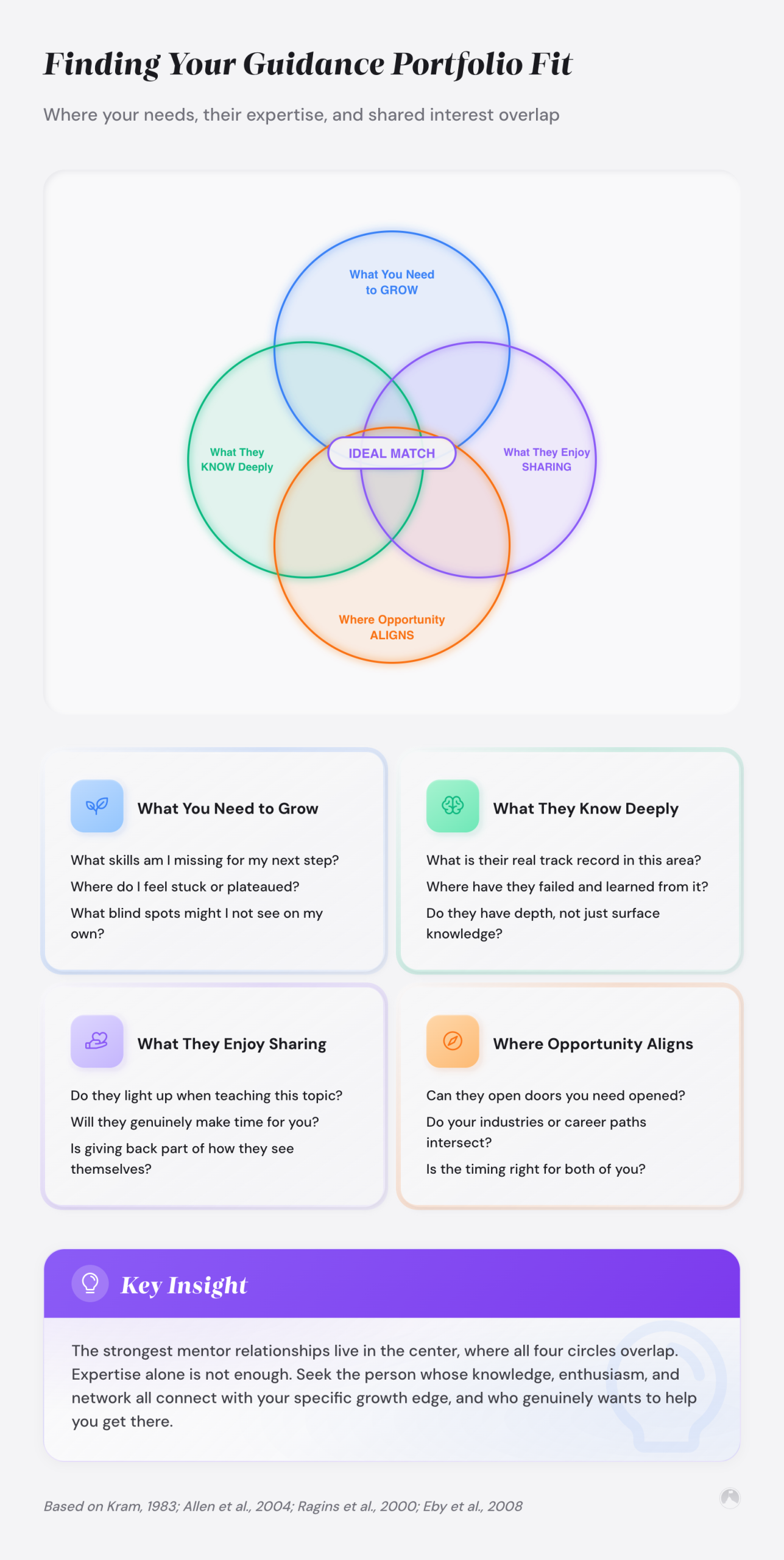
What works better is the Guidance Portfolio – building a small advisory network of 3-5 people where each person fills a different role. One might be an industry insider who helps you read the terrain. Another might be a peer who holds you accountable.
A third might be a paid coach who provides structured skill development. No single person needs to be everything.
A 2024 systematic review by Mullen and colleagues on mentorship in higher education found that mentoring outcomes span career path selection, plan implementation, network development, and career progression [4]. That’s at least four distinct functions. Expecting one person to deliver all of them is like expecting your doctor to also be your accountant.
The Guidance Portfolio works because mentorship needs change as careers evolve, and no single advisor can fill every role at once.
The Guidance Portfolio Framework
- Identify 3-5 guidance roles you need right now
- Map one person to each role
- Approach each person with a role-specific request
- Review your portfolio quarterly to swap, add, or retire advisors as your needs shift
If you’re working on broader personal development strategies, thinking in portfolios rather than single mentors makes the whole process feel achievable instead of paralyzing.
The difference between mentors and sponsors (and where coaches fit)
Before you start searching, you need to know what you’re searching for. The difference between mentors and sponsors trips up a lot of people. Add coaches into the mix, and the confusion grows. But each fills a different gap, and confusing them wastes time on both sides. Here’s how they actually differ across the dimensions that matter:
| Dimension | Mentor | Coach | Sponsor |
|---|---|---|---|
| Relationship | Informal, experience-sharing | Formal, structured accountability | Advocacy on your behalf |
| Cost | Free (time investment) | $100-500/session typical | Free (earned through performance) |
| Focus | Career wisdom and perspective | Specific skill development | Opening doors and visibility |
| Duration | Months to years | 3-12 month contracts | Ongoing within organization |
| How to find | Network, platforms, events | ICF directory, referrals | Earned through internal track record |
| Best when you need | Industry navigation and perspective | Behavioral change or skill gaps | Promotion or organizational access |
Professional coaching is a paid, structured relationship where a credentialed practitioner uses questioning techniques and accountability frameworks to help clients achieve specific behavioral or performance goals – distinct from mentoring, which relies on the advisor’s personal experience rather than formal methodology.
If you’re trying to decide between paying for a coach and finding business coaches and advisors versus free mentors, here’s a quick test. When the primary gap is knowledge about a specific industry or role, seek a mentor. When the primary gap is execution and accountability, invest in a coach. Most people need both at different stages.
For evaluating coach credentials and fit, look for International Coaching Federation (ICF) certification as a baseline. ICF-credentialed coaches at the Professional Certified Coach (PCC) level have completed a minimum of 125 hours of coach-specific training and passed competency assessments, with entry-level credentials requiring at least 60 hours [5]. But credentials alone don’t guarantee fit. Ask for a trial session before committing to a multi-month package.
A coach who works well for executive leadership development might be wrong for creative career pivots. If you’re thinking about how to create a personal development plan, a good coach can help you build one that actually sticks.
Where to find mentors when your network is thin
The biggest barrier to mentor coaching for career growth isn’t willingness – it’s access. If you’re early in your career, switching industries, or working remotely, your existing network might not contain a single viable mentor candidate. That’s normal, not a personal failure.
If cold outreach makes you break into a sweat, platforms handle the introduction for you. MentorCruise matches mentees with experienced professionals in tech, design, and business. SCORE pairs small business owners with retired executives at no cost. ADPList opens free sessions with design and product professionals. The awkward “will they respond?” phase is engineered out of the process.
Research on formal mentoring programs shows that structured matching increases the likelihood of sustained mentoring relationships compared to organic networking [6].
Beyond platforms, virtual mentorship programs have grown significantly since 2020. Industry-specific communities on Slack and Discord often have dedicated mentoring channels. LinkedIn groups focused on your field can surface potential mentors through consistent participation. But the key is contributing value to these spaces before asking for anything – comment on posts, share resources, answer questions from people earlier in their careers than you.
Networking for mentorship opportunities starts with giving, not asking – contribute genuine value in professional communities before requesting anyone’s time. If you’ve been working on personal growth goals and want accountability, online communities provide peer mentoring options that don’t require an existing network.
For those who can’t afford paid platforms or coaching, free alternatives include:
- SCORE – free mentoring for entrepreneurs from retired executives
- Industry association mentoring programs – many professional orgs run formal programs
- Alumni networks – university career services often run post-graduation mentoring programs
- Peer coaching circles – structured groups of 4-6 peers who rotate advice-giving roles
How to approach potential mentors without sounding desperate
You know where they are now. But the question that stops most people isn’t where – it’s how to approach potential mentors for the first time without seeming entitled or presumptuous.
Here’s what practical experience and research both suggest: never ask “will you be my mentor?” That question is too big, too vague, and too open-ended. Busy people don’t say yes to undefined commitments.
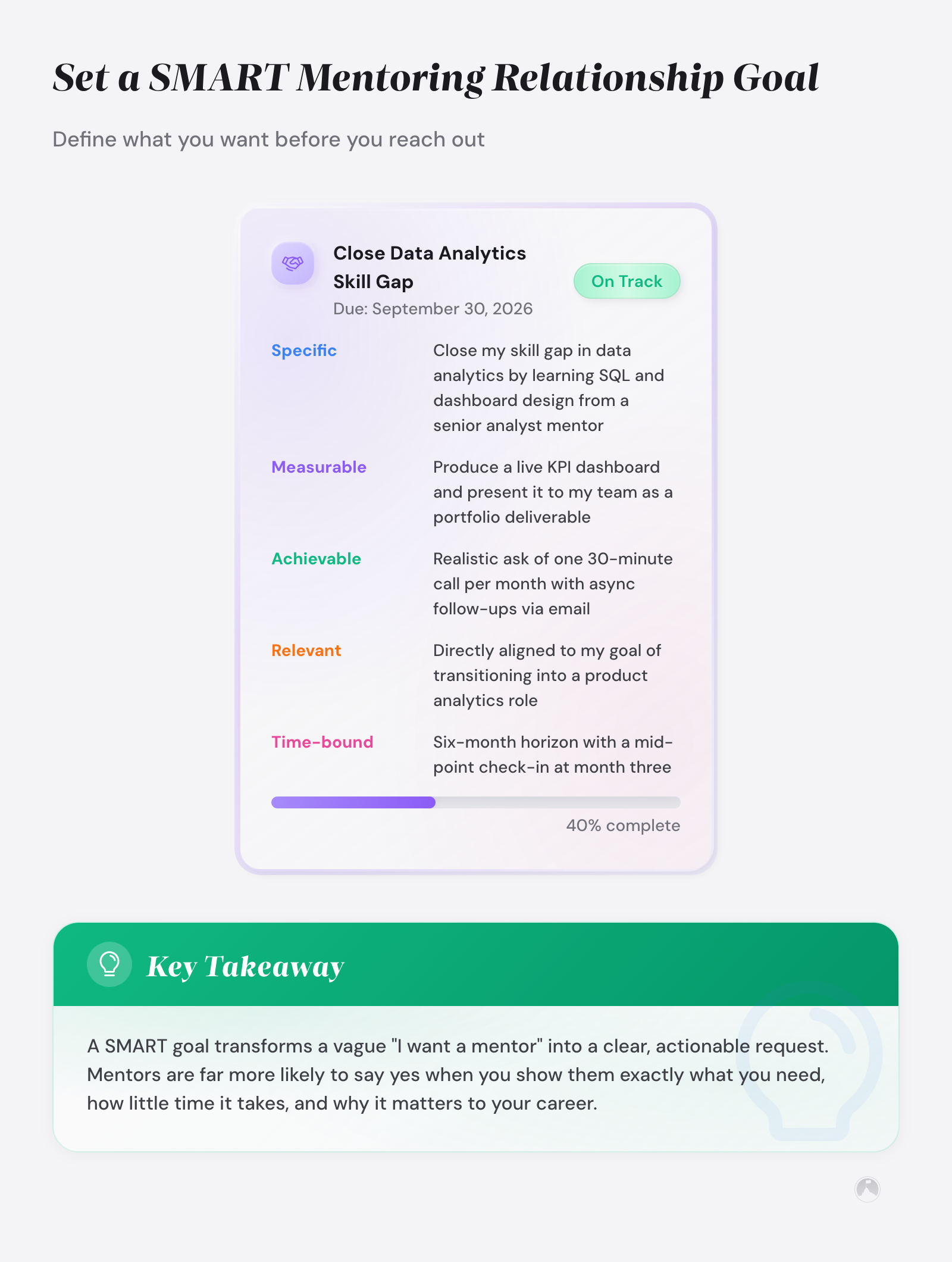
The most effective mentor outreach is a specific, time-bounded request that shows you’ve done your homework on the person’s background. Instead of “will you mentor me,” try: “I’m working through a career transition into product management and noticed you made a similar move three years ago. Could I ask you three specific questions over a 20-minute call this month?” That request is concrete, small, and flattering. And it gives the potential mentor an easy out if they’re too busy.
Mentoring benefits the mentor too. Ghosh and Reio’s meta-analysis found that mentors experience career gains from the relationship, including expanded professional networks and new perspectives [2]. When you approach a potential mentor, you’re not asking for charity – you’re offering a relationship that benefits both parties. Frame it that way.
Eby, Allen, and colleagues confirmed this pattern across 112 studies in a multidisciplinary meta-analysis, finding that mentoring relationships produce measurable career and psychological benefits for both parties involved [7].
Career mentoring is significantly correlated with career success for the mentor, while psychosocial mentoring most strongly predicts organizational commitment. – Ghosh and Reio [2]
Here’s the outreach template that works across contexts:
Mentor outreach template
Mentor outreach template
Subject: Quick question about [their specific expertise/transition]
Line 1: Specific compliment about their work (cite a specific project, article, or achievement)
Line 2: Your situation in one sentence (I’m a [role] working toward [goal])
Line 3: Your specific, bounded request (20 minutes, 3 questions, one conversation)
Line 4: Easy out (I completely understand if your schedule doesn’t allow it)
If they say no or don’t respond, that’s data – not failure. Wait six months, interact with their content in the meantime, and try again. Many mentor relationships start on the second or third approach, after the potential mentor has seen your name enough times to recognize you. Thinking about this as part of your broader networking for career growth strategy keeps rejection in perspective.
Making the mentoring relationship last beyond the first coffee
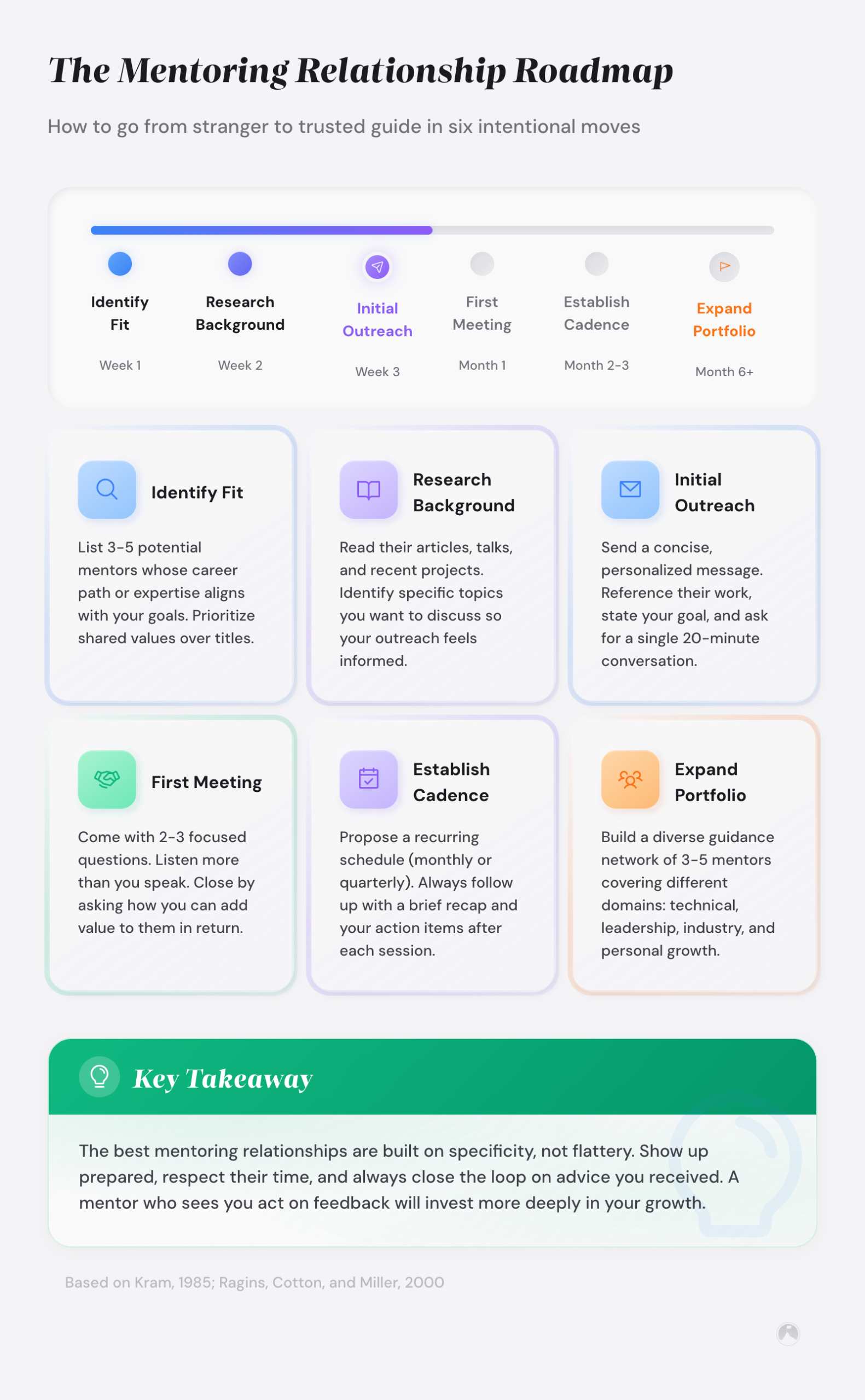
Getting a yes to the first conversation is only the beginning. What determines whether this becomes a lasting relationship or a single awkward meeting is what happens in the first few months. Kram’s foundational research on mentoring relationship development identified predictable phases – initiation, cultivation, separation, and redefinition – with the early initiation phase being the most fragile [3].
Here are the mentor relationship building strategies that separate lasting advisory bonds from one-off conversations:
Follow up on advice within 48 hours. When your mentor suggests something, try it and report back quickly. Nothing kills a mentoring relationship faster than asking for advice and then doing nothing with it. A short message – “I tried your suggestion about X. Here’s what happened” – signals that you value their time.
Come prepared with specific questions, not open-ended requests. Before each conversation, write down 2-3 concrete questions and share them in advance so your mentor can think through their answers. This respects their time and produces better guidance. If you’re working through a structured framework like the GROW framework, bring the specific step you’re stuck on rather than the whole problem.
Provide value back. Share relevant articles, introduce them to useful contacts, or help with projects where your skills complement theirs. Building reciprocal mentor relationships means the exchange doesn’t feel one-directional. Even early-career professionals bring fresh perspectives, technical skills, and generational insights that experienced mentors appreciate.
Test this: share one relevant article with your mentor within 48 hours of your next conversation and notice what changes. Set a recurring cadence – many sustained mentoring relationships operate on a monthly schedule, while lighter advisory relationships work at quarterly intervals. And know when to let go. If your needs evolve beyond what a mentor can offer, transitioning gracefully is better than letting the relationship drift.
“Structured mentorship programs improve career progression and reduce professional attrition, with mentoring outcomes including career path selection, plan implementation, and network development.” – Mullen et al. [4]
Ramon’s take
My take: skip the polished intro and lead with a specific question. One good question tells a potential mentor more about you than any elevator pitch. That’s usually how the real relationship starts anyway.
They remember the specific problems I’m facing because they were dealing with those same problems recently. Their advice is tactical, not theoretical.
When I transitioned from corporate product management into building goalsandprogress.com, the people who helped most weren’t the successful bloggers with 500,000 monthly readers. They were the ones at 5,000-10,000 readers who could tell me which mistakes they’d made six months ago. The tactical gap matters more than the prestige gap.
Don’t wait for the perfect mentor. Build a scrappy advisory board from the people already in your orbit, and upgrade it over time.
Stop waiting for the perfect mentor
Finding a mentor and coaching guide isn’t about luck or knowing the right people from the start. It’s a learnable skill with a repeatable process: clarify the type of guidance you need, build a Guidance Portfolio instead of seeking one perfect advisor, approach people with specific time-bounded requests, and maintain relationships through consistent follow-through and reciprocal value. Allen and Eby’s meta-analysis of 43 studies makes the case clearly – mentored professionals achieve better outcomes across every metric measured [1]. And the tools to find mentors, from professional mentor matching platforms like MentorCruise to peer coaching circles, have never been more accessible.
The person who figures everything out alone isn’t brave. They’re just slow.
Next 10 minutes
- Write down the three biggest gaps in your current career guidance (industry knowledge, skill development, accountability, or access).
- Identify one person in your existing network – even a loose connection – who could fill one of those gaps.
This week
- Sign up for one mentor matching platform relevant to your field (MentorCruise, SCORE, ADPList, or an industry-specific program).
- Draft a specific, time-bounded outreach message using the template above and send it to one potential advisor.
- If you already have a mentor, schedule a follow-up conversation and prepare 2-3 specific questions in advance.
There is more to explore
If this guide helped you think about who to bring into your corner, the next step is figuring out what to actually work on with them. Our guide on how to create a personal development plan walks through the process of turning vague goals into structured conversations you can bring to your mentor. And if you’re debating whether to follow a program or build your own path, self-paced vs structured personal development breaks down when each approach works best.
Related articles in this guide
- how-to-create-a-personal-development-plan
- how-to-master-the-grow-framework-a-step-by-step-guide-for-real-results
- kaizen-personal-productivity
Frequently asked questions
How do I approach a potential mentor for the first time?
1. Open with a specific compliment about their work. 2. State your situation in one sentence. 3. Make a bounded request such as a 20-minute call to discuss 2-3 focused questions. Avoid the phrase will you be my mentor – open-ended commitments get rejected more often than small, concrete asks. Research by Mullen and colleagues found that structured initial approaches lead to more sustained relationships [4].
What if my ideal mentor says no or is too busy?
A rejection is data about timing, not your worth. Wait 3-6 months and interact with their content through comments or shares, then try again with a fresh request. Many strong mentoring relationships started after an initial no. In the meantime, fill that Guidance Portfolio slot with a peer advisor or a different professional who can address the same gap.
How can I provide value to my mentor in return?
1. Share relevant industry articles they might have missed. 2. Make introductions to people in your network. 3. Offer help with projects where your skills complement theirs. 4. Provide the fresh perspective that comes from being closer to the front lines. Ghosh and Reio found that mentors gain long-term career benefits from the relationship, including expanded networks and new viewpoints [2].
Should I look for a mentor inside or outside my company?
Both serve different purposes. Internal mentors help with organizational navigation, promotion strategy, and political dynamics – they know the unwritten rules. External mentors provide objective career perspective, industry-wide insights, and advice unconstrained by company politics. A complete Guidance Portfolio includes at least one of each when possible.
What questions should I ask during mentor meetings?
Focus on decisions you are currently facing rather than general career advice. Strong questions include: 1. What would you do differently if you were in my position right now? 2. What is the biggest mistake people make at this career stage? Prepare 2-3 questions before each conversation and share them in advance so your mentor can think through their responses.
How do I know when it is time to end a mentoring relationship?
Natural endings happen when your needs evolve beyond what the mentor can offer, when conversations feel repetitive, or when meeting cadence drops below once per quarter without either party noticing. End gracefully by expressing genuine gratitude for their impact and suggesting a shift to occasional check-ins rather than structured meetings.
Do virtual mentorship programs actually work?
Yes. Industry-specific Slack groups, LinkedIn communities, and platforms like ADPList have become legitimate mentorship channels since 2020. Virtual mentorship programs work best when you contribute value to the community first – answer questions, share resources – before requesting individual time from more experienced members.
What is the difference between formal and informal mentorship?
Formal mentorship operates through structured programs with matching processes, defined timelines, and specific goals – often run by companies or professional organizations. Informal mentorship develops organically through professional relationships without predefined structure. Formal mentoring programs that use structured matching show higher sustained relationship rates [6], but informal mentorships often produce deeper personal connections since both parties chose the relationship freely.
References
[1] Allen, T. D., Eby, L. T., Poteet, M. L., Lentz, E., and Lima, L. “Career benefits associated with mentoring for proteges: A meta-analysis.” Journal of Applied Psychology, vol. 89, no. 1, pp. 127-136, 2004. https://doi.org/10.1037/0021-9010.89.1.127
[2] Ghosh, R., and Reio, T. G., Jr. “Career benefits associated with mentoring for mentors: A meta-analysis.” Journal of Vocational Behavior, vol. 83, no. 1, pp. 106-116, 2013. https://doi.org/10.1016/j.jvb.2013.03.011
[3] Kram, K. E. Mentoring at Work: Developmental Relationships in Organizational Life. Scott, Foresman, 1985. ISBN: 978-0673156174
[4] Mullen, C. A., et al. “The impact of mentoring in higher education on student career development: a systematic review and research agenda.” Studies in Higher Education, vol. 50, no. 4, 2024. https://doi.org/10.1080/03075079.2024.2354894
[5] International Coaching Federation. “ICF Credential Requirements and Standards.” 2023. https://coachingfederation.org/credentials
[6] Ragins, B. R., Cotton, J. L., and Miller, J. S. “Marginal mentoring: The effects of type of mentor, quality of relationship, and program design on work and career attitudes.” Academy of Management Journal, vol. 43, no. 6, pp. 1177-1194, 2000. https://doi.org/10.2307/1556344
[7] Eby, L. T., Allen, T. D., Evans, S. C., Ng, T., and DuBois, D. L. “Does mentoring matter? A multidisciplinary meta-analysis comparing mentored and non-mentored individuals.” Journal of Vocational Behavior, vol. 72, no. 2, pp. 254-267, 2008. https://doi.org/10.1016/j.jvb.2007.04.005