
The alarm rings and nothing changes
Monday morning. The alarm goes off. You know exactly how your day will unfold – the same emails, the same meetings, the same tasks you could do in your sleep. You’ve been telling yourself for months that things need to change, but instead of change, there’s this heavy weight in your chest.
A year ago, you told yourself things would change. They haven’t.
Feeling stuck in career isn’t about being lazy or ungrateful – it’s about a disconnect between who you are becoming and what your current role allows you to express. Whether you describe it as feeling stuck at work or full-on career stagnation, the experience is the same. And here’s what most people get wrong: they think there’s one type of “stuck,” so they apply solutions meant for a different problem entirely.
Knowing which kind of career stagnation you’re experiencing changes everything about how you respond to the plateau.
What follows is not a motivational pep talk about “finding your passion.” This is a diagnostic framework for the three distinct types of career stagnation, how to identify which one is happening to you, and exactly what to do first. For the broader picture on career progression, see our career growth strategies guide.
What does “feeling stuck in career” actually mean
Feeling stuck in career is the subjective experience of perceiving no meaningful advancement opportunities, combined with a sense that your current role no longer challenges or fulfills you in the way it once did. It encompasses both the structural reality of limited growth (no promotions available, no new responsibilities offered) and the psychological reality of stagnation (capability outpacing challenge, values misalignment, identity evolution).
Gallup’s 2025 State of the Workplace report found that only 31% of U.S. employees are fully engaged at work – meaning roughly two-thirds of workers experience some form of disengagement [1]. Career stagnation is widespread. And it deserves serious attention.
But here’s the part nobody talks about: the label “stuck” sounds singular. It’s not. There are actually three distinct types of career stagnation, and each requires a different response.
Here are 5 signs you are stuck in your career that map to the three stagnation types:
- You can do your job in your sleep – no new challenges exist.
- Your manager has told you there’s no advancement path available.
- Your values have shifted but your role hasn’t kept pace.
- You think about leaving every Monday morning.
- You’ve been in the same role for two or more years with no change in responsibilities.
What you will learn
- The three types of career stagnation and how to diagnose which one you’re experiencing
- Why lateral moves are underrated and how they can be your fastest path forward
- The Stagnation Clarity Matrix – a simple diagnostic tool you can use right now
- Specific first steps for each type of stagnation you might be facing
- How to tell the difference between a temporary slump and genuine career plateau
Key takeaways
- Career stagnation falls into three categories: structural (no opportunities), skill (capability exceeds challenge), and alignment (values have evolved) – each requires different solutions.
- A single job change won’t fix the problem if you misdiagnose the stagnation type – you’ll just bring the same pattern into a new role.
- Lateral moves are linked to higher future promotion rates and broader skill foundations, yet most people dismiss them as consolation prizes [2].
- The Stagnation Clarity Matrix helps you identify which type applies to you in under 10 minutes, giving you a clear first action.
- Career plateau is linked to burnout, reduced satisfaction, and higher turnover intentions – ignoring stagnation has real consequences [3].
- Diagnostic clarity – knowing what problem you’re solving – is the factor distinguishing people who breakthrough career stagnation from those who stay stuck.
The three types of career stagnation
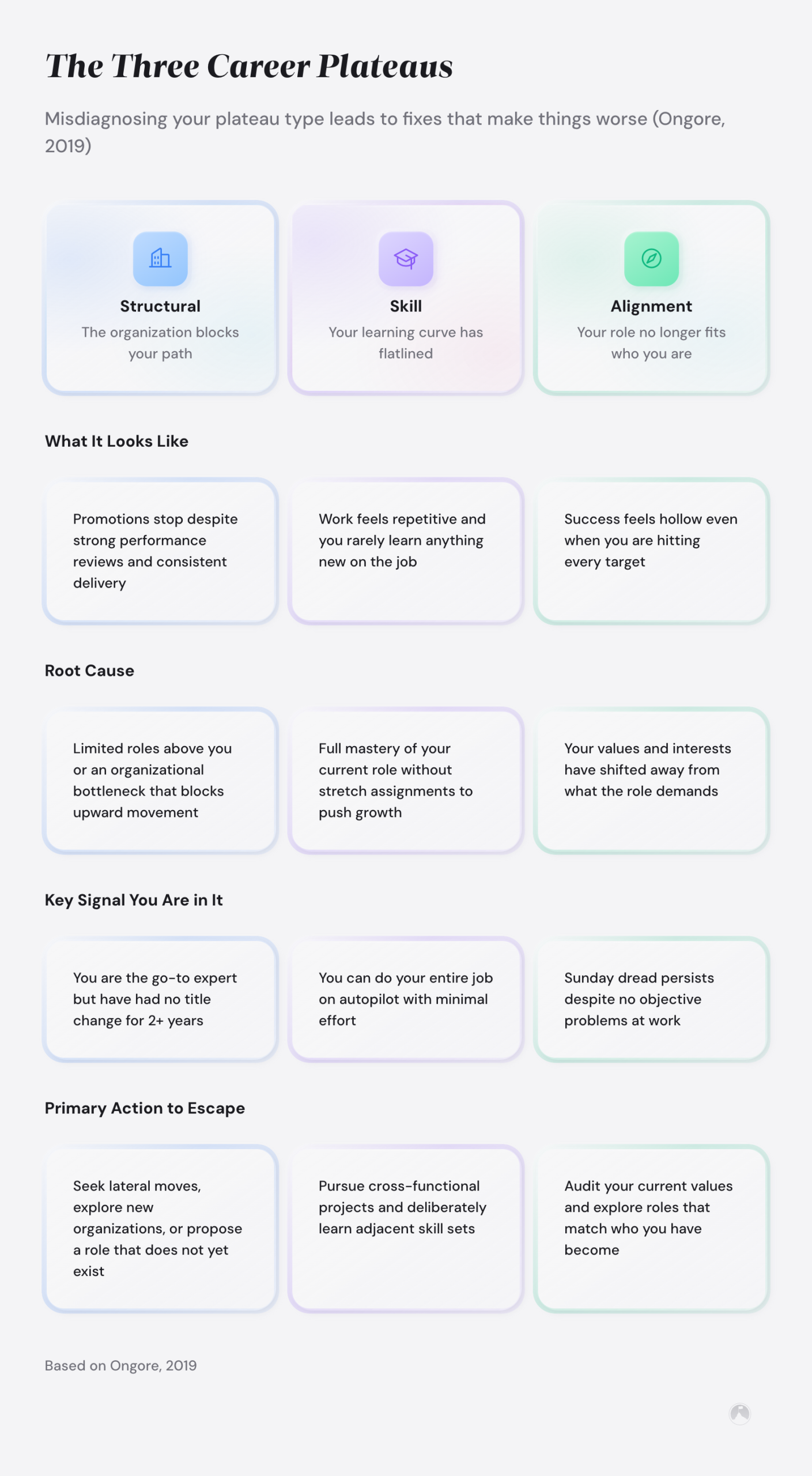
Structural plateau: the organization limits your growth
You’re good at your job. Maybe you’re very good. But there’s nowhere to go.
Your company is small, or shrinking, or the hierarchy is locked in place. You’ve asked about advancement and been told there’s nothing available – not this year, not realistically in the next three years. You’re not failing. The organization just doesn’t have room for you to climb.
The psychological experience of a structural plateau is distinct: it combines competence with helplessness. You know you could do more, but the system won’t let you. Structural career stagnation creates a different kind of frustration than a skill plateau because the limitation is organizational, not personal.
Research synthesizing decades of empirical studies on career plateau found that individuals experiencing structural career limits report substantially higher turnover intentions and lower organizational commitment than those in other plateau types [4]. Employees experiencing structural career limits leave not because of poor performance but because they’ve hit an invisible ceiling.
Structural stagnation is the one type where the problem is the organization, not you.
Skill plateau: your capability now exceeds the challenge
This is different. You’re great at what you do. You know the job inside and out. You could mentor someone new in a week. The challenge that once energized you has become routine – you’re not bored because the work is hard, you’re bored because it’s predictable. Same responsibilities, same complexity level, year after year. These are clear signs you are stuck in your career at the skill level.
The psychological experience here is what Mihaly Csikszentmihalyi’s flow research identifies as a flow deficit [5]. Flow deficit is the specific state that occurs when a person’s professional skills consistently exceed the challenges available in their role – distinct from ordinary boredom because it stems from competence outpacing opportunity, not from disinterest or low motivation. You have capacity that’s going unused. And that creates a restless, unfulfilled feeling even though the job itself is stable and you’re performing well.
Research by Kwon (2022) found that career plateau is closely linked to psychological distress, including burnout and emotional exhaustion. When capabilities consistently exceed available challenges, the resulting flow deprivation creates the opposite of optimal engagement [3].
When workplace challenge disappears from a role, so does the sense of meaning.
Alignment plateau: your values have evolved, your role hasn’t
Maybe you took this job before you had kids, and now you need flexibility that this role doesn’t offer. Or you built a career in finance and suddenly realized you care about impact more than returns. Or you became conscious of ethical issues within your company that you can’t unknow.
Your values have changed, but your job hasn’t. This creates a different kind of stagnation – not about capability or opportunity, but about whether this path still feels like your path.
Research on organizational justice and psychological capital shows that when personal values and organizational values misalign, employees experience disengagement independent of compensation or advancement prospects [6]. You can have a great job and still feel trapped if it doesn’t align with who you’re becoming.
The type of stagnation determines the fix. Get the diagnosis wrong, and you’ll solve the wrong problem.
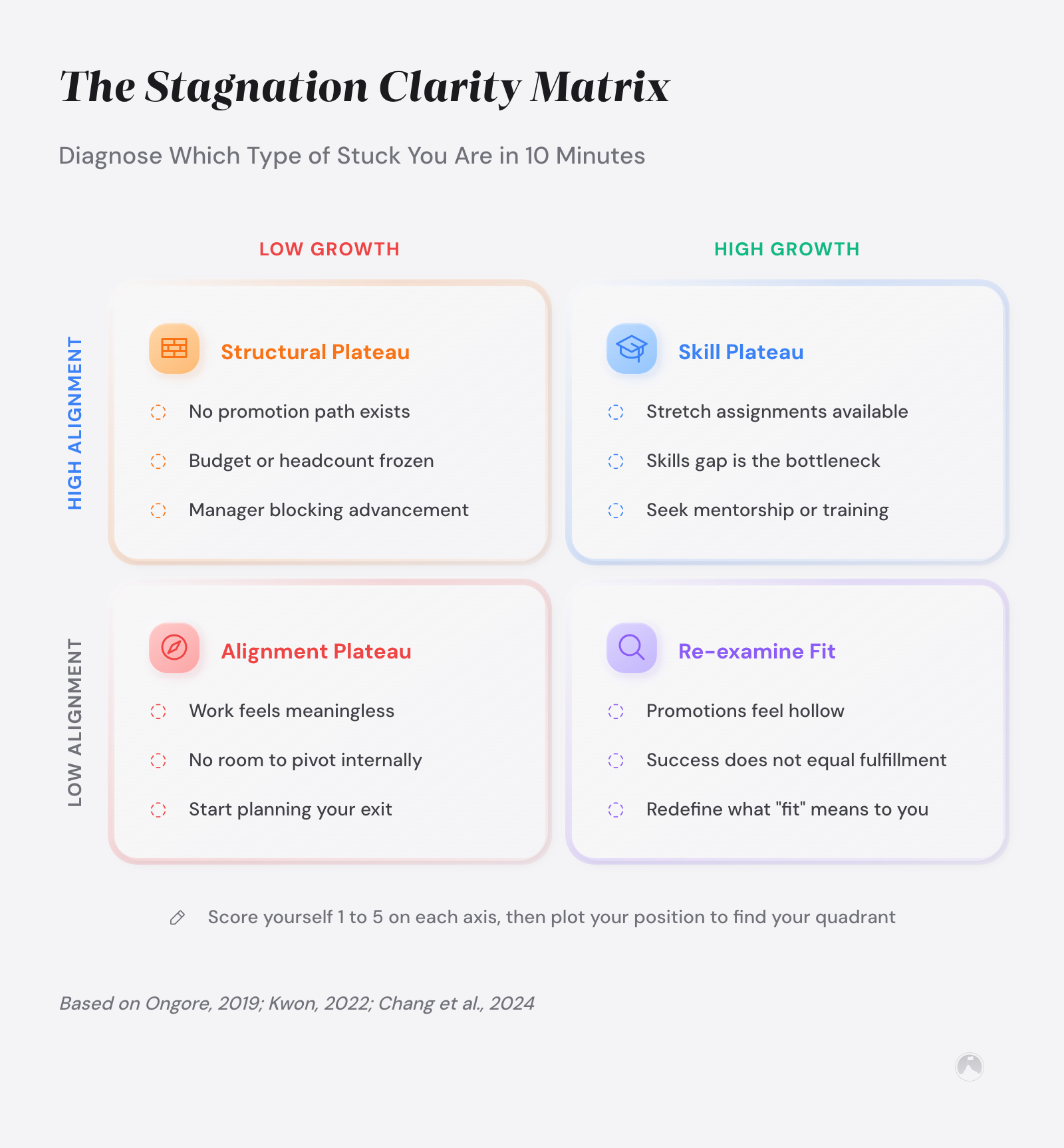
The Stagnation Clarity Matrix: diagnose yourself in 10 minutes
Here’s a diagnostic framework we developed by synthesizing patterns across career plateau research. Six questions, scored across the three plateau types.
The Stagnation Clarity Matrix is a self-assessment tool that maps six diagnostic statements across three career plateau types – structural, skill, and alignment – to identify which form of stagnation a person is primarily experiencing.
For each statement, note whether it feels “definitely true” (DT), “somewhat true” (ST), or “not really true” (NR).
Structural plateau statements:
| Statement | DT / ST / NR |
|---|---|
| My manager has told me directly that there are no advancement opportunities. | |
| I’m frustrated not because the work is hard, but because it never changes. | |
| The problem isn’t my capability – it’s that the position itself has limits. |
Skill plateau statements:
| Statement | DT / ST / NR |
|---|---|
| I could do my job in my sleep. I know every possible variation and edge case. | |
| I’m frustrated not because the work is hard, but because it never changes. | |
| I could succeed in this role for another 5-10 years, but I don’t want to. |
Alignment plateau statements:
| Statement | DT / ST / NR |
|---|---|
| My values or priorities have shifted in a way that makes this role feel misaligned. | |
| I could succeed in this role for another 5-10 years, but I don’t want to. | |
| The problem isn’t my capability – it’s that the position itself has limits. |
Count your “definitely true” answers for each group. The group with the most is your primary stagnation type. If you have two groups tied, you’re likely experiencing a combination – which is actually more common than any single type alone.
Why lateral moves are strategic gold – not consolation prizes
Here’s where most career advice gets it wrong. When you’re stuck, the default response is either “learn more skills” or “climb higher.” But research on career transitions shows something counterintuitive.
A lateral career move is a transition to a different role at the same organizational level – often in a different department, function, or team – that prioritizes breadth of experience over hierarchical advancement.
Research shows that lateral moves are linked to higher future promotion rates and greater long-term salary growth than staying in place and waiting for vertical advancement [2].
Why does a lateral move work so well? Because it resets all three stagnation types simultaneously: fresh challenge (skill plateau), new team structure with different opportunities (structural plateau), and exposure to different cultural values (alignment plateau).
The fastest path up sometimes requires moving sideways first.
How to overcome career plateau: what each type requires
To overcome a career plateau, first identify whether your stagnation is structural (limited organizational opportunities), skill-based (capability exceeding challenge), or alignment-based (values have evolved past the role). Each type requires a different response: structural plateaus need organizational change or exit, skill plateaus need new complexity, and alignment plateaus need values reassessment.
If you’re on a structural plateau
The decision point is straightforward: Does the organization have the structure to grow you, or are you fundamentally outgrowing the container?
If advancement exists but is just slow, your first move is a conversation with your manager. Ask specifically: “What does the path to the next level look like, and what would I need to demonstrate?” This isn’t a complaint – it’s clarifying expectations. Building relationships across teams through networking for career growth can also open doors not visible from your current position.
If advancement genuinely doesn’t exist (and your manager admits this), you have two options: move laterally within the organization to a team with more growth room, or start exploring outside. Don’t stay in a career rut you’ve outgrown hoping things will change – they won’t without structural change. For deeper context on this decision, see our guide on comparing career advancement strategies.
If you’re on a skill plateau
Your first move is deliberately adding complexity, not just more responsibility. Ask for projects that stretch you in new directions – managing a different stakeholder group, leading a new initiative, or owning a domain you’ve never touched. Not “more work” – different work.
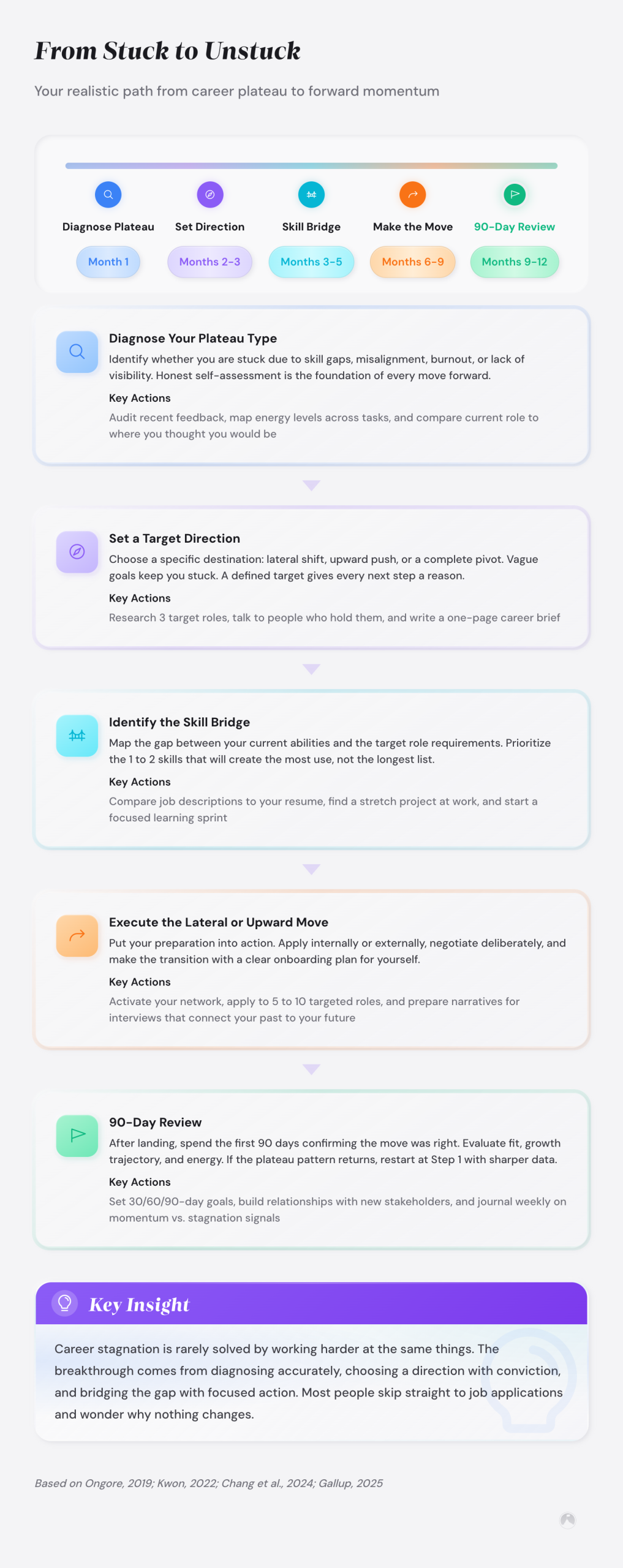
If your current role can’t provide this complexity, a lateral move to a new area (even at the same level) often solves this faster than waiting for a promotion. You get to be a beginner again – the antidote to capability-outpacing-challenge. Research on career plateaus confirms that job content plateau is distinct from hierarchical plateau and responds best to role variety rather than vertical promotion [4].
Explore strategic career planning frameworks to think about how skill-building fits into your long-term trajectory.
If you’re on an alignment plateau
This one requires honest conversation with yourself first. Has your priority shifted temporarily (new parent needing flexibility for 3-5 years) or fundamentally (career ambition has given way to values alignment)?
If it’s temporary, the question is whether this organization can accommodate it. Many companies offer flexible schedules, remote work, or projects aligned with specific values. Ask about these options before assuming you need to leave.
If it’s fundamental, no amount of negotiation within the current role will fix the misalignment. The solution to an alignment plateau is not to change yourself back – it’s to change environments. A role at a values-aligned company will feel completely different, even if the job description is identical. For those in mid-career wrestling with this shift, our article on career growth for mid-career professionals covers how to make this transition. And if a career shift feels overwhelming, career change anxiety solutions addresses that specific fear.
The difference between a slump and real stagnation
Not every Monday morning dread is a career plateau. Sometimes it’s a bad week, a difficult project, or normal work stress. The distinction matters because treating temporary frustration as permanent stagnation leads to hasty decisions.
A slump typically resolves within a few weeks. Something specific triggered it – a bad meeting, a project fell apart, a colleague frustrated you. You can identify the trigger clearly. A week or two later, something shifts and the feeling eases.
Real stagnation persists across months. You can’t point to a specific trigger – the feeling is diffuse and persistent. Monday mornings consistently feel heavy. Multiple aspects of the role feel unfulfilling. You’ve considered looking for a new job seriously, not just in passing. A career rut has a pattern, not a single cause.
Career plateau research confirms that prolonged stagnation correlates with elevated burnout, emotional exhaustion, and reduced job satisfaction [3]. If you’re less than three months into persistent dissatisfaction, give yourself that timeframe to gather data before making big moves. But if you’re six months or beyond, the signal warrants attention. If the data points toward a mindset shift rather than a structural problem, mindset shifts for career changers covers that terrain.
A slump has a trigger. Stagnation has a pattern.
Ramon’s take
Turns out ‘I’m stuck’ covers three completely different problems that need three completely different fixes. Which is both helpful and annoying, because now you can’t just blame the job and move on. You’ve got to actually figure out which kind of stuck you are.
The biggest mistake is treating all stagnation the same and reaching for the most dramatic solution. Sometimes you don’t need to reinvent your career. You need to diagnose the actual problem.
Conclusion
Feeling stuck in career is not a character flaw. It’s a signal that something in the alignment between your capabilities, your environment, or your values has shifted. The goal of addressing career stagnation is not to stay in an uncomfortable place and “learn to be grateful” – it’s to understand what type of stagnation you’re experiencing so you can respond with precision instead of desperation.
The difference between people who get unstuck and people who stay stuck is often just clarity. They know what problem they’re solving. You now have that clarity.
Next 10 minutes
- Spend 5 minutes filling out the Stagnation Clarity Matrix above. Which type showed the most “definitely true” answers for you?
- Write down one specific example of how this stagnation is showing up in your daily work life – not vague feelings, but concrete evidence.
This week
- If you identified structural plateau: Schedule a conversation with your manager about the path forward in your organization.
- If you identified skill plateau: Identify one project or domain in your current role (or nearby team) that would stretch you in a new direction. Send a proposal or inquiry.
- If you identified alignment plateau: List 3-5 values that have become important to you, and honestly assess how well your current role aligns with them. Then decide: Is the gap bridgeable, or does it require an environment change?
Build your action plan using our career development plan template.
There is more to explore
If structural plateau resonated, compare your options in career advancement strategies compared. For skill plateau, strategic career planning frameworks maps your next growth trajectory. For alignment plateau, career development psychology research covers values-driven career transitions. For the full picture, explore our career growth strategies guide.
Related articles in this guide
- networking-for-career-growth
- planning-for-long-term-career-transitions
- strategic-career-planning-frameworks
Frequently asked questions
What are the most common reasons people feel stuck in their careers?
The three primary reasons are structural (organization lacks advancement opportunities), skill-based (mastery has outpaced challenge), and values-based (priorities have evolved but the job hasn’t). Structural plateau is the most frequently reported type in career research. Mid-career professionals with 5-10 years of experience are most vulnerable, and experiencing two or more types simultaneously is more common than any single type alone.
How can I identify the root cause of my career stagnation?
Use the Stagnation Clarity Matrix – answer the six diagnostic statements and see which plateau type scores the most definitely true responses. If your results are unclear, try the Monday morning test: if the heaviness is about sameness, you’re likely skill-plateaued; if it’s about the environment limiting you, structural; if it’s a sense of misalignment with deeper priorities, alignment.
What should I do first if I feel stuck in my career but can’t quit?
Start by diagnosing your stagnation type using the matrix. If structural, ask your manager directly about advancement paths or consider lateral moves within the organization. If skill-based, request projects with new complexity. If values-based, explore whether your organization can accommodate your evolving priorities.
Are lateral moves as valuable as promotions for career growth?
Research shows lateral moves are linked to higher future promotion rates and greater long-term salary growth [2]. They are most effective for skill plateaus, where fresh challenge is the primary need. However, if you’re experiencing an alignment plateau, a lateral move within the same company may not help if the values misalignment is organizational rather than role-specific.
How do I know if I should stay and try to advance or leave my job?
If stagnation has persisted for six months and diagnosis shows structural barriers the organization can’t remove, leaving is often the right choice. If stagnation is skill-based or values-based, your current organization may be able to accommodate it through lateral moves or project changes.
Is it normal to feel stuck in a career after several years in the same role?
Yes. Gallup’s 2025 data shows that only 31 percent of U.S. employees are fully engaged, meaning roughly two-thirds of workers experience some form of disengagement [1]. Career plateau is a normal part of career evolution, not evidence of failure.
References
[1] Gallup. (2025). “U.S. Employee Engagement Sinks to 10-Year Low.” State of the Workplace 2025 Report. Gallup Workplace Report
[2] Groysberg, B., Lee, L.-E., & Nanda, A. (2023). “Stepping Sideways to Step Up: Lateral Mobility and Career Advancement Inside Organizations.” Management Science, 69(7), 3916-3934. DOI: 10.1287/mnsc.2021.03746
[3] Kwon, J. E. (2022). “The Impact of Career Plateau on Job Burnout in the COVID-19 Pandemic: A Moderating Role of Regulatory Focus.” International Journal of Environmental Research and Public Health, 19(3), 1087. DOI: 10.3390/ijerph19031087
[4] Ongore, O. (2019). “Career Plateau: A Review of 40 Years of Research.” Journal of Vocational Behavior. DOI: 10.1111/1748-8583.12539
[5] Csikszentmihalyi, M. (1990). Flow: The Psychology of Optimal Experience. Harper & Row.
[6] Chang, P.-C., Geng, X., & Cai, Q. (2024). “The Impact of Career Plateaus on Job Performance: The Roles of Organizational Justice and Positive Psychological Capital.” Behavioral Sciences, 14(2), 144. DOI: 10.3390/bs14020144