
Why Your Habits Keep Dying on Day Twelve
You start strong. The first week of any new habit feels powered by pure intention – and then somewhere around day ten or twelve, you skip once, shrug, and never come back. Psychologist Phillippa Lally’s research at University College London found that reaching automaticity for a new behavior takes a median of 66 days, with a range stretching from 18 to 254 days depending on complexity [1]. That gap between your enthusiasm and the finish line is where most habits go to die.
The seinfeld strategy offers a fix that is almost absurdly simple. Behavioral scientist Wendy Wood has shown that roughly 43% of daily actions happen on autopilot – repeated in the same context with minimal conscious thought [2]. The question isn’t whether your brain can automate a behavior. It’s whether you can stay consistent long enough for that automation to kick in.
The Seinfeld Strategy (also called “don’t break the chain”) is a streak-based habit tracking method where a person marks each successful day on a visible calendar, creating a growing visual chain that motivates continued daily action. Unlike reward-based habit systems, the seinfeld strategy relies on loss aversion – the psychological discomfort of breaking an established streak – as the primary motivational driver.
What You Will Learn
- The real origin of the seinfeld strategy and why it went viral
- How streak psychology and loss aversion keep you showing up
- A step-by-step daily schedule for building your habit chain
- An interactive chain tracker template you can use today
- What to do when the chain breaks – without losing progress
- How the seinfeld strategy compares to other habit methods
Key Takeaways
- The seinfeld strategy uses a visible calendar chain to turn daily consistency into a self-reinforcing streak.
- Loss aversion makes breaking a streak feel roughly twice as painful as the pleasure of extending it.
- Monitoring goal progress increased attainment rates across 138 studies and 19,951 participants.
- Missing a single day does not reset habit formation – the process survives occasional gaps.
- The Chain Resilience Protocol (a goalsandprogress.com framework) replaces all-or-nothing thinking with structured recovery.
- Starting with a minimum viable daily action of two minutes builds the chain faster than ambitious targets.
- Physical recording of progress produced stronger effects than digital-only tracking in meta-analytic research.
Where did the seinfeld strategy actually come from?
The story goes like this. In the early 1990s, a young comedian named Brad Isaac spotted Jerry Seinfeld backstage at a comedy club and asked for advice. Seinfeld told Isaac to get a big wall calendar – the kind that shows the entire year on one page – and a red marker. Every day he wrote new material, he’d draw a big red X through that day [6].
“After a few days you’ll have a chain,” Seinfeld reportedly said. “Your only job is to not break the chain.” Isaac shared this story on Lifehacker around 2007, and it became one of the most-shared productivity tips on the internet. Seinfeld himself has since distanced himself from the story, but the method took on a life of its own.
The seinfeld strategy works by tracking the act of showing up rather than tracking outcomes, reducing a complex goal to a single binary question each day: did you do it or not? That simplicity is the whole point. And it maps directly onto what behavioral researchers have since confirmed about how habits actually form.
Why does streak psychology make the seinfeld strategy chain so hard to break?
Two psychological forces make the seinfeld strategy more effective than a simple to-do list. The first is progress monitoring. Benjamin Harkin and colleagues at the University of Sheffield analyzed 138 studies involving 19,951 participants and found that prompting people to monitor their progress toward a goal measurably increased the likelihood they’d achieve it [3]. The effect was strongest when progress was physically recorded – not just mentally noted.
The second force is loss aversion. Daniel Kahneman and Amos Tversky’s prospect theory, published in 1979, established that losses feel roughly twice as painful as equivalent gains feel pleasurable [4]. Loss aversion in streak-based habit tracking means the psychological pain of breaking a 30-day chain exceeds the satisfaction of building a 31-day chain. That asymmetry is what gives the chain its grip.
Apps like Duolingo have turned this into a business model. But the wall calendar version that Seinfeld described has an advantage digital tools don’t: constant ambient visibility. Wood’s research on context cues shows that environmental triggers account for a large portion of habitual behavior [2]. A calendar hanging next to your desk fires that cue every time you glance at it – your phone, buried in a pocket, doesn’t.
This connects to the broader science behind habit tracking and why format matters as much as frequency.
Streak motivation vs. traditional tracking
| Feature | Seinfeld Strategy (Streak-Based) | Traditional Habit Tracking |
|---|---|---|
| Primary motivator | Loss aversion – fear of breaking chain | Reward-based – satisfaction of checking off |
| Tracking format | Binary (did it / didn’t do it) | Often quantitative (reps, minutes, pages) |
| Visual feedback | Growing chain creates momentum | Scattered checkmarks, less visual pattern |
| Recovery from missed day | Psychologically costly (chain “resets”) | Lower stakes per individual day |
| Best for | Building new daily habits | Maintaining established routines |
| Research support | Progress monitoring meta-analysis [3] | Self-determination theory frameworks |
How to set up your seinfeld strategy daily schedule – step by step
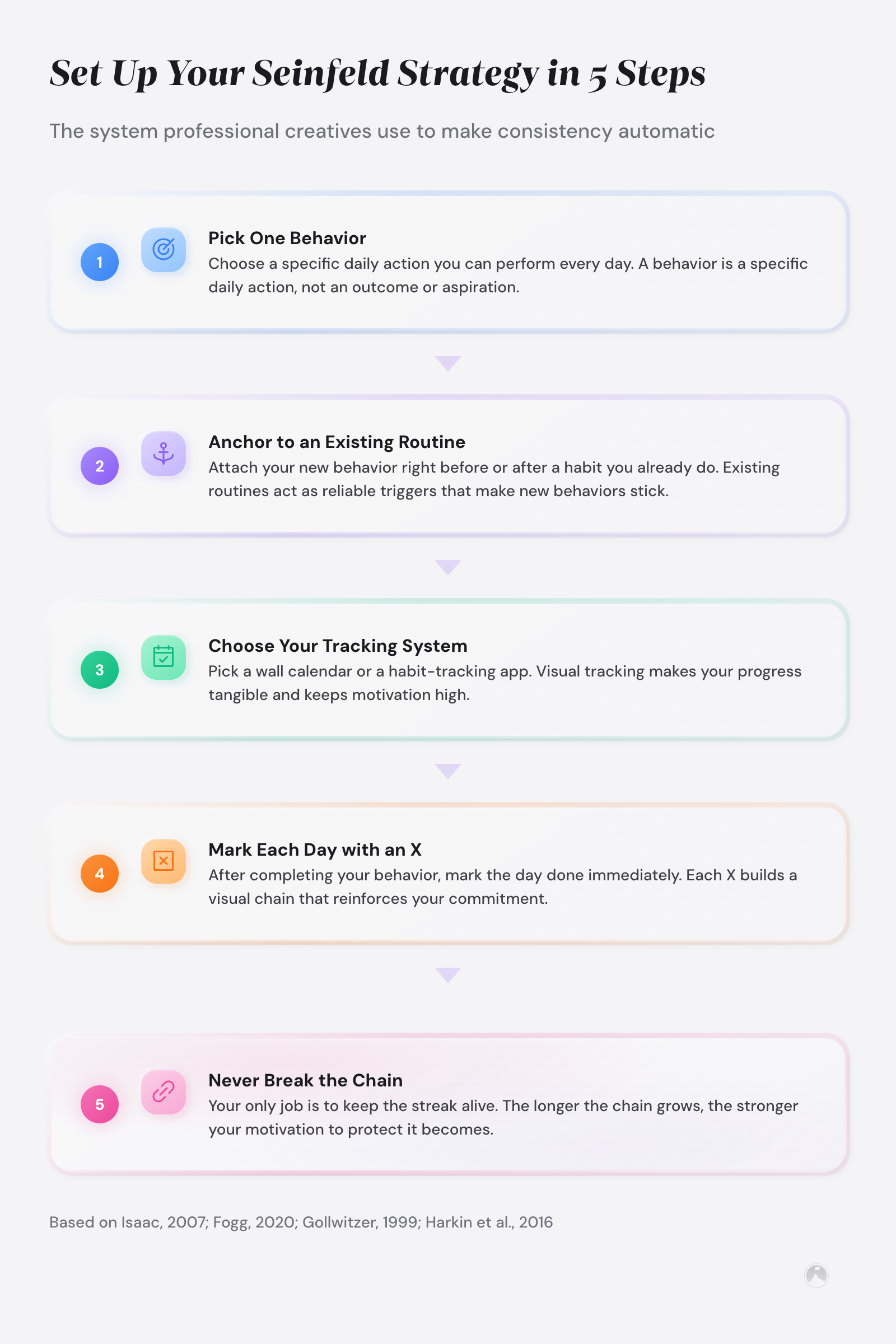
The seinfeld strategy is only as good as the daily schedule wrapped around it. Here’s how to build one that holds.
Step 1: Pick one behavior (not a goal)
Goals are outcomes; behaviors are actions. “Lose 10 pounds” is a goal, but “do 15 minutes of bodyweight exercises” is a behavior – and the seinfeld strategy tracks behaviors, not results. BJ Fogg’s research at Stanford’s Behavior Design Lab confirms this distinction matters – his Tiny Habits framework shows that starting with a minimum viable action (something you can finish in under two minutes) increases the odds of long-term consistency [5].
Streak-based habit tracking produces the strongest results when the daily target is small enough that low-motivation days still count. If your chain demands a 60-minute writing session, you’ll break it the first time you’re exhausted. If it demands “write one sentence,” you’ll mark that X even on your worst days. And on good days, you’ll write far more than one sentence anyway.
Step 2: Anchor it to an existing routine
Peter Gollwitzer’s research on implementation intentions shows that “if-then” plans roughly double the success rate for behavior follow-through [7]. The seinfeld strategy gets stronger when you tie your habit to a fixed point in your day. Not “I’ll meditate sometime today” but “After I pour my morning coffee, I’ll sit for five minutes of breathing.”

This is closely related to habit stacking, where you chain a new behavior onto an existing one. The difference is that the seinfeld strategy adds the visual tracking layer on top – giving you both the context cue and the streak motivation simultaneously.
Step 3: Set up your tracking system
You need three things: a year-at-a-glance calendar, a marker, and a location where you’ll see the calendar multiple times per day. The Harkin meta-analysis found that physical recording outperformed passive monitoring [3]. A wall calendar next to your bathroom mirror or workspace keeps the chain visible without requiring you to open an app.
Digital trackers work too – our guide to building a habit tracker covers the options. But if you go digital, set the app’s widget on your phone home screen. The chain needs to be something you can’t avoid seeing.
Step 4: Build your daily schedule around the chain
Here’s a sample daily schedule that integrates the seinfeld strategy with a realistic workday:
| Time | Action | Seinfeld Strategy Role |
|---|---|---|
| 6:30 AM | Wake up, glance at calendar (visual cue) | Environmental trigger fires |
| 6:45 AM | Complete minimum viable habit (2-10 min) | Core chain-building action |
| 6:55 AM | Mark the X on your calendar | Reward signal + visual chain extends |
| 7:00 AM | Continue with morning routine | Habit complete – rest of day is free |
| 9:00 PM | Evening check: did you mark your X today? | Safety net for forgotten mornings |
Morning placement works best for most people. Wood’s research shows that consistent context – same time, same location – accelerates the shift from deliberate effort to automatic behavior [2]. But the specific time matters less than the consistency of the time. If you’re a night owl, anchor your chain to an evening routine instead.
Don’t break the chain – a printable tracker template
Use this interactive chain tracker to plan your first 30 days. Each box represents one day. The template works as a quick visual reference for what we call at goalsandprogress.com the Chain Resilience Protocol – a framework for maintaining streaks without falling into all-or-nothing thinking.
30-Day Seinfeld Strategy Chain Tracker
Print this template or recreate it on a wall calendar. Mark each day you complete your habit.
Chain Resilience Protocol:
Green zone (Days 1-7): Focus only on showing up. Minimum viable action counts.
Momentum zone (Days 8-21): The chain becomes visually satisfying. Loss aversion kicks in.
Autopilot zone (Days 22-30): Behavior starts feeling automatic. Expand the target if it feels too easy.
If you miss a day: Never miss twice. Mark the next day with a different color and keep going.
What happens when the seinfeld strategy chain breaks?
Here’s the part most seinfeld strategy guides skip. The chain will break. Not if – when. And the way you respond to that break determines whether the method works long-term or becomes another abandoned experiment.
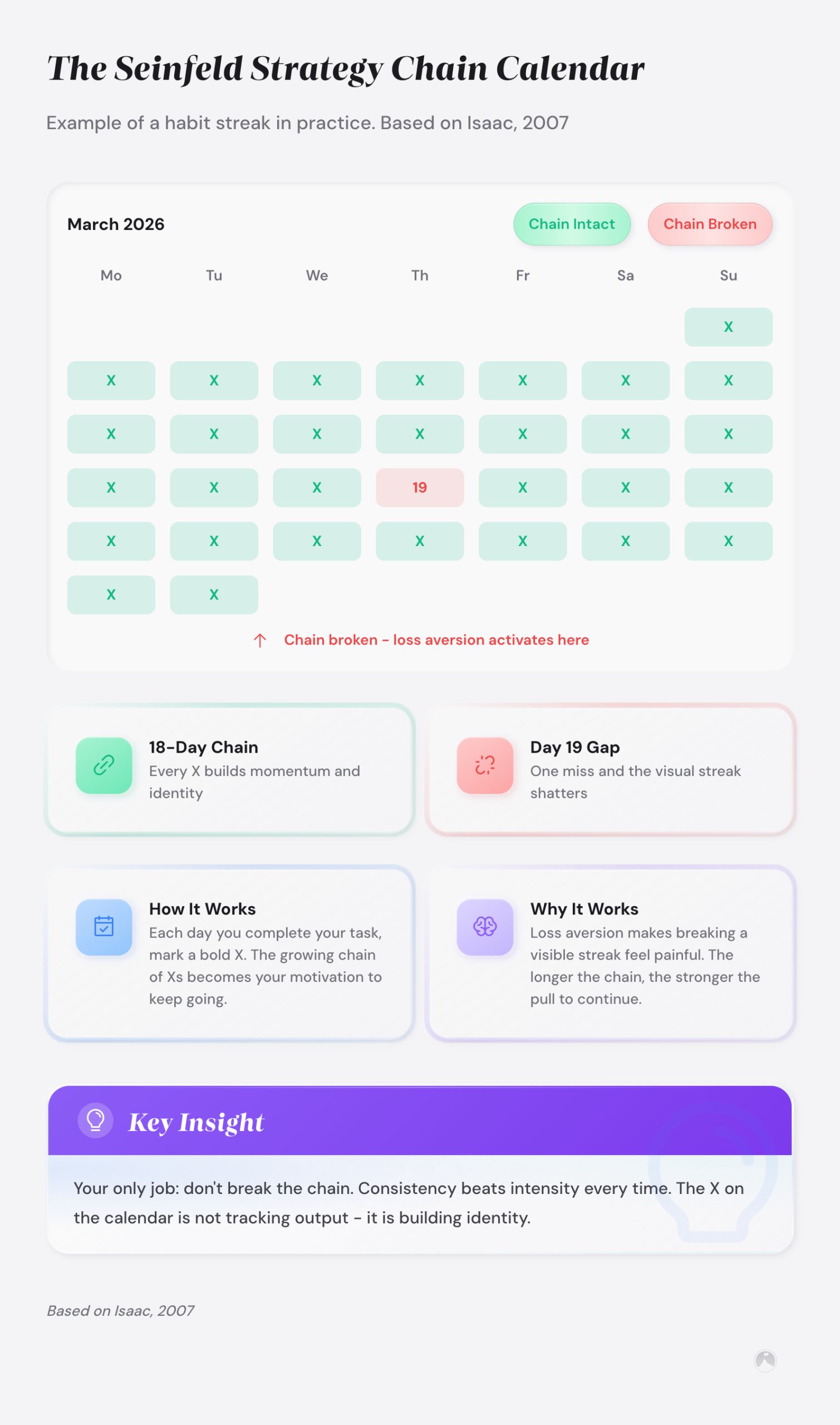
Lally’s 2010 research offers the most reassuring data point here: missing a single day did not materially affect the habit formation process [1]. The trajectory toward automaticity barely wobbled. A single missed day in a daily habit chain does not reset the neurological process of habit formation because the brain’s context-response associations remain largely intact after isolated disruptions.
The real danger isn’t the missed day. It’s the “what-the-hell effect” – a term psychologists use for the all-or-nothing spiral where one slip becomes total abandonment. Research on self-regulation failure shows that people who frame setbacks as evidence of personal inadequacy are far more likely to abandon goals entirely than those who treat lapses as isolated events [8].
The Chain Resilience Protocol
We developed the Chain Resilience Protocol at goalsandprogress.com as a structured way to handle broken chains without losing the motivational benefits of streak tracking. It works in three steps:
- Never miss twice. One miss is a data point. Two misses is the start of a new pattern. Commit to the minimum viable version of your habit the day after any break.
- Use a different color. Instead of pretending the break didn’t happen, mark “recovery days” with a blue or green marker instead of red. This preserves honesty and still keeps the visual chain going.
- Track completion rate, not streak length. Shift your metric from “consecutive days” to “days completed out of last 30.” A 27-out-of-30 record is outstanding – and it lets you absorb the occasional miss without psychological collapse.
This approach connects to a broader pattern in why habits fail – the system breaks not because of one bad day, but because of how we interpret that day. If your habit chain relies on perfection, it’s brittle. If it relies on consistency with built-in forgiveness, it bends without breaking.
Seinfeld strategy vs. other habit formation methods
The don’t break the chain approach isn’t the only game in town. How does it compare to other popular methods?
| Method | Core Mechanism | Best For | Limitation |
|---|---|---|---|
| Seinfeld Strategy | Visual streak + loss aversion | Daily binary habits (write, exercise, meditate) | All-or-nothing risk without recovery protocol |
| Tiny Habits (BJ Fogg) | Minimum viable action + celebration | Starting from zero, building identity | No built-in tracking or visual momentum |
| Habit Stacking | Chaining new behavior to existing one | Adding habits to established routines | Depends on stability of anchor habit |
| Implementation Intentions | If-then planning for specific cues | Bounded, initiating-type behaviors | Accessibility decreases over time [7] |
| Accountability Partner | Social commitment + external check-in | High-stakes goals, complex behaviors | Depends on partner reliability |
The seinfeld strategy pairs best with tiny habits when users set a minimum viable daily target and track it on a visible calendar, combining low friction with strong visual motivation. These methods aren’t competitors. They’re complements. You can use Fogg’s approach to shrink the action, Gollwitzer’s implementation intentions to anchor the timing, and Seinfeld’s chain to maintain the streak.
For a deeper look at how these methods interact, our habit formation complete guide covers the full range of evidence-based approaches. And if you’re interested in adding game-like motivation layers, productivity gamification builds on many of the same psychological principles that make streak tracking stick.
Advanced daily habit chain tactics that most guides miss
Once you’ve got the basics running, a few adjustments can make your seinfeld strategy habits stronger.
The “two-minute floor” rule
Fogg’s Tiny Habits research found that starting with minimal viable habits made people significantly more likely to maintain long-term consistency compared to those who started with ambitious targets [5]. Apply this to the seinfeld strategy: your chain’s daily requirement should never take more than two minutes on a bad day. On good days, do more – on terrible days, do two minutes and mark the X. The chain survives either way.
Multiple chains, different calendars
Some people try to run five chains simultaneously, and that usually collapses by week three. Start with one, and once it feels automatic – typically around the 30 to 45 day mark – add a second on a separate calendar. Running more than three daily habit chains at once dilutes the loss-aversion effect that makes each individual seinfeld strategy chain motivating. Your attention splits, and the stakes for any single chain drop.
Pair the chain with environment design
Wood’s context-cue research shows that designing your physical environment around your target habit accelerates the transition to automaticity [2]. If your chain is for morning journaling, put the journal on top of your phone the night before; if it’s for exercise, set your shoes by the bed. The calendar chain provides the motivation, and environment design provides the friction reduction.
Rotating visual cues to prevent habituation
Here’s something the original seinfeld strategy doesn’t account for. The same poster on your wall for six months becomes invisible to your brain – a phenomenon researchers call perceptual adaptation. Move your calendar to a different wall every four to six weeks, or switch marker colors at regular intervals. Small changes in the visual presentation keep your brain registering the chain as a signal rather than background noise.
Ramon’s Take
My take? Skip the wall calendar for now. Just grab a sticky note and put an X on it today. If you’re still doing it after a week, then buy the fancy calendar. Most people quit before they even need the system.
Seinfeld Strategy Conclusion: One X at a Time
The seinfeld strategy doesn’t ask you to overhaul your life. It asks you to do one small thing today and mark it on a calendar. Then do it tomorrow. The research confirms what Seinfeld’s advice implied: consistency beats intensity for habit formation [1] [2], visual tracking strengthens follow-through [3], and loss aversion turns a simple red X into a surprisingly strong commitment device [4].
The chain doesn’t care if you had a bad day. It only cares if you showed up.
Next 10 Minutes
- Choose one daily behavior you want to build into a habit – keep it small enough to do in two minutes.
- Find or order a year-at-a-glance wall calendar and a red marker.
- Pick the spot where you’ll hang the calendar – somewhere you pass at least three times daily.
This Week
- Complete your first seven X marks and observe how the visual chain feels after a full week.
- Write down your implementation intention: “After [existing routine], I will [habit], and then I will mark my X.”
- Set a 9 PM phone alarm as a safety net reminder in case you forget to do (or mark) your habit.
There is More to Explore
If the seinfeld strategy clicks for you, the natural next step is building a full system around it. Our precommitment psychology guide explains the broader science of binding yourself to future behavior, and the uncommon accountability systems article offers alternatives when solo streak tracking isn’t enough.
For those looking at the planning side, our review cadence framework pairs well with the seinfeld strategy when you want to build regular reflection into your habit system.
Related articles in this guide
Frequently Asked Questions
How long should you use the seinfeld strategy before a habit becomes automatic?
Most habits reach automaticity between 18 and 254 days, with a median of 66 days according to Lally et al. [1]. The seinfeld strategy works best when maintained for at least 90 days, giving even complex behaviors enough repetition to become largely automatic. Simpler habits like drinking a glass of water may lock in within three weeks.
Does the don’t break the chain method work for exercise habits?
Streak-based tracking is effective for exercise when the daily minimum is set low enough to maintain on rest days. A two-minute stretching session or a short walk counts toward the chain. Lally’s research found exercise habits took roughly 91 days to form, longer than simpler behaviors [1]. Setting the chain threshold at showing up rather than peak performance prevents the streak from becoming a source of overtraining.
Can you use the seinfeld strategy with a digital app instead of a wall calendar?
Digital apps work for streak-based habit tracking, but the Harkin et al. meta-analysis found that physically recording progress produced stronger effects on goal attainment [3]. The advantage of a wall calendar is ambient visibility – it fires a context cue every time you walk past it. If using an app, placing a home screen widget where you see it frequently replicates some of that passive cueing effect.
What is the best daily habit to start with using the seinfeld strategy?
The best starting habit is one that takes under five minutes and can be done at the same time each day. Writing one paragraph, doing five pushups, or reading two pages are common choices. BJ Fogg’s research shows that habits starting at the minimum viable level have higher long-term adherence rates than ambitious targets [5]. Pick the behavior where consistency matters more than volume.
How many habit chains can you track at the same time?
Start with one chain for the first 30 days. Adding a second chain after the first feels automatic is reasonable, but running more than three simultaneous daily chains dilutes the loss-aversion effect that makes each chain motivating. The attentional demand of tracking multiple streaks can shift focus from doing the habits to managing the tracking system itself.
Is the seinfeld strategy effective for people with ADHD?
Streak-based tracking can work for ADHD brains when the daily target is very small and the tracking method is highly visible. The binary simplicity of the seinfeld strategy – did it or didn’t – reduces the executive function load compared to complex tracking systems. Pairing it with physical calendars rather than apps removes the friction of opening and navigating software. For ADHD-specific adaptations, combining the chain with body doubling or external accountability adds a social motivation layer that compensates for inconsistent internal motivation.
References
[1] Lally, P., van Jaarsveld, C. H. M., Potts, H. W. W., & Wardle, J. (2010). “How are habits formed: Modelling habit formation in the real world.” European Journal of Social Psychology, 40(6), 998-1009. https://doi.org/10.1002/ejsp.674
[2] Wood, W., & Runger, D. (2016). “Psychology of Habit.” Annual Review of Psychology, 67, 289-314. https://doi.org/10.1146/annurev-psych-122414-033417
[3] Harkin, B., Webb, T. L., Chang, B. P. I., Prestwich, A., Conner, M., Kellar, I., Benn, Y., & Sheeran, P. (2016). “Does monitoring goal progress promote goal attainment? A meta-analysis of the experimental evidence.” Psychological Bulletin, 142(2), 198-229. https://doi.org/10.1037/bul0000025
[4] Kahneman, D. & Tversky, A. (1979). “Prospect Theory: An Analysis of Decision under Risk.” Econometrica, 47(2), 263-291. https://doi.org/10.2307/1914185
[5] Fogg, B.J. (2020). Tiny Habits: The Small Changes That Change Everything. Houghton Mifflin Harcourt.
[6] Isaac, B. (2007). “Jerry Seinfeld’s Productivity Secret.” Lifehacker. https://lifehacker.com/jerry-seinfelds-productivity-secret-281626
[7] Gollwitzer, P. M. (1999). “Implementation intentions: Strong effects of simple plans.” American Psychologist, 54(7), 493-503. https://doi.org/10.1037/0003-066X.54.7.493
[8] Polivy, J., & Herman, C. P. (2002). “If at first you don’t succeed: False hopes of self-change.” American Psychologist, 57(9), 677-689. https://doi.org/10.1037/0003-066X.57.9.677