
You were told to think outside the box, but nobody handed you the tools
Creative thinking techniques sound like something reserved for designers and artists. But a 2020 study by Ritter, Gu, Crijns, and Biekens in PLOS ONE tracked students through a year-long creativity training program and found that structured exercises significantly improved ideation skills and cognitive flexibility [1]. Originality scores didn’t change – which is actually the insight that matters.
The distinction between ideation fluency and originality means creative thinking isn’t about waiting for genius to strike. It’s about building specific cognitive muscles through focused, repeated practice.
Creative thinking techniques are structured exercises and methods designed to push cognition beyond habitual patterns, enabling the generation of novel ideas, unexpected connections, and unconventional solutions to problems. Unlike general brainstorming, creative thinking techniques target specific cognitive abilities such as divergent thinking, analogical reasoning (borrowing solutions from one domain and applying them to another), and assumption reversal.
What you will learn
- Why creative thinking is trainable and which cognitive skills each technique develops
- How constraint flipping forces your brain out of repetitive patterns
- How random entry – a lateral thinking technique – produces non-obvious solutions
- How assumption reversal exposes hidden opportunities in any problem
- How to build a daily creativity practice using the Cognitive Shift Ladder
Key takeaways
- Creative thinking develops through structured exercises, not waiting for inspiration to strike.
- A single 1.5-hour creativity session can measurably improve ideation and flexibility [2].
- Constraint flipping works by turning limitations into creative springboards that bypass habitual thinking.
- Random entry, a lateral thinking technique, injects unrelated stimuli to break predictable thought paths.
- Assumption reversal exposes invisible rules governing how a problem has been framed.
- The Cognitive Shift Ladder sequences exercises from basic to advanced for lasting creative capacity.
- Analytical thinkers often perform well with structured techniques that channel logic toward novelty.
- Combining brainstorming activities, lateral thinking, and design thinking produces measurable creative gains [3].
Why are creative thinking techniques trainable skills, not inborn talents?
The myth that creative people are born collapses under the data. Ritter and Mostert tested whether a single 1.5-hour cognitive creativity training session could improve divergent thinking. It did [2]. Participants showed measurable improvements in fluency and flexibility after a session shorter than a movie.
Creative thinking breaks into distinct cognitive operations: pattern recognition (spotting connections between unrelated domains), perspective shifting (seeing a problem from a different vantage point), constraint manipulation (turning limitations into advantages), and analogical reasoning (borrowing solutions from one field to another) [5].
“A single 1.5-hour cognitive-based creativity training significantly improved participants’ ability to generate original and flexible ideas.” – Ritter & Mostert, Journal of Cognitive Enhancement [2]
Isaksen’s 2023 review found that creative potential develops through the interaction of process, people, and place [4]. Creative thinking improves through structured practice the same way physical fitness improves through exercise – not through talent, but through repetition and progressive challenge.
If your brainstorming sessions keep producing the same safe ideas, the fix is the right exercises practiced consistently. For a deeper look at how your brain physically changes through learning, our guide on neuroplasticity and learning science covers the mechanism.
How does constraint flipping break repetitive thinking patterns?
Most people treat constraints as obstacles. Constraint flipping is a creative thinking technique that identifies the limitations governing a problem and intentionally reverses, exaggerates, or eliminates them to force the brain into unfamiliar solution territory, distinct from standard brainstorming because it uses existing boundaries as creative fuel rather than ignoring them.
Here’s how it works. First, list every constraint you’re operating under – budget, time, tools, team size, format. Second, pick one constraint and flip it: if you have too little time, imagine you had ten years. Third, generate ideas in this flipped reality, then pull the best ones back into real constraints and ask which elements survive translation.
Research on creative and analytic thinking shows that constraint reversal activates cognitive flexibility, forcing your brain to operate outside its default solution space [6]. Flipping a constraint temporarily disables the automatic narrowing that habitual thinking creates.
Constraint flipping turns the boundaries of a problem into entry points for original thinking by forcing the brain to operate outside its default solution space. Try it now: write down your three biggest constraints, flip the worst one, and spend 60 seconds generating ideas in that flipped reality. Constraint flipping is one of the most accessible creative problem solving methods you can practice solo or with a team.
What is random entry and why does this lateral thinking technique work?
Random entry is one of Edward de Bono’s lateral thinking techniques: introduce a completely unrelated word, image, or object into your problem-solving process, then force connections between that random element and your challenge.
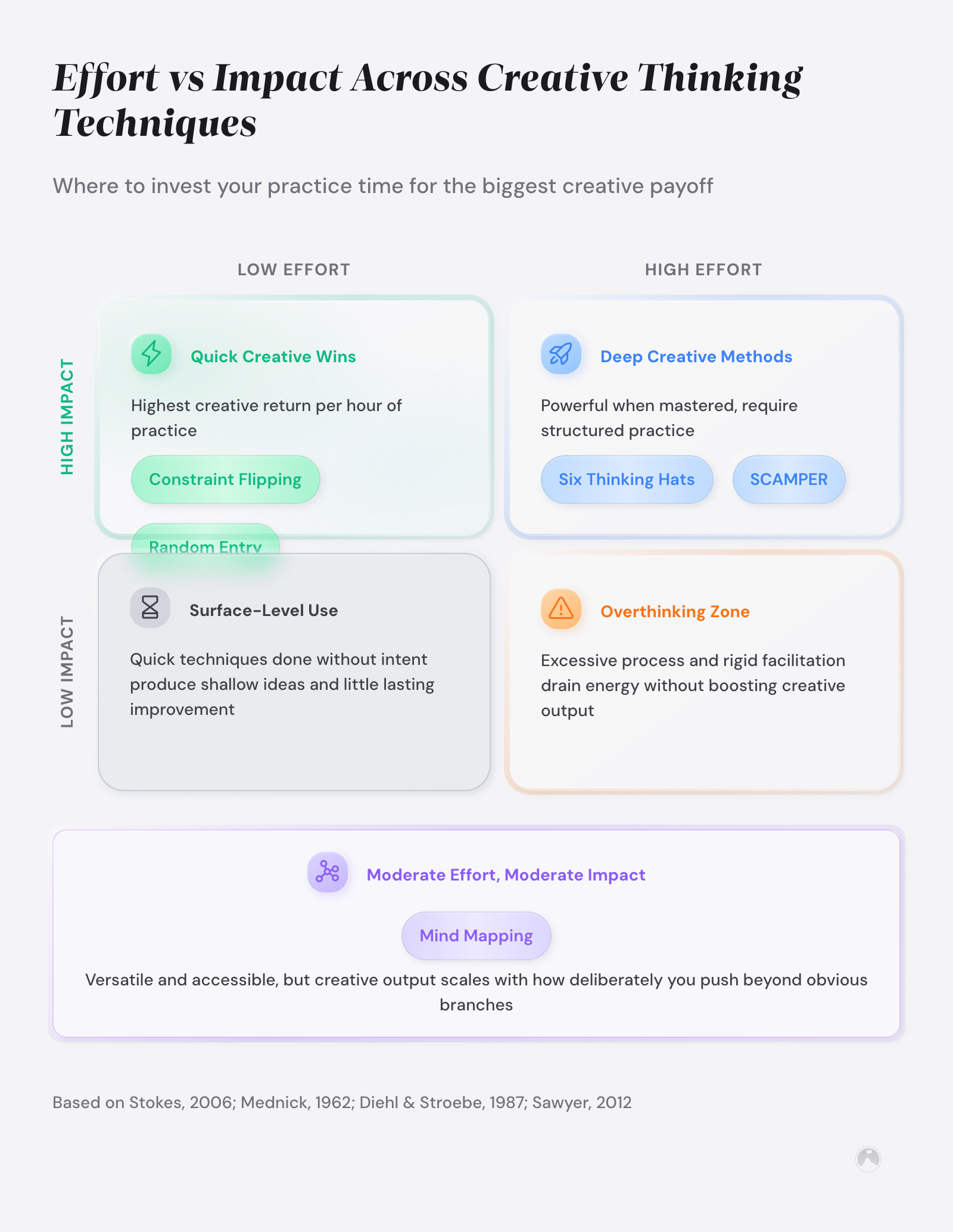
Open a dictionary to a random page or pick any object within reach. Spend five minutes connecting that random element to your problem. If you’re redesigning an onboarding process and your random word is “lighthouse,” you might ask: what if onboarding had a single bright signal guiding new users to the most important feature?
When you think about a problem normally, your brain follows established neural pathways. A random stimulus creates a forced association, requiring your brain to build new connections between semantically distant concepts [7]. Mednick’s foundational research showed that the ability to form remote associations – linking ideas that don’t obviously belong together – is a core mechanism of creative thinking, and the basis behind many divergent thinking exercises and idea generation techniques.
Each technique targets a different cognitive skill: constraint flipping develops perspective shifting, random entry strengthens associative thinking (forming connections between unrelated concepts), assumption reversal builds a critical-creative blend, SCAMPER trains systematic modification, and brainwriting develops independent divergence.
| Technique | Best for | Format |
|---|---|---|
| Constraint flipping | Problems with rigid boundaries | 10-15 min / Solo or team |
| Random entry | Breaking out of mental ruts | 5-10 min / Solo or team |
| Assumption reversal | Reframing stuck problems | 15-20 min / Solo or team |
| SCAMPER | Improving existing products or processes | 20-30 min / Solo or team |
| Brainwriting (brainstorming activity) | Team idea generation without groupthink | 15-25 min / Team |
| Six Thinking Hats | Structured group decision-making | 30-45 min / Team |
| Mind mapping | Exploring connections visually | 10-20 min / Solo or team |
Applied to a weekly team meeting: Substitute the conference room with a walking meeting. Combine the status update with brainstorming. Adapt a stand-up format. Modify from 60 to 20 minutes. Eliminate the slide deck. Reverse: let the most junior person run the agenda. The best ideas come from combining two or three modifications.
Random entry produces original ideas by forcing the brain to construct novel neural connections that habitual thinking never activates. For scheduling creative exercises when your brain is most receptive, our guide on managing creative energy covers the timing.
Three more creative thinking techniques worth practicing
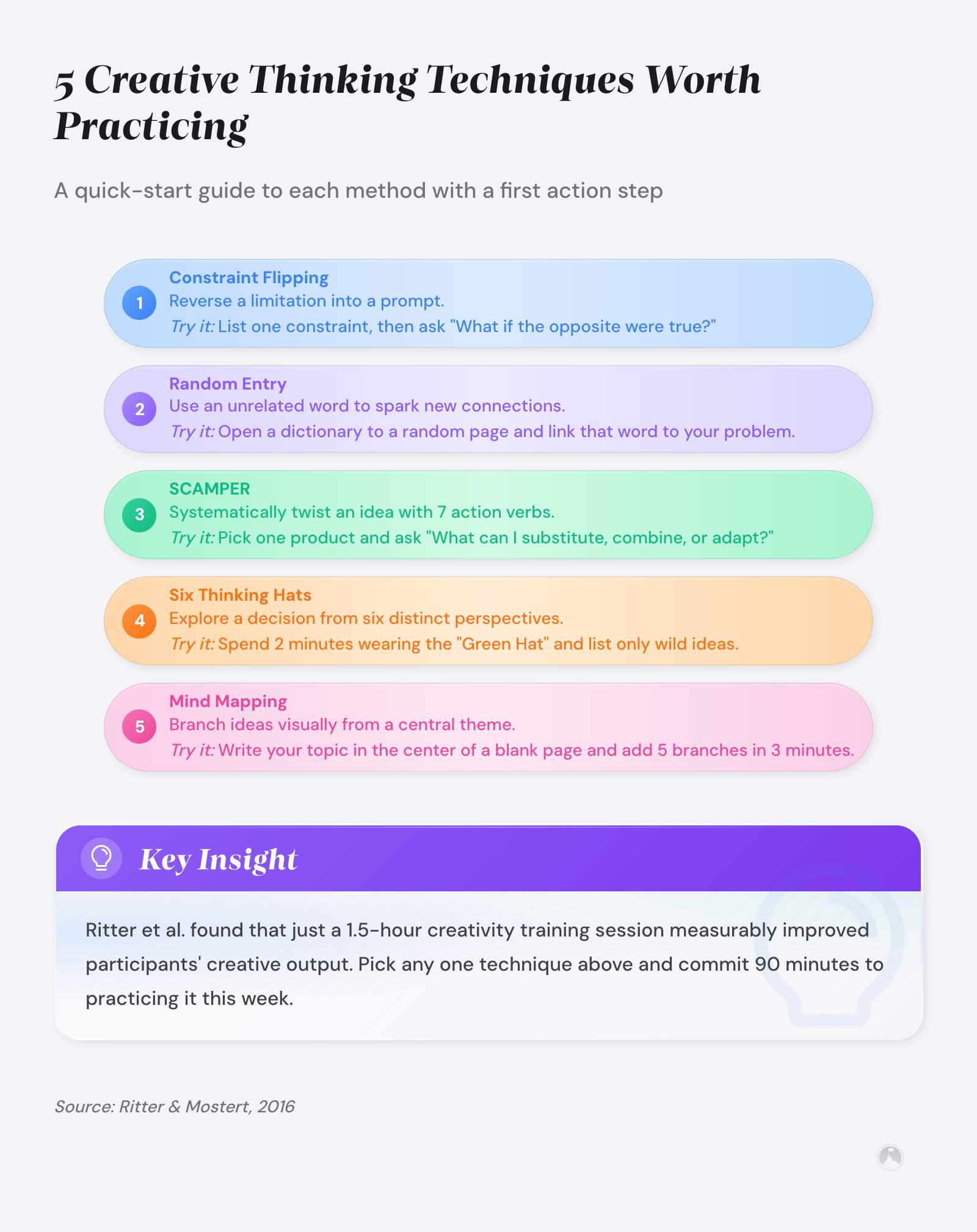
SCAMPER: systematic creativity through structured modification
SCAMPER uses seven prompts – Substitute, Combine, Adapt, Modify, Put to other uses, Eliminate, Reverse – to generate variations on an existing product, process, or idea. Select any workflow, work through each prompt for two to three minutes, then select the strongest ideas. A product designer might substitute text with video, combine onboarding with a gamified tutorial, and eliminate the registration wall – three improvement paths from one framework.
Six Thinking Hats: parallel thinking for groups
Six Thinking Hats separates group discussion into six modes: facts (white), emotions (red), caution (black), optimism (yellow), creativity (green), and process (blue). The facilitator selects a hat and the entire group thinks in that mode simultaneously, cycling through all six at three to five minutes each. This idea generation technique prevents one skeptic from derailing creative momentum, because critical thinking gets its own dedicated phase.
Mind mapping: visual idea generation
Mind mapping externalizes thinking by radiating associations outward from a central concept. Write your problem in the middle of a blank page, draw branches for each sub-topic, then add secondary branches using single words rather than sentences. The most original ideas often appear in unexpected connections between branches on different sides of the map. See our guide on mind mapping for brainstorming.
How does assumption reversal expose hidden opportunities?
Every problem comes wrapped in invisible assumptions. Assumption reversal is a creative problem-solving method that makes the implicit assumptions governing how a problem has been framed visible, then systematically reverses each one to reveal opportunities and solution spaces that conventional analysis misses.
Start by writing down everything you assume to be true about the problem. If you’re improving team meetings, your assumptions might include: meetings need an agenda, meetings should happen weekly, everyone must be present. Now reverse each one. What if meetings had no agenda? What if they happened daily for five minutes instead of weekly for an hour? What if only two people attended?
Faqih and colleagues combined brainstorming activities, lateral thinking techniques, and design thinking exercises in a 12-week study and found statistically significant improvements in creative thinking [3]. Assumption reversal sits at the intersection of lateral thinking and design thinking – it forces you to question the problem itself before solving it.
“Collaborative interventions integrating brainstorming, lateral thinking, and design thinking led to statistically significant improvements in creative thinking skills.” – Faqih et al., Thinking Skills and Creativity [3]
This technique pairs well with building a growth mindset. Assumption reversal strips away the invisible rules that constrain problem-solving, revealing solution spaces that conventional analysis never reaches.
Creative thinking techniques as a daily practice: the cognitive shift ladder
Knowing creative thinking techniques is useful. Practicing them consistently is what changes how you think. We call this progression the Cognitive Shift Ladder – a framework we developed for organizing creative thinking techniques into a progressive daily creativity practice. It sequences exercises from surface-level pattern disruption to deep structural reframing, building creative stamina the way interval training builds physical endurance.
Level 1: perception shifts (5 minutes daily)
Start with exercises that disrupt automatic perception. Random entry is ideal – pick a random word and force three connections to whatever you’re working on. Or try “wrong answers only” for two minutes. These exercises activate the brain’s associative networks (the interconnected web of concepts linking ideas together) without requiring deep analysis.
Level 2: frame shifts (10 minutes daily)
Move to exercises that change how you see the problem. Constraint flipping and assumption reversal live here – you’re questioning whether the angle itself is correct. Spend ten minutes listing and reversing assumptions in one current challenge.
Level 3: integration shifts (15 minutes weekly)
Once a week, tackle a real problem using multiple creative problem solving methods in sequence: assumption reversal to redefine, random entry to generate unexpected solutions, then constraint flipping to test which ideas survive real-world limits. Combining multiple creative thinking techniques in a single weekly session is where creative capacity becomes second nature.
The Cognitive Shift Ladder works because each level builds on the previous one. Perception shifts activate associative networks at low cognitive cost, building the neural flexibility frame shifts require. Frame shifts demand questioning assumptions, which draws on the flexible thinking Level 1 develops. Integration shifts combine both capacities under real-world constraints, consolidating skills into transferable creative problem-solving ability.
A product manager starts Monday with Level 1 – picking the word “aquarium” and forcing three connections to a user retention problem. On Wednesday, Level 2 – reversing five assumptions about why users drop off at onboarding. By Friday, a 15-minute integrated session combining all three techniques to redefine the problem and test which ideas survive engineering limits.
A daily creativity practice structured from perception shifts to frame shifts to integration shifts builds creative capacity the way progressive overload builds physical strength. This fits naturally into a personal learning system. Our guide on leveraging hobbies for a creativity boost shows how non-work activities feed ideation, and our guide on achieving flow state explains how to protect creative sessions from interruption.
What if creative thinking techniques feel forced or unnatural?
Creative thinking exercises feel awkward at first. That’s the signal they’re working, not failing – your brain is operating outside its default mode, which is precisely the point.
Analytical thinkers often struggle with the perceived lack of structure in creative exercises. The fix is to choose creative thinking techniques that channel analytical strengths. Assumption reversal requires rigorous logical thinking. SCAMPER provides a systematic checklist. These aren’t loose and free-flowing – they’re disciplined exercises with clear rules.
“The desire to create is one of the deepest yearnings of the human soul. No matter our age, circumstance, or ability, we can all participate in creative work.” – Keith Sawyer, Explaining Creativity: The Science of Human Innovation [10]
For team brainstorming activities that keep falling flat, the problem is usually the dynamics. Diehl and Stroebe showed that group brainstorming underperforms individual brainstorming due to production blocking and evaluation apprehension [8].
Try brainwriting instead: each person writes ideas silently for five minutes, then papers rotate. Thompson’s research at the Kellogg School of Management found brainwriting groups generate up to 42% more original ideas than verbal brainstorming groups [9].
If you have ADHD or a brain that works in non-linear patterns, structured creative exercises can be particularly effective – the constraint itself prevents hyperfocus spirals. Our guide on creative learning strategies for ADHD covers adaptations for different cognitive styles. The discomfort of unfamiliar thinking patterns signals that cognitive growth is occurring – not that the exercise is failing.
Ramon’s take
Pick just one technique. Not two, not a rotation. One. Try it on a real problem you’re actually stuck on this week, not a practice scenario. That’s the only way to know if it clicks for how your brain works.
I manage global product communications in the medical device industry, where problems are regulated, technical, and heavily constrained. When I tried assumption reversal on a product launch that wasn’t landing, I listed twelve assumptions we had baked into the plan. Reversing three exposed that we were solving the wrong problem entirely – we weren’t failing at communication, we were failing at stakeholder buy-in.
Creative thinking isn’t about generating wild ideas. It’s about seeing the problem you’re really facing instead of the problem you assumed you were facing. The techniques in this article are tools for that kind of seeing.
I use Level 1 exercises before planning meetings. They take three minutes and they work – not always, but often enough that I keep doing it. One honest caveat: daily creativity practice sounds great in theory. In practice, between a demanding corporate role and a toddler who treats schedules as suggestions, I manage Level 1 most days and Level 2 maybe twice a week. That’s enough.
Conclusion
Creative thinking techniques don’t require you to become a different person – just to practice seeing problems differently, starting with five minutes a day. The research is clear: structured exercises improve ideation, flexibility, and non-obvious solution generation [1][2][3]. The Cognitive Shift Ladder gives you a framework for progressing from basic perception shifts to integrated creative problem solving. Analytical thinkers often take to these techniques faster than they expect, since the exercises reward precision as much as imagination.
The paradox of creative thinking is that the most original ideas come from the most disciplined practice. For a broader view of how creative thinking fits into learning and personal development, explore our creativity and learning strategies guide.
Next 10 minutes
- Pick one problem you’re currently stuck on and list its three biggest constraints.
- Flip the worst constraint and spend 60 seconds generating ideas in that flipped reality.
- Open a random Wikipedia article and force three connections to your problem.
This week
- Practice Level 1 of the Cognitive Shift Ladder for five minutes each morning before your first meeting.
- Run one assumption reversal on a project that feels stuck.
- Try brainwriting instead of traditional brainstorming in your next team session.
There is more to explore
For more strategies on developing creative capacity, explore our guides on overcoming creative blocks in learning, comparing different learning methods, and learning new skills quickly.
Related articles in this guide
- cultivating-a-growth-mindset-for-lifelong-learning
- learning-methods-compared
- learning-new-skills-quickly
Frequently asked questions
How often should I practice creative thinking exercises?
Creative exercises produce the strongest results when practiced before demanding cognitive work rather than after, because divergent thinking draws on the same prefrontal resources that fatigue depletes throughout the day. Start with five minutes of Level 1 perception shifts before your first meeting or focused work block. As the habit solidifies over two to three weeks, add a 10-minute Level 2 frame shift session on two additional days.
Can creative thinking exercises improve problem-solving skills?
Yes, and the mechanism is specific. Creative exercises train the brain to generate multiple solution pathways instead of defaulting to the first workable answer. A 2025 study found that combining brainstorming activities with lateral thinking and design thinking led to significant improvements in both creative and analytical problem solving [3].
What is the difference between divergent and convergent thinking?
Divergent thinking generates many possible solutions by exploring different directions from a single starting point. Convergent thinking narrows those options down to the best answer. Effective creative problem solving requires both: divergent phases to expand possibilities and convergent phases to select and refine the strongest ideas.
Which creative thinking exercises work best for teams?
A brainwriting session works well with four to six participants. Give each person a sheet with the problem statement at the top. Set a timer for five minutes of silent idea generation, then rotate sheets clockwise so each person builds on someone else’s ideas. After three to four rounds, collect all sheets and use dot voting – each person gets three votes – to converge on the strongest ideas for further development.
Can I practice creative thinking exercises alone?
Solo practice often produces more varied ideas than group settings because there is no social pressure to filter or self-censor. Free tools like RandomWordGenerator.com, Watchout4Snakes.com, and the Random Word function in Oblique Strategies apps provide instant stimuli for random entry exercises. Pair a random word generator with a five-minute timer for constraint drills, or keep an assumption reversal journal where you list and flip three assumptions about a current project each evening.
How do I measure improvement in creative thinking?
Track three metrics: fluency (number of ideas generated in a fixed time), flexibility (number of distinct categories your ideas fall into), and originality (percentage of ideas that differ from your previous solutions). Run the same creative prompt monthly and compare your scores over time.
What are warm-up exercises before creative brainstorming?
Three warm-up prompts you can use immediately before any brainstorming session: (1) Name 10 uses for a brick in 60 seconds – this forces rapid associative thinking without quality pressure. (2) Describe your current problem as if explaining it to a 5-year-old – this strips away jargon and reveals core assumptions. (3) Describe the exact opposite of your product or service – this primes assumption reversal thinking before the main session begins.
Do creative thinking exercises have long-term benefits?
The benefits persist as long as practice continues, but they decay without maintenance – similar to physical fitness. If you stop practicing for a month or more, restart with Level 1 perception shifts for one week before returning to frame shifts. This re-entry protocol rebuilds associative flexibility without the frustration of attempting advanced exercises with rusty cognitive muscles. Most people regain their previous creative fluency within two weeks of resumed practice.
References
[1] Ritter, S.M., Gu, X., Crijns, M., & Biekens, P. “Fostering students’ creative thinking skills by means of a one-year creativity training program.” PLOS ONE, 2020. https://doi.org/10.1371/journal.pone.0229773
[2] Ritter, S.M. & Mostert, N.M. “Enhancement of Creative Thinking Skills Using a Cognitive-Based Creativity Training.” Journal of Cognitive Enhancement, 2016. https://doi.org/10.1007/s41465-016-0002-3
[3] Faqih, A. et al. “Transforming higher education through collaborative learning for creative thinking and problem-solving.” Thinking Skills and Creativity, 2025. https://doi.org/10.1016/j.tsc.2024.101821
[4] Isaksen, S.G. “Developing creative potential through the power of process, people, and place.” Journal of Advanced Academics, 2023. https://doi.org/10.1177/1932202X231156389
[5] Benedek, M., Franz, F., Heene, M., & Neubauer, A.C. “Differential effects of cognitive inhibition and intelligence on creativity.” Personality and Individual Differences, 2012. https://doi.org/10.1016/j.paid.2012.04.014
[6] Stokes, P.D. “Creativity from Constraints: The Psychology of Breakthrough.” Springer Publishing, 2006. https://doi.org/10.1891/9780826127365
[7] Mednick, S.A. “The associative basis of the creative process.” Psychological Review, 1962, 69(3), 220-232. https://doi.org/10.1037/h0048850
[8] Diehl, M., & Stroebe, W. “Productivity loss in brainstorming groups: toward the solution of a riddle.” Journal of Personality and Social Psychology, 1987. https://doi.org/10.1037/0022-3514.53.3.497
[9] Thompson, L. “Creative Conspiracy: The New Rules of Breakthrough Collaboration.” Harvard Business Review Press, 2013.
[10] Sawyer, R.K. “Explaining Creativity: The Science of Human Innovation.” Oxford University Press, 2012.