
Your brain did not stop growing at 25
Most adults carry a quiet assumption about continuous learning research and science – that it confirms what they already suspect. Learning is good for you, staying curious keeps you sharp, and reading a book now and then probably helps. That assumption is both right and dangerously incomplete.
Narushima, Liu, and Diestelkamp’s 2018 cohort study found that participation in continuous learning is independently associated with higher psychological wellbeing, even among populations typically classified as vulnerable [1]. But the same body of research reveals something less comfortable: without deliberate retention strategies, most of what you learn vanishes within weeks. The science of continuous learning isn’t a simple endorsement. It’s a set of specific conditions that separate people who actually grow from people who just consume information.
What is continuous learning?
Continuous learning Continuous learning is the sustained, deliberate pursuit of knowledge and skill acquisition across the lifespan, distinguished from one-time education by its ongoing nature and reliance on active retrieval strategies to convert information into lasting competence. The concept encompasses formal coursework, self-directed study, and workplace skill building across professional and personal domains.
Continuous learning research and science shows that the brain retains the capacity for neuroplasticity throughout life, but the forgetting curve ensures that passive consumption erodes most gains within days. Strategy matters more than volume: active retrieval, spaced repetition, and real-world application produce substantially better retention than re-reading or passive listening alone.
Key takeaways
- Adult neuroplasticity and skill acquisition research confirms the brain forms new neural connections well past age 60 [2].
- Continuous learning is linked to slower cognitive decline and higher psychological wellbeing across peer-reviewed studies [1].
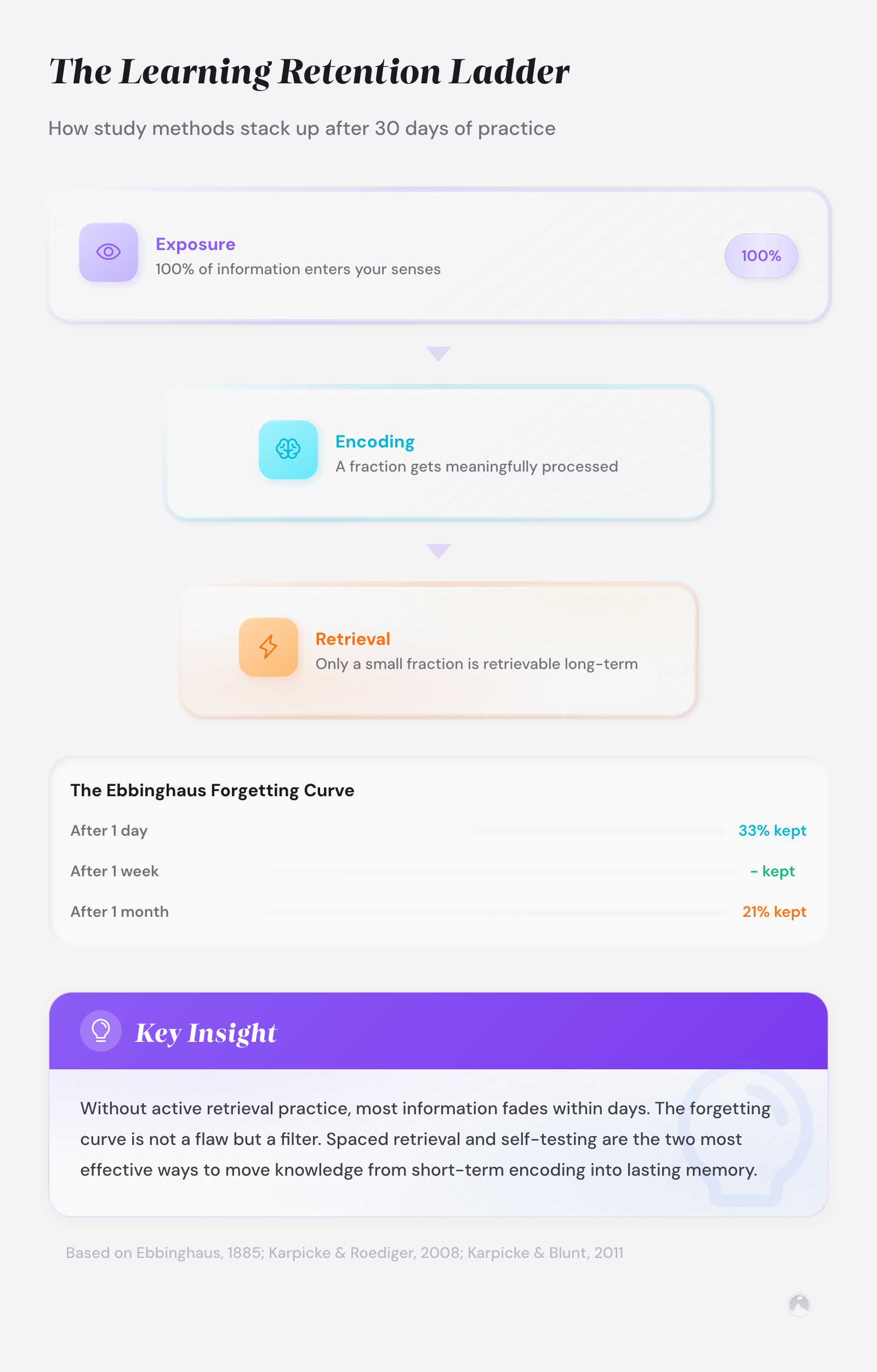
- Ebbinghaus’s forgetting curve shows learners retain roughly 30-40% of new material after one day without active recall [3].
- Spaced repetition and retrieval practice produce substantially better retention than passive re-reading [4].
- Workplace learning and development studies show continuous learners report higher job satisfaction and engagement [5].
- Habit formation research finds learning routines solidify around 66 days of consistent practice, not the 21-day myth [6].
- The Learning Retention Ladder identifies five tiers of engagement that predict how much knowledge you keep.
- Effective continuous learning depends on how you study, not how many courses you finish.
What does neuroplasticity research say about adult learning?
The idea that your brain is mostly “set” by your mid-twenties persists in popular culture. And it’s wrong.
Neuroplasticity and skill acquisition research over the past two decades has demonstrated that the adult brain continues forming new synaptic connections in response to learning stimuli throughout the lifespan. The changes are slower than in childhood, but they’re real and measurable. This is one reason why a growth mindset grounded in neuroscience – not just positive thinking – matters for adults at any stage.
Yaakov Stern’s research on cognitive reserve, published in The Lancet Neurology, shows that continuous learning builds what neuroscience calls a buffer of extra neural connections that protects brain function as we age [2]. People who maintain learning habits throughout life can sustain more brain aging before experiencing cognitive decline. In practice, each time you learn something new at 45 or 60 or 75, you’re building a neural safety net.
The practical implication is counterintuitive. Learning a new skill at 45 isn’t just nice to have for career purposes. The personal development strategies that include regular skill acquisition may be doing something more fundamental – actively maintaining the brain’s ability to process, adapt, and recover. **The cognitive benefits of ongoing education aren’t a bonus. They’re the main event.**
But there’s a catch that the optimistic headlines about neuroplasticity leave out. The type of learning matters enormously. Passive content consumption – scrolling through articles, half-watching a tutorial – doesn’t trigger the same neuroplastic response as active, effortful learning.
Karpicke and Roediger’s research on retrieval difficulty shows that your brain must work to pull information from memory for lasting neural changes to occur [7]. Material that feels easy probably isn’t building new connections. Flow researcher Mihaly Csikszentmihalyi described this as the optimal challenge zone – challenging enough to require effort but not so frustrating that you disengage [8].
Why does most learning vanish within a week?
Hermann Ebbinghaus mapped the forgetting curve in his foundational 1885 research on memory, and modern studies have confirmed his core finding with depressing consistency. Without active recall, learners retain roughly 30-40% of new material after one day and 20-25% after a week [3]. The exact percentages vary by material complexity, but the directional pattern is consistent across the literature. And the curve is steep, predictable, and indifferent to how motivated you felt during the learning session.
This is the gap between learning and knowledge retention in continuous education that the research keeps circling back to. You can complete a course, take notes, and feel the pleasant glow of having learned something new. A month later, you’ll struggle to recall the key points.
The solution isn’t more studying. It’s studying differently.
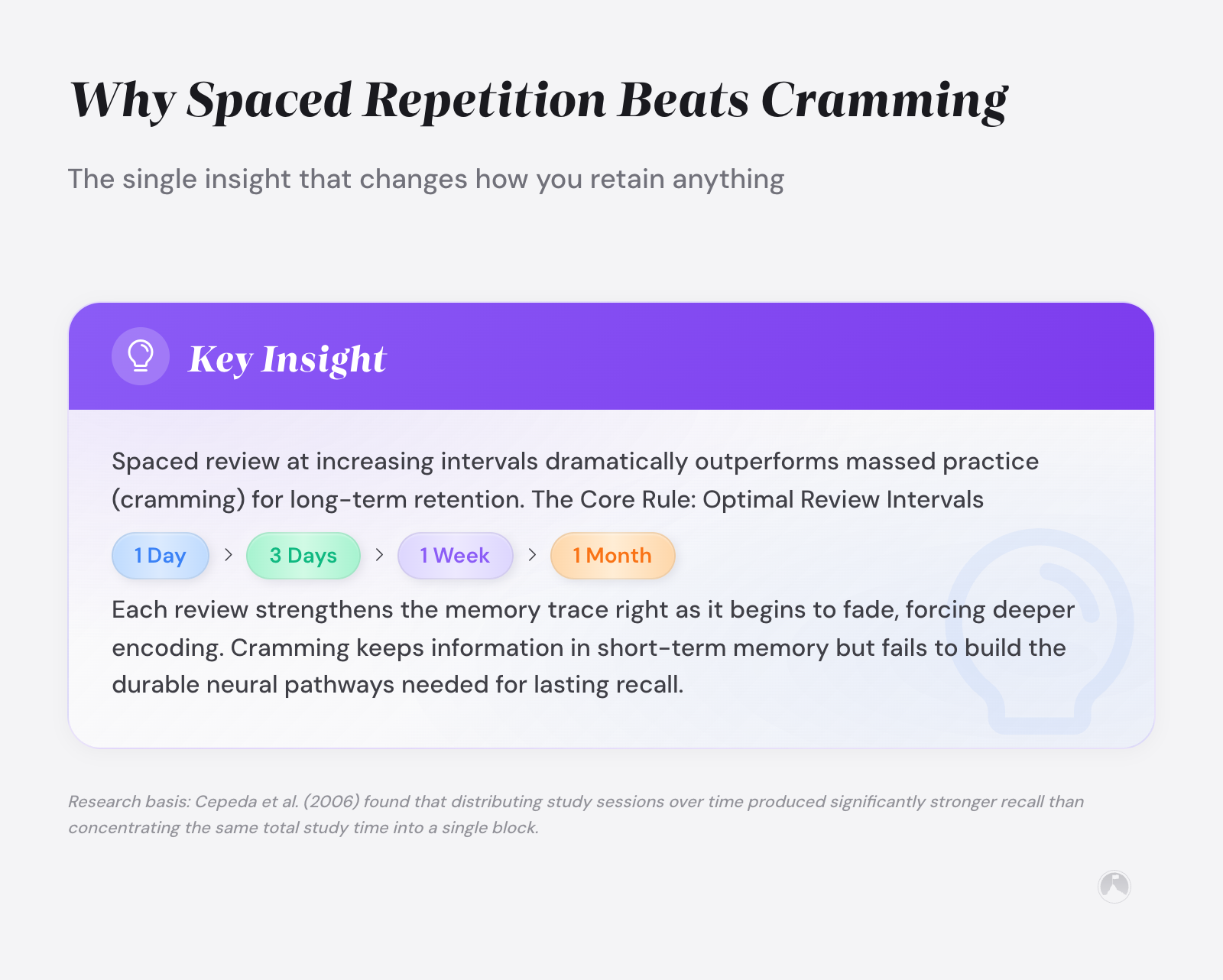
Karpicke and Blunt’s research, published in Science, demonstrated that retrieval practice – actively pulling information from memory rather than re-reading it – produced significantly greater retention than elaborative studying with concept maps, with a large effect size [9]. Cepeda and colleagues’ meta-analysis of 317 studies then documented the spacing effect: distributing practice over time produces substantially better retention than massing it into a single session, with optimal spacing intervals depending on the desired retention period [4]. Ebbinghaus identified the problem. Modern cognitive science identified the fix.
**If you don’t force yourself to recall it, your brain decides you don’t need it.** This is why people who read 50 books a year sometimes can’t summarize five of them. Reading without retrieval is entertainment, not education.
The learning retention ladder
The Learning Retention Ladder organizes learning activities by their retention impact. The idea is simple: the more active your engagement with material, the higher you climb on the ladder and the more you retain.
| Tier | Activity | Retention impact | Why it works |
|---|---|---|---|
| 1 (lowest) | Passive reading or listening | Weakest | No retrieval demand; brain encodes weakly |
| 2 | Highlighting and note-taking | Low | Minimal processing; creates illusion of learning |
| 3 | Summarizing in your own words | Moderate | Requires reformulation; activates deeper encoding |
| 4 | Teaching or explaining to someone | High | Forces complete retrieval and gap identification |
| 5 (highest) | Spaced retrieval practice with application | Highest | Combines recall, spacing, and real-world use |
The Learning Retention Ladder demonstrates that active retrieval methods (Tiers 4-5) produce measurably stronger long-term retention than passive exposure methods (Tiers 1-2), a pattern consistently supported by cognitive science research [10].
The hierarchy draws from Edgar Dale’s Cone of Learning from the 1940s, though the specific percentage estimates Dale’s framework assigned to each tier have not been validated in modern peer-reviewed research. What the evidence does confirm is the ranking itself. Soderstrom and Bjork’s meta-analysis of learning versus performance research supports the principle that active retrieval activities produce measurably stronger long-term retention than passive exposure [10]. The question isn’t whether the hierarchy is real – it’s how far apart the tiers actually are.
Most professional development programs live at Tiers 1 and 2. Most effective learners operate at Tiers 4 and 5. The ladder isn’t a value judgment – sometimes passive reading is the right move. **But if your goal is retention, knowing which tier you’re on tells you whether you’re learning or browsing.**
Does continuous learning actually improve career outcomes?
The career argument for continuous learning gets thrown around casually. Stay competitive. Upskill or get left behind. But what do workplace learning and development studies show?
According to Edwards’s research in Industry and Higher Education, organizations with active learning cultures reported higher employee engagement, greater job satisfaction, and improved knowledge retention [5]. The benefits extended beyond the individual learner to affect team-level innovation and adaptability.
AARP’s 2021 survey of over 1,500 Americans age 45 and older found that 55% actively pursue continuous learning, with cognitive maintenance cited more often than career advancement as their primary motivation [11]. The National Academies’ 2015 report on cognitive aging confirms this pattern – the drive to sustain cognitive function is a major factor in ongoing education across the lifespan [12].
According to Edwards’s research in Industry and Higher Education, organizations with active continuous learning cultures report measurable gains in innovation, adaptability, and employee job satisfaction [5].
So the lifelong learning benefits research shows career gains are real, but they’re secondary effects of a more fundamental process: maintaining your brain’s adaptability. People who learn continuously don’t simply know more. They adapt faster when their industry shifts, recover from setbacks with more flexibility, and report higher satisfaction with their work.
The skill obsolescence data adds urgency. The World Economic Forum’s Future of Jobs Report documents that in fast-moving technical fields like software and data science, skills have a half-life of 18 months to three years – meaning half of what you learned becomes outdated in that timeframe [13]. In more stable industries, this extends to five years, but the trend is consistent.
The same neuroplasticity that protects cognitive function also equips you to keep pace with that rate of change, but only if you’re practicing at the Learning Retention Ladder’s Tier 3 or above. **Continuous learning isn’t a career strategy. It’s career insurance.**
When does the research on continuous learning fall short?
The evidence for continuous learning is strong. But it isn’t a magic solution, and the research has limitations worth acknowledging.
First, most studies on lifelong learning benefits are correlational. People who engage in continuous learning tend to have higher wellbeing and slower cognitive decline. But the same people who choose to keep learning may also be more financially secure, more socially connected, and more health-conscious. Disentangling the effect of learning from these confounding factors is genuinely difficult.
Second, there’s a real risk of what researchers call the “more is better” fallacy. Consuming more courses, more podcasts, and more books doesn’t linearly translate into more growth. Growth mindset and learning agility research suggests that the quality of engagement matters more than volume – a principle that the self-improvement industry routinely ignores when selling you the next certification.
Third, the research on formal versus informal learning effectiveness is messier than either camp wants to admit. Structured courses provide accountability and credentialing. Self-paced learning provides relevance and flexibility. Neither consistently outperforms the other across all contexts.
The honest synthesis: continuous learning research and science points strongly toward learning being protective for cognitive health, positive for career outcomes, and dependent on strategy for actual knowledge retention. It does not support the claim that any learning activity is equally valuable, or that more consumption equals more development. **The research is clear about what works. It’s also clear about what doesn’t count.**
How does continuous learning become a sustainable habit?
Knowing that learning works is different from making it stick. So where do most people stall? In the gap between “I should learn more” and doing it consistently.
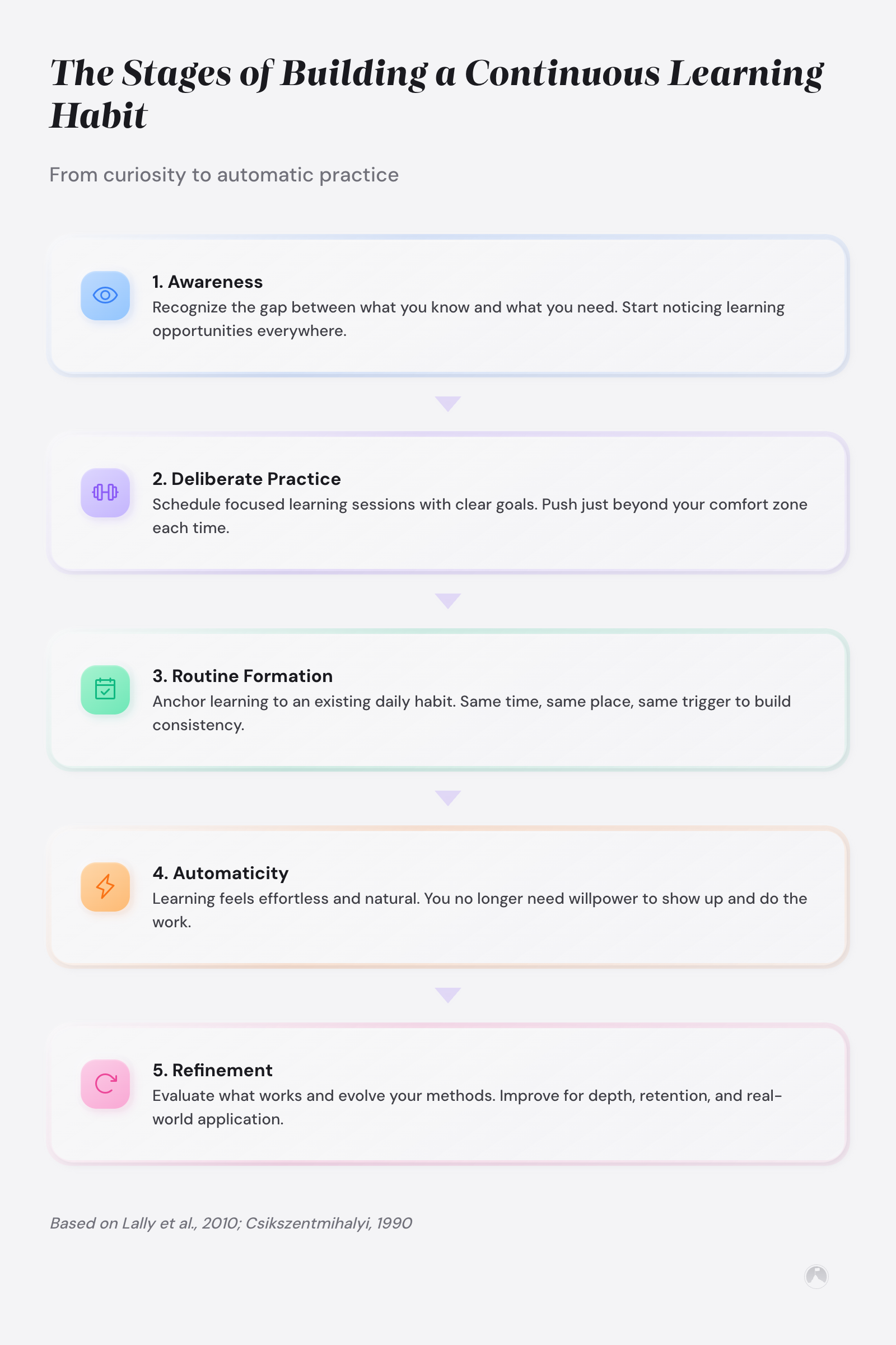
Lally and colleagues’ habit formation research found that new behaviors take a median of 66 days to become automatic – not the 21 days that pop psychology insists on [6]. For a learning habit specifically, environmental cues and consistent timing were stronger predictors of habit formation than motivation or willpower. Translation: picking a fixed time and place for your learning practice matters more than feeling inspired to do it.
Lally and colleagues found that habit formation reaches automaticity at a median of 66 days, with environmental cues and routine consistency predicting success more reliably than motivation [6].
Adult learning theory applications in practice
Adult learning researcher Malcolm Knowles established the principles of andragogy – the study of how adults learn differently from children [14]. Adults learn best when the material connects to problems they’re currently facing, when they control the pace and direction, and when they can immediately apply what they’ve learned. Dunlosky and colleagues’ meta-analysis of learning techniques confirms that application to real-world problems significantly improves retention compared to abstract study [15]. This is why corporate training disconnected from actual work often fails to transfer – and why the best adult learning theory applications center on real problems, not abstract curricula.
Here’s what that looks like in practice. A marketing manager who reads about A/B testing theory retains almost nothing after a month. But the same manager who reads about A/B testing while actively running a campaign – and tests herself on the key principles each Friday – retains most of it six months later.
The difference isn’t intelligence. It’s Tier 5 versus Tier 1 on the Learning Retention Ladder. (If you want to build this kind of practice into your routine, the kaizen approach to personal productivity applies the same incremental logic to daily learning.)
A useful three-sentence recall template (that takes about 90 seconds after any learning session):
Three-sentence recall template
- Close the source material completely.
- Write three sentences from memory: (1) What was the main idea? (2) What surprised me? (3) How does this connect to something I already know?
- Check yourself against the source. Correct any gaps.
**The most effective continuous learning system is one where you study something you need this week, recall it actively over the next month, and teach it to someone within 90 days.** That single sentence synthesizes more of the research than most entire personal development books on the subject.
Ramon’s take on the research
My brain apparently kept growing past 25, which is great news, except nobody told my study habits. I’m still out here reading things once and hoping they stick. Does anyone actually do the spaced repetition thing consistently, or is it just me?
What the continuous learning research means
Continuous learning research and science tells a more specific story than most people expect. The cognitive benefits of ongoing education are real – protective for cognitive health, positive for career outcomes, and dependent on active retrieval for actual retention. Neuroplasticity keeps the door open for skill acquisition at any age – but the forgetting curve closes that door fast without deliberate recall practice. And if you want to build a daily learning habit that actually sticks, the 66-day window and fixed-time approach give you a concrete starting framework.
The question isn’t whether to keep learning. It’s whether what you call learning qualifies as learning at all.
In the next 10 minutes
- Pick one thing you read today – this article counts – and write three sentences about it from memory without looking back.
- Check where your current learning sits on the Learning Retention Ladder. If it’s Tier 1 or 2, choose one strategy to move up one tier this week.
This week
- Set a fixed 20-minute block for focused learning at the same time each day. The consistency matters more than the duration.
- Try the three-sentence recall technique after one learning session. Close the material and write what you remember.
- Identify one concept from your current work that you could teach to a colleague. Teaching forces Tier 4 retrieval.
Related articles in this guide
- finding-a-mentor-and-coaching-guide
- how-to-create-a-personal-development-plan
- how-to-master-the-grow-framework-a-step-by-step-guide-for-real-results
References
[1] Narushima, M., Liu, J., & Diestelkamp, N. (2018). “Lifelong learning in active ageing discourse: its conserving effect on wellbeing, health, and vulnerability.” Ageing and Society, 38(4), 651-673. https://pmc.ncbi.nlm.nih.gov/articles/PMC5848758/
[2] Stern, Y. (2012). “Cognitive reserve in ageing and Alzheimer’s disease.” The Lancet Neurology, 11(11), 1006-1012. https://doi.org/10.1016/S1474-4422(12)70191-6
[3] Ebbinghaus, H. (1885). Memory: A Contribution to Experimental Psychology. (H.A. Ruger & C.E. Bussenius, Trans.). Teachers College Press. https://doi.org/10.1037/h0092553
[4] Cepeda, N. J., Pashler, H., Vul, E., Wixted, J. T., & Rohrer, D. (2006). “Distributed practice in verbal recall tasks: a review and quantitative synthesis.” Psychological Bulletin, 132(3), 354-380. https://doi.org/10.1037/0033-2909.132.3.354
[5] Edwards, R. (2018). “The importance of continuous learning for innovation, progression and survival.” Industry and Higher Education, 32(1), 22-28. https://journals.sagepub.com/doi/full/10.1177/0266382118762967
[6] Lally, P., van Jaarsveld, C. H. M., Potts, H. W. W., & Wardle, J. (2010). “How are habits formed: modelling habit formation in the real world.” European Journal of Social Psychology, 40(6), 998-1009. https://doi.org/10.1002/ejsp.674
[7] Karpicke, J. D., & Roediger, H. L. (2008). “The critical importance of retrieval for learning.” Science, 319(5865), 966-968. https://doi.org/10.1126/science.1152408
[8] Csikszentmihalyi, M. (1990). Flow: The Psychology of Optimal Experience. Harper & Row.
[9] Karpicke, J. D., & Blunt, J. R. (2011). “Retrieval practice produces more learning than elaborative studying with concept mapping.” Science, 331(6018), 772-775. https://doi.org/10.1126/science.1199327
[10] Soderstrom, N. C., & Bjork, R. A. (2015). “Learning versus performance: an integrative review.” Perspectives on Psychological Science, 10(2), 176-199. https://doi.org/10.1177/1745691615569000
[11] AARP & Research Strategy Group. (2022). “Lifelong learning among 45+ adults.” AARP Public Policy Institute. https://www.aarp.org/pri/topics/social-leisure/activities-interests/lifelong-learning-older-adults/
[12] Institute of Medicine. (2015). Cognitive Aging: Progress in Understanding and Opportunities for Action. The National Academies Press. https://doi.org/10.17226/21693
[13] World Economic Forum. (2020). The Future of Jobs Report 2020. https://www.weforum.org/reports/the-future-of-jobs-report-2020/
[14] Knowles, M. S., Holton, E. F., & Swanson, R. A. (2015). The Adult Learner: The Definitive Classic in Adult Education and Human Resource Development (8th ed.). Routledge.
[15] Dunlosky, J., Rawson, K. A., Marsh, E. J., Nathan, M. J., & Willingham, D. T. (2013). “Improving students’ learning with effective learning techniques: promising directions from cognitive and educational psychology.” Psychological Science in the Public Interest, 14(1), 4-58. https://doi.org/10.1177/1529100612453266