
Why career planning tools and frameworks matter more than you think
Many people drift through their careers the same way they drift away from gym memberships – not from laziness, but from trying to improve without a system. Career planning tools and frameworks exist to close that gap between intention and action. Rather than vague aspirations about “moving up,” these tools create the scaffolding for assessment, progress tracking, and structured decision-making.
Career planning tools and frameworks are structured systems that help professionals assess current skills, map progression routes, and track development over time. They include assessment platforms like CliftonStrengths and LinkedIn Career Explorer, pathing models like career ladders and lattices, and goal-setting methods like SMART goals and OKRs.
So the question isn’t whether you need a system. It’s which one fits your current situation. Should you develop new skills or deepen existing ones? Are you aiming for management or do you want to stay technical? Can your current organization support your progression, or do you need to look elsewhere?
Without a framework, these questions linger as background anxiety instead of becoming clear decision points. And that’s where most people get stuck – not because they lack ambition, but because they lack structure. The difference between professionals who advance and those who stagnate rarely comes down to talent – it comes down to systems.
Career planning tools and frameworks are systems – sometimes proprietary assessments, sometimes strategic models, sometimes software platforms – that bring structure to the process of defining where you’re going and measuring whether you’re getting there. They differ in depth, cost, accessibility, and whether they’re meant for self-directed use or organizational implementation.
A 2022 systematic review by Soares and colleagues, analyzing 26 career intervention studies, found that structured career planning tools improve career decision-making, self-efficacy, and reduce career anxiety. Interventions incorporating written exercises, individualized feedback, and goal-setting produced the strongest outcomes [1].
The right tool depends entirely on your current position, your constraints, and your definition of career success. But all effective systems share three things: they help you assess where you are, they show you where you’re going, and they let you measure progress. Without assessment, direction, and progress measurement, you’re not planning – you’re just hoping.
What you will learn
- How the dual-track career model is reshaping career planning across industries
- The best career assessment tools that provide actionable insights versus entertainment-grade personality quizzes
- The difference between career ladders and career lattices and when each career pathing framework fits your situation
- How to measure progress without creating a tracking burden
- Which professional development assessment platforms work for self-directed planning versus those requiring organizational support
Key takeaways
- Career planning tools serve three functions: assessment, pathing, and tracking.
- The dual-track model (management vs IC) is now standard at companies like Amazon, Buffer, and Spotify.
- Competency assessments identify specific skill gaps; personality tests reveal work-style preferences. Pairing both gives you a development roadmap, not just a label.
- Career lattices allow lateral moves alongside vertical advancement, matching how modern work progresses.
- The 70-20-10 framework: development comes from challenging experiences (70%), mentorship (20%), formal training (10%).
- Career development systems need 3-6 months minimum to show real momentum.
- A quarterly career review you actually complete outperforms a sophisticated competency platform you abandon after month two.
- Quarterly reviews work for tracking career development without missing drift.
1. The dual-track career framework
The dual-track career model is a career progression system that creates two parallel advancement paths – management and individual contributor (IC) – with equivalent compensation, status, and growth opportunities at each level. It differs from traditional single-track models where management is the only route to senior roles.
Before exploring specific tools, you need a foundational lens for evaluating them: the dual-track model. This framework recognizes that career progression doesn’t mean one path anymore. You can advance into management, or you can go deeper into individual contributor (IC) roles as a senior engineer, lead researcher, principal designer, or architect. Both tracks offer advancement, compensation growth, and status – but they require different skill development, different mentorship patterns, and different success metrics.
Research on career promotion decisions shows that promoting top performers into management without regard for management aptitude can reduce team performance. Benson, Li, and Shue’s 2019 study of 53,035 sales workers found that firms systematically promote the best salespeople into management, despite sales performance being a poor predictor of managerial ability [2]. Dual-track systems address this by allowing technical experts to advance into principal or staff-level roles while others advance into management. Companies publishing dual-track frameworks are associated with higher engagement when employees can choose their advancement path.
Amazon’s publicly documented career framework, for instance, lets individual contributors progress from SDE I through Distinguished Engineer (L4-L10) with compensation equivalent to the management track at each level [3]. Buffer’s published career framework takes it a step further, letting engineers move horizontally into management and then back to IC roles without status or compensation loss [4]. If you’re thinking about the psychology behind career development decisions, the dual-track model explains why “stuck” often means wrong track, not wrong talent.
You’re not stuck – you’re either on the wrong track for your strengths, or you haven’t built the specific competencies that track requires.
2. Skills assessment for career planning: know your starting point
Self-awareness is free, but self-assessment is often wrong. You overestimate soft skills and underestimate technical gaps. Or you see yourself as better at execution than you actually are (most of us do). The best career planning starts with an honest assessment of where you actually are, not where you think you are.
Modern skills assessment tools fall into two categories: personality-based and competency-based. Career development experts distinguish these clearly – personality assessments map behavioral preferences and career fit, while competency assessments identify specific skill gaps against job requirements [5]. The older generation (Myers-Briggs, DISC, StrengthsFinder) map your type or strengths. They’re useful for understanding how you prefer to work, but they don’t tell you what skills you’re missing for your target role.
Competency-based tools like LinkedIn’s Career Explorer map individual skills against over 36,000 documented skills and 6,000+ job titles, providing data-driven identification of skill gaps and learning recommendations matched to actual job market demand [6]. Zavvy’s competency platform uses 360-degree feedback and skills assessments to map current capabilities against requirements for target roles [7].
The difference between entertainment-grade personality assessment and career-planning-grade skill assessment comes down to one word: actionability. A personality quiz tells you “You’re a Strategist type.” A competency assessment tells you “You’re strong in problem-solving but need development in systems thinking, cross-functional communication, and data literacy to reach Principal level.” One is identity affirmation. The other is a development roadmap.
For individual use, tools like myIDP (developed by AAAS for STEM researchers, free) walk users through self-assessment, career exploration matched to their profile, goal-setting, and implementation planning [8]. ImaginePhD serves a similar purpose for humanities and social science PhD students (also free), matching profiles to job families across sectors with built-in mentor check-ins [9]. CliftonStrengths offers a top-5 strengths assessment for $24.99 or the full 34-strengths profile for $59.99 [14]. And that distinction matters: myIDP is built for STEM, ImaginePhD for humanities. Picking the right one depends on your field.
3. Career pathing frameworks: map the route
Once you understand where you are and which track you’re on, you need to map the route. A career pathing framework shows how progression actually works in your field – what skills matter at each level, what transitions are possible, and what the typical timeline looks like. This is where career planning tools and frameworks move from theory into action.
Career pathing frameworks come in three architecture types: vertical ladders (junior to senior to principal), career lattices (lateral moves across functions alongside vertical advancement), and dual-track paths (management and technical expertise as equal advancement routes). The type you use shapes every development decision that follows.
The vertical ladder was the standard for decades: each step is a promotion. But the career lattice lets people move laterally – stepping into different functions, then up within that function. Buffer’s engineering career framework demonstrates this in practice, letting a developer move into project management, or a manager move back into an individual contributor role without it counting as a demotion [4].
Most organizations don’t publish their career frameworks, which creates the feeling that progression is mysterious and political. When frameworks are public, people stop guessing and start planning. Medium’s engineering growth framework breaks down specific competencies expected at each level and encourages personalized growth plans reviewed every 6 weeks [10]. Spotify’s career steps framework emphasizes progression based on impact and knowledge depth, explicitly allowing lateral and backwards movement as part of development [11].
If your organization doesn’t have a published framework (most don’t), you can reverse-engineer one. GitLab’s open-source handbook provides detailed career frameworks by discipline, breaking down specific technical and behavioral competencies for each career level [12]. Even if you don’t work there, studying published frameworks gives you a realistic map for strategic career planning.
Public frameworks turn career anxiety into career planning. If you can see the criteria, you can meet the criteria.
4. Competency-based career frameworks: define what success looks like
A competency-based career framework breaks down each role into specific, measurable capabilities – technical skills, behavioral competencies, and knowledge areas – so professionals can identify exact gaps between where they are and where they want to be. Beyond pathing (what the progression looks like), competency definition tells you what you actually have to do and know at each level.
Rather than thinking “I need to become a better leader,” a competency framework says “For a senior manager role, you need demonstrated competency in:”
- Conflict resolution in high-stakes situations
- Systems thinking across three-plus departments
- Executive communication
- Strategic planning with 12-plus month horizons
Korn Ferry’s Leadership Architect framework maps 38 defined leadership competencies to specific role requirements, allowing professionals to see exact gaps between current capabilities and target role expectations [13]. The assessment includes targeted development guides for each competency, making career advancement more systematic. Korn Ferry operates on enterprise pricing with no self-serve option for individuals. Gallup’s CliftonStrengths assessment ($24.99 for top 5, $59.99 for full 34) now includes career compatibility mapping, linking individual strengths to roles where those strengths drive performance [14].
Korn Ferry’s research on the Leadership Architect framework found that professionals who map specific competency gaps to targeted development activities advance more predictably than those pursuing general self-improvement [13]. The framework identifies 38 leadership competencies, each with measurable behavioral indicators.
The practical value is enormous. Instead of vague self-improvement, you can say “I’m working on building executive communication skills by leading quarterly town halls and presenting strategy to the board.” That’s measurable. That’s directional. Mapping specific competency gaps to targeted development activities is not just ambition – it’s a system.
5. The 70-20-10 learning framework: structured development strategy
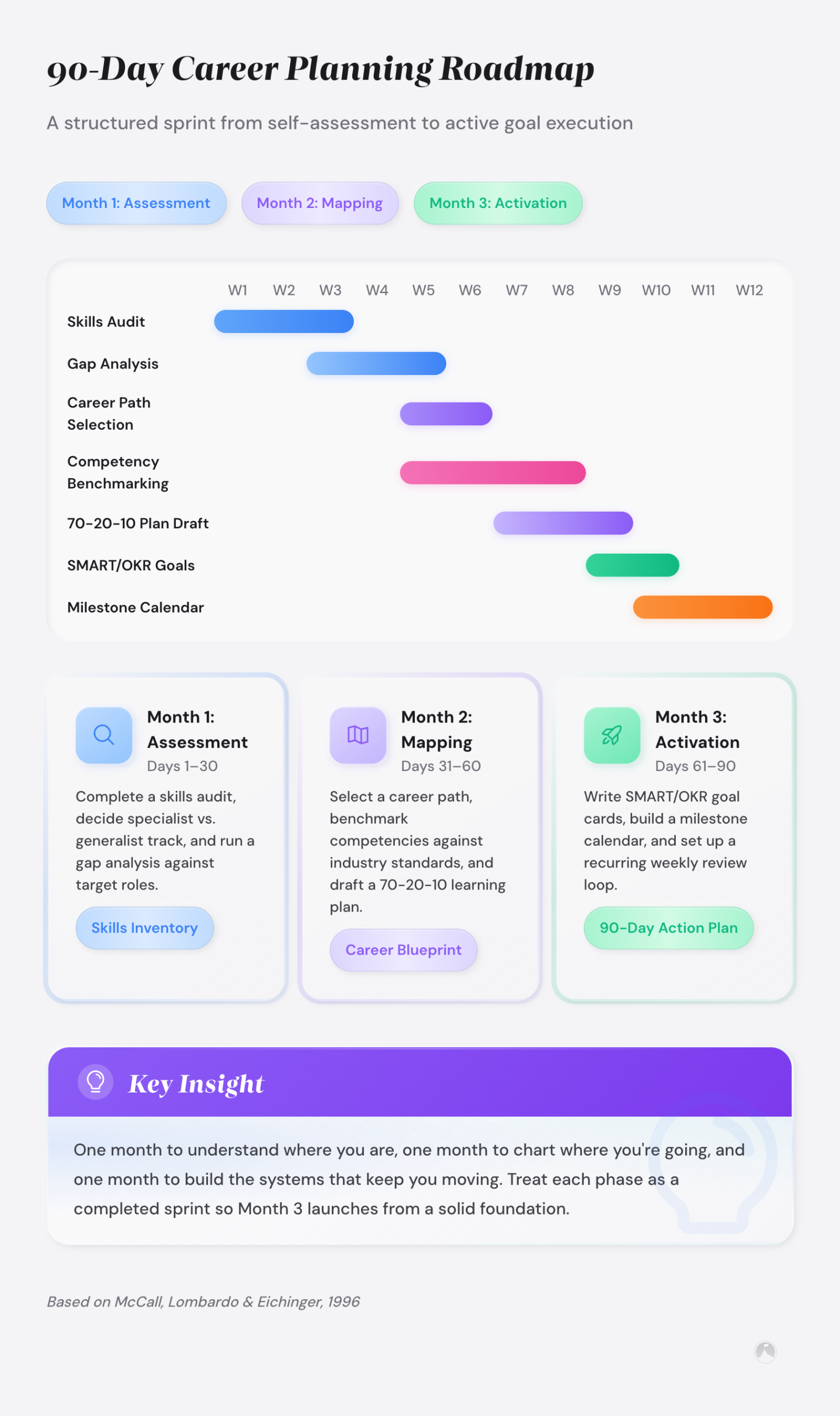
The 70-20-10 framework describes how professional competence actually develops: roughly 70% from challenging work experiences, 20% from mentorship and peer learning, and 10% from formal training. Most people try to learn through formal training alone, but courses account for only about 10% of how competency actually develops. McCall, Lombardo, and Eichinger’s foundational 1996 research identified this distribution through retrospective interviews with nearly 200 senior executives [15].
One important note: this framework originated from retrospective interviews, not from controlled experimental studies [15]. So the specific percentages are directional rather than precise. But the core insight holds across decades of follow-up research – the bulk of professional development happens through doing, not through courses.
This changes how you approach development. If your current role has plateaued in difficulty, you’re not getting the 70% learning component. That’s why people who move between roles faster often advance faster – each transition provides challenging-work learning. And if you don’t have access to mentorship or peer learning in your organization, you’re limited to the 10% from training alone. This is why networking becomes a career development tool, not just a professional nicety.
It also explains why bootcamp graduates and fresh MBAs sometimes struggle: they’re 100% training, with zero challenging work experience and unclear mentorship. The 70-20-10 framework doesn’t just guide what to learn – it guides where and how to learn it.
6. Goal-setting methods for career planning: SMART, OKR, and milestone-based
Career progression requires goals, but the goals need to align with your chosen path and competency gaps. Three popular frameworks each work differently, and knowing which to pick (or how to combine them) is half the battle.
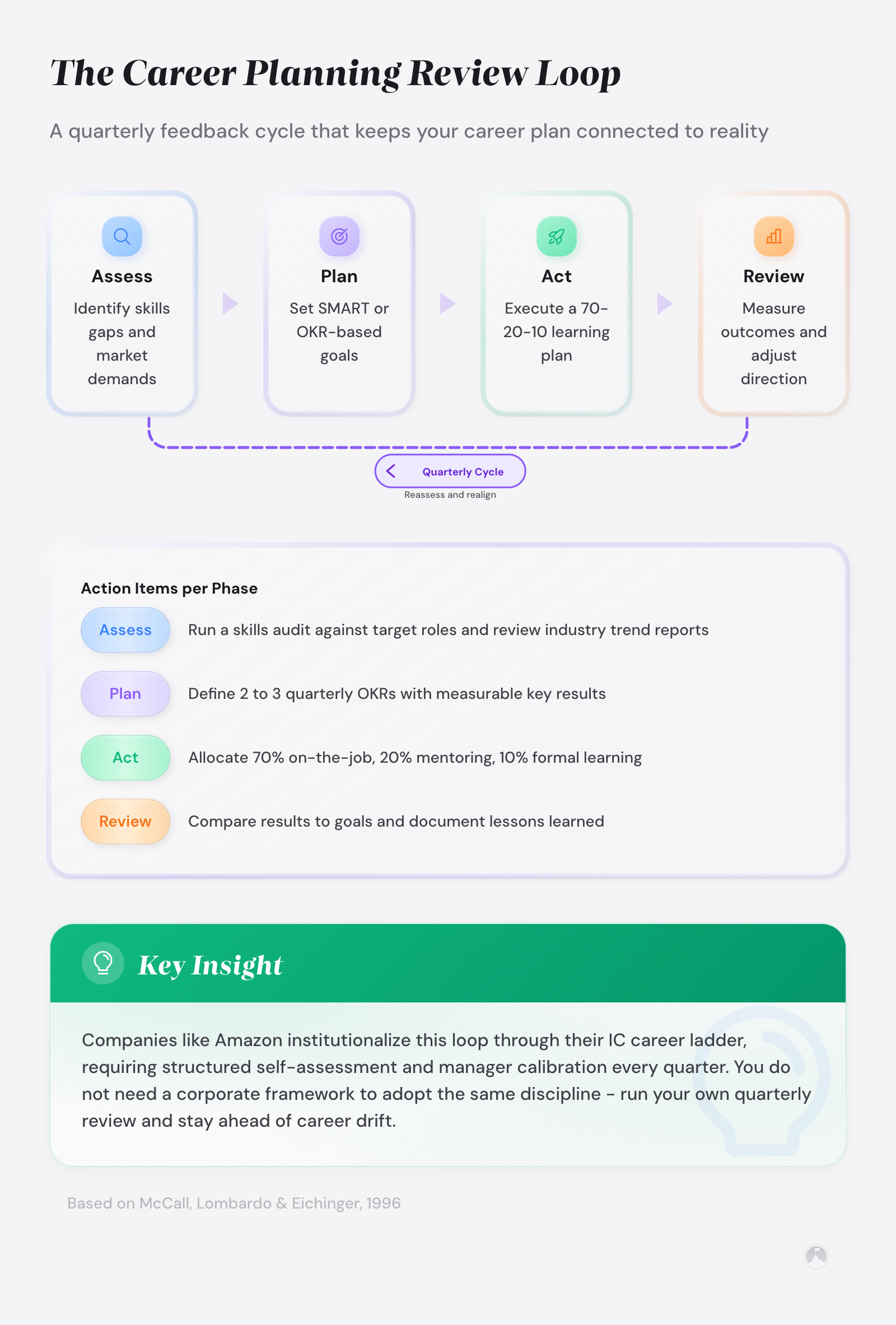
SMART goals (Specific, Measurable, Achievable, Relevant, Time-bound) work well for tangible skills. “Complete the data analytics certification by June 30” is classic SMART. OKRs (Objectives and Key Results) work when you’re aiming for transformation across your role – “Become the point person for data strategy” with key results like “Lead three cross-department data projects” and “Present quarterly data insights to leadership.”
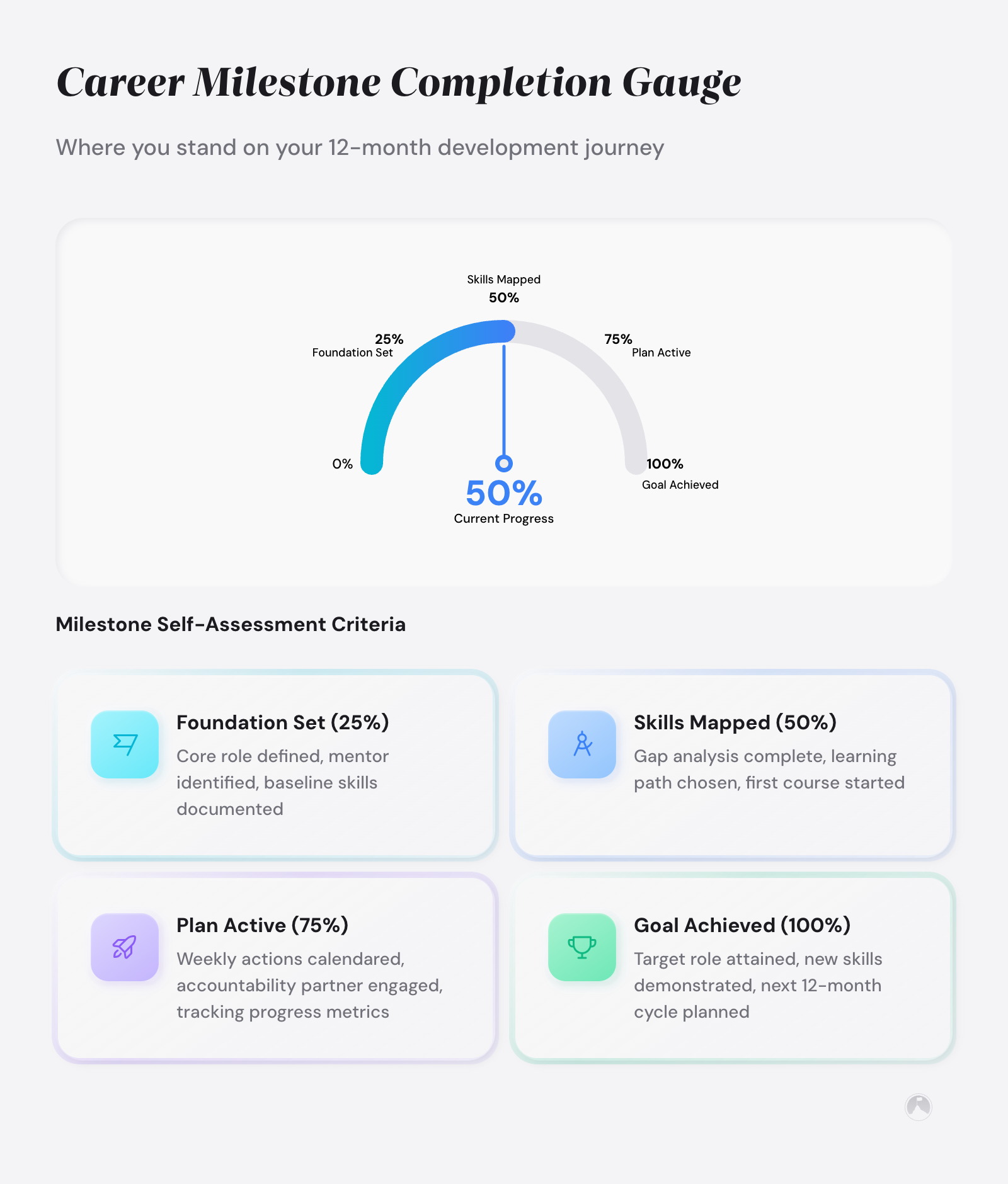
Milestone-based planning works when the timeframe is longer than a quarter but the path isn’t entirely linear. Rather than “By next review, be ready for promotion,” you set milestones like “Month 3: Build expertise in A, Month 6: Lead project in A, Month 9: Mentor others in A, Month 12: Influence strategy around A.” This approach works well for career pivots or deep skill development that takes a year or more.
Most career planning systems now let you mix methods. You might use SMART for learning goals, OKRs for role progression, and milestones for long-term direction. For a deeper look at how to build a career development plan that combines these approaches, the template process walks you through each step.
The flexibility matters because real careers don’t fit one template.
Career planning tools comparison
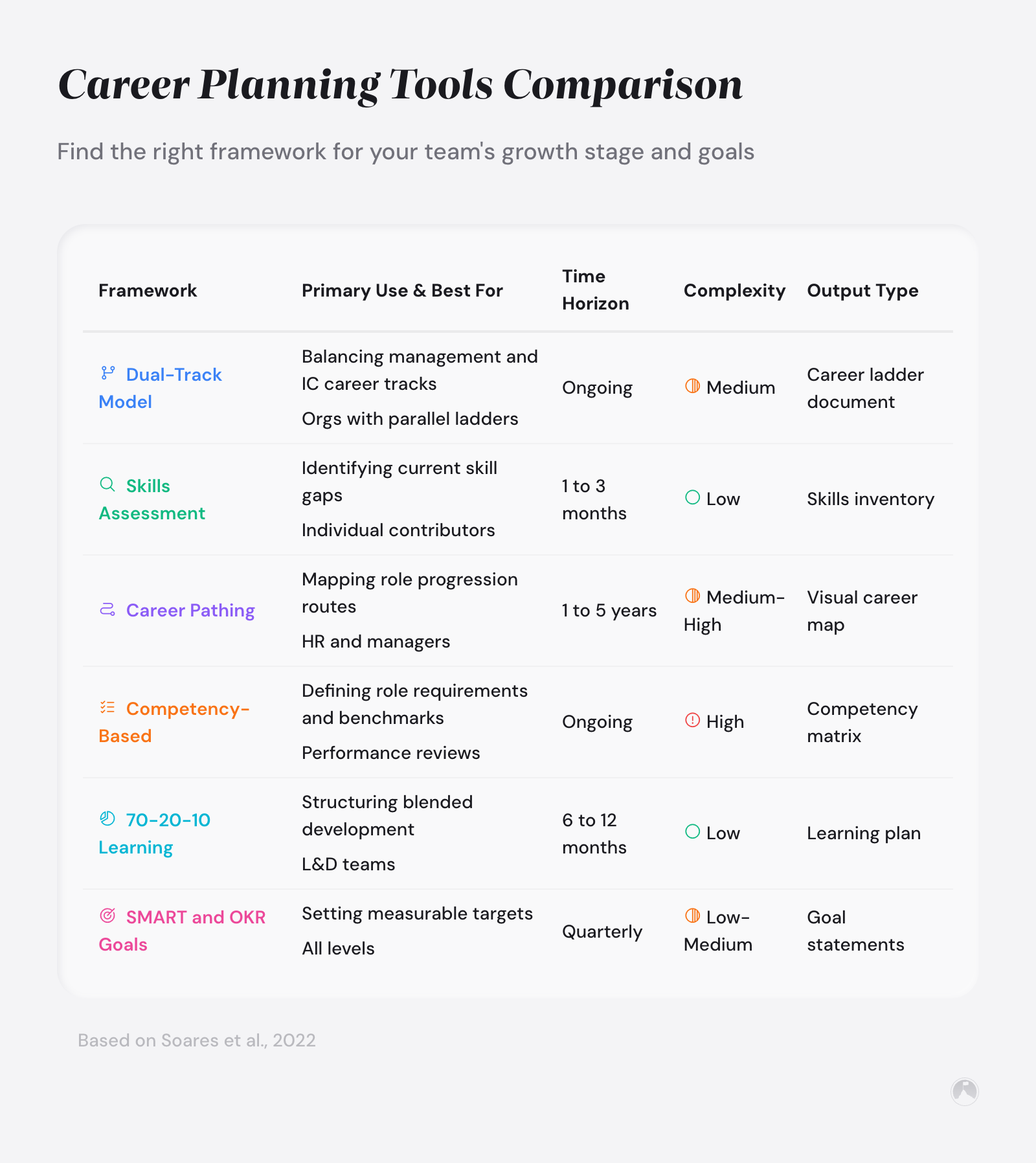
Here’s how the major career planning tools and frameworks compare across the dimensions that actually matter for your decision.
| Framework | Category | Best for |
|---|---|---|
| Dual-track model | Pathing | Anyone choosing between management and IC paths |
| Skills assessment tools (LinkedIn, myIDP) | Assessment | Early career, career changers |
| Career pathing frameworks | Pathing | Mid-career professionals in established organizations |
| Competency frameworks (Korn Ferry, Gallup) | Assessment | Senior professionals targeting specific roles |
| 70-20-10 learning framework | Development | Anyone feeling stuck in formal training |
| SMART goals | Goal-setting | Tangible skill acquisition |
| OKRs | Goal-setting | Role transformation and impact goals |
| Progress tracking (quarterly reviews) | Tracking | Anyone with an active development plan |
Details by framework
Dual-track model | Free | Low time investment (conceptual lens) | Only addresses direction, not skill gaps | Ramon’s verdict: Start here – everything else builds on this decision.
Skills assessment tools (LinkedIn Career Explorer, myIDP) | Free | 1-3 hours for initial assessment | Quality varies widely between tools | Ramon’s verdict: Best ROI for self-directed planners.
Career pathing frameworks | Free (public frameworks) | Medium time investment (research + mapping) | Most organizations don’t publish theirs | Ramon’s verdict: Reverse-engineer from public ones if yours is hidden.
Competency frameworks (Korn Ferry, Gallup) | Enterprise pricing to $59.99 | Medium-high time investment | Can feel bureaucratic without manager support | Ramon’s verdict: Most precise gap analysis available.
70-20-10 learning framework | Free | Low time investment (shifts mindset) | Percentages are directional, not exact | Ramon’s verdict: Changes how you think about development entirely.
SMART goals | Free | Low time investment | Too rigid for career-level goals | Ramon’s verdict: Good for learning goals, weak for career strategy.
OKRs | Free | Medium time investment | Needs organizational context to work well | Ramon’s verdict: Best goal method for career-level ambitions.
Progress tracking (quarterly reviews) | Free | 2-3 hours per quarter | Requires discipline to maintain | Ramon’s verdict: Non-negotiable if you’re serious about progress.
7. Career planning measurement: tracking without burnout
The last piece of a complete system is tracking progress. Many people avoid this because tracking systems feel like overhead. But without it, you don’t know whether your development plan is working or whether you’ve drifted. The key is lightweight tracking – frequent enough to catch problems, light enough to sustain.
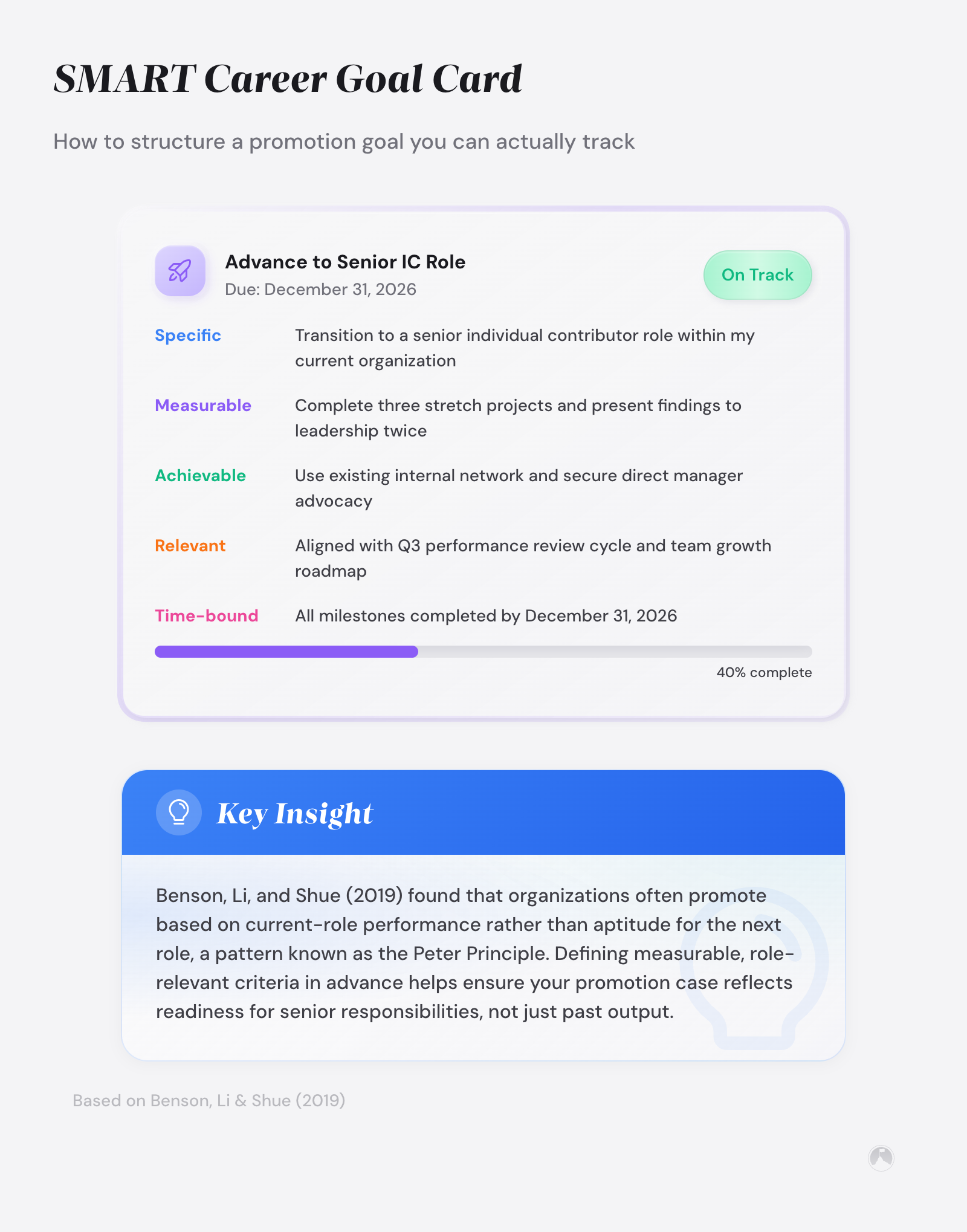
The annual review is too infrequent for career planning purposes. Quarterly reviews work better, especially if structured around your chosen goal-setting method. Some high-growth organizations use more frequent pulse checks – one-on-ones focused explicitly on career progression rather than just current project status.
Tracking tools range from simple (a shared Google Sheet between you and your manager showing milestones and progress) to professional development assessment platforms like 15Five or Lattice that integrate goal-setting, feedback, and reviews. For individual-driven career planning without organizational structure, a quarterly reflection document works well.
Here’s a copy-pasteable quarterly career review template you can start using today:
The psychological benefit of tracking is often underestimated. You notice progress you otherwise miss. You catch derailment early instead of realizing at review time that you’ve drifted. Momentum is the compound interest of career development – small, consistent progress beats sporadic bursts every time.
8. Choosing your career planning tools: a decision framework
With multiple types of tools available, how do you choose? The fit depends on three dimensions: your career stage, your organization’s maturity in supporting career development, and whether you’re planning independently or with organizational structure.
Early career (first three years): Start with skills assessment tools to build self-awareness, combine with mentorship (that critical 20% of your learning), and gain breadth across roles. Career lattice models work well here – you’re exploring, not committing to one path.
Mid-career (years 4-10): Skill assessment moves into gap analysis – what’s stopping your next step? The dual-track decision becomes critical. This is where career pathing frameworks and competency models matter most. Goal-setting shifts to OKRs or milestone-based planning. If you’re working through mid-career growth specifically, the challenges (and solutions) are different from early-career exploration.
Senior-career (10-plus years): Development often focuses on influence, strategic impact, and mentoring others. Competency frameworks emphasize leadership and vision alignment. Tracking becomes less about personal development and more about organizational impact.
If your organization provides structure, use their frameworks, assessments, and tools as your primary input. Supplement with external tools where gaps exist. If you’re planning independently, start with a free self-assessment (LinkedIn Career Explorer, myIDP, or CliftonStrengths), map it to a public career framework in your industry, set quarterly milestones, and track against them.
The most common mistake is tool-jumping – trying six different systems in a year. Career development systems need at least three to six months to show real momentum. Pick one and commit for a quarter minimum before changing direction. The commitment is where most people struggle, not the tool selection itself.
Ramon’s take
Pick the section that felt awkward to read because you recognized yourself in it. That’s your actual starting point. Don’t build a whole system yet. Just deal with that one uncomfortable thing first and see what happens.
Conclusion
Career planning tools and frameworks exist to close the gap between knowing you want to advance and actually advancing. The tool itself isn’t the success factor – your willingness to use it, be honest in your self-assessment, and adjust as you learn is. McCall, Lombardo, and Eichinger’s 70-20-10 framework applies to career planning systems too: 70% of the value comes from your commitment to taking challenging assignments, 20% comes from your mentors and peer learning, and 10% comes from the tool itself [15].
Start with honest self-assessment of where you are and which path calls to you (management or technical depth). Then choose a framework that matches your career stage and organization type. For the full picture on advancing strategically, explore our career growth strategies guide. The tools change. The frameworks evolve. But the principle stays the same: structure converts ambition into progress.
In the next 10 minutes
- Take a free career assessment (LinkedIn Skills Assessment or CliftonStrengths) to identify three current strengths and three gaps.
- Look up one published career framework for your role or target role (try progression.fyi or GitLab’s handbook).
This week
- Draft a career pathing plan: your current level, target level, and one milestone for the next three months.
- Fill out the quarterly career review template above and save it where you’ll see it in 90 days.
- Schedule a conversation with a mentor or peer about what “next level” looks like in your field.
There is more to explore
If you’re weighing different strategic approaches, our comparison of career advancement strategies breaks down what works at each stage. For understanding how to build skills that compound over time, explore skill development strategies. And for leadership-track professionals, see our guide on leadership development frameworks.
Related articles in this guide
- effective-development-goals-planning-achievement
- feeling-stuck-in-career
- networking-for-career-growth
Frequently asked questions
What is the difference between career ladders and career lattices?
Choose a career ladder if your industry has clearly defined, sequential levels with specific credential requirements — law, medicine, or traditional engineering. Choose a career lattice if you work in a fast-changing field where cross-functional skills create more value than deep specialization in one vertical, or if your target role did not exist five years ago.
Are free career assessment tools accurate?
Free personality-based tools (Myers-Briggs type indicators, basic strength assessments) provide useful self-awareness but lack actionable development guidance. Free competency-based tools like LinkedIn Career Explorer and myIDP are more job-market aligned and directly show skill gaps. For career planning purposes, competency-based assessments are more valuable than personality-based ones, even when free.
How often should I track progress on my career development plan?
The right frequency depends on your career velocity. During active transitions — a new role, a pivot, or a promotion stretch — monthly check-ins prevent drift. During stable growth periods, quarterly reviews catch enough without creating overhead. The signal to increase frequency: two consecutive quarters where you cannot name a concrete skill you developed.
Should I follow the dual-track model even if my organization does not support it?
Yes. Understanding the dual-track framework helps you make intentional choices about your career direction even when your organization does not explicitly name both paths. This prevents the assumption that management is the only way to advance and helps you articulate to your manager what kind of advancement you are seeking.
What if my organization does not have a published career framework?
You can reverse-engineer career progression by talking to people at each level in your field and looking at published frameworks from other companies. GitLab, Buffer, and Spotify all publish their frameworks openly. You can also ask your manager for the unofficial progression path since most people in the organization know how advancement actually works even when it is not written down.
What is the 70-20-10 framework and how does it apply to career planning?
Professionals frequently misapply the 70-20-10 framework by treating the percentages as a time allocation formula rather than an insight about where competence actually develops. The framework does not mean you should spend 70% of your work week on stretch assignments. It means that when you look back at what made you capable, roughly 70% of that capability came from challenging experiences, not from any course or certification.
How can I assess my skills for career planning if I have not received formal feedback?
Use a multi-source approach: self-assessment tools like LinkedIn Career Explorer and myIDP, trusted peer feedback through informal conversations, observation of what you do well and what drains you, and comparison against job descriptions for roles you aspire to. Avoid relying solely on self-perception without external validation from at least two other sources.
References
[1] Soares, J., Carvalho, C., Silva, A. D., et al. (2022). “A systematic review on career interventions for university students: Framework, effectiveness, and outcomes.” Australian Journal of Career Development, 31(2), 81-92. Link
[2] Benson, A., Li, D., & Shue, K. (2019). “Promotions and the Peter Principle.” The Quarterly Journal of Economics, 134(4), 2085-2134. DOI
[3] Amazon Software Engineer Career Ladder (IC Track). Aggregated career framework documentation available at: https://progression.fyi/f/amazon
[4] Buffer. “How Individuals Advance at Buffer, Without Becoming Managers” and “Engineering Career Paths Framework.” Link
[5] Toggl (2023). “Competency Assessment: 8 Testing Methods Explained.” Link. See also: University of Arizona Graduate Center (2024). “Leveraging Personality Assessments for Effective Career Planning.” Link
[6] LinkedIn. “Career Explorer Tool.” Link
[7] Zavvy (Deel Engage). “Competency Management Software.” Link
[8] AAAS/Science Career Resources. “myIDP (Individualized Development Plan).” Link
[9] ImaginePhD. “Career Planning Tool for PhD Students and Postdocs.” Link
[10] Medium Engineering Blog. “Engineering Growth Framework Series.” Link
[11] Spotify Engineering Blog. “Spotify Technology Career Steps.” Link
[12] GitLab Handbook. “Engineering Career Development and Career Matrix.” Link
[13] Korn Ferry. “Leadership Architect Global Competency Framework.” Link
[14] Gallup. “CliftonStrengths for Career Development.” Link
[15] McCall, M. W., Lombardo, M. M., & Eichinger, R. W. (1996). “The Career Architect Development Planner.” Center for Creative Leadership. ISBN 978-0-933146-98-6.