
Career growth strategies fail when they ignore your stage
Most career growth strategies fail for one simple reason: they ignore where you are right now. The skill-building playbook that launches an early-career professional into their first management role can actively stall a mid-career professional who needs strategic positioning instead. Gallup’s State of the Global Workplace 2024 report found that only 21% of employees worldwide feel actively engaged in their work, down from 23% the prior year, with the US and Canada performing above average at 33% [1]. Lack of growth opportunity ranks among the top three reasons employees leave their jobs across all regions.
But here’s the thing: your career isn’t broken. The strategy just isn’t matched to your stage. This guide maps the full territory of career growth strategies, organized by where you actually are. Whether you’re building a foundation, breaking through a plateau, shifting into leadership, or pivoting entirely, the strategies here are matched to your reality – not some generic playbook.
Career growth strategies are deliberate, stage-matched actions professionals use to build skills, visibility, relationships, and positioning throughout their careers. The most effective strategies shift as professionals move through early-career, mid-career, senior, and pivot phases, with each stage requiring different priorities and investments to produce measurable forward momentum.
Career growth strategies are intentional, research-informed actions professionals take to increase their skills, visibility, influence, and opportunity access. Unlike career development, which describes lifetime professional learning, career growth strategies focus on stage-appropriate moves that create measurable forward momentum.
What you will learn
- Why career stage determines which growth strategies work and which backfire
- The foundational strategies that accelerate early-career professionals
- How mid-career professionals break through plateaus using strategic positioning
- What senior professionals need for influence expansion and continued growth
- How career pivoters identify transferable skills and build bridges to new industries
- Growth strategies for remote workers, flat organizations, and workforce re-entry
- How to measure career growth when promotions aren’t the only metric
Key takeaways
- Career growth strategies must match your current stage; early-career tactics often backfire at the mid-career level.
- A meta-analysis shows skill-building drives early growth while positioning drives mid-career advancement [2].
- Visibility of accomplishments predicts advancement independent of actual performance quality [6].
- Career growth stalls when professionals over-invest in one Compass dimension and neglect the other three.
- Mid-career growth is less about what you can do and more about what the right people believe you can do next.
- Career pivots succeed when professionals build an identity bridge connecting past experience to future roles.
- Network diversity predicts career advancement more strongly than network size [7].
- Remote workers face significant promotion gaps from proximity bias and need intentional visibility strategies [11].
Why do career growth strategies depend on career stage?
The biggest mistake in career development is applying the wrong strategy at the wrong time. An early-career professional who focuses on “building their personal brand” before establishing core competence is skipping the foundation. A mid-career professional who keeps stacking certifications when their real gap is visibility is solving the wrong problem.
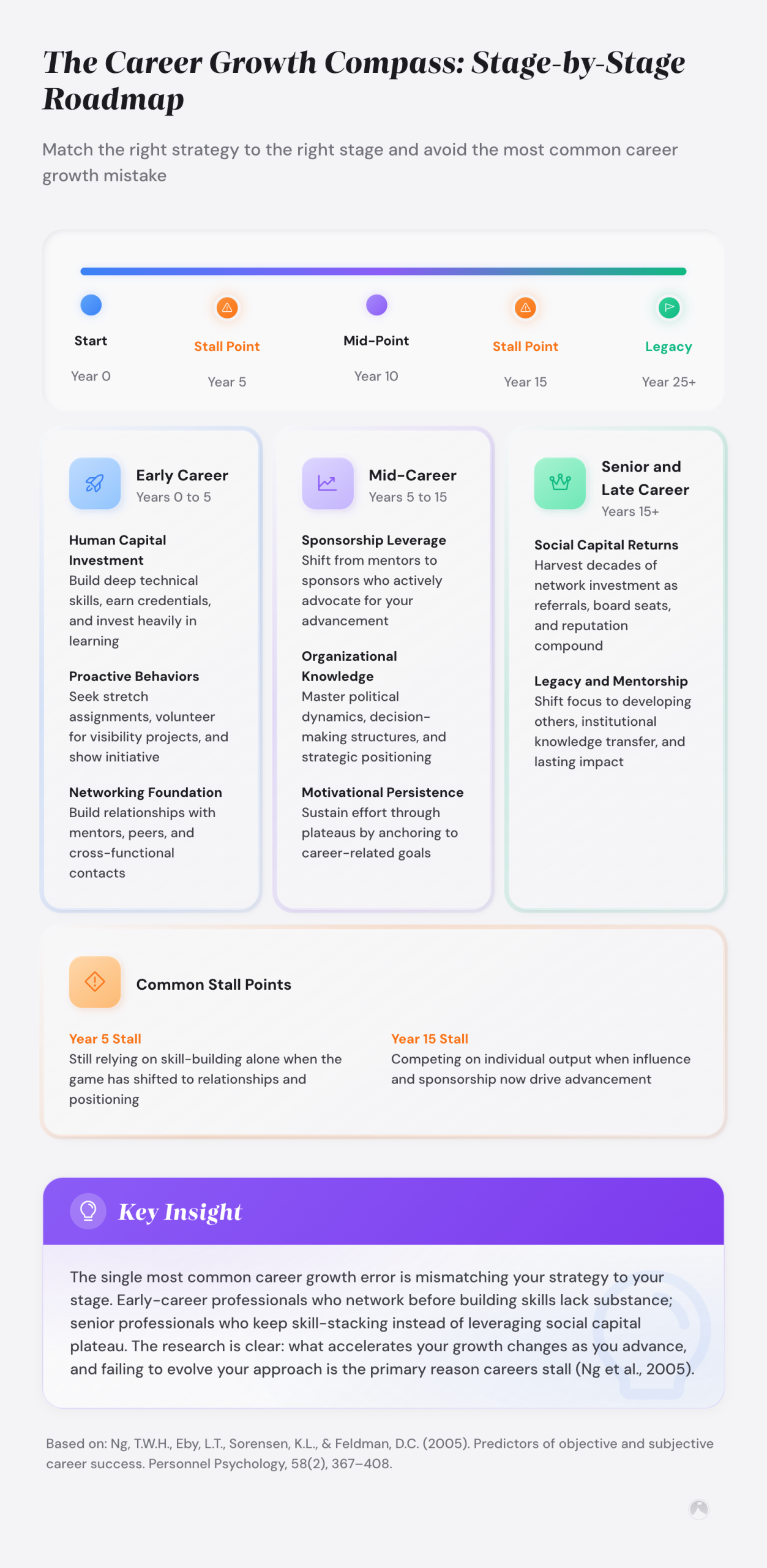
A meta-analysis by Ng, Eby, Sorensen, and Feldman tracking career success predictors across thousands of professionals found that the factors driving advancement shift dramatically by career stage [2]. Early-career success depends on rapid skill acquisition and task mastery. Mid-career success depends on visibility and strategic positioning. And senior-level success depends on influence and legacy building.
“The predictors of objective career success differ markedly across career stages, with human capital factors dominating early careers and social capital factors dominating mid-to-late careers.” – Ng et al., Personnel Psychology meta-analysis [2]
The World Economic Forum’s 2025 Future of Jobs Report found that 39% of workers’ key skills will change by 2030, down from 44% projected in the 2023 report [3]. But which skills, and which career development strategies to pursue, depends entirely on where someone sits in their career arc. What produces growth at one stage can produce stagnation at another.
Think of career growth as a progression through four distinct phases, each with different constraints and best moves. Early-career is about building capability. Mid-career is about building strategic weight. Senior-career is about building influence. And career pivots are about building bridges.
Career stage framework is a model that categorizes professional growth into four phases (early career, mid-career, senior/leadership, career pivot), each requiring different strategies, metrics, and investment patterns to produce forward momentum.
Stage-matched strategy selection is the core insight that separates effective career planning from generic advice. So if you want a structured approach to connecting your professional growth strategies to your career timeline, our guide on strategic career planning frameworks breaks down the planning side in detail.
The career growth compass: a framework we developed
A pattern keeps showing up across the career development research. Four dimensions, assessed at regular intervals, that tell you where your growth is strong and where it’s stalling. We call it the Career Growth Compass, and its ingredients come from research on career capital theory, social network analysis, and strategic positioning literature.
The four dimensions of the Career Growth Compass are: Skills (your ability to deliver results), Visibility (whether the right people know about those results), Relationships (the quality and breadth of your professional network), and Positioning (how you’re perceived relative to the opportunities you want). At any career stage, growth stalls when one or more of these dimensions falls behind the others.
An early-career professional might score high on Skills but low on Visibility. A mid-career professional might score high on Relationships but low on Positioning. The Compass doesn’t tell you what to do – it tells you where to look. And the answer changes as you move through career stages.
Career growth stalls when professionals over-invest in one Compass dimension and neglect the other three. Research by Ng et al. across thousands of professionals confirms that single-dimension career investment produces diminishing returns [2].
Career growth strategies for early-career professionals
In the first one to five years of a career, skills are the primary growth engine. This sounds obvious, but the nuance matters. Early-career professionals don’t need more knowledge – they need demonstrated capability that produces visible results. In tech, this means shipping products; in healthcare, it means building clinical competency across settings; in creative fields, it means assembling a portfolio of diverse work.
The early-career Compass profile is typically: Skills (building), Visibility (low), Relationships (nascent), Positioning (undefined). Your strategy is to invest heavily in Skills and start seeding Visibility through high-quality deliverables. Career development research and industry analysis suggest that building cross-functional skill combinations creates more career options than single-domain specialization [5].
Build a skill stack, not a skill silo
The professionals who advance fastest in the first five years rarely become the deepest expert in a single area. Instead, they build what career researchers call a “skill stack” – a combination of two to three competencies that become more valuable together than individually. A marketer who can write code. A designer who understands data analytics. A project manager who speaks finance.
McKinsey Global Institute’s analysis of skill shifts in the AI era found that the demand for combined skill sets (technical paired with interpersonal, analytical paired with creative) is growing faster than demand for single-domain expertise [5]. The era of “pick one lane and go deep” is giving way to strategic skill combinations. McKinsey’s analysis suggests cross-functional professionals gain leadership opportunities at significantly higher rates than single-domain peers [5].
“Cross-functional skill combinations create career optionality: the ability to operate across teams and functions, making professionals valuable to multiple career paths simultaneously.” – McKinsey Global Institute, Future of Work analysis [5]
For a structured approach to mapping out your early-career plan, see our career development plan template. And for a curated reading list on this topic, our roundup of career growth books for professionals covers the best research-backed titles.
Make your work visible before you need it to be
Early-career professionals often assume that great work speaks for itself. It doesn’t. A longitudinal study by Seibert, Kraimer, and Crant following professionals over multiple years found that proactive visibility of accomplishments predicts career advancement independent of actual performance [6]. The gap between work quality and stakeholder awareness is one of the strongest predictors of mid-career stall.
Early-career visibility means volunteering for cross-functional projects where different teams see your work. It means sharing progress updates proactively with your manager and skip-level leaders. It means documenting your results in formats that are easy for others to reference (project summaries, after-action reviews, short email updates).
The best early-career growth strategy is making quality work visible to the people who decide promotions before the promotion conversation begins.
Start relationships before you need them
Networking as an early-career professional feels awkward for a reason: you don’t have much to offer yet. But the research shows that professional networks built before they’re needed produce better career outcomes than networks built under pressure. Mark Granovetter’s foundational research on professional networks demonstrated that breakthrough career opportunities come disproportionately from “weak ties” – distant acquaintances who know different people and have access to non-redundant information [7].
The key at this stage is curiosity-driven relationship building, not transactional networking. Ask questions. Request informational conversations. Attend events where you can learn, not where you hand out business cards. For specific frameworks on building a career-accelerating network at any stage, our guide on networking for career growth covers the mechanics in depth.
| Compass dimension | Early-career priority | Actions and time investment |
|---|---|---|
| Skills | HIGH | Build a 2-3 skill stack, pursue stretch assignments (60% of growth effort) |
| Visibility | MEDIUM | Share progress updates, volunteer for cross-team projects (20% of growth effort) |
| Relationships | LOW-MEDIUM | Curiosity-driven conversations, internal mentorship (15% of growth effort) |
| Positioning | LOW | Observe how others are positioned, start forming preferences (5% of growth effort) |
How do mid-career professionals break through plateaus?
The mid-career stage (roughly five to fifteen years) is where most career growth strategies break down. Professionals who thrived by building skills and working hard hit a ceiling, and the response is almost always to work harder or add more skills. But the problem is rarely capability. It’s positioning and strategic weight.
Research by Eby, Butts, and Lockwood on career success in what they call the “boundaryless career” era found that mid-career plateaus cluster into three distinct patterns, each requiring a different intervention [8]. The mid-career Compass profile often looks like: Skills (strong), Visibility (moderate), Relationships (moderate), Positioning (weak). The growth bottleneck has shifted from “can you do the work?” to “do the right people see you as the person for the next opportunity?”
If you’re feeling the weight of a mid-career stall, you’re not alone. Our essay on feeling stuck in your career explores the psychology behind that sensation, and our how-to guide on career growth for mid-career professionals covers the tactical playbook.
Shift from skill-building to strategic positioning
Mid-career growth requires a fundamental mindset shift. The question stops being “What skills should I learn?” and starts being “How do the decision-makers in my organization or industry perceive me?” This is where professional growth strategies diverge from career development strategies. Development is about getting better. Growth, at this stage, is about being recognized for the capabilities you already have. In tech, this means aligning your contributions to product revenue; in healthcare, it means connecting your clinical expertise to departmental strategy; in creative fields, it means curating a public body of work that signals leadership.
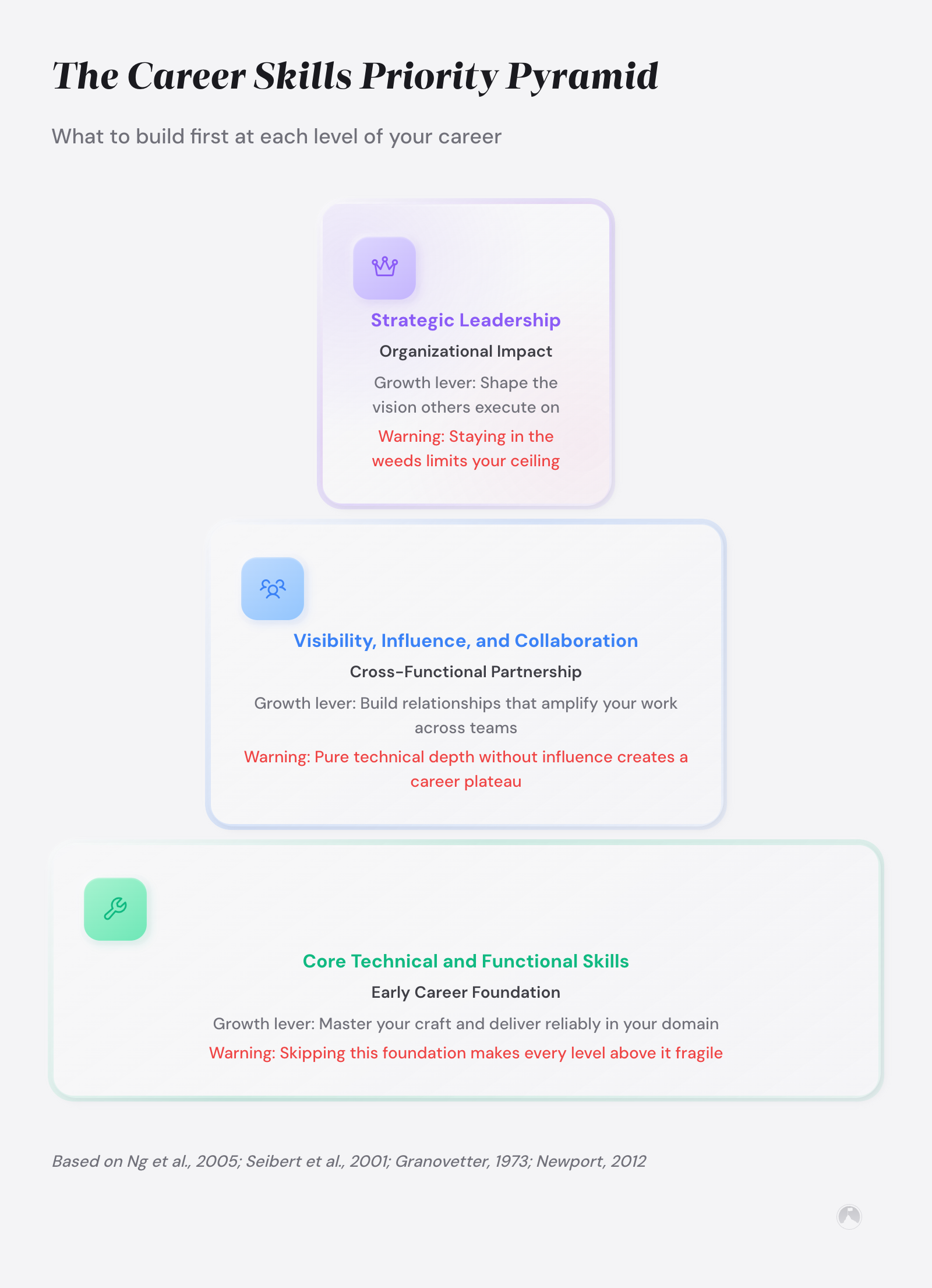
Strategic positioning means deliberately shaping how you’re perceived by the people who influence your next career move. It involves matching your visible contributions to the organization’s top priorities, volunteering for high-profile initiatives (not the busywork that keeps the lights on), and crafting a clear narrative about where you’re heading and why. The Ng et al. meta-analysis confirms this shift: social capital factors overtake human capital factors as the dominant predictor of advancement once professionals move past the early-career stage [2]. Compensation negotiation also maps to Positioning on the Compass and becomes a critical career growth lever from the mid-career stage onward, when professionals have enough market data and track record to negotiate from strength.
Strategic positioning is the practice of intentionally matching visible work contributions, professional narrative, and relationship investments to the decision-makers who influence career advancement. Positioning differs from general skill-building by focusing on perception and access rather than capability alone.
Mid-career growth is less about what you can do and more about what the right people believe you can do next.
Build your career board of advisors
At the mid-career stage, a single mentor isn’t enough. You need what amounts to a personal board of advisors – and the research explains why. Granovetter’s weak ties theory [7] and four decades of follow-up research show that professionals who maintain diverse advisory networks (mentors, sponsors, peers, and connectors across different functions) advance faster than those relying on a single mentor relationship. Different advisors serve different functions.
A mentor helps you think through decisions. A sponsor advocates for you in rooms you’re not in (and this distinction matters more than most people realize). A peer advisor keeps you honest about your blind spots. And a cross-industry connector exposes you to opportunities outside your current bubble. Building this advisory board is one of the highest-impact mid-career career advancement tips available.
For a research-grounded comparison of different approaches at this stage, see our guide on career advancement strategies compared.
Diagnose the plateau before treating it
Career plateaus come in three types, and each requires a different response. A skill plateau means your current capabilities have topped out for your role – the fix is targeted upskilling in adjacent domains, not more depth in your current one. A structural plateau means your organization doesn’t have a next step for you – the fix is creating a new role or exploring external opportunities. A visibility plateau means you have the skills and the path exists, but the decision-makers don’t see you as the candidate – the fix is strategic relationship investment [8].
Most people treat all three the same way: get another certification. Treating all three plateau types with the same certification is like taking cold medicine for a broken bone. Diagnosing which type of plateau you’re facing is the first step toward a career progression plan that actually works.
| Compass dimension | Mid-career priority | Actions and time investment |
|---|---|---|
| Skills | MEDIUM | Targeted upskilling in strategic areas, leadership development (25% of growth effort) |
| Visibility | HIGH | High-profile projects, industry presence, internal thought leadership (30% of growth effort) |
| Relationships | HIGH | Build career board of advisors, develop sponsor relationships (25% of growth effort) |
| Positioning | HIGH | Craft career narrative, match efforts to organizational priorities (20% of growth effort) |
What do senior professionals need for continued career growth?
At the senior level (fifteen-plus years, leadership roles, or recognized domain authority), the growth game changes again. Skills are assumed. Visibility is established. The question becomes: “What impact do I want to leave, and how do I scale my influence beyond my direct responsibilities?”
Leadership researchers Bennis and Thomas studied senior professionals across generations and found a consistent pattern: continued growth at the senior level depends on what they call “multiplication” – creating value through others rather than through direct individual contribution [9]. The senior Compass profile often shows: Skills (deep), Visibility (high), Relationships (extensive but possibly stale), Positioning (needs refresh for the next phase). In tech, this stage often means transitioning from principal engineer to CTO-track advisory; in healthcare, from clinical lead to department strategy; in creative industries, from senior practitioner to creative director or agency founder.
Expand influence through multiplication
Senior career growth is measured by influence, not by individual output. The shift is from “What can I produce?” to “What can I enable others to produce?” This is where mentoring junior talent, building organizational capability, and contributing to industry conversations become genuine growth strategies rather than nice-to-haves.
Gallup’s 2024 workplace research shows that managers and senior leaders who invest in developing their teams report higher personal satisfaction and engagement scores themselves [1]. The mechanism is direct: when you help others grow, you deepen your own expertise, expand your network of loyal advocates, and create a reputation that opens doors you didn’t know existed.
Senior professionals grow by making others grow. The influence compounds in ways that individual achievement never does.
Refresh your network for the next decade
A common pattern among senior professionals: the network that got them to their current position is the same network from ten years ago. Same industry, same function, same peer group. This creates a blind spot. The opportunities that matter at the senior level often come from adjacent industries, emerging sectors, or cross-functional connections that a homogeneous network can’t provide.
Granovetter’s research on network diversity [7], replicated across four decades of follow-up studies, consistently shows that network breadth predicts career advancement more strongly than network depth. The fix is intentional network diversification: attend events outside your industry. Join advisory boards for startups or nonprofits in different sectors. Teach or speak at institutions where you’ll meet people with fundamentally different professional backgrounds. The goal isn’t more connections – it’s more different connections.
The network that got you here is too narrow to get you there. Diversify or calcify.
Build a legacy through knowledge transfer
At the senior level, one of the most effective career growth strategies is counterintuitive: give away everything you know. Write about your expertise. Mentor publicly. Speak at industry events. This isn’t charity – it’s strategic positioning for the next career phase, whether that’s executive leadership, board service, consulting, or launching something new.
The psychology behind this works in two directions. Knowledge transfer forces you to distill your expertise into teachable frameworks, which deepens your own grasp of the material. And it creates a visible body of work that signals authority to people who might offer your next opportunity. For a deeper exploration of the research behind career development patterns at every level, see our article on career development psychology research.
How do career pivoters build bridges to new industries?
Career pivots are the most psychologically demanding career growth challenge. You’re asking someone to let go of a professional identity they’ve built over years and step into uncertainty. Herminia Ibarra’s multi-year study of career changers found that successful pivots follow a specific pattern: they don’t happen in one dramatic leap but through a series of small experiments that gradually build credibility and confidence in the new direction [10]. In tech, pivots often run through bootcamps and open-source contributions; in healthcare, through volunteer clinical hours; in creative industries, through freelance portfolio building.
The pivot Compass profile is unique: Skills (high in old domain, low in new), Visibility (must be rebuilt), Relationships (partially transferable), Positioning (completely new). The strategy centers on building what career researchers call an “identity bridge” between who you were and who you’re becoming. McKinsey’s research on career transitions confirms that the number of professionals considering a career change has increased substantially in the post-pandemic era, with reskilling needs accelerating across industries [5].
Identity bridge is the narrative and evidence a career pivoter constructs to connect their previous professional experience to a new career direction, making the transition legible and credible to hiring managers and professional contacts in the target industry.
Map your transferable skill inventory
The first step in any career pivot is identifying which skills transfer. Most professionals dramatically undercount their transferable skills, partly since they think of skills in job-title terms (“marketing”) rather than capability terms (“persuasive communication,” “audience analysis,” “data interpretation”). The World Economic Forum’s 2025 report identifies analytical thinking, creative thinking, resilience, and AI literacy as the top transferable skills across industries [3].
And here’s what’s interesting: the skills that matter most for pivots aren’t technical. They’re the thinking and communication skills that transfer across any industry. How you approach problems, how you communicate under pressure, how you build relationships in unfamiliar territory. For a detailed framework on managing the emotional side of career pivots, see our guide on career change anxiety solutions.
Build credibility in the new domain before the pivot
The smartest career pivoters start building credibility in their target domain while still employed in their current role. Ibarra’s research [10] shows that successful transitions follow a three-phase approach: first, map transferable skills; second, build credibility through side projects and volunteer work in the new domain; third, develop industry-specific credentials. The key insight is that arriving as an “informed outsider” with fresh perspective is more powerful than arriving as a learner playing catch-up on fundamentals.
Take courses. Contribute to open-source projects. Write about the new domain. Attend industry events. Build a small portfolio of work that demonstrates you’re serious about the transition, not just daydreaming about it. This approach answers a hiring manager’s core question: “Why should I take a risk on someone who’s never done this?” You answer it with evidence.
Career pivots succeed when you build the bridge before you need to cross it.
Career growth strategies for special situations
Career growth strategies for remote workers, flat organizations, and workforce re-entry follow the same four-dimension framework but require adjusted tactics for visibility and positioning.
The four career stages above apply across most professional contexts. But three common situations — remote work, flat organizations, and workforce re-entry — create specific bottlenecks in the Career Growth Compass that require targeted adjustments.
Remote workers and visibility gaps
Remote work creates a specific bottleneck: visibility. A randomized controlled trial by Stanford economist Nick Bloom and colleagues found that remote workers’ promotion rates dropped by approximately half compared to in-office peers, even when performance metrics were equivalent [11]. The gap stems from proximity bias – managers unconsciously notice in-office contributions more readily, regardless of output quality.
Remote workers can counter the visibility gap through strategic communication effort. This means approximately twice the proactive outreach compared to in-office peers, including weekly progress emails, cross-functional project participation, and intentional visibility moments during all-hands meetings. Bloom’s experimental findings confirm that deliberate visibility strategies can significantly narrow the promotion gap for remote workers [11].
But here’s the opportunity: you can design your visibility more strategically than in-office workers can. You’re not competing on “who’s in the coffee room.” You’re competing on “who has the clearest track record of results.” So document your wins. Share progress proactively. Find ways to contribute that are visible across the organization, not just to your immediate team. For a complete playbook on this, see our guide on career growth for remote workers.
Flat organizations and redefining growth
Flat organizations don’t have many rungs on the ladder, so traditional growth (moving up) hits a ceiling fast. But growth in a flat organization can mean expanding scope (taking on bigger projects), deepening expertise (becoming the go-to authority in a domain), or horizontal movement (building skills in adjacent areas). The Career Growth Compass works the same way – you’re just optimizing for different outcomes.
Workforce re-entry after a break
Career breaks (parenthood, health, sabbatical, unemployment) create a unique Compass profile: your skills might be current or stale depending on break length, your visibility has reset to near-zero, your relationships may have atrophied, and your positioning is “person coming back.” The growth strategy is to re-establish credibility and visibility quickly. Volunteer for high-impact projects, seek visibility actively, and be explicit about what you’ve learned during the break.
The strategies for career success in non-traditional situations are the same four dimensions – just applied with different emphasis and urgency.
How to measure career growth beyond promotions
Here’s the trap most professionals fall into: they measure career growth solely by promotions and title changes. But titles are lagging indicators. By the time you get the promotion, the real growth work happened months ago. So if you’re waiting for a promotion to know whether you’re growing, you’re measuring at the wrong time.
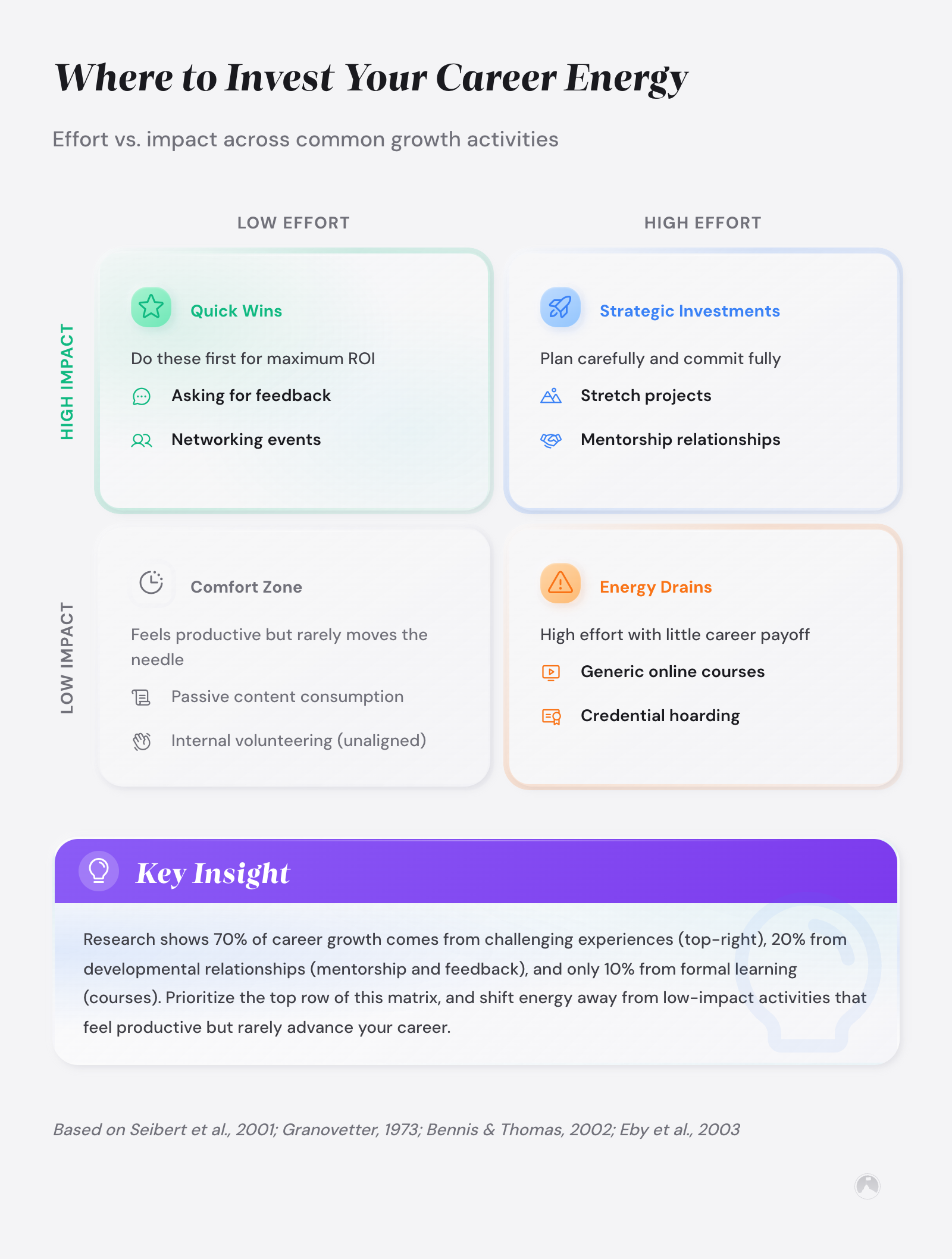
Cal Newport’s research on career capital [12] – the accumulated stock of rare and valuable skills – suggests that tracking leading indicators gives you a far more accurate picture of career trajectory. Track four categories aligned with the Career Growth Compass:
- Skills gained: What new capabilities have you added in the last quarter? Not certifications – actual skills you can deploy.
- Visibility earned: Who knows about your work who didn’t before? Have you broadened beyond your immediate team?
- Relationship quality: Has the diversity and depth of your advisory network expanded? Do you have people in your corner who can open doors?
- Options created: How many viable career paths are available to you now compared to a year ago? Has your negotiating power increased?
These four indicators, assessed quarterly, tell you whether you’re on a growth trajectory or just staying busy. If you want to know how to grow your career, stop counting promotions and start counting options. For specific frameworks and assessment tools, see our career planning tools and frameworks.
How to create a career progression plan
Use these career development strategies to build a structured career progression plan in seven steps:
- Identify your current career stage (early, mid, senior, or pivot) to determine which strategies apply.
- Score yourself on all four Compass dimensions (Skills, Visibility, Relationships, Positioning) using a 1-10 scale.
- Identify your lowest-scoring dimension as your primary growth bottleneck for this quarter.
- Set one measurable quarterly goal for that dimension with a specific action and deadline.
- Align your goal to your organization’s priorities so growth effort and visible contribution overlap.
- Build accountability into your plan by sharing your goal with a mentor, sponsor, or peer advisor.
- Review and rotate focus quarterly as your bottleneck shifts across Compass dimensions over time.
Career growth strategies compared by stage
| Career stage | Primary compass focus | Biggest risk | Key metric and time horizon |
|---|---|---|---|
| Early career (0-5 years) | Skills + Visibility | Staying invisible despite good work | New capabilities demonstrated (quarterly skill sprints) |
| Mid-career (5-15 years) | Positioning + Relationships | Over-investing in skills when the gap is visibility | Decision-maker awareness of your work (annual positioning review) |
| Senior (15+ years) | Relationships + Positioning | Network calcification and echo chambers | Value created through others (multi-year influence mapping) |
| Career pivot | Skills (new domain) + Visibility | Waiting too long to build credibility in new field | Credibility signals in target domain (6-18 month transition plan) |
Ramon’s take
If you’re stuck at mid-career and still grinding on new skills, just pause. From what I’ve read, that strategy stops working around year five and positioning takes over. Try one intentional conversation this week about where you want to go.
Career growth strategies: match the strategy to the stage
Career growth isn’t a single strategy that works across all stages. It’s a progression of different strategies, each matched to where you are right now. The advice that got you here won’t get you there, because the bottleneck changes. Early-career professionals need to build capability and visibility. Mid-career professionals need strategic positioning and a diverse advisory network. Senior professionals need to expand their influence beyond direct output. And career pivoters need to build an identity bridge from where they’ve been to where they’re going.
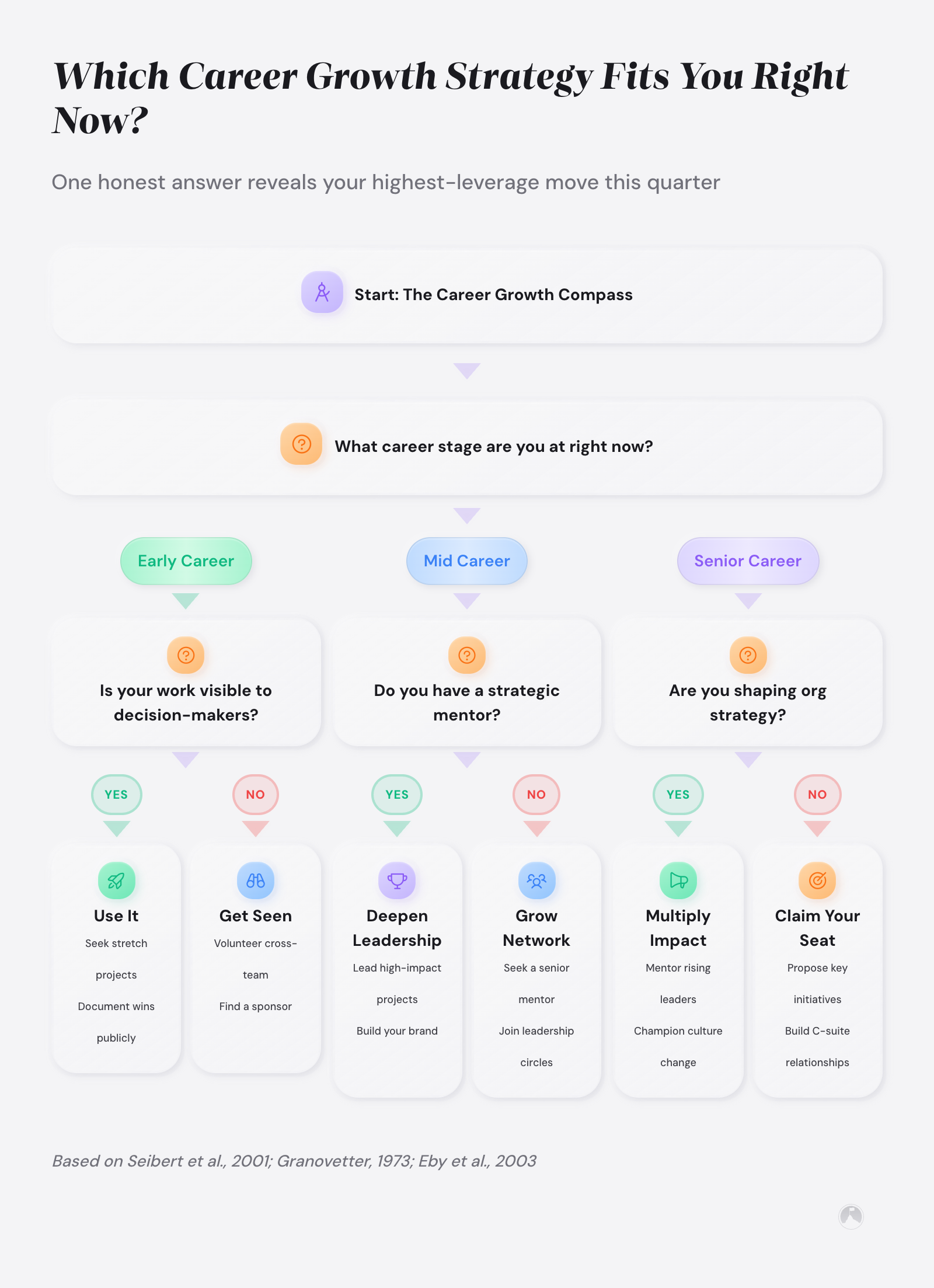
The Career Growth Compass – your assessment of Skills, Visibility, Relationships, and Positioning – is the diagnostic tool that tells you where to invest your effort. And when you invest according to your stage and your specific gaps, career growth stops feeling like a mystery and starts feeling like a strategic problem you can solve. The most expensive career mistake isn’t choosing the wrong strategy. It’s applying the right strategy at the wrong stage.
Next 10 minutes
- Identify which career stage you’re in (early, mid, senior, or pivot).
- Rate yourself 1-10 on each Career Growth Compass dimension: Skills, Visibility, Relationships, Positioning.
- Find your lowest-scoring dimension. That’s where your growth strategy should focus next.
This week
- Take one action from your lowest Compass dimension – something you can do in under five minutes.
- Identify one person (mentor, sponsor, peer, or connector) you could reach out to who addresses your weakest dimension.
- Read the supporting guide linked in this article that matches your specific career stage.
There is more to explore
For more strategies on personal and professional growth, explore our personal development strategies guide and our creativity and learning strategies guide. If you’re ready to build a structured career plan, our career development plan template provides the step-by-step framework. And for the complete picture of growth resources across our site, visit our growth hub.
Take the next step
Ready to turn your career growth strategy into a concrete plan with timelines and milestones? The Life Goals Workbook includes dedicated career planning sections that connect career growth goals to your broader life vision, helping you build a career progression plan that fits what matters most to you.
Frequently asked questions
What are the key dimensions of career growth?
Career growth spans four measurable dimensions: skill development, visibility and reputation, professional relationships, and strategic positioning. The Career Growth Compass framework maps these four dimensions into an actionable assessment tool, with the priority emphasis shifting across career stages.
What is the difference between career growth and career development?
Career growth refers to measurable forward movement in responsibility, compensation, influence, or scope, often visible through promotions or expanded roles. Career development is the broader, ongoing process of building professional knowledge, skills, and competencies throughout a career. Growth is the outcome; development is the practice that produces it. A meta-analysis by Ng et al. found that the predictors of career growth shift across career stages, while development remains relatively constant [2].
How do I create a career growth plan?
Start by assessing your current Career Growth Compass dimensions: Skills, Visibility, Relationships, and Positioning. Identify which dimension is lagging most. Then set one quarterly goal for that dimension with a specific, measurable action. Review quarterly and rotate focus as your bottleneck shifts. Research on goal-setting suggests that focusing on one priority at a time produces measurable improvement, whereas attempting multiple simultaneous changes diffuses effort.
How can I advance my career when feeling stuck?
First, diagnose the type of plateau: skill-based, structural, or visibility-based. A skill plateau requires targeted learning in adjacent domains. A structural plateau means your organization lacks a next step, and you may need to create one or look externally. A visibility plateau means decision-makers don’t see your capabilities, which requires proactive relationship and reputation investment rather than more skill-building. Research by Eby et al. confirms these three plateau types require fundamentally different interventions [8].
What skills are most important for career advancement in 2025?
The World Economic Forum’s 2025 Future of Jobs Report identifies analytical thinking, creative thinking, resilience, flexibility, and AI literacy as the top skills driving career advancement across industries [3]. McKinsey Global Institute’s analysis of skill demand shifts shows that cross-functional skill combinations, where professionals pair technical skills with interpersonal or strategic capabilities, are gaining value faster than deep single-domain expertise [5].
How do you measure career growth without promotions?
Track leading indicators across four dimensions aligned with the Career Growth Compass: skills gained (new capabilities you’ve added), visibility earned (who knows about your work beyond your immediate team), relationship quality (diversity and depth of your advisory network), and options created (number of viable career paths available to you). Cal Newport’s career capital framework suggests these leading indicators predict future career mobility more accurately than title changes alone [12].
What role does networking play in career growth?
Networking contributes to three of the four Career Growth Compass dimensions: Visibility, Relationships, and Positioning. Mark Granovetter’s foundational research on professional networks, replicated across four decades of studies, shows that network diversity matters more than network size for career advancement [7]. Professionals with bridges to different industries and functions encounter more novel opportunities and advance faster than those with homogeneous networks.
How do career growth strategies differ for remote workers?
Remote workers face a specific Visibility deficit driven by proximity bias. A randomized controlled trial by Nick Bloom and colleagues found that remote workers’ promotion rates dropped by approximately half compared to in-office peers with equivalent performance [11]. Effective strategies include sharing work-in-progress proactively, volunteering for cross-functional projects, sending regular progress updates, and strategically prioritizing in-person events when they occur.
Glossary of related terms
Career development plan is a structured document that outlines a professional’s current skills, target career position, identified gaps, and a timeline of specific learning and growth activities to close those gaps over a defined period.
Professional development roadmap is a long-range plan spanning three to five years that maps the sequence of skills, experiences, and relationship investments a professional needs to reach a defined career milestone.
Career capital is the accumulated stock of rare and valuable skills, experience, reputation, and professional relationships that a professional can deploy to create career options, negotiate opportunities, and withstand career disruptions.
Proximity bias is the tendency for managers and decision-makers to favor employees who are physically present in the workplace over remote employees when making promotion, assignment, and recognition decisions, regardless of performance differences.
Skill stack is a combination of two to three complementary competencies that become more valuable together than individually, creating career optionality and making a professional adaptable across roles and industries.
Identity bridge is the narrative and evidence a career pivoter constructs to connect their previous professional experience to a new career direction, making the transition credible to hiring managers and professional contacts in the target industry.
Weak ties are distant professional acquaintances (as opposed to close colleagues) who provide access to non-redundant information and novel career opportunities, based on Mark Granovetter’s foundational network research.
Career plateau is a period where professional advancement stalls despite continued effort, occurring in three forms: skill-based (capabilities topped out), structural (organization lacks next step), or visibility-based (decision-makers unaware of capabilities).
References
[1] Gallup. “State of the Global Workplace Report 2024.” Gallup Workplace, 2024. Link
[2] Ng, T. W., Eby, L. T., Sorensen, K. L., and Feldman, D. C. “Predictors of objective and subjective career success: A meta-analysis.” Personnel Psychology, 58(2), 367-408, 2005. DOI
[3] World Economic Forum. “The Future of Jobs Report 2025.” World Economic Forum, 2025. Link
[4] Ng, T. W. H., and Feldman, D. C. “The relationship of age to ten dimensions of job performance.” Journal of Applied Psychology, 93(2), 392-423, 2008. DOI
[5] McKinsey Global Institute. “The Future of Work: Career Transitions and Skill Shifts in the AI Era.” McKinsey and Company, 2024. Link
[6] Seibert, S. E., Kraimer, M. L., and Crant, J. M. “What do proactive people do? A longitudinal model linking proactive personality and career success.” Personnel Psychology, 54(4), 845-874, 2001. DOI
[7] Granovetter, M. S. “The strength of weak ties.” American Journal of Sociology, 78(6), 1360-1380, 1973. DOI
[8] Eby, L. T., Butts, M., and Lockwood, A. “Predictors of success in the era of the boundaryless career.” Journal of Organizational Behavior, 24(6), 689-708, 2003. DOI
[9] Bennis, W. G., and Thomas, R. J. “Crucibles of leadership.” Harvard Business Review, 80(9), 39-45, 2002.
[10] Ibarra, H. Working Identity: Unconventional Strategies for Reinventing Your Career. Harvard Business School Press, 2003.
[11] Bloom, N., Liang, J., Roberts, J., and Ying, Z. J. “Does working from home work? Evidence from a Chinese experiment.” The Quarterly Journal of Economics, 130(1), 165-218, 2015. DOI
[12] Newport, C. So Good They Can’t Ignore You: Why Skills Trump Passion in the Quest for Work You Love. Grand Central Publishing, 2012.