Career growth for remote workers: the hidden pattern most never see
You’re doing excellent work. Your projects ship on time, your deliverables are solid, and your manager knows you’re competent. So why does the promotion keep going to someone less qualified who works down the hall?
The answer is proximity bias – and the data on it is stark. Live Data Technologies analyzed two million white-collar workers in 2023 and found that remote workers were promoted 31% less frequently than their in-office peers. Specifically, 3.9% of remote workers received promotions compared to 5.6% of office-based workers [1].
That gap persists even when performance is equal. The problem isn’t your work quality. The problem is that your work is invisible to the people making advancement decisions.
But here’s where career growth for remote workers gets interesting. Buffer’s 2023 State of Remote Work survey of 3,000 remote workers found that 36% report career growth actually feels easier working remotely, with 48% attributing this to a “level playing field because everyone is remote” [2].
The difference isn’t the work arrangement. It’s the system. In remote-first cultures, everyone plays by the same visibility rules. In hybrid environments, remote workers face systemic disadvantage by default.
Career growth for remote workers requires four deliberate systems: weekly work documentation shared with leadership, strategic relationship building outside your reporting line, remote executive presence through camera and preparation technique, and proactive opportunity positioning. These systems replace the informal visibility that in-office workers receive through physical proximity.
You don’t need to pretend to be in an office, and you don’t need to burn out over-communicating. You need to build the visibility systems that in-office proximity used to provide automatically. For a broader view of career growth strategies, start with the parent guide.
Career growth visibility is a remote worker’s capacity to make contributions, decisions, and professional development transparent to decision-makers without physical presence – distinct from self-promotion because career growth visibility focuses on documenting existing work rather than talking about yourself more.
What we call the Career Growth Visibility System has four interconnected components that operate as a weekly rhythm:
- Work documentation – The record of what you accomplished and its impact
- Relationship depth – The trust and connection you have with decision-makers
- Executive presence – How you show up in virtual settings and on camera
- Opportunity positioning – How visible you are when opportunities emerge
Most remote workers optimize one or two of these. The ones who break through promotion disadvantage optimize all four as a weekly routine, not a heroic effort.
What you will learn
- How to build a 50-minute weekly visibility routine with three touchpoints that create continuous promotion-building documentation
- The four relationship-building patterns that work in all-virtual environments – without forced networking
- How to demonstrate executive presence through video calls using research-backed camera, vocal, and preparation techniques
- How to diagnose whether your company culture genuinely supports remote career growth – or whether you need to move
Key takeaways
- Live Data Technologies and Buffer’s State of Remote Work survey both confirm that remote workers face a 31% promotion gap in hybrid settings, yet 36% report easier growth in remote-first companies.
- The Visibility System has four components: documentation, relationships, executive presence, and opportunity positioning.
- A weekly visibility routine of about 50 minutes replaces the informal visibility in-office workers get automatically.
- Proximity bias in hybrid environments means remote workers need deliberate systems that office colleagues don’t.
- Remote executive presence relies on camera framing, thorough preparation, and vocal clarity – not stage presence.
- Some companies have unfixable proximity bias. Diagnosing which situation you’re in saves years of wasted effort.
- Evidence from employment data, remote work surveys, and mentoring research supports visibility-centered remote work career advancement strategies over simply working harder.
Weekly visibility routine: the system that replaces office hallways
Great remote work disappears into silence. Your completed project sits in a shared folder. Your good idea gets discussed in a meeting and never mentioned again.
Proximity bias is the tendency to favor people who are physically near you. In workplace settings, proximity bias shows up as more informal mentorship, greater visibility to leadership, and faster advancement for in-office workers compared to equally qualified remote employees, according to employment data and workplace research [1].
Office workers receive informal mentorship and visibility spontaneously through proximity and shared tasks. Informal mentoring relationships tend to develop through daily observation and physical nearness, and these organic connections often provide strong career support [3]. Remote workers lack these touchpoints entirely.
As Harvard Business Review reported, hybrid environments disrupt natural mentorship formation because proximity benefits are distributed unevenly [4]. The Weekly Visibility Routine replaces those lost informal touchpoints with three deliberate ones. It takes about 50 minutes total across the week.
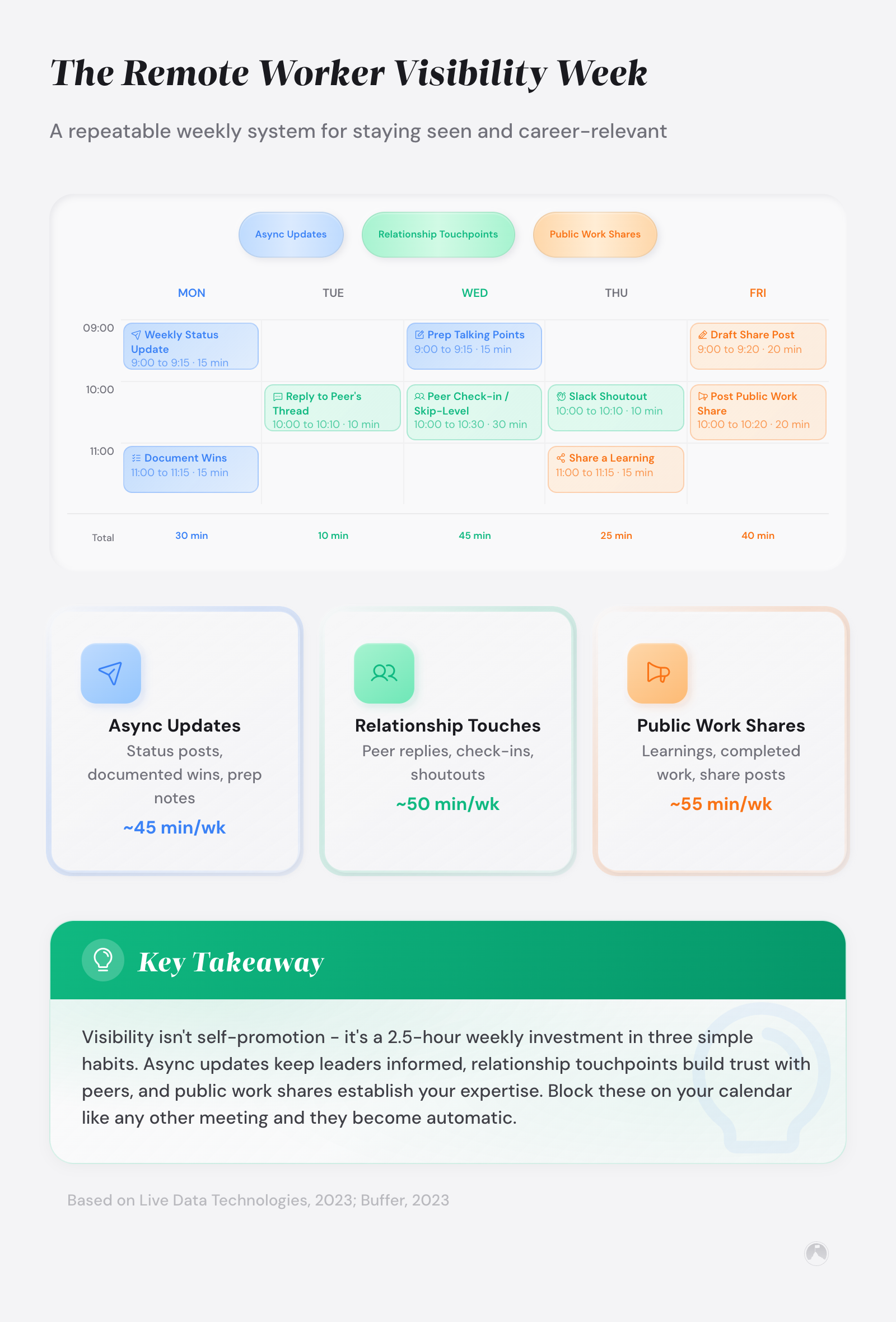
Monday planning share (15 minutes): Start the week by sharing your three priority outcomes with your manager and any cross-functional stakeholders. Don’t dump your to-do list. Frame it like this: “This week, I’m focused on X (which supports our larger goal of Y), Z (which removes a blocker for another team), and W (my development goal).” Send it as a brief Slack message or calendar note.
Wednesday progress check-in (20 minutes): Document your progress against those Monday priorities. Did you hit the blocker you committed to tackling? Did something shift your priorities? Send a short update to the same audience.
Keep it to 3-5 bullet points. The purpose isn’t to prove you’re busy. The purpose is to make progress visible in real time, not just at month-end. That distinction matters for how decision-makers perceive momentum.
Friday reflection and forward link (15 minutes): End the week by documenting what shipped, what you learned, and what’s coming next. The Friday reflection is the highest-leverage visibility moment.
Make this visible not just to your manager, but to your manager’s manager (your skip-level leader). Forward a link to a shared document (Notion, Google Doc, whatever your company uses) containing: (1) what was completed, (2) who it impacts, (3) what it enables next, (4) what you’re learning in the role.
Most remote workers have no idea if their manager shares their wins with leadership. By making this visible in a shared space, you remove that uncertainty. Your skip-level leader now has direct visibility into your impact. If you’re looking for a template to structure your professional development alongside these weekly updates, a career development plan template can help.
You’re not creating extra work. You’re making work visible that you’re already doing. The 50 minutes per week replaces the informal visibility that in-office workers get automatically when their manager overhears their work, watches them run a project, or mentions them casually to leadership.
And if you’re introverted and this feels like performing (which, fair point, it is), here’s the upside: it’s a documented performance, not a constant one. You write these updates once. They stay visible.
In-office workers have to perform visibility every single day. You do it on a schedule and you’re done. The delivery method matters less than consistency. Video snippets work, voice memos work, even dashboards work. Experiment until you find the format that feels least artificial.
Overcoming visibility challenges working from home means making the work you already do traceable to you, not working harder.
The four relationship patterns that build career capital remotely
Visibility is only half the equation. The other half is relationships with people who control opportunities.
In-office environments, these relationships form passively. You sit near someone, get coffee together, bond over shared frustrations, and gradually build trust. Remote work removes that passive relationship-building engine.
But here’s the counterintuitive part – this is actually an advantage if you’re intentional about it. You’re not wasting time on small talk with people who won’t influence your career. Relationships built around shared work and mutual help tend to be higher-quality than relationships built on proximity alone [3]. So build around substance, not location.
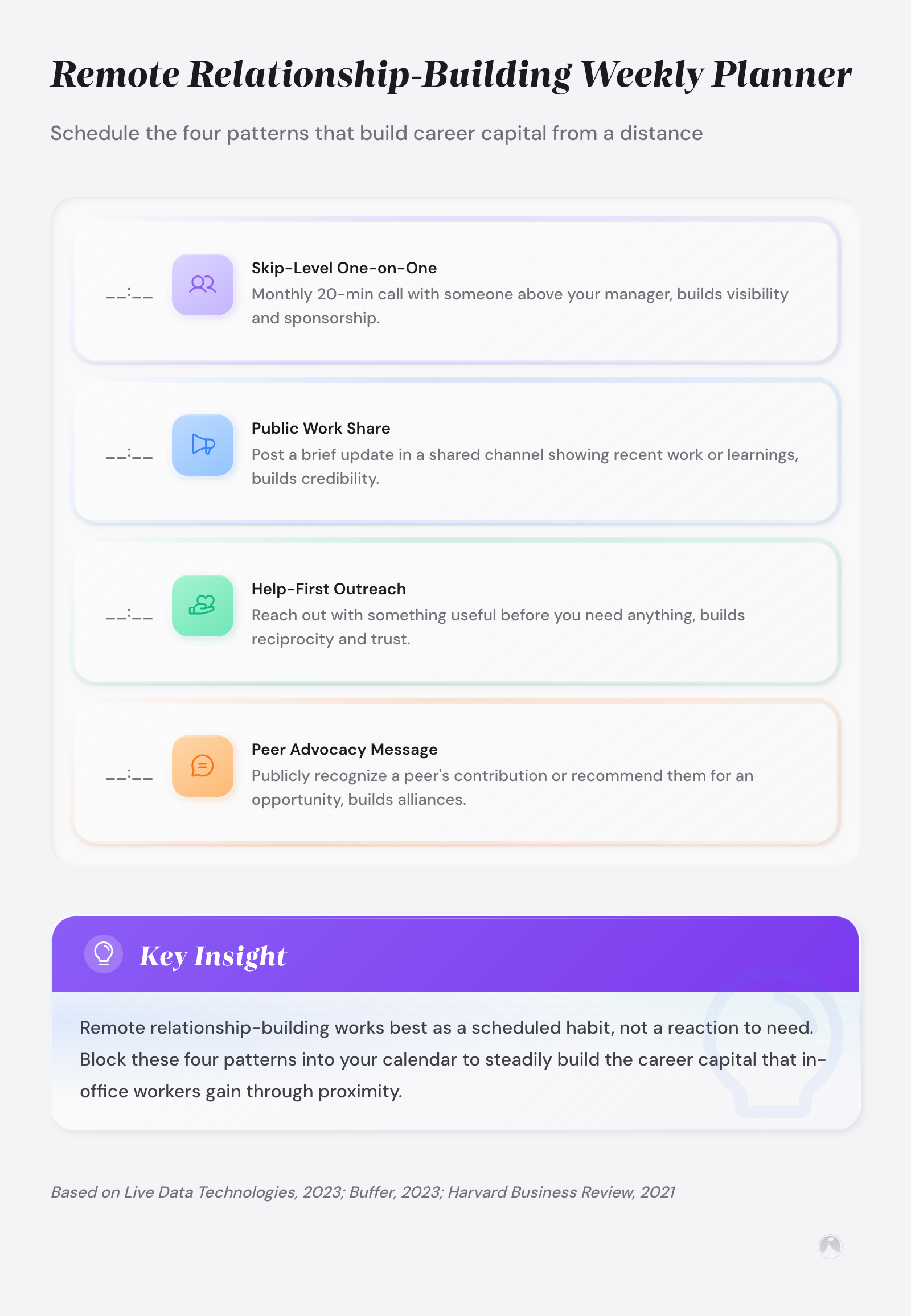
Pattern 1: The monthly one-on-one outside your direct line
Pick one person per month who is not your direct manager but who influences career decisions or controls resources you want access to. The target might be your manager’s manager, a peer in another team, a leader you admire, or someone who leads a project you want to join.
Set a 30-minute video call with a specific agenda – not a “getting to know you” coffee, but a focused conversation about one topic they care about. “I’ve been thinking about the strategic direction of our content platform. I saw your recent update on resource allocation. I’d love to understand your thinking and share how I see the constraints.”
You’re not wasting their time. You’re engaging on substance. People remember substantive conversation far longer than small talk. For more on building professional relationships remotely, see our guide on networking for career growth.
Pattern 2: The public work share
When you complete something significant, mention it in a public channel where leadership can see it. Not excessively – once or twice a month. “Shipped the new customer dashboard redesign. Performance improved 40% on the critical path. Full details in the doc link.” You’re not bragging. You’re making impact visible in spaces where career decisions get made.
Pattern 3: The help-first relationship build
When someone senior faces a problem you can solve, solve it before they ask you to. See a technical bottleneck? Fix it. Knowledge gap? Document an answer. Process inefficiency? Propose a solution.
You’re building equity before asking for anything. This is the remote equivalent of “showing up early to demonstrate competence.” The help-first approach works because you’re delivering value before a relationship even exists.
Pattern 4: The peer advocacy network
Career advancement happens when people advocate for you in rooms you’re not in. In-office environments, advocacy happens organically – your manager mentions you in meetings. Remote requires intentionality.
Identify 3-5 people at your level or one level above who influence hiring and promotions. Share your wins with them. Help them when you can. When opportunities emerge, they’ll think of you because you’ve been visible and helpful.
The progression goes like this: visibility (they know what you do), substance (they see quality in what you do), trust (they believe in your judgment), advocacy (they recommend you). Remote work career advancement strategies that skip the relationship layer always stall at visibility. The advocates show up when opportunities materialize.
Building executive presence remotely: how remote workers project authority
Executive presence is the ability to influence and command attention despite not having formal authority. In-office, much of this comes from physical cues: how you carry yourself, whether people defer to you in hallway conversations, even the size of your desk.
Remote work strips away those cues. But it also removes the physical discomfort some leaders use to project authority – the interruption, the loud voice, the domination of physical space. Building executive presence remotely is actually more accessible than the in-office version because it relies on substance and clarity, not stage presence.
- Camera framing – How you occupy the screen and use visual presence
- Preparation – How thoroughly you command the content of each meeting
- Speaking authority – How your vocal patterns and phrasing signal confidence
Camera framing and the attention hierarchy: On your camera, frame yourself so your head and shoulders fill 40-50% of the frame. This framing convention is standard for professional video settings and signals confidence to other participants. Lean slightly forward when making points that matter.
Don’t fidget – it reads as nervous. Move deliberately when you want to shift attention. Research by Bayraktar et al. (2025) at the CHI Conference found that simulated eye contact had little measurable impact on interview evaluations, suggesting content quality and preparation matter more than gaze direction [5].
In video calls, speakers who communicate with deliberate precision tend to be more effective because the video format provides less context than in-person meetings. Compensating with clarity rather than relying on physical presence is a practical advantage remote workers can develop.
The preparation gap: Remote executive presence depends heavily on preparation. In-person meetings give room to improvise because your physical presence carries weight. Video meetings leave less margin.
Before important calls, prepare three specific talking points. Know your data cold. Have your conclusions ready before questions arrive. The remote workers who get promoted are the ones better prepared than their in-office counterparts – because they can’t coast on presence.
Speaking patterns that build authority: Speak clearly with deliberate pauses. Remote audio quality is imperfect, and pauses create space for clarity. Reducing filler words (“um,” “uh,” “like”) during key moments helps project authority.
Record yourself for two weeks. You’ll hear patterns you don’t notice live. Fix the two biggest ones. When you disagree, don’t apologize first. “I see it differently” lands better than “I might be wrong, but…” You’re not being aggressive. You’re being direct.
Remote video meetings reward clarity over politeness because virtual communication strips away every nonverbal signal.
The visible learning signal: Ask forward-thinking questions in meetings. Not “I don’t understand” questions (those broadcast uncertainty). Ask systemic questions: “What happens to the roadmap if X changes?” “How does this decision cascade to the next team?” These signal you’re thinking at a strategic level, not just executing.
Proximity bias diagnosis: when to fight and when to leave
Not every remote work situation is worth optimizing. Some organizations have cultural proximity bias so deep that no visibility system fixes it.
Research on hybrid work maturity published in the Sarhad Journal of Management Sciences found that organizations which deliberately redesigned their systems for distributed work achieved 61% greater cultural cohesion and 47% higher employee engagement [6]. Organizations that didn’t do this work showed increased turnover and eroded trust. You need to diagnose which situation you’re in before investing energy.
Three signals your company genuinely supports remote career growth
Remote workers get promoted at similar rates to in-office workers. This isn’t aspirational – you can check this. Look at org charts. Track promotions over the last 18 months. If remote workers are advancing, the system works.
Compensation is equal. Some companies pay remote workers less or offer smaller raises. That’s the company telling you it values your contribution less. This is diagnostic.
Leadership acknowledges remote work requires different systems. They don’t say “just be more visible.” They say “we have documentation expectations, communication norms, and async (asynchronous) protocols – communication designed for different-time responses rather than real-time conversation – for a reason.” This signals they understand the structural challenge [6].
Three signals your company has unfixable proximity bias
Only office workers get stretch projects and promotions. This is the clearest signal. If you’re feeling stuck in your career, this might be the root cause rather than anything about your performance.
Your manager admits proximity bias exists but says you need to come into the office to fix it. This is the company choosing the problem over the solution.
Unwritten rules favor in-office presence. They say “culture matters” but define culture as “being here.” They have surprise meetings on short notice. They make decisions informally in hallways. They’re not going to change because the current system benefits the people already in power.
The decision framework
If your company genuinely supports remote work: use the systems in this guide. You’ll outperform in-office counterparts because you’re being systematic about what they do passively. Career planning tools and frameworks can help you map the path forward.
If your company has fixable bias: push for the systems changes (documentation expectations, communication norms, async protocols). Give it 6 months. If nothing moves, move yourself.
If your company has unfixable bias: don’t waste energy trying to change it. Start looking for a genuinely remote-first company now. Your career growth window is limited in a culture that’s rigged against you. The best remote work career advancement strategy in a biased company is leaving the biased company.
Common mistakes that sabotage remote work career advancement
The visibility trap: Over-communicating. Some remote workers think “I need to be seen more” and start flooding channels with status updates, jumping on every meeting, being constantly present. This backfires. Over-communication reads as anxiety, not competence. Use the Weekly Visibility Routine. Three touchpoints per week is enough.
The documentation fallacy: Assuming good work speaks for itself. It doesn’t. The project you completed will be forgotten in 90 days unless you document its impact. Your boss won’t remember that you solved the critical blocker without being asked. Document it.
The relationship mistake: Only building relationships with people you like. The person who doesn’t inspire you but controls 40% of advancement opportunities in your company? Build a relationship there. Building strategic relationships isn’t fake – strategic networking is professional. You don’t have to be best friends with decision-makers. You have to be competent, helpful, and visible to them.
The async martyr: Some remote workers avoid synchronous meetings thinking they’re “embracing async.” But the remote workers who get promoted show up to meetings, present clearly, and build relationships in real time. Async is a tool for documentation and deep work. Synchronous time is where relationships and visibility happen. Use both.
The wrong company trap: Optimizing visibility in a company that structurally disadvantages remote workers. If you’re in a culture with unfixable proximity bias, no amount of documentation systems will get you promoted faster than your in-office counterparts. The most expensive remote career mistake is spending years optimizing visibility in a company where proximity bias makes remote promotion structurally impossible.
Ramon’s take
My read: before you build any visibility system, figure out if your company actually promotes remote workers. If the last five people promoted were all in-office, that’s your answer. No system fixes a company that’s already decided.
Remote work made this pattern unavoidable rather than optional. In an office, you can coast on proximity. Remotely, you have to be systematic (which, honestly, is an advantage). In companies that have adapted their systems for distributed work, the systematic remote workers advance faster than passive in-office counterparts – not because they’re better, but because they’re intentional about what others leave to chance.
Conclusion
Career growth for remote workers isn’t harder than for in-office workers if you work in a company that has adapted its culture. But in hybrid environments that favor physical presence, proximity bias remote workers face requires systems that in-office colleagues don’t need.
The Career Growth Visibility System gives you those systems. It’s not glamorous – it’s documentation, relationships, and clear communication. But it works. Remote workers who build deliberate visibility systems close the 31% promotion gap by making their impact impossible for decision-makers to miss.
Next 10 minutes
- Identify one person in leadership (not your direct manager) you want to build a relationship with. Send them a calendar invite for a 30-minute call with a specific agenda about something they care about.
- Create a shared document where you’ll maintain your Friday Reflection. One document. Share the link with your manager and your manager’s manager.
This week
- Do your first Weekly Visibility Routine: Monday Planning Share, Wednesday Progress Check-in, Friday Reflection. Notice how the documentation feels. Adjust the format if it doesn’t match your communication style.
- Review your last three months of accomplishments. Count how many were documented and communicated beyond your manager. That gap is your promotion disadvantage. The Visibility System fills it.
There is more to explore
For mid-career challenges specifically, see career growth mid-career. If you’re comparing different approaches to advancement, our career advancement strategies compared article breaks down the options. For structured approaches to setting development targets, see effective development goals. And for development beyond your career track, personal development for remote professionals covers growth outside the promotion ladder.
Related articles in this guide
- career-planning-tools-frameworks
- effective-development-goals-planning-achievement
- feeling-stuck-in-career
Frequently asked questions
Does remote work negatively impact career advancement?
It depends on company culture. Live Data Technologies found remote workers are promoted 31% less frequently in hybrid and traditional companies due to proximity bias [1]. But Buffer’s research shows 36% of remote workers report career growth feels easier in fully remote settings [2]. The impact also varies by industry — tech companies with remote-first cultures tend to show less bias than finance or consulting firms where in-person presence has traditionally signaled commitment.
How can remote workers increase their visibility without seeming like they are bragging?
The difference between bragging and professional communication is structure. Share accomplishments through consistent channels (weekly updates, shared progress documents, public project completions) rather than constant self-promotion. Frame visibility around impact: talk about what shipped and who it helped, not how hard you worked.
What is proximity bias and how does it affect remote workers?
Proximity bias is the tendency to favor people who are physically near you. In workplace settings, it results in more informal mentorship, greater visibility, and faster advancement for in-office workers [1]. Test for proximity bias by tracking who gets stretch projects over 6 months. If in-office workers consistently receive high-visibility assignments, proximity bias is active in your organization.
How should remote workers approach networking for career growth?
Focus on substantive relationships built around shared work rather than casual small talk. Help leaders solve problems, show thoughtful engagement in your domain, and document your contributions so decision-makers see your impact. Monthly one-on-ones with influential people outside your direct reporting line are more effective remotely than large networking events.
What is the difference between career growth in remote-first versus hybrid companies?
In remote-first companies, everyone uses the same visibility systems and nobody benefits from physical proximity. In hybrid companies, remote workers compete with in-office workers who have automatic visibility advantages. Buffer’s research shows this disadvantage disappears in genuinely remote-first cultures [2]. If you’re evaluating companies, ask in interviews: ‘What percentage of your senior leadership works remotely?’ and ‘How do you ensure remote workers are considered equally for promotions?’
How can remote workers demonstrate their value to leadership?
Document impact through structured channels: weekly progress updates that reach skip-level leaders, public work shares in company channels, and measurable outcomes tied to strategic goals. Build direct relationships with decision-makers through substantive conversation about problems they care about. Counterintuitively, demonstrating value is less about frequency and more about timing — share impact updates after major decisions are made, not before, to position your work as evidence rather than campaigning.
How do you build executive presence as a remote worker?
Remote executive presence relies on camera framing (fill 40-50% of the screen), thorough preparation (specific talking points and data), and clear speaking patterns (deliberate pauses, reduced filler words). The most common remote executive presence mistake is over-performing energy on camera — calm authority reads as more competent than high-energy enthusiasm in video settings.
When should a remote worker consider changing to a remote-first company?
Consider moving if your company explicitly favors in-office workers for advancement, if leadership acknowledges proximity bias but refuses to change systems, or if unwritten rules make remote work a structural disadvantage. Research shows companies that deliberately redesign for distributed work achieve 61% greater cultural cohesion [6]. If your company hasn’t done this work, your career growth ceiling may be lower than you think.
References
[1] Live Data Technologies. (2023). Remote worker promotion analysis. Employment data analysis of two million white-collar workers. Referenced in: National Desk (2024). “Remote workers receive fewer promotions than in-person colleagues, report says.” Link
[2] Buffer. (2023). “State of Remote Work 2023.” Annual survey of 3,000 remote workers on work location preferences, productivity, and career development. Link
[3] Coworkers’ Perspectives on Mentoring Relationships in the Workplace. Published in PMC (National Center for Biotechnology Information). Link
[4] Harvard Business Review. (2021). “What Great Mentorship Looks Like in a Hybrid Workplace.” Link
[5] Bayraktar, S., et al. (2025). “Investigating the Effects of Simulated Eye Contact in Video Call Interviews.” Proceedings of the 2025 CHI Conference on Human Factors in Computing Systems. ACM. Link
[6] Sarhad Journal of Management Sciences. (2024). “The Hybrid Work Paradox: Reimagining Organizational Culture, Employee Engagement, and Leadership Effectiveness in Distributed Workforces.” Link