
You’re not stuck in the middle – you’re positioned at your strongest point
You’ve been in the workforce long enough to build real expertise. You have relationships and a track record. Yet most career advice seems split between tactics for people five years in (“take on more projects”) and strategies for C-suite leaders (“build your board network”).
Nothing speaks to your specific challenge: the gap between deep expertise and unclear upward mobility. Career growth for mid-career professionals isn’t about working harder – it’s about using what you’ve already built. According to PayScale’s analysis of hiring data, only 7% of job applicants receive internal referrals, yet referrals account for 40% of new hires [1]. Separate research shows that roughly 70% of employees got their current position through some form of networking [2]. Mid-career professionals – who have the deepest networks of their entire career – have a structural advantage that most are leaving on the table.
The problem isn’t that you’re stuck. It’s that your growth strategy still relies on visibility and effort when it should be focused on strategic positioning and relationship capital.
What you will learn
- How the mid-career advantage actually works
- The expertise positioning framework that makes you valuable at every career stage
- Three distinct pathways for advancing beyond mid-level without waiting for promotion
- How to build visibility with senior decision-makers without self-promotion
- Career growth tips for mid-level professionals facing the plateau mindset
Key takeaways
- Mid-career professionals hold a unique advantage: deep expertise combined with strong networks that junior employees lack and senior leaders have outgrown.
- Mid-career plateau happens when expertise is visible internally but strategic value isn’t clear to decision-makers.
- The Expertise-Market Fit Model positions growth in three dimensions: expertise depth, market value, and visibility fit.
- Lateral moves and specialist depth often accelerate advancement faster than waiting for promotions.
- Continuous mid-career skill development means building future-facing skills on top of existing expertise.
Career growth for mid-career professionals starts with the advantage you already have
Most mid-career professionals experience a strange paradox. You have more expertise than someone at year three, but less title authority than someone at year twenty. You’ve built relationships across your organization, yet these same people see you as a peer, not a potential leader.
The stall in mid-career growth isn’t because of poor performance. It’s because your growth strategy is still stuck in early-career mode.
The mid-career advantage is the combination of deep domain expertise, organizational knowledge, and relationship capital that neither junior employees nor newly promoted senior leaders possess. But this advantage stays invisible if you’re using junior-career tactics: taking on extra projects, volunteering for everything, hoping visibility leads to advancement.
So here’s what changes. The networking data from PayScale [1] and workforce surveys [2] tells the same story: mid-career professionals have deeper networks than people at any other career stage. Yet most are passive about using them for growth because they feel like they should earn advancement through performance alone. Moving from performance-based to relationship-based growth strategies is the exact mindset shift required for mid-career growth.
The gap between being valuable and being seen as valuable is where mid-career careers stall.
Mid-career advancement strategies: three pathways where growth actually happens
Mid-career growth doesn’t follow a single path upward. The traditional ladder model breaks down at mid-level because organizations have fewer roles above you than below. This is why mid-career professionals often feel “capped.” But the cap only exists if you’re measuring success as “getting the next title.”
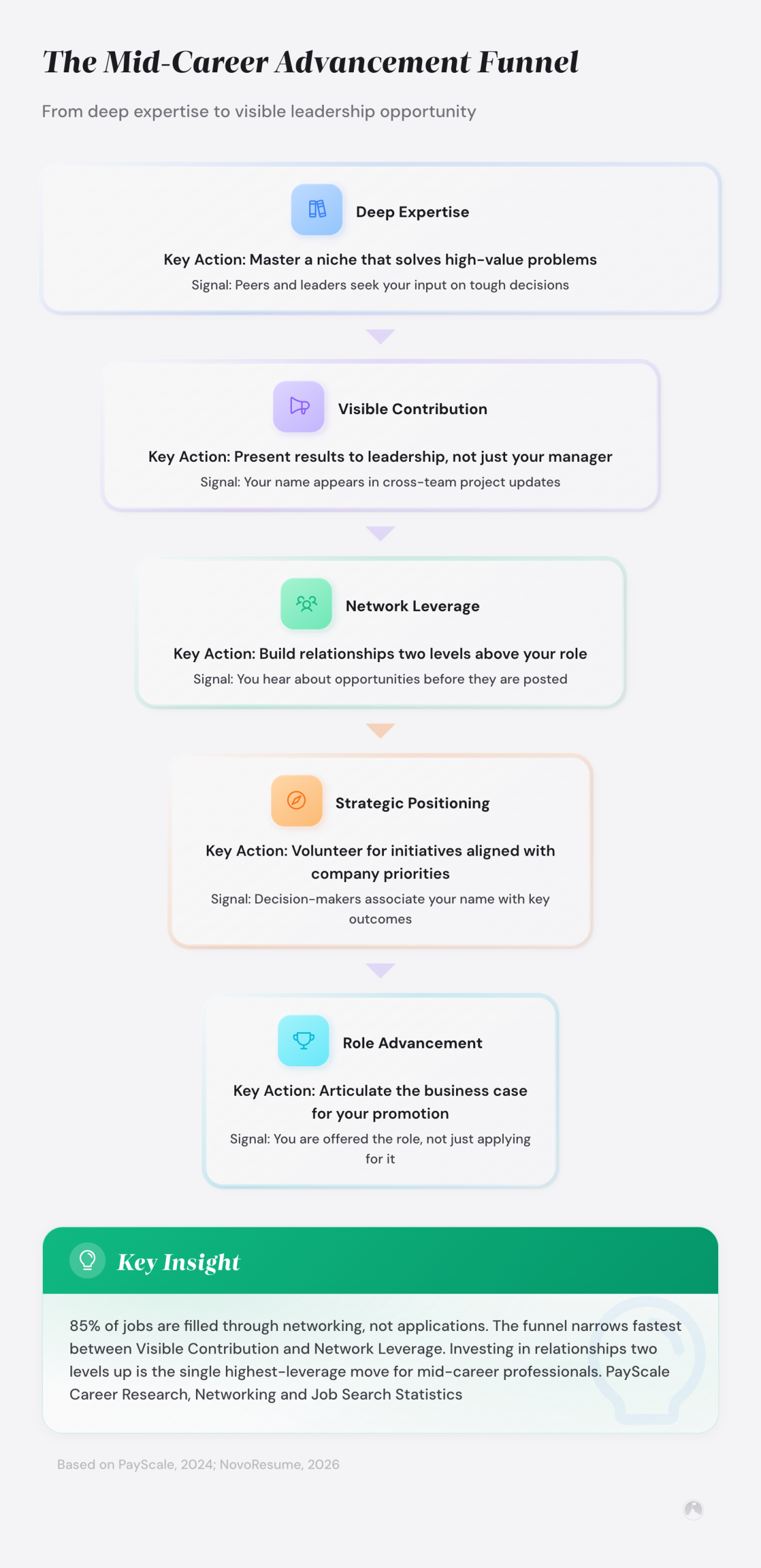
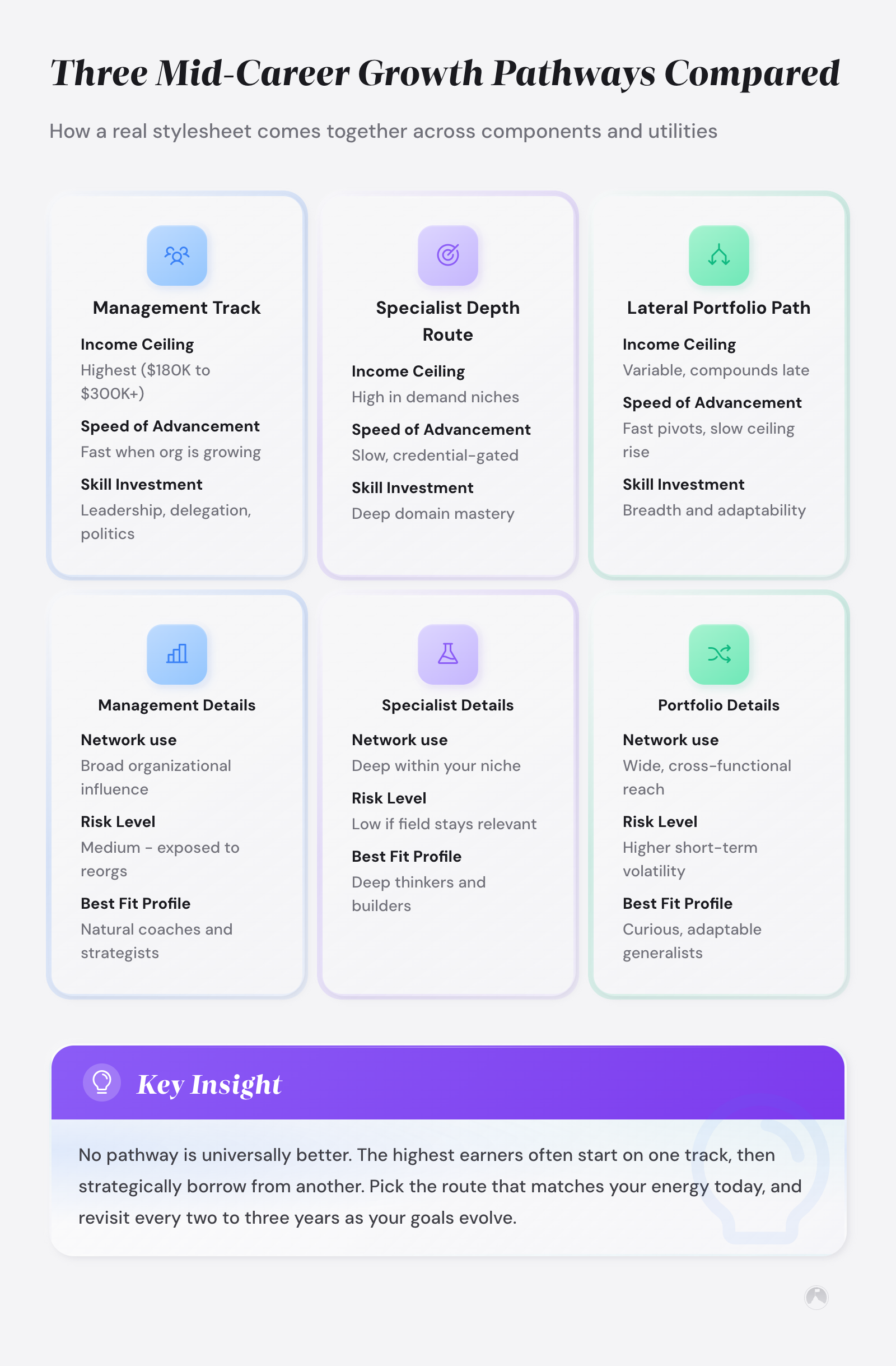
Growth for mid-career professionals actually follows three distinct pathways, and most people need to combine elements from all three rather than pick one. (For a deeper comparison of which mid-career advancement strategies fit which situations, see our guide to career advancement strategies compared.)
Pathway 1: the management track (if that’s your goal)
If your goal is to advance into leadership, this is the most direct path – but the one with the most competition. Mid-career professionals seeking management roles face a specific challenge: you’re competing with both junior rising stars (who are hungrier) and external candidates (who bring fresh perspective).
Executive presence is the ability to communicate strategic thinking, inspire confidence, and project leadership readiness through verbal and nonverbal cues – distinct from charisma or public speaking skill alone.
Research on leadership advancement consistently identifies executive presence as a critical factor in promotion decisions. Senior executives often rank it above track record when evaluating candidates with comparable skills [3]. For mid-career professionals, the communication of strategic thinking matters as much as the thinking itself.
To position yourself for management:
Start by building visible leadership outcomes before you need the title. Lead a cross-functional initiative, mentor junior team members formally, run conversations between departments. The goal isn’t to add to your current workload – it’s to shift your workload toward leadership-oriented tasks.
Second, invest in executive presence. Practice articulating decisions from the business perspective, not the task perspective. Move from “we completed the project” to “this project positioned us for the Q4 initiative.”
Senior decision-makers are listening for whether you think like a leader, not whether you work like one.
Third, build visibility above your current manager. Volunteer for visible projects with senior leadership oversight. Contribute to strategy conversations. Ask thoughtful questions in all-hands meetings. You’re not self-promoting – you’re demonstrating that you think strategically.
Executive presence isn’t a trait you’re born with. It’s a skill that mid-career professionals can develop deliberately.
Pathway 2: the specialist depth route (the overlooked path)
Not everyone wants to manage. Many mid-career professionals achieve more satisfaction and higher compensation by becoming the person everyone trusts for critical expertise. The specialist depth route is the path many skip because it sounds like you’re “not advancing,” when you’re actually becoming indispensable.
Organizations need specialists. Principal engineers, senior strategists, head researchers – these roles exist and pay competitively because the expertise is rare. The gap between mid-career competence and specialist mastery is focused development in a specific niche, not a decade of waiting.
To move into specialist depth:
Identify the specific area where your expertise is becoming rare. Not “I’m good at project management” but “I understand how to integrate legacy systems with modern platforms” or “I can handle regulatory requirements in cross-border transactions.” The more specific and valuable the niche, the more indispensable you become.
Invest in credentials or certifications in that niche if they matter in your field. More importantly, become the person who writes the internal standards, mentors others in the approach, and is consulted when problems arise in that domain.
Build external credibility in the niche. Speak at industry conferences, publish articles, contribute to open source projects if applicable. When your organization considers you for a specialist role, they want evidence that you’re at the forefront of the field, not just internally competent.
A 2023 systematic review of professional development research by Shiri and colleagues found that continuing training and development programs help workers remain in their current roles and advance within them [4]. For mid-career professionals seeking specialist depth, structured development aligned with career goals shows the highest retention and advancement impact.
The specialist who owns a rare niche in an organization doesn’t wait for promotions. When critical expertise is scarce, promotions come looking for the expert.
Pathway 3: the lateral moves and portfolio path (the flexible route)
Some of the fastest career growth for mid-career professionals happens through lateral moves that expand your capabilities rather than moving you up a single ladder. Moving from one department to another, taking on a different function, or building a portfolio approach to your career often accelerates advancement faster than waiting for the next rung.
LinkedIn Learning’s analysis of career advancement data shows that at the two-year mark, employees who have made internal career moves are roughly 20% more likely to remain with their organization than those who haven’t advanced [5]. The two-year internal mobility window matters because it shows organizations that lateral mobility signals commitment, not restlessness.
Lateral moves work because they solve an organizational problem (you bring expertise to a new area) while expanding your perspective and skill set. You come back to your original area more valuable, or you stay in the new area with more authority.
To execute lateral moves strategically:
Look for moves that combine: (1) organizational need, (2) your existing expertise, and (3) skill expansion. Moving from marketing to product when you have marketing depth but want product skills checks all three boxes. Moving to a role with no connection to your background checks only one. (A strategic career planning framework can help you map which lateral moves create the most value.)
Propose the move as a value creation opportunity. “This move would position me to bridge insights from [your area] into [new area], which would improve [specific outcome].” You’re not asking for a lateral move – you’re proposing a strategic business case for it.
Set clear success metrics. “In six months, I want to have established [specific outcome] in this new role.” This turns what could look like running away from advancement into a deliberate career strategy.
The fastest path up is sometimes sideways.
Comparing the three pathways
| Management Track | Specialist Depth | Lateral Moves | |
|---|---|---|---|
| Best for | People who want to lead teams and shape strategy | People who want mastery and deep impact in a domain | People who want breadth, flexibility, and cross-functional influence |
| Timeline | 1-3 years with intentional positioning | 2-4 years of focused niche development | 6-18 months per move, compounding over time |
| Key action | Build executive presence and visibility above your manager | Own a rare niche and build external credibility | Propose moves as strategic business cases |
Mid-career skill development: building what the market needs next
One of the biggest mid-career advancement strategies that gets overlooked is deliberate skill development. Not skill maintenance – skill expansion. The difference matters.
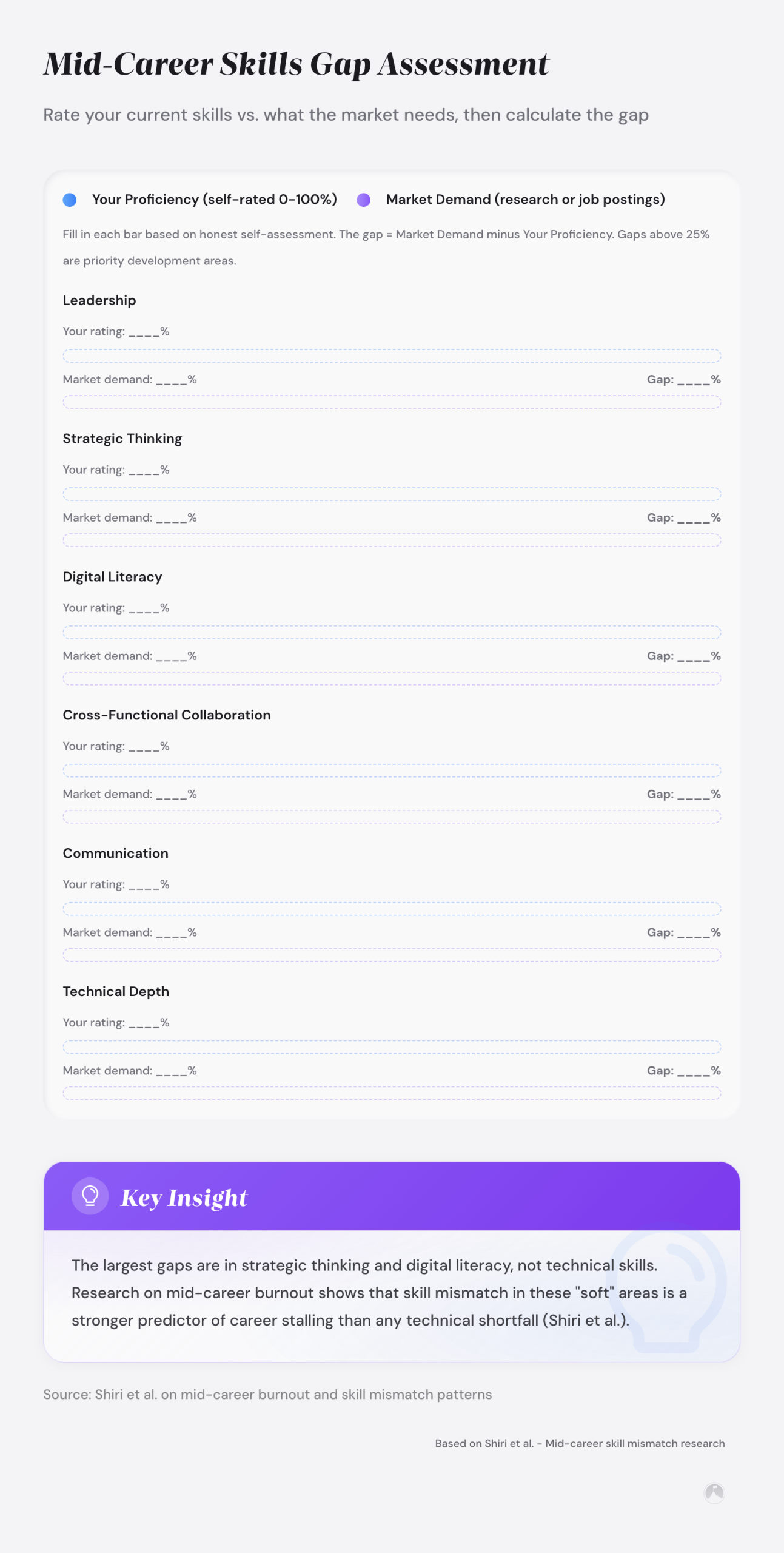
Mid-career professionals should develop skills in three categories. Strategic thinking is first: understanding business outcomes and connecting your expertise to organizational priorities. Leadership capability is second: mentoring, communication, and cross-functional influence whether or not you’re pursuing management. Future-facing technical skills is third: capabilities like AI literacy that demonstrate you’re building forward, not standing still. (For a structured approach to identifying and building these skills, our career development plan template walks through the process step by step.)
The ENCORE program, a structured development initiative for early-to-mid-career researchers studied by Kapoor and colleagues, demonstrated what happens when skill development combines with peer networking. Participants produced over 30 peer-reviewed publications, 36 conference presentations, and 3 successful grant awards [6]. The pattern replicates across industries: combining expertise development with deliberate network-building produces outsized results.
The most valuable mid-career development isn’t learning something new. It’s building future-facing skills on top of what you already know.
How to build visibility without self-promotion
The real barrier to mid-career growth isn’t competence – it’s the fact that your expertise is invisible to the people making advancement decisions. This happens naturally because you’re busy doing your job, and senior decision-makers aren’t in your daily work.
The solution isn’t to self-promote. It’s to make your strategic thinking visible through the work you do.
Visibility for mid-career professionals happens when you connect your daily work to organizational outcomes. Start every major project or initiative by naming the business outcome it supports. In meetings, translate your technical expertise into business impact. When you solve a problem, explain not just how you solved it, but why solving it mattered strategically.
Framing contributions as strategic connections to organizational goals is subtle but consequential. You’re not saying “look at what I did.” You’re saying “here’s how what we’re doing connects to where the organization is headed.” That’s what senior decision-makers want to see – not your effort, but your strategic thinking.
The second visibility lever is controlled networking. You don’t need to be an extrovert or attend every event. You need to be genuinely curious about three to four senior people in your organization (or industry). Asking senior colleagues for specific advice turns networking from awkward small talk into genuine relationship building. “I’m thinking about how to deepen my expertise in X. Who would you recommend I talk to?” (Our guide on networking for career growth goes deeper on how to build these relationships without it feeling forced.)
Wolff and Moser’s longitudinal research on career development found that professionals who actively network experience measurably better advancement outcomes, including salary progression and salary growth rate [7]. For mid-career professionals with existing networks, strategic activation of those relationships yields outsized returns compared to other career development strategies.
The third lever is strategic contribution. Volunteer for projects that are visible to senior leadership, but only projects where you can actually add value and complete successfully. A failed volunteer project is worse for your visibility than no visibility at all.
Visibility isn’t self-promotion. It’s strategic communication of the value you’re already creating.
Overcoming the mid-career plateau mindset
A mid-career plateau is the period when a professional’s advancement stalls despite continued strong performance, typically occurring between years 8-15 when organizational roles narrow and visibility to decision-makers decreases.
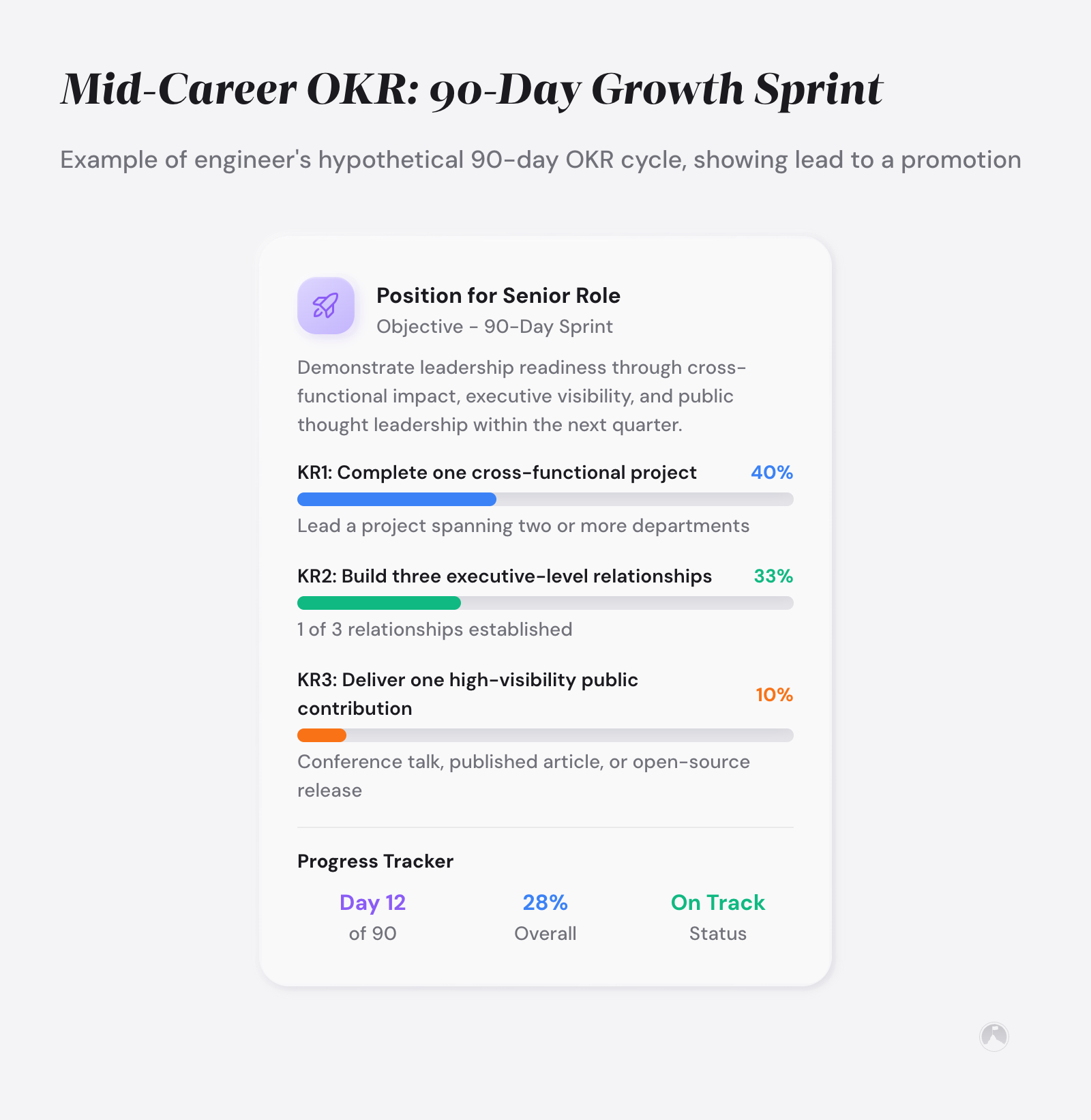
The hardest part of overcoming mid-career plateau isn’t external – it’s the internal narratives. Mid-career professionals carry beliefs that sabotage advancement: that learning new skills at this stage looks desperate rather than ambitious, that job-hopping after 40 looks unstable, that asking for development support signals weakness. (If this sounds familiar, you’re not alone – our article on feeling stuck in your career addresses these patterns in detail.)
The beliefs that mid-career learning looks desperate and job-hopping looks unstable are false, but they’re incredibly common. Let’s address each one.
“Learning new skills at mid-career looks desperate.” Learning new skills at mid-career signals the opposite of desperation. Staying static looks desperate. When mid-career professionals learn new technologies (like AI literacy), it positions them as forward-thinking. The person who learned Python at 45 to stay current is more valuable than the person still using approaches from 20 years ago.
“Job-hopping after 40 looks unstable.” Only if you job-hop to similar roles. Strategic moves that advance your career – especially lateral moves into new domains – read as growth, not instability. Staying in the same role for 15 years reads as stability, but it reads as “this person isn’t ambitious” too. Strategic movement at mid-career signals intentional expertise-building.
“Asking for development support signals weakness.” Organizations that are serious about retention invest in mid-career development. The employees who ask for development opportunities are the ones who stay and advance. The ones who don’t ask are assumed to be fine with stagnation.
“Competing with younger colleagues on technical skills is a losing game.” You’re not competing. You’re complementing. Younger colleagues have recency and hunger. You have judgment and context. Position yourself as the mentor (which builds leadership) rather than the competitor (which breeds resentment). When you frame it as bridging your expertise with emerging approaches, it becomes strength. (For a deeper look at the mindset shifts that career changers need, we’ve written a full guide on the topic.)
The mid-career plateau isn’t a place. It’s a perspective – and perspectives can shift.
The framework that changes everything: the Expertise-Market Fit Model
The core problem mid-career professionals face is that their expertise is misaligned with what the market (internal or external) actually values right now. You might be expert at something that was important three years ago but is becoming commoditized. Or you might have valuable expertise but nobody knows it.
Here’s a framework we’ve developed by mapping patterns across career development research. We call it the Expertise-Market Fit Model. Three dimensions, assessed honestly, for every career decision. None of these dimensions are new – but the model that maps them together is our synthesis of what career development research consistently highlights.
The Expertise-Market Fit Model positions your growth in three dimensions: expertise depth, market value, and visibility fit.
Dimension 1 – Expertise depth: What are you genuinely expert at? Not “good at” – expert. Where can you legitimately claim to be in the top 10-15% of your field? This is where you operate from a position of confidence, not hustle.
Dimension 2 – Market value: Of your areas of expertise, which ones does the market (your organization, your industry, your next potential employer) actually need right now? An expert in a dying skill isn’t valuable. An expert in a skill the market is scrambling to find is invaluable.
Dimension 3 – Visibility fit: Of the expertise that the market values, how aware is the market that you have it? A valuable expertise that’s invisible is only valuable to you personally. Visibility without expertise is just noise.
Growth happens at the intersection of all three. If you have expertise depth in something the market needs but you’re invisible, visibility is your growth lever. If you’re visible for something but the market’s priorities are shifting, developing new expertise is your growth lever. If your expertise is visible but becoming commoditized, developing new depth is your growth lever.
Map your three dimensions honestly. Then choose your growth lever based on which dimension is weakest.
Career growth isn’t about getting better at everything. It’s about getting visible at what the market values most.
What’s holding your growth back: the diagnosis
Before implementing any strategy, diagnose where you actually are. Most mid-career professionals blame one of three things for their plateau: their company, their manager, or themselves. Usually it’s more nuanced.
Company-level plateau: You’re in an organization with genuine structural limits. There are only so many senior roles, and they’re not opening. In this case, lateral moves and specialist depth become more valuable than management advancement. If your organization isn’t investing in mid-career development, that’s information you can act on.
Manager-level plateau: Your manager doesn’t have the authority to promote you, or isn’t advocating for you. This is frustrating but solvable. Build visibility directly with decision-makers above your manager. Make your case for advancement clearly and strategically, but don’t rely solely on your manager to open the door.
Personal capability plateau: You have specific gaps (leadership skills, technical depth, business acumen) that are genuinely holding you back. This is actually the most solvable because it’s in your control. Be honest about what you need to develop and invest in it deliberately.
Most mid-career plateaus are a combination of all three, but in different proportions. Diagnosis comes first. Strategy follows the diagnosis, not the other way around.
The person who diagnoses accurately moves faster than the person who works harder.
Conclusion
The mid-career years are when you have the most control over your trajectory. You have enough expertise to be genuinely useful. You have enough experience to make strategic decisions about where you want to go. You haven’t yet calcified into a single role the way some senior people do. This is the sweet spot for career growth for mid-career professionals, not the plateau most people think it is.
The paths forward aren’t mysterious. They’re management advancement, specialist depth, and lateral movement – often in combination.
The strategies aren’t complicated – they’re visibility, strategic contribution, and relationship building. The only thing that changes at mid-career is that none of this works if you’re waiting to be discovered. You have to be intentional about where you’re going and strategic about building the expertise and visibility to get there.
The question isn’t whether you can grow at mid-career. It’s whether you’ll treat your position as a limitation or a launching point.
Next 10 minutes
- Identify which of the three pathways (management, specialist, lateral) aligns best with where you want your career to go
- Write down one specific outcome you want in the next 18 months
- Identify one senior person in your organization (or industry) you’d like to build a relationship with
This week
- Schedule a conversation with that senior person asking for advice on moving toward your 18-month goal
- Map your current expertise against what the market actually needs right now
- Identify the weakest dimension in your Expertise-Market Fit Model and commit to one concrete action to strengthen it
Ramon’s Take
From what I’ve read, the visibility piece is where most people stall, not the skills. So before you sign up for another certification, spend 30 minutes writing down who outside your company could benefit from what you already know. That list probably matters more.
There is more to explore
For the pillar overview of all career growth strategies across stages, visit our career growth strategies guide. And for practical approaches to navigating career transitions at this stage, explore our guide to career growth after 40.
Related articles in this guide
- career-growth-remote-workers
- career-planning-tools-frameworks
- effective-development-goals-planning-achievement
Frequently asked questions
What are the unique challenges of mid-career professionals?
Mid-career professionals face a structural challenge: the traditional career ladder has fewer rungs above than below. Organizations have limited senior roles but many mid-level ones. Mid-career professionals compete with both younger rising stars (who are hungry and mobile) and external candidates (who bring fresh perspective). Expertise developed over 10-15 years becomes taken for granted internally, making advancement require intentional visibility-building, not just performance.
How can I break through a mid-career plateau?
Start by diagnosing the type of plateau you’re facing. If your company has structural limits on senior roles, lateral moves or specialist depth may be more effective than waiting for a promotion. If your manager isn’t advocating for you, build direct visibility with decision-makers one or two levels above. Working with a career coach or trusted mentor outside your organization can help you see blind spots in your positioning that colleagues inside your company may not surface.
Should mid-career professionals pursue management or specialist roles?
It depends on your goals, energy, and organizational structure. Management advancement is faster in organizations with many senior roles but more competitive. Specialist depth is often more satisfying and can be equally well-compensated but requires becoming genuinely rare in a specific domain. Lateral moves combined with either pathway often accelerate advancement faster than waiting for a promotion in your current direction. Choose based on what energizes you, not what sounds more prestigious.
How important is networking for mid-career advancement?
Networking is the single most important mid-career advancement strategy, but at this stage it works differently than early-career networking. Focus on activating your existing relationships rather than building new ones from scratch. Reach out to three to four senior contacts per quarter with specific questions about your growth area. The difference between maintaining a network and activating it is the difference between staying visible and creating opportunities.
Can mid-career professionals compete with younger talent?
Mid-career professionals don’t need to compete on the same terms. In hiring committees, your value proposition is judgment, organizational knowledge, and the ability to mentor others — qualities that take years to develop. In technical interviews, frame your answers through the lens of business impact rather than raw technical speed. In youth-focused industries, position your experience as the bridge between fast execution and strategic direction that teams need.
What skills should mid-career professionals develop?
Mid-career professionals should develop skills in three categories: (1) Strategic thinking – understanding business outcomes and connecting your expertise to organizational priorities; (2) Leadership capability – mentoring, communication, and cross-functional influence whether or not you’re pursuing management; (3) Future-facing technical skills – like AI literacy – that demonstrate you’re staying current on top of deep expertise. The most valuable development is building future-facing skills on top of existing expertise, not abandoning expertise to chase trends.
Is it too late to change careers in your 40s or 50s?
It’s not too late, but it requires a different strategy than changing careers at 25. At mid-career, your market value comes from combining your expertise with fresh direction. Lateral moves into adjacent domains (using existing expertise) are often more effective than complete pivots. Professional maturity and metacognitive awareness mean mid-career professionals often learn adjacent skills faster than early-career workers. Frame the change as expanding your expertise rather than abandoning it.
How do I demonstrate value to employers if I’ve been in the same role for years?
Demonstrate value by making your strategic impact visible. Translate your technical accomplishments into business outcomes. Lead visible projects that solve organizational problems. Mentor junior people (which builds leadership visibility). Contribute to strategy conversations. Update your skills visibly – learn new tools, attend relevant conferences, share insights with colleagues. The gap between being valuable and being seen as valuable is visibility. Focus on closing that gap through how you frame your work and contribute to organizational priorities.
References
[1] PayScale. “How Many Jobs Are Filled Through Networking?” PayScale Career Advice, 2024. https://www.payscale.com/career-advice/many-jobs-found-networking
[2] NovoResume. “25+ Surprising Networking Statistics.” Accessed 2026. https://novoresume.com/career-blog/networking-statistics
[3] Hewlett, S. A. (2014). Executive Presence: The Missing Link Between Merit and Success. Center for Talent Innovation / HarperBusiness. Research originally published by the Center for Talent Innovation (now Coqual), 2012.
[4] Shiri, R., El-Metwally, A., Sallinen, M., Poyry, M., Harma, M., & Toppinen-Tanner, S. (2023). “The Role of Continuing Professional Training or Development in Maintaining Current Employment: A Systematic Review.” Healthcare, 11(21), 2900. https://pmc.ncbi.nlm.nih.gov/articles/PMC10647344/
[5] LinkedIn Learning. “How Career Pathing Leads to Employee Retention.” LinkedIn Learning Resources, 2022. https://learning.linkedin.com/resources/career-development/career-pathing-employee-retention
[6] Kapoor, N., et al. (2024). “Strengthening Research Capacity of Early-Mid Career Researchers: Implementation and Evaluation of the ENCORE Program.” SAGE Open, 14(2). https://doi.org/10.1177/10815589241236156
[7] Wolff, H.-G. & Moser, K. (2009). “Effects of Networking on Career Success: A Longitudinal Study.” Journal of Applied Psychology, 94(1), 196-206. https://doi.org/10.1037/a0013350