
Why most professionals read the wrong career books
Career growth books for professionals sit on shelves gathering dust because they don’t match the specific challenge in front of you. A book about executive presence doesn’t help when you’re weighing a career pivot. And a book about non-linear careers misses the mark when you’re struggling with confidence in a new role. The gap between reading career books and applying career books isn’t about the books themselves. Most professionals read career books generically when they should be reading surgically – matching each book to a specific development need.
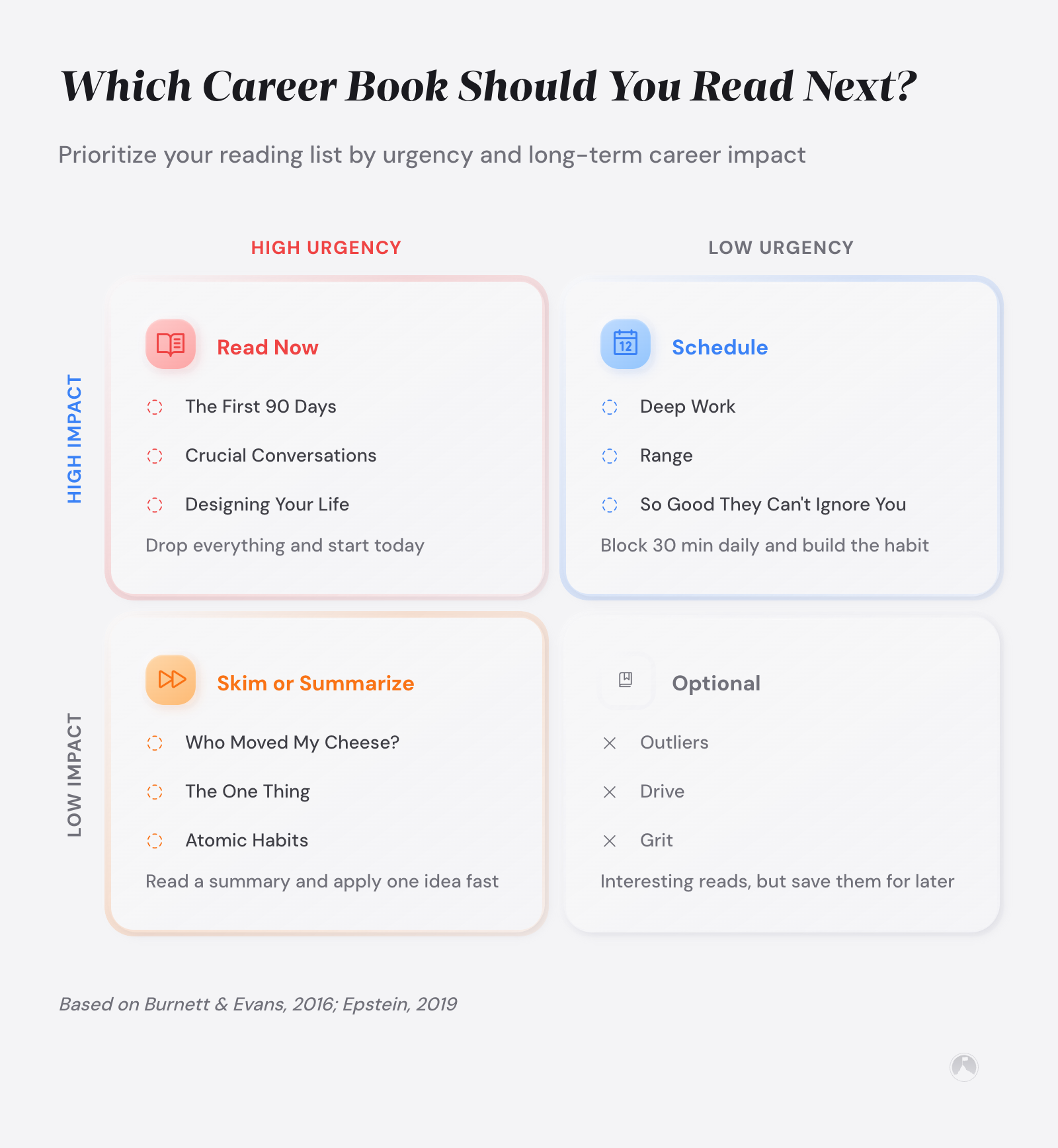
The professionals who actually advance read intentionally. Rather than chasing the latest bestseller, they match books to specific development needs. Strategic, goal-targeted learning produces significantly better outcomes than generic resource consumption. But here’s what separates the readers who grow from the ones who just accumulate information: they treat career books as tools, not general education.
This guide uses a four-dimension framework we developed to organize eight foundational career growth books for professionals by what they solve: non-linear paths, resilience, strategic visibility, and transitions. You’ll find your entry point – whether you’re feeling stuck in your current role, preparing for a promotion, or making a major change.
The best career growth books for professionals are The Squiggly Career and Range (for non-linear paths), Mindset and The Happiness Advantage (for resilience), Platform and Never Eat Alone (for visibility), and Designing Your Life and The Start-up of You (for career transitions).
What you will learn
- How to thrive in careers that don’t follow a straight path, and why that’s your advantage
- What separates high performers from those who burn out (hint: it’s not opportunity)
- How to build a personal brand that creates opportunities without traditional self-promotion
- Frameworks for making career changes without starting from scratch
Key takeaways
- Match your book choice to your immediate career challenge, not to bestseller lists – this single shift changes what you actually implement.
- The four-dimension framework (non-linearity, resilience, visibility, transitions) helps you diagnose which gap is holding you back.
- Many professionals revisit the same books as their needs change, rather than constantly reading new ones – strategic rereading beats volume.
- 89% of Gen Z workers and 92% of millennials say a sense of purpose is important to job satisfaction, suggesting non-linear career paths driven by meaning may offer higher satisfaction than traditional ladder climbing [2].
- Carol Dweck’s research shows that growth mindset changes how people interpret setbacks, which determines whether they persist or retreat [3].
- Research by Jennifer Kahnweiler shows introversion is an advantage in personal branding, not a barrier – introverts build platforms through writing and depth [4].
- Career transition books turn abstract fear into concrete, testable experiments.
- The best career books combine research with concrete exercises you can use this week.
Dimension 1: career growth books for non-linear paths
Career advice assumes a linear ladder – entry-level to manager to director to executive. But modern careers aren’t ladders. You pivot industries. You take a step sideways for growth. You leave a prestigious company to join something earlier-stage. Most of us are doing something messier (and that’s actually fine).
The squiggly career by Sarah Ellis and Helen Tupper
The Squiggly Career is the foundational book for making sense of modern careers. Sarah Ellis and Helen Tupper, founders of the coaching platform Amazing If, define a squiggly career as nonlinear, multidirectional, and driven by growth rather than titles [5]. Ellis and Tupper’s reframe of non-linear careers as competitive advantage changes how professionals view unconventional paths.
Rather than viewing a career pivot as proof you were lost, Ellis and Tupper show how each variation builds diverse skills that become irreplaceable [5]. The most useful section covers identifying your “squiggly ingredients” – the specific combination of skills, interests, and motivations that guide your next move, even when you can’t articulate the full path yet. You don’t need the entire career mapped to make the next right step.
Best for: Mid-career transitions, people who’ve changed industries, anyone whose career doesn’t match the traditional narrative. Read this first if you’re unsure whether your unconventional path is an asset or liability.
Ellis and Tupper’s core insight: non-linear careers aren’t plan failures – they’re evidence of adaptability, and adaptability is among the most valued professional skills in 2026 [5].
Range by David Epstein
David Epstein’s Range [6] challenges the core assumption in achievement literature: that early specialization and deep focus are the only paths to excellence. David Epstein’s research in Range shows that broad experience often outperforms narrow specialization in complex environments [6].
The book provides case studies of Fortune 500 CEOs, Olympic athletes, and innovators who explored multiple interests before finding their ultimate domain. Range reframes those “wasted” years in the wrong field as foundation-building. Career variety builds the cross-domain thinking that complex modern problems actually require.
Best for: Career-changers with scattered experience, professionals feeling early-specialization pressure, anyone building a career in complex or emerging fields.
Dimension 2: best professional development books for mindset and resilience
Career advancement isn’t usually blocked by lack of opportunity. It’s blocked by how you interpret setbacks. A failed project, a missed promotion, or critical feedback sends some professionals into retreat while others see it as data for improvement. Carol Dweck’s research shows this difference comes down to your underlying belief system about whether abilities are fixed or can be developed [3].
Mindset by Carol Dweck
Mindset is the influential research on growth versus fixed mindset. Carol Dweck’s work, which has become foundational to professional development practice, found that people who believe abilities can be developed through effort show greater persistence after setbacks than those who view abilities as static [3]. A longitudinal study by Blackwell, Trzesniewski, and Dweck confirmed the mechanism: growth mindset changes how individuals interpret challenges, which directly affects their behavioral response and effort [7]. In your career, this distinction determines whether a skill gap means “I can’t do this” or “I can’t do this yet.” It’s worth noting that growth mindset research has faced replication challenges, and the effects may be more nuanced than originally reported. The practical applications – focusing on effort and learning from setbacks – remain widely endorsed even as the underlying science continues to develop.
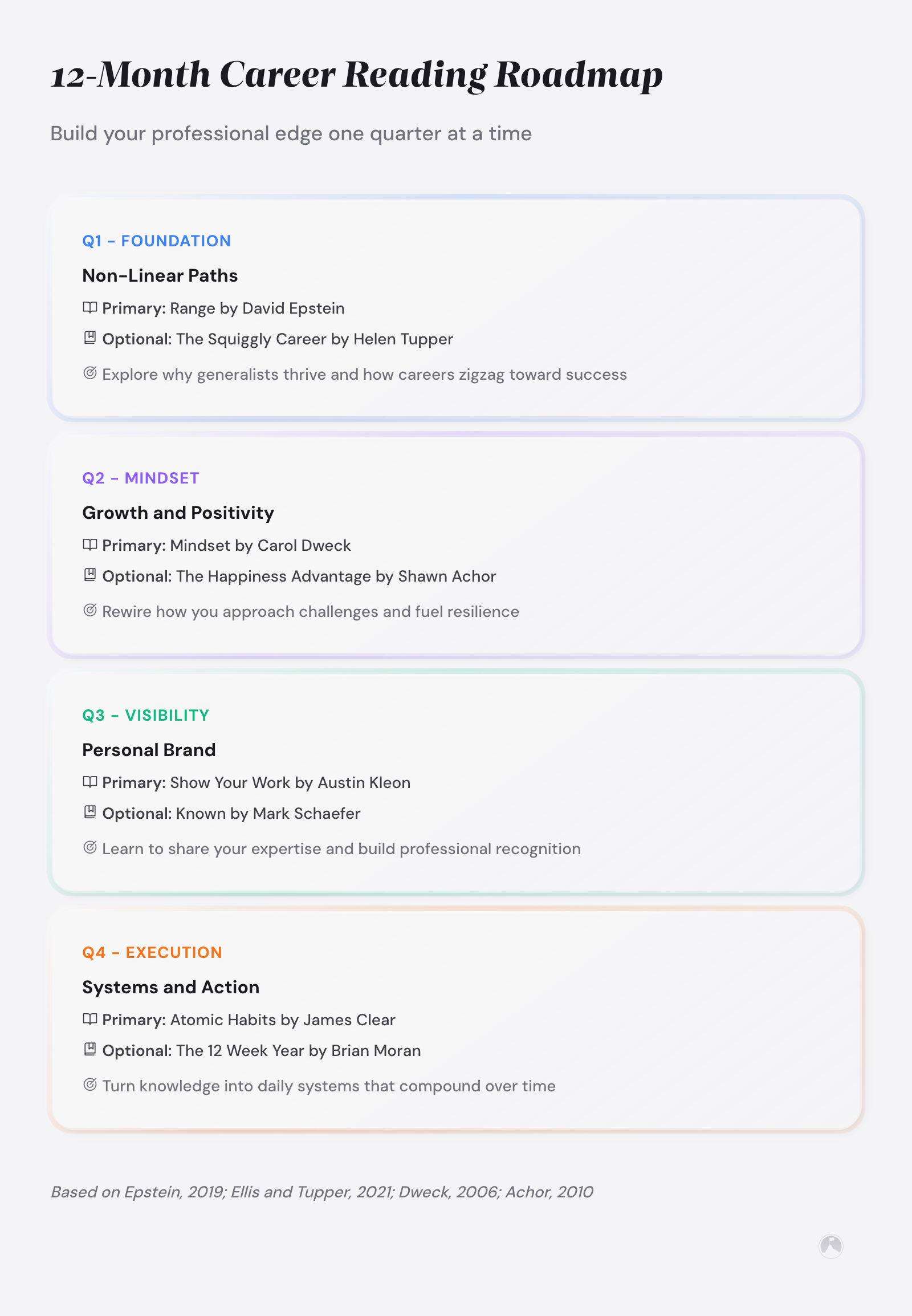
The book walks through how mindset shapes your responses to challenges, criticism, and effort. Then it provides specific language and practices for shifting toward growth mindset. For instance, Dweck recommends replacing “I’m not good at this” with “I’m not good at this yet” – a single word change that shifts your brain from fixed to growth interpretation. So even if the concepts feel familiar from productivity reading, the practical exercises help you identify where limiting beliefs are quietly holding you back.
Best for: Professionals facing new challenges outside their comfort zone, those struggling with perfectionism, people in high-stakes roles where mistakes feel catastrophic.
Research by Dweck and colleagues shows that professionals who believe abilities are developable through effort show greater persistence after setbacks than those who view abilities as fixed [3] – making mindset one of the highest-leverage factors in career advancement.
The happiness advantage by Shawn Achor
Most career literature tells you to fix yourself first, then success will follow. Shawn Achor reverses this. His neuroscience research in The Happiness Advantage [8] shows that when you’re in a positive mental state, your brain becomes more engaged, creative, motivated, and resilient. Positivity isn’t the outcome of success – it’s the precondition for it.
The book provides seven research-backed principles for building sustainable positivity even when workplace stress is high. Unlike typical motivation books, Achor’s work is grounded in neuroscience and includes small, specific practices (21-day protocols) you can implement immediately. One protocol: spend two minutes each morning writing down three things you’re grateful for. Achor’s research found this simple practice measurably shifts how your brain scans for opportunities versus threats. Having immediately implementable practices matters when you’re in a difficult role or managing a transition where stress is high and motivation naturally dips.
Best for: Burned-out professionals, those managing transitions or difficult projects, anyone whose job has made them pessimistic about their prospects.
The path to career success runs through your neurochemistry, not just your credentials.
Dimension 3: top career advancement books for visibility and personal brand
Career advancement requires visibility. But most professionals resist personal branding because it feels like self-promotion. For introverts and technical specialists especially, building visibility can feel inauthentic. These books show how to create visibility through expertise and relationship-building rather than performative self-promotion.
Platform by Michael Hyatt
A professional platform is a visible body of work, expertise, and audience built through consistent value-sharing rather than self-promotion. Michael Hyatt’s Platform [9] is designed for professionals who want visibility but don’t want to become influencers. The book walks through identifying your unique message, finding your audience, and creating content that demonstrates competence rather than promoting ego.
Hyatt’s starting point is writing one article per week on your area of expertise – not to build an audience immediately, but to clarify your unique message through the discipline of putting ideas into words. The practical focus on LinkedIn, writing, speaking, and community-building makes this immediately actionable. And research by Jennifer Kahnweiler shows that introversion is actually a distinct advantage in this approach – introverts’ deeper thinking and writing strength naturally align with content-based platform building [4]. So if you’ve built real expertise but haven’t turned it into visibility, this framework is straightforward and non-sleazy.
Best for: Technical professionals, introverts, subject-matter experts promoted past their comfort zone but lacking executive visibility. This is one of the best professional development books for 2026 if you’re strong on substance but invisible to decision-makers.
Professional platform building works best as expertise-sharing rather than self-promotion – professionals who consistently share domain knowledge build visibility that creates career opportunities without performative networking [9].
Never eat alone by Keith Ferrazzi
Relationship capital is the cumulative value of professional connections built through genuine reciprocity rather than transactional networking. Keith Ferrazzi’s Never Eat Alone [10] is built on this idea – that authentic relationships, not contact volume, drive career opportunities. Unlike transactional networking books, Ferrazzi frames networking as genuine relationship-building, not contact collection.
When you eat alone, you don’t build the relationships that surface opportunities, mentorship, and real support. And this isn’t just Ferrazzi’s philosophy. A longitudinal study by Wolff and Moser found that professionals who strategically build and maintain networks experience measurable salary growth and increased promotion opportunities over time [11]. Ferrazzi provides specific tactics for overcoming networking anxiety, maintaining relationships through dormant periods, and creating genuine mutual value.
Best for: People entering new roles, those transitioning to leadership, professionals whose careers have been isolated or technical. Read this if you’re promoting into a position where you need visibility across a wider organization.
Ferrazzi’s core argument: career opportunities flow through relationships – invest in genuine connections, not contact collection [10].
Dimension 4: career change books for professionals in transition
Career transitions aren’t just logistical – they’re identity shifts involving emotional and financial complexity that require systematic attention [12]. You’re leaving behind expertise you built over years and managing financial uncertainty and imposter syndrome simultaneously. Surface-level career advice misses what these transitions require.
Designing your life by Bill Burnett and Dave Evans
Design thinking applied to careers means prototyping multiple life and career options through small experiments before committing to a single path. Bill Burnett and Dave Evans, design researchers at Stanford, bring this approach to career transitions in Designing Your Life [13]. Rather than asking “What’s my dream job?” (which is an impossible question), Burnett and Evans teach you to prototype different options and test them before committing. The framework reduces fear by making big decisions into smaller, testable experiments.
The book walks through exercises like creating alternative life designs and identifying what’s actually driving your transition desire versus what’s noise. One particularly useful section on “dysfunctional beliefs” helps you distinguish between real barriers and self-imposed limitations that feel like barriers. If you’re building a career development plan, this book gives you the thinking tools to back it up.
Best for: Anyone considering a career change, people wanting to exit a dead-end role, professionals at identity inflection points (becoming a manager, changing fields, mid-life pivots).
Design your transition as an experiment with multiple options, not as a single irreversible decision.
The start-up of you by Reid Hoffman and Ben Casnocha
Reid Hoffman, founder of LinkedIn, frames your career as a startup in The Start-up of You [14]. Hoffman’s career-as-startup reframe is powerful during transitions because it shifts your mental model from “getting hired for a job” to “building a career that adapts and grows.” The book provides frameworks for identifying your competitive advantage and taking intelligent risks.
One key insight is the ABZ framework: Plan A (your current path), Plan B (your prepared pivot), and Plan Z (your fallback if everything fails). The ABZ framework reduces anxiety because you’re not betting everything on one outcome. The book also emphasizes continuous learning as insurance against disruption – increasingly relevant as AI and industry change accelerate.
Best for: Professionals making major pivots, those in volatile industries, people building careers across multiple income streams, anyone wanting to think strategically about career risk.
Your career is a long-term strategy with multiple plans, not a single path – build optionality into every move.
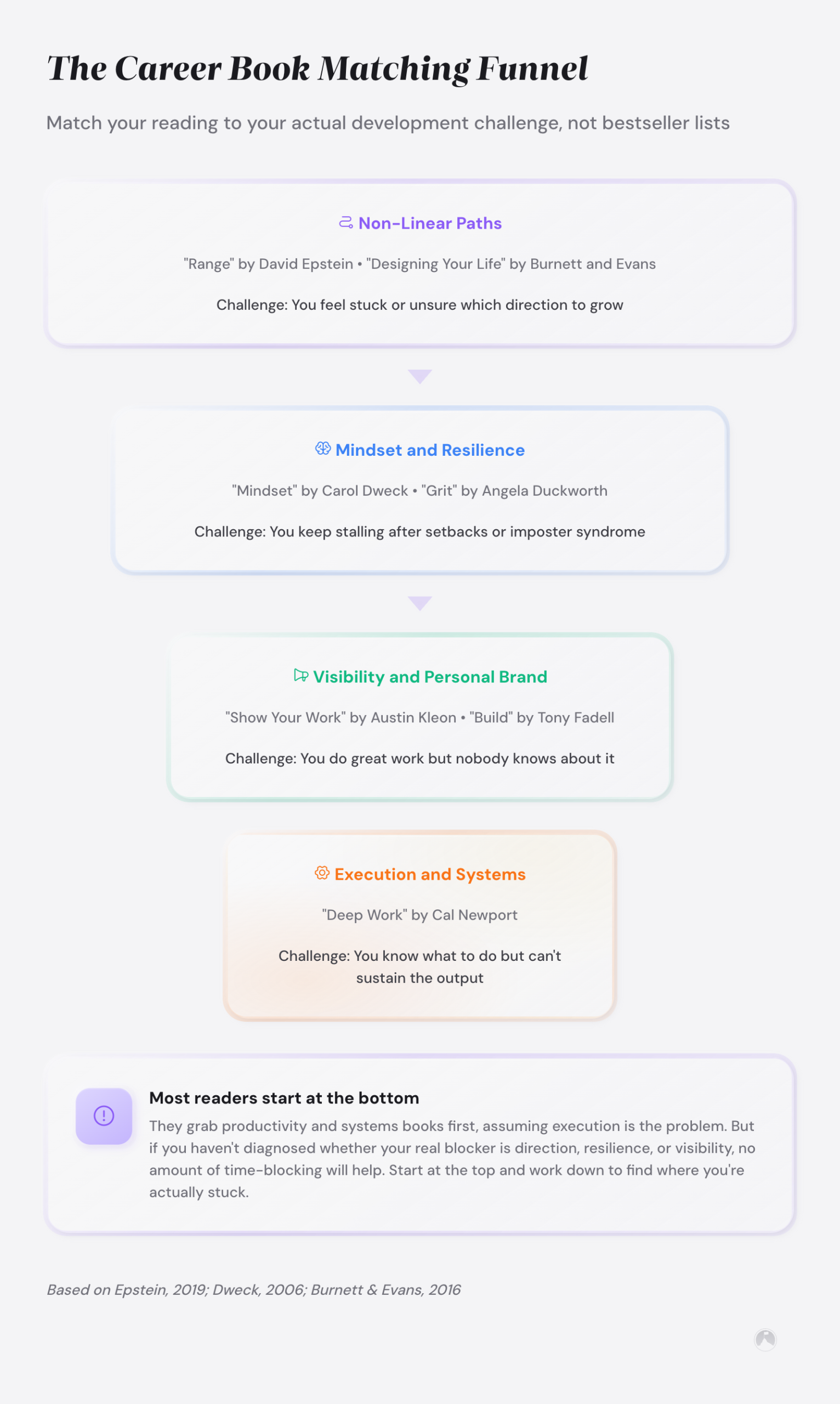
Comparing all 8 career growth books for professionals
Here’s a quick-reference comparison so you can match books to your situation without scrolling back through each section.
| Book | Best for (Dimension) | Key insight |
|---|---|---|
| The Squiggly Career | Career-changers, unconventional paths (Non-linear paths) | Reframes non-linear careers as advantage |
| Range | Scattered experience, late specializers (Non-linear paths) | Research-backed case for generalists |
| Mindset | New challenges, perfectionism (Resilience) | Foundational growth vs. fixed research |
| The Happiness Advantage | Burnout, difficult transitions (Resilience) | Neuroscience-backed positivity protocols |
| Platform | Introverts, technical experts (Visibility) | Visibility through expertise, not ego |
| Never Eat Alone | New roles, isolated professionals (Visibility) | Relationship-based career advancement |
| Designing Your Life | Career changers, identity shifts (Transitions) | Prototyping approach to big decisions |
| The Start-up of You | Major pivots, volatile industries (Transitions) | ABZ framework for career optionality |
How to choose your first read from these leadership development book recommendations
You don’t need to read all eight books. And you shouldn’t read them randomly. Here’s how to choose your entry point based on what’s actually blocking your career growth right now.
If you’re in a stable role but feeling stuck or uninspired, start with Mindset – your growth ceiling is often psychological, not circumstantial. If you’re energized but your visibility doesn’t match your contribution, start with Platform. If you’re considering a major change, start with Designing Your Life. And if your career path has felt “wrong” because you’ve taken unconventional steps, start with The Squiggly Career.
Many professionals find it useful to read one book from the mindset dimension first, then one from the dimension matching their immediate challenge. Combining internal mindset work with external career strategy creates the conditions for actual career advancement rather than just theoretical knowledge.
But here’s the part most people miss: revisit these books as your career evolves. A book on transitions becomes relevant again when you consider another pivot. A book on visibility becomes valuable again when you’re promoted. The professionals advancing fastest aren’t reading more books – they’re using books more strategically.
Book selection template
Copy this into your notes and fill in the blanks:
My current career challenge: _______________
Dimension it falls under: [ ] Non-linear paths [ ] Resilience [ ] Visibility [ ] Transitions
Book I'm starting with: _______________
One thing I want this book to help me do: _______________
Date I'll revisit this choice: _______________ (set 3 months out)
Conclusion
In 2026, career growth books for professionals work best when matched to your current development need rather than your current interest. The four-dimension framework – non-linear paths, resilience, visibility, and transitions – helps you identify which books will create the most impact for your situation right now. The professionals who advance fastest aren’t reading constantly. They’re reading strategically and implementing frameworks across years rather than just absorbing ideas.
Your career advancement isn’t blocked by lack of knowledge. It’s blocked by misalignment between your internal beliefs and external strategies. The professionals who advance fastest aren’t the ones who read the most career books. They’re the ones who read one book at exactly the right moment and act on it before the insight fades.
In the next 10 minutes
- Identify which of the four dimensions matches your current career challenge
- Pick one book from that dimension and order it or download it
- Fill out the book selection template above so you have a clear starting point
This week
- Read the first 10-15 pages to grasp the book’s core framework
- Identify one concept that directly applies to something happening in your role right now
- Do one small experiment with that concept and observe what shifts
- Set a calendar reminder for 3 months out to reassess which dimension needs attention next
Ramon’s take
Pick the book that matches what’s annoying you at work right now, not the one that sounds smartest. From what I’ve read, people who do that actually finish the book. And finishing one book beats having a great reading list every time.
Related articles in this guide
Frequently asked questions
What are the best professional development books for mid-career professionals?
For mid-career professionals, start with The Squiggly Career if you’re reassessing direction, or Mindset if you’re facing new challenges in your current role. If you’ve been in your field for 5-10 years and feel invisible, Platform is particularly valuable for building the visibility that leads to senior-level opportunities.
Which career books help with imposter syndrome?
Mindset by Carol Dweck addresses the fixed beliefs that fuel imposter syndrome, while Range by David Epstein reframes career variety as expertise rather than failure. Many professionals find Designing Your Life helpful because it separates real barriers from self-imposed limitations.
Are career development books worth reading if I’m already successful?
Yes, especially if you’re successful in one dimension but stuck in another. Successful professionals often plateau because they’ve optimized their current role but haven’t addressed new challenges. Reading strategically – matching the book to your current development need – is how successful people maintain momentum.
What should I read if I’m planning a career change?
Start with Designing Your Life if you’re unsure whether to change – its prototyping exercises help you test options before committing. If you’ve already decided to change, The Start-up of You provides the strategic framework (especially the ABZ planning method) for managing risk during the transition. Pair either with one book from the resilience dimension, since career changes test your mindset as much as your strategy.
How often should professionals read career development books?
Watch for these signals that it’s time for your next career book: you’ve been in the same role for 12+ months without growth, you’re facing a challenge outside your current skill set, or you notice yourself avoiding a specific career conversation (that avoidance usually points to the dimension you need). Most professionals benefit from one strategic career book every 6-12 months, not continuous reading.
Which books are best for introverts or technical professionals?
Platform by Michael Hyatt works for introverts because it replaces networking events with written content – and introverts naturally produce deeper, more thoughtful written work. Start with one long-form piece per month on your area of expertise. For relationship-building, Never Eat Alone’s approach of deeper one-on-one connections over broad networking suits introverts’ preference for meaningful conversation over small talk.
What are the best leadership development book recommendations from this list?
For leadership development, start with Mindset if you’re building resilience as a new leader, or Platform if you need to increase your visibility across the organization. The Start-up of You is strong for leaders thinking strategically about career optionality and managing teams through transitions. If you’re working on a broader career growth strategy, these three books cover the internal and external dimensions of leadership development.
References
[2] Deloitte. (2025). Gen Z and Millennial Survey. https://www2.deloitte.com/us/en/insights/topics/talent/gen-z-millennials-survey.html
[3] Dweck, Carol S. (2006). Mindset: The New Psychology of Success. Random House.
[4] Kahnweiler, J.B. (2013). The Introverted Leader: Building on Your Quiet Strength. Berrett-Koehler Publishers.
[5] Ellis, Sarah and Tupper, Helen. (2021). The Squiggly Career: The New Model for Work and Success. Hodder and Stoughton.
[6] Epstein, David. (2019). Range: Why Generalists Triumph in a Specialized World. Riverhead Books.
[7] Blackwell, L.S., Trzesniewski, K.H., and Dweck, C.S. (2007). Implicit Theories of Intelligence Predict Achievement Across an Adolescent Transition: A Longitudinal Study and an Intervention. Child Development, 78(1), 246-263. https://doi.org/10.1111/j.1467-8624.2007.00995.x
[8] Achor, Shawn. (2010). The Happiness Advantage: The Seven Principles of Positive Psychology That Fuel Success and Performance at Work. Crown Business.
[9] Hyatt, Michael. (2012). Platform: Get Noticed and Grow Your Business. Thomas Nelson.
[10] Ferrazzi, Keith. (2005). Never Eat Alone: And Other Secrets to Success, One Relationship at a Time. Crown Business.
[11] Wolff, H.-G., & Moser, K. (2009). Effects of networking on career success: A longitudinal study. Journal of Applied Psychology, 94(1), 196-206.
[12] Schlossberg, N.K. (2011). The Challenge of Change: The Transition Model and Its Applications. Journal of Employment Counseling, 48(4), 159-162. https://doi.org/10.1002/j.2161-1920.2011.tb01102.x
[13] Burnett, Bill and Evans, Dave. (2016). Designing Your Life: How to Build a Well-Lived, Joyful Life. Knopf.
[14] Hoffman, Reid and Casnocha, Ben. (2012). The Start-up of You: Adapt to the Future, Invest in Yourself, and Transform Your Career. Crown Business.