
The person who keeps winning at jobs they hate
Career development psychology research points to a pattern that rational planning can’t explain: people who consistently succeed at work they find meaningless. They climb, they deliver, they get promoted. And they feel worse each year.
Research on career development theory shows this pattern clearly. Career satisfaction depends less on how fast you advance and more on whether your career fits who you’re becoming [1]. The finding that career satisfaction depends on identity fit rather than advancement speed upends the standard advice to “network harder” or “build more skills.” The real question isn’t whether you’re advancing. It’s whether your career is developing in a direction your psychology can sustain.
Career development psychology is the study of how identity, personality, beliefs, and chance interact to shape career trajectories over a lifetime. It examines why some career paths feel sustainable and others create friction – even when external markers of success look identical.
Career development psychology is the study of how identity, personality, self-efficacy beliefs, and chance shape career trajectories. Four foundational theories – Super’s self-concept theory, Holland’s RIASEC model, social cognitive career theory, and Krumboltz’s happenstance learning theory – explain why career paths that look successful can feel unsustainable.
Key takeaways
- Career development psychology studies how identity, personality, beliefs, and chance shape career trajectories.
- Super’s self-concept theory shows career choices reflect evolving identity, not fixed early preferences.
- Holland’s RIASEC model links satisfaction to personality-environment fit rather than salary or prestige.
- Social cognitive career theory reveals self-efficacy beliefs filter career options before rational analysis begins.
- Krumboltz’s happenstance learning theory reframes unplanned career events as opportunities, not planning failures.
- The Career Lens Stack combines four psychological perspectives to diagnose career friction patterns.
- Modern non-linear career patterns align more closely with Krumboltz’s model than with Super’s original linear stage framework.
Career development psychology offers four diagnostic lenses for recognizing why some career paths feel right and others drain you, even when both look successful on paper. These four theories explain the specific patterns most professionals notice but can’t name.
If you’re working through your own career growth strategies, these four theories give you a framework for understanding why some strategies work for you and others don’t. Psychological theories of career choice offer more diagnostic power than most strategic frameworks because they address the person, not just the path.
Career development psychology and the identity problem
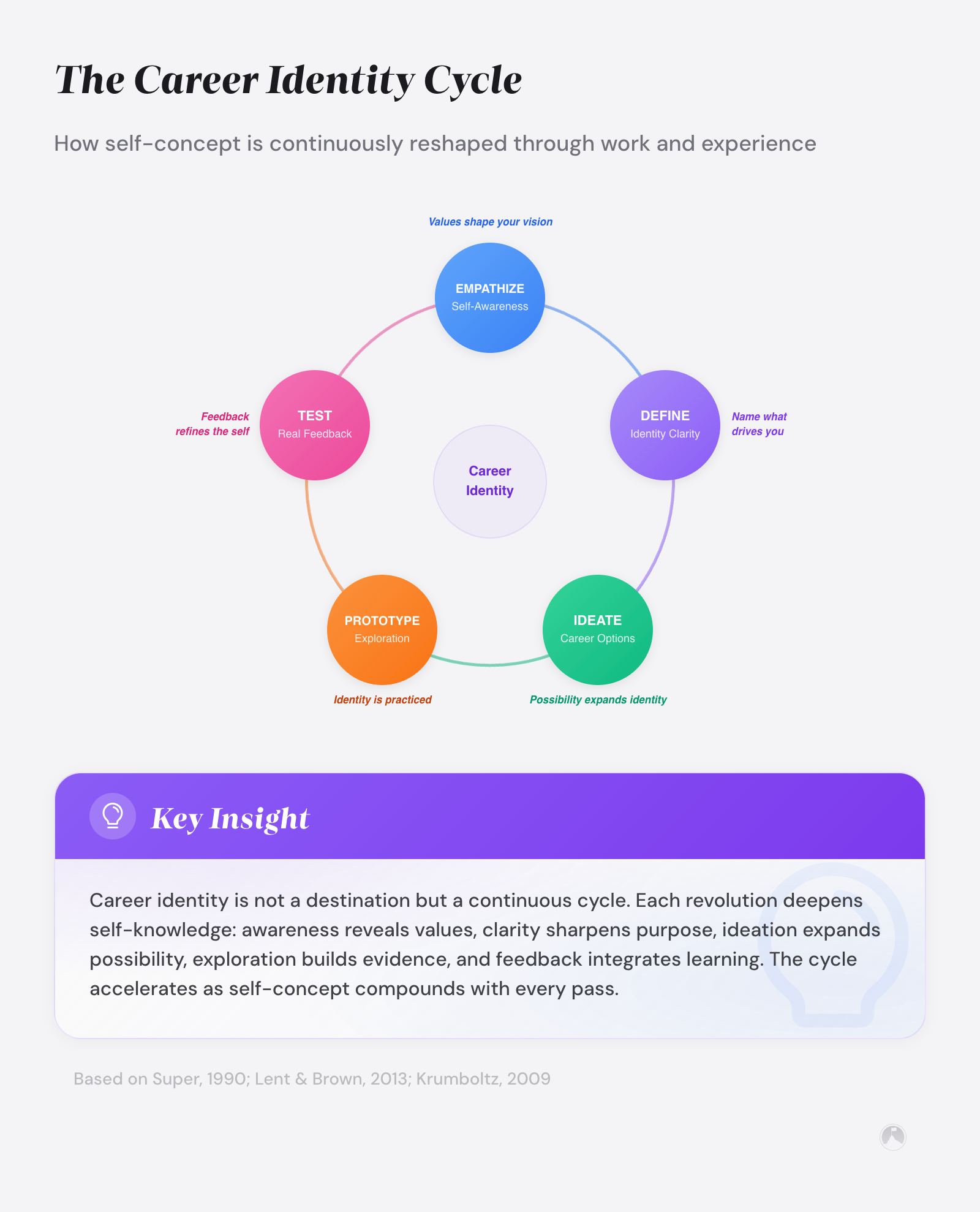
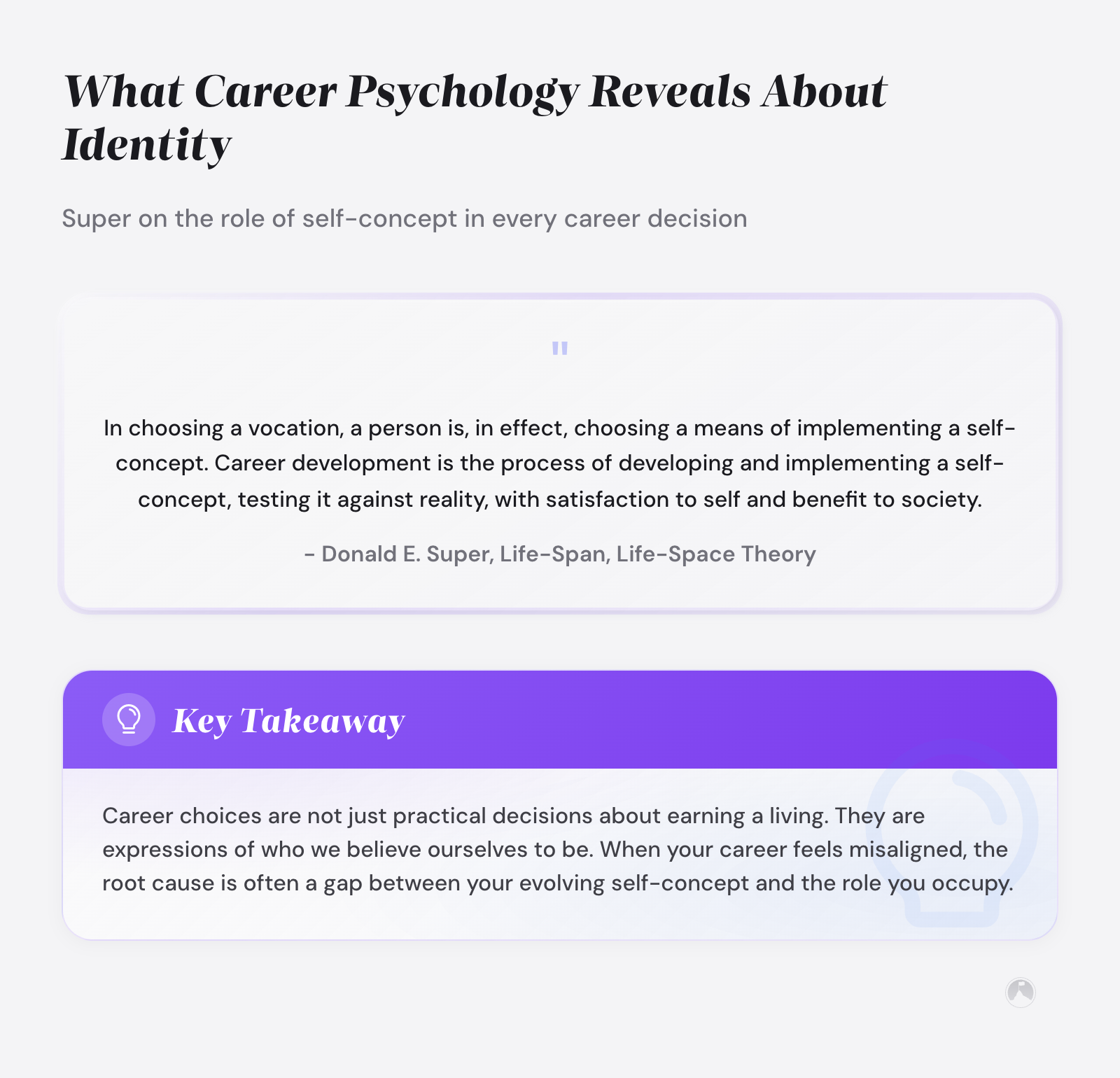
Donald Super’s developmental self-concept theory argues that career choices aren’t rational calculations. They’re expressions of identity [2]. As your sense of who you are shifts across life stages, the careers that “fit” shift with it. Super’s self-concept theory explains something most career advice ignores: why a job that felt right at 28 can feel suffocating at 38, when the role hasn’t changed at all.
The five developmental stages of career growth
Super mapped five developmental stages of career growth: Growth (birth to age 14, building self-concept), Exploration (roughly ages 15-24, testing identities), Establishment (25-44, committing to a direction), Maintenance (45-64, sustaining achievement), and Disengagement (65+, shifting focus) [2].
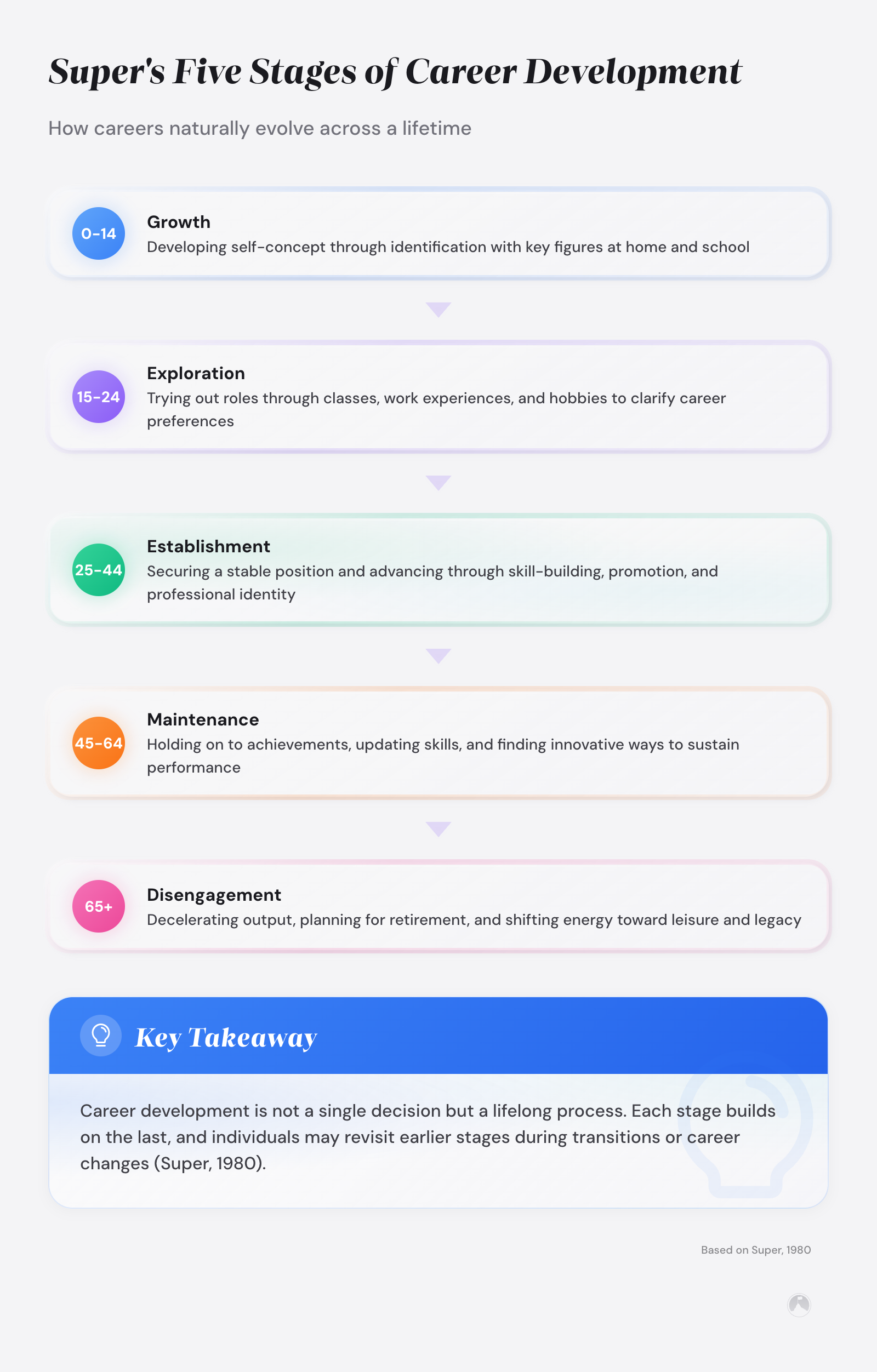
The conventional model assumed people moved through these stages in order, once. But modern careers don’t work that way.
Super’s own later research recognized that career maturity – the readiness to make age-appropriate career decisions – develops through ongoing cycles of exploration and establishment rather than a single linear progression [2]. Mid-career professionals re-enter exploration when they outgrow their established identity. The person who leaves a stable corporate role at 42 to start a consulting practice isn’t regressing. They’re recycling through Super’s stages with new self-knowledge. (This is something anyone going through mindset shifts during a career change will recognize.)
“Individuals cycle and recycle throughout their life span as they adapt to their own internal changes or to changed opportunities to which they are exposed.” – Super’s life-span, life-space theory [2]
Here’s the practical implication. If your career feels stale but you can’t pinpoint why, Super’s lens suggests the issue isn’t your job. It’s that your self-concept has outgrown the role you built around an earlier version of yourself.
Career dissatisfaction in a well-matched role often signals identity evolution rather than poor career planning.
Holland’s vocational personality types: why fit beats strategy
John Holland’s theory of vocational personality types takes a different angle on career development theories explained through psychology. Where Super focuses on how identity evolves over time, Holland focuses on the match between personality type and work environment at any given moment. His RIASEC model categorizes both people and work environments into six types: Realistic, Investigative, Artistic, Social, Enterprising, and Conventional [3].
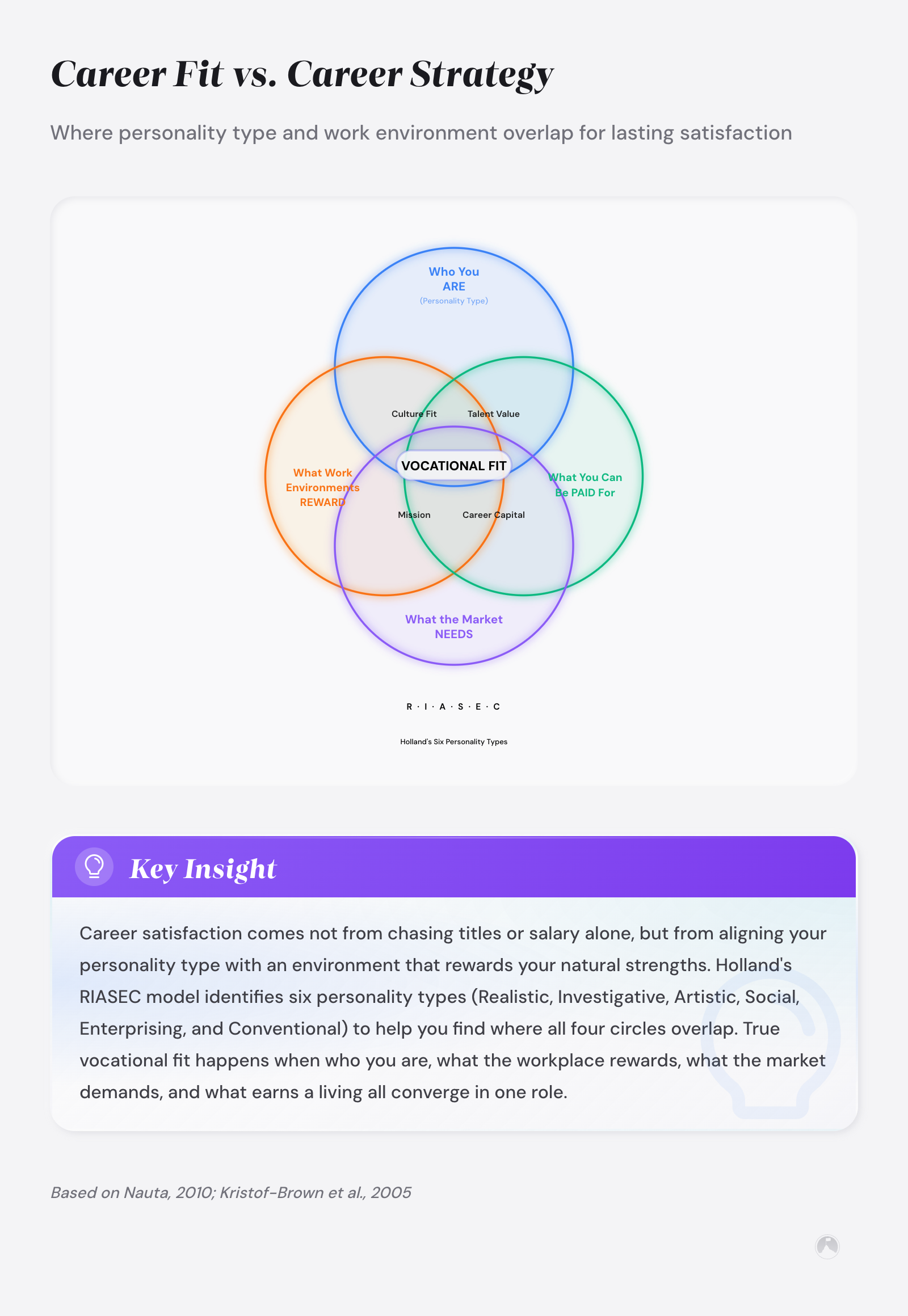
The research on Holland’s model is extensive. A landmark meta-analysis by Kristof-Brown, Zimmerman, and Johnson examined 172 studies with 836 effect sizes and found that person-job fit correlates strongly with job satisfaction (r = .56) [4]. The .56 person-job fit correlation is far stronger than the link between compensation and satisfaction. In plain terms: you can earn well and still be miserable if your personality doesn’t match the environment you work in every day.
The hexagonal structure of Holland’s model matters. As Nauta documented in her review of five decades of Holland’s research, adjacent types on the hexagon (like Investigative and Artistic) share more characteristics than types on opposite sides (like Artistic and Conventional) [3]. So an Artistic person forced into a Conventional role faces maximum friction – not from lack of skill, but from a work environment that constantly demands behaviors that drain them.
Holland’s model has real limitations. It can oversimplify career fit into a single dominant type when most people are blends of two or three types [3]. And it was developed before modern remote work environments where a single person might inhabit different “environments” within the same week.
Still, the core insight holds. If you’re exploring how different career advancement strategies affect your trajectory, Holland’s model adds a filter most strategy frameworks miss: does the advancement path you’re chasing match the type of environment where you do your best work?
Personality-environment congruence predicts career satisfaction more reliably than salary, prestige, or advancement speed.
Social cognitive career theory: how self-efficacy beliefs quietly narrow your options
Social cognitive career theory, developed by Robert Lent, Steven Brown, and Gail Hackett, centers on a variable that neither Super nor Holland directly addresses: belief [1]. Specifically, self-efficacy beliefs – domain-specific judgments about capability to perform particular tasks, distinct from general self-confidence because self-efficacy can be high in one area and low in another within the same person. SCCT argues that career interests don’t form in a vacuum. They form through a feedback loop between self-efficacy, outcome expectations, and personal goals [1].
SCCT’s self-efficacy mechanism works through a feedback loop. You try something. If you succeed, your self-efficacy for that type of task increases [1]. Higher self-efficacy makes you expect positive outcomes from similar tasks. Positive outcome expectations drive interest. Interest drives goals. Goals drive action.
The problem is that the same cycle works in reverse. Lent and Brown’s career self-management model proposes that early failures can suppress self-efficacy through a mechanism where negative experiences get filtered out rather than integrated into one’s sense of capability [1]. One early failure in a domain (especially during adolescence and early adulthood) can suppress self-efficacy so completely that a person never develops interest in that area. Not from lack of ability, but from a belief system that filtered out the option before rational analysis ever engaged.
A student who struggles with one math class at 16 might never consider data analytics at 35 – not from lack of aptitude, but from lack of belief. If that sounds like you, exploring research on overcoming limiting beliefs might open doors you didn’t know were closed.
Self-efficacy beliefs act as invisible gatekeepers, eliminating career options from consideration before conscious decision-making begins.
SCCT’s insight about belief barriers matters for anyone feeling stuck in their career. SCCT suggests that feeling stuck often reflects a belief barrier, not a capability barrier. The path forward may require updating what you believe you can do, which is fundamentally different from acquiring new skills. Skills training addresses competence. Belief work addresses the willingness to even try.
Krumboltz’s happenstance learning theory: the case against rigid career plans
John Krumboltz’s happenstance learning theory challenges the assumption underlying every other career development model: that careers should be planned. Krumboltz argued that unplanned events play a larger role in career development than planned choices, and that the skill worth building isn’t planning but preparedness for unexpected opportunities [5].
Krumboltz’s happenstance theory sounds like “get lucky,” which is the common misreading. The theory describes something more specific. In his 2009 paper in the Journal of Career Assessment, Krumboltz identified five specific skills for capitalizing on chance: curiosity, persistence, flexibility, optimism, and risk-taking [5]. These aren’t passive traits. They’re active orientations that increase the probability of beneficial unplanned events.
Consider a marketing director who signs up for a weekend design workshop out of curiosity (not career strategy). She meets someone building a startup. Six months later, she’s leading brand for a company she didn’t know existed when she registered for the class. The marketing director’s career shift isn’t luck. That’s Krumboltz’s happenstance learning theory in action – curiosity created the conditions for an opportunity no career plan could have predicted.
“The goal of career counseling is to help clients learn to take actions to achieve more satisfying career and personal lives – not to make a single career decision.” – Krumboltz, Journal of Career Assessment [5]
Modern career paths support Krumboltz more than any other theorist. Research from the U.S. Bureau of Labor Statistics shows that individuals born between 1957 and 1964 held an average of 12.9 jobs from ages 18 to 58 [6]. While not all job changes represent career changes, the frequency shows that linear career paths are increasingly rare. These shifts look less like failed plans and more like what Krumboltz described: a series of adaptations to unforeseen circumstances, shaped by the person’s openness to chance.
For professionals building a career development plan, Krumboltz’s theory doesn’t argue against planning entirely. It argues against rigid planning. The best career plans are loose enough to accommodate the opportunities that no plan can anticipate.
The career lens stack: reading your career through four perspectives
Each of these four career development theories explained above illuminates one dimension of career development. Super explains timing and identity evolution. Holland explains fit and energy. SCCT explains beliefs and hidden barriers. Krumboltz explains chance and adaptability. Individually, each theory is incomplete. Combined, they create something more powerful.
What we call the Career Lens Stack is a framework for analyzing career patterns through all four psychological perspectives simultaneously, rather than defaulting to whichever lens is most familiar. The Career Lens Stack is a diagnostic framework that analyzes career patterns through four psychological perspectives – identity (Super), fit (Holland), belief (SCCT), and chance (Krumboltz) – to identify which hidden dimension is creating friction in a career that looks successful on the surface.
When you’re trying to understand a career pattern – whether that’s career change anxiety, repeated restlessness, or persistent underperformance – you run it through four diagnostic questions.
The career lens stack: four diagnostic questions
| Lens (Theory) | Diagnostic question | If yes, the issue is… |
| Identity (Super) | Has my self-concept outgrown this role? | Developmental recycling |
| Fit (Holland) | Does my environment match my personality type? | Person-environment mismatch |
| Belief (SCCT) | Am I avoiding paths out of doubt in my ability? | Self-efficacy barrier |
| Chance (Krumboltz) | Am I keeping enough doors open for unplanned opportunities? | Over-planning, closed mindset |
Consider a product manager earning well but dreading Monday mornings. Through Super’s lens, her self-concept has evolved past execution into mentorship. Through Holland’s lens, her Investigative-Social personality clashes with the Conventional reporting demands. Through SCCT’s lens, she avoids exploring a pivot to leadership development because she once received negative feedback on her facilitation skills. Through Krumboltz’s lens, her rigid five-year plan has closed her off to unexpected opportunities. The hidden issue isn’t fit alone – SCCT’s belief barrier combined with over-planning is blocking her next move.
The power of this stack is that it prevents you from using only the lens that’s most familiar or comfortable. A manager steeped in Holland might default to “fix the personality-environment fit” without noticing that the deeper issue is a self-concept evolution (Super) or a belief barrier (SCCT). Running the same situation through all four perspectives reveals which dimension is actually creating friction.
Most career decisions make sense through one lens. The best decisions make sense through multiple lenses.
Here’s a comparison of all four theories for quick reference:
| Theory | Core Insight | Best For |
|---|---|---|
| Super’s Self-Concept | Career choices express evolving identity, not fixed preferences | Understanding why a good role stops feeling right over time |
| Holland’s RIASEC | Personality-environment fit predicts satisfaction more than salary | Diagnosing persistent energy drain at work |
| SCCT (Lent & Brown) | Self-efficacy beliefs invisibly filter career options | Identifying belief barriers vs. actual skill gaps |
| Krumboltz’s Happenstance | Preparedness for chance outperforms rigid planning | Building flexibility into career strategies |
Ramon’s take
Nobody tells you that your dream job from age 25 was basically a costume for a version of you that no longer exists. Krumboltz called it happenstance. I just call it Tuesday. Does anyone actually know what they want, or are we all just reacting to what showed up?
Conclusion
Career psychology research – specifically the career development psychology framework covered here – reveals something that strategic career advice often misses: you can’t separate career choices from psychological patterns. The person who succeeds at work they hate isn’t broken. They’re operating without the psychological frameworks that would reveal what they actually need.
Super’s lens shows you’re not the same person across your entire career. Holland’s lens shows that some environments drain you regardless of achievement. Social cognitive career theory’s lens shows that beliefs shape options invisibly. Krumboltz’s lens shows that some of your best moves won’t be planned.
For a practical starting point, compare different career planning frameworks through these four lenses. The deeper shift: career decisions stop being about climbing higher and start being about moving in a direction your psychology can sustain.
Next 10 minutes
- Pick one of the four lenses and ask yourself that diagnostic question for your current situation
- Identify which dimension (identity, fit, belief, or chance) might be the hidden issue you haven’t been naming
- Note the pattern you see and what it suggests about your next move
This week
- Run a recent career decision or pattern through all four diagnostic questions from the Career Lens Stack
- Identify which lens reveals something you hadn’t considered
- Take one action based on what that lens suggests (whether it’s exploring identity shifts, environment fit, belief barriers, or opportunity creation)
Related articles in this guide
Frequently asked questions
What is career development psychology?
Career development psychology studies how identity, personality, beliefs, and chance shape career trajectories over a lifetime. The field draws primarily from the work of Donald Super, John Holland, Albert Bandura (whose research on self-efficacy underpins SCCT), and John Krumboltz, each contributing a distinct theoretical lens. Unlike career counseling, which focuses on individual guidance sessions, career development psychology examines the underlying psychological mechanisms that drive career patterns across populations [1].
Why would my career feel stale if I’m doing well?
Career development psychology research suggests this often signals identity evolution. According to Super’s developmental self-concept theory, your sense of who you are shifts across your lifespan. A role that fit your identity at 28 may feel suffocating at 38, not because the job changed but because your self-concept did. This is a sign of psychological growth, not career failure [2].
How does Holland’s RIASEC model affect career satisfaction?
A meta-analysis of 172 studies found that person-job fit correlates strongly with job satisfaction (r = .56), which is far stronger than the link between compensation and satisfaction [4]. Each personality type has different motivations, values, and preferred work styles. An Artistic person in a Conventional role will experience friction not from lack of skill, but from a constant mismatch between how they work and what the environment demands [3].
Can self-efficacy beliefs actually limit my career options?
Yes. According to social cognitive career theory, self-efficacy beliefs act as invisible gatekeepers that filter career options from consideration before rational analysis begins. Lent and Brown’s career self-management model proposes that early failures can suppress self-efficacy so completely that a person never develops interest in entire career paths [1]. This is why someone might never consider data analytics at 35 based on a struggle with one math class at 16.
Does Krumboltz’s theory mean I shouldn’t plan my career?
Krumboltz’s happenstance learning theory argues against rigid planning, not planning itself. The best career plans leave room for opportunities that cannot be predicted. To practice Krumboltz’s five skills: seek activities outside current job responsibilities (curiosity), continue through initial discomfort in new domains (persistence), adjust goals when circumstances change rather than forcing original plans (flexibility), interpret setbacks as data rather than verdicts (optimism), and take small professional risks like volunteering for unfamiliar projects (risk-taking) [5].
How do I use the Career Lens Stack to understand my own patterns?
Run a career decision or situation through all four diagnostic questions: Has your self-concept outgrown your role (Super)? Does your environment match your personality type (Holland)? Are you avoiding options from self-doubt (SCCT)? Are you keeping doors open for unexpected opportunities (Krumboltz)? You will typically find that multiple dimensions are at play, and the least obvious one often reveals the hidden issue.
References
[1] Lent, R.W., and Brown, S.D. “Social Cognitive Model of Career Self-Management: Toward a Unifying View of Adaptive Career Behavior Across the Life Span.” Journal of Counseling Psychology, 60(4), 557-568, 2013. https://doi.org/10.1037/a0033446
[2] Super, D.E. “A Life-Span, Life-Space Approach to Career Development.” In D. Brown and L. Brooks (Eds.), Career Choice and Development: Applying Contemporary Theories to Practice (2nd ed., pp. 197-261). Jossey-Bass, 1990. https://psycnet.apa.org/record/1990-97532-007
[3] Nauta, M.M. “The Development, Evolution, and Status of Holland’s Theory of Vocational Personalities: Reflections and Prospects.” Journal of Counseling Psychology, 57(1), 11-22, 2010. https://doi.org/10.1037/a0018213
[4] Kristof-Brown, A.L., Zimmerman, R.D., and Johnson, E.C. “Consequences of Individuals’ Fit at Work: A Meta-Analysis of Person-Job, Person-Organization, Person-Group, and Person-Supervisor Fit.” Personnel Psychology, 58(2), 281-342, 2005. https://doi.org/10.1111/j.1744-6570.2005.00672.x
[5] Krumboltz, J.D. “The Happenstance Learning Theory.” Journal of Career Assessment, 17(2), 135-154, 2009. https://doi.org/10.1177/1069072708328861
[6] U.S. Bureau of Labor Statistics. “National Longitudinal Survey (NLS): Number of Jobs Held in a Lifetime.” 2024. https://www.bls.gov/nls/