
The 2 AM negotiation you keep losing
Career change anxiety doesn’t arrive politely. It shows up at 2 AM, sits on your chest, and starts listing everything that could go wrong. The racing thoughts, the tight stomach before work, the way you rehearse your resignation and then delete it — none of this feels like a normal response to a career decision. And if you’re coping with job change anxiety right now, you’re far from alone.
Career change anxiety is the heightened stress response triggered when a person considers or begins a professional transition. Symptoms include insomnia, difficulty concentrating, and persistent dread, driven by the brain treating identity change as a survival threat rather than a growth opportunity.
But here’s what the research says: Holmes and Rahe’s foundational 1967 research on life stress found that career change ranks among the top 20 most stressful life events on their Social Readjustment Rating Scale, right alongside major personal losses and financial upheaval [1]. Your brain isn’t broken. It’s responding to a genuine threat — the threat of losing an identity you’ve spent years building.
The real question is whether that anxiety is a useful signal or just noise. Most people never learn the difference.
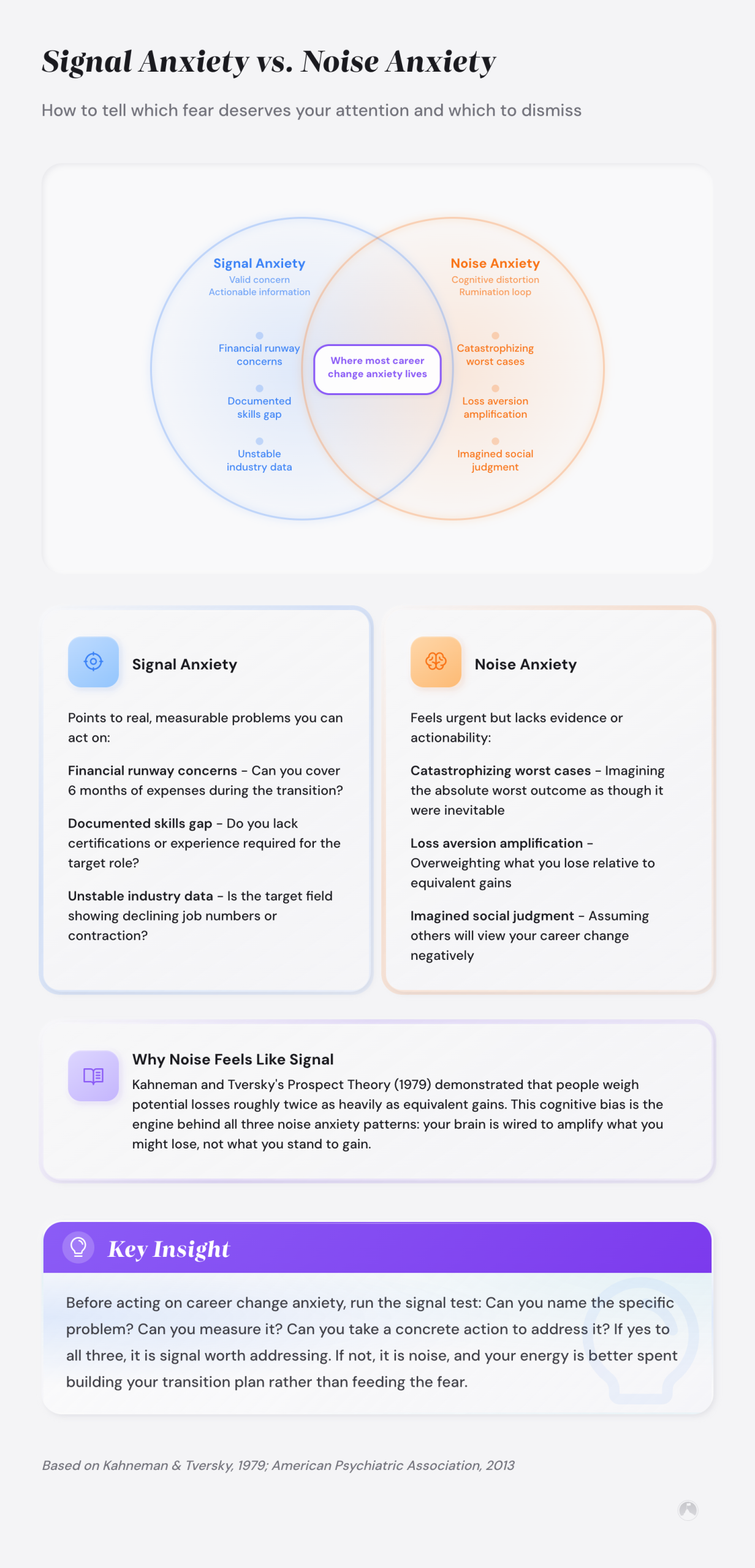
Signal anxiety is a fear response tied to a specific, addressable risk — like a concrete financial gap or a verifiable skills shortfall. Signal anxiety points to problems that need a plan.
Noise anxiety is the repetitive, exaggerated worry generated by cognitive biases and rumination loops — like catastrophizing about worst-case scenarios that have no specific timeline or probability. Noise anxiety is the brain’s threat detection system running on false alarm.
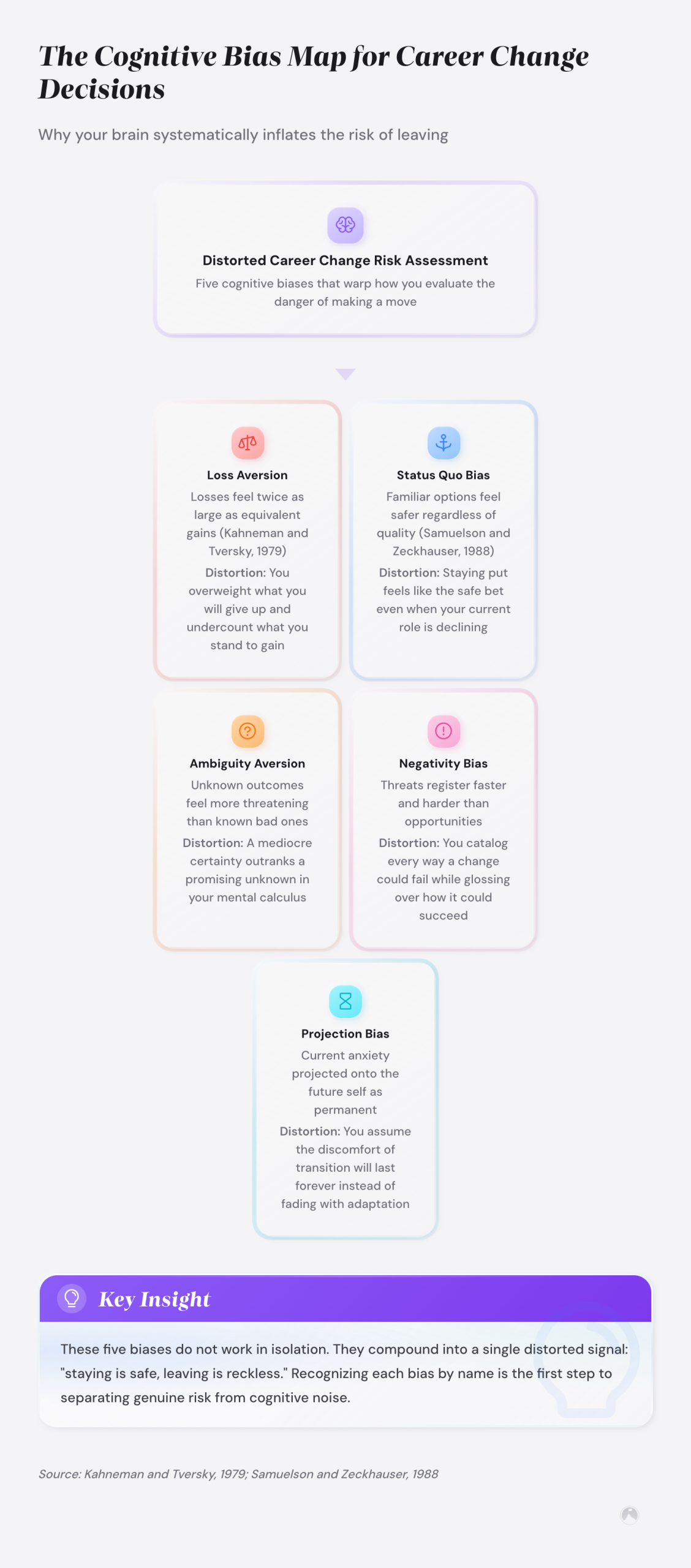
Loss aversion is the psychological phenomenon where the pain of losing something feels roughly twice as intense as the pleasure of gaining an equivalent benefit. Kahneman and Tversky’s foundational research showed this bias makes people systematically overweight losses in decision-making [2].
What you will learn
- Why career change triggers your brain’s threat detection system and the emotional impact of career transitions
- How to overcome fear of changing careers using what we call The Anxiety Audit
- The cognitive biases and psychological effects of changing jobs that keep you stuck
- Evidence-based techniques for managing career transition stress and reducing anxiety during career shifts
- When career change anxiety crosses into clinical territory and therapy for career change anxiety is warranted
Key takeaways
- Career change anxiety is your brain treating a growth decision like a survival threat — the gap between real and felt risk is where suffering lives.
- The Anxiety Audit helps separate signal anxiety from noise anxiety so you address real risks without spiraling.
- Loss aversion causes people to overestimate the risks of change by roughly two to one compared to equivalent gains [2].
- Status quo bias makes people systematically prefer the option they already have, even when alternatives offer better terms [3].
- Career decision-making self-efficacy is linked to lower anxiety levels during transitions [4].
- Career change anxiety symptoms include sleep disruption, stomach problems, and difficulty concentrating — recognizing these as predictable responses, not red flags, is the first step.
- Clinical guidelines suggest professional support when anxiety persists beyond 3-4 weeks or impairs daily functioning [5].
- Analysis without a stopping rule tends to become rumination — the same skills that drive professional success can sabotage career decisions.
Why does career change trigger a threat response?
Most people assume career change anxiety is about the practical risks: money, skills gaps, a bad fit. Those risks are real. But the psychological research points to something deeper — career change threatens identity, and your brain treats identity threats with the same alarm system it uses for physical ones.
The emotional impact of career transitions runs much deeper than most people expect, and the mindset shifts required for career changers start with knowing why the fear exists in the first place.
When you’ve spent a decade as a marketing director or an engineer or a nurse, that title isn’t a label. It’s woven into how you introduce yourself, how you make decisions, and how other people relate to you. Neuroscientist Naomi Eisenberger’s fMRI research demonstrates that social pain — including identity loss — activates the same brain regions (the anterior cingulate cortex and anterior insula) as physical pain [6].
So walking away from a career identity you’ve spent years building triggers the brain’s threat detection system in a measurably similar way to physical danger. That’s not a metaphor. It’s neuroscience.
A 2025 study published in BMC Psychology with 806 participants found that lower self-efficacy in career decisions is associated with significantly higher anxiety levels [4]. In plain terms: the less confident you feel about your ability to choose well, the more your brain sounds the alarm. And career changes, by definition, put you in unfamiliar territory where confidence is scarce.
“Career transitions can significantly impact psychological well-being, with job-seeking anxiety linked to elevated stress, depression, and broader mental health challenges.” Kim, Oh, and Rajaguru (2022) [7]
The symptoms are real and measurable. Career change anxiety symptoms include insomnia, irritability, digestive problems, difficulty concentrating, and a persistent sense of dread that follows you into unrelated parts of your life. These aren’t signs of weakness. They’re the predictable output of a nervous system that equates professional identity with survival.
Career change anxiety is the brain treating a growth decision like a survival threat, and the gap between the real risk and the felt risk is where most of the suffering lives.
How do cognitive biases make career change anxiety worse?
Your anxiety about changing careers isn’t running on accurate data. It’s running on biased data, and the biases all point in the same direction: stay put. The psychological effects of changing jobs start with the mental traps your brain sets.
The first bias is loss aversion. Daniel Kahneman and Amos Tversky’s foundational 1979 research on prospect theory demonstrated that people experience losses roughly twice as intensely as equivalent gains [2]. Applied to career change, this means the prospect of losing your current salary, status, and routine feels approximately twice as painful as the potential benefits of a more fulfilling career feel rewarding.
The loss aversion math is rigged before you even start calculating.
The second bias is the status quo effect. Samuelson and Zeckhauser’s landmark 1988 research on decision-making demonstrated a consistent pattern: when faced with uncertainty, decision-makers systematically prefer the option they already have, even when alternatives objectively offer better terms [3]. Staying in a career that drains you feels “safe” since it’s familiar. But familiarity isn’t the same thing as safety.
Consider a project manager who has been underpaid and underutilized for three years. She has two offers from companies willing to pay 20% more with roles that match her skills. She turns both down because “the devil you know” feels less risky. That is status quo bias converting a rational upgrade into a perceived gamble.
The psychological effects of staying in the wrong career accumulate quietly: burnout, disengagement, health problems that compound over years. For mid-career professionals, these compounding effects are especially pronounced — explore career growth strategies for mid-career professionals.
Catastrophizing is a cognitive distortion where the mind treats the worst possible outcome as the most likely outcome, generating fear disproportionate to actual probability.
The third pattern is catastrophizing, where your mind jumps to the worst possible outcome and treats it as the most likely one. “I’ll run out of money.” “Nobody will hire me in a new field.” “I’ll regret this forever.” These thoughts feel like predictions. They’re not. They’re your threat detection system generating worst-case scenarios at maximum volume.
Loss aversion, status quo bias, and catastrophizing form a triple lock that keeps people in careers they’ve already outgrown. Knowing that these biases exist doesn’t eliminate them. But it does give you permission to question whether the fear you feel is proportional to the actual risk involved. If you’re feeling stuck in your career, these cognitive patterns may be a bigger obstacle than any practical barrier.
How to overcome fear of changing careers: separating signal from noise
Here’s the uncomfortable truth that most career advice skips: some of your anxiety is useful. The goal isn’t to eliminate career change anxiety. The goal is to sort it.
What we call The Anxiety Audit is a framework we developed for categorizing career change fears into two buckets: signal anxiety and noise anxiety. Signal anxiety points to legitimate risks that need a plan. Noise anxiety is generated by the cognitive biases described above and fed by rumination. The two feel identical in the moment (which is exactly what makes them so dangerous), and that’s why most people either ignore all their anxiety or obey all of it.
Signal anxiety sounds like: “I have six months of expenses saved, but my target industry typically takes nine months to break into.” That’s a solvable problem. It needs a financial plan, not a breathing exercise.
Noise anxiety sounds like: “What if I’m making the biggest mistake of my life?” That’s a catastrophizing thought dressed up as a question, and no amount of planning will resolve it — the thought isn’t pointing to a specific, addressable risk.
The anxiety audit: a quick sorting exercise
Write down your top 5 career change fears. For each one, ask:
| Question | If yes… |
| Can I name a specific, concrete risk? | Signal. Make a plan for this risk. |
| Is this fear about a worst-case scenario I am treating as the most likely scenario? | Noise. Label it and move on. |
| Would I give this advice to a friend in my situation? | If no, it is noise. Your standards for yourself are distorted. |
| Does this fear have a timeline and a number attached to it? | Signal. Fears with specifics are solvable. |
The Anxiety Audit works by breaking the binary. Instead of asking “Should I be anxious or not?” you ask “Which of these fears deserve a plan and which ones deserve a label?” Research on career decision-making self-efficacy supports this approach: a 2025 BMC Psychology study found that when people develop structured methods for assessing their career options, their anxiety decreases and their confidence in the decision increases [4].
The opposite of career change anxiety isn’t fearlessness — it’s a sorting system that turns vague dread into specific, manageable problems.
What reduces career change anxiety according to research?
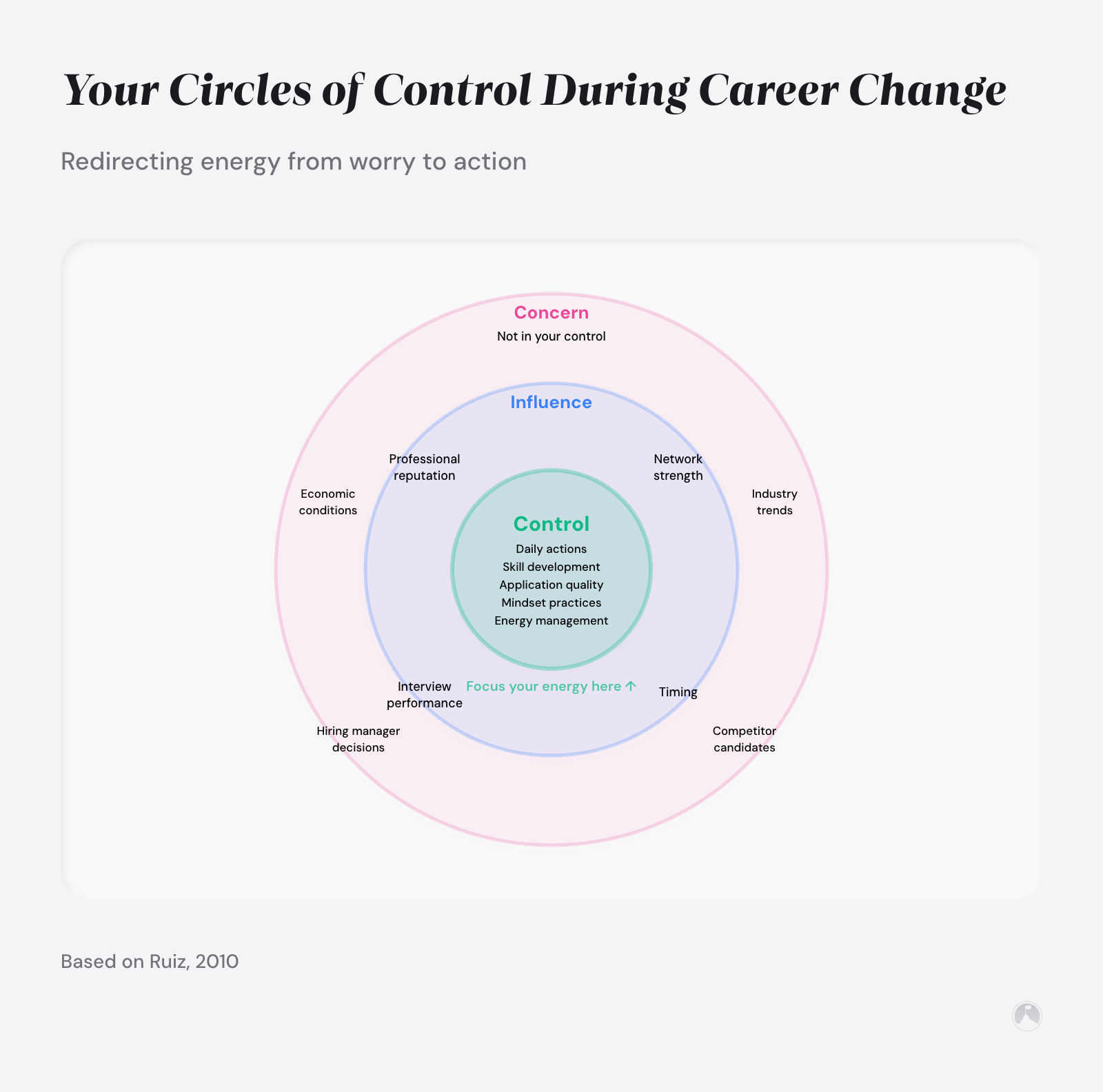
Once you’ve sorted signal from noise, you need different tools for each category. Signal anxiety needs practical problem-solving. Noise anxiety needs cognitive reframing. Using the wrong tool on the wrong type makes everything worse. So managing career transition stress effectively means matching the right intervention to the right type of fear.
For signal anxiety: build the bridge before you cross
Financial fear is the most common signal anxiety in career transitions, and it deserves a concrete response. Calculate your actual runway: monthly expenses multiplied by the number of months you expect the transition to take, plus a 30% buffer.
Here’s a copy-pasteable formula to get you started:
Expected transition months: ____
Buffer (30%): $____ x 0.3 = $____
Total runway needed: (Monthly x Months) + Buffer = $____
Current savings: $____
Gap (if any): $____
A number on paper is less frightening than a vague sense of “I might run out of money.” If you want a structured approach to this kind of planning, a career development plan template can help you map the practical steps.
Skills gaps are the second most common signal. Social cognitive career theory suggests that integrating anxiety management with concrete skill-building is more effective than addressing either one in isolation [8]. The Career/Anxiety Alignment Protocol structures this dual pathway: as you take action to close skills gaps, your anxiety decreases proportionally because decision confidence increases [9].
Action narrows the gap between what you know and what you need to know, and anxiety decreases proportionally. Translation: taking one course, attending one industry event, or having one informational interview does more for reducing anxiety during career shifts than any amount of rumination.
For noise anxiety: interrupt the rumination loop
Noise anxiety feeds on repetition. The same fears play on a loop, and each repetition feels like new evidence. Cognitive behavioral therapy research identifies several techniques for interrupting this cycle, and you don’t need a therapist to start using them (though therapy for career change anxiety is worth considering if the patterns persist).
Scheduled worry time is one of the most counterintuitive but effective approaches for coping with job change anxiety. Set aside 15 minutes each day for career worrying and nothing else. Outside that window, when a career fear surfaces, write it down and defer it to your worry time. In practice, it looks like this: you sit with a notebook, set a timer, and let every career fear surface without filtering. When the timer goes off, you close the notebook. Most people find that after a few days, the deferred fears feel smaller by the time their window arrives. Cognitive-behavioral therapy research on generalized anxiety suggests that worry containment — setting aside a daily period dedicated to anxiety — paradoxically reduces overall worry frequency and intensity [8].
This isn’t suppression — it’s containment. The brain often drops anxious thoughts once it knows they’ve been acknowledged and scheduled for attention.
Lent, Brown, and Hackett’s (2000) social cognitive career theory suggests that career counseling approaches integrating anxiety management with structured career planning can reduce both anxiety symptoms and decision-making paralysis [8].
Cognitive defusion is a therapeutic technique where a person learns to observe anxious thoughts as passing mental events rather than facts, creating psychological distance from the thought without arguing against its content.
Cognitive defusion is another technique worth knowing. When you notice yourself thinking “I’m going to fail at this new career,” try restating it as “I’m having the thought that I’m going to fail.” This tiny linguistic shift creates distance between you and the thought, reducing its emotional power without requiring you to argue against it.
Ruiz’s 2010 review of acceptance and commitment therapy research found that cognitive defusion — learning to observe anxious thoughts as passing mental events rather than facts — is supported by multiple studies as a mechanism for reducing anxiety [10]. The defusion component emerged as one of the key processes driving improvement across anxiety presentations.
Building a broader career growth strategy can help reduce anxiety by placing your career change within a longer arc of professional development rather than treating it as a single high-stakes bet. You don’t need to solve the whole career problem at once. You need to solve the next piece of it.
When does career change anxiety need professional support?
There’s a line between normal career transition stress and something that needs clinical attention. Most career advice articles pretend that line doesn’t exist. It does.
Kim, Oh, and Rajaguru’s research on job-seeking anxiety found that prolonged career uncertainty is associated with elevated rates of depression, chronic stress, and broader mental health challenges [7]. Clinical mental health guidelines suggest that career transition anxiety warrants professional support when anxiety persists beyond 3-4 weeks or when it begins impairing your ability to function at work or in relationships [5].
If you’re experiencing panic attacks or persistent physical symptoms, or if the fear has spread from your career into unrelated areas of your life, those are signals that self-help strategies alone may not be sufficient.
A therapist who specializes in career transitions or anxiety disorders can offer structured support that goes beyond what any article can provide. Therapy for career change anxiety has a strong evidence base, and career counseling frameworks increasingly integrate mental health treatment with practical career planning [8]. Seeking professional help isn’t a sign that your anxiety has “won.” It’s a sign that you’re taking a research-backed approach to career development psychology.
If you’re managing a career transition and working remotely at the same time, the isolation can make anxiety worse. Remote professionals dealing with career change may benefit from exploring strategies for career growth as remote workers to address the added layer of disconnection.
The right time to get help isn’t when the anxiety wins. It’s when you notice the same fears cycling without resolution.
Ramon’s take
Reading about loss aversion didn’t fix my spiral, but it made me feel less crazy for having one. Does naming the bias actually help, or does it just give you a smarter story to tell yourself while staying exactly where you are?
Conclusion
Career change anxiety is not a verdict on your decision. Career change anxiety is the predictable response of a brain that evolved to protect existing identity, status, and routine from perceived loss. Loss aversion, status quo bias, and identity threat combine to make staying feel safer than leaving, even when staying carries its own long-term costs.
The Anxiety Audit gives you a framework for sorting which fears point to genuine risks worth planning for and which fears are cognitive noise amplified by rumination. When the anxiety exceeds what self-help strategies can manage, professional support isn’t a last resort — it’s a rational next step.
The people who successfully change careers aren’t the ones who stopped feeling afraid. They’re the ones who learned which fears to listen to and which ones to walk through. If you’re looking for a broader perspective on how career change fits into your long-term professional trajectory, explore our strategic career planning frameworks.
The bravest career decisions aren’t the fearless ones. They’re the ones made with full knowledge of the risk, a plan for the parts you can control, and the willingness to move before the anxiety gives you permission.
In the next 10 minutes
- Write down your top three career change fears and categorize each as signal or noise using The Anxiety Audit.
- For one signal fear, identify one concrete action you could take this week to reduce it.
This week
- Schedule one informational conversation with someone in your target career field.
- Calculate your actual financial runway using the formula above (monthly expenses multiplied by expected transition months plus a 30% buffer).
- Try scheduled worry time: set 15 minutes each day for career-related anxiety, and defer worries outside that window.
Related articles in this guide
- career-development-plan-template
- career-development-psychology-research
- career-growth-books-professionals
Frequently asked questions
Is career change anxiety normal?
Yes. Career change ranks among the top 20 most stressful life events on the Holmes-Rahe Stress Scale [1]. The anxiety is a predictable neurological response to identity threat, not a sign that you are making the wrong decision. Most people experience some combination of insomnia, irritability, and difficulty concentrating during career transitions.
How long does career change anxiety last?
Normal career transition anxiety typically peaks in the first few weeks and tends to decrease as the new career path becomes more concrete. If anxiety persists or worsens beyond the initial transition period, clinical guidelines suggest professional support [5].
What are the most common career change anxiety symptoms?
Career change anxiety symptoms overlap with generalized anxiety — insomnia, digestive problems, irritability, and difficulty concentrating — but are tied specifically to career-related triggers. A distinguishing feature is that symptoms often improve during activities unrelated to the career decision and worsen when confronted with career-related cues such as job postings, LinkedIn, or conversations about work.
How do I know if my career anxiety is a real warning or just fear?
Use The Anxiety Audit: if a fear points to a specific, concrete risk with a timeline and a number (like a financial gap), it is signal anxiety and needs a plan. If it is a vague worst-case scenario without specifics, it is noise anxiety generated by cognitive biases like loss aversion and catastrophizing.
When should I see a therapist for career change anxiety?
Look for therapists who specialize in career transitions, adjustment disorders, or cognitive behavioral therapy for anxiety. Many offer a free consultation call where you can describe your situation before committing. If your employer offers an Employee Assistance Program (EAP), that can be a fast, no-cost starting point for 3-6 sessions.
Does career change anxiety get worse with age?
Career change anxiety often intensifies in your 30s and 40s as financial obligations grow and professional identity becomes more entrenched. Research on loss aversion [2] suggests that the more you have invested in a career, the more painful it feels to walk away. However, mid-career changers also bring transferable skills and clearer self-knowledge that can offset the anxiety.
References
[1] Holmes, T.H. and Rahe, R.H. (1967). “The Social Readjustment Rating Scale.” Journal of Psychosomatic Research, 11(2), 213-218. DOI
[2] Kahneman, D. and Tversky, A. (1979). “Prospect Theory: An Analysis of Decision Under Risk.” Econometrica, 47(2), 263-291. DOI
[3] Samuelson, W. and Zeckhauser, R.J. (1988). “Status Quo Bias in Decision Making.” Journal of Risk and Uncertainty, 1(1), 7-59. DOI
[4] “Career Decision-Making Self-Efficacy and Anxiety Among Adolescents.” BMC Psychology, 13, 39 (2025). Link
[5] American Psychiatric Association (2013). Diagnostic and Statistical Manual of Mental Disorders (5th ed.). Arlington, VA: American Psychiatric Publishing. DOI
[6] Eisenberger, N.I. and Lieberman, M.D. (2004). “Why Rejection Hurts: A Common Neural Alarm System for Physical and Social Pain.” Trends in Cognitive Sciences, 8(7), 294-300. DOI
[7] Kim, J., Oh, J., and Rajaguru, V. (2022). “Job-Seeking Anxiety and Job Preparation Behavior of Undergraduate Students.” Healthcare (Basel), 10(2), 288. Link
[8] Lent, R.W., Brown, S.D., and Hackett, G. (2000). “Contextual Supports and Barriers to Career Choice: A Social Cognitive Analysis.” Journal of Counseling Psychology, 47(1), 36-49. DOI
[9] National Career Development Association (2024). “Anxiety and Career Exploration: The C/AAP Framework Applied to Two Cases.” NCDA Career Convergence. Link
[10] Ruiz, F.J. (2010). “A Review of Acceptance and Commitment Therapy (ACT) Empirical Evidence: Correlational, Experimental Psychopathology, Component and Outcome Studies.” International Journal of Psychology and Psychological Therapy, 10(1), 125-162. Link