![Career Advancement Strategies Compared [2026 Research]](https://goalsandprogress.com/wp-content/uploads/2026/04/Career-Advancement-Strategies-Compared-2026-Research.jpg)
The promotion that never came
You’ve done everything right. Positive reviews, extra certifications, late nights on high-profile projects. And still, the promotion went to someone else.
When career advancement strategies are compared against actual promotion data, a pattern shows up that most professionals miss: the strategies that feel productive and the strategies that produce advancement are often entirely different things. Rezaiee and Kareshki’s 2024 research in Frontiers in Education found that combining self-regulation with structured career guidance produced stronger advancement outcomes than either approach alone [1]. The gap between effort and results usually isn’t about working harder. It’s about investing your career energy in the right places.
Career advancement strategies are the deliberate methods professionals use to move toward higher roles, greater responsibility, and increased compensation. These include experiential learning, networking, mentorship, formal training, and internal mobility – each producing different results depending on career stage, barrier type, and time horizon.
The most effective career advancement strategies are experiential learning (stretch projects and cross-functional work), mentorship and sponsorship, professional networking, formal skill-building, and internal mobility. Research shows experiential learning produces the fastest combination of competence growth and visibility, accounting for roughly 70% of career-relevant skill development [5].
What you will learn
- How five major career advancement strategies stack up on time, impact, and career stage fit
- Why the 70-20-10 learning model explains most stalled careers
- Whether networking or mentorship produces better advancement outcomes for your situation
- When internal mobility beats external job searching
- A framework for matching your career stage to the right strategy mix
- What separates proactive career advancement methods from passive waiting
Key takeaways
- Experiential learning (stretch projects, cross-functional work) accounts for roughly 70% of career-relevant skill development according to the 70-20-10 model [5].
- Formal training alone rarely produces promotions since it addresses the smallest portion of skills development for career growth.
- Networking builds breadth of opportunity; mentorship builds depth of readiness. Both serve different career stages.
- Internal mobility opportunities can carry lower risk for mid-career professionals who have established credibility and relationships within their organization.
- The Advancement ROI Matrix helps match strategies to career stage and context.
- Proactive career management outperforms passive “do good work and wait” by creating visibility alongside competence [1].
- Career barriers split into intrinsic (self-efficacy, mindset) and extrinsic (structural, political) categories that need different strategies [2].
How do career advancement strategies compare on what matters most?
Most career advice lists strategies without comparing them. You get told to network, build skills, find a mentor, and seek stretch projects as if all of these carry equal weight. They don’t.
When career advancement strategies are compared using three dimensions that predict advancement, clear winners emerge depending on where you are in your career. The three dimensions that matter: time to impact (how quickly results appear), effort intensity (how much sustained energy the strategy demands), and stage sensitivity (whether the strategy works better early, mid, or late in a career).
| Strategy | Time to impact | Effort intensity | Best career stage |
|---|---|---|---|
| Experiential learning (stretch projects) | 3-6 months | High | All stages |
| Mentorship and sponsorship | 6-18 months | Medium | Early to mid-career |
| Professional networking | 12-36 months | Low-medium | Mid to senior |
| Formal skill-building (courses, certifications) | 1-3 months | Medium | Early career or career pivots |
| Internal mobility (lateral moves, transfers) | 3-12 months | Medium-high | Mid-career |
Time-to-impact estimates are based on practitioner consensus and editorial analysis, not controlled research studies.
What each strategy does best and where it falls short:
- Experiential learning builds competence and visibility simultaneously, but depends on manager support and opportunity access.
- Mentorship and sponsorship accelerates readiness and political navigation, but finding the right mentor takes time and sponsors are rare. Research by Allen and colleagues found that employees who received mentoring were promoted five times more often than those without mentors [8].
- Professional networking opens doors to opportunities you can’t see from your current seat, but returns are delayed and difficult to measure.
- Formal skill-building closes specific knowledge gaps quickly, but rarely leads directly to promotion without application.
- Internal mobility broadens skill base and organizational perspective, but can feel like a step sideways and requires political finesse.
Experiential learning produces the fastest combination of competence growth and visibility, which is why the 70-20-10 model places it at the center of career development. But raw experience without reflection or mentorship often plateaus. The strategies work best in combination, and choosing the right combination depends on your career stage and the barriers you’re facing.
Why does the 70-20-10 split explain most career stalls?
The 70-20-10 learning model, originally developed by McCall, Eichinger, and Lombardo at the Center for Creative Leadership [5], maps how professionals develop the capabilities that lead to advancement. Roughly 70% of career-relevant learning comes from on-the-job experiences, 20% from relationships like mentoring and coaching, and 10% from formal education and training.
Why most professionals get the ratio backward
Here’s the problem. A common mistake professionals make is investing their career development energy in the exact opposite ratio. They sign up for certifications, attend webinars, and complete online courses (the productivity equivalent of rearranging deck chairs). The formal training category, the 10% slice, gets the majority of their time and money.
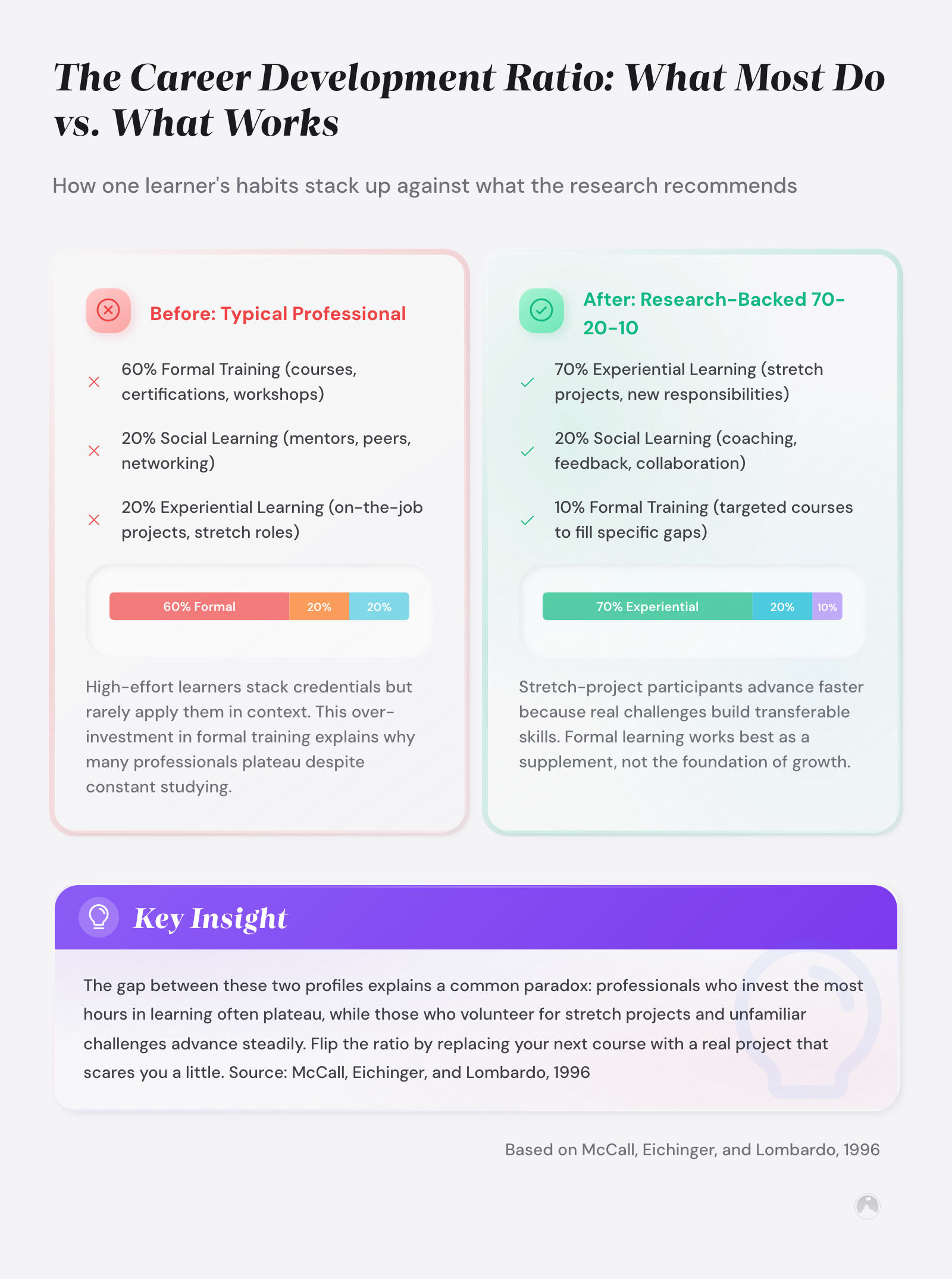
Meanwhile, the strategies in the 70% and 20% categories go almost completely neglected. This is because formal training is easy to measure and shows up on a resume, while experiential learning is harder to track and less obviously credential-worthy.
“Blending introspective self-regulation with strategic career guidance cultivates personal agency and strengthens career development pathways.” – Rezaiee and Kareshki [1]
How the 70-20-10 mismatch stalls skills development for career growth
This mismatch between where development happens and where people invest their effort explains why so many high-performing professionals feel stuck in their career even with constant self-improvement. They’re putting energy into the slice with the smallest return.
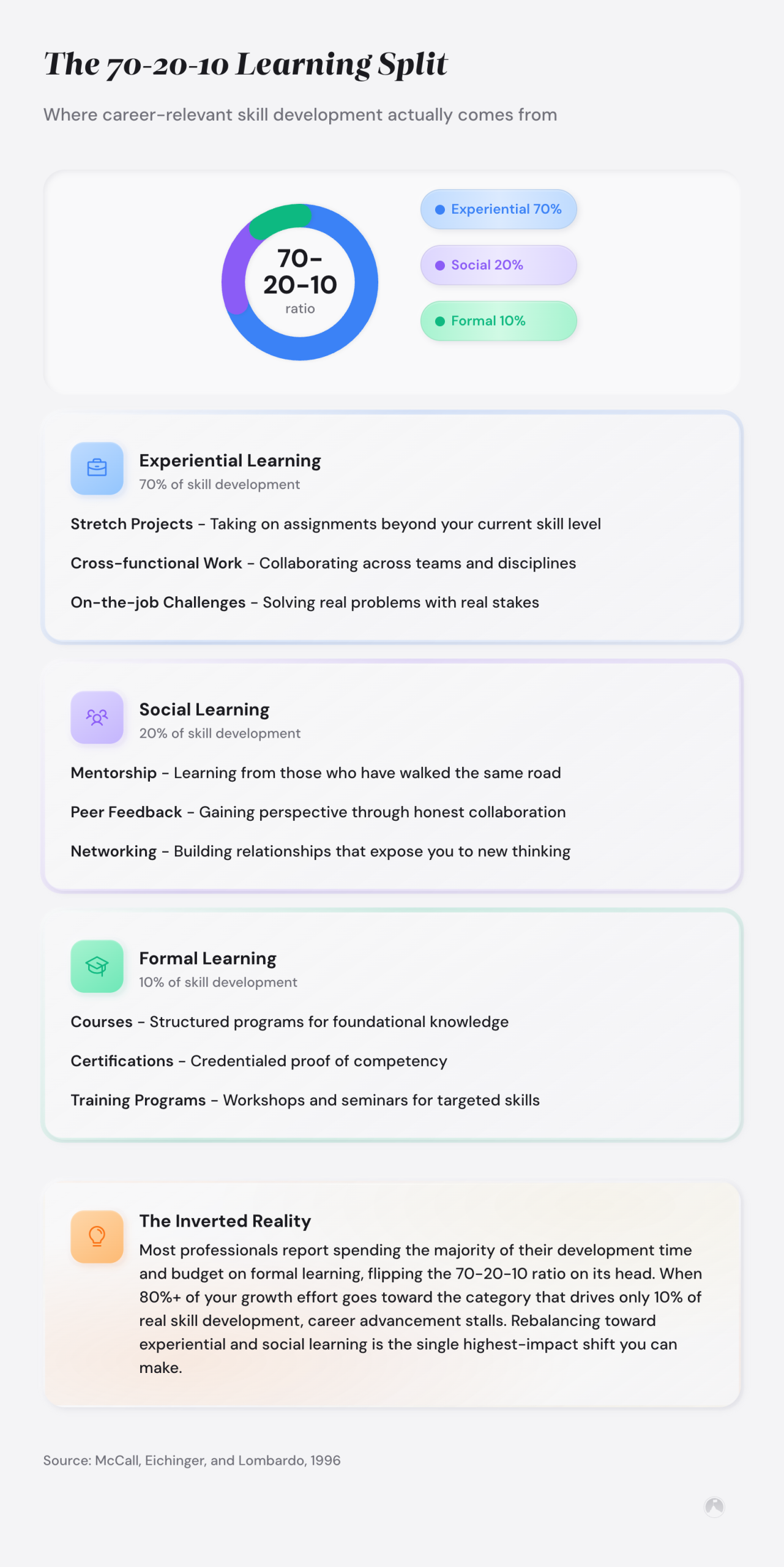
Wang and Ma’s 2024 study on career development barriers reinforced this finding, identifying that both intrinsic barriers like low self-efficacy and extrinsic barriers like limited stretch opportunities prevent advancement more than any knowledge gap [2]. Courses can’t fix a visibility problem. And visibility comes from the 70%, not the 10%.
The professionals who advance fastest aren’t the ones with the most credentials. The fastest-advancing professionals engineer their work to include the kinds of experiences that build career-critical skills. If you’re building a career development plan, start by auditing how much of your growth effort falls in each of the three categories.
Networking versus mentorship: which produces better career advancement?
This is one of the most common career strategy trade-offs. And the answer depends on a factor most people overlook: whether your current bottleneck is access to opportunities or readiness for opportunities. When networking versus mentorship for advancement is the question, the right answer changes at different career stages.
How networking and mentorship serve different functions
Networking expands your opportunity surface area. Mentorship deepens your ability to capitalize on the opportunities you already have. Career development coaching approaches fall somewhere between the two, offering structured guidance without the organic relationship dynamics of mentorship.
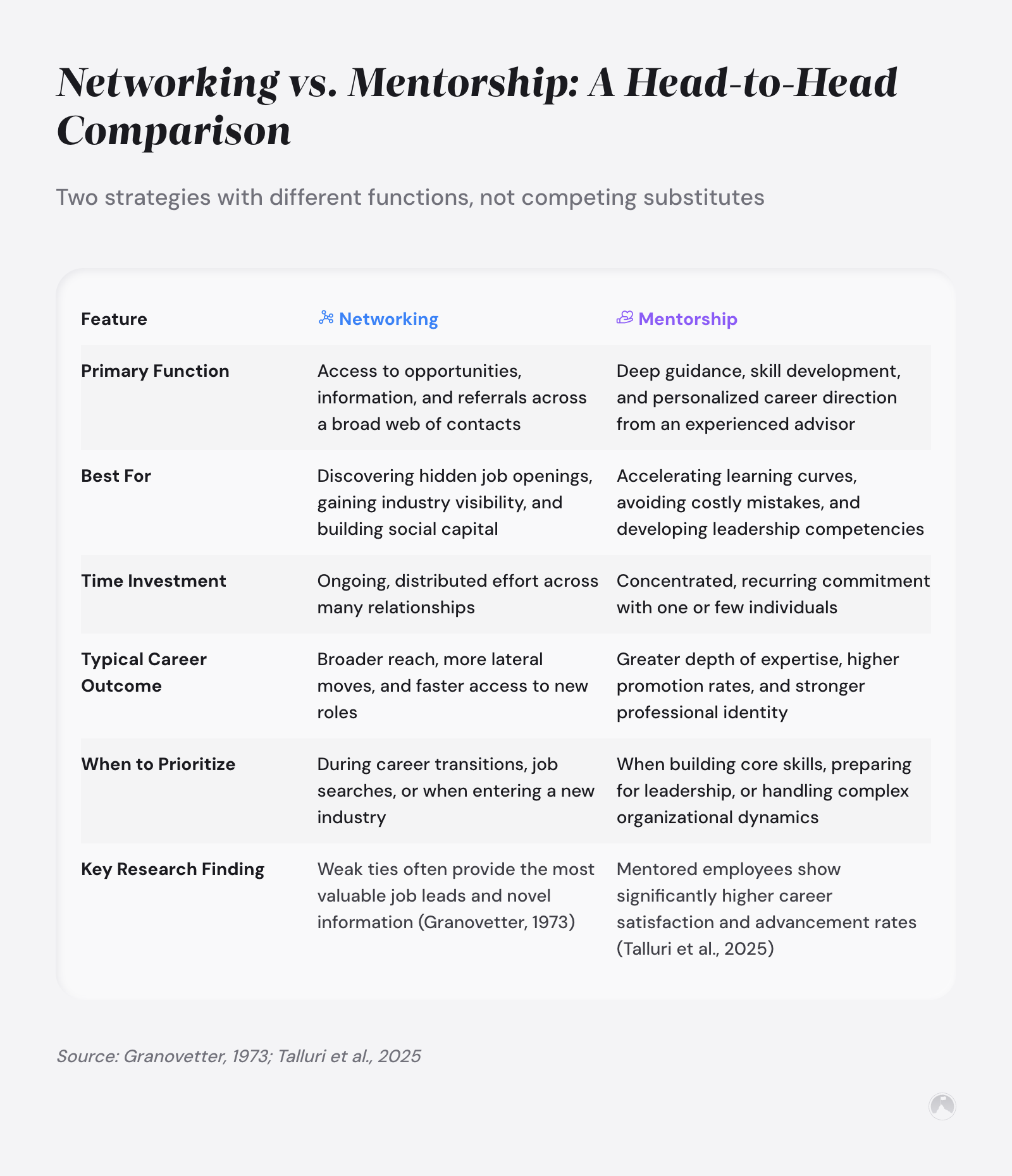
| Dimension | Networking | Mentorship |
|---|---|---|
| Core function | Creates awareness of hidden opportunities | Accelerates skill readiness and political savvy |
| Time investment | Variable hours per week, ongoing | 1-2 hours per week, concentrated periods |
| Payoff timeline | 12-36 months (relationship compounding) | 6-18 months (direct guidance) |
| Best for | Mid to senior professionals; those seeking external moves | Early to mid-career; those preparing for next-level roles |
| Biggest risk | Surface-level relationships that never convert | Dependency on one person’s perspective |
When mentorship has the edge
For professionals in the first five to seven years of their career, mentorship almost always delivers higher returns per hour invested. A mentor who has walked the path you’re on can compress years of trial and error into months of directed effort. But mentorship has a ceiling. At some point, the opportunities you need won’t come from inside your current sphere of influence.
When networking takes over
That’s where networking for career growth becomes the higher-return strategy. Granovetter’s foundational research on professional networks showed that weak ties — people you know casually across industries — provide access to novel information and opportunities that strong ties cannot [6]. Senior professionals benefit more from these weak ties than from close colleagues and mentors.
Talluri and Strauss’s 2025 systematic review in Applied Psychology found that future work self-salience – a psychological construct measuring how clearly and vividly a person can picture their future professional self, distinct from general career goals because it focuses on identity rather than outcomes – is associated with higher career adaptability and better performance outcomes [3]. Networking conversations naturally produce this kind of future-oriented thinking.
Networking builds the breadth of your career opportunities; mentorship builds the depth of your readiness to seize them. The mistake is treating this as either/or. The question is which one deserves more of your limited time right now, and the answer shifts as your career evolves.
When should you pursue internal mobility over external moves?
Internal mobility is the practice of moving between roles, departments, or functions within the same organization rather than seeking advancement through external job changes. This includes lateral moves, departmental transfers, and cross-functional project assignments. Internal mobility is the most underrated career advancement strategy. Most career advice focuses on either getting promoted in place or leaving for a better title somewhere else. But for mid-career professionals who have institutional knowledge and established credibility, internal mobility opportunities often deliver the best risk-adjusted returns.
Why internal moves protect your career capital
A lateral move within your company lets you build new skills while maintaining relationships and credibility. External moves, by contrast, require rebuilding your network and often involve a reset in compensation alignment with career growth goals you’ve already established.
Talluri and Strauss’s 2025 systematic review found that career advancement is strongly linked to future work self-salience [3]. Internal mobility makes that visualization concrete since you can see the roles and the people in them.
According to Talluri and Strauss’s systematic review, future work self-salience stimulates self-regulation, resulting in better performance, higher career adaptability, increased learning behavior, and more intensive job search [3]. Professionals who can vividly picture themselves in a specific future role tend to take more deliberate steps toward reaching it.
How internal moves affect compensation alignment with career growth
One common concern with internal mobility is whether lateral moves come with appropriate pay adjustments. When internal moves don’t include compensation alignment with career growth, it can signal that the organization undervalues internal development. Before pursuing a lateral move, research external market rates for the target role and use that data in your transition conversations.
Three conditions that make internal mobility the right choice
Internal mobility makes the most sense when three conditions are met: your organization values internal development, your current skills have a natural adjacent application in another team, and your career stall is caused by role constraint rather than organizational constraint. If your company genuinely doesn’t promote from within, no amount of lateral movement will fix that.
For professionals exploring this path alongside broader career growth strategies, internal moves work best as a deliberate portfolio play, not a retreat from external searching. The strongest career trajectories alternate between deepening expertise in one domain and broadening perspective through cross-functional exposure.
The advancement ROI matrix: matching strategies to your career stage
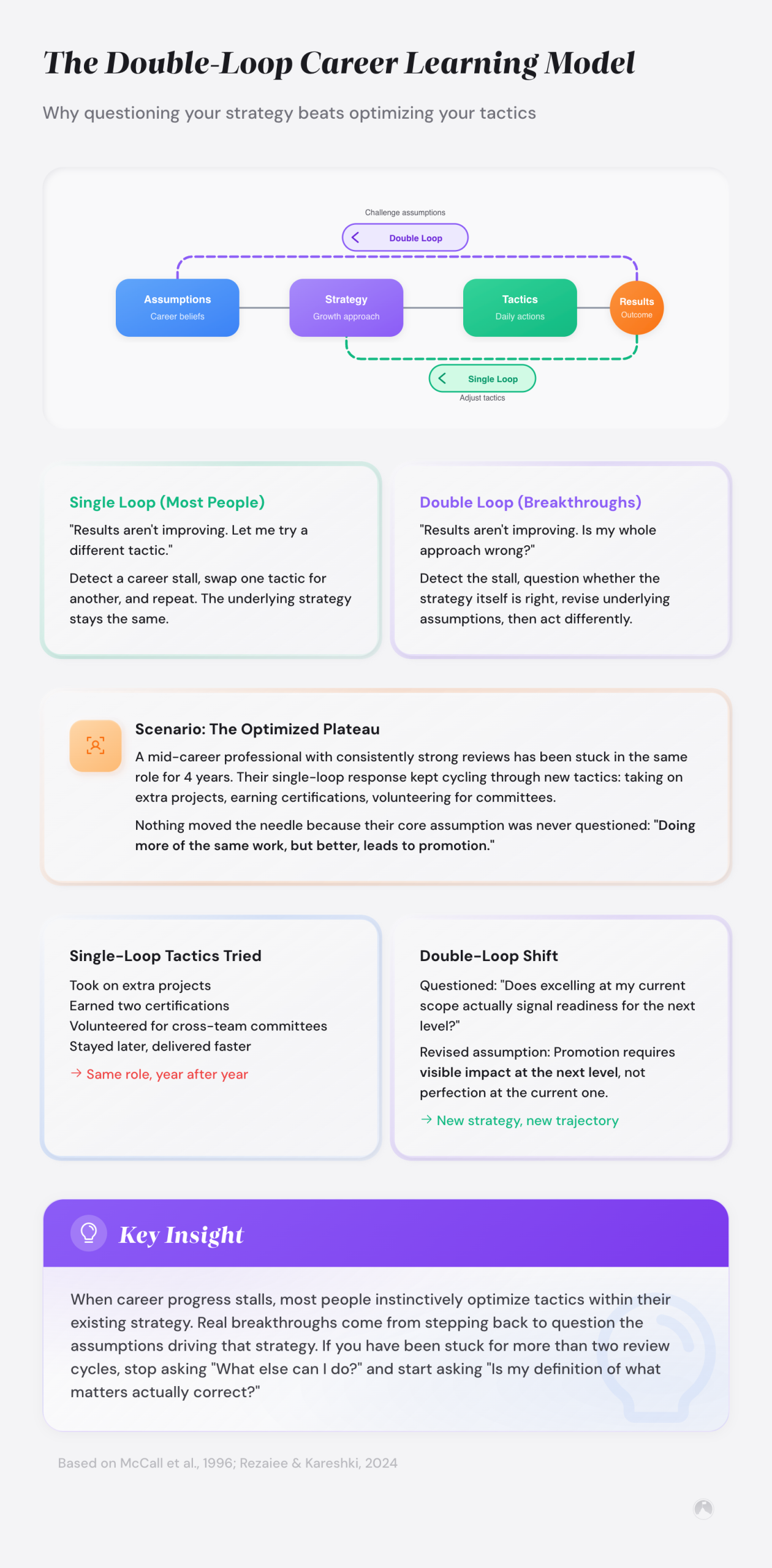
Here’s a simple filter that keeps showing up when career advancement strategies are compared across research and real-world outcomes. Three questions, asked in order, for every career investment you’re considering. None of these questions are new, but asking them together works better than any single career planning framework we’ve come across.
We call this the Advancement ROI Matrix — a framework we developed for matching career strategies to context. It works by filtering each potential strategy through three sequential questions that together predict whether the strategy will produce advancement in your specific situation.
Question 1: competence gap or visibility gap?
A visibility gap exists when a professional has the skills required for a higher role but decision-makers are unaware of or unconvinced by that readiness — distinct from a competence gap, where the skills themselves are missing.
If you lack the skills for the role above you, invest in the 70% (experiential learning) and 20% (mentorship). Skills-based career progression means focusing on stretch projects that build demonstrable capabilities. If you have the skills but aren’t being seen as promotion-ready, invest in networking and proactive advocacy.
Here’s a quick way to tell the difference. Ask two colleagues you trust: “Do you think I’m ready for the next level?” If they say yes without hesitation, your gap is visibility. If they hedge, your gap is competence.
Question 2: intrinsic or extrinsic barrier?
Wang and Ma identified two distinct categories of career barriers [2]. Intrinsic barriers include low self-efficacy, limited psychological resources, and fixed mindset patterns. Extrinsic barriers include resource constraints, organizational politics, and environmental uncertainty. Different strategies address different barrier types, and applying the wrong strategy to the wrong barrier wastes time.
Question 3: what is your time horizon?
If you need movement in the next six months, formal skill-building and internal mobility deliver faster. If you’re building toward a role two to three years out, strategic career planning techniques like networking and mentorship produce compounding returns that outpace short-term strategies.
| Your situation | Primary strategy | Supporting strategy | Avoid |
|---|---|---|---|
| Early career, competence gap | Experiential learning (stretch projects) | Mentorship | Heavy networking (too early to convert) |
| Mid-career, visibility gap | Networking + proactive advocacy | Internal mobility | More certifications (skills aren’t the bottleneck) |
| Mid-career, role constraint | Internal mobility | Skill-building for adjacent roles | Waiting for a promotion in current role |
| Senior, access gap | Executive networking | Sponsorship (not mentorship) | Formal training (diminishing returns at this level) |
| Career pivot | Formal skill-building + experiential projects | Mentorship in new domain | Relying on existing network (wrong domain) |
The most common career strategy mistake is applying the same approach to every situation when advancement is deeply context-dependent. A mid-career professional with a visibility gap who invests in another certification is solving the wrong problem. An early-career professional who prioritizes executive networking over competence building is skipping a critical foundation.
For a deeper look at the psychological drivers behind these patterns, explore career development psychology research.
What separates proactive from passive career management?
The single most damaging career belief is “do good work and the recognition will follow.” Rezaiee and Kareshki’s research on career development consistently shows that performance alone is a necessary but insufficient condition for advancement [1]. So what do professionals who use proactive career advancement methods actually do differently? Three things.
Document and communicate your impact
Not in an obnoxious way, but by framing your contributions in terms of organizational outcomes rather than task completion. “I finished the project” becomes “the project I led reduced customer onboarding time by 30%.” Here’s a template you can copy and adapt for your next performance conversation:
Impact statement template: “I [action verb] [project/initiative], which resulted in [measurable outcome] for [team/department/company]. This supported [strategic priority] by [specific contribution].”
Seek strategic assignments
Proactive professionals identify the projects that will build both skills and visibility, and they actively volunteer or pitch for those roles. This is strategic career planning in action, not career opportunism.
Build sponsor relationships
A sponsor is a senior leader who actively advocates for your promotion and puts their professional reputation behind your advancement — distinct from a mentor, who advises without direct advocacy. Rezaiee and Kareshki found that professionals who combine self-directed strategies with structured career guidance advance faster than those using either approach in isolation [1].
Proactive career management isn’t about self-promotion. Proactive career management is about making your contributions legible to the people who make advancement decisions. If you’ve been passed over with a strong performance record, the gap is almost always in legibility, not quality.
How do you know if your career stall is strategic or structural?
Not every career stall can be fixed with a better strategy. Sometimes the problem is the organization itself. Before investing more energy in advancement tactics, diagnose whether your barrier is strategic (something you can change) or structural (something the environment imposes).
Strategic barriers look like this: you have the skills but lack visibility, you’re not in the right conversations, you haven’t built sponsor relationships, or you’re investing in low-return development activities. These are addressable with the strategies compared in this article.
Structural barriers look different: your organization has a flat hierarchy with limited upward mobility, promotion decisions are driven by tenure rather than performance, or leadership roles are filled externally rather than from within. Wang and Ma’s 2024 study confirmed that extrinsic barriers like resource constraints and environmental uncertainty can stall careers regardless of individual effort [2].
If your barriers are structural, the highest-ROI move is often an external one. For professionals working through career change anxiety, recognizing that the stall isn’t personal but organizational can be the reframe that makes a transition feel less like failure and more like strategic repositioning.
The hardest career skill isn’t choosing the right advancement strategy. Honest self-diagnosis of whether any strategy will work where you currently sit is the real starting point.
Making career advancement strategies work for ADHD brains and working parents
Career advancement strategies that assume you control your schedule and have unlimited energy for networking events don’t work for everyone. If you’re managing ADHD or parenting young children (or both), the standard playbook needs adjustments.
Adapting for ADHD energy patterns
For professionals with ADHD, the experiential learning category in the 70-20-10 model is a natural strength. Hotte-Meunier and colleagues’ 2024 systematic review in Neurodiversity found that ADHD brains often demonstrate heightened engagement with novel challenges and hyperfocus on interesting projects [4]. So stretch assignments can be both a growth strategy and an engagement strategy.
Professionals with ADHD often excel at experiential learning because stretch assignments align with ADHD-typical hyperfocus on novel, stimulating challenges [4].
The risk is in the sustained relationship-building that mentorship and networking require. Consider replacing weekly coffee meetings with shorter, more frequent digital check-ins that match ADHD energy patterns. And front-load your networking into high-energy windows rather than spreading it across the week.
Adapting for working parents
For working parents, the critical constraint is time, not motivation. A 2025 KPMG survey found that 76% of working parents report that parenthood boosted their career motivation, yet many also report that work schedules frequently clash with parenting duties [7]. The most effective adaptation is ruthless prioritization within the Advancement ROI Matrix. Pick one primary strategy per quarter rather than trying to maintain all five simultaneously.
If you’re in mid-career with a visibility gap, invest your limited discretionary hours in two strategic networking conversations per week rather than spreading thin across courses, mentorship sessions, and networking events. Remote career growth strategies can help here by reducing commute and travel time.
The best career strategy for constrained professionals isn’t doing more. The best approach for time-constrained professionals is doing less, in the right category, with more intensity.
Quick diagnostic: where should you invest your career energy?
Step 1: Is your biggest gap competence or visibility?
Competence gap — Focus on experiential learning + mentorship
Visibility gap — Focus on networking + proactive advocacy
Step 2: Is your barrier intrinsic (mindset, confidence) or extrinsic (organizational structure, politics)?
Intrinsic — Mentorship + coaching + self-regulation work
Extrinsic — Internal mobility or external move
Step 3: What is your time horizon?
Under 6 months — Skill-building + internal mobility
Over 12 months — Networking + mentorship (compounding returns)
Ramon’s take
I used to think that advancement was mostly about competence and credentials. But I’ve watched plenty of talented people get passed over, and it’s almost never because they weren’t skilled enough. Once you’re competent, visibility becomes the ceiling. And visibility comes from strategic work choices and relationships, not from working harder at the same things.
Conclusion
When career advancement strategies are compared honestly, the uncomfortable truth is that the strategies most professionals default to — courses, certifications, and self-improvement — sit in the category with the smallest impact on actual advancement. The 70-20-10 model makes the case clearly: experiential learning and relationship-building drive the bulk of career growth, and formal training plays a supporting role. The Advancement ROI Matrix helps you match the right strategies to your specific bottleneck, barrier type, and time horizon.
Career advancement is not a single strategy applied universally — it is a sequence of right strategies applied at the right stages, and the first step is diagnosing which stage you are actually in.
In the next 10 minutes
- Answer the three Advancement ROI Matrix questions for your current situation
- Estimate what percentage of your current career development time goes to the 70%, 20%, and 10% categories
- Identify one stretch project or cross-functional opportunity you could volunteer for this month
This week
- Schedule one conversation with someone who holds the type of role you want next
- Rewrite your last three accomplishments using the impact statement template from the proactive management section
- Decide whether your current career barrier is strategic or structural and pick one strategy from the ROI Matrix to test for 30 days
Related articles in this guide
- career-change-anxiety-solutions
- career-development-plan-template
- career-development-psychology-research
Frequently asked questions
What are the most effective career advancement strategies for mid-career professionals?
Schedule quarterly skip-level conversations with leaders one or two levels above your manager to build visibility beyond your immediate team. Identify one cross-functional project per quarter that involves senior leadership exposure. Mid-career advancement stalls most often because the right people don’t know what you’re capable of, not because you lack capability.
Why should I invest in sponsorship over mentorship?
Mentors provide guidance and advice, while sponsors actively advocate for you in rooms where you are not present. A sponsor recommends you for stretch assignments, promotions, and high-visibility projects. This distinction matters: mentorship builds your readiness, but sponsorship converts that readiness into actual opportunities.
How can I advance my career without changing companies?
Start by pitching an internal move to your manager using a framing that benefits the team: explain how your skills in a new role would strengthen cross-department collaboration. Address the common objection ‘but my team needs me’ by proposing a transition timeline and offering to train your replacement. Internal moves work best when positioned as organizational wins rather than personal career moves.
What is the difference between a competence gap and a visibility gap?
If you regularly get asked to train others but rarely get tapped to lead projects, that signals a visibility gap. If peers with less experience are chosen for stretch assignments, that is another visibility indicator. A competence gap shows up differently: you feel uncertain in high-stakes meetings, struggle with unfamiliar domains the role requires, or receive feedback pointing to specific skill deficits. Knowing which gap you have determines whether you need more experience or more exposure.
Why do certifications rarely lead directly to promotions?
Formal training addresses the 10% slice of the 70-20-10 learning model developed by McCall, Eichinger, and Lombardo [5], meaning it contributes the smallest portion to career-relevant development. Certifications signal knowledge acquisition but don’t demonstrate the applied judgment, leadership, or political skill that promotion committees look for. They are most valuable for career pivots where you need to establish baseline credibility in a new domain.
How do I know if my career stall is something I can fix or if I need to change companies?
Give yourself six months with a focused strategy from the Advancement ROI Matrix — one primary strategy, executed consistently. If you see no movement in visibility, responsibilities, or compensation conversations after that period, treat the lack of progress as structural evidence. Track specific metrics like new project invitations, skip-level meeting frequency, or promotion-related feedback to make the assessment objective rather than emotional.
How does compensation alignment factor into career advancement strategy?
Compensation alignment with career growth means your pay trajectory should reflect your increasing value, not just your tenure. When internal moves don’t come with appropriate compensation adjustments, it signals the organization undervalues internal development. Use external market data during internal transitions, and treat compensation stagnation as a potential structural barrier worth diagnosing through the ROI Matrix.
References
[1] Rezaiee, M. and Kareshki, H. (2024). Empowering career pathways: integrating self-regulation strategies with career counseling practices. Frontiers in Education, 9, 1422692. DOI
[2] Wang, L. and Ma, H. (2024). From jobs to careers: drivers and barriers to career development in emerging labor markets. Frontiers in Sociology, 9, 1486871. DOI
[3] Talluri, S. B., Strauss, K., Newman, A., and Voigt, J. (2025). Future work self-salience: A systematic review and future research agenda. Applied Psychology: An International Review, 74(3), e70018. DOI
[4] Hotte-Meunier, A., Sarraf, L., Bougeard, A. et al. (2024). Strengths and challenges to embrace attention-deficit/hyperactivity disorder in employment: A systematic review. Neurodiversity, 2. DOI
[5] McCall, M. W., Eichinger, R. W., and Lombardo, M. M. (1996). The Career Architect Development Planner. Center for Creative Leadership.
[6] Granovetter, M. S. (1973). The strength of weak ties. American Journal of Sociology, 78(6), 1360-1380. DOI
[7] KPMG (2025). Working Parents Survey 2025. Link
[8] Allen, T. D., Eby, L. T., Poteet, M. L., Lentz, E., and Lima, L. (2004). Career benefits associated with mentoring for proteges: A meta-analysis. Journal of Applied Psychology, 89(1), 127-136. DOI