
Most habit tracker reviews pick the wrong app for you
You downloaded a habit tracker. You used it for five days. Then you forgot it existed. Abandoning a tracker after five days is not a failure of tracking itself – it’s a failure of fit. Harkin and colleagues analyzed 138 studies covering over 19,000 participants and found that self-monitoring is one of the most effective behavior change techniques available [1]. The self-monitoring mechanism works. The problem is that most people pick a daily habit tracker app based on star ratings instead of matching it to how their brain forms habits. The best habit tracking apps align with a specific psychological mechanism: loss aversion through streaks, variable rewards through gamification, or visual progress through completion maps. Pick the wrong mechanism for your personality, and the app becomes digital clutter within a week. This guide matches each habit tracking software option to the science that makes it stick. The best habit tracking apps for 2026 are Streaks (streak-driven consistency, iOS), Habitica (gamified habit building), Habitify (data-driven analytics), Strides (flexible goal tracking), HabitNow (best free habit tracking app, Android), Loop Habit Tracker (minimalist open-source), Way of Life (pattern awareness), Daylio (mood-linked tracking), and Productive (structured daily habit tracker app routines, iOS).Habit tracking is the practice of recording daily completion or performance of a behavior to increase self-awareness and use progress monitoring as a motivational tool.
What you will learn
- Why habit tracking works at all
- The best habit tracking apps for 2026
- Best habit tracking apps compared
- How to choose the right app for your situation
- Three setup principles that keep trackers alive
Key takeaways
- Self-monitoring alone improves goal attainment across 138 studies, making tracking one of the most evidence-backed behavior change tools [1]
- Streak-based apps tap into loss aversion; gamified apps use variable reward schedules; visual apps use the endowed progress effect [3]
- The Mechanism-First Selection method — a framework we developed for matching your tracker to your primary behavioral driver (loss aversion, variable rewards, or visual progress) rather than a feature list — narrows the choice to the right app category first
- Habit formation takes a median of 66 days, so commit to any app for at least two months before switching [2]
- The biggest predictor of tracker abandonment is setup friction, not missing features – start with three habits or fewer
- Free habit tracking apps like HabitNow and Loop cover the core tracking features; paid upgrades are optional for most users
Why habit tracking works at all
Self-monitoring changes behavior even without external accountability. A meta-analysis by Harkin et al. covering 138 studies found that monitoring progress toward a goal significantly increased likelihood of goal attainment [1]. The goal-monitoring effect held across fitness, nutrition, academic, and professional goals. But the mechanism matters — different apps rely on different psychological drivers, and these drivers aren’t interchangeable. Streak-based tracking relies on loss aversion. Kahneman and Tversky’s prospect theory found that losses feel roughly twice as painful as equivalent gains feel satisfying [3]. Once you build a 14-day streak, breaking it registers as a loss that stings more than the satisfaction of adding another day. Apps like Streaks and HabitBull build their entire interface around this principle. Gamified tracking uses variable reward schedules – the same mechanism Skinner identified behind persistent behavioral engagement [4]. Hamari, Koivisto, and Sarsa’s systematic review found that gamification elements generally increased engagement, though the effects were context-dependent and may be partly driven by initial novelty [5]. Habitica is the clearest example. Visual progress tracking taps into what Nunes and Dreze call the endowed progress effect: when people see how far they’ve already come, they work harder to finish [6]. Completion heatmaps, color-coded calendars, and progress bars in habit apps exploit this principle. Apps like Habitify lean heavily on data visualization. | Tracking Type | Psychological Mechanism | How It Works | |—|—|—| | Streak-based | Loss aversion (Kahneman & Tversky) [3] | Breaking a built streak feels like a loss, which motivates continued daily completion | | Gamified | Variable reward schedules (Skinner) [4] | Points, badges, and random rewards sustain engagement past the novelty phase | | Visual progress | Endowed progress effect (Nunes & Dreze) [6] | Seeing existing progress on charts and heatmaps creates momentum to continue | > “Monitoring goal progress significantly increased likelihood of goal attainment across fitness, nutrition, academic, and professional domains. The effect held regardless of whether monitoring was public or private.” – Harkin et al., Psychological Bulletin [1] The question isn’t “which app has the best features?” It’s “which psychological mechanism keeps you engaged?”The best habit tracking apps for 2026
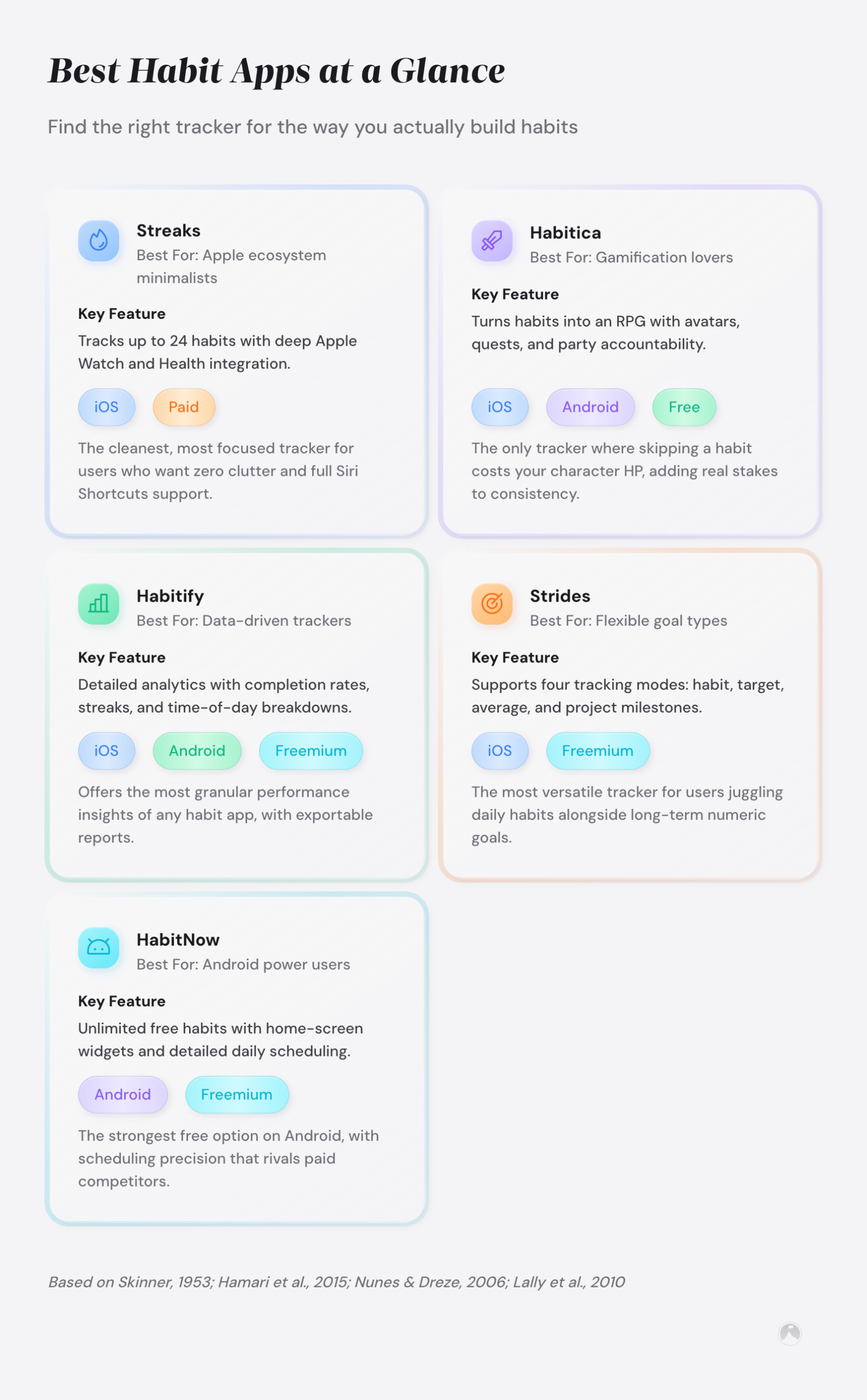
Streaks (best daily habit tracker app for streak-driven consistency)
Streaks is the most focused streak tracker available. Streaks limits users to 12 habits, reducing the decision fatigue that undermines completion rates during the 66-day habit formation window Lally’s research identified [2]. The app reinforces one message: don’t break the chain. Apple Watch integration makes daily check-ins take under five seconds. Health app sync means habits like “walk 10,000 steps” complete automatically. 4.9 stars with 24K+ ratings on the App Store. Available on iOS only. Pricing: $4.99 one-time. Best for: iPhone users who respond to loss aversion and want zero-friction daily tracking.Habitica (best for gamified habit building)
Habitica is the only major habit tracking app that uses RPG game mechanics — experience points, health bars, and boss battles — as its primary engagement driver. The variable reward schedule (random item drops, boss battles tied to group accountability) taps into the reinforcement loops Skinner identified [4] and that Hamari’s gamification review confirmed [5]. Social features add genuine accountability through parties where others depend on your completion. 4.5 stars on both the App Store and Google Play. Free with optional $4.99/month subscription. Available on iOS, Android, and web. Best for: People who respond to game mechanics, especially if traditional methods feel boring or rigid.Habitify (best for data-driven visual tracking)
Habitify is for people who want analytics. Completion heatmaps, success rate calculations, and trend graphs give detailed pictures of habit patterns. The endowed progress effect that Nunes and Dreze documented is core here [6]: watching your consistency chart fill in creates forward momentum. Organizes habits by time of day (morning, afternoon, evening, anytime), which pairs well with time-anchored habit stacking. 4.7 stars on the App Store. Free tier tracks three habits; premium is $4.99/month. Available on iOS, Android, Mac, and web. Best for: Analytical people motivated by seeing their data and wanting cross-platform access.Strides (best for flexible goal and habit tracking)
Strides handles both habits and goals in one app. Track a daily habit (meditate), a target goal (read 24 books yearly), a running average (sleep 7 hours), or a project milestone. Charts show rolling averages rather than binary pass/fail. Lally’s research showed that occasional missed days did not significantly affect the overall habit formation trajectory [2]. Apps that punish one missed day can be counterproductive. Strides avoids this. 4.7 stars on the App Store. Available on iOS and web. Free tier tracks seven habits; premium is $4.99/month. Best for: People building habits as part of a broader goal-setting system like OKRs.HabitNow (best free habit tracking app for Android)
HabitNow is the strongest free habit tracking app for Android. It offers streak tracking, flexible scheduling (daily, weekly, or custom), and a clean interface. The home screen widget means checking off habits without opening the app — aligning with research on implementation intentions, which shows that simplifying the decision point increases follow-through [7]. Free version includes everything most users need. Premium ($2.99/month) adds themes and advanced statistics. 4.5 stars on Google Play. Available on Android. Best for: Android users wanting a capable, no-cost tracker without ads.Loop Habit Tracker (best minimalist open-source option)
Loop is a free, open-source Android app with no accounts, no cloud sync, and no subscription. Your data stays on your device. The interface is deliberately minimal: checkboxes, streaks, and simple charts. For people finding most habit apps over-engineered, Loop strips tracking to its core function. Gollwitzer and Sheeran’s meta-analysis of 94 studies found that when people pre-plan the exact moment and context for action, follow-through increases significantly [7]. The app you actually open every day beats the app with the longest feature list. 4.7 stars on Google Play. Available on Android only. Best for: Privacy-conscious users and minimalists wanting tracking without gamification or subscriptions.Way of Life (best for yes/no habit awareness)
Way of Life takes the simplest approach: each habit gets a daily yes, no, or skip. The color-coded calendar (green for yes, red for no) creates instant pattern recognition. You spot problem days and recurring gaps at a glance. If you’re still figuring out why your habits keep failing, Way of Life gives diagnostic data without another complicated system. 4.6 stars on the App Store. Available on iOS. Free tracks three habits; lifetime purchase is $4.99. Best for: Beginners needing awareness of patterns before optimizing.Daylio (best for mood-linked habit tracking)
Daylio pairs habit tracking with daily mood logging. You log your mood alongside completed activities, and Daylio generates correlation charts showing which habits associate with better mood patterns. 4.8 stars on both the App Store and Google Play. Free with premium at $4.99/month. Available on iOS and Android. Best for: People who want to connect daily habits to emotional wellbeing and need motivation beyond streaks.Productive (best daily habit tracker app for structured routines on iOS)
Productive organizes habits into morning, afternoon, and evening routines with scheduled reminders for each. The structured time-blocking approach pairs well with habit stacking, helping you anchor new behaviors to specific parts of your day. 4.6 stars on the App Store. Free tier covers core features; premium is $3.99/month. Available on iOS only. Best for: iOS users wanting a structured, time-blocked daily habit tracker app. No Android version available.Best habit tracking apps compared
*Prices verified as of March 2026. Check app stores for current pricing.* | App | Core Mechanism | Platform + Price | Best For | |—–|—|—|—| | Streaks | Streak/loss aversion | iOS, Apple Watch / $4.99 one-time | Focused daily tracking | | Habitica | Gamification/variable rewards | iOS, Android, Web / Free or $4.99/mo | Engagement through game mechanics | | Habitify | Visual progress/analytics | iOS, Android, Mac, Web / Free or $4.99/mo | Data-driven tracking | | Strides | Flexible goal + habit | iOS, Web / Free or $4.99/mo | Habits tied to larger goals | | HabitNow | Streak + scheduling | Android / Free or $2.99/mo | Free Android tracking | | Loop Habit Tracker | Minimalist/open-source | Android / Free | Privacy and simplicity | | Way of Life | Binary yes/no awareness | iOS / Free or $4.99 lifetime | Pattern recognition | | Daylio | Mood-habit correlation | iOS, Android / Free or $4.99/mo | Mood-linked habit insight | | Productive | Structured routines | iOS / Free or $3.99/mo | Time-blocked daily habits | Key limitations: Streaks caps at 12 habits, no Android. Habitica’s game interface is not for everyone. Habitify free tier limited to 3 habits. Strides has no Android. HabitNow has no iOS. Loop has no cloud sync. Way of Life has very basic features. Daylio’s habit tracking is secondary to mood logging. Productive has no Android.How to choose the right app for your situation
What we call the Mechanism-First Selection approach works in three steps: identify your behavioral driver, match it to the right app category, then filter by platform and budget. If you respond to loss aversion (you hate losing progress more than you enjoy gaining it), pick a streak-based tracker: Streaks (iOS) or HabitNow (Android). If you need external engagement to stay interested (you get bored with simple checklists), try Habitica. Variable rewards sustain engagement past the initial novelty. If you’re motivated by seeing your own data (checking fitness stats, financial dashboards), go with Habitify or Strides. If you want to understand how habits affect your mood, Daylio connects behavior tracking with emotional patterns. If you find most apps over-complicated, start with Loop or Way of Life. Gollwitzer and Sheeran’s research shows that pre-planning the when and where of an action — what they call implementation intentions — significantly increases follow-through [7]. > “Habit formation takes a median of 66 days in real-world conditions, with a range from 18 to 254 days depending on behavior complexity. Committing to an app for 8 to 12 weeks is the minimum for the tracking behavior itself to become automatic.” – Adapted from Lally et al. [2]ADHD-friendly and parent-friendly picks
If you have ADHD, prioritize widget support (so you never need to open the app and lose focus) and flexible scheduling (so missing a day doesn’t punish you). While no controlled studies specifically test habit tracking apps for ADHD, the executive function literature suggests that external cues and flexible systems reduce the cognitive load that undermines consistency [8]. Strides and HabitNow handle this well. For more context, see our habit building with ADHD guide. If you’re a parent with unpredictable schedules, avoid strict daily-only trackers. Strides’ rolling averages forgive disrupted days, and Lally’s research confirms that occasional missed days don’t reset the habit formation trajectory [2]. For parent-specific habit strategies, our habits for working parents guide covers the scheduling side in depth.Three setup principles that keep trackers alive
The app is only half the equation. How you set it up determines whether it lasts. These principles apply regardless of which app you choose. Start with three habits or fewer. Starting with three or fewer habits is the single most important setup decision for long-term tracker retention. Each additional habit adds a decision point during the 66-day automaticity window [2], and Gollwitzer’s research on implementation intentions shows that reducing daily decision points increases follow-through [7]. Start with one to three habits that genuinely matter this month. Anchor your tracking to an existing routine. Pair the tracking action with something you already do: check off habits after your morning coffee, or log them during your evening commute. This is habit stacking applied to the tracking behavior itself. Give the app 66 days before switching. Lally et al. found that automatic habit formation takes a median of 66 days [2]. If you switch apps every two weeks, you never give any system enough time to become routine. Commit to one app, evaluate at the two-month mark, and only switch if the mechanism genuinely doesn’t fit. The tracker you use for two months beats the tracker you research for two weeks.Ramon’s take
I’ve abandoned more habit trackers than I’ve maintained, and the pattern is always the same: download something new, feel inspired for three days, then the friction of checking it daily outlasts the motivation. What finally stuck was realizing I respond to simple streaks – so I switched to Streaks with just one habit (writing 500 words) and the Apple Watch integration made it frictionless enough to survive past the novelty phase. The streak hit 120 days before I stopped counting, and writing is now automatic enough that I don’t even check the app most mornings. The insight: the best tracker isn’t the one with the best reviews – it’s the one that doesn’t require willpower to use.Conclusion
Among habit tracking apps 2026 offers, the ones that last match the psychological mechanism that drives your behavior. Streak apps work through loss aversion [3]. Gamified apps sustain engagement through variable rewards [4]. Visual trackers motivate through the endowed progress effect [6]. What we call the Mechanism-First Selection approach gets you to the right tool faster than comparing 50 features. Your habit formation process depends less on which app you pick and more on whether that app aligns with how your brain works. The tracker you use for two months beats the tracker you research for two weeks.Next 10 minutes
- Decide which behavioral driver fits you: loss aversion, gamification, visual data, or simplicity
- Download the matching app from the comparison table above
- Add exactly one habit to track starting tomorrow
This week
- Track your one habit for seven consecutive days without adding more
- Anchor the tracking action to an existing daily routine so it becomes automatic
- At the end of the week, add one or two more habits only if the first felt effortless
There is more to explore
For the brain science behind habit loops, our neuroscience of habit formation guide explains the dopamine mechanisms that make tracking work. And if you want to understand how reward systems reinforce habits at a deeper level, our habit rewards and reinforcement guide covers the mechanics.Take the next step
Pick one app that matches your mechanism, commit to it for 66 days, and keep the setup minimal. Everything else is overthinking.Related articles in this guide
- beyond-21-day-myth-how-long-does-it-take-to-form-a-habit
- daily-schedule-with-seinfeld-strategy
- goldilocks-rule-habits-optimal-challenge
FAQ
Do habit tracking apps actually work?
Yes. The effect holds whether tracking is public or private, and whether done digitally or on paper [1]. The practical effect size (d = 0.40) means the average person who self-monitors moves from the 50th percentile to approximately the 66th percentile of goal attainment. The key is consistent use for at least 66 days to let the tracking behavior itself become automatic [2].
What is the best free habit tracking app?
Loop Habit Tracker is the best fully free option for Android, with streaks, charts, and open-source transparency with no ads. For iOS, Way of Life tracks three habits free with a $4.99 lifetime upgrade available. HabitNow provides the most feature-complete free Android experience.
What is the best habit tracker for iPhone?
Streaks is the strongest iPhone option, with Apple Watch integration and a one-time $4.99 purchase. For cross-platform access, Habitify offers iOS, Android, Mac, and web. Strides is best if you want to combine habit and goal tracking in one app.
What is the best daily habit tracker app for ADHD?
Prioritize home screen widgets (to avoid opening the app and losing focus) and flexible scheduling (so missed days do not trigger shame). Strides and HabitNow score highest on these. Habitica can work if the game mechanics sustain attention without overwhelming.
What is the difference between a habit tracker and a goal tracker?
A habit tracker monitors daily recurring behaviors like exercise or reading. A goal tracker monitors progress toward specific outcomes like running a marathon. Strides handles both in one app, using rolling averages for habits and milestone tracking for goals.
How many habits should I track at once?
Start with one to three habits. Research on cognitive load suggests that each additional tracked habit competes for the same limited daily attention, and completion rates for all habits decline as the total count rises. Add new habits only after existing ones feel automatic — which typically takes 66 days or more [2] — and focus first on habits you are building from scratch, since tracking behaviors you already do reliably adds little value.