
Why one goal-setting method works brilliantly for you and bombs for your colleague
You have probably tried at least one goal-setting system. Maybe it worked. Maybe it sat in a notebook collecting dust by February. Here’s the thing: most people pick a method based on whoever marketed it loudest, not based on how their brain actually processes motivation. When you look at goal setting methods compared side by side, the differences become obvious fast.
The best goal setting frameworks share one trait: they work only when matched to the right person. A 2024 study by Pietsch and colleagues, published in Educational Psychology, found that SMART goals did not outperform exploratory “open goals” or “do-your-best” goals in a creative task with 247 participants, challenging the assumption that any single method dominates across all contexts [1]. This article breaks down 10 proven methods with a decision matrix so you can match the framework to the human actually trying to use it. For a broader look at how to measure progress once you have chosen a method, see our complete guide to goal tracking systems.
When goal setting methods are compared using research data, the pattern is consistent: SMART goals excel for measurable targets, OKRs drive ambitious team alignment, and WOOP increases follow-through by forcing obstacle planning. Your personality type, goal complexity, and timeline determine which of these effective goal setting strategies will actually stick. The decision matrix below matches each framework to specific personality profiles so you can skip the trial-and-error phase.
What you will learn
- The 10 most evidence-backed goal-setting methods and how each one works
- Research on which methods produce the highest success rates for different personality types
- A decision matrix to identify your ideal method based on five key dimensions
- How to combine methods for maximum effectiveness
- Common failure patterns and how to prevent them
Don’t have time to read all 10? Skip to the Goal Method Matrix to find your best-fit framework in 2 minutes.
Key takeaways
- SMART goals excel for specific, measurable projects but a 2024 study found they are no more effective than open goals for creative work [1].
- OKRs drive ambitious team-wide objectives; SMART goals handle individual execution.
- In one study of anesthesiology residents, the WOOP group spent nearly triple the study time compared to a goal-setting-only group [2].
- Personality type predicts which goal framework you’ll sustain – conscientiousness favors SMART, openness favors OKRs [9].
- Hybrid approaches combining OKRs for strategy and SMART for execution outperform single-framework systems for complex goals.
- Framework-personality mismatch is the top cause of goal abandonment – test one method for two months before adding layers.
1. SMART goals: the structured foundation
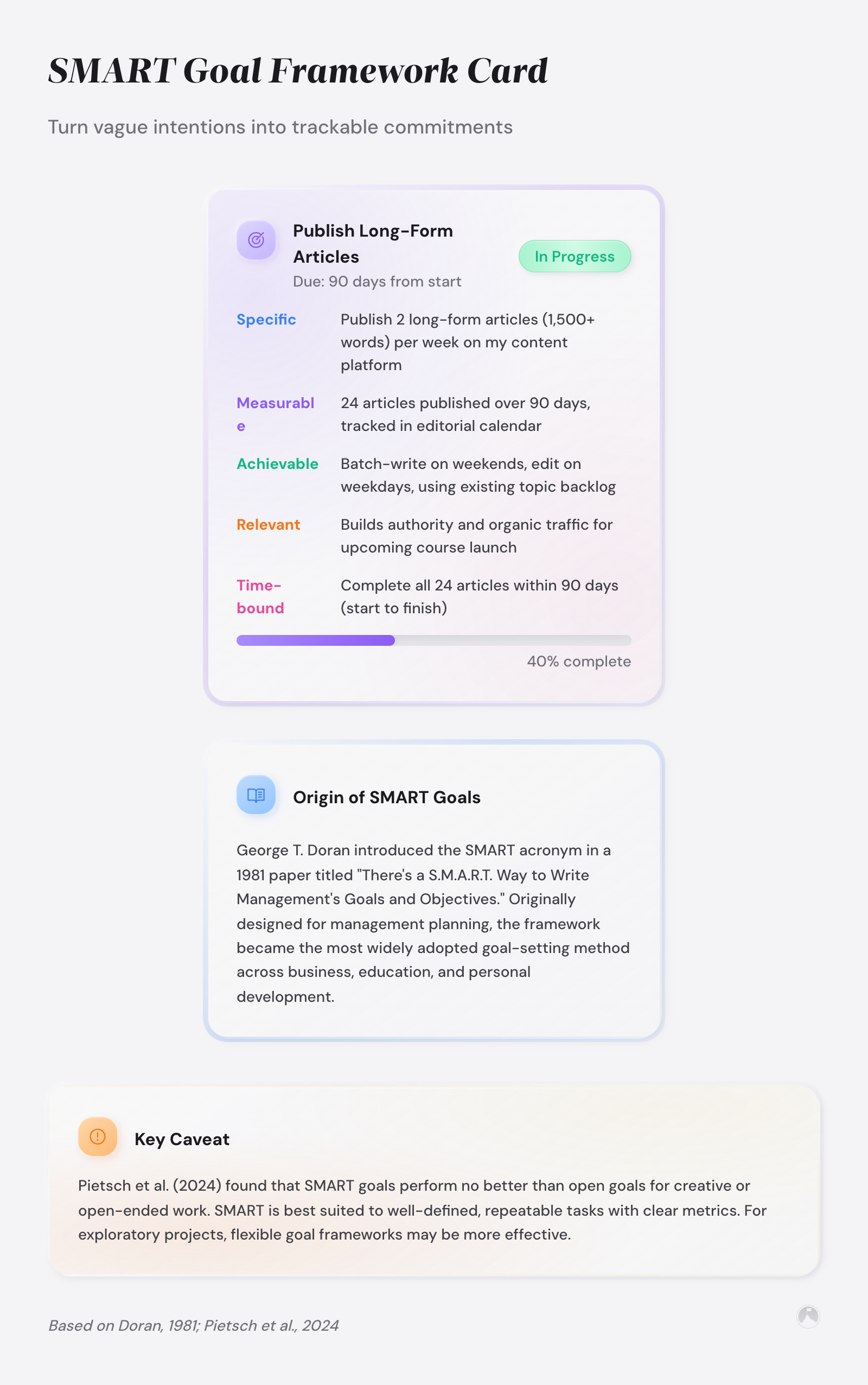
SMART goals SMART goals are a goal-setting framework requiring each goal to be Specific, Measurable, Achievable, Relevant, and Time-bound, designed to eliminate ambiguity and make progress tracking straightforward.
SMART goals are most effective for career progression, fitness targets, and project milestones where clear completion criteria exist. SMART stands for Specific, Measurable, Achievable, Relevant, and Time-bound. George T. Doran introduced this framework in 1981, and it became the most widely adopted approach in corporate and individual goal-setting [3]. For a deeper look at how SMART compares head-to-head with other structured frameworks, see our comparison of SMART, OKR, and FAST goal-setting approaches.
How it works: Instead of “get healthier,” you write “run 3 miles, three times per week, starting Monday.” Every element is quantified and dated. This clarity reduces ambiguity and makes progress tracking straightforward.
Best for: Career progression goals, fitness targets, project milestones, and anything requiring clear completion criteria. Ideal personality type: People who thrive on measurement and visible progress (common in Type A personalities and conscientious individuals).
Key strength: SMART’s specificity eliminates the guesswork. As Edwin Locke and Gary Latham demonstrated in their foundational goal-setting research, specific and difficult goals lead to higher performance levels than vague, nonquantitative goals like “do your best” [4]. Their research has been validated across thousands of participants in academic, organizational, and sports settings.
> “Specific and difficult goals lead to higher performance than vague, nonquantitative goals” – Locke and Latham’s goal-setting research, validated across thousands of participants [4].Specific goals work because they remove the “did I succeed?” ambiguity that generic goals leave hanging. And when the target is clear, effort becomes focused.
When it falls short: But here is the catch. A 2024 study published in Educational Psychology by Pietsch and colleagues found that among 247 participants performing creative tasks, SMART goals were no more effective than exploratory “open goals” or “do-your-best” goals for creative performance [1]. If your goal involves learning complex new skills or creating something original, pure SMART might constrain you.
Implementation timeline: One week to set up; ongoing tracking takes 10 minutes per week. The clearer the target, the less willpower you need to chase it. But what if your goals need more ambition than SMART allows?
2. OKRs (Objectives and Key Results): the strategic amplifier
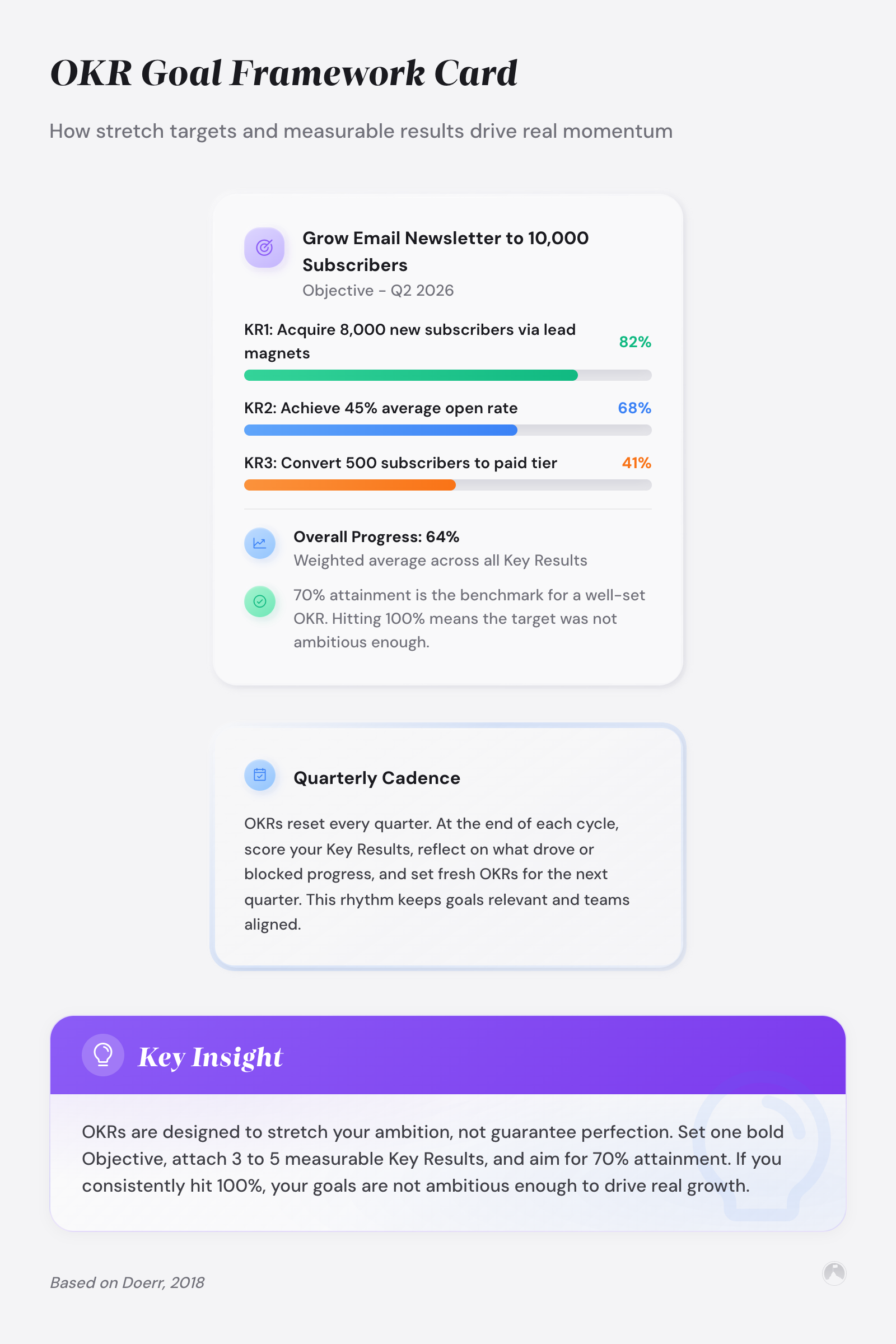
OKRs (Objectives and Key Results) OKRs are a goal-setting framework that separates an aspirational objective from 3-4 measurable key results, intentionally setting ambitious targets where achieving 70% counts as success.
OKRs are most effective for leadership roles, company-wide strategic alignment, and cross-functional projects requiring ambitious direction-setting. Originally developed by Andy Grove at Intel and later popularized by John Doerr in Measure What Matters, OKRs now guide teams at Google, Amazon, and hundreds of other companies [5].
How it works: You set 3-5 ambitious objectives per quarter. For each objective, you define 3-4 key results that, if achieved, prove you nailed the objective. An objective is directional and inspirational (“become a recognized industry voice”). Key results are quantified wins (“publish 24 articles,” “reach 50K Twitter followers,” “speak at 3 major conferences”).
OKRs intentionally set targets ambitious enough that hitting 70% counts as success. As John Doerr describes in Measure What Matters, this is the core philosophy of the OKR methodology – stretch goals that push teams beyond what feels comfortable [5]. If you want to apply OKRs to your personal life, our guide on tracking OKRs for personal progress walks through the setup step by step.
Best for: Leadership roles, company-wide strategic alignment, cross-functional projects, startup scaling. Ideal personality type: Big-picture thinkers and people who work well with ambiguity (high openness, lower conscientiousness).
Key strength: OKRs create clarity at scale. When a whole organization uses the same framework, alignment cascades naturally. The framework prevents the “we are all busy but pulling in different directions” trap.
When it falls short: OKRs require comfort with ambitious targets you know you might miss. For people with perfectionist tendencies or those working in risk-averse environments, the “70% success” mentality can feel like failure.
Hybrid option: Many mature organizations use OKRs for strategy (company level) and SMART goals for execution (individual level). This combines ambition with clarity.
Implementation timeline: Two weeks to establish the system; monthly check-ins (1 hour each). Strategy without execution is a daydream. OKRs force you to define what “done” looks like at every level. But what about the gap between setting a goal and actually following through?
3. WOOP (Wish, Outcome, Obstacle, Plan): the realist’s framework
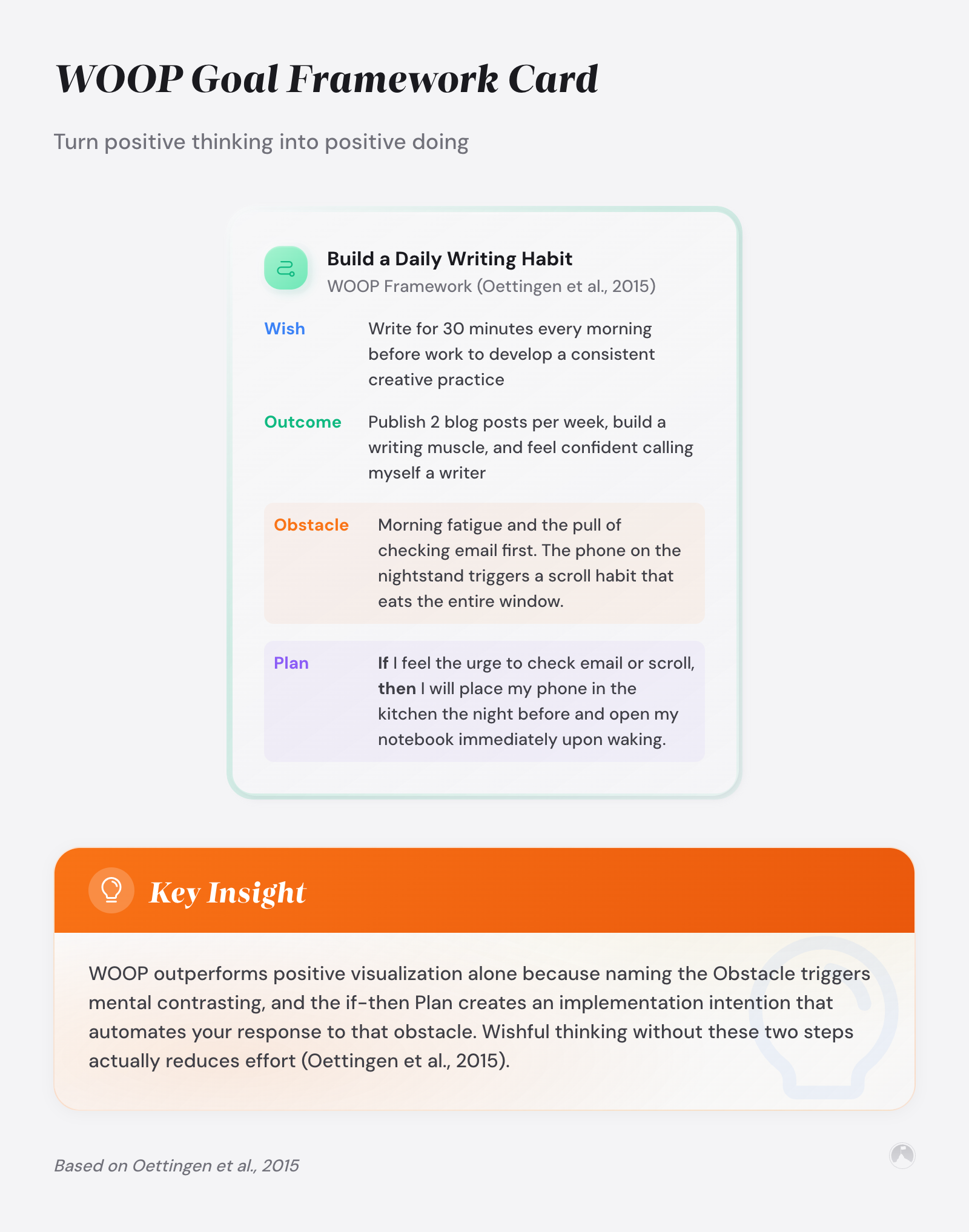
WOOP (Wish, Outcome, Obstacle, Plan) WOOP is a behavior-change framework combining positive visualization with obstacle identification and if-then planning, designed to increase goal follow-through by precommitting to handle specific friction points before motivation fades.
WOOP is most effective for habit formation, behavior change, and academic achievement goals where follow-through is the primary challenge. Developed by psychologist Gabriele Oettingen, WOOP is sometimes called Mental Contrasting with Implementation Intentions (MCII). Positive visualization alone does not work. WOOP combines positive dreaming with brutal realism about obstacles [2].
In any goal setting techniques comparison, WOOP stands out for its emphasis on precommitting to obstacle handling before motivation fades. For a full breakdown of the science behind this framework, see our guide to the WOOP goal system.
How it works:
- Wish: State your goal clearly and emotionally (“I want to exercise 4x per week”)
- Outcome: Vividly imagine the best outcome (“I feel stronger, have more energy, fit into my favorite jeans again”)
- Obstacle: Identify the realistic internal or external barrier blocking you (“I get tired after work and convince myself I will go tomorrow morning instead”)
- Plan: Create a specific if-then implementation intention (“If I feel tired after work, then I will put on my gym clothes immediately and do a 20-minute session at home”)
Best for: Habit formation, behavior change, weight loss, academic achievement, physical activity goals. Ideal personality type: Realists and people skeptical of positive thinking alone (high agreeableness and conscientiousness).
WOOP works because it forces you to precommit to handling friction before temptation arrives. The obstacle-planning step is the mechanism that separates WOOP from generic positive visualization.
Key strength: In a randomized study of anesthesiology residents, Gabriele Oettingen and colleagues found that the WOOP group spent significantly more time studying their goals than the goal-setting-only group (median 4.3 hours vs 1.5 hours, p=.021) [2]. This single-domain study illustrates how the obstacle-planning step forces you to precommit to handling the specific friction you will encounter. The underlying mechanism – pairing mental contrasting with implementation intentions – has been tested across multiple goal types.
When it falls short: WOOP requires genuine self-awareness about your obstacles. If you are prone to self-deception or don’t want to acknowledge your resistance, WOOP forces confrontation with uncomfortable truths.
Implementation timeline: 30 minutes to set up; refreshing takes 5 minutes per goal quarterly. Optimism without obstacle planning is just wishful thinking. But what if your goal is not a single target but a daily behavior you need to sustain?
4. Habit goals vs. achievement goals: the duration question
Habit goals are most effective for building automated daily behaviors, while achievement goals work best for outcome-driven milestones. Rather than choosing one framework, research suggests you actually need two parallel goal types that serve different purposes. Habit goals are the small daily behaviors you repeat (exercise 3x weekly, meditate 10 minutes daily). Achievement goals are the outcomes you are chasing (run a 10K, get promoted). Wendy Wood, Asaf Mazar, and David Neal’s 2021 research in Perspectives on Psychological Science demonstrates that habits and goals operate as separate but interacting systems in human behavior [6]. Our deep look into the differences between habit goals and achievement goals explores how to balance both types effectively.
The distinction matters. Habits operate on automaticity and context. Phillippa Lally and colleagues at University College London found that once a habit forms (a process that takes a median of 66 days) your environment directly triggers the behavior without conscious effort [7]. Achievement goals are volitional and immediate – you experience them consciously in the moment.
A small action performed daily creates stronger behavioral patterns than an intense action performed sporadically. This is why consistency beats intensity. People commonly neglect habit goals in favor of the more exciting achievement goal, then wonder why they fail.
Best combination: Start with your achievement goal (the outcome you want). Then work backward to identify the daily 1-3 habits that, if automated, will get you there. Track the habits religiously. The achievement goal will follow.
Implementation timeline: Habit tracking requires 2 minutes daily. Achievement goal reviews happen monthly. So your daily investment is tiny, but the compounding effect is not. The question then becomes: how hard should you push?
5. The Goldilocks rule: balanced challenge
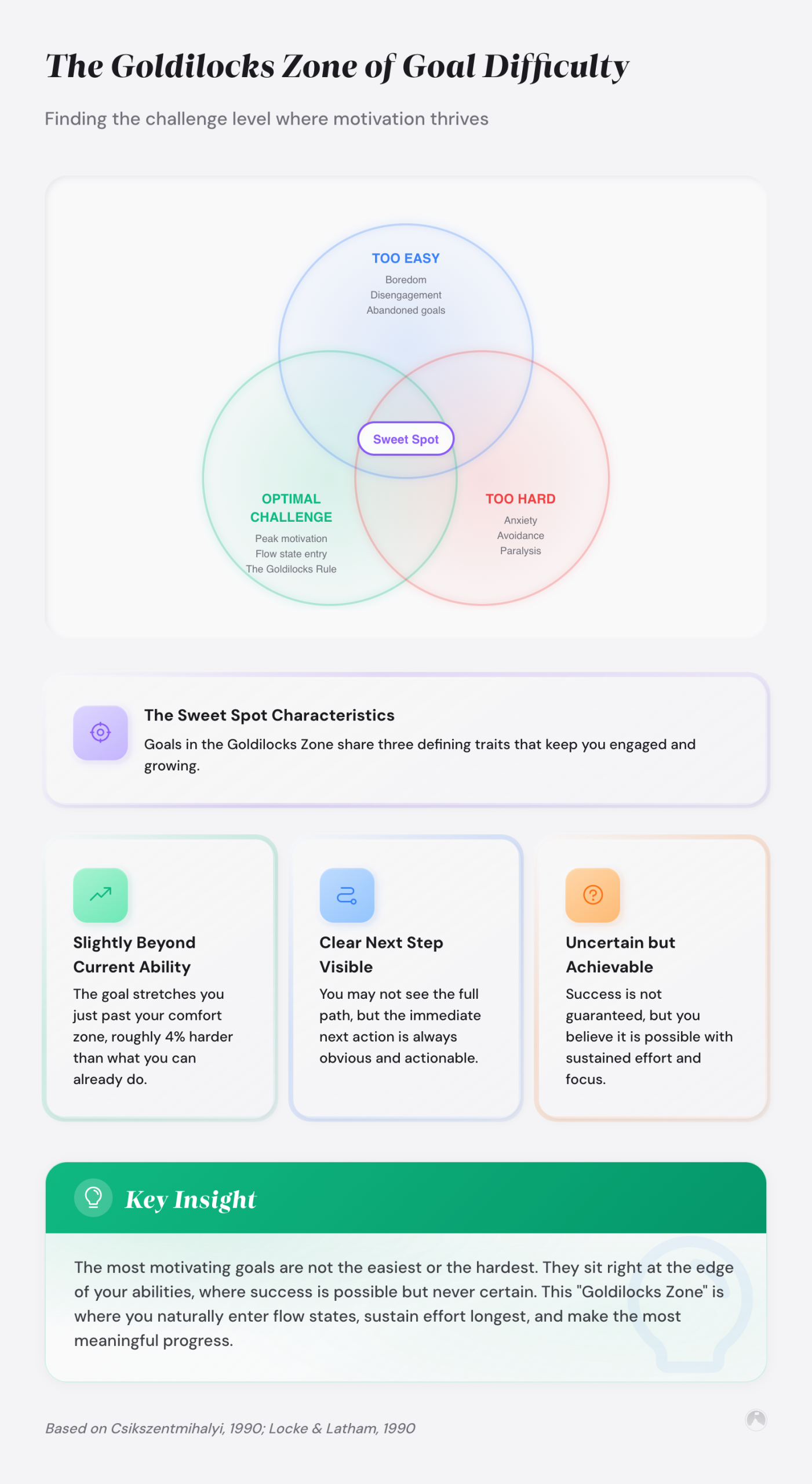
The Goldilocks Rule The Goldilocks Rule is a goal-calibration principle stating that peak motivation occurs when a challenge sits 1-2 levels above current capability – hard enough to feel meaningful but achievable with focused effort.
The Goldilocks Rule is most effective for skill-building goals and creative development where sustained engagement matters more than a specific deadline. The rule states that humans experience peak motivation when a challenge sits at the edge of their current capability – hard enough to feel meaningful but achievable with effort. It is the sweet spot between boredom and panic. For a practical guide on applying this principle, see our article on the Goldilocks goal framework for goals that stick.
How it works: You assess your current skill level at something (say, writing, coding, public speaking) on a 1-10 scale. Then you set a goal that requires you to reach 1-2 levels above current ability. Not 5 levels. Not maintaining current level. Just 1-2 levels.
This prevents the “I am too far behind, why bother” trap and the “this is too easy, I am bored” trap.
Best for: Skill-building goals, learning-oriented contexts, competitive pursuits, creative development. Ideal personality type: Growth-oriented people, competitive individuals, creatives.
Key strength: The rule aligns with flow-state research. Mihaly Csikszentmihalyi’s foundational work on optimal experience demonstrates that sustained engagement and happiness both require the challenge-to-skill ratio to stay in this Goldilocks zone – where the challenge slightly exceeds your current capability [8].
Limitation: Requires honest self-assessment. People either overestimate their ability (setting too-hard goals) or underestimate it (setting too-soft goals). Getting calibrated often requires external feedback.
Implementation timeline: 20 minutes to assess current level; quarterly recalibration. The right goal is not the most ambitious one. It is the one that keeps you engaged long enough to finish. But what if even a well-calibrated goal loses urgency because the deadline is too far away?
6. The 12-week year: the quarterly refresh
The 12-Week Year The 12-Week Year is a goal-execution framework that compresses annual planning into 12-week cycles, using deadline proximity to maintain psychological urgency and enable frequent course correction.
The 12-Week Year is most effective for entrepreneurs, ambitious professionals, and anyone struggling with annual goal decay. The framework compresses annual planning into a 12-week sprint. The logic: one year is psychologically too long to maintain discipline. Twelve weeks feels urgent without being frantic. Brian P. Moran and Michael Lennington developed this framework based on the principle that shorter planning horizons create sustained focus [13].
How it works: Instead of setting annual goals, you set quarterly tactical goals with a detailed 12-week action plan. Every week you review progress (1 hour per week). Every 12 weeks, you assess results and start fresh with a new 12-week plan.
Best for: Entrepreneurs, ambitious professionals, people in competitive environments, anyone struggling with annual goal decay. Ideal personality type: Action-oriented people, those who like frequent feedback, people who chafe at long planning horizons.
Key strength: Psychological urgency and frequent course correction. The 12-week window creates enough timeline to accomplish something meaningful and stays short enough to maintain focus. This aligns with Steel and König’s temporal motivation theory, which indicates that motivation increases as a deadline approaches – shorter cycles keep that urgency consistently elevated [14].
When it falls short: For goals requiring longer incubation (publishing a book, building a business from scratch to sustainable), 12-week cycles can feel fragmenting. Some people find quarterly pressure too frequent.
Hybrid approach: Use 12-week sprints for execution. Nest them within a multi-year vision for direction.
Implementation timeline: 2-3 hours to plan a quarter; 1 hour weekly reviews. Urgency is not the enemy. The enemy is a deadline so far away you forget it exists. But urgency alone does not determine success – what you focus on daily matters just as much.
7. Outcome vs. process goals: the control question
Process goals are most effective for long-term pursuits with external uncertainty, while outcome goals set the direction. Outcome goals focus on the result (“lose 20 pounds,” “get promoted”). Process goals focus on the daily behaviors that produce that outcome (“track calories 6 days per week,” “deliver one high-impact project monthly”). Our framework for balancing outcome and process goals details how to structure both types so they reinforce each other.
This matters. You cannot always control outcomes, but you can control process. External factors (hiring decisions, market conditions, competitor actions) affect outcomes. Your daily effort affects process.
And here is the counterintuitive part: people who emphasize process goals over outcome goals commonly experience less anxiety and more consistency. Zimmerman and Kitsantas’ research on self-regulation found that process goals are particularly advantageous during initial learning because of their close linkage to strategic planning and implementation [15]. Many find they actually achieve better outcomes over time. Releasing attachment to outcomes and focusing on daily actions lets the results follow naturally.
Best for: Long-term goals, goals with external uncertainty, athletic performance, career development. Ideal personality type: People with internal locus of control, anxious individuals (process focus reduces anxiety).
Practical implementation: Write down your outcome goal. Then identify 3-5 process goals that, if executed consistently, would produce that outcome. Track the process goals obsessively. Trust the outcome will follow.
Implementation timeline: 30 minutes to identify process goals; daily tracking takes 2 minutes. You cannot control whether you get promoted. You can control what you ship this week. Now that you know the 7 core methods, which one actually fits your personality?
8. The goal method matrix: goal setting methods compared by personality type
Goal Method Matrix The Goal Method Matrix is a personality-to-framework matching tool that maps Big Five personality traits to optimal goal-setting frameworks, based on the principle that personality-framework fit determines long-term goal adherence more than any framework’s theoretical superiority.
Research on personality suggests that individual differences in traits like Conscientiousness and Openness predict which goal-setting frameworks will be adopted and sustained. Dan McAdams and Jennifer Pals’ work on integrative personality science, published in American Psychologist, shows that personality operates at multiple levels – from broad traits to personal goals to life narratives – and each level shapes how people pursue their objectives [9]. For a deeper look at the research behind why motivation differs across individuals, explore the psychology of goal setting.
| Your Personality | Best Framework | Why It Works |
|---|---|---|
| Conscientious + Detail-Oriented | SMART Goals or Process Goals | Systems-oriented brains naturally track and adjust. |
| Big-Picture Thinker + Strategic | OKRs | Direction and autonomy without tactical boredom. |
| Realistic + Skeptical of Hype | WOOP | Obstacle-planning appeals to pragmatism. |
| Ambitious + Impatient | 12-Week Year | Quarterly cycles deliver quick wins and sustained focus. |
| People-Pleaser + Needs Accountability | Habit Goals + Accountability Partner | External check-ins compensate for weak self-expectations. |
| Creative + Risk-Tolerant | Open Goals | Aspirational objectives with flexible execution paths. |
| Highly Anxious | Process Goals + WOOP | Controllable daily actions plus obstacle-planning reduce anxiety. |
The key insight: Personality-framework fit determines success more than the framework’s theoretical superiority. Choose the method that aligns with how your brain naturally works, not the one with the best marketing. When evaluating SMART vs OKR vs WOOP, the answer always depends on who is using it.
9. The hybrid approach: combining goal setting methods for maximum effect
None of the frameworks are mutually exclusive. Many high achievers find that combining them strategically – matching different frameworks to different goal types – produces better results than committing to a single system.
For career goals: OKRs (strategic direction) + SMART goals (quarterly execution) + Process goals (daily focus) + 12-week sprints (urgency)
For habit-building: Habit goals (daily behavior) + Goldilocks Rule (skill calibration) + WOOP (obstacle precommitment) + 12-week tracking (urgency)
For complex projects: OKRs (overall direction) + SMART goals (milestone clarity) + Process goals (team accountability) + Outcome goals (end-state vision)
But don’t combine frameworks randomly. Choose one primary framework that matches your personality. Then layer in others that address specific challenges your primary framework does not handle. The goal is not to use every system. It is to use the right parts of each.
10. When goal setting methods fail (and how to prevent it)
Goal-setting does not work universally. Research identifies specific failure modes and how to prevent them. If you have chosen a framework but still struggle with execution, our guide on how to follow through on goals addresses the gap between planning and doing.
Failure Mode 1: Goals Without Plans
Goal-setting increases motivation but only produces results if paired with an actual implementation plan. Peter Gollwitzer and Paschal Sheeran’s meta-analysis of 94 studies on implementation intentions found that pairing a goal with a specific if-then plan significantly increases follow-through [10]. Having a goal without a plan creates a false sense of progress – you feel motivated but lack the concrete steps to act on it. Fix: Spend 30 minutes creating an obstacle-and-plan map (WOOP) or identifying process goals.
> Gollwitzer and Sheeran’s meta-analysis of 94 studies found that pairing a goal with a specific if-then plan significantly increases follow-through [10].Failure Mode 2: Mismatched Difficulty
Goals set either too easy (boring, demotivating) or too hard (overwhelming, demotivating). The Goldilocks Rule addresses this. Recalibrate quarterly.
Failure Mode 3: Goal Conflict
When goals compete for time and energy, your brain gets stuck in analysis paralysis. Research on cognitive load suggests that managing multiple competing goals taxes working memory and attention, reducing performance across the board (note: early ego-depletion findings in this area have faced significant replication challenges in multi-lab studies) [11]. Fix: Ruthlessly prioritize. Three goals maximum per quarter.
Failure Mode 4: Missing Feedback Loop
You set a goal and disappear for three months. Without interim feedback, you lose motivation and drift. Fix: Choose a measurement cadence (weekly for habits, monthly for outcomes) and actually review it. A structured weekly goal review process keeps you honest and provides the course-correction data you need.
Failure Mode 5: Achievement Fallacy
You reach the goal and feel empty. The hedonic treadmill resets your baseline happiness. You thought the external achievement would fulfill you but it does not. This is not a goal-setting failure – it is a values alignment failure. Tim Kasser and Richard Ryan’s research on intrinsic versus extrinsic goals shows that pursuing extrinsic goals (wealth, status, others’ approval) provides only temporary satisfaction, and goals aligned with intrinsic values (autonomy, mastery, purpose) sustain well-being [12].
Fix: Before setting a goal, ask whether it is aligned with your intrinsic values, not just extrinsic rewards. The most dangerous goal is the one you achieve and realize you never wanted.
All 10 goal setting methods compared at a glance
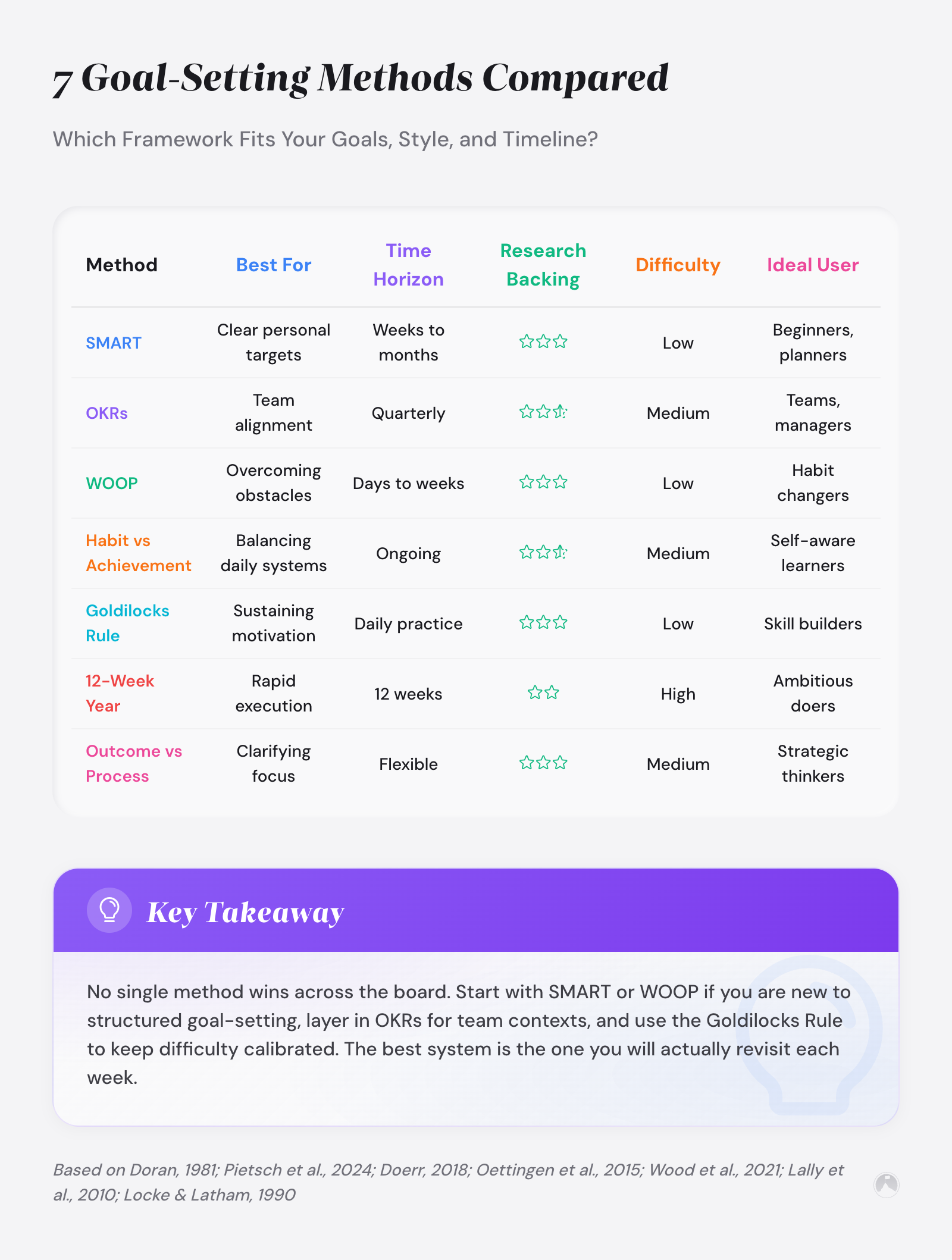
| Method | Best For | Setup Time | Key Strength | Key Weakness |
|---|---|---|---|---|
| SMART Goals | Measurable targets | 1 week | Eliminates ambiguity | Constrains creativity [1] |
| OKRs | Strategic alignment | 2 weeks | Clarity at scale | 70% success feels like failure to perfectionists |
| WOOP | Behavior change | 30 minutes | Obstacle precommitment | Requires honest self-awareness |
| Habit Goals | Daily behaviors | 2 minutes/day | Automaticity after ~66 days [7] | Neglected for flashier achievement goals |
| Goldilocks Rule | Skill building | 20 minutes | Sustained engagement | Requires accurate self-assessment |
| 12-Week Year | Quarterly execution | 2-3 hours | Psychological urgency [14] | Fragmenting for long-incubation goals |
| Process Goals | Long-term pursuits | 30 minutes | Controllable daily focus | Results feel indirect |
| Outcome Goals | Direction setting | 15 minutes | Clear end-state vision | External factors reduce control |
| Goal Method Matrix | Choosing a framework | 15 minutes | Personality-framework fit | Requires personality self-knowledge |
| Hybrid Approach | Complex multi-type goals | Varies | Covers multiple goal types | Complexity if over-layered |
Ramon’s take
I use different frameworks for different goal types (OKRs for quarterly work objectives, habit goals plus WOOP for daily behaviors, Goldilocks calibration for skill development) and my experience contradicts the typical “find one system and stick with it” advice. But the framework matters less than the decision to review progress weekly – I have watched people fail with the “best” framework simply because they set it and forgot about it. The system you review is the system that works.
Conclusion
You don’t have a goal-setting problem. You have a system-personality fit problem. With so many goal setting methods compared in this guide, the pattern is clear: the best method for you is the one you will actually use, and the one you will use is the one that matches how your brain works.
The Goal Method Matrix above is not theoretical. It is built on decades of research on personality differences and motivation. Before you spend three hours setting goals using the “best” framework, spend 15 minutes identifying which framework matches your psychology.
And the second most common failure? Combining too many frameworks at once. Start with one. Layer in others only if your primary system is not producing results after two months. If you are ready to put your chosen framework into practice, our guide on turning goals into results walks through the execution process step by step.
In the next 10 minutes
- Identify your personality type on the Goal Method Matrix above
- Find the 2-3 frameworks that map to your style
- Pick the one framework you will actually use (not the “optimal” one)
- Set one test goal this week using that framework
This week
- Commit to one weekly review time (same day, same time each week)
- Create your obstacle map for your primary goal (even if you don’t use full WOOP, identify the one friction point you will face)
- Share your goal with one person who will ask you about it – having an accountability partner transforms intention into follow-through
- Check back at the end of the week to see what you learned about how the framework actually feels for you
There is more to explore
Once you have selected your goal-setting framework, explore our complete guide to goal tracking systems to learn how to measure progress effectively. For those focused on building accountability, see our guide on accountability partner strategies for practical approaches to maintaining consistency. If you want to add a motivational layer to your tracking process, check out quick ways to gamify your task list. And for setting up ambitious quarterly goals systematically, see our guide on setting up an OKR tracking system.
Related articles in this guide
- best-goal-tracking-apps
- commitment-devices-that-help-you-stick-to-goals
- dependency-mapping-for-goals
Frequently asked questions
What is the most effective goal-setting method for 2026?
No single method is universally most effective – the best goal-setting method depends on personality type, goal complexity, and timeline. Research shows SMART goals excel for specific, measurable targets, and OKRs work better for ambitious strategic goals. WOOP produces strong adherence rates for behavior change in studies of specific populations [2]. The most effective method is the one that matches your personality and you will actually use. A 2024 study found that SMART goals did not outperform open goals for creative work [1].
What is the difference between SMART goals and OKRs?
SMART goals are specific, measurable, achievable, relevant, and time-bound – designed for clear, individual targets with high confidence in success rates. OKRs separate aspirational objectives from measurable key results, intentionally setting ambitious targets where 70% achievement counts as success [5]. SMART handles tactical execution. OKRs handle strategic direction. Many organizations use both: OKRs for company strategy and SMART goals for individual execution.
How do I choose the right goal-setting framework for my personality?
Use the Goal Method Matrix in this article, which matches frameworks to Big Five personality types. Conscientious and detail-oriented people do best with SMART goals or process goals. Big-picture thinkers thrive with OKRs. Realistic and skeptical personalities benefit most from WOOP. The key is choosing a method that matches how your brain naturally processes motivation, not picking the framework with the best marketing.
Can you combine different goal-setting methods?
Yes, and hybrid approaches often work better than single frameworks. For example, use OKRs for strategic direction, SMART goals for quarterly execution, process goals for daily focus, and WOOP for obstacle precommitment. Start with one primary framework, then layer in others to address specific challenges. Don’t combine randomly – choose methods that serve different functions in your goal hierarchy.
Are SMART goals still relevant in 2026?
Yes, SMART goals remain highly effective for specific, measurable targets where success criteria are clear. But a 2024 study of 247 participants found SMART goals were no more effective than exploratory open goals for creative work [1]. For innovation or learning complex skills, rigid SMART frameworks can inhibit progress. Use SMART for tactical execution and operational goals. Use OKRs or open goals for strategic or creative objectives.
What should I do if goal-setting is not working for me?
First, confirm you are pairing your goal with an actual implementation plan – Gollwitzer and Sheeran’s meta-analysis found that implementation intentions significantly increase goal follow-through [10]. Second, check that your goal difficulty is calibrated correctly (Goldilocks Rule: 1-2 levels above current ability, not 5 levels). Third, make sure you have a weekly review cadence. Finally, verify the framework matches your personality. If it does not, switch frameworks. Success often comes from changing the system, not trying harder within a system that does not fit you.
References
[1] Pietsch, S., Riddell, H., Semmler, C., Ntoumanis, N., & Gucciardi, D. F. (2024). “SMART goals are no more effective for creative performance than do-your-best goals or non-specific, exploratory ‘open goals.'” Educational Psychology, 44(6), 946-962. https://doi.org/10.1080/01443410.2024.2420818
[2] Oettingen, G., et al. (2015). “Mental contrasting with implementation intentions (WOOP) and goal attainment in anesthesiology residents.” BMC Medical Education. https://www.ncbi.nlm.nih.gov/pmc/articles/PMC5559239/
[3] Doran, G. T. (1981). “There’s a S.M.A.R.T. way to write management’s goals and objectives.” Management Review, 70(11), 35-36.
[4] Locke, E. A., & Latham, G. P. (1990). A Theory of Goal Setting and Task Performance. Prentice-Hall. https://doi.org/10.5465/amr.1991.4279486
[5] Doerr, J. (2018). Measure What Matters: How Google, Bono, and the Gates Foundation Rock the World with OKRs. Portfolio.
[6] Wood, W., Mazar, N., & Neal, D. T. (2021). “Habits and goals in human behavior: Separate but interacting systems.” Perspectives on Psychological Science, 30(6), 503-509. https://doi.org/10.1177/1745691621994226
[7] Lally, P., van Jaarsveld, C. H. M., Potts, H. W. W., & Wardle, J. (2010). “How are habits formed: Modelling habit formation in the real world.” European Journal of Social Psychology, 40(6), 998-1009. https://doi.org/10.1002/ejsp.674
[8] Csikszentmihalyi, M. (1990). Flow: The Psychology of Optimal Experience. Harper Perennial.
[9] McAdams, D. P., & Pals, J. L. (2006). “A new Big Five: Fundamental principles for an integrative science of personality.” American Psychologist, 61(3), 204-217. https://doi.org/10.1037/0003-066X.61.3.204
[10] Gollwitzer, P. M., & Sheeran, P. (2006). “Implementation intentions and goal achievement: A meta-analysis of effects and processes.” Advances in Experimental Social Psychology, 38, 69-119. https://doi.org/10.1016/S0065-2601(06)38002-1
[11] Vohs, K. D., Baumeister, R. F., Schmeichel, B. J., Twenge, J. M., Nelson, N. M., & Tice, D. M. (2008). “Making choices impairs subsequent self-control.” Journal of Personality and Social Psychology, 94(5), 883-898. https://doi.org/10.1037/0022-3514.94.5.883
[12] Kasser, T., & Ryan, R. M. (1996). “Further examining the American dream: Differential correlates of intrinsic and extrinsic goals.” Personality and Social Psychology Bulletin, 22(3), 280-287. https://doi.org/10.1177/0146167296223006
[13] Moran, B. P., & Lennington, M. (2013). The 12 Week Year: Get More Done in 12 Weeks than Others Do in 12 Months. Wiley.
[14] Steel, P., & König, C. J. (2006). “Integrating theories of motivation.” Academy of Management Review, 31(4), 889-913. https://doi.org/10.5465/amr.2006.22527462
[15] Zimmerman, B. J., & Kitsantas, A. (1997). “Developmental phases in self-regulation: Shifting from process goals to outcome goals.” Journal of Educational Psychology, 89(1), 29-36. https://doi.org/10.1037/0022-0663.89.1.29