The accountability collapse happens by week three
You picked an app. Found an accountability partner. Set up a check-in schedule. And by week three, the whole system was abandoned. This is not laziness or lack of commitment. It is that standard accountability was built for a brain that works differently than yours. ADHD creates measurable differences in the prefrontal cortex, the part of the brain that handles planning, working memory, and impulse control. According to a 2020 study published in BMC Psychiatry, Rosello and colleagues found that adults with persistent ADHD show significant impairment in shift, working memory, inhibition, and planning functions, and these deficits predict real-world functional struggles [1]. Your brain does not lack discipline. It processes executive function differently.
And that is exactly why accountability systems for ADHD creatives need to be built from the ground up. Groves and colleagues found that working memory deficits predict emotion dysregulation in children with ADHD [2], a pattern that clinical practitioners widely observe extending to adults. Shame-based check-ins create a feedback loop where the accountability itself becomes the obstacle. This guide walks through how to build accountability that works with your neurology instead of against it.
Accountability systems for ADHD creatives work when they use external structure, not willpower. The most effective approaches combine body doubling for co-regulation, visual progress tracking to compensate for working memory gaps, and interest-based motivation that aligns with how ADHD brains actually process reward. For a broader look at how tracking systems work across different contexts, our complete guide to goal tracking systems covers the full picture.
Accountability systems for ADHD creatives Accountability systems for ADHD creatives are structured external supports designed around executive function differences. Unlike standard accountability that relies on internal motivation and self-monitoring, ADHD-adapted systems use human presence, visible progress, and dopamine-friendly rewards to keep creative work moving.
Executive function Executive function is a set of cognitive processes managed by the prefrontal cortex that coordinate planning, working memory, impulse control, and task-switching. In ADHD, these processes operate differently than in neurotypical brains, creating specific challenges for self-monitoring and sustained goal pursuit.
What you will learn
- Why standard accountability systems for ADHD creatives fail
- The Accountability Flex System: three pillars that address specific executive function gaps
- How body doubling works and practical protocols to use it
- How to find ADHD-friendly accountability partners
- What to do when accountability creates shame instead of progress
Key takeaways
- ADHD executive function deficits make internal self-monitoring unreliable; external accountability structures compensate for this neurological difference.
- The Accountability Flex System combines three pillars – human presence, visual tracking, and interest-based motivation – to address ADHD-specific accountability gaps.
- Body doubling provides external regulation through presence alone, without requiring detailed progress reports that trigger shame.
- ADHD motivation responds to novelty and interest, not obligation [4], so rotating accountability formats prevents system collapse after 3-4 weeks.
- Working memory deficits predict emotion dysregulation in ADHD [2], making shame-based accountability counterproductive and gentle approaches essential.
- Check-in frequency of 2-3 days hits the right balance between structure and flexibility for most ADHD creatives.
- Accountability framed around learning (“what did I learn?”) shows lower burnout than performance-based framing (“did I finish?”) [5].
Why do standard accountability systems fail for ADHD creatives?
Standard accountability assumes executive functions that ADHD brains do not reliably provide. It assumes you can plan ahead, monitor your own progress, control impulses, and stay on task without external cues. For ADHD, these are not willpower issues (no matter how many times you have been told otherwise). They are neurological.
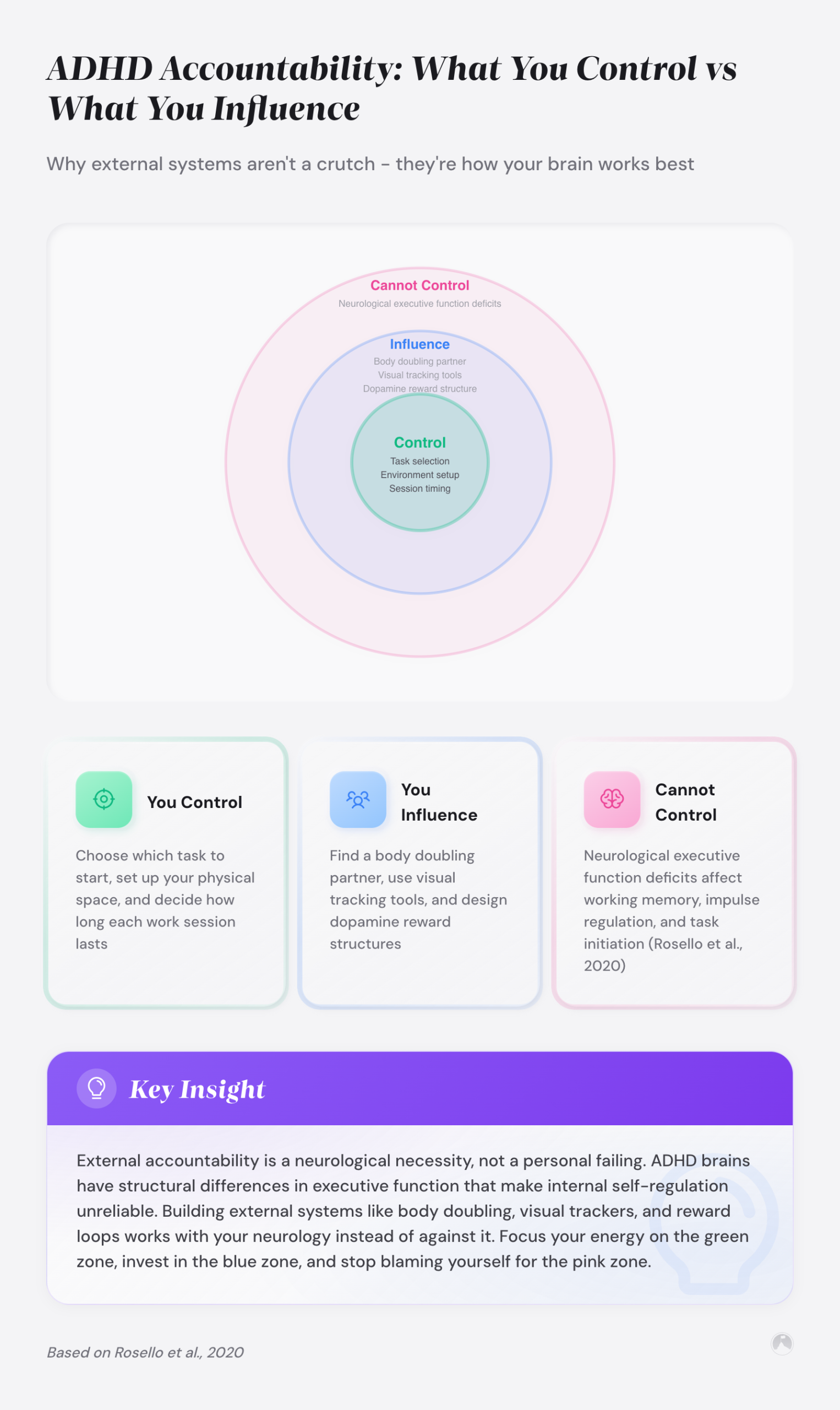
According to a 2020 study published in BMC Psychiatry, Rosello and colleagues tested adults with persistent ADHD against age-matched controls. The ADHD group showed significant impairment in shift (task-switching), working memory, inhibition, and planning functions. The key finding: these executive function deficits predicted real-world functional impairment in work, relationships, and daily life [1]. So when your accountability system collapses, it is not because you are not trying hard enough.
For creatives, this compounds. Creative work requires irregular schedules, periods of unstructured thinking, and hyperfocus sessions that do not fit into weekly check-in boxes. And here is where it gets complicated: when you spend fourteen hours hyperfocusing on a task that was not on your original list, your accountability system reads that as failure instead of genuine productivity. If ADHD-related planning strategies for creative work are something you struggle with, you are not alone – the planning side of this equation deserves its own attention.
But the real trap is emotional. Groves and colleagues found that working memory deficits in children with ADHD predict emotion dysregulation both directly and through hyperactivity/impulsivity symptoms [2], a pattern that clinical research on adults with ADHD has consistently confirmed [6]. Shame does not motivate ADHD brains – it creates an emotional loop that makes getting back to work even harder. So what does accountability look like when shame is off the table?
What is the Accountability Flex System for ADHD creatives?
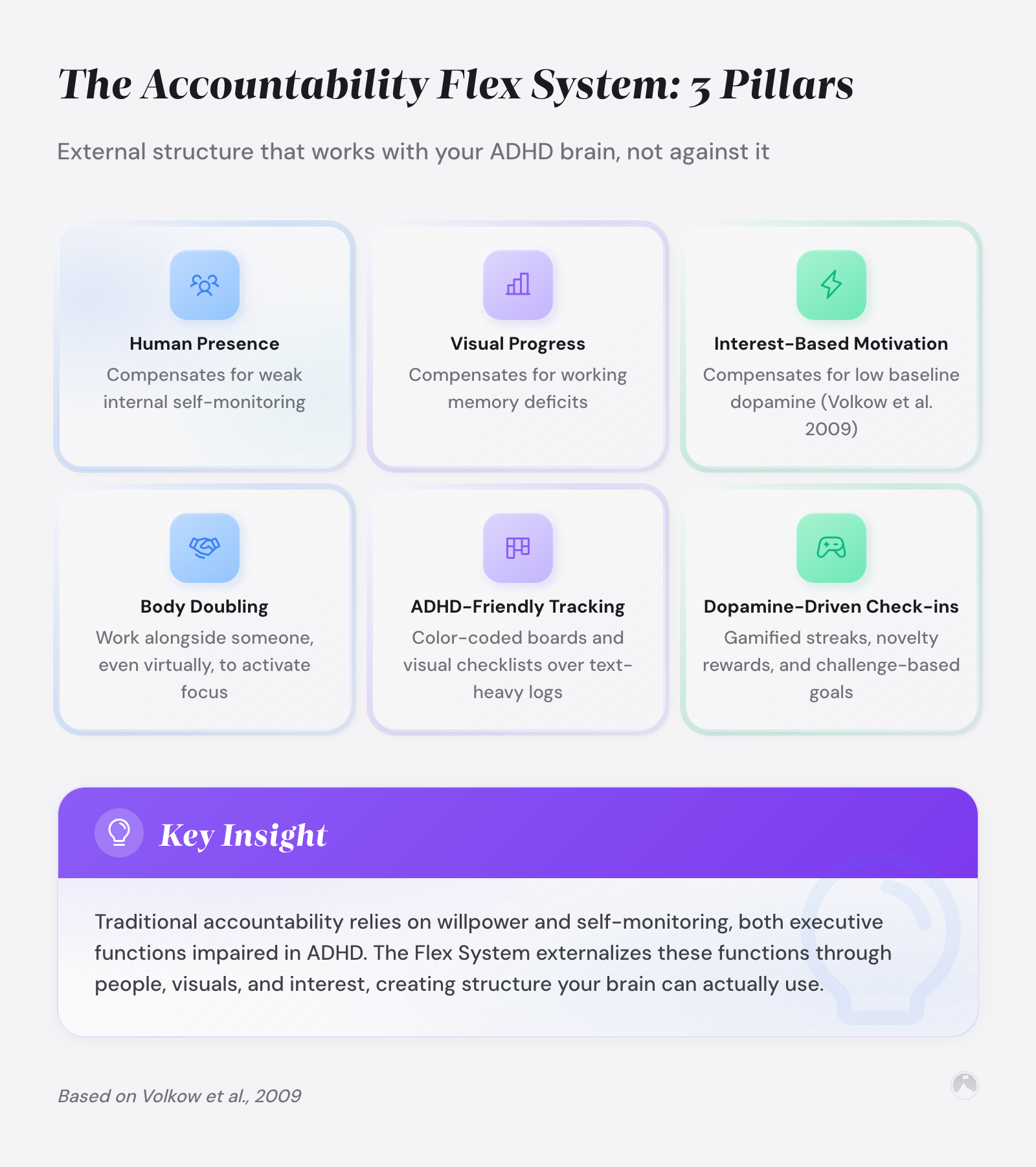
The Accountability Flex System is a three-pillar framework that addresses the specific executive function gaps causing ADHD accountability failures. These neurodivergent accountability methods combine human presence, visual progress tracking, and interest-based motivation into executive function support systems that adapt to variable energy and creative work patterns.
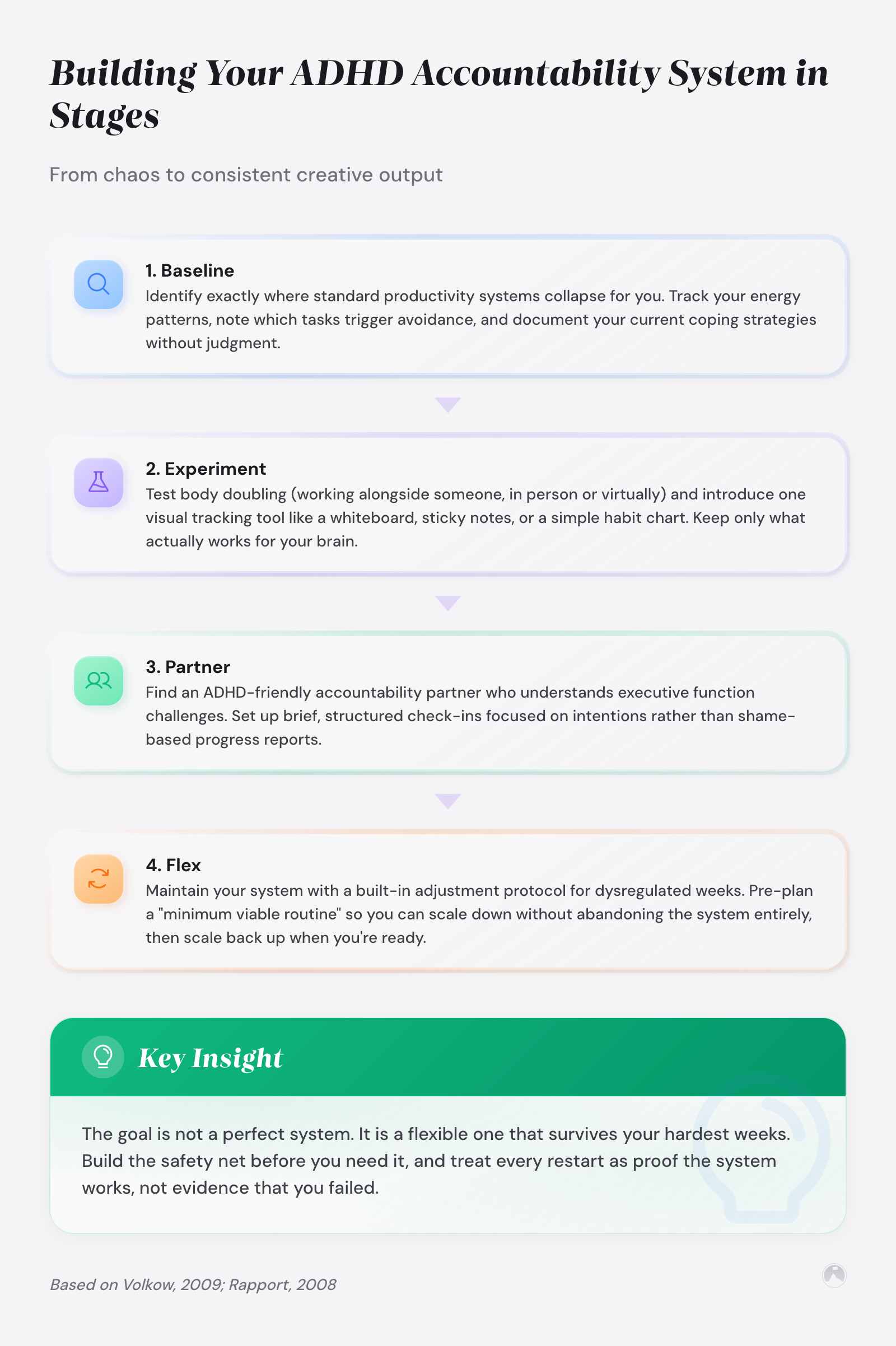
Accountability Flex System The Accountability Flex System is a three-pillar accountability framework designed for ADHD creatives that combines human presence, visual progress tracking, and interest-based motivation. Each pillar compensates for a specific executive function gap, and the system is designed to bend with variable energy and hyperfocus periods rather than requiring rigid consistency.
You do not need all three at once. Start with one, add another when it is stable, swap them out when something stops working. The best accountability system for ADHD creatives is the one flexible enough to survive the worst ADHD week.
Pillar 1: human presence (body doubling and partnership)
ADHD brains often struggle to initiate and sustain tasks without external stimulation. As Rapport and colleagues demonstrated in their self-regulation model, external environmental cues improve attention regulation and task initiation in ADHD [3]. The presence of another person – even someone working on something completely different – provides a low-level social signal that helps regulate attention and reduce task avoidance. This is body doubling.
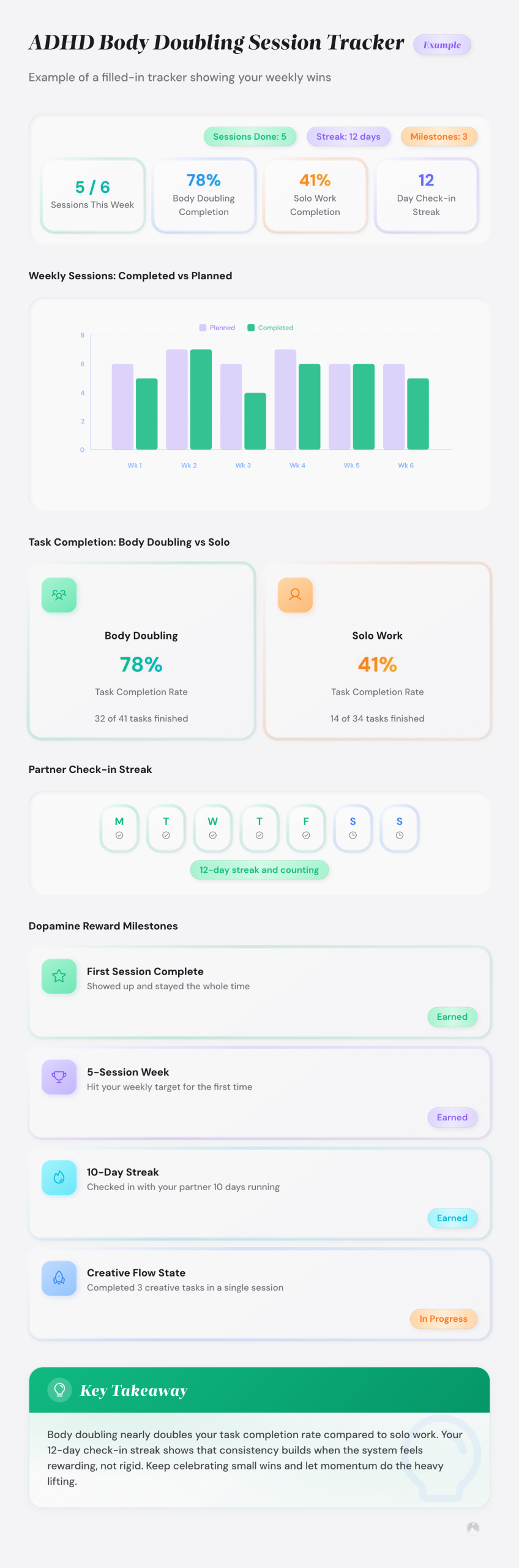
And here is why it works for creative accountability specifically: it provides structure without interrupting your flow state. You do not need to stop painting to give a progress report. No need to pause writing to explain what you did. The presence itself is the accountability (which is a relief for anyone who dreads check-in calls). For a deeper look at how body doubling supports focus beyond accountability contexts, our guide on body doubling as a focus technique covers the mechanics in detail.
Pillar 2: visual progress tracking for ADHD-friendly goal tracking
Working memory deficits mean ADHD creatives often lose track of what they have accomplished. Even when real progress happens, it feels invisible. Visual tracking solves this by making progress tangible and visible without requiring effort to maintain a digital system. This kind of ADHD-friendly goal tracking prioritizes simplicity and physical visibility over feature-rich apps.
The simpler and more physical, the better. A whiteboard with sticky notes. A jar you drop a marble into after each creative session. A paper chart on the wall. The point is that progress becomes something you can see without opening an app or trying to remember to check a system. If you want to explore app-based options, our comparison of goal tracking apps reviews which ones work best for different needs.
Pillar 3: interest-based motivation and dopamine-driven accountability
This is where ADHD accountability needs to fork from standard advice. Neurotypical accountability works on obligation and consequence. For ADHD brains, this runs directly into the interest-based nervous system. As dopamine researcher Nora Volkow demonstrated in her landmark ADHD study, ADHD brains show reduced dopamine signaling in reward pathways, meaning they respond more strongly to immediate and novel stimuli than to long-term obligations [4]. ADHD motivation responds to novelty, urgency, challenge, and personal interest – not importance or long-term reward.
Interest-based nervous system The interest-based nervous system is a framework describing how ADHD brains prioritize tasks based on novelty, urgency, challenge, and personal interest rather than importance or long-term consequences. This differs from the importance-based nervous system that drives neurotypical motivation and most conventional accountability approaches.
Dopamine-driven accountability Dopamine-driven accountability is an approach to tracking and check-in systems that builds novelty, gamification, and rotating formats into the accountability structure itself. By activating dopamine reward pathways through variety and short-term wins, these systems sustain engagement beyond the initial novelty period that typically causes ADHD system abandonment.
Dopamine-driven accountability means designing check-ins and tracking systems that are themselves interesting. Rotate formats: voice memo one week, shared document the next, co-working session the third. This prevents the novelty decay that kills most ADHD systems after a few weeks (usually right around week three, like clockwork). And here is the research piece: research published in the Journal of Educational Psychology by Senko and Dawson found that mastery approach goals (focused on learning and growth) were negatively associated with burnout, unlike performance-avoidance goals [5]. Accountability framed around “what did you learn” instead of “what did you finish” matches both ADHD motivation patterns and burnout prevention research.
Building sustainable habits around these dopamine-friendly patterns takes specific strategies – our guide on habit building for ADHD covers how to make these approaches stick over time. So now you have the framework. But how do you actually do body doubling in practice?
| Pillar | Addresses | How it works | Best for |
|---|---|---|---|
| Human presence | Task initiation deficits | Body doubling, co-working, partner check-ins | Starting tasks, maintaining focus during sessions |
| Visual progress | Working memory gaps | Physical trackers, wall charts, tangible tokens | Recognizing real progress, preventing discouragement |
| Interest-based motivation | Dopamine-driven attention | Gamification, novelty rotation, mastery framing | Sustaining engagement beyond the first few weeks |
Which pillar do you need most?
- If starting tasks is your biggest challenge, start with Pillar 1 (Human Presence). Body doubling and co-working sessions directly address task initiation deficits.
- If you lose track of what you have accomplished, start with Pillar 2 (Visual Progress). Physical trackers compensate for working memory gaps and make progress feel real.
- If your system dies after a few weeks, start with Pillar 3 (Interest-Based Motivation). Rotating formats and gamification prevent the novelty decay that kills ADHD accountability systems.
How body doubling works as an accountability system for ADHD creatives
Body doubling is one of the most widely recommended neurodivergent accountability methods, and it requires almost no setup. At its simplest: you work alongside another person (physically or virtually) on your own separate tasks, independently but in shared space.
Body doubling for ADHD Body doubling for ADHD is a co-regulation strategy where the physical or virtual presence of another person provides external stimulation that helps regulate attention and reduce task avoidance, without requiring direct supervision or verbal accountability.
While body doubling lacks formal randomized controlled trials, it is widely supported in ADHD clinical practice and coaching literature, and the underlying co-regulation mechanism is consistent with Rapport’s self-regulation model [3]. For creative accountability partnerships specifically, body doubling has a unique advantage: it provides structure without stopping your flow. You are not pausing to give detailed progress updates. You are not explaining your creative process. The shared presence does the heavy work.
Here is a practical protocol:
- Set a session length (60-90 minutes works well for creative work)
- Each person states what they will work on in one sentence
- Work independently with cameras on (virtual) or in shared space (in-person)
- At the end, share one accomplishment – not a full report, one sentence
- Schedule the next session before ending
The minimal reporting structure matters. Traditional accountability check-ins ask for detailed progress updates, which triggers perfectionism and shame spirals in ADHD brains. Body doubling reduces this to presence plus a single sentence. Minimal reporting requirements in ADHD accountability systems produce more output than detailed progress tracking, because less reporting pressure means less avoidance. That is the paradox of ADHD accountability.
Several platforms now support virtual body doubling for accountability systems for ADHD creatives. Focusmate matches you with co-working partners on-demand. Flown offers structured “flocking” sessions designed for deep work. Flow Club provides group body doubling with facilitators. And ADHD-specific Discord communities like ADHD Online and r/ADHD often host informal co-working channels. If procrastination is the main barrier you face alongside accountability, our guide on procrastination strategies for ADHD covers that overlap directly. But body doubling is only as good as the person sitting across from you – so how do you find the right partner?
“Adults with persistent ADHD show significant impairments in shift, working memory, inhibition, and planning functions, and these deficits predict functional impairments across major life activities.” – Rosello and colleagues [1]
How to find and work with ADHD-friendly accountability partners
Not every accountability partner understands ADHD. And a partner who does not can do more damage than no partner at all – reinforcing shame instead of building structure. ADHD accountability partners need specific qualities that go way beyond “someone who checks in on you.”
An ADHD-friendly partner understands that missed deadlines are not moral failures. They recognize that hyperfocus on unexpected projects is a feature of ADHD, not poor prioritization. They ask “what got in the way?” instead of “why didn’t you do it?” This is what gentle accountability for creatives looks like in practice – curiosity instead of judgment, pattern recognition instead of blame. Research on adults with ADHD confirms that emotional dysregulation is a primary symptom alongside inattention and hyperactivity [6], which means accountability partners who trigger shame responses are working against the very neurology they are trying to support.
Gentle accountability Gentle accountability replaces judgment with curiosity, focuses on patterns rather than individual failures, and adapts expectations based on energy levels and symptom fluctuation rather than fixed performance standards.
Where to find these partners:
- ADHD online communities (r/ADHD, ADDitude forums, ADHD communities on X/Twitter)
- Neurodiverse-friendly co-working spaces
- Virtual body doubling platforms (Focusmate, Flow Club, Flown)
- ADHD coaching groups with peer accountability components
When starting a partnership, set explicit ground rules. One useful rule: “We celebrate consistency of effort, not completion of tasks.” Another: “Either person can adjust their goals mid-week without explanation.” These boundaries protect the partnership from becoming another source of ADHD-related shame. The right accountability partner makes the system invisible. The wrong one makes it another thing to dread.
For a broader look at how task management can be structured around ADHD needs, our guide on task management systems for ADHD covers the operational side of staying organized alongside accountability partnerships. But what happens when even a well-designed system starts working against you?
What do you do when accountability creates shame instead of progress?
When ADHD accountability systems fail, they do not fail quietly. They fail loudly, leaving guilt, frustration, and reinforced beliefs about personal inadequacy. Research explains exactly why this happens, and why it hits ADHD brains harder than neurotypical ones.
Working memory deficits in children with ADHD predict difficulties with emotion regulation [2], a pattern confirmed in adults where emotional dysregulation has been identified as a primary symptom of ADHD itself [6]. When an accountability check-in triggers negative emotions, those emotions are harder to manage. This is not weakness. It is neuroscience. So if your system triggers shame, the shame itself becomes the obstacle to ADHD productivity accountability.
Signs that your accountability system has crossed from helpful to harmful:
- You start avoiding check-ins or dreading them
- You feel worse after reporting than before
- You begin under-committing to avoid the possibility of failure
- You lie about or exaggerate progress to your partner
If any of those sound familiar, the system needs adjustment, not abandonment. Switch from task-based check-ins to process-based ones: “I worked on the project for 45 minutes” instead of “I finished three sections.” Reduce check-in frequency from daily to every 2-3 days. Or shift to body doubling entirely, which removes the reporting component (and for a lot of people, that one change fixes everything).
Your tracking system itself might be part of the problem. Our guide on when goal tracking hurts explores the specific scenarios where measurement becomes counterproductive, which overlaps heavily with ADHD shame dynamics.
Accountability without self-blame starts with accepting that executive function differences are neurological, not character flaws. The goal is not to force your ADHD brain into neurotypical accountability structures. The goal is to build structures that work with your actual neurology. If you are interested in the broader research foundation, our guide on accountability psychology research digs deeper into the science.
“Working memory deficits in individuals with ADHD predict emotion dysregulation difficulties both directly and indirectly through hyperactive/impulsive symptoms.” – Groves and colleagues [2]
Ramon’s take
My honest suggestion: don’t try to build the whole system this week. Just pick one person you can work near, even on a video call, and try it twice. That’s the version that sticks, and the rest can wait.
Conclusion
Accountability systems for ADHD creatives work when they are built around executive function differences rather than against them. The Accountability Flex System offers three pathways: human presence through body doubling and gentle partnerships, visual progress that compensates for working memory gaps, and interest-based motivation that works with dopamine-driven attention. The right combination depends on your specific ADHD profile, your creative work style, and how your symptoms fluctuate across different seasons.
But here is what sits underneath all of this: if you are running solo without partners, our guide on accountability for solo entrepreneurs covers systems that work without partnership. And for ADHD-specific productivity techniques beyond accountability, our guide on productivity techniques for managing ADHD broadens the toolkit.
The paradox of ADHD accountability is that the people who need the most structure are the ones for whom rigid structure works the least. The answer is not abandoning accountability. It is building accountability that bends.
In the next 10 minutes
- Identify one creative task you have been avoiding and text one person to ask if they would body double with you for 60 minutes this week
- Pick one visual tracking method from Pillar 2 (whiteboard, jar, wall chart) and set it up near your workspace
This week
- Complete one body doubling session and notice whether presence alone changes your task initiation
- Test two different check-in formats (voice memo vs. text vs. shared doc) to find what feels lowest-friction
- Write down one ground rule you would want in an accountability partnership and share it with a potential partner
There is more to explore
For more on tracking and accountability, explore our guides on goal tracking methods compared, planning strategies for ADHD creatives, and accountability for solo entrepreneurs.
Related articles in this guide
- best-goal-setting-methods-compared
- best-goal-tracking-apps
- commitment-devices-that-help-you-stick-to-goals
Why do traditional accountability systems fail for ADHD brains?
Traditional accountability relies on self-monitoring, internal motivation, and consistent task completion – all of which depend on executive functions that are impaired in ADHD [1]. ADHD brains respond to novelty and urgency rather than obligation and long-term reward [4]. When a system measures only task completion, it misses the variable energy, hyperfocus detours, and activation difficulties that define ADHD productivity patterns.
What makes an accountability partner ADHD-friendly?
An ADHD-friendly partner treats missed deadlines as data, not moral failure. They ask curiosity-based questions, adjust expectations based on symptom fluctuation, and celebrate effort consistency over task completion. The partner should understand that hyperfocus on unexpected projects is a feature of ADHD, not avoidance. Shared ADHD experience helps but isn’t required if the partner is willing to learn.
How often should accountability check-ins happen for ADHD creatives?
Many ADHD creatives find that check-ins every 2-3 days hit the right balance between structure and flexibility. Daily check-ins create reporting fatigue and trigger avoidance. Weekly check-ins allow too much drift between sessions. The ideal frequency depends on project urgency and individual symptom patterns, so build in permission to adjust without explanation.
Can accountability apps replace human accountability for ADHD?
Apps provide reminders and tracking but lack the co-regulation effect of human presence. Many ADHD individuals find apps helpful as supplements but insufficient as replacements. Notification fatigue common in ADHD means app reminders often get silenced within weeks. Body doubling and live check-ins activate social motivation circuits in ways that align with Rapport’s self-regulation model [3], providing external cues that notifications cannot replicate.
What role does dopamine play in ADHD accountability?
Dopamine regulation differences in ADHD mean that motivation follows interest, novelty, and urgency rather than importance or long-term benefit [4]. Effective ADHD accountability systems build dopamine-friendly features into the structure: rotating formats to maintain novelty, gamified progress tracking, short-term milestones that create small wins, and social interaction through body doubling or partner check-ins.
How do I handle accountability when I’m in hyperfocus mode?
Hyperfocus is productive time, even when it lands on unplanned tasks. Build a rule into your accountability partnership: hyperfocus sessions count as productive work regardless of whether they match the original plan. Report what you accomplished rather than whether you hit specific targets. This prevents the guilt spiral that occurs when genuine deep work gets labeled as off-task behavior.
References
[1] Rosello, B., Berenguer, C., Baixauli, I., et al. (2020). “Empirical examination of executive functioning, ADHD associated behaviors, and functional impairments in adults with persistent ADHD, remittent ADHD, and without ADHD.” BMC Psychiatry. https://doi.org/10.1186/s12888-020-02542-y
[2] Groves, N.B., et al. (2022). “Executive Functioning and Emotion Regulation in Children with and without ADHD.” Research on Child and Adolescent Psychopathology. https://pmc.ncbi.nlm.nih.gov/articles/PMC9091051/
[3] Rapport, M.D., et al. (2008). “Attention-Deficit/Hyperactivity Disorder: Application of a Dysfunctional Self-Regulation Model.” Journal of Clinical Child & Adolescent Psychology. https://doi.org/10.1080/15374410802163972
[4] Volkow, N.D., et al. (2009). “Evaluating Dopamine Reward Pathway in ADHD: Clinical Implications.” JAMA. https://doi.org/10.1001/jama.2009.1308
[5] Senko, C., and Dawson, B. (2017). “Performance-Approach Goal Effects Depend on How They Are Defined: Meta-Analytic Evidence From Multiple Educational Outcomes.” Journal of Educational Psychology, 109, 574-598. https://doi.org/10.1037/edu0000160
[6] Hirsch, O., Chavanon, M.L., Riechmann, E., and Christiansen, H. (2018). “Emotional dysregulation is a primary symptom in adult Attention-Deficit/Hyperactivity Disorder (ADHD).” Journal of Affective Disorders, 232, 41-47. https://doi.org/10.1016/j.jad.2018.02.007