

Most people mistake tasks for Key Results – this tool catches that before it becomes a problem
This free OKR builder tool checks your Key Results in real time, flags activity-based language, and renders a visual alignment tree connecting every Key Result to its Objective. No account required.
Type your first Objective below and Key Result fields appear automatically.
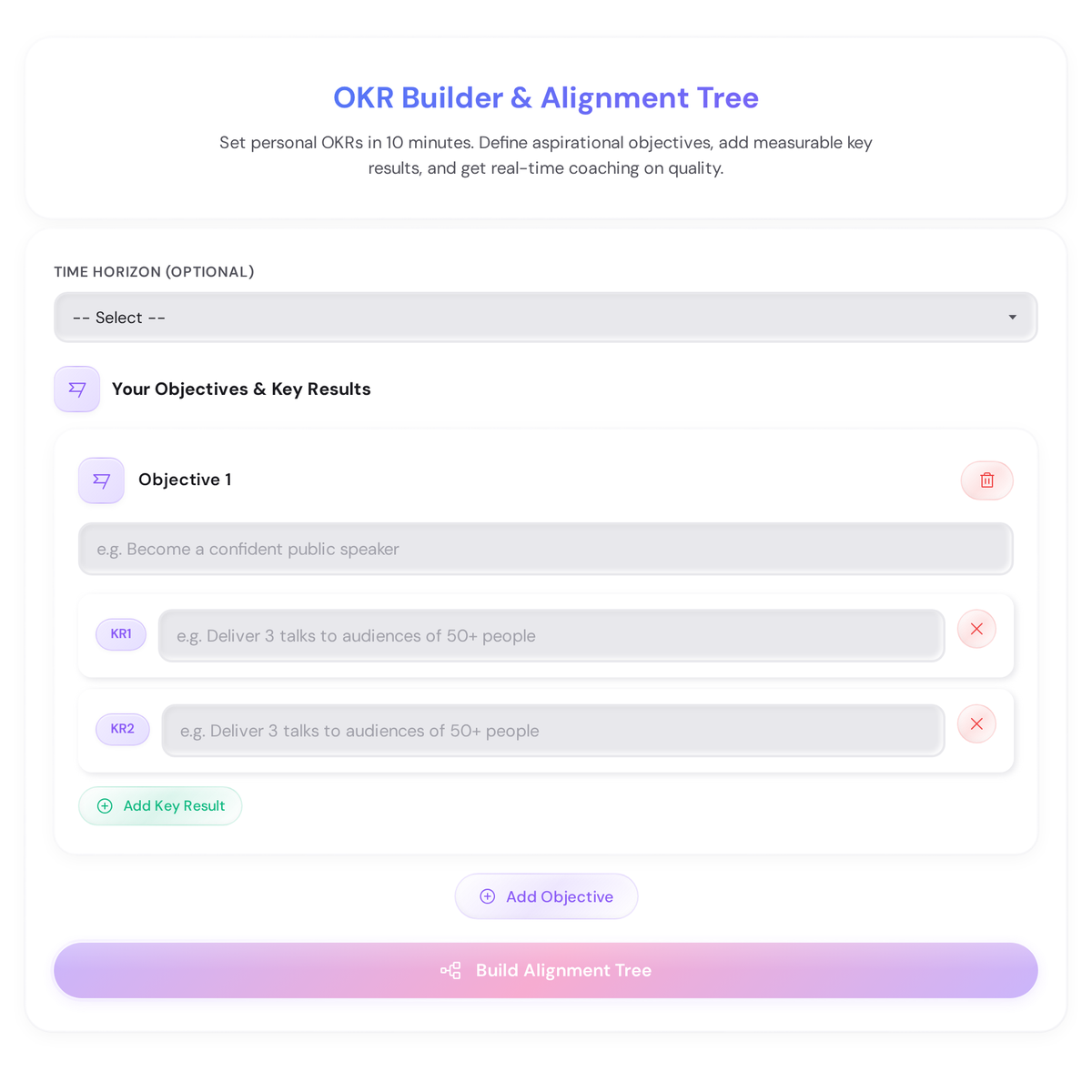
Set personal OKRs in 10 minutes. Define aspirational objectives, add measurable key results, and get real-time coaching on quality.
Click any status chip in the tree to update progress. Score each Key Result at the end of the period:
What this OKR builder tool actually solves
The biggest problem with OKRs is not that people find them complicated. It is that people write Key Results that describe what they plan to do rather than what they want to achieve. “Go to the gym three times a week” is a task. “Reduce body fat from 28% to 24%” is a Key Result. Both live under the same Objective but only one tells you whether you succeeded. Most goal-setting tools do not flag this distinction because they have no way to evaluate the content – they just accept whatever text you type.
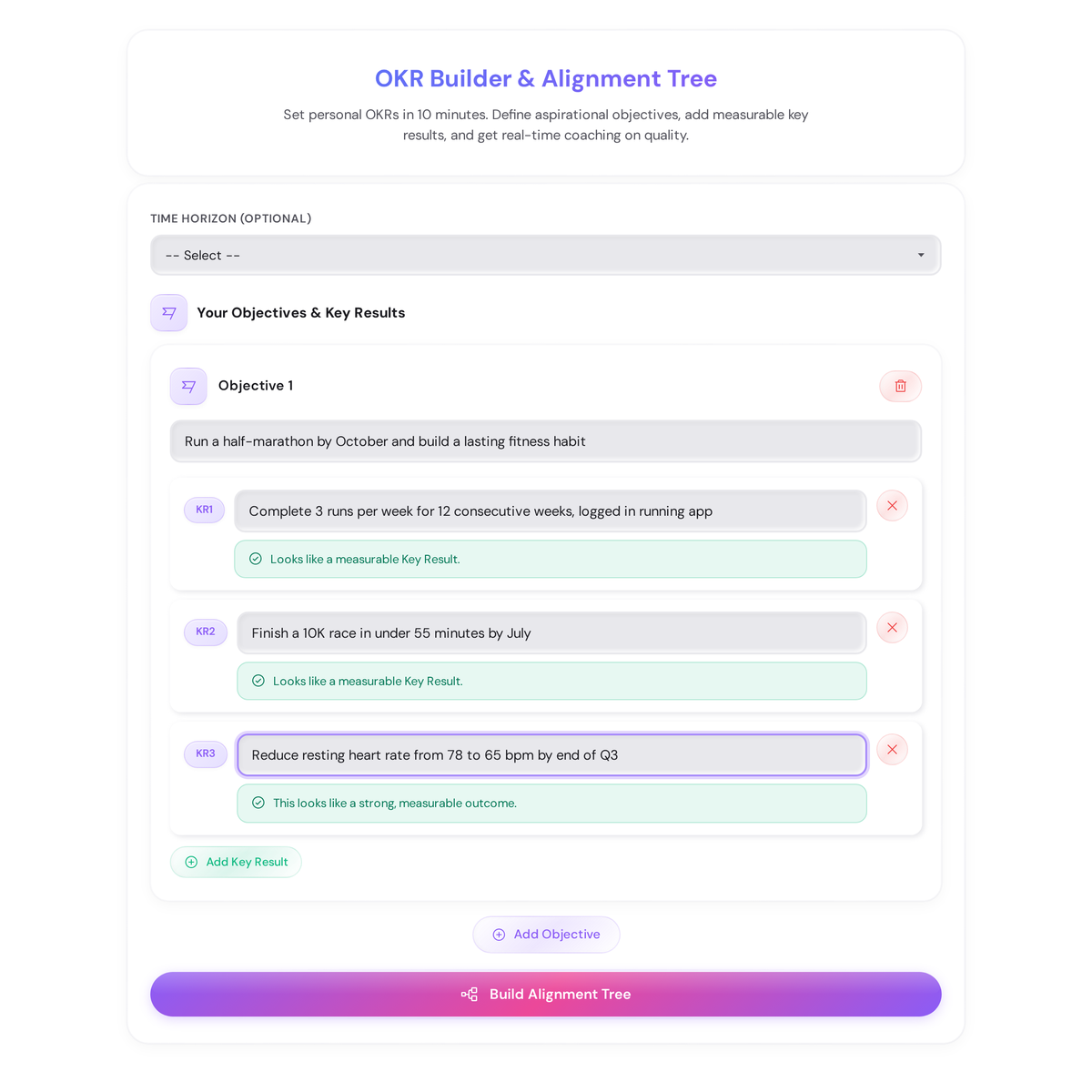
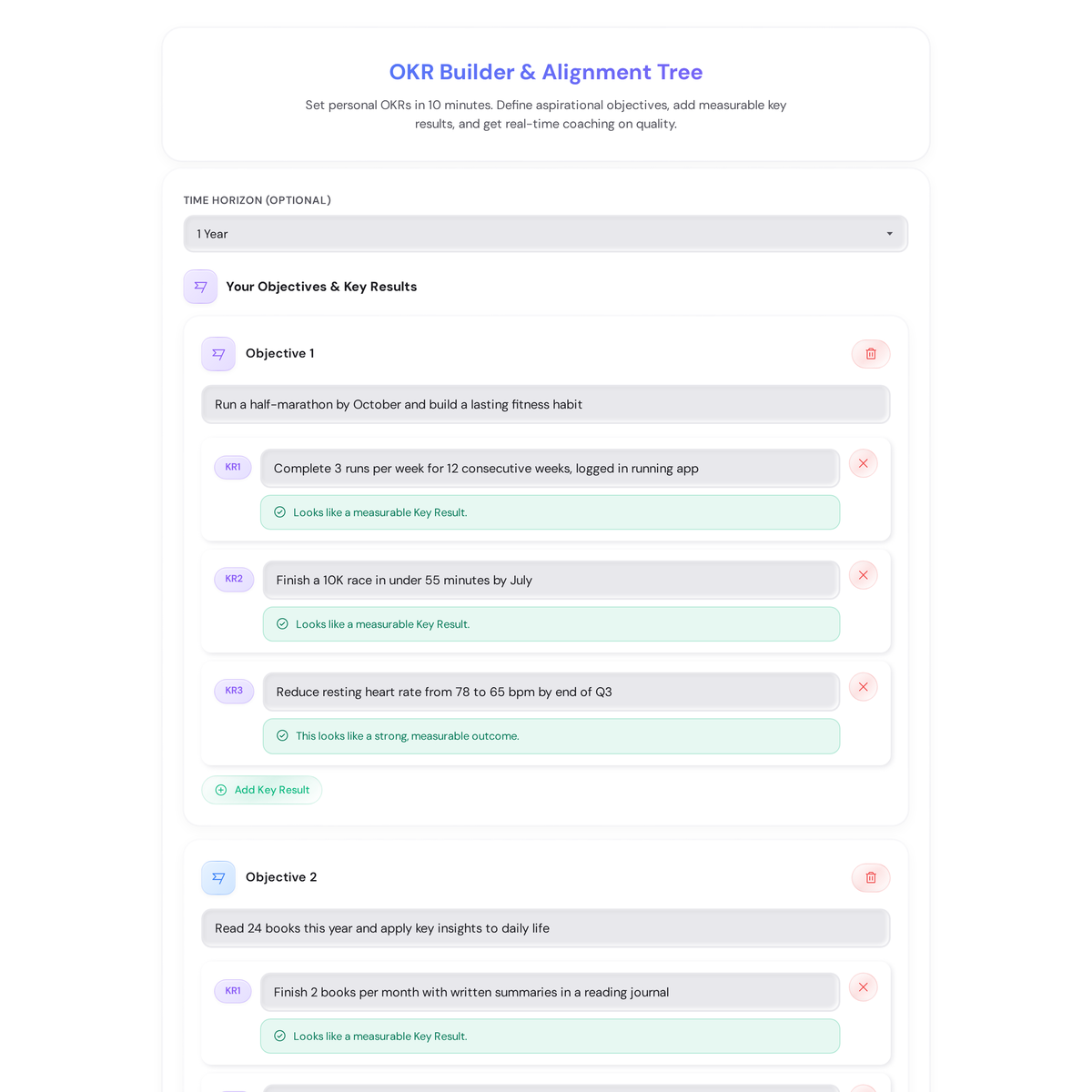
This tool evaluates each Key Result as you type it and tells you when it looks like a task in disguise. The coaching message does not just flag the problem – it explains why a measurable outcome is different from a measurable activity and suggests the kind of reframe that would fix it. The difference between a Key Result that coaches you all quarter and a task you can check off in a week is usually one reframe, and the tool makes that reframe visible.
The alignment tree is the other thing this solves. When you are running multiple Objectives at the same time – which is normal for anyone applying OKRs seriously – it is easy to lose track of how everything connects. The tree view makes the hierarchy explicit. You can see at a glance whether your Key Results are spread evenly across Objectives or whether three of them are propping up one goal while another sits thin. That visual check is hard to do in a notes document or a spreadsheet.
Screenshot walkthrough
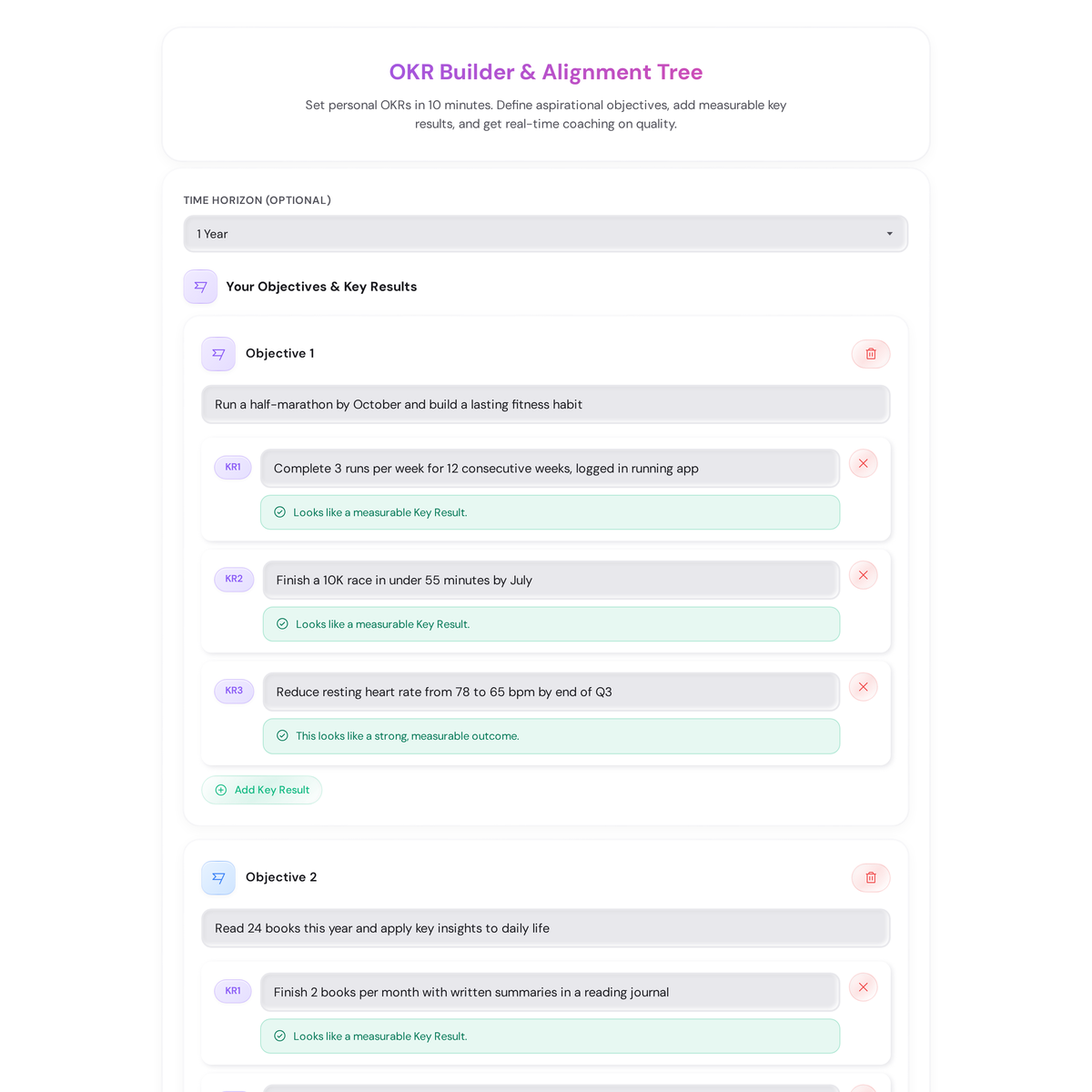
These screenshots show the tool working through a real set of personal OKRs – fitness, reading, and relationships – so you can see what the quality coaching looks like in practice and what the alignment tree produces at the end.
OKR components explained
The OKR framework has two components. They look simple, but the distinction between them is where most people get into trouble.
Objectives
An Objective is a qualitative, aspirational statement of direction. It should be motivating and clear enough that you can explain it to someone in one sentence. “Transform my physical health and energy levels this quarter” is an Objective. “Be healthier” is too vague. “Run 5 kilometres in under 30 minutes” is actually a Key Result wearing Objective clothes – it describes an outcome, not a direction. Objectives answer the question: where do I want to go?
Key Results
A Key Result is a quantitative measure that tells you whether you reached the Objective. It must be specific enough that at the end of the period there is no argument about whether you hit it. “Sleep 7 or more hours on at least 5 nights per week, tracked by sleep app” is a Key Result. “Sleep better” is not. The most common failure mode is writing activities as Key Results: “Go to the gym three times per week” describes something you will do, not something you will have achieved. The tool’s quality coaching exists specifically to catch this. It looks for outcome language – numbers anchored to a result, not to a behaviour – and flags when the text looks more like a habit or a task.
The 0.0 to 1.0 scoring scale
At the end of your time period, you score each Key Result from 0.0 (no progress) to 1.0 (fully achieved). The intended target is 0.6 to 0.7, not 1.0. If you are consistently hitting 1.0, your Key Results are not ambitious enough. If you are consistently hitting 0.2, they may be unrealistic or poorly defined. The tool explains this scale in the output so you have context for how to read your results when the period ends.
The OKR methodology and why it works for personal goal setting
Objectives and Key Results were developed by Andy Grove at Intel in the 1970s and popularized by John Doerr, who brought the framework to Google in 1999 and later wrote “Measure What Matters” to document how it works in practice. The framework was designed to give organizations a way to align effort at every level – from individual contributors to company-wide strategy – by making the connection between work and outcomes explicit and visible.
What most people do not know is that Grove built OKRs on Peter Drucker’s Management by Objectives, which itself was grounded in research showing that specific, measurable targets consistently outperform vague directives. The measurability requirement is not bureaucracy – it is the mechanism that makes goals actionable. When you cannot measure whether you hit a target, you lose the feedback loop that tells you whether to adjust your approach or stay the course.
OKRs translate well to personal goal setting because the underlying problem is the same at every scale: people set directions without defining success. The personal OKR builder applies the same structure Grove used for Intel’s quarterly planning to a single person’s fitness goals, career development, or creative projects. The hierarchy is simpler – no company-wide alignment required – but the quality discipline is identical. Define where you want to go. Define what measurable evidence will tell you that you got there. Check in regularly. Score honestly at the end.
Who gets the most out of this tool
You have heard of OKRs through work but the process there is managed by someone else – HR runs the kickoff, a manager sets the top-level objectives, and you fill in a template. You want to know how to apply the same structure to your own goals without a system built around you.
You have tried writing quarterly goals before and ended up with a list that looked more like a project plan than a set of outcomes. The activities piled up, the review at the end of the quarter felt arbitrary, and nothing meaningfully changed. The tool gives you a way to stress-test what you have written before you commit to it for three months.
You are making a significant change this year – a career move, a health overhaul, a major skill acquisition – and you want a framework that can hold complexity. A single goal statement is not enough. OKRs let you define one directional Objective and multiple concrete Key Results that together constitute evidence of success, which is more useful than one goal when the change involves multiple dimensions of progress.
You coach or manage people and want a structured way to help them articulate what a good quarter looks like. You can walk someone through this tool in under fifteen minutes and come out with a set of Objectives and Key Results that both of you agree are measurable and ambitious. It is faster than going back and forth on goal language in a document.
Related articles
- Set Up an OKR Tracking System – goes deeper on the operational side of running OKRs: what to track week to week, how to run a mid-period check-in, and what a useful end-of-quarter retrospective actually covers.
- Combining OKRs and SMART Goals – explains how the two frameworks complement rather than compete with each other, and when it makes sense to apply SMART criteria to individual Key Results to sharpen them further.
- OKRs vs Quarterly Planning – compares the OKR approach with traditional quarterly planning, including when OKRs add structure and when they add overhead you do not need.
What is the difference between an Objective and a Key Result?
An Objective is a qualitative, aspirational statement of direction – it describes where you want to go. A Key Result is a quantitative measure that defines whether you got there. Objectives are motivating and directional. Key Results are specific, measurable, and binary at the end of the period: you either hit the number or you did not. The most common mistake is writing a Key Result that describes an activity (what you will do) instead of an outcome (what you will have achieved).
Why does the tool flag some Key Results as tasks?
A task-like Key Result describes an action you will take rather than a result you will achieve. ‘Send 20 networking emails per month’ is a task. ‘Receive 5 informational interview offers from outreach’ is a Key Result. The tool looks for activity language – verbs like complete, attend, send, do, practice – and checks whether the text is anchored to a measurable outcome or just to a behaviour. When it detects task language, it explains the distinction and suggests the kind of reframe that shifts the focus from activity to result.
How many Objectives and Key Results should I set?
One to three Objectives with two to four Key Results each. The OKR framework is built on focus – more than three Objectives dilutes attention across too many directions. More than four Key Results per Objective usually means the Objective is too broad or the Key Results are overlapping. If you find yourself wanting more, that is often a sign to narrow the Objective rather than add more Key Results.
What does a score of 0.7 mean at the end of the quarter?
It means you achieved roughly 70 percent of what a full success would look like. In the OKR framework, 0.6 to 0.7 is the intended target range – not 1.0. If you set Key Results that you consistently hit at 1.0, the targets were not ambitious enough. If you consistently score 0.2 or 0.3, the targets may be unrealistic or the Key Results may not be well-defined. The scoring is a feedback mechanism, not a grade.
Can I use personal OKRs alongside team OKRs at work?
Yes, and many people do. Personal OKRs typically cover dimensions that team OKRs do not: skill development, career growth, side projects, health, or relationships. The cadence is usually the same – quarterly – which makes it easy to review both at the same time. Personal OKRs do not need to align with team OKRs, though they sometimes do naturally when a personal development goal connects to a professional one.
How often should I check in on my OKRs during the quarter?
A light weekly check-in – five to ten minutes reviewing whether Key Result progress is on track – is enough to catch problems early. A more thorough mid-quarter review, where you assess whether any Key Results need to be adjusted or retired, takes thirty to sixty minutes. At the end of the quarter, a retrospective scores each Key Result and captures what you learned. The printable dashboard the tool generates gives you a reference sheet that makes those check-ins faster because you are not hunting for what you originally committed to.
Is my data private and secure?
Yes. All information you enter stays in your local browser storage. Nothing is shared with, processed by, or saved on the Goals and Progress servers or any third-party provider. The trade-off is that clearing your browser cache will erase your data. Some tools include a save and load function so you can export your inputs as a local file and reload them later.
Set your OKRs now
The OKR builder is free to use, requires no account, and runs entirely in the browser. Type your first Objective above, add your Key Results, and let the quality coaching tell you whether what you have written will hold up at the end of the quarter. The alignment tree takes under ten minutes to build and gives you something concrete to review against for the next 90 days.
