

Stop picking a framework at random
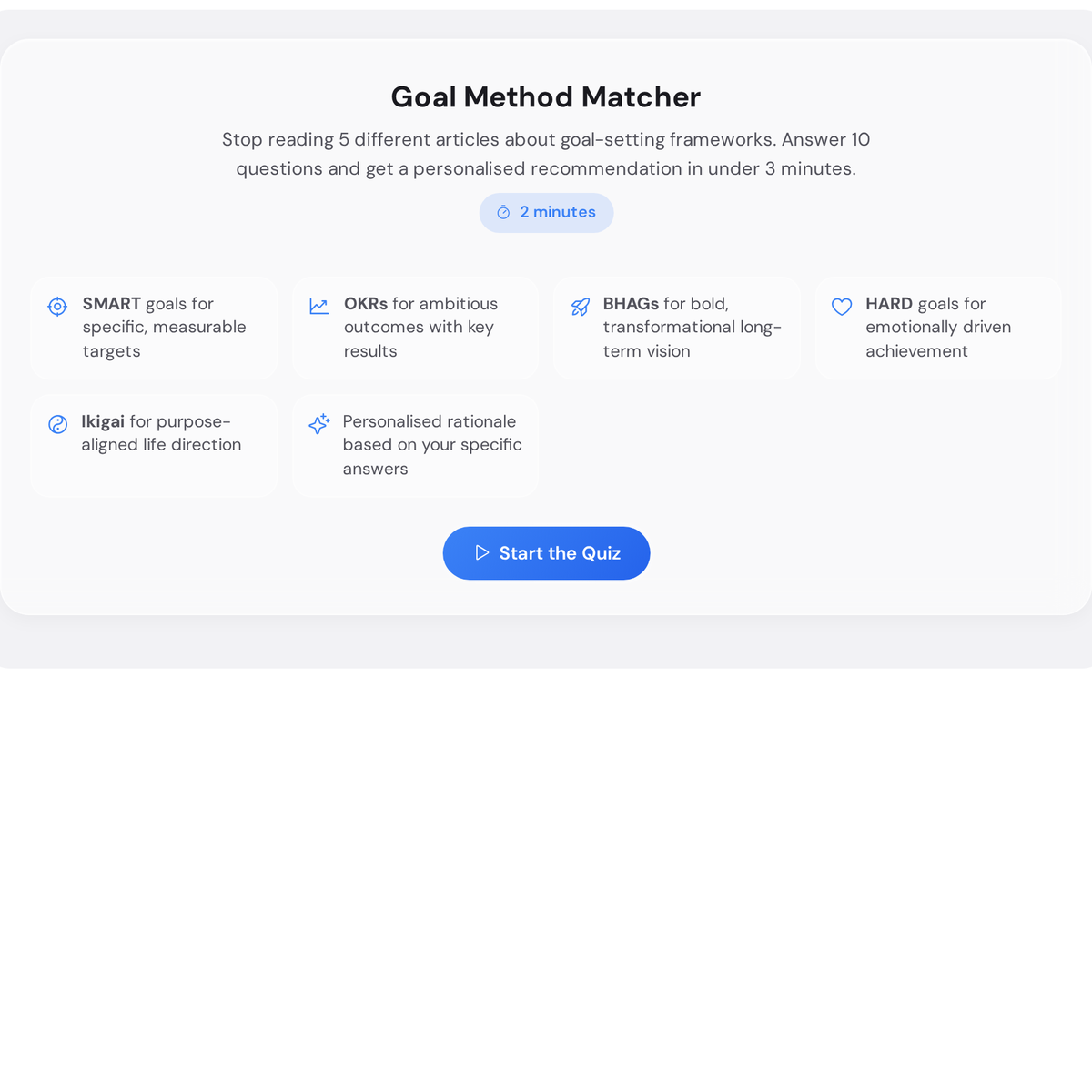
Most people try SMART goals, find them mechanical, abandon them, and go back to winging it. The problem is not the method. It is the mismatch. This goal setting method quiz takes 10 questions about your time horizon, motivation style, and situation, and tells you which of five frameworks actually fits how you work.
Click “Start the Quiz” and your personalised recommendation appears instantly.
Stop reading 5 different articles about goal-setting frameworks. Answer 10 questions and get a personalised recommendation in under 3 minutes.
What this tool solves
There are five serious goal-setting frameworks in common use: SMART Goals, OKRs, BHAG, HARD Goals, and Ikigai. Each one works brilliantly in the right context and fails quietly in the wrong one. SMART goals are precise and measurable, but they can feel suffocating if you are a big-picture thinker. OKRs are great for ambitious quarterly cycles, but they are overkill for personal habits. BHAGs are built for decade-long visions, not six-month projects.
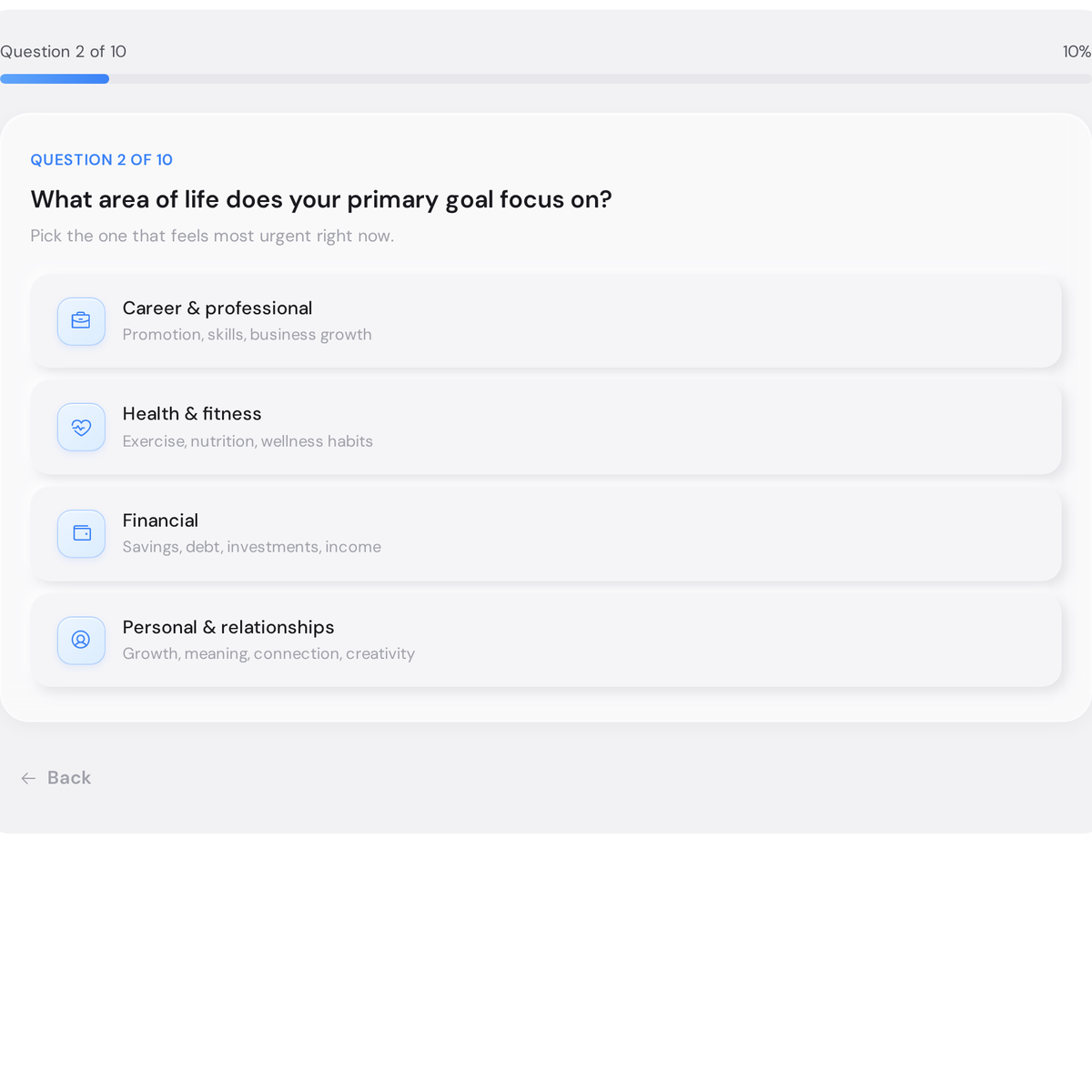
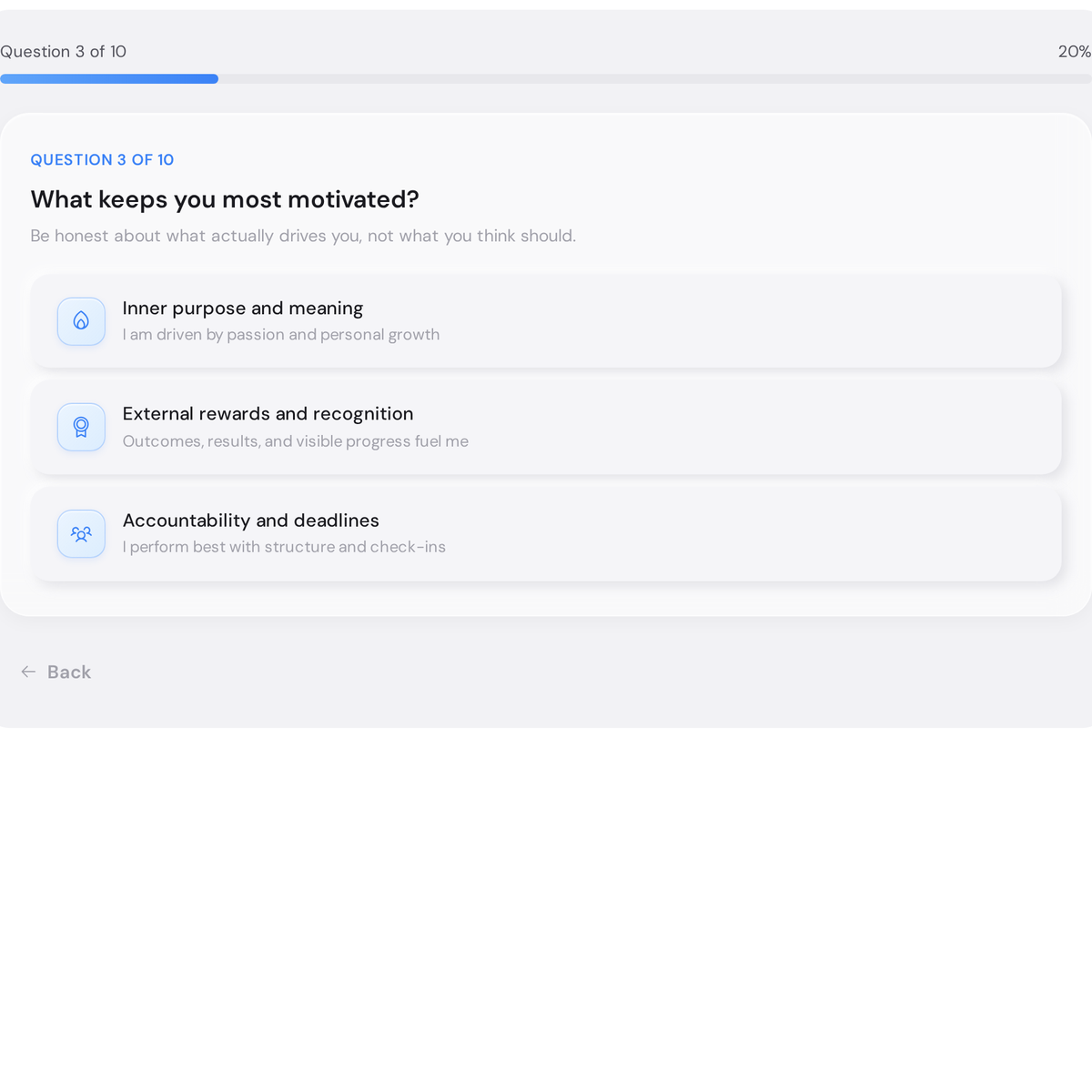
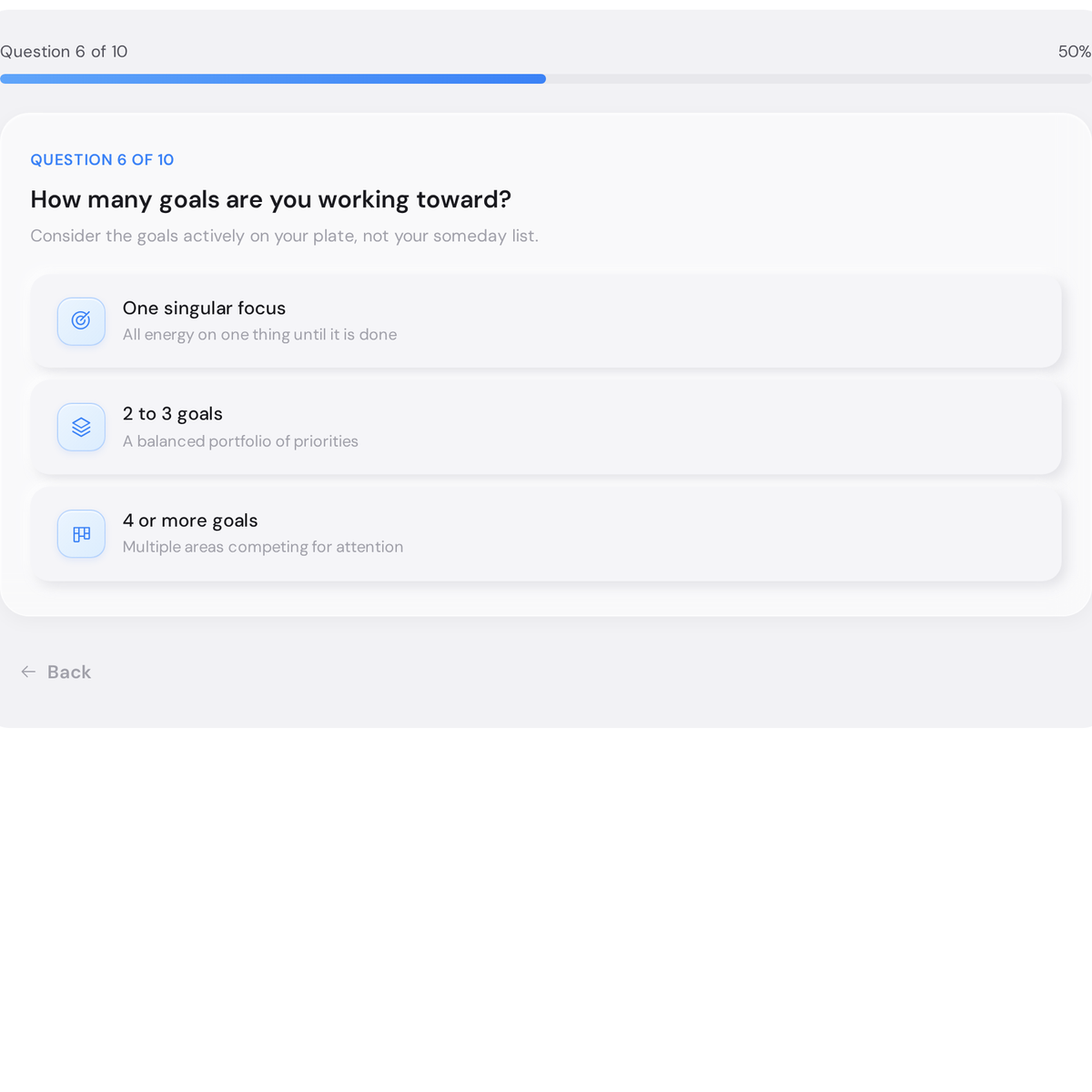
The quiz weighs 10 situational answers across six dimensions: time horizon, goal domain, motivation type, current situation, preferred structure, and past failure patterns. Your combination of answers, not any single response, determines the recommendation. The result comes with a personalised rationale, a fit score breakdown for all five frameworks, a runner-up pick, and a three-step quick-start guide you can act on today.
And it works differently for different people. Someone planning a 10-year career shift will get a different answer than someone trying to build a morning workout habit. That is the point.
See it in action: a walkthrough of every step
The five result types: what each one means
SMART Goals are the most widely used framework for a reason. They force you to state a goal as Specific, Measurable, Achievable, Relevant, and Time-bound. That structure cuts vagueness fast. They work best for short-to-medium timeframes where the path is reasonably clear, and they are particularly effective if you tend to abandon goals because you never defined what “done” looks like.
OKRs (Objectives and Key Results) were built inside Intel and spread through Google in the late 1990s. You set one inspiring Objective and three to five measurable Key Results that prove you got there. They work best for quarterly cycles and team contexts, though solo users can run them effectively too. If you have a handful of competing priorities and need a way to stay aligned, OKRs handle that better than any other framework here.
BHAG (Big Hairy Audacious Goal) comes from Jim Collins and Jerry Porras, who coined it in their 1994 book “Built to Last.” A BHAG is a single, clear, long-term target that takes 10 to 25 years to reach. It is directional and motivating rather than operational and precise. It works for people with genuine long-term ambition who need a north star to orient around, not a quarterly checklist.
HARD Goals were developed by Mark Murphy, who found that emotionally resonant goals outperform mechanically correct ones. HARD stands for Heartfelt, Animated, Required, and Difficult. If past goals have failed because they felt like obligations rather than genuine desires, this framework addresses that gap directly. It suits people who are purpose-driven and need a visceral connection to the outcome to stay engaged.
Ikigai is not strictly a goal-setting method. It is a Japanese concept for identifying where your passions, skills, the world’s needs, and what you can be paid for all overlap. The quiz recommends it for people who feel stuck or lost at a deeper level, where the question is not “how do I reach this goal” but “what direction should I even be pointed in.” It is exploratory rather than prescriptive. (That is a meaningful distinction, and most goal-setting quizzes ignore it.)
The research behind this goal setting method quiz
Goal-setting research goes back to Edwin Locke’s work in the 1960s, which established that specific and challenging goals produce better outcomes than vague or easy ones. That finding is now replicated hundreds of times over. But the research on framework fit is less settled, because the answer genuinely depends on the person and context.
SMART Goals formalised Locke’s specificity principle into a usable checklist. OKRs added the concept of separating the aspirational direction (the Objective) from the measurable proof points (Key Results), a split that Andy Grove developed at Intel in the 1970s. BHAGs emerged from Collins and Porras’s study of visionary companies, where the unifying pattern was a single clear long-term target. Mark Murphy’s HARD Goals framework, published in “Hard Goals” (2010), drew on neuroscience research showing that emotional engagement and difficulty both independently predict goal attainment.
The right framework is the one you will actually use, and that depends on who you are right now. This quiz scores you across six dimensions because no single answer tells the full story. Time horizon interacts with motivation type. Structure preference interacts with how many goals you are running at once. The scoring model weights each dimension differently for each framework, which is why two people can answer most questions the same way and still get different recommendations.
Who gets the most out of this tool
You will find this most useful if you have tried a goal-setting method before and it did not stick. That is not a character flaw. It usually means the framework was wrong for your motivation style or situation, not that you are bad at goals.
You will also benefit if you are facing a genuinely new type of goal. The method that helped you hit a fitness target this year may be completely wrong for a three-year career pivot. Different goal types often need different frameworks, and the quiz accounts for that by asking about your primary goal right now, not your goals in general.
If you are a manager or team lead trying to figure out whether OKRs are right for your team, the quiz is not a substitute for a proper OKR rollout, but it will help you think through whether the conditions for OKRs are actually present. And if you are feeling directionless rather than just unproductive, the quiz is designed to route you toward Ikigai rather than push you into a tracking-heavy system you are not ready for.
So: anyone from students to senior leaders, solo goal-setters to team managers, people who love spreadsheets and people who hate them. The questions are calibrated to account for all of it.
Related articles worth reading next
- Best goal setting methods compared – A deep-dive into every major framework with research summaries, side-by-side comparisons, and practical guidance on when to use each one. Read this after you get your quiz result to go deeper on your recommended method.
- Combining OKRs and SMART Goals – Most people treat these as competing frameworks. They work better together. This article shows you how to use SMART goals as the implementation layer inside an OKR structure, which is a combination the quiz’s runner-up recommendation often points toward.
- HARD Goals vs SMART Goals – The two frameworks look similar on the surface but are built on completely different assumptions about what drives behaviour. If the quiz recommended HARD Goals or you want to understand why SMART goals keep falling flat for you, start here.
Frequently asked questions
Does the quiz cover Ikigai or is it just SMART and OKR?
The quiz evaluates all five frameworks: SMART Goals, OKRs, BHAG, HARD Goals, and Ikigai. Ikigai is included specifically for people who feel directionless rather than just unfocused, because that is a fundamentally different problem than needing a better tracking system.
How does the quiz decide which goal setting method to recommend?
Your result comes from a weighted score across all 10 answers. The quiz maps each answer option to a point value for each of the five frameworks, then totals the scores. The framework with the highest total becomes your primary recommendation and the second-highest becomes the runner-up. No single answer determines the outcome.
Can I use more than one framework at the same time?
Yes, and many people do. The quiz recommends both a primary and a runner-up framework for this reason. A common pattern is using OKRs for professional goals and SMART goals for personal habits, or using a BHAG as a long-term north star while running quarterly OKR cycles underneath it.
What if my situation changes? Should I retake the quiz?
Yes. The quiz is calibrated to your current goal, not your goals in general. If your primary focus shifts from a short-term health target to a long-term career change, the right framework probably changes too. Retaking takes two minutes and you can do it as often as you like.
Is there a version of this quiz for teams rather than individuals?
The quiz has one question that accounts for whether others are involved in your goal, and OKRs score higher in team contexts. But it is primarily designed for individual goal-setters. If you are evaluating goal frameworks for a whole team or organisation, the results work best as a conversation starter rather than a definitive answer.
What is Ikigai and why is it in a goal setting quiz?
Ikigai is a Japanese concept for finding purpose at the intersection of what you love, what you are good at, what the world needs, and what you can be paid for. It appears in this quiz because some people who search for goal-setting frameworks are not actually ready for a goal-tracking system yet. They need direction first. Routing someone in that situation to SMART goals would be the wrong answer, so the quiz is designed to catch it.
Is my data private and secure?
Yes. All information you enter stays in your local browser storage. Nothing is shared with, processed by, or saved on the Goals and Progress servers or any third-party provider. The trade-off is that clearing your browser cache will erase your data. Some tools include a save and load function so you can export your inputs as a local file and reload them later.
Take the goal setting method quiz now
Picking the wrong framework is not a minor inconvenience. It is the reason most goals quietly die. Ten questions, two minutes, and you get a framework matched to how you actually think, plus a quick-start guide so you can do something with it today rather than saving it for later.
