

Most accountability advice fails because it assumes everyone works the same way
If you’ve tried habit trackers and accountability partners and nothing stuck, it’s not a willpower problem. This accountability style quiz identifies which of four tendencies drives how you actually follow through, then gives you matched tactics and a structure built for your type.
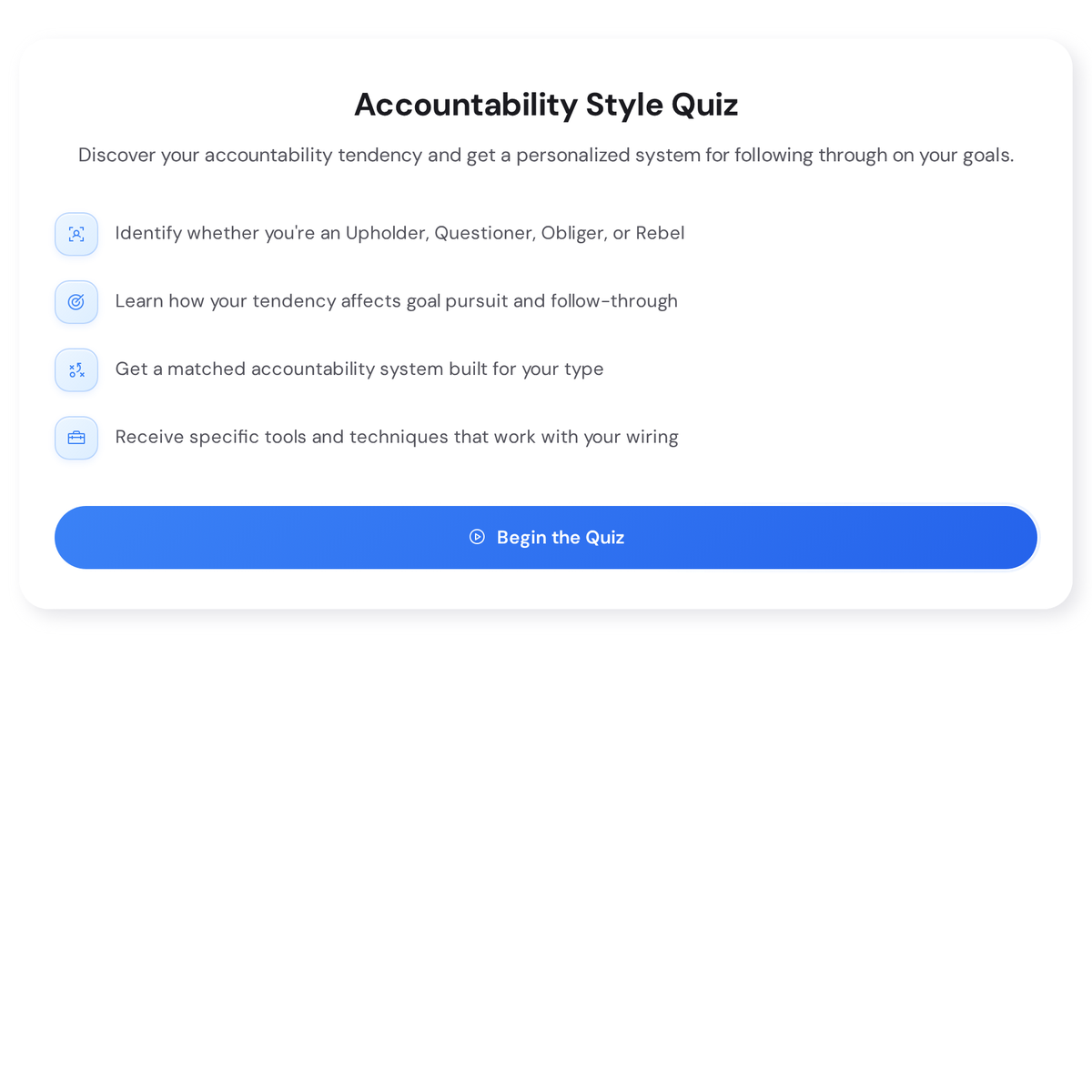
Hit “Begin the Quiz” and answer each scenario honestly and your results appear instantly.
Discover your accountability tendency and get a personalized system for following through on your goals.
What this accountability quiz actually solves
The core problem with most accountability advice is that it’s generic. “Get an accountability partner” works brilliantly for one person and feels suffocating to another. “Set your own deadlines” keeps some people on track and means absolutely nothing to others. The reason isn’t motivation – it’s tendency. And your tendency is largely stable, which means fighting it is expensive and building with it is cheap.
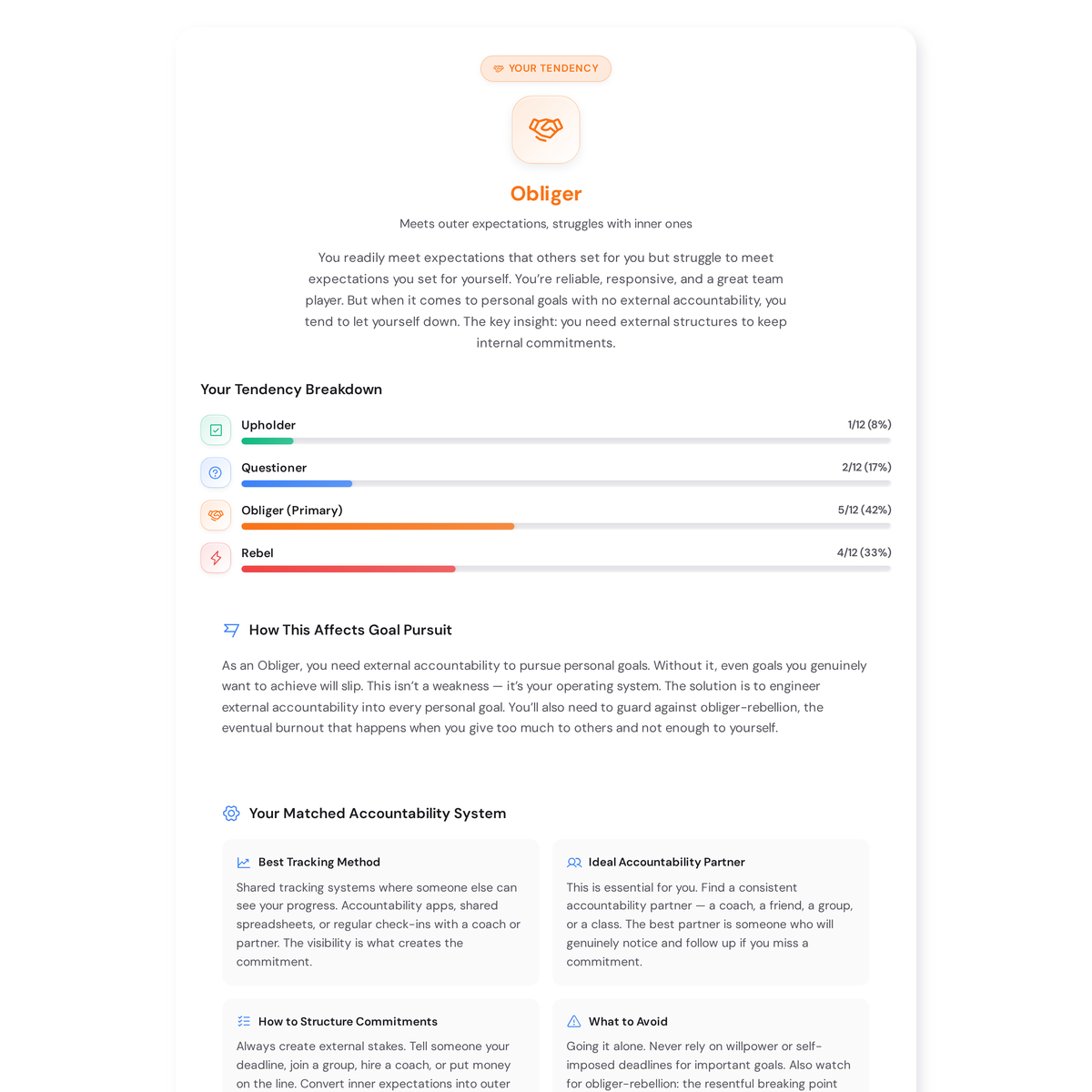
This quiz uses Gretchen Rubin’s Four Tendencies framework as its backbone, but the output isn’t just a label. You get a matched accountability system with specific tools, a breakdown of your tendency scores across all four types, and the failure points most likely to trip up your type. Knowing where you’ll break down is more useful than knowing what works when everything is going well.
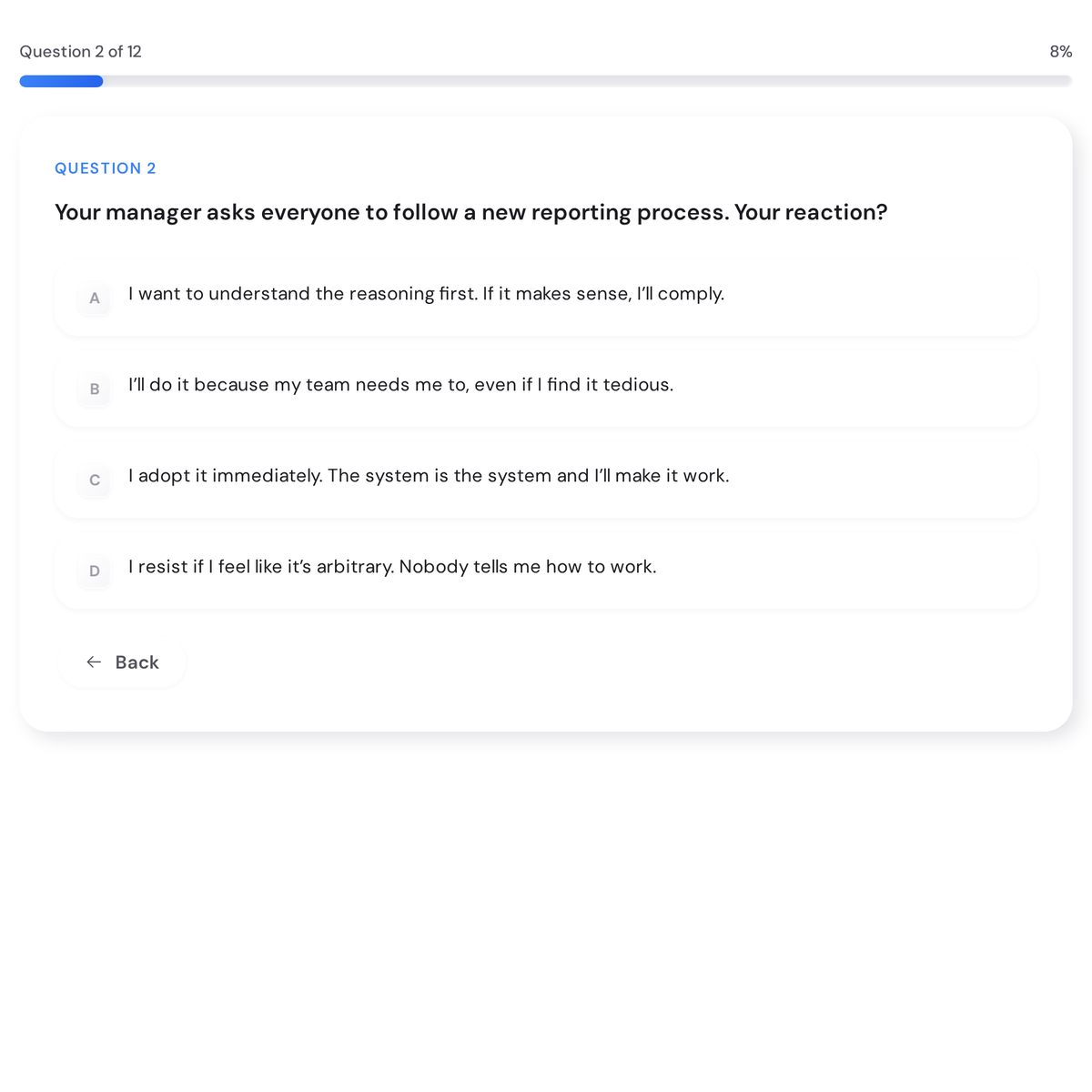
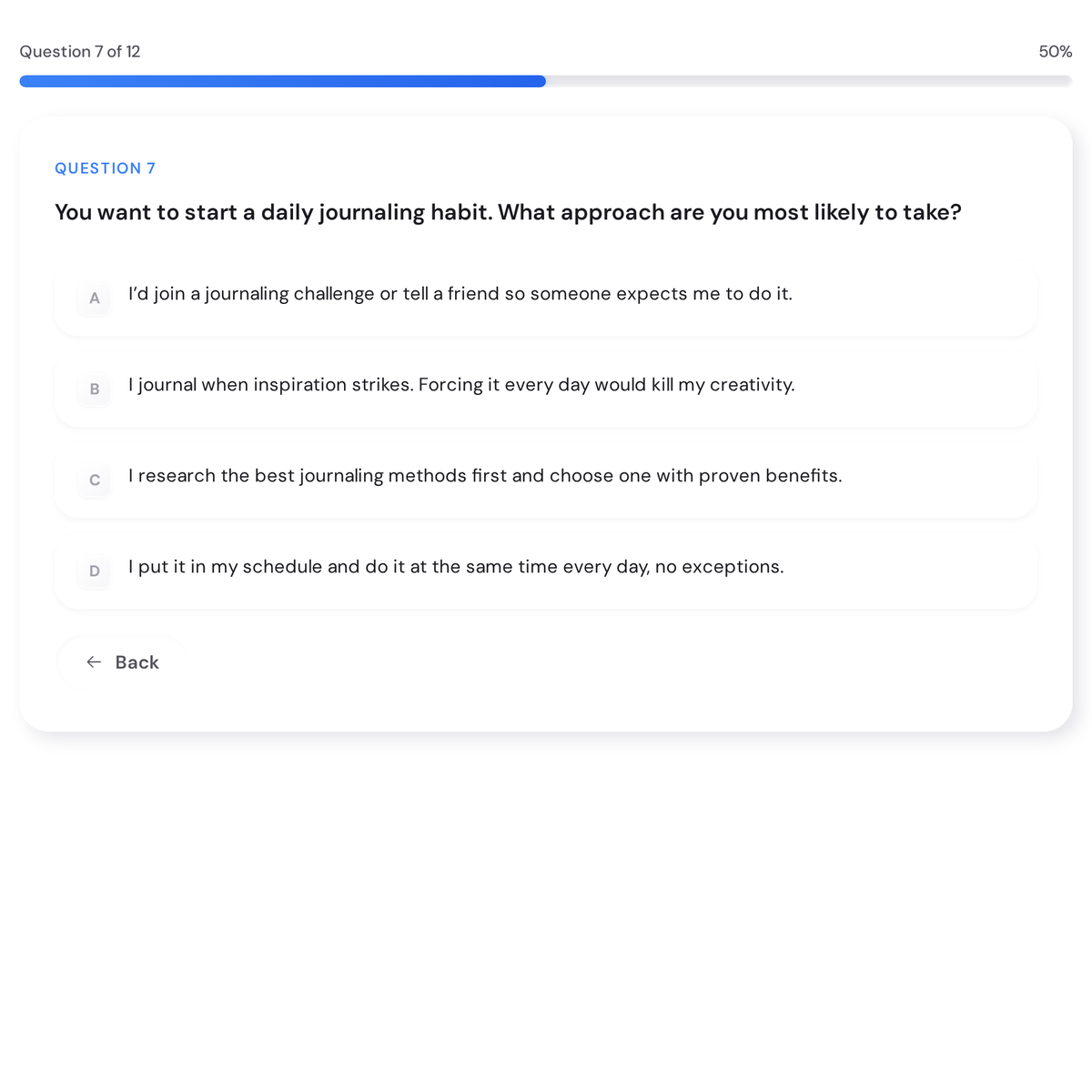
The questions are scenario-based rather than preference-based. Asking “do you prefer working alone or with others?” produces aspirational answers. Asking “your workout buddy cancels – what happens?” reveals actual behaviour. That distinction is the difference between a result that feels accurate and one that just tells you what you already hoped was true.
What each screenshot shows you
The four accountability types: what each one means
Upholders meet both internal and external expectations without much friction. They set a goal, build a schedule, and follow it – even when no one is watching and motivation has faded. The risk is rigidity: Upholders can become brittle when circumstances change and struggle to adapt a system they’ve committed to. Best strategies for them are personal schedules, habit streaks, and self-imposed rules.
Questioners resist external expectations but meet internal ones – once they’re convinced something is worth doing. They research deeply before committing, and they’ll abandon a goal the moment it stops making logical sense to them. Arguing “everyone else does it” has zero effect on a Questioner. What works is evidence, clear rationale, and letting them design their own system.
Obligers are the most common type and the most misunderstood. They follow through brilliantly for others but struggle to sustain personal goals without external stakes. This isn’t laziness – it’s a fundamental feature of how they’re motivated. Obligers thrive with accountability partners, classes they’ve paid for, and public commitments. They need to make their personal goals feel like obligations to someone else.
Rebels resist all expectations, including their own. They do what they want, when they want, and don’t respond well to rules, schedules, or being told what to do – even by themselves. But they’re often intensely motivated when they choose something. The key is framing goals as identity and choice rather than obligation. A Rebel won’t run because they “should” – they’ll run because they’re the kind of person who runs.
The research behind this accountability style quiz
This quiz is built on Gretchen Rubin’s Four Tendencies framework, developed through years of researching why people do and don’t follow through on their intentions. The framework’s central insight is that people differ not in how much willpower they have but in how they respond to expectations – specifically, whether they meet expectations that come from others, themselves, or both.
Your tendency is the operating system, and every accountability tactic is just an app – it only works if it’s compatible with the OS underneath. That’s why an Obliger using an Upholder’s tactics will always underperform, and a Rebel trying to follow a Questioner’s research-first approach will feel trapped before they start. The framework has been validated across thousands of people and is backed by research in self-determination theory, which distinguishes between controlled motivation (external) and autonomous motivation (internal).
The scenario-based question format adds a layer of behavioural accuracy. Research in social psychology consistently shows that hypothetical-behaviour questions (what would you do if…) predict actual behaviour more reliably than stated-preference questions (do you prefer…). The quiz uses this to surface your real tendency, not your aspirational one. Results include your primary type plus a score breakdown across all four tendencies, which is more informative than a single label because most people have a mix.
Who gets the most from this quiz
You’ve tried the productivity app, the accountability partner, the morning routine, and none of them lasted longer than six weeks. Something keeps breaking down but you can’t identify what. This quiz will almost certainly name the pattern you’ve been circling.
You’re building a goal-tracking system or picking an accountability method and want to invest in the right one from the start. Knowing your tendency before you commit saves you months of trial and error on approaches that were never going to work for your wiring.
You manage a team and keep seeing people fail at goals they seemed genuinely committed to. Understanding your own tendency – and recognising it’s not universal – changes how you structure expectations, check-ins, and follow-through for different people on your team.
You’re helping someone else build better habits (a partner, a client, a coaching relationship) and need a fast, accurate read on what kind of accountability structure will actually land. Three minutes with this quiz produces more useful information than most intake conversations do.
Related articles worth reading alongside this
- Accountability psychology research – the science of why external and internal accountability work differently, with a breakdown of the experimental evidence behind each approach
- Goal tracking systems complete guide – how to build a tracking setup that matches your tendency, from low-friction analog options to automated digital systems
- Habit formation complete guide – the mechanics of how habits form and how to design cue-routine-reward loops that don’t rely on willpower alone
Frequently asked questions
What accountability styles does this quiz identify?
The quiz identifies four types based on Gretchen Rubin’s Four Tendencies: Upholder (meets both internal and external expectations), Questioner (meets internal expectations once satisfied with the reasoning), Obliger (meets external expectations but struggles with purely personal goals), and Rebel (resists all expectations and needs to choose goals on their own terms). Each result comes with a matched accountability system, three specific tools, and named failure points.
Why does this quiz use scenarios instead of direct preference questions?
Stated preferences often reflect how people want to see themselves rather than how they actually behave. Scenario questions – what would you do if your workout partner cancels, or if your manager introduces a process you didn’t ask for – reveal behavioural patterns with more accuracy. The result feels more honest because it’s drawn from what you’d do, not what sounds ideal.
Is the Four Tendencies framework scientifically validated?
Gretchen Rubin’s framework is grounded in research on self-determination theory and expectation response patterns, and it’s been used by researchers and coaches studying habit formation and goal pursuit. It’s descriptive rather than a clinical diagnostic, which means it’s most useful as a practical planning tool rather than a definitive personality classification. The quiz results should be treated as a starting point for experimenting with different accountability structures.
Can my accountability style change over time?
Your dominant tendency is fairly stable, but context shifts it. Obligers may behave more like Upholders in high-stakes professional settings where they’ve internalised expectations. Rebels may adopt more structured habits for things they deeply value. Retaking the quiz in different contexts (work versus personal, high-stress versus calm) is itself a useful exercise because the variation tells you something about how much your tendency is situational.
What if I get a result that doesn’t feel accurate?
Go back and retake it, but this time answer based on what you actually do rather than what you’d prefer to do or what you think the ‘right’ answer is. Most misfits come from answering aspirationally. If the result still doesn’t fit, look at the score breakdown rather than just the dominant type – a near-tie between two tendencies often explains why generic advice for one type has never quite worked for you.
Does the quiz store my answers or results?
No. The quiz runs entirely in your browser and stores nothing. Your answers and results are not sent anywhere. If you want to save your results, use the print button on the results screen, which produces a clean printable version without the navigation elements.
Is my data private and secure?
Yes. All information you enter stays in your local browser storage. Nothing is shared with, processed by, or saved on the Goals and Progress servers or any third-party provider. The trade-off is that clearing your browser cache will erase your data. Some tools include a save and load function so you can export your inputs as a local file and reload them later.
Take the accountability style quiz and stop guessing at your own wiring
The right accountability system is one that works with how you’re built, not one you have to push against every day. This quiz takes about three minutes, requires no signup, and gives you results you can use immediately. The fastest path to better follow-through is knowing which type of accountability you actually respond to. Scroll up and start the quiz now.
