
Why the drive for excellence becomes the enemy of progress
You came here because you suspect something: your perfectionism, the trait you’ve always felt proud of, might actually be holding you back. You procrastinate on important tasks. You can’t celebrate wins because you’re already cataloging what could have been better. You watch opportunities pass because the conditions weren’t perfect.
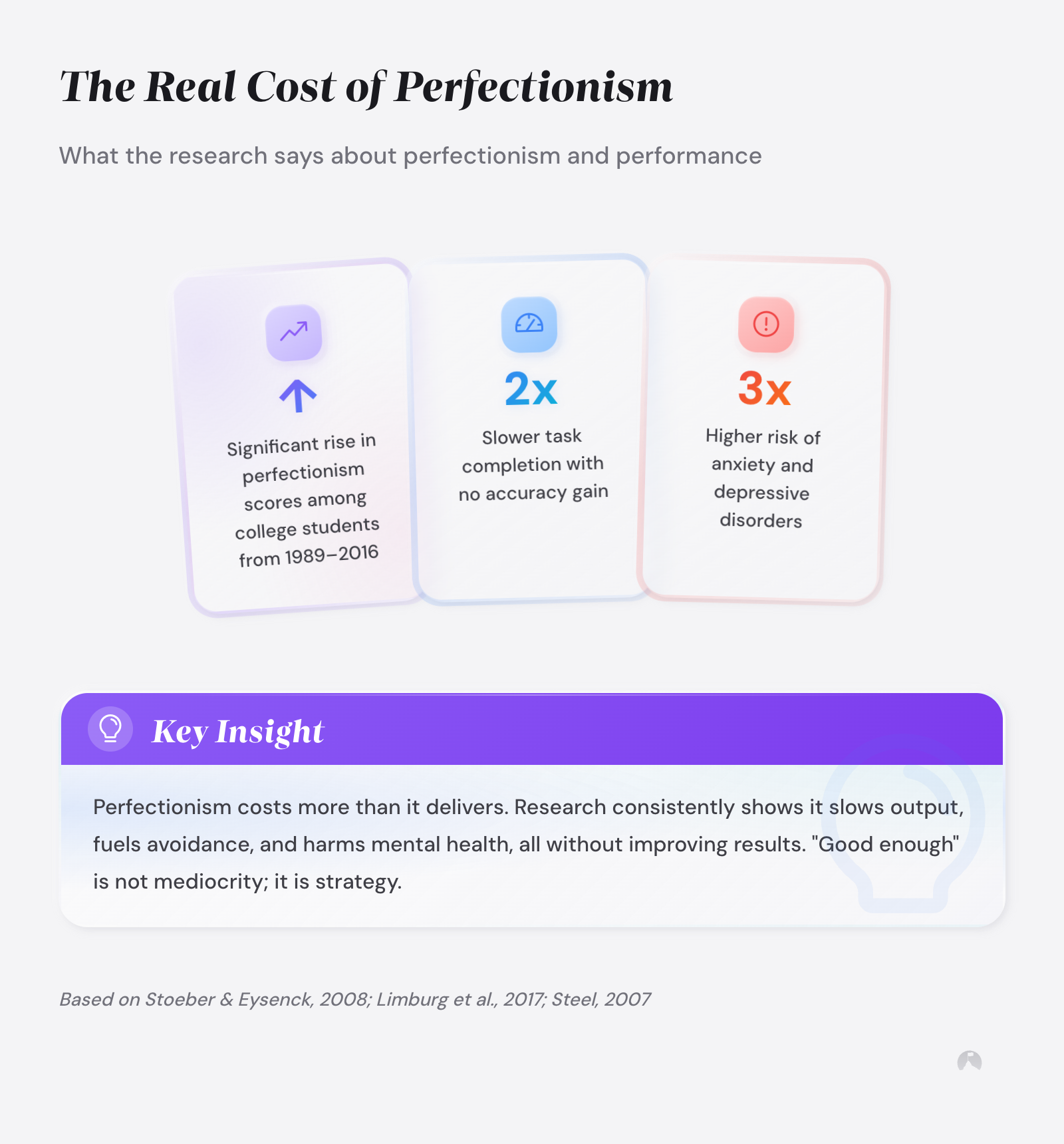
According to researchers Gordon Flett at York University and Paul Hewitt at the University of British Columbia, whose decades of perfectionism research have shaped how psychologists understand the construct, perfectionism is associated with procrastination, anxiety, and burnout – the exact opposite of high performance [1]. The higher your standards, the more you risk paralysis instead of progress. Most perfectionists don’t realize their pursuit of excellence has quietly become a pursuit of impossibility.
Here’s the key distinction: high standards drive quality. Perfectionism adds a second layer – fear. Fear of falling short. Fear of being seen as less-than. That fear is what makes you spend three hours on a presentation slide that gets glanced at for fifteen seconds, while your actual goal stalls.
Maladaptive perfectionism – what psychologists distinguish from healthy striving – is the compulsive pursuit of flawlessness combined with harsh self-criticism when standards are not met, producing procrastination, avoidance, and reduced productivity rather than enhanced performance. Unlike adaptive perfectionism, which involves high standards with self-compassion, maladaptive perfectionism ties self-worth to flawless outcomes and treats any shortfall as personal failure.
What you will learn
- How perfectionism triggers procrastination on your most important work
- Why perfectionists struggle to finish projects and ship work
- The invisible cost to your career growth and opportunities
- How perfectionism damages your relationships with others
- The burnout and chronic stress signs you’re ignoring
- Why you can’t celebrate wins or feel satisfied with your work
Key takeaways
- Perfectionism causes procrastination because the gap between reality and your impossible standard creates paralysis instead of motivation.
- Perfectionists rarely finish projects because they continuously reset the finish line higher, turning done work into endless refinement cycles.
- Career growth stalls because risk-avoidance and inability to delegate prevent advancement.
- Relationships suffer when perfectionists apply impossible standards to others, leading to criticism and emotional distance.
- Chronic stress and burnout are predictable outcomes because the emotional cost of constant self-judgment exhausts your nervous system.
- Perfectionists often can’t celebrate achievements because they immediately fixate on flaws, preventing satisfaction.
- The true cost of perfectionism is opportunity – projects not shipped, relationships not deepened, risks not taken.
1. Do you procrastinate because the standard feels impossible?
This is the most recognizable sign that perfectionism is holding you back. You have a major project due. But the gap between “good” and your internal standard for “perfect” feels insurmountable. So you don’t start. Not because you’re lazy. Because starting means confronting the impossibility of meeting your own bar.
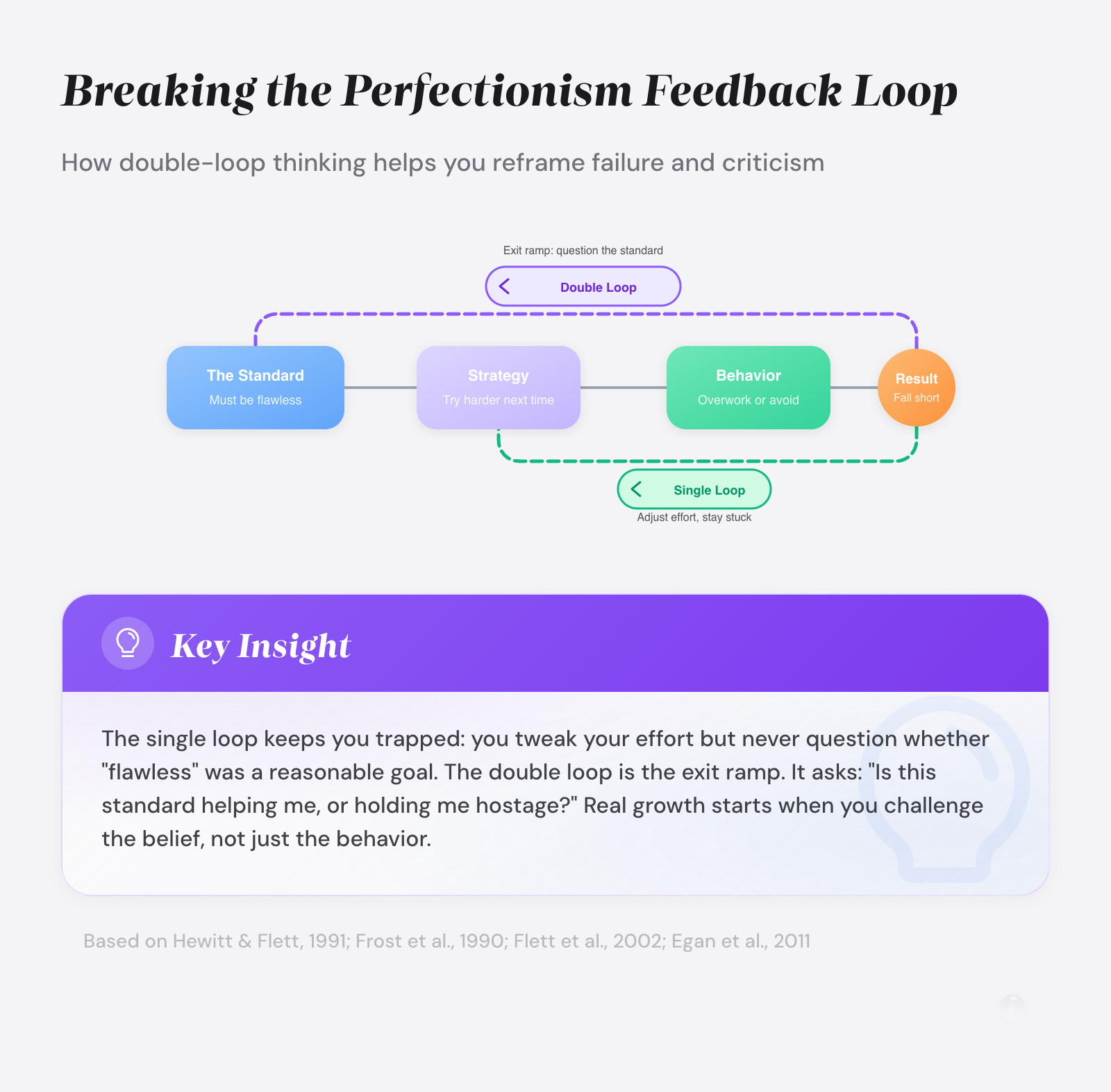
While self-help narratives often link perfectionism broadly to procrastination, the research shows the relationship is more nuanced. Steel’s meta-analysis of 216 sources found that perfectionistic concerns – specifically fear of judgment and doubt about actions – predicted procrastination, while perfectionistic striving did not [2]. You tell yourself you work better under deadline pressure.
The truth: you procrastinate until the deadline removes your choice. At that point, you produce something less than perfect, and the time pressure gives you permission to stop. That’s the perfectionism procrastination connection in its clearest form: fear of imperfection disguised as waiting for the right moment.
The perfectionism-procrastination cycle is a self-reinforcing behavioral pattern in which impossible performance standards generate anticipatory anxiety, which triggers task avoidance, which then produces guilt and lowered self-efficacy, which in turn raises the perceived stakes for future attempts – distinguished from ordinary procrastination by its origin in fear of inadequacy rather than poor time management.
2. You cannot finish projects because you keep raising the bar
Related to procrastination but distinct: the endless refinement cycle. You get to 90% done. Then you see something that could be better. You fix it. Now it’s 92% done. While improving that section, you notice another edge case.
Research by Stoeber and Eysenck found that perfectionism leads to accuracy behaviors without proportional quality gains – perfectionists invest more time in tasks but the extra time doesn’t translate to proportionally better results [3]. What we call the Refinement Trap – the cycle of reaching 90% completion and then resetting the finish line higher – is one of the most costly signs in this list.
Done beats perfect. But telling a perfectionist that feels like giving permission to ship garbage. So ideas stay half-finished. Projects you spent months on never launch because they’re “not ready.” This is how perfectionism prevents achievement at the most basic level: it redefines the finish line as infinitely distant.
3. You avoid new challenges where failure is possible
The refinement cycle is self-focused. But perfectionism also affects how you engage with new challenges. Growth lives outside your current skill set. But outside your skill set is exactly where you can’t guarantee perfection. So you skip opportunities. That leadership role? You’re not ready. That side project? Too risky. That conversation you need to have? The conditions aren’t right yet.
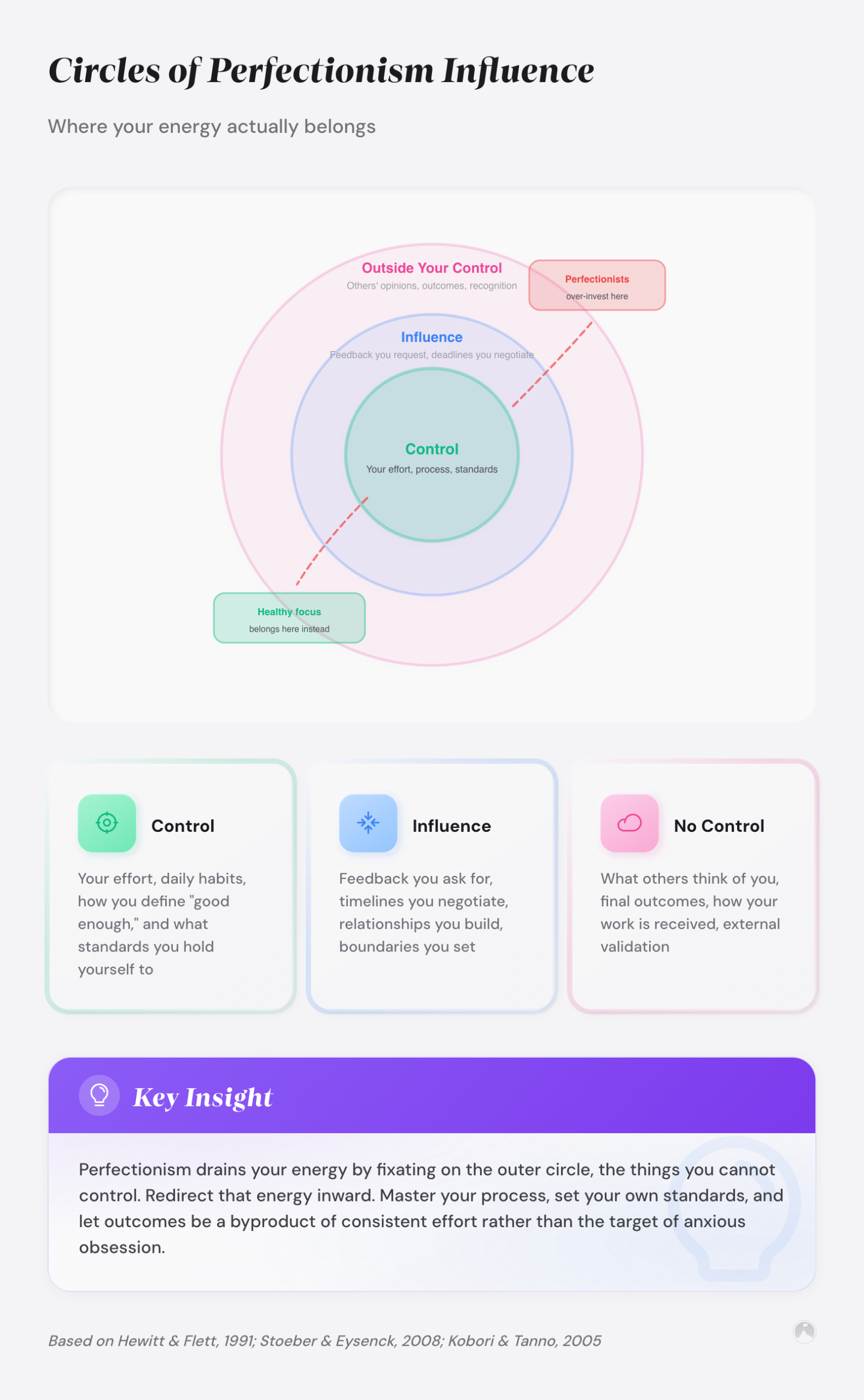
You stay in the narrow band of work you’ve already mastered, where you can reliably be excellent. The outside world sees this as playing it safe. You experience it as prudent risk management. Neither is accurate.
Research by Egan, Wade, and Shafran, who reviewed perfectionism as a transdiagnostic process across multiple psychological conditions, found that perfectionism strongly predicts avoidance behaviors and lower willingness to take on challenging tasks [4]. You’re not incompetent. You’re just risk-averse in one specific way: you’ll only play games you’ve already won. That strategy works until everyone else has advanced and you haven’t. This is perfectionism limiting career growth at its most insidious – not through visible failure, but through invisible avoidance.
4. You spend disproportionate time on minor details while major goals stall
If risk avoidance keeps you from new challenges, this sign describes what happens to the work itself. Your presentation is due Friday. The content is rough but directionally correct. But the slide designs aren’t right. So you spend 15 hours perfecting visuals for a 30-minute meeting where nobody will remember the fonts. Meanwhile, the actual strategic problem you were hired to solve remains unsolved.
Why? Because details are controllable. You can make a spreadsheet pixel-perfect. You cannot guarantee a new product launch will succeed. The details give you a sense of control and mastery. The big stuff terrifies you because outcome is never fully in your hands. Frost and colleagues’ foundational research on perfectionism dimensions found that excessive concern over mistakes – the maladaptive core of perfectionism – redirects effort toward controllable details rather than uncertain high-stakes goals [5].
So unconsciously, you trade progress on what matters for perfection on what doesn’t. Perfectionism doesn’t prioritize well. It prioritizes what can be made flawless, regardless of whether it matters.
5. You take feedback as personal attack instead of useful information
Choosing controllable details over risky goals also shows up in how you handle critique. Someone offers a suggestion on your work. Your stomach drops. Your first instinct isn’t “how can I improve” but “they think I’m not good enough.” Constructive criticism feels like evidence you’ve failed.
This happens because your identity and your output are fused. Flett and Hewitt’s research on self-evaluative perfectionism documents that when self-worth becomes contingent on flawless performance, critique of work is processed as critique of the self – triggering defensive responses rather than openness to improvement [1]. To the perfectionist, imperfect work equals imperfect self.
Over time, you become defensive about feedback. You explain why the suggestion won’t work. You justify your approach. You avoid asking for help because asking for help is admitting you don’t know. This isolation makes you worse, not better, because you’re cutting off outside perspective. If you recognize this pattern in yourself, understanding the psychology behind perfectionism can help you separate your identity from your output.
6. Why can you never feel satisfied with your achievements?
If the previous signs describe what perfectionism does to your work, this one describes what it does to your ability to feel. You accomplish something real. By any normal standard, it’s a win. But within seconds, your brain catalogs what’s wrong with it.
The presentation was good but the Q&A was shaky. The project shipped but the design could have been refined. You’ve never experienced the simple satisfaction of work well done. There’s always a flaw to fixate on. Kobori and Tanno’s research on self-oriented perfectionism found that perfectionists show post-performance dissatisfaction even after objectively successful outcomes, because the internal standard continuously adjusts upward to remain out of reach [6].
So you move immediately to the next task, still feeling like you haven’t succeeded yet. This creates what we call the Satisfaction Gap – the pattern where perfectionists reach goals and feel nothing. You’re successful on paper and miserable in experience. Achievement without satisfaction, repeated over years, produces a deep sense of failure despite obvious external success.
7. You apply impossible standards to others and feel frustrated when they don’t meet them
The Satisfaction Gap describes an internal experience. But perfectionism also projects outward. Your partner loads the dishwasher – not the way you would do it. You feel irritated. Your colleague submits good work with some minor issues. You feel disappointed. Your child tries something new and doesn’t execute it on the first attempt. You offer corrections instead of encouragement. This is perfectionism affecting relationships in real time.
The pattern: you expect others to operate at your internal standard. When they don’t, you experience it as failure on their part. This damages relationships. The people around you feel constantly criticized. Nothing they do is quite right. They learn that effort doesn’t matter to you – only flawless execution does.
Over time, they stop trying to please you. They stop being vulnerable around you. They become distant. From your perspective, they’re not pulling their weight. From theirs, they’re protecting themselves from constant judgment. If perfectionism is straining your closest relationships, understanding how perfectionism affects relationships and parenting can be a useful starting point.
8. You feel chronic stress even when work is on track
Relationship strain is visible to others. This sign is mostly invisible. Everything is technically fine. Projects are progressing. Nobody is upset with you. But you feel anxious. Always.
A low-level dread lives in your body. This is what perfectionism does to your nervous system. You’re always aware of the gap between reality and your standard. You’re always one flaw away from failure. There’s always something you could be doing better. Your brain is in a constant state of “not yet, not good enough.”
Research conducted by Gordon Flett, Paul Hewitt, and colleagues found that perfectionism predicts heightened stress reactivity independent of actual workload – meaning perfectionists’ suffering is self-generated through harsh internal standards rather than driven by external demands [7]. You could have less work than your colleagues and feel more stressed. The stress isn’t about the work. It’s about the distance between where you are and where you think you should be. And that distance is infinite because your standard for “enough” doesn’t exist.
All-or-nothing thinking is a cognitive distortion in which outcomes are evaluated as falling into only two extreme categories – perfect or failed, excellent or incompetent – with no acknowledgment of middle-ground performance. In perfectionism research, all-or-nothing thinking is identified as a core cognitive component of maladaptive perfectionism that amplifies distress from normal mistakes and errors.
9. You experience burnout despite not being overworked
Chronic stress is the warning sign. Burnout is what comes next. The cruel twist: perfectionists often burn out despite having reasonable workloads. Not because of hours, but because of the emotional weight of constant self-judgment.
Limburg, Watson, Hagger, and Egan’s meta-analysis, reviewing 284 studies on perfectionism and psychopathology, confirmed that perfectionistic concerns are strongly associated with anxiety, depression, and emotional exhaustion independent of objective task demands [8]. Your brain never gets to rest. Even when you’re not working, you’re mentally reviewing what you did and preparing for what you should do better.
This is different from burnout caused by overwork. With overwork burnout, the solution is clear: do less. With perfectionism burnout, doing less doesn’t help if your internal standard doesn’t change. You’re finishing your 40-hour work week. Your manager says the project is on track. But you’re exhausted because you’re the one exhausting yourself – not external demand.
The research on perfectionism and burnout makes this mechanism clear. If you also struggle with broader patterns of overcommitment and depletion, perfectionism may be a contributing factor worth addressing directly.
Perfectionism burnout is emotional and physical exhaustion produced by the relentless internal pressure of perfectionist self-evaluation, occurring independently of objective workload or task demands. Unlike overwork burnout, which resolves when workload decreases, perfectionism burnout persists until the internal standards and self-critical evaluations driving it are directly addressed.
10. You interpret mistakes as evidence of incompetence
Burnout is systemic. This final sign shows up in each individual moment a mistake occurs. You make an error. Normal humans think “I’ll fix that.” Your brain thinks “I am fundamentally flawed. How did I miss this? People will think I’m incompetent.” One mistake becomes evidence that your whole competence is in question.
Psychologists call this all-or-nothing thinking, and it’s a core component of maladaptive perfectionism [8]. You’re good or you’re bad. Excellent or incompetent. There’s no middle ground. The reality: everyone makes mistakes. The difference is how you interpret them.
Healthy people integrate mistakes as data points. Perfectionists interpret them as verdicts. This keeps you in a defensive posture. You over-explain mistakes. You avoid scenarios where mistakes are likely. You become hypervigilant for signs of failure. All of this mental energy is exhausting and makes you less capable, not more. The symptoms of perfectionism hurting you are rarely dramatic. They’re quiet – a slow erosion of confidence disguised as high standards.
Recognizing your perfectionism pattern
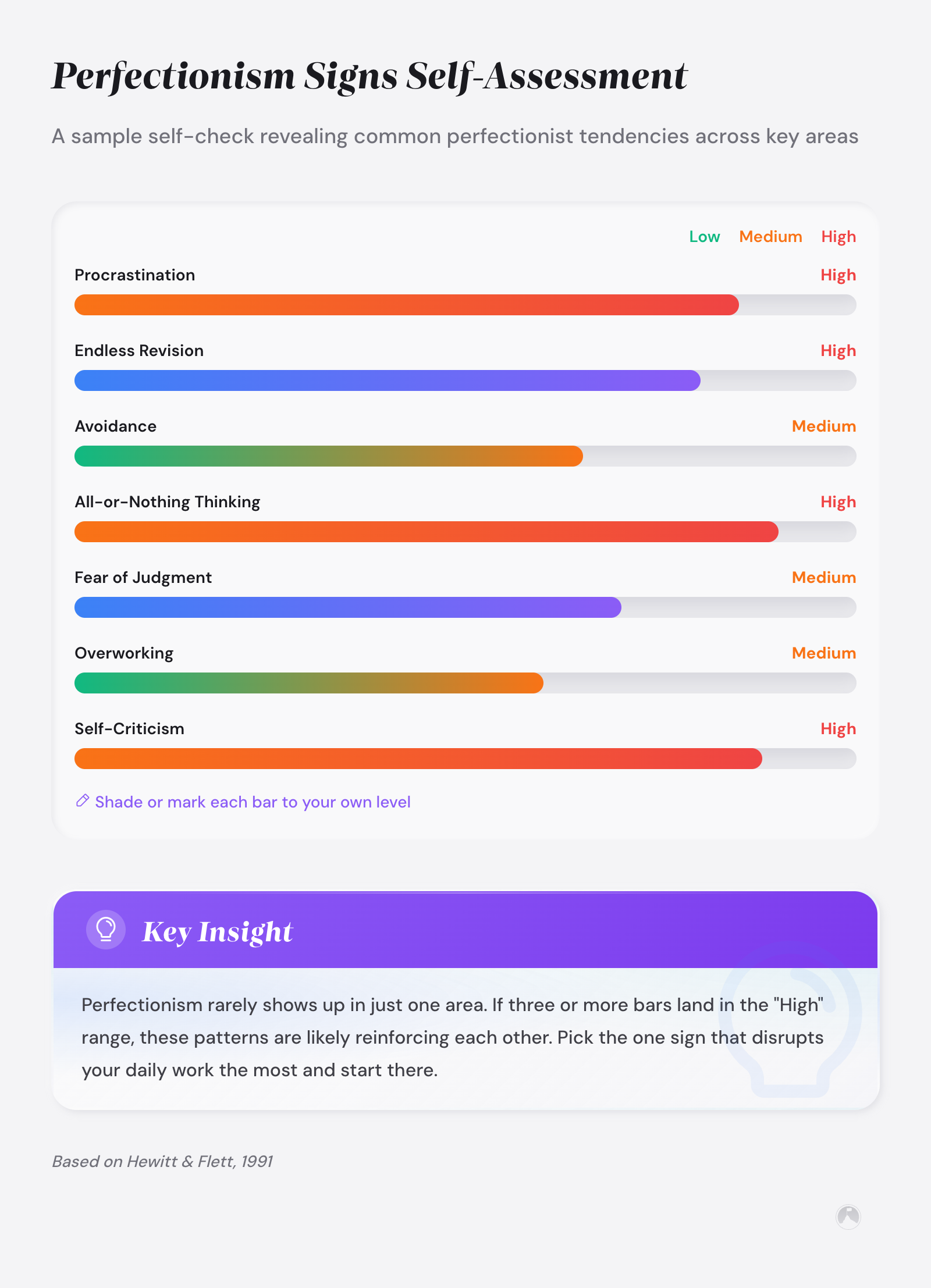
You don’t need to see yourself in all ten signs. Most perfectionists have a primary domain where this pattern shows up. Some are perfectionists about work but relaxed at home. Others apply impossible standards to relationships but are fine with hobbies.
The most important question isn’t how many signs match. It’s whether perfectionism is blocking success in a way that costs you something: time, opportunities, relationships, or peace of mind. If yes, that’s your signal. Not that you’re broken. Not that high standards are bad. But that the way you’re pursuing them is harming rather than helping. Understanding the full picture of overcoming perfectionism starts with recognizing these patterns in your own life.
Ramon’s take
Calling it perfectionism makes it sound kind of noble. But mostly it’s just really well-dressed avoidance. And the project folder I haven’t opened since 2022 would agree.
The real price of the perfect standard
The signs that perfectionism is holding you back aren’t about low standards or lack of ambition. They’re about the distance between your actual self and your impossible standard becoming so large that it paralyzes you instead of propelling you.
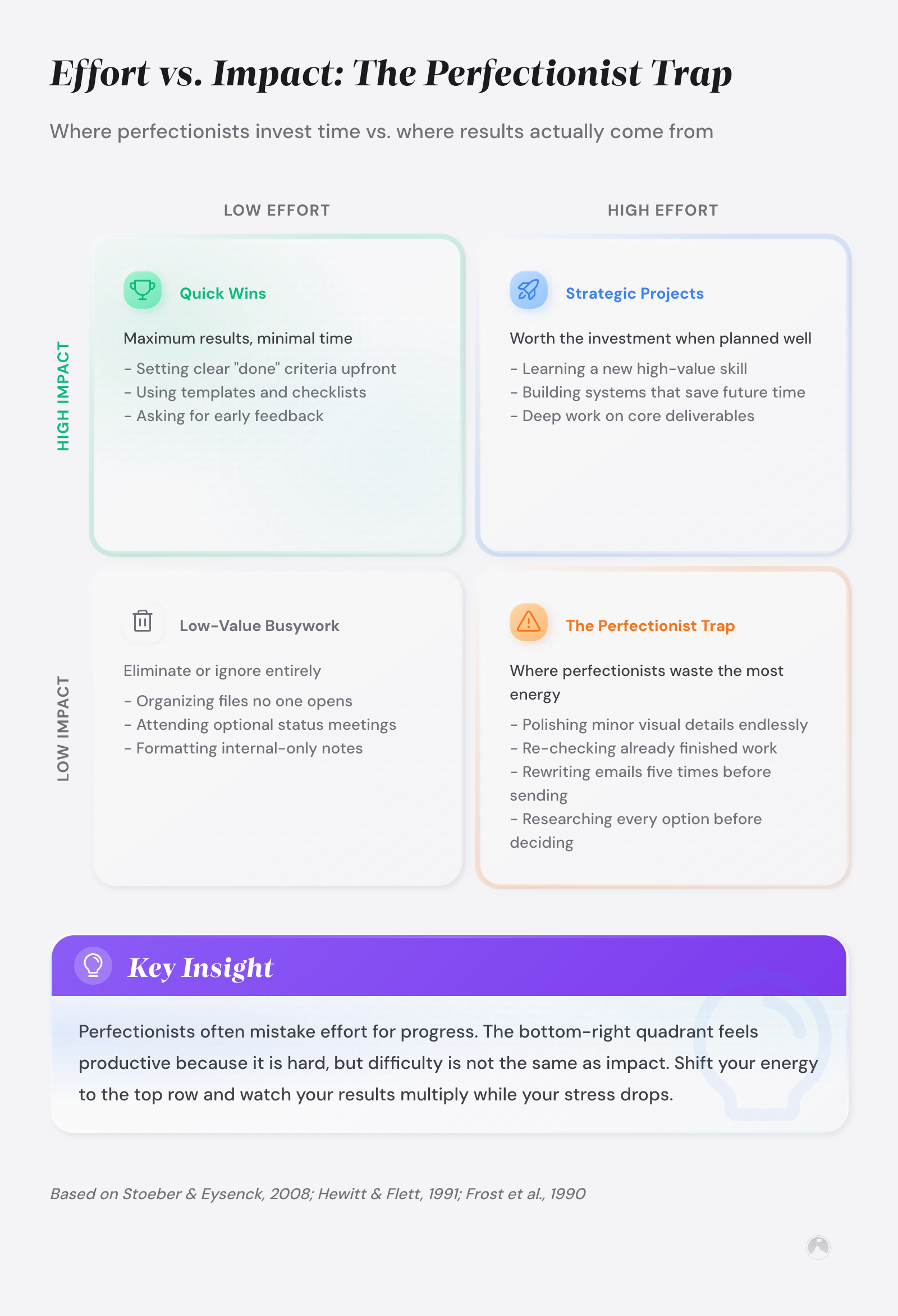
Procrastination. Unfinished projects. Avoided opportunities. Frustrated relationships. Chronic stress. The inability to feel satisfied. These aren’t character flaws. They’re signals that your drive for excellence has become counterproductive.
Overcoming perfectionism isn’t about lowering your standards. It’s about redirecting your drive toward things that matter – finishing projects, taking growth risks, deepening relationships, shipping work – instead of endless refinement of things that don’t. If you’ve recognized several of these patterns in yourself, exploring concrete solutions for perfectionism paralysis or practices that prioritize progress over perfection can help you channel that intensity productively.
Next 10 minutes
Identify which sign resonates most with your pattern – work, relationships, wellness, or self-perception. Write down one specific example where this sign showed up in your life this week.
This week
- Identify one current project where you’re caught in the endless refinement cycle and commit to shipping it by Friday, even if it’s not perfect
- Choose one piece of feedback you’ve been avoiding and ask for it from someone you trust
- Create a “good enough” standard for one low-stakes task and stick to it, even when your brain tells you to refine further
There is more to explore
- Overcoming perfectionism: a research-backed guide – the parent guide covering three types and recovery strategies
- Setting realistic standards – how to recalibrate your goals without lowering ambition
- Perfectionism psychology research – the science behind these patterns
- Breaking free from perfectionism – practical steps for shifting from perfection to progress
- Perfectionism and high achievers – why driven people are most vulnerable to these patterns
Take the next step
Pick one sign from this list where you see yourself most clearly. Commit to one small action this week that directly counters that pattern – ship something unfinished, ask for feedback, or celebrate a win without immediately finding flaws. Notice what actually happens versus what you feared would happen.
Related articles in this guide
Frequently asked questions
What are the main warning signs of harmful perfectionism?
A useful threshold: if 3 or more of the 10 patterns have been present for 6 or more months and are interfering with work, relationships, or wellbeing, clinical assessment may be warranted. The most diagnostically significant signs are chronic burnout without overwork [8], inability to finish projects [3], and interpreting mistakes as evidence of incompetence – because these indicate the pattern has become self-sustaining rather than situational.
How does perfectionism cause procrastination?
Perfectionism causes procrastination primarily through perfectionistic concerns – fear of judgment and doubt about actions – rather than through high standards themselves [2]. The most effective technique for breaking this cycle is the terrible first draft method: committing to producing a deliberately rough version of the work within a fixed time window, which lowers the perceived stakes and separates creation from evaluation.
Why does perfectionism reduce productivity instead of increase it?
Perfectionism reduces productivity through three mechanisms: procrastination delays when work begins [2], the Refinement Trap prevents completion [3], and risk avoidance limits what is attempted [4]. Research tracking time investment in perfectionists shows extra hours spent refining do not produce proportional quality improvements – the law of diminishing returns applies sharply to perfectionist revision cycles.
How does perfectionism damage relationships?
Perfectionism damages relationships when impossible standards are applied to others and shortfalls are treated as failures. A practical repair strategy: when noticing irritation at someone’s imperfect effort, explicitly name the effort before the critique – ‘You did X, and I appreciate it. One thing that would help next time is…’ This separates acknowledgment of effort from standards correction, which prevents the defensive distancing that perfectionist criticism typically produces.
What opportunities do perfectionists typically miss?
A practical risk assessment for perfectionists: before avoiding an opportunity, estimate the realistic worst-case outcome (not the catastrophic one) and compare it to the cost of not trying. Career growth (promotions requiring risk), relationship deepening (vulnerability), skill development (learning in areas where beginner status is inevitable), and life experiences (trying new things without guaranteed success) all require accepting imperfect starting conditions [4].
What’s the difference between healthy standards and harmful perfectionism?
Three diagnostic questions separate healthy standards from harmful perfectionism: (1) Can you feel satisfied when the standard is met, or does the standard shift upward immediately? (2) Does falling short feel like information or a verdict on your worth? (3) Do you start tasks readily or avoid them until conditions are ideal? Healthy standards motivate and allow satisfaction. Perfectionism paralyzes and prevents celebration [1].
When should I seek professional help for perfectionism?
Consider professional support when perfectionism causes chronic anxiety [7], prevents starting or finishing important projects [2][3], damages relationships, or contributes to burnout despite manageable workload [8]. A therapist can help redirect that drive toward sustainable progress. Brief CBT interventions (8-12 sessions) targeting perfectionistic concerns – not standards – are documented as effective for outpatient populations.
References
[1] Hewitt, P. L., & Flett, G. L. “Perfectionism in the self and social contexts: Conceptualization, assessment, and association with psychopathology.” Journal of Personality and Social Psychology, 1991. DOI
[2] Steel, P. “The nature of procrastination: a meta-analytic and theoretical review of quintessential self-regulatory failure.” Psychological Bulletin, 2007. DOI
[3] Stoeber, J., & Eysenck, M. W. “Perfectionism and efficiency: Accuracy, response bias, and invested time in proof-reading performance.” Journal of Research in Personality, 2008. DOI
[4] Egan, S. J., Wade, T. D., & Shafran, R. “Perfectionism as a transdiagnostic process: a clinical review.” Clinical Psychology Review, 2011. DOI
[5] Frost, R. O., Marten, P., Lahart, C., & Rosenblate, R. “The dimensions of perfectionism.” Cognitive Therapy and Research, 1990. DOI
[6] Kobori, O., & Tanno, Y. “Self-oriented perfectionism and its relationship to positive and negative affect: The mediation of positive and negative perfectionism cognitions.” Cognitive Therapy and Research, 2005. DOI
[7] Flett, G. L., Madorsky, D., Hewitt, P. L., & Heisel, M. J. “Perfectionism cognitions, rumination, and psychological distress.” Journal of Rational-Emotive and Cognitive-Behavior Therapy, 2002.
[8] Limburg, K., Watson, H. J., Hagger, M. S., & Egan, S. J. “The relationship between perfectionism and psychopathology: a meta-analysis.” Journal of Clinical Psychology, 2017. DOI