
How ambitious people set goals they actually achieve
Last January you set a goal to exercise five times a week, eat only whole foods, wake at 5am, and read for an hour daily. Two weeks later, all four were abandoned. The problem was not your drive. It was that you tried to change too much at once while setting standards designed for someone with unlimited time and cognitive load.
You’ve probably noticed something: the people who achieve the most aren’t always those with the highest standards. They succeed because setting realistic standards keeps ambition sustainable. Perfectionism disguises itself as drive – but research by Thomas Curran and Andrew Hill shows that perfectionism has been rising across generations, with concerning implications for anxiety, depression, and well-being, based on a meta-analysis of over 41,000 college students [1].
Realistic standards are ambitious goals calibrated to actual resources, available timeline, and current capacity – not hypothetical ideal conditions. They require a framework, not good intentions. This guide shows you four specific frameworks – SMART goals, the Standards Ladder, checkpoints, and the 80% Experiment – that work together to let you pursue meaningful ambition without self-destructing.
Realistic goal-setting means establishing targets that align with available time, energy, resources, and current skill level while maintaining genuine challenge. Unlike unrealistic goals that assume unlimited willpower, realistic standards are achievable within stated constraints and fit a person’s current capacity rather than an imaginary future version.
What you will learn
- How to audit your current standards using the “Would I expect this from a friend?” test
- Why the SMART framework prevents the goal-setting patterns that cause burnout
- The Standards Ladder: moving from minimum acceptable to ideal range
- How to break ambitious goals into realistic checkpoints that feel achievable
- The 80% Experiment: a safe way to test whether “good enough” is actually sufficient
Key takeaways
- Perfectionism fails because you set goals for an imaginary version of yourself with unlimited time and willpower.
- Realistic standards aren’t low standards – they’re ambitious goals structured around constraints and checkpoints.
- The Standards Ladder (minimum, realistic, ideal) prevents all-or-nothing thinking that makes people swing between extremes.
- George Doran’s SMART framework prevents the vague standards that set you up for failure from the start.
- The 80% Experiment proves that your catastrophic predictions about “good enough” are almost always wrong.
- Habit research shows simple changes take 4-6 weeks to feel automatic, so stacking three or more at once overwhelms your cognitive bandwidth.
Step 1: Audit your standards using the Friend Test
The first step in setting realistic standards is determining whether your current goals are achievable or whether you’re already caught in the perfectionist trap. Here’s what we call the Friend Test:
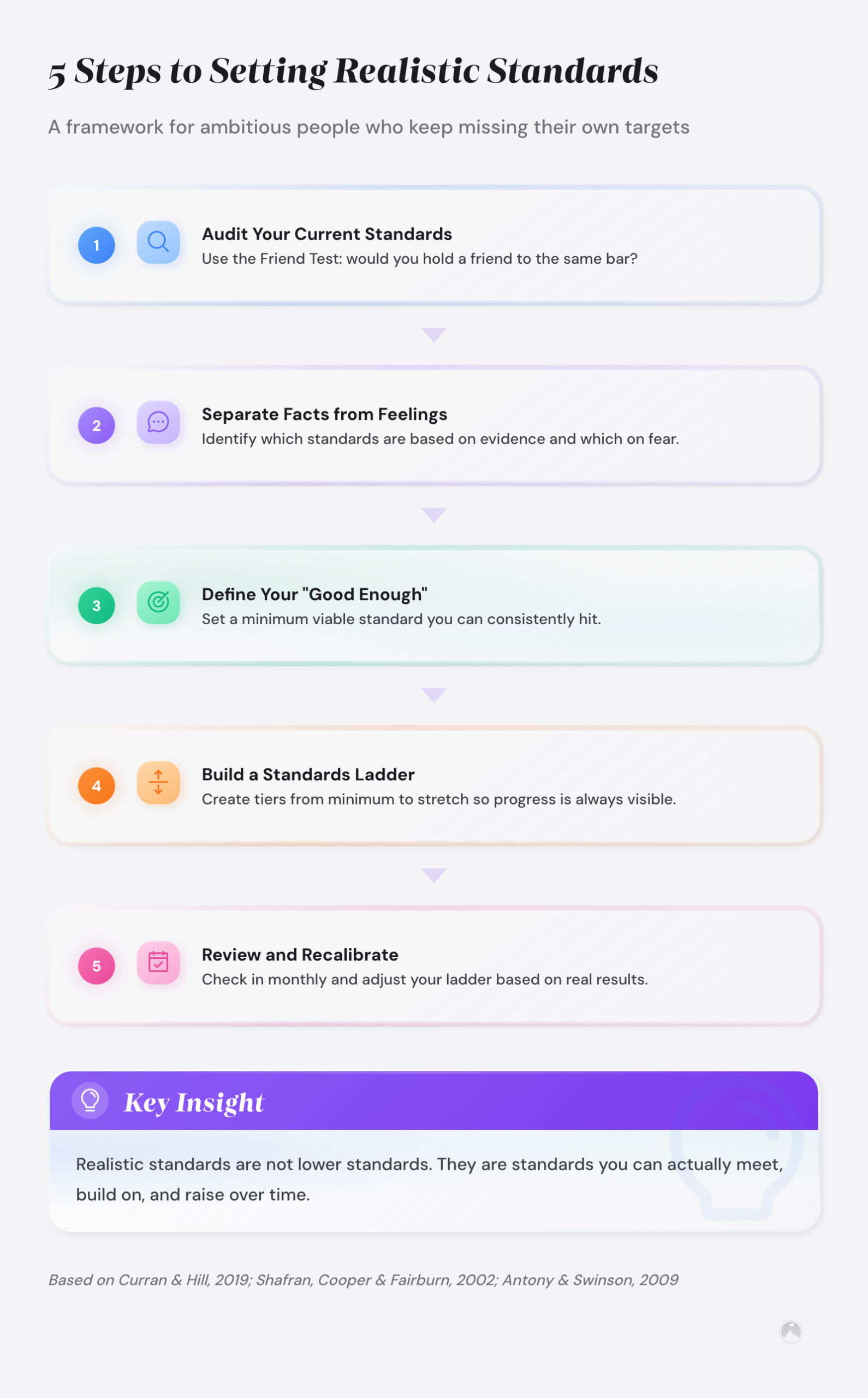
The Friend Test is a self-audit technique where a person evaluates whether a goal meets reasonable standards by asking: “Would I recommend this exact standard to a close friend in my same situation?” A gap between self-imposed standards and friend-recommended standards signals perfectionist distortion.
Take one major goal you’re currently pursuing. Now imagine your closest friend told you they had the same exact goal, with your exact same timeline, resources, and current skills. Would you think their standard was reasonable? Or would you worry they were setting themselves up for failure?
Most perfectionists immediately recognize that they’d tell a friend the standard is too high. You’d say: “You’re working full-time, have young kids, and haven’t exercised in three months – asking yourself to go to the gym six days a week is unrealistic.”
The phrase “I could never tell that to someone else” is the giveaway. Psychologist Roz Shafran and colleagues describe this pattern as conditional self-worth – where your self-evaluation hinges entirely on meeting standards you’d never impose on anyone else [2]. Your current standards probably exceed what you’d recommend to anyone you care about. That’s the definition of a perfectionist standard.
Write down three major active goals (work, health, relationships, learning, creative pursuits). For each, describe your current standard. Then ask: “Would I recommend this to someone in my exact situation?” Be honest. This creates distance from perfectionism’s voice and reconnects you to reasonable judgment.
Why multiple simultaneous changes fail
The conventional wisdom says you need more willpower. But research on cognitive bandwidth tells a different story. Sendhil Mullainathan and Eldar Shafir’s work on scarcity demonstrates that when mental resources are spread across multiple domains, decision-making quality declines sharply – even on unrelated tasks [3]. When you try to overhaul five areas of life simultaneously, your brain is managing five competing standards. Each decision to stick to a goal requires attention. By the time you face the third or fourth goal of the day, you’re operating on fumes.
The solution isn’t more willpower. It’s fewer simultaneous changes. A realistic goal setting framework starts by being honest about how many areas you can genuinely improve at once.
Research by Phillippa Lally and colleagues found that simple daily habits take a median of 66 days to become fully automatic, though simpler behaviors (like drinking a glass of water with lunch) reached automaticity in roughly 4-6 weeks [4]. More complex changes took considerably longer. So even one major change demands sustained attention for weeks.
- One major change requires 4-6 weeks of focused attention before it starts to feel automatic
- Two major changes can work if they’re very different (like exercise and reading, which use different cognitive systems)
- Three or more simultaneous changes typically overwhelms cognitive bandwidth, even for accomplished people
This isn’t a character flaw. It’s how human attention works. Before you build your standards ladder, identify which single goal or pair of goals deserves your focus over the next eight weeks. Everything else gets put on pause – not abandoned, paused. This one decision transforms your realistic standards from “overwhelming list of improvements” into “sustainable focus on one or two areas.”
What happens when your standards stay unrealistic
Understanding the cost of unrealistic standards matters before you start building new ones. Three patterns typically emerge when standards exceed capacity:
First, the boom-bust cycle. Clinical psychologists Martin Antony and Richard Swinson document this as a characteristic perfectionist pattern: weeks of pushing hard at an unsustainable pace, followed by complete collapse [5]. This creates the belief that you lack discipline, when actually you set yourself up for a fall. If you keep burning out on your own standards, the standards are the problem.
Second, procrastination intensifies. A meta-analysis by Sirois, Molnar, and Hirsch found that perfectionistic concerns – the fear component of perfectionism where you doubt you can meet your own bar – show a consistent positive relationship with procrastination [6]. When the standard feels impossibly high, starting becomes threatening. You can’t imagine reaching that bar, so you don’t even try. Perfectionism paradoxically becomes a form of self-sabotage.
Third, your self-worth takes the hit. Shafran and colleagues call this conditional self-worth – your self-esteem becomes entirely contingent on achieving impossible standards [2]. You’re constantly failing a test that’s rigged. You measure yourself against the ideal tier while living the constraints of the realistic tier, so you feel inadequate almost constantly. The gap between your standards and your performance widens until you give up entirely.
“Clinical perfectionism is maintained by the biased evaluation of self based on personally demanding standards despite adverse consequences.” – Shafran, Cooper, and Fairburn, Clinical Psychology Review [2]
Now that you understand what’s at stake, here are the four tools that replace perfectionist standards with ones that actually work.
Step 2: Apply the SMART framework to your priority goal
George T. Doran proposed the SMART framework in 1981 [7], and decades of goal-setting research have validated the core principle. Edwin Locke and Gary Latham’s 35-year review of goal-setting research found that specific, measurable, challenging goals consistently improve performance compared to vague “do your best” targets [8]. Most perfectionists fail not because their standards are too high, but because their standards aren’t actually defined.
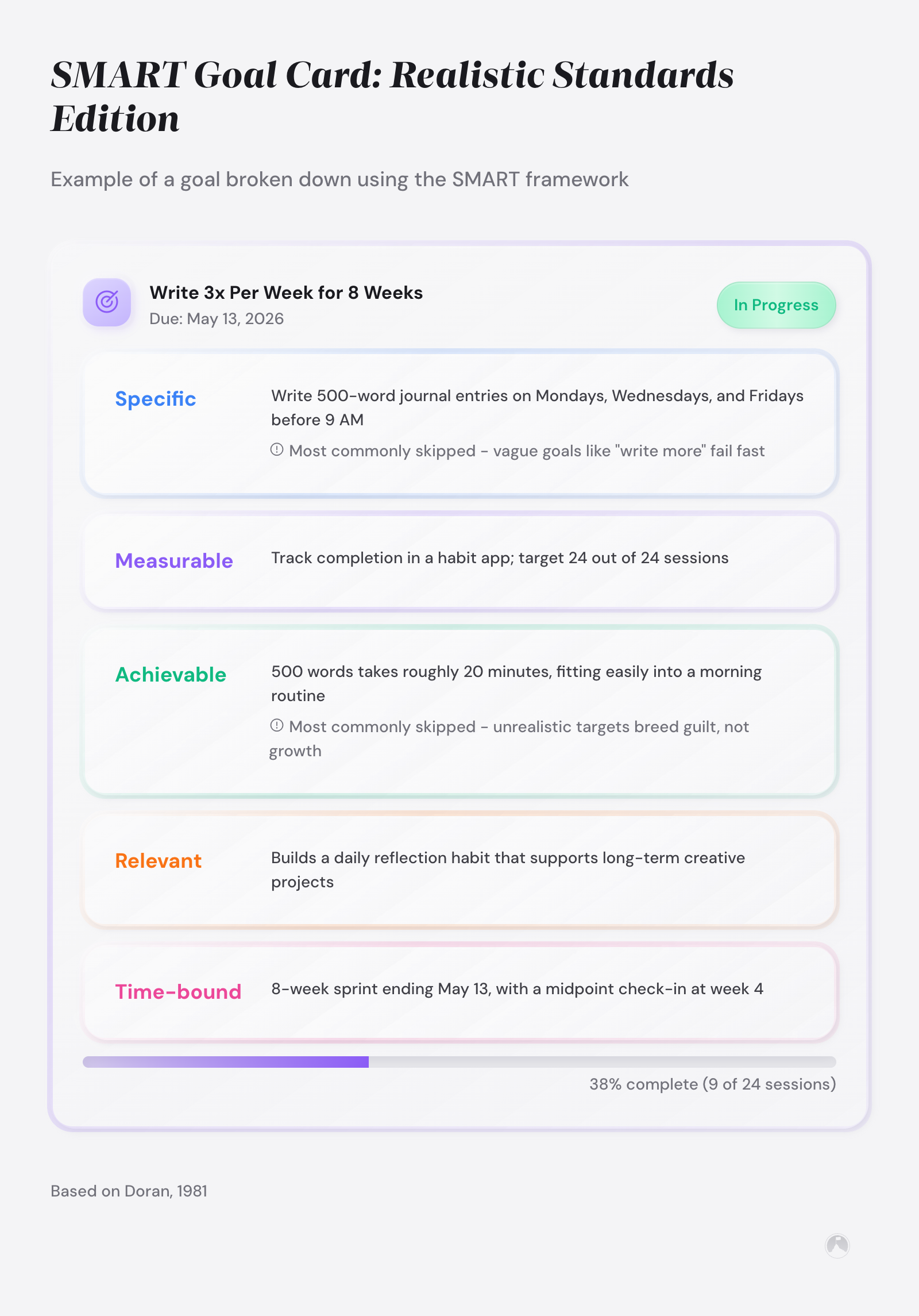
Let’s say your focus is health. A perfectionist standard sounds like “get healthy” or “exercise consistently.” That’s not specific enough to measure or achieve. The SMART goals methodology works differently:
- Specific: Walk or jog three days per week (not “exercise more”)
- Measurable: 30 minutes each session (not “get better at running”)
- Achievable: Given your work schedule and current fitness level (not “train like a distance runner when you haven’t run in years”)
- Relevant: Supports your goal of sustainable health and energy (not because you think you “should”)
- Time-Bound: For the next eight weeks, then reassess (not open-ended, which feeds all-or-nothing thinking)
The SMART version is simultaneously more ambitious and more realistic than the perfectionist version. You’re committing to something measurable your brain can actually track – which is why goal tracking systems pair so well with the SMART approach. You’re setting a time boundary that prevents it from becoming a permanent identity standard. And you’re anchoring achievability to your actual situation, not an imaginary version of yourself.
“The effects of goal setting are very reliable. Ninety percent of the studies showed positive or partially positive effects.” – Locke and Latham, American Psychologist [8]
Write out your primary goal using all five SMART components. If you can’t fill in all five, it’s not yet realistic. Vagueness is the enemy of achievement.
Step 3: Build your Standards Ladder from minimum to ideal
What we call the Standards Ladder prevents the all-or-nothing thinking that drives perfectionism. It creates three tiers so you’re not trapped between “perfect” and “complete failure.” It draws on perfectionism research showing that binary thinking – where anything below the ideal counts as failure – is one of the core mechanisms keeping perfectionism locked in place [2].
The minimum acceptable tier
This is the lowest version of the goal you’d consider a success. For the exercise example: “Two 20-minute sessions per week.” Not ambitious, but not zero. This is your safety net. If you hit this, you didn’t fail. You made real progress, and it’s achievable on your worst weeks.
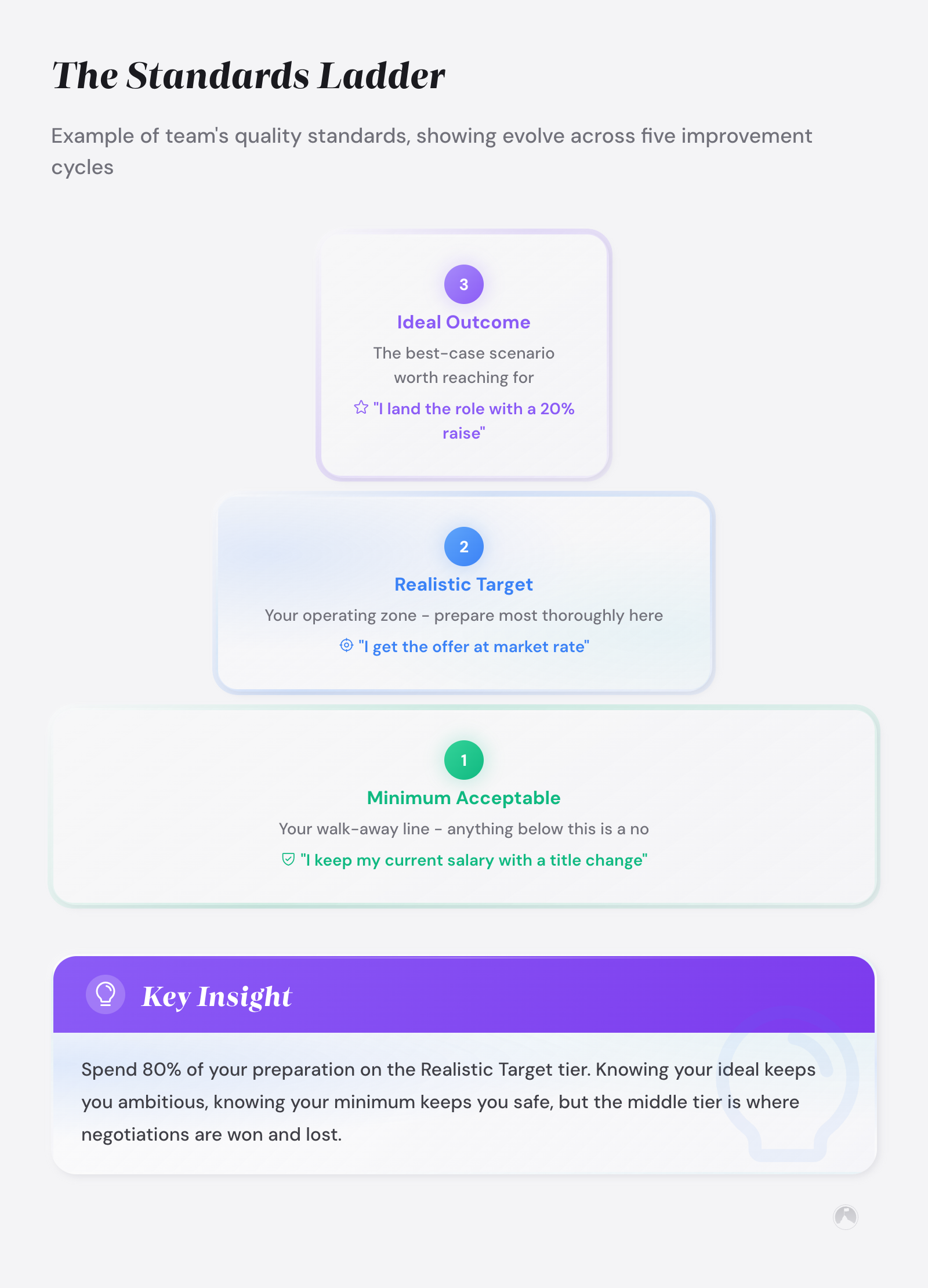
The realistic tier (the middle)
This is where you expect to land most weeks given normal circumstances. “Three 30-minute sessions per week” is realistic because it accounts for occasional conflicts, illness, or fatigue without being so low it doesn’t move you toward your goal. This tier matters most for long-term success.
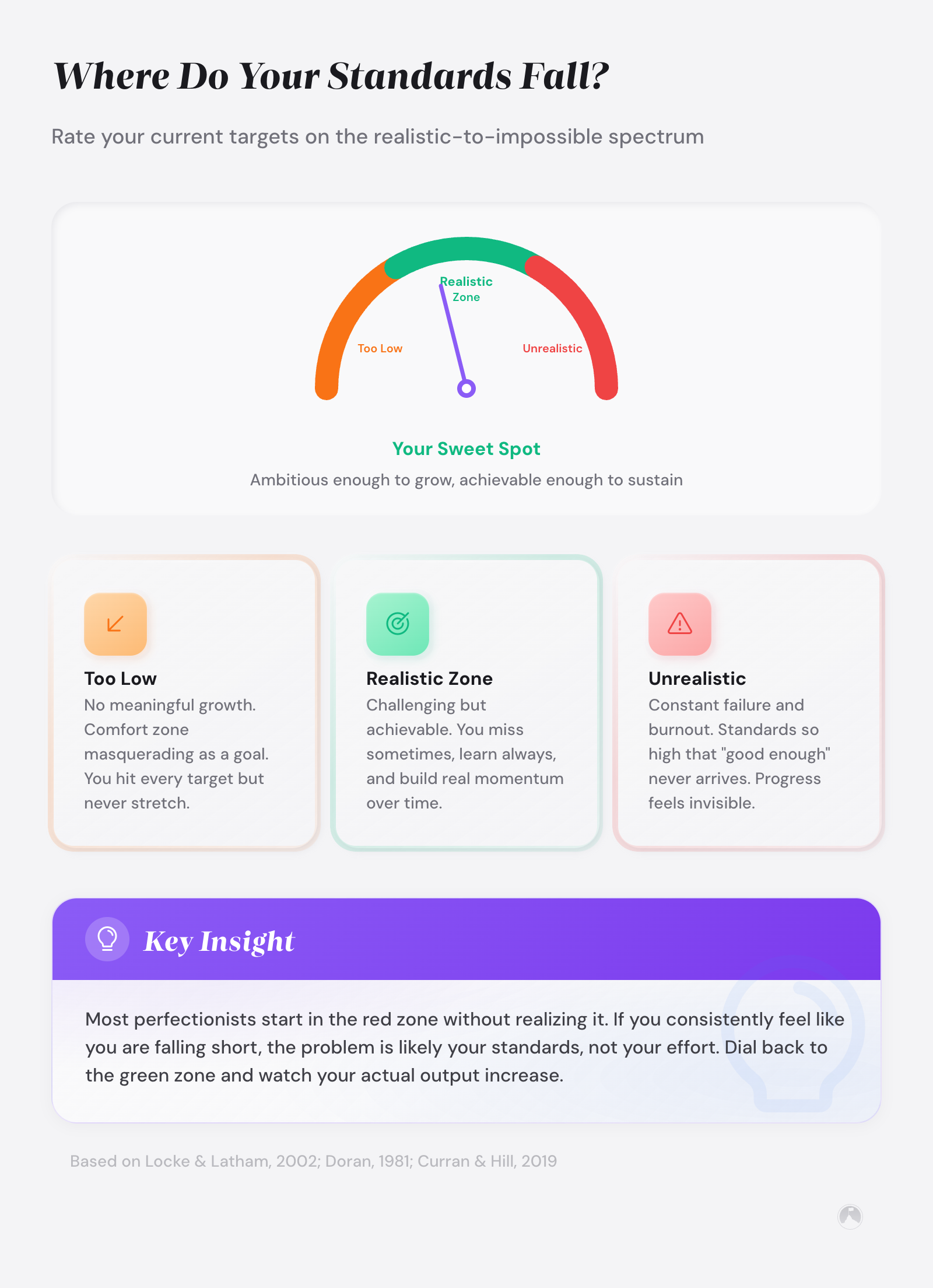
Here’s the key: most ambitious people should aim for the realistic tier 80% of the time, not the ideal tier. That’s how they maintain achievable standards week after week. Perfectionists reverse this. They chase ideal constantly and feel like failures the other 80% of the time.
The ideal tier
“I’m operating at absolute best with no obstacles.” That’s “five 45-minute sessions, including strength training twice.” It’s worth pursuing on good weeks, but it shouldn’t be your default expectation. This is what happens when everything aligns perfectly – rarely.
Building your ladder
For your SMART goal, define all three tiers. Be specific about what counts as success at each level. Perfectionism researchers Hewitt and Flett describe a pattern where individuals continuously escalate their own standards, making it psychologically impossible to ever feel successful [9]. Your ladder prevents that by giving you a fixed frame. Hit your realistic tier? That’s success. Full stop.
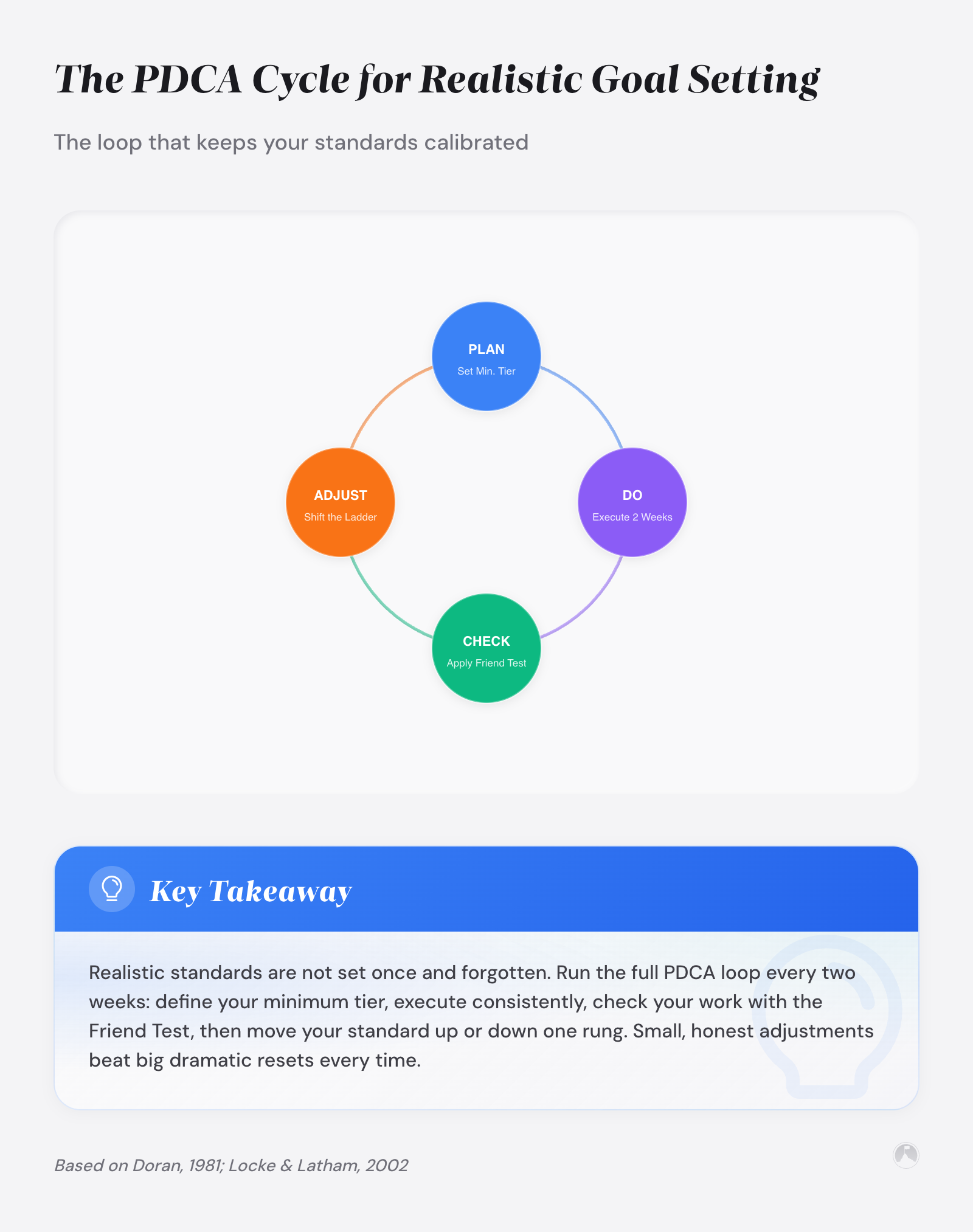
In summary, the Standards Ladder creates three fixed tiers – minimum acceptable, realistic, and ideal – so that any performance above minimum counts as genuine progress, the realistic tier serves as the primary success target, and the ideal tier is reserved for rare weeks when all conditions align.
Step 4: Break ambition into checkpoints that feel achievable
Breaking down large goals across longer timescales requires structure. Say you want to go to medical school. That’s multi-year. If you treat it as one giant goal, perfectionism gets louder: “I need perfect grades, perfect MCAT scores, perfect clinical hours.” Everything becomes high-stakes. One B-plus feels like the entire dream is collapsing.
What we call the checkpoint method reframes this. You break the multi-year goal into 6-12 month segments with specific measurable targets:
- Year one: Maintain a 3.8 GPA (realistic, not 4.0), complete 100 volunteer clinical hours, and take MCAT prep courses
- Year two: Complete MCAT, score above 510 (realistic for your target schools, not 520 on first try), maintain clinical involvement
Each checkpoint is ambitious but realistic for its timeframe. Missing one doesn’t collapse the entire dream. It triggers recalibration, not abandonment. Epton, Currie, and Armitage’s meta-analysis across 141 behavior-change studies confirmed that goal-setting works best when targets are broken into specific, measurable sub-goals rather than left as broad aspirations [10].
Take your largest goal and break it into 2-3 checkpoints. For each checkpoint, assign realistic (not ideal) metrics. This transforms “someday I’ll accomplish X” into “by month six, I will have achieved Y as measured by Z.” That’s how progress over perfection actually works in practice.
Step 5: Run the 80% Experiment to reset your all-or-nothing beliefs
The 80% Experiment is a behavioral test where a person intentionally performs a single task at 80% effort for one week, then compares predicted outcomes against actual outcomes. The experiment reveals that catastrophic predictions about reduced effort are typically inaccurate, resetting all-or-nothing beliefs about performance standards.
Perfectionism is maintained by a specific belief: “If I don’t do it excellently, it’s not worth doing at all.” That belief is usually wrong. What we call the 80% Experiment tests it directly.
Take a single task you normally try to do perfectly. This week, intentionally do it at 80% effort. If you normally write a detailed morning journal entry, write three quick sentences. If you normally prepare elaborate home-cooked meals, use pre-cut vegetables and simple recipes. If you normally prepare extensively for meetings, do a quick outline instead of deep-diving into every possible angle.
Then observe what actually happens. Does the sky fall? Do people judge you? Does the outcome suffer catastrophically? This approach mirrors the behavioral experiment technique central to cognitive behavioral therapy, where testing catastrophic predictions against real-world outcomes consistently produces belief change more effectively than reasoning alone [11]. Many perfectionists find that the gap between 100% effort and 80% effort produces a much smaller gap in actual results.
The actual impact is often negligible, but you’ve saved significant time and energy. Run this experiment for one week with one task. Notice what your brain predicted versus what actually occurred. Most people find their catastrophic predictions were wildly inaccurate. That reset is the beginning of truly setting realistic standards – grounded in evidence instead of fear.
Ramon’s take
Try this for just one goal, not your whole life. Pick whatever’s been nagging you the longest and figure out what the bare minimum acceptable version looks like. Sometimes just naming that floor is enough to stop the spiral.
That single reframe – treating the realistic tier as the actual success target instead of the consolation prize – transformed how sustainable my improvement actually is. The Standards Ladder gave me a fixed frame where hitting the realistic tier means I succeeded. Not “I settled.” Succeeded.
Conclusion: realistic standards drive long-term achievement
Setting realistic standards isn’t about lowering ambitions. It’s about recalibrating them to match your actual resources and capacity so you can sustain improvement. Perfectionists mistake excellence for unrealistic standards, then wonder why they stall out completely.
The SMART framework (backed by Locke and Latham’s decades of research [8]) prevents vague intentions. The Standards Ladder prevents all-or-nothing thinking. The checkpoint method breaks large ambitions into achievable segments. The 80% Experiment proves that your catastrophic predictions are usually inaccurate. Together, these tools let you be genuinely ambitious while actually achieving your goals.
The irony of realistic standards: they’re how accomplished people maintain the highest long-term achievements.
Next 10 minutes
Take one active goal and apply the Friend Test: Would you recommend this standard to someone in your situation?
This week
- Build the Standards Ladder for your primary goal: minimum, realistic, and ideal tiers
- Write your SMART goal using the five components
- Run the 80% Experiment with one task and notice what actually happens versus your prediction
There is more to explore
- Overcoming perfectionism: a research-backed guide – the three types and recovery strategies
- Perfectionism psychology research – the Hewitt-Flett model explained
- Overcoming procrastination – targeted strategies for task avoidance
- Perfectionism in high achievers – when high standards become self-defeating
- Building sustainable habits – how to make changes stick beyond the first few weeks
Related articles in this guide
- signs-perfectionism-holding-you-back
- breaking-free-from-perfectionism
- building-systems-beat-perfectionism
Frequently asked questions
What makes a goal realistic versus unrealistic?
A realistic goal aligns with available time, current skill level, energy capacity, and actual resources. An unrealistic goal assumes unlimited time or willpower, or ignores competing demands. Use the Friend Test: would you recommend this standard to someone in your exact situation? If not, it’s unrealistic.
How does the SMART framework help with realistic goal-setting?
The SMART framework transforms vague intentions into trackable commitments. Where perfectionism thrives on ambiguity (‘be healthier,’ ‘work harder’), SMART criteria force precision that makes self-deception harder. Research shows the time-bound element is particularly important for perfectionists because open-ended goals become permanent identity standards that escalate over time. Adding a reassessment date (‘for eight weeks, then evaluate’) gives permission to adjust without feeling like a failure.
Can I set ambitious goals that are still realistic?
Yes. Ambition and realism aren’t mutually exclusive. The difference is that ambitious realistic goals are broken into checkpoints and structured with the Standards Ladder. Medical school is ambitious. A checkpoint of ‘3.8 GPA and 100 clinical hours this year’ is realistic. Treat each checkpoint as its own goal.
How do I break down large goals into achievable steps?
Use the checkpoint method: divide multi-year goals into 6-12 month segments with specific metrics for each. Instead of ‘become a better writer,’ use checkpoints like ‘draft 10,000 words by month three’ and ‘complete first revision by month six.’ Each checkpoint is ambitious but realistic for its timeframe.
What is the right balance between challenge and achievability?
Research on flow states suggests optimal challenge sits at roughly 4% above current ability – enough stretch to engage without triggering anxiety. In practice, this means a goal should feel slightly uncomfortable but not threatening. If thinking about the goal creates dread or avoidance, the standard is too high. If it creates no excitement, it is too low. The Standards Ladder’s realistic tier is designed to hit this sweet spot by building in flexibility for normal disruptions.
How do I know if I’m being overly ambitious?
Three warning signs indicate overly ambitious standards: (1) repeated failure to start – not just finish – the goal, which signals that the bar feels threatening rather than motivating; (2) physical symptoms like tension, sleep disruption, or avoidance behavior when thinking about the goal; (3) inability to describe what ‘good enough’ looks like, which means the standard is undefined and therefore unmeetable. If two or more apply, scale the goal back to the realistic tier of the Standards Ladder.
Does the 80% Experiment really work?
Clinical evidence on behavioral experiments in CBT supports the principle behind the 80% Experiment: testing catastrophic predictions against reality consistently reduces anxiety and changes beliefs more effectively than reasoning alone [11]. The key is choosing a task where the stakes feel real to the perfectionist but where objective consequences of reduced effort are minimal – work emails, household organization, or social media posts are common starting points. Track predictions versus outcomes in writing for maximum impact.
References
[1] Curran, T., & Hill, A. P. “Perfectionism is increasing over time: A meta-analysis of birth cohort differences from 1989 to 2016.” Psychological Bulletin, 2019. DOI
[2] Shafran, R., Cooper, Z., & Fairburn, C. G. “Clinical perfectionism: A cognitive-behavioral analysis.” Clinical Psychology Review, 2002. DOI
[3] Mullainathan, S., & Shafir, E. Scarcity: Why having too little means so much. Times Books, 2013.
[4] Lally, P., van Jaarsveld, C. H., Potts, H. W., & Wardle, J. “How are habits formed: Modelling habit formation in the real world.” European Journal of Social Psychology, 2010. DOI
[5] Antony, M. M., & Swinson, R. P. When perfect isn’t good enough: Strategies for coping with perfectionism (2nd ed.). New Harbinger Publications, 2009.
[6] Sirois, F. M., Molnar, D. S., & Hirsch, J. K. “A meta-analytic and conceptual update on the associations between procrastination and multidimensional perfectionism.” European Journal of Personality, 2017. DOI
[7] Doran, G. T. “There’s a S.M.A.R.T. way to write management goals and objectives.” Management Review, 1981.
[8] Locke, E. A., & Latham, G. P. “Building a practically useful theory of goal setting and task motivation: A 35-year odyssey.” American Psychologist, 2002. DOI
[9] Hewitt, P. L., & Flett, G. L. “Perfectionism in the self and social contexts: Conceptualization, assessment, and association with psychopathology.” Journal of Personality and Social Psychology, 1991. DOI
[10] Epton, T., Currie, S., & Armitage, C. J. “Unique effects of setting goals on behavior change: Systematic review and meta-analysis.” Journal of Consulting and Clinical Psychology, 2017. DOI
[11] Bennett-Levy, J., Butler, G., Fennell, M., Hackmann, A., Mueller, M., & Westbrook, D. Oxford guide to behavioural experiments in cognitive therapy. Oxford University Press, 2004. DOI