
The completion gap that hides the real choice
You want to grow. The path splits between self-paced vs structured personal development: learning on your terms, or signing up for programs with external deadlines and peer support. Most people choose based on what sounds easier. That’s the wrong question.
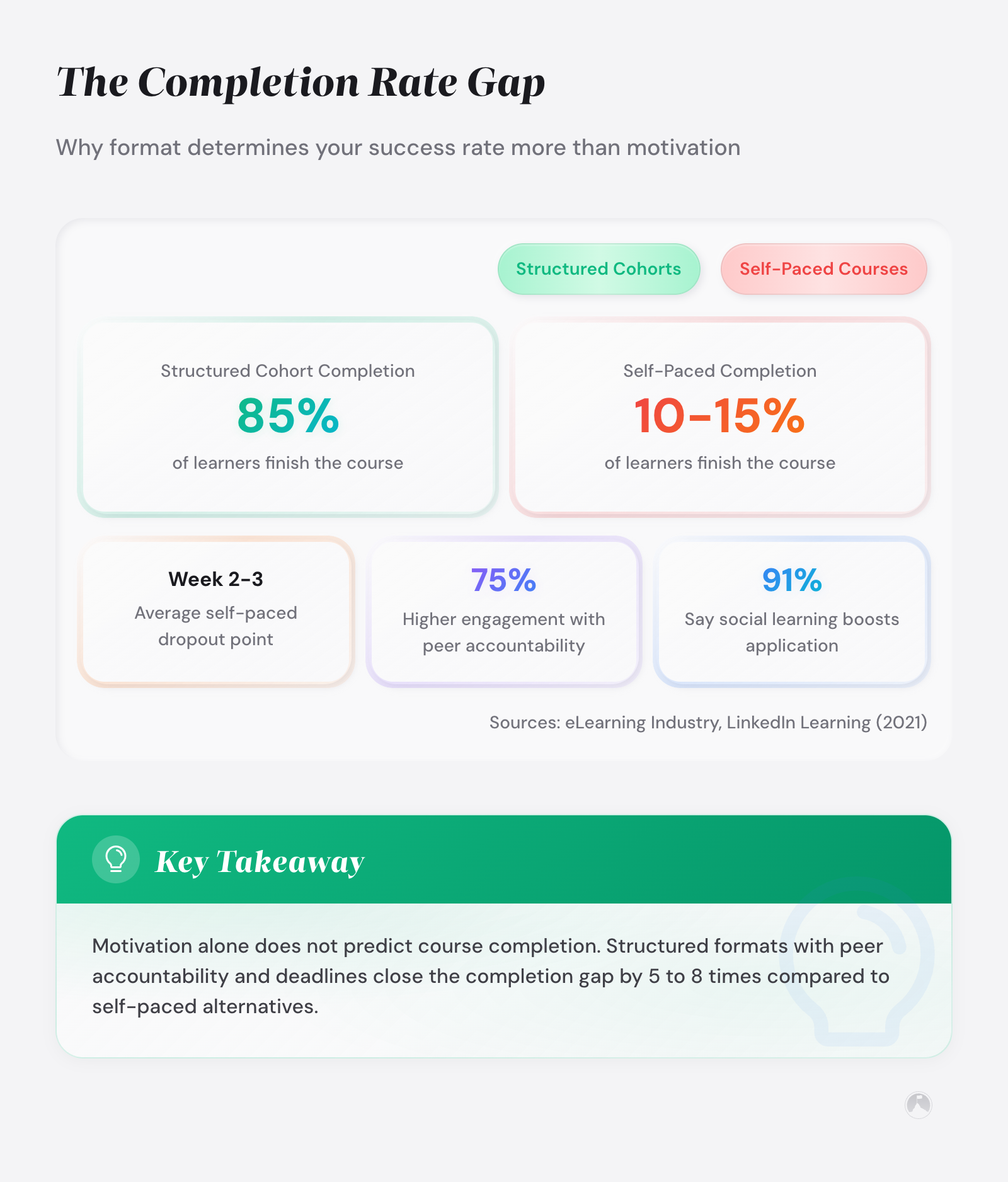
According to industry data aggregated by eLearning Industry, cohort-based structured programs achieve completion rates around 85%, while self-paced online courses typically see completion rates of 10% to 15%, though rates vary based on format and learner self-regulation [1]. That gap looks decisive. But completion rates don’t measure what actually matters to you: whether the approach matches how you work best, how much energy it costs, and whether you’ll keep going six months from now.
The right choice isn’t about picking winners. It’s about knowing five specific factors that determine your ideal blend of structure and autonomy. This article walks through those factors and gives you a three-question assessment that works better than any gut instinct about which format fits you.
Self-paced personal development is a learning approach conducted on an individually chosen timeline using resources such as books, online courses, podcasts, and deliberate practice, where the learner controls the speed, sequence, and depth without external deadlines or group requirements.
Structured personal development is a guided learning path with set curriculum, schedules, and milestones, usually delivered through cohorts, coaching, certifications, or instructor-led courses with built-in deadlines and peer interaction.
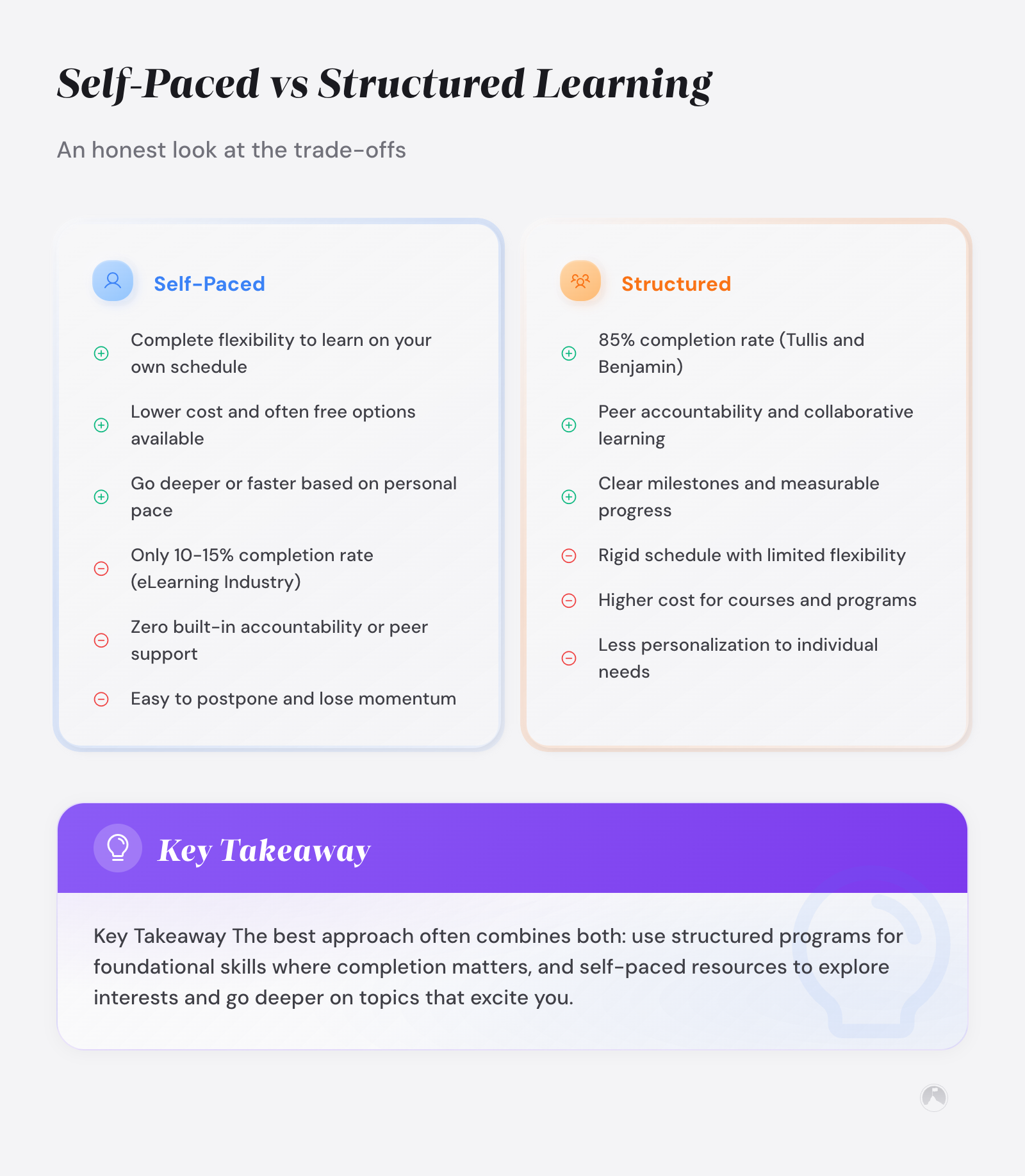
Self-paced vs structured personal development differs across flexibility, completion rates, accountability, and energy cost. Self-paced learning offers full schedule control and depth, while structured programs provide external accountability and credentials. Research shows that completion rates diverge sharply depending on self-regulation capacity. The best approach depends on your self-discipline track record, skill complexity, and available energy.
What you will learn
Key takeaways
- Structured programs average 85% completion; self-paced courses typically complete at 10-15%, varying by format and accountability [1].
- Tullis and Benjamin found self-paced learners outperform fixed-schedule students only when they spend more time on harder material [2].
- LinkedIn Learning reports 58% of professionals prefer self-paced learning, yet structured programs still achieve higher completion [3].
- In a study comparing formats, 65% of learners preferred bite-sized structured modules over traditional online lectures, citing better attention and motivation [4].
- Introvert-friendly structured options exist so you don’t need to choose between growth and energy protection.
- The Structure Spectrum Assessment predicts completion success better than completion rates alone.
- Completion matters less than application. Real growth shows up in changed behavior, not finished courses.
- Your ideal format shifts with life circumstances – reassess when stress, job changes, or family demands increase.
How self-paced and structured approaches actually compare
Before going deeper, here’s the side-by-side view. These eight dimensions cover what matters most for your decision. Look at which advantages matter to you versus which trade-offs you can live with.
| Dimension | Self-Paced | Structured | What this means |
|---|---|---|---|
| Completion rate | 10-15% [1] | Around 85% [1] | Structure works. But finishing the wrong thing helps nobody. |
| Depth of learning | High (you control time allocation) | Moderate (curriculum sets pace) | Self-paced rewards curiosity. Structured prevents rabbit holes. |
| Flexibility | Total (anytime, anywhere) | Limited (fixed schedules) | Unpredictable schedule? Self-paced wins. Predictable schedule? Structured works better. |
| Accountability | Self-driven only | External: deadlines, peers, instructors | Most people underestimate how much external pressure they need. |
| Social energy cost | Minimal (solo work) | Moderate-to-high (groups, networking, calls) | Introverts: factor this heavily before choosing. |
| Financial cost | Low-to-moderate | Moderate-to-high | Structured programs may pay back faster even with higher cost. |
| Career signaling | Weak (no proof, no credential) | Strong (certificates, networks, brand) | Credentials matter in some fields, not others. |
| Introvert compatibility | High (solitude, control, no forced interaction) | Variable (design-dependent) | Structured programs vary widely. Screen before enrolling. |
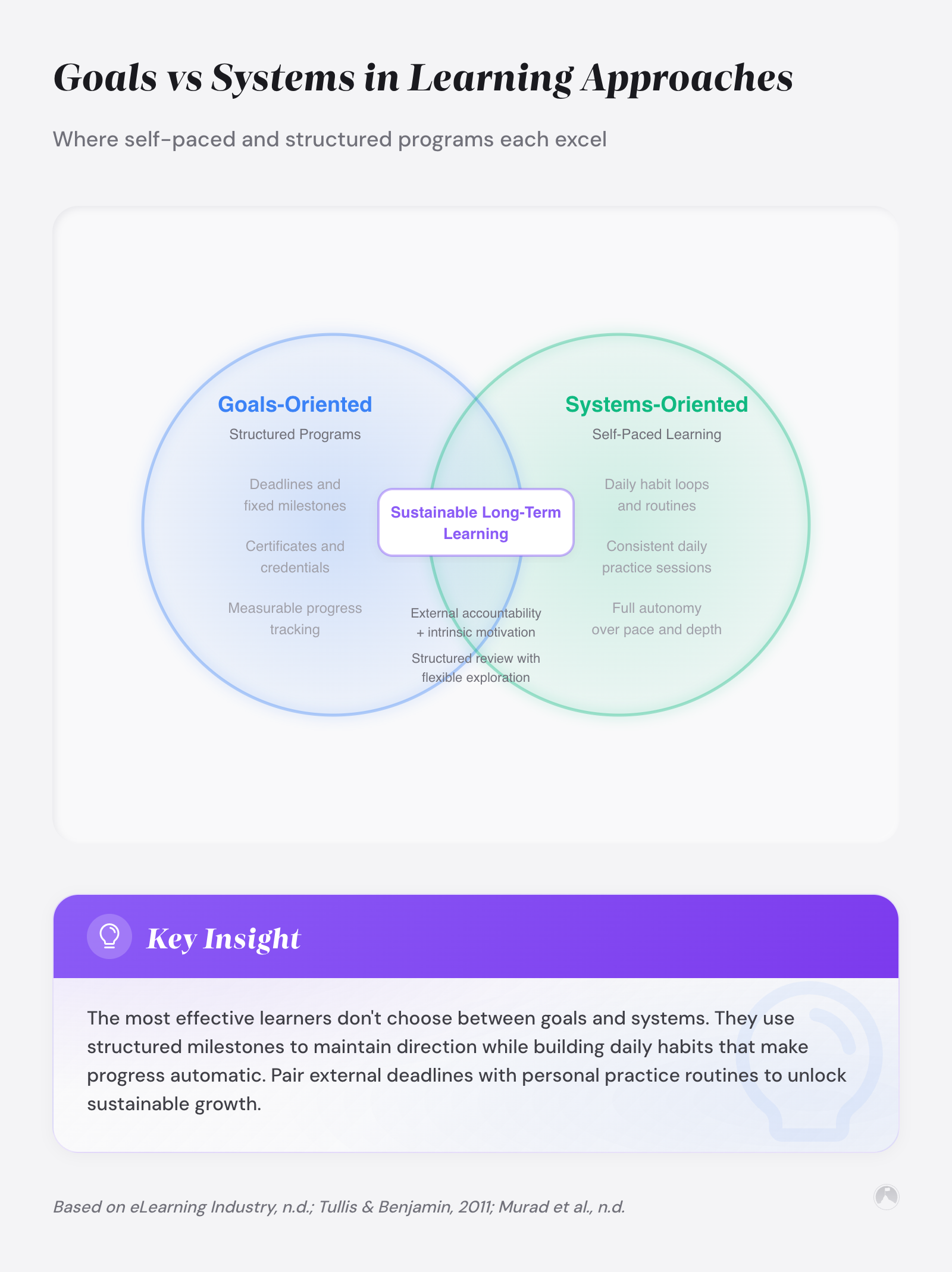
Self-paced learning wins on depth and flexibility. Structured learning wins on completion and career visibility. Everything else depends on your situation.
When self-paced learning works (and when it doesn’t)
Most people think self-paced learning is the easier option. It’s the opposite. Self-paced is harder because it demands the very skills you’re trying to develop: self-discipline, clear goals, and honest self-assessment.
Tullis and Benjamin found that learners with control over their schedule outperformed those on fixed timelines, but only when they spent more time on difficult material [2]. Without that targeted strategy, the self-pacing advantage disappeared entirely. Translation: flexibility means nothing if you use it to avoid the hard parts.
So when does self-paced learning actually work? When you bring four things to the table: a clear development goal, baseline knowledge in the area, self-discipline to maintain regular practice, and access to quality resources. If you’re missing more than one, self-paced learning tends to become passive consumption – reading without implementing, watching without practicing, collecting information that never becomes capability.
Self-regulation in learning is the ability to set learning goals, manage time allocation across different topics, monitor progress independently, and change strategies when the current approach is not producing results.
For introverts and introspective professionals, self-paced has a natural advantage: it respects your energy boundaries. No group exercises demanding small talk. No Zoom call after an already draining workday. You learn during peak-energy hours and stop when you need to recharge. That rhythm often produces deeper learning – you’re working when your mind is sharpest.
The data is clear: self-paced learners who front-load time on difficult material outperform everyone else. But most don’t do that [2]. They spread effort evenly and wonder why they finish but don’t retain anything.
As Tullis and Benjamin’s research demonstrated, learners who controlled their own study-time allocation outperformed those on fixed schedules – but only when they invested more time in the material they found most difficult [2].
What structured programs deliver that self-paced cannot replicate
Structured programs get people to the finish line. eLearning Industry reports that cohort-based programs achieve around 85% completion, but self-paced courses often drop to 10-15% [1]. That’s not a small gap.
And here’s the interesting thing: according to LinkedIn Learning’s 2021 survey of over 5,000 professionals, 58% say they prefer learning at their own pace [3]. Yet structured programs succeed anyway, working against what most people claim they want. That tells you something about external accountability. It works whether you feel like it or not.
Structured programs deliver three specific advantages. First, they design the curriculum for you, eliminating the exhausting “what should I learn next” decision. Second, they create external deadlines that prevent indefinite postponement. Third, they provide peer interaction that accelerates learning through shared experience and different perspectives.
As eLearning Industry’s analysis notes:
“Cohort-based programs achieve completion rates exceeding 85%, with many programs reporting rates over 90%. The cohort structure provides social accountability, peer learning, instructor engagement, and clear deadlines that support completion.” – eLearning Industry [1]
But here’s where it gets complicated for introverts and energy-conscious professionals: that peer interaction costs social energy. Group coaching calls, networking sessions, breakout rooms, accountability partnerships – all of it drains people who already expend energy just showing up to work. If your introvert professional development strategies leave you exhausted, completion becomes meaningless.
Structured programs work partly by removing the burden of deciding when and what to learn. For people who struggle with consistency, that’s worth the cost. For self-directed people, it feels like paying for constraints you don’t need.
Five factors that should actually drive your choice
Most comparison articles list pros and cons, then leave you figuring out what matters for your life. That’s not enough. The right self-paced vs structured personal development choice depends on five specific factors. Knowing how they interact matters more than the factors themselves.
Factor 1: your actual self-regulation capacity
Be honest. In the past 12 months, how many books, courses, or learning projects did you start and finish? If it’s fewer than half, you need more structure than you think. Research on self-directed learning suggests that the main barriers to self-directed learning are time management challenges, distraction from technology, and motivation loss without external support [5].
Factor 2: your energy management constraints
If you’re an introvert, a parent with limited discretionary time, or someone whose work already drains you socially, the energy cost of a structured program is real. Energy management for introverts isn’t optional – it’s a constraint that determines whether you sustain development over months or burn out after weeks. Self-paced learning lets you learn during your natural high-energy windows without the added drain of group dynamics.
Factor 3: complexity of what you’re learning
Basic skill acquisition (learning a tool, memorizing a framework) works fine self-paced. Complex skill development (leadership, communication, negotiation) often needs the feedback loops that structured programs provide. Research on self-directed learning suggests that learners working independently struggle more with complex topics that require interpersonal practice and real-time feedback [5]. If the skill requires working with other people, structure gives you a built-in practice environment.
Factor 4: career signaling value
Some industries care about credentials. Others care about what you can actually do. If you need a visible signal (a certification, a degree, a program name on your resume), structured development delivers that. Self-paced learning builds real competence but produces no external proof. Career advancement the introvert way sometimes means choosing the development path others can verify, not the one that feels most comfortable. Explore career growth strategies that align with your working style.
Factor 5: your budget and timeline
Structured programs cost more upfront but compress the timeline. Self-paced costs less but can stretch indefinitely. If you need results within three months, structured deadlines get you there faster. If you have a year and want to go deep, self-paced lets you explore without artificial time pressure.
The Structure Spectrum Assessment: find your ideal blend
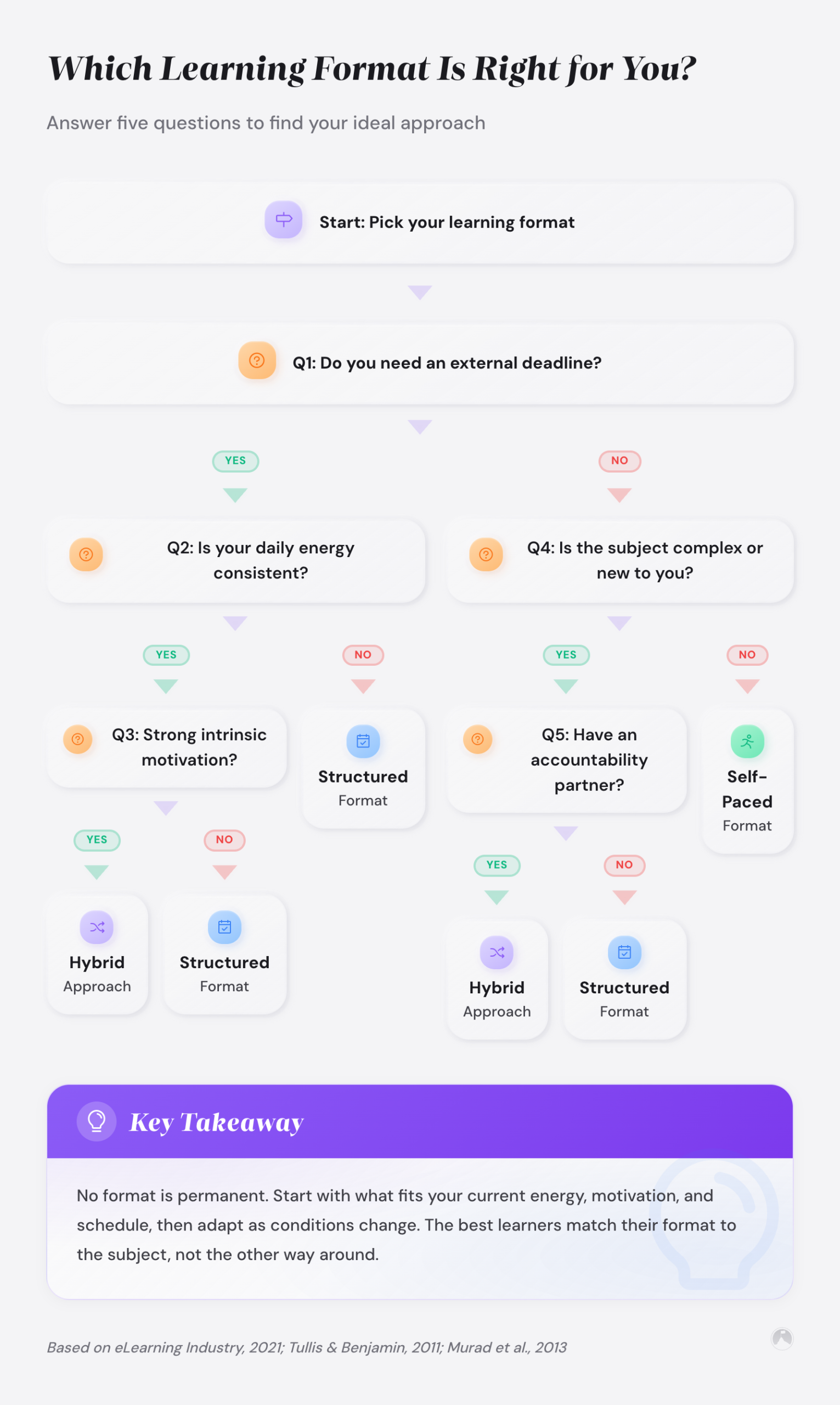
Most people don’t need pure self-paced or pure structured. They need a specific blend tuned to their situation. Three questions work better than any single decision method for matching learners to the right format. Ask them in order for each development goal you’re considering.
But asking them together in sequence predicts completion success more reliably than any single factor.
The Structure Spectrum Assessment is a three-question framework that matches any learning goal to the right balance of flexibility and external accountability based on the learner’s self-regulation track record, skill complexity, and energy constraints.
Question 1: Can you describe what “done” looks like without help from someone else? If yes, self-paced is viable. You know where you’re going. If you can’t articulate the endpoint, you need the curriculum structure that guided programs provide.
Question 2: Have you successfully completed a similar learning project on your own in the last 12 months? If yes, you’ve proven self-regulation in this domain. If no, Tullis and Benjamin’s research suggests external accountability will help [2]. Past behavior predicts future behavior more reliably than good intentions.
Question 3: Does learning this skill require feedback from other people? If the skill is interpersonal (leadership, negotiation, public speaking), self-paced resources teach theory but not practice. Structured programs with live practice components fill that gap.
Score yourself: three yes answers point toward self-paced. Two or more no answers point toward structured. One no suggests a hybrid where you add one structural element (monthly coaching session, accountability partner) to a self-paced foundation. For help setting up that foundation, see our guide on how to create a personal development plan.
| Your score | Your ideal path | What to add |
|---|---|---|
| 3 yes | Self-paced with check-ins | Schedule a quarterly review with a peer or mentor |
| 2 yes, 1 no | Self-paced plus one structural element | Add a coaching session, accountability partner, or cohort community |
| 1 yes, 2 no | Structured program with flexible options | Choose programs with asynchronous options and limited group requirements |
| 3 no | Fully structured program | Prioritize clear milestones, deadlines, and instructor feedback |
The best approach matches your self-regulation capacity, the complexity of the skill, and the energy you can sustain.
Why hybrid approaches consistently outperform pure models
Tan and colleagues found something worth noticing. When structured content was delivered in small, self-paced modules instead of long lectures, 65% of learners preferred bite-sized structured modules over synchronous lectures, citing better attention and enhanced motivation [4]. The evidence points toward borrowing structure from one approach and pacing from the other.
As Tan and colleagues reported:
“Bite-sized structured learning promoted better attention and enhanced motivation compared to online lectures, with 65% of students expressing a strong preference for this format.” – Tan et al. [4]
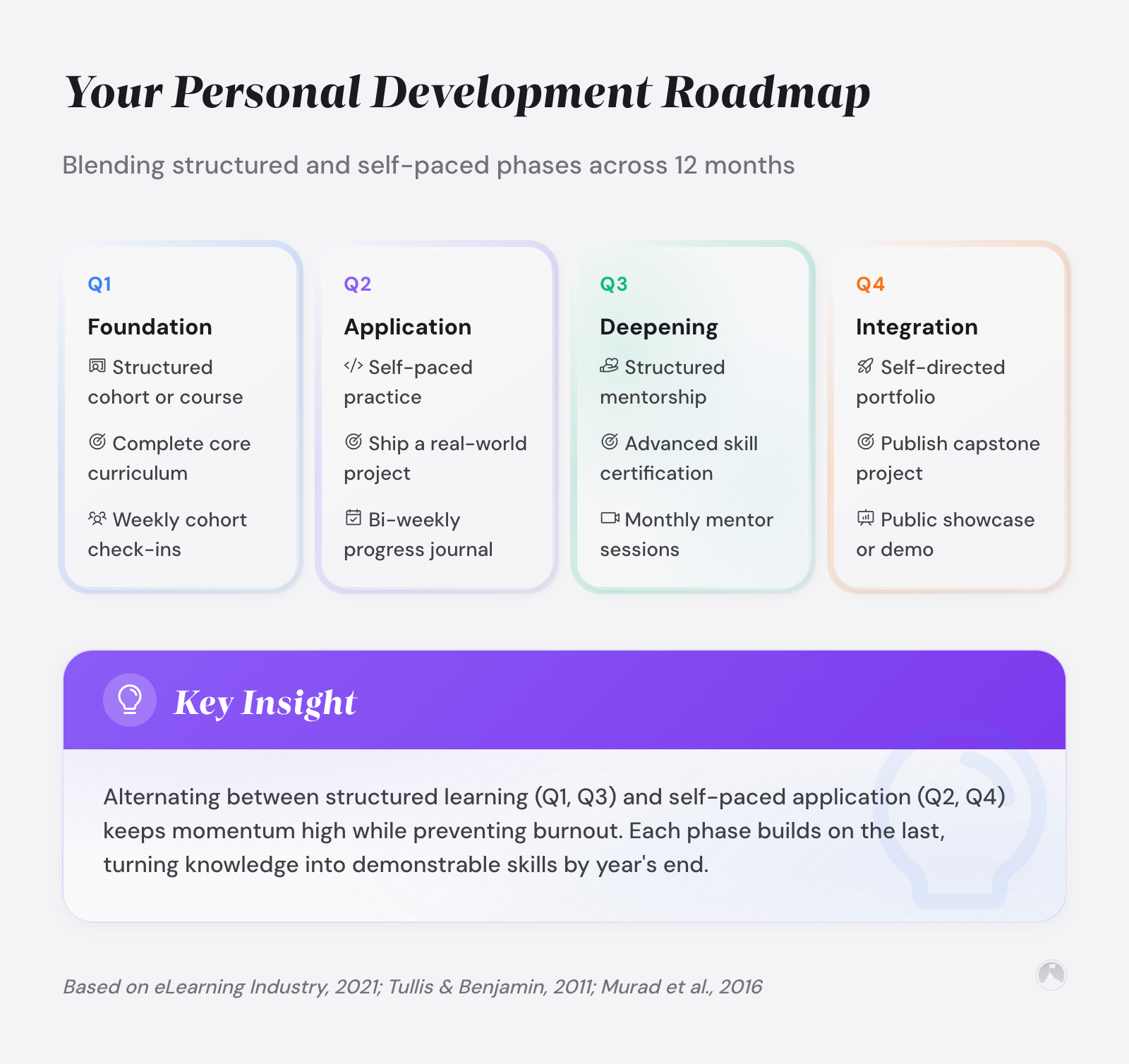
This matches what the data consistently shows. Pure self-paced learning often lacks the accountability and curriculum design that keeps people moving forward. Pure structured learning often lacks the timing flexibility and energy management that keeps people engaged.
The hybrid sweet spot takes the curriculum sequencing and periodic deadlines from structured programs and wraps them in the timing flexibility and energy autonomy of self-paced learning.
For introverted professionals, hybrid solves a specific problem. You get accountability that prevents drift without the social energy drain of full cohort programs. Practical hybrid strategies include pairing a self-paced online course with biweekly one-on-one mentorship, joining a low-interaction online community for accountability without group calls, or following a structured curriculum at your own pace with self-imposed deadlines and a weekly personal development strategies review. These are self improvement tips introverted personalities can actually maintain.
If you want to go deeper on the research behind continuous learning, the science backs this hybrid model consistently.
Bite-sized structured learning delivered at the learner’s own pace was preferred by 65% of students over traditional lecture formats, with participants reporting better attention and motivation [4].
How introverts should approach this decision
Most introvert professional development strategies ignore one fundamental question: how much social energy does this approach cost per unit of growth? Structured programs vary wildly in social demands. One-on-one coaching has a completely different energy profile than a 30-person cohort with weekly group calls and breakout sessions.
Before dismissing structured development, check the specific program design against your energy capacity. Some structured programs are introvert-friendly. Others aren’t. Online learning for introverted professionals works best when it includes asynchronous options that let you participate on your own schedule.
Building confidence and career visibility as an introvert
Self-paced learning builds confidence through mastery. Building confidence as an introvert often means lingering on topics that matter to you, without the performance pressure of group settings. That depth often translates into quiet competence that colleagues notice over time. Research on self-directed learning confirms that self-directed learners develop stronger self-assessment skills and better time management [5].
But structured approaches have situations where they work better for introverts. If you’re developing interpersonal skills, seeking career-relevant credentials, or struggling with accountability, the right structured program (one with small groups, written communication, or asynchronous participation) can deliver growth without the extrovert tax that traditional programs impose. Look at personal development for introverts resources that honor your energy patterns.
Career advancement the introvert way doesn’t mean avoiding all structured learning. It means screening programs for energy cost before signing up. A mentor or coaching relationship often delivers structured accountability at a fraction of the social drain.
Introverts don’t need to choose between growth and energy management. They need to choose programs and methods that respect both as non-negotiable constraints.
When your approach stops working
Sometimes the approach you chose was right when you started but wrong now. Life changes. Your self-regulation capacity shifts with stress, job transitions, and family demands. A self-paced plan that worked when you had quiet evenings might collapse when a new project eats your free time.
The fix isn’t to quit and start over. It’s to adjust the blend. If your self-paced learning has stalled, add one structural element: a deadline, a partner, or a paid session you don’t want to waste. If your structured program is draining you, negotiate modifications – skip optional group sessions, switch to asynchronous participation, or take a planned break without dropping out entirely.
People who experience personal development burnout often chose an approach too rigid for their actual life. The goal isn’t perfect consistency. The goal is sustainable progress over months and years. If you’re running out of energy before interest, the structure-to-flexibility ratio needs adjusting, not your motivation.
Setting personal growth goals that stick means choosing a development format you can maintain when conditions aren’t ideal. And if you’re feeling overwhelmed by all the options, our guide on personal development overwhelm can help you cut through the noise.
The development approach that works is the one you can sustain when motivation dips, schedules shift, and life stops cooperating with your plans.
Ramon’s take
Before you pick a format, look at your last three unfinished things. Was it structure you lacked, or just interest? That answer matters more than any completion stat or framework comparison.
That contrast taught me completion isn’t the same as learning. But I also abandoned three self-paced courses in a row when nothing held me to a timeline. The honest answer: most people need a hybrid. Take the assessment above – my guess is you’ll land in the middle zone, and that’s exactly where sustainable growth happens.
Conclusion
The self-paced vs structured personal development debate isn’t about which approach is universally better. It’s about which blend of autonomy and accountability matches your current situation. Self-paced development rewards self-regulated learners with flexibility and depth. Structured development rewards commitment with completion rates and credentials. Most people perform best with a hybrid.
The Structure Spectrum Assessment gives you a three-question filter for matching any development goal to the right format. Run it. Be honest. Then build your development plan around what the answers tell you, not what you wish was true.
The approach that delivers real growth isn’t the one with the best marketing. It’s the one you’re still doing in six months.
Next 10 minutes
- Run the Structure Spectrum Assessment for your current development goal. Write down your score.
- List the development projects you started in the past 12 months and mark which ones you finished.
- Identify one area where your current approach (self-paced or structured) isn’t producing results.
This week
- Based on your score, add or remove one structural element from your current development plan.
- If you scored toward “structured,” research one introvert-friendly program with asynchronous or one-on-one options.
- If you scored toward “self-paced,” find one accountability partner or set a concrete deadline for your next learning milestone.
There is more to explore
For more strategies on growing at your own pace, explore our guides on building a daily learning habit and self-determination theory and growth.
Take the next step
Ready to put these principles into practice? The Life Goals Workbook provides structured prompts for mapping your development goals to the right format – self-paced, structured, or hybrid – based on your actual energy, timeline, and accountability needs.
Related articles in this guide
- best-personal-development-apps-and-resources
- building-a-daily-learning-habit
- continuous-learning-research-and-science
Frequently asked questions
What self-paced learning methods work best for introverted professionals?
Online courses with flexible deadlines, curated reading lists, podcast-based learning, and independent practice sessions work best for introverted professionals. Pair self-paced resources with one accountability partner rather than a group program to add structure without social energy drain. Start with one resource at a time rather than multiple simultaneous courses – research on cognitive load suggests sequential focus produces deeper retention than parallel learning across formats.
Can self-paced development produce the same career results as structured programs?
Self-paced development builds deeper expertise but produces weaker career signals. Structured programs offer credentials, peer networks, and brand recognition that self-paced learning cannot replicate. In credential-heavy industries, the visible certification from structured programs may translate to faster recognition, even if self-paced learning builds comparable skill. For skill depth and flexible scheduling, self-paced approaches match or exceed structured outcomes.
What role does one-on-one mentorship play in introvert professional development?
One-on-one mentorship is often the highest-return development investment for introverted professionals. It provides deep, personalized guidance at a predictable energy cost. Monthly scheduled calls work better than open-ended availability. The structured cadence of a mentoring relationship adds accountability without the group dynamics that drain introverted learners.
How do introverts use deep thinking skills for professional growth?
Deep thinking, careful analysis, and sustained concentration are competitive advantages in roles requiring complex problem-solving and strategic planning. Self-paced development formats play to these strengths by allowing extended focus on single topics. Introverts can build career visibility through written communication, documented results, and specialized expertise rather than networking volume.
What are the best online versus in-person development options for introverts?
Online asynchronous formats score highest on introvert compatibility: self-paced courses, recorded talks, and podcast learning allow full control over timing and social exposure. In-person options work best when limited to small workshops with five or fewer participants or one-on-one coaching sessions where introverts can contribute without competing for speaking time.
How does the Structure Spectrum Assessment help predict completion success?
The assessment works by isolating the three factors most predictive of follow-through: whether the learner can define a clear endpoint, whether they have recent completion history in similar projects, and whether the skill requires interpersonal feedback. Unlike completion rate statistics, which describe group averages, these questions predict individual success by matching format to the specific learner’s constraints. A learner scoring two no answers, for instance, would benefit from a structured program – not because of low ability, but because of low situational self-regulation in that domain.
How often should I reassess my development approach?
Reassess when major life changes occur: new job, increased stress, family changes, or schedule shifts. If your current approach has stalled for more than two weeks, run the assessment again to determine if you need to adjust the structure-to-flexibility ratio.
Glossary of related terms
- Accountability – External pressure (deadlines, peers, instructors) that motivates consistent progress toward a learning goal.
- Asynchronous learning – Learning where content is accessed on your schedule, without live meetings or group synchronization.
- Cohort-based learning – A structured program where a fixed group of learners progresses through material together with shared deadlines and group interaction.
- Completion rate – The percentage of people who start a learning program and finish it fully. Cohort-based programs report rates around 85%, while self-paced courses range widely [1].
- Energy cost – The social, emotional, or mental energy required by a learning approach, particularly relevant for introverts.
- Hybrid learning – An approach combining elements of both self-paced and structured formats to balance flexibility with accountability.
- Learner autonomy – The degree of control a learner has over pacing, sequencing, and focus within their learning.
- Motivation decay – The gradual loss of enthusiasm or effort that occurs in self-paced learning without external accountability.
- Self-regulation – The ability to set learning goals, manage study time, monitor progress, and adjust strategies independently. Tullis and Benjamin (2011) found this capacity is the primary differentiator between successful and unsuccessful self-paced learners [2].
- Structure Spectrum – The range from fully self-directed to fully externally structured, where most effective learning falls somewhere in between.
References
[1] eLearning Industry. “Cohort-Based Learning vs. Self-Paced Learning: How to Choose the Right Learning Approach.” eLearning Industry, 2024. https://elearningindustry.com/cohort-learning-vs-self-paced-learning
[2] Tullis, J. G., and Benjamin, A. S. “On the effectiveness of self-paced learning.” Journal of Memory and Language, vol. 64, no. 2, 2011, pp. 109-118. https://doi.org/10.1016/j.jml.2010.11.002
[3] LinkedIn Learning. “2021 Workplace Learning Report: Skill Building in the New World of Work.” LinkedIn Learning, 2021. https://learning.linkedin.com/resources/workplace-learning-report-2021
[4] Tan, X. R., Lee, A. T. H., Harve, K. S., and Leung, B. P. L. “Bite-sized structured learning: a preferred self-paced approach that enhanced learning of muscle physiology for allied health students.” Advances in Physiology Education, vol. 49, no. 1, 2025, pp. 96-104. https://doi.org/10.1152/advan.00157.2024
[5] Murad, M. H., et al. “The effectiveness of self-directed learning in health professions education: a systematic review.” Medical Education, vol. 44, no. 11, 2010, pp. 1057-1068. https://doi.org/10.1111/j.1365-2923.2010.03750.x