
The graveyard of abandoned growth projects
You started the journal. Bought the course. Set the alarm for 5:30 AM. Three weeks later, all of it was dead.
The conventional story is familiar: you lacked willpower. But that story is wrong.
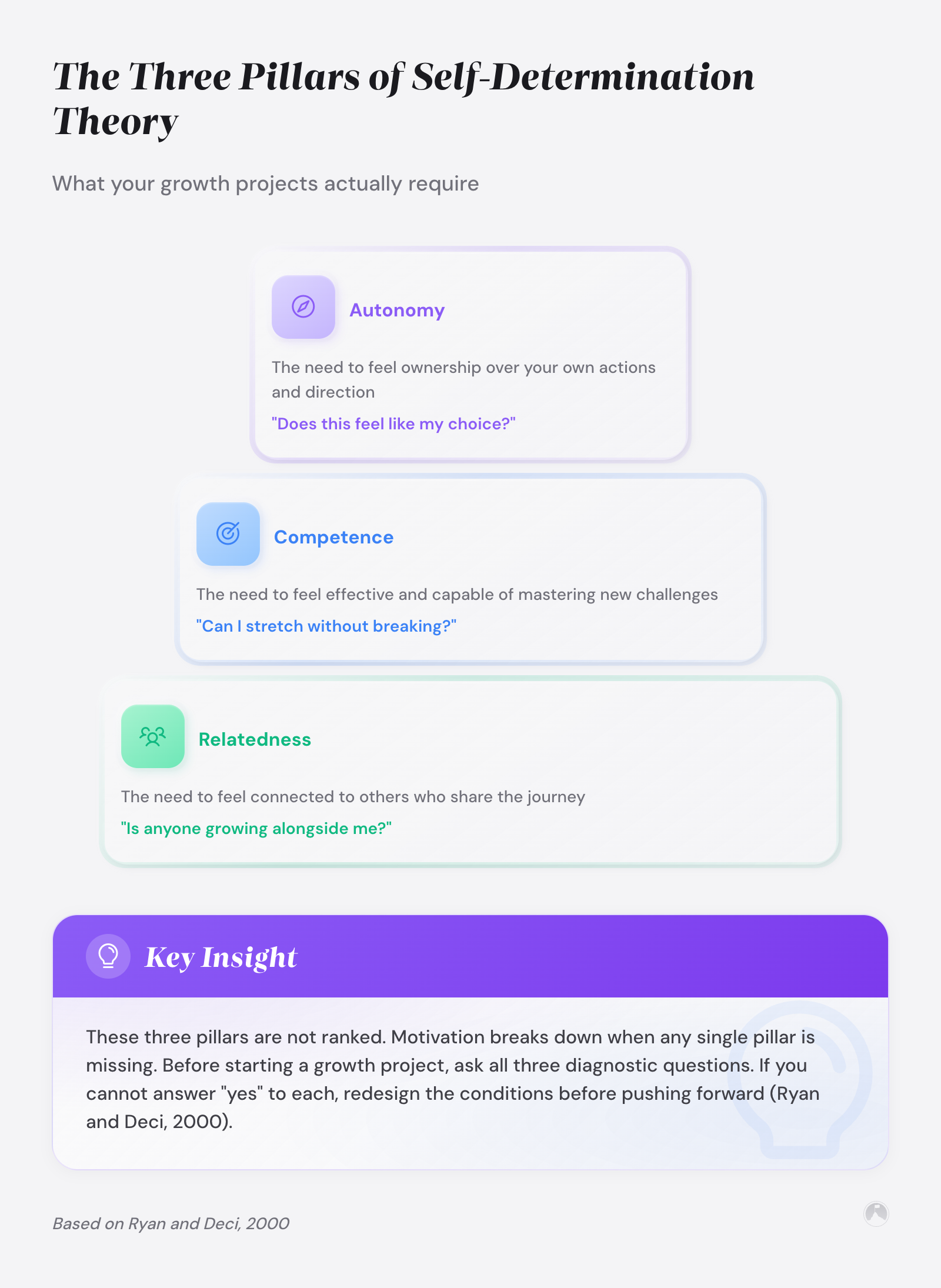
Psychologists Ryan, R. M., and Deci, E. L. built a foundational body of research showing that self-determination theory personal growth depends on satisfying three basic psychological needs – not on increasing discipline [1]. You didn’t fail from not trying hard enough. You failed from pursuing growth under the wrong conditions.
What if the entire willpower framework for personal development is flawed? What if motivation isn’t a resource you exhaust but a signal your conditions are broken?
Self-determination theory (SDT) is a psychological framework developed by Edward Deci and Richard Ryan proposing that human motivation and well-being depend on satisfying three innate needs: autonomy (feeling volitional control over one’s actions), competence (experiencing effectiveness and mastery), and relatedness (feeling connected to others). Unlike willpower-based models, SDT treats motivation as a product of environmental conditions rather than individual effort.
Key takeaways for self-determination theory personal growth
- Self-determination theory identifies autonomy, competence, and relatedness as the three psychological needs driving sustained personal growth.
- Willpower-based development fails because it ignores the environmental conditions that produce lasting motivation.
- Autonomous motivation, where you act from genuine interest, outperforms controlled motivation driven by guilt or obligation.
- A 2025 meta-analysis of 388,912 participants found that need support categories were strongly linked (r = .64 to r = .68) [2].
- The Needs Diagnostic helps identify which unmet need is stalling your development efforts.
- Competence grows through progressive challenge and feedback loops, not perfection.
- Relatedness transforms solitary development into supported growth without requiring external control.
- SDT-based interventions show measurable results, with autonomy support producing large effect sizes in experimental settings.
Why self-determination theory personal growth research reframes failure
Most personal development advice operates on a hidden assumption: if you want something badly enough and apply enough effort, you will get it. The logic seems airtight. Set clear goals. Build habits. Stay disciplined.
And when the discipline fades (which it always does), try harder.
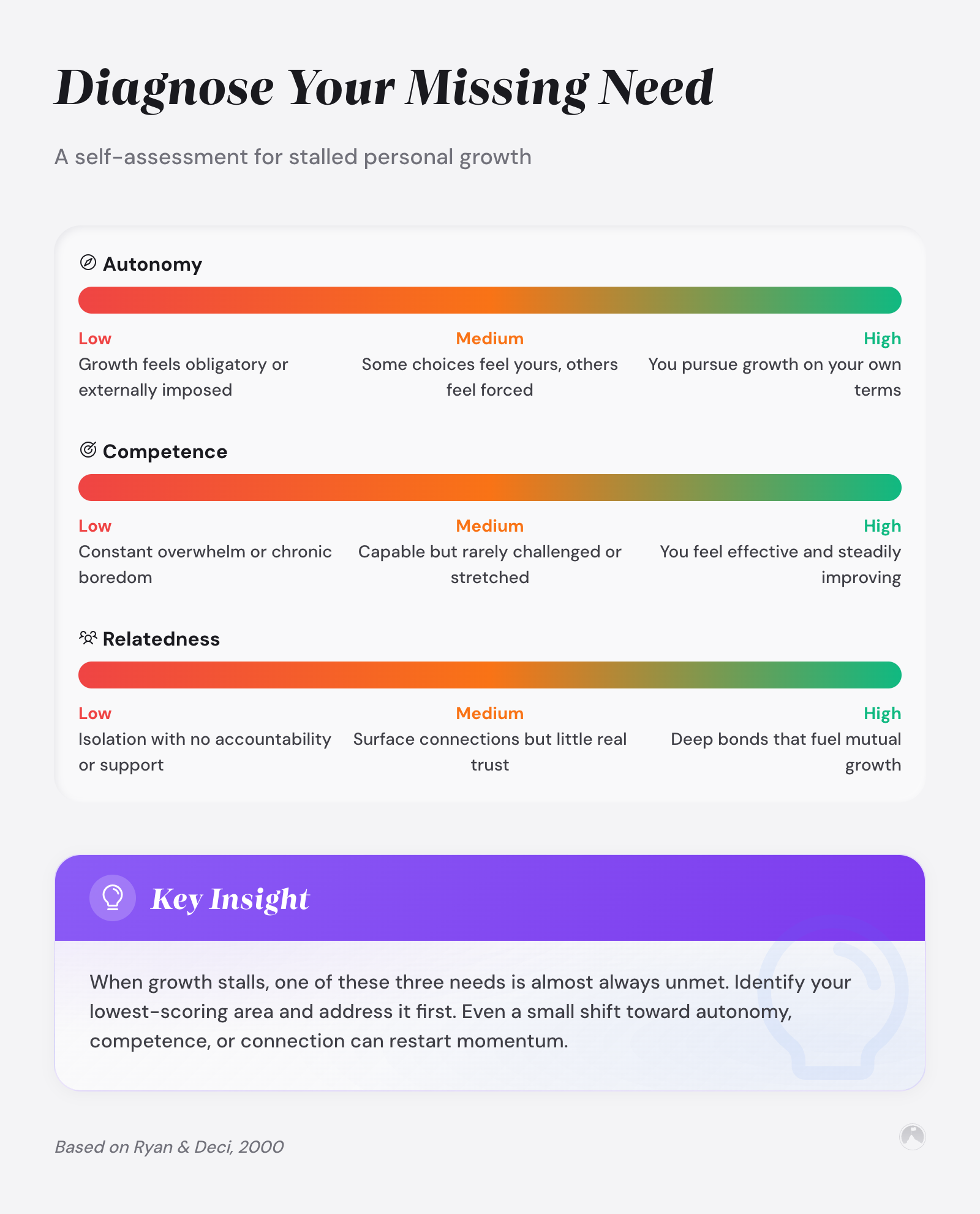
Self-determination theory challenges this at its root. The autonomy, competence, and relatedness psychology that Deci and Ryan developed over four decades shows that the type of motivation matters far more than the amount [1].
A person who exercises from genuine satisfaction will outlast one who exercises from guilt. Both have motivation. But only one has the kind that lasts.
SDT draws a line between autonomous motivation (acting from genuine interest or internalized values) and controlled motivation (acting from external pressure, guilt, or obligation). This distinction between internal versus external motivation is the whole game.
Controlled motivation creates what researchers call “motivational conflict,” where you are simultaneously pushing yourself forward and resisting the push. That conflict exhausts you. It is why your persistence runs out.
(Note: The idea that willpower depletes like a finite fuel, sometimes called ego depletion, has been contested by large-scale replication failures. SDT’s explanation operates through a different mechanism – motivational conflict does not deplete a finite resource but rather produces competing drives that undermine persistence.)
Autonomous motivation is a state where behavior originates from genuine interest, personal values, or inherent satisfaction rather than external rewards or pressures. The drive originates internally rather than from externally imposed consequences.
Howard, Slemp, and Wang’s 2025 meta-analysis pulled together 8,693 effect sizes from 637 samples covering 388,912 participants. They found that relations between autonomy, competence, and relatedness support were very strong, ranging from r = .64 to r = .68 [2].
That is not subtle. Across nearly 400,000 people, the three needs consistently cluster together – when one form of support is present, the others tend to follow.
What we call the Conditions-First Principle – the idea that motivation is a signal about environmental conditions, not a fuel tank to be refilled – reframes every personal development failure.
Personal development built on controlled motivation burns fuel it cannot replenish, which is why discipline-based approaches produce short bursts of effort followed by predictable collapse.
So when your meditation practice collapses after two weeks, the productive question is not “how do I build more discipline?” It is “which of my three psychological needs is this practice failing to satisfy?”
Autonomy: when growth feels like a choice, not a sentence
Autonomy doesn’t mean independence or doing everything alone. In SDT, autonomy means feeling that your actions are volitional – that you are the author of your choices rather than a puppet responding to demands. You can follow someone else’s program and still feel autonomous if you chose that program freely and understand why it matters.
Most personal development structures do the opposite. They are designed to remove autonomy. Rigid 30-day challenges. Non-negotiable daily habits.
Programs that say “do this exact sequence or you are doing it wrong.”
These structures feel safe since they eliminate decisions. But they eliminate ownership too. And without ownership, motivation erodes.
When exploring different development approaches, autonomy support makes the difference between strategies that stick and ones you abandon. Whether you are building personal growth goals that stick or exploring personal development strategies more broadly, autonomy is what transforms external frameworks into personally meaningful pursuits.
“The fullest representations of humanity show people to be curious, vital, and self-motivated. At their best, they are agentic and inspired, striving to learn; extend themselves; master new skills; and apply their talents responsibly.” – Edward Deci and Richard Ryan [1]
Consider two people learning a new language. One signed up for a class after their partner insisted. The other chose to learn so they could read novels in the original language.
Same activity. Same difficulty level. But radically different motivational conditions. The second person sticks longer since the pursuit itself satisfies their need for autonomy.
Autonomy in personal development means choosing what you grow in, how you grow, and why you are growing – even when someone else introduced the idea.
Practical autonomy support looks like choosing between three possible development goals rather than being told which to pursue. Selecting the format that fits your schedule (a book, a podcast, a course) rather than following a prescribed format. Setting your own milestones instead of accepting someone else’s timeline.
The content can come from outside. The choice must come from within. The autonomous motivation benefits compound over time since you are reinforcing ownership with every decision.
Competence: the right kind of hard
Competence in SDT is not about becoming an expert. It is about feeling effective – sensing that you are making progress and that your actions produce results. This explains why personal development efforts die when they are either too easy (no sense of growth) or too hard (no sense of progress). Competence building strategies must thread this needle.
Wang and colleagues’ 2024 meta-analysis of SDT-based interventions in education found that competence support produced a moderate but significant effect size (g = 0.48, p < 0.05), confirming that actively building a person's sense of mastery improves outcomes [4].
But here is the catch: competence doesn’t come from hitting targets. It comes from experiencing the process of getting better.
This is where many personal growth goals go wrong. They set an outcome (lose 20 pounds, read 50 books, earn a certification) without building in feedback on progress. The person pursuing the goal has no way to feel competent during months of effort before the outcome is reached. So they quit – not from a lack of discipline, but from a lack of evidence that they are improving.
Progressive challenge is the practice of incrementally increasing difficulty in a development activity so the individual consistently operates at the edge of current ability. It maintains the optimal zone where effort produces visible improvement.
Building competence into your development means designing for progressive challenge. Start a writing practice at 200 words a day, not 1,000. Learn three guitar chords before tackling a song. The point is not to go slow. The point is creating a chain of visible progress where each step makes the next feel achievable. This mirrors the thinking behind comparing development frameworks like kaizen and GROW, which both emphasize incremental improvement and visible progress over big leaps.
Competence doesn’t require reaching the goal. Competence requires perceiving progress toward the goal, which is why feedback loops matter more than finish lines.
Relatedness: growth is not a solo sport
Relatedness is the need that personal development culture most consistently gets wrong. The dominant narrative celebrates the lone self-improver – the person who wakes before everyone else, grinds in silence, and lets results speak for themselves. SDT research suggests this narrative actively undermines sustained growth.
The need for relatedness and personal development go hand in hand. Growth efforts sustained by social connection outperform isolated ones.
Koole, Schlinkert, Maldei, and Baumann published an integrative review examining how self-determination theory and personality systems interact, finding that SDT proposes the person, supported by the social environment, naturally moves toward growth through satisfying basic psychological needs [3].
This is why accountability partners work better than punishing yourself, why group coaching outperforms solo reading, and why the meditation practice you do with a friend survives longer than the one you do alone. Relatedness doesn’t create external pressure (that would undermine autonomy). It creates a context where growth feels shared rather than solitary.
Consider finding a mentor or coaching relationship – these connections satisfy relatedness while preserving your autonomy.
“Need satisfaction and autonomous motivation are positively associated with well-being indicators and negatively associated with depression across lifespan populations.” – Tang, Wang, and Guerrien, from their 2020 meta-analysis of basic psychological needs in older adults [5]
Satisfying relatedness in personal development looks different from socializing. It means finding someone who understands what you are working on. Sharing your progress (not performance) with someone who cares.
Joining a learning community where people are at different stages of the same pursuit. The goal is not external accountability. It is belonging.
Relatedness transforms personal development from a test of individual willpower into a shared pursuit, which is why isolated growth efforts fail at higher rates than connected ones.
How to diagnose which need is missing
Understanding the three needs is useful. But real value comes from using SDT as a diagnostic tool for basic psychological needs fulfillment. When a development effort stalls, one of the three needs is almost certainly being undermined. The question is which one.
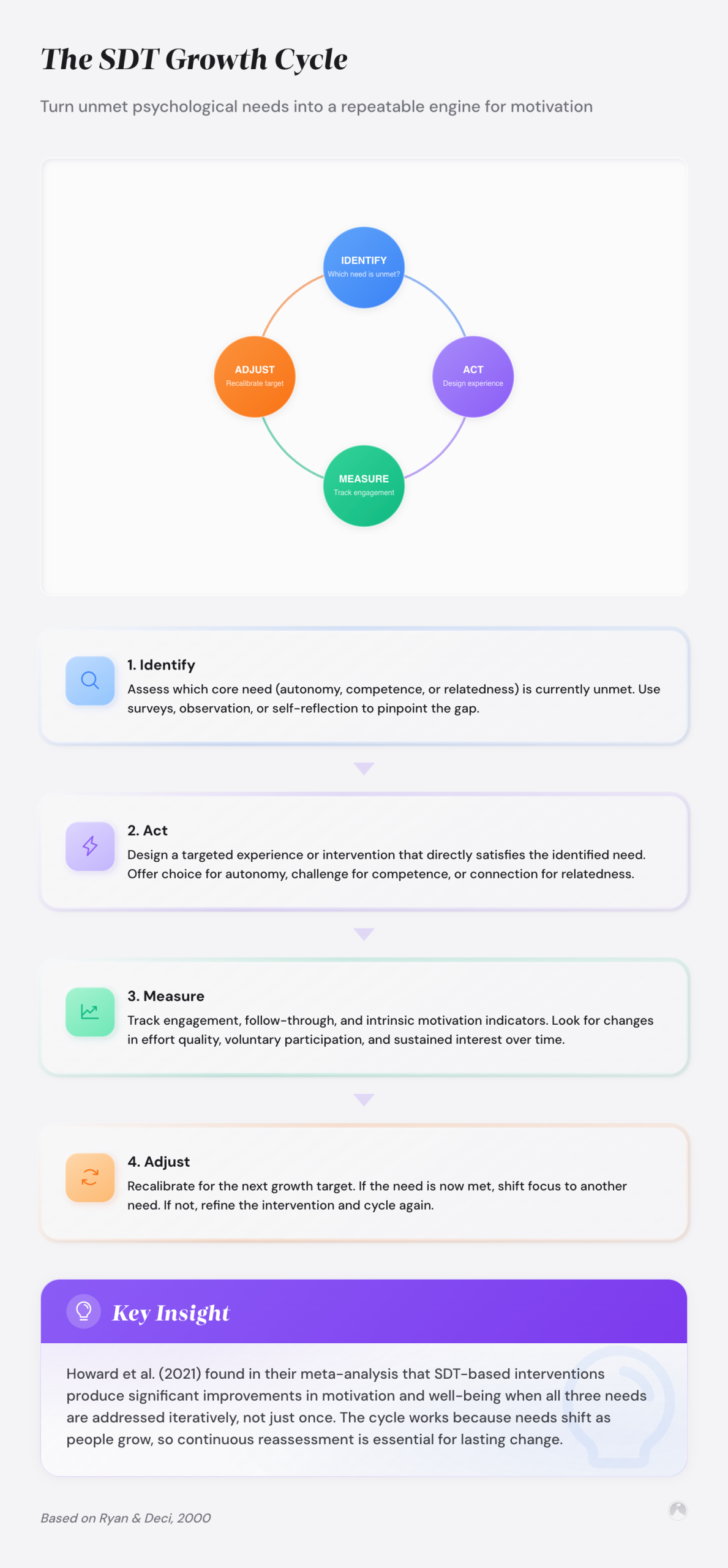
Here is a practical filter that keeps showing up in research on psychological needs and growth. Three questions, asked in order, about any development effort that feels stuck.
Needs Diagnostic is a three-question assessment framework for identifying which of the three SDT psychological needs – autonomy, competence, or relatedness – is undermined in a stalled development effort. It shifts troubleshooting from individual blame to structural gap analysis.
We call this the Needs Diagnostic – our framework for pinpointing the psychological bottleneck in stalled development.
1. Autonomy check: “Did I choose this goal, or was it imposed by someone else’s expectations?”
If the answer is “imposed,” the fix is reframing: find the aspect of the goal that genuinely connects to your values, or replace the goal entirely.
2. Competence check: “Can I see progress, or does this feel like running in place?”
If the answer is “running in place,” the fix is structural: add feedback loops, break the goal into smaller stages, or reduce difficulty until you can see yourself improving.
3. Relatedness check: “Am I pursuing this alone, or does someone else know and care about this effort?”
If the answer is “alone,” the fix is connection: tell one person what you are working on, find a community, or pair up with someone on a similar path.
The Needs Diagnostic works by shifting troubleshooting from “what is wrong with my motivation?” to “what is wrong with my conditions?” That reframe alone changes the trajectory. Instead of blaming yourself for quitting, you identify the structural gap and fix it.
Most stalled development efforts fail on exactly one of the three needs, which means the fix is usually one structural change, not a complete overhaul.
If you are exploring different self-determination theory applications, SDT offers a unifying lens for personal development strategies. It explains why comparing kaizen and GROW frameworks matters (progressive challenge satisfies competence). It explains why crafting a personal mission statement helps (value alignment supports autonomous motivation). And it explains why you might explore personal development for introverts to find approaches calibrated to your energy and social context.
What the research shows about SDT-based interventions
Theory is one thing. Evidence is another. SDT has been tested across education, healthcare, sports, work, and personal development contexts. The results are consistent enough to be actionable.
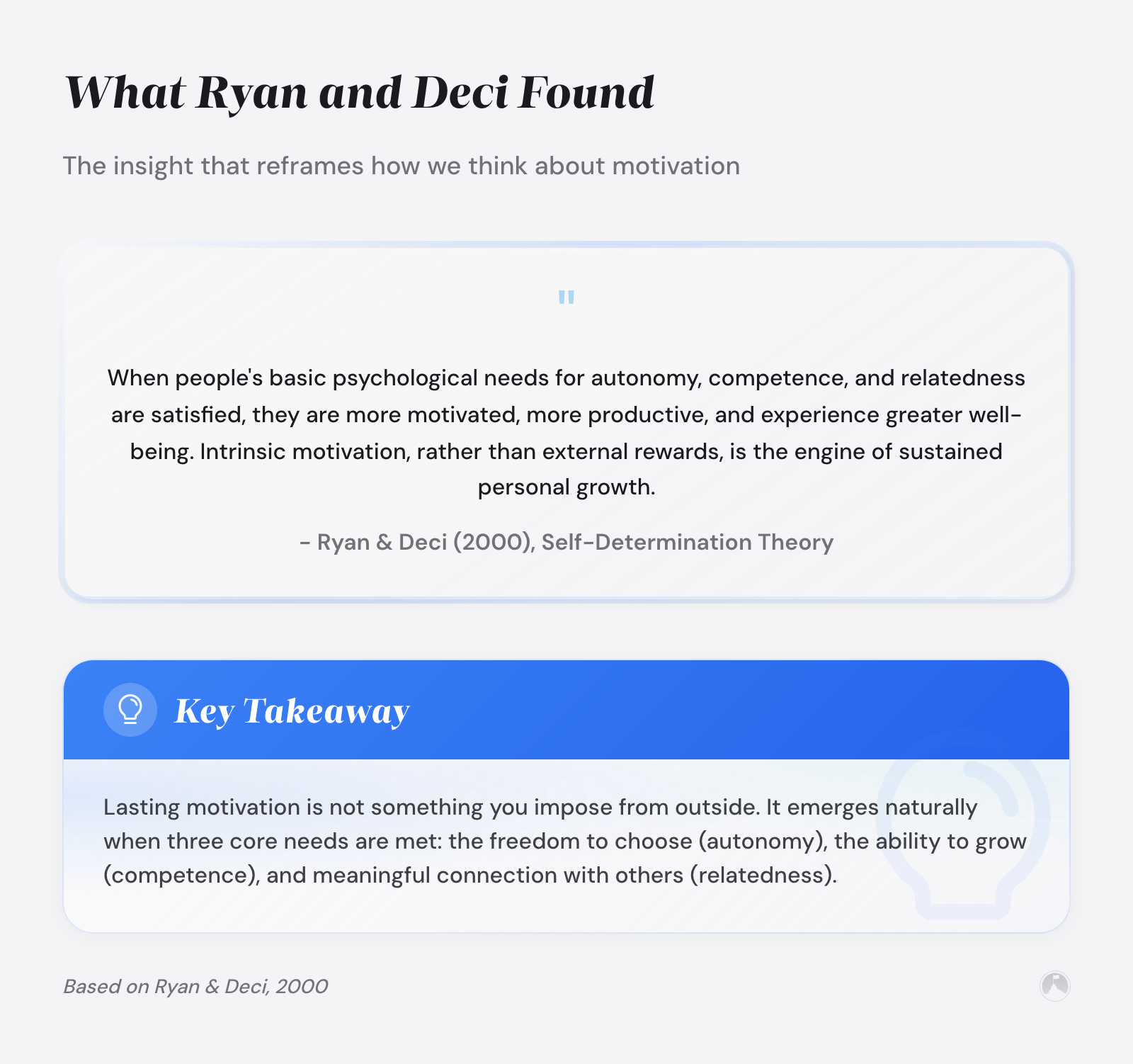
Wang and colleagues’ 2024 meta-analysis found that SDT-based interventions supporting autonomy produced large effect sizes (g = 1.14, p < 0.0001) in experimental settings [4]. That is substantial. Actively designing environments that support autonomy doesn't just feel better. It produces measurably better outcomes.
These findings strengthen the case for intrinsic motivation for development over forced discipline.
Across the lifespan, the pattern holds. Tang, Wang, and Guerrien’s 2020 meta-analysis found that basic psychological need satisfaction was positively associated with well-being and negatively associated with depression in older adults [5]. So SDT is not a framework for young achievers. It applies to personal development at any life stage.
And the connection between need satisfaction and identity development adds another layer. Koole and colleagues’ integrative review found that SDT proposes the person naturally moves toward growth through satisfying autonomy, competence, and relatedness needs, suggesting that SDT-compatible development helps people become more authentically themselves [3].
The following table summarizes the key evidence supporting SDT-based personal development:
| Evidence | Finding | Practical implication |
|---|---|---|
| Howard, Slemp, and Wang meta-analysis of 388,912 participants [2] | Need support categories strongly linked (r = .64 to r = .68) | Design development activities where you choose the method |
| Wang et al. SDT intervention meta-analysis [4] | Autonomy support: large effect (g = 1.14) | Restructuring environments beats pushing harder |
| Tang, Wang, and Guerrien lifespan meta-analysis [5] | Need satisfaction linked to well-being at every age | These principles don’t expire; adapt them as life changes |
| Koole and colleagues integrative review [3] | Need satisfaction supports authentic identity development | SDT-compatible growth contributes to becoming more yourself |
The evidence for self-determination theory personal growth is not theoretical speculation. It is empirical data from hundreds of studies spanning decades and populations.
Ramon’s take on self-determination theory and growth
The relatedness piece gets skipped in every growth plan I’ve seen. People go it alone and wonder why they quit. Find one person working on something similar and just check in with them weekly. Seriously, that’s probably it.
Conclusion
Self-determination theory personal growth research points to a conclusion that should change how you approach development: motivation is not a fuel tank that runs dry. It is a signal.
When motivation fades, your autonomy, competence, or relatedness needs are going unmet. The fix is not more discipline. The fix is redesigning the conditions of your pursuit so those needs are satisfied by default.
Most people who learn about SDT make one mistake: they try to optimize all three needs simultaneously. That misses the point of the Needs Diagnostic. The bottleneck is almost always one need, not three. Identify the single unmet need, make one structural change, and let momentum build before addressing the others.
The person who grows is not the one with the most discipline. The person who grows is the one whose conditions make discipline unnecessary.
Next 10 minutes
- Pick one development effort that recently stalled and run it through the Needs Diagnostic: did you choose it freely, can you see progress, and does someone know you are working on it?
- Identify which of the three needs (autonomy, competence, relatedness) is least satisfied in that effort.
This week
- Make one structural change to your stalled effort that addresses the unmet need: reframe the goal to connect with your values (autonomy), add a visible progress marker (competence), or tell one person about your effort (relatedness).
- Notice whether the motivation shift feels different from “trying harder.” That difference is the whole point.
Related articles in this guide
- self-paced-vs-structured-personal-development
- best-personal-development-apps-and-resources
- building-a-daily-learning-habit
FAQ
What is self-determination theory?
Self-determination theory is a psychological framework by Deci and Ryan proposing that motivation and well-being depend on satisfying three psychological needs: autonomy, competence, and relatedness. Unlike willpower-based models, SDT treats motivation as driven by environmental conditions rather than individual effort. First published in foundational form in the 1985 book Self-Determination and Intrinsic Motivation in Human Behavior, SDT has since been tested in thousands of studies across more than six continents.
Why does autonomy matter in personal development?
Autonomy means feeling that actions are volitional and that one is the author of one’s choices. Personal development efforts fail when autonomy is removed through rigid structures. In healthcare settings, for example, SDT research shows that patients given autonomy in treatment decisions demonstrate significantly better medication adherence than those following rigid protocols – a finding that generalizes well to self-directed growth. Supporting autonomy means choosing goals, methods, and timelines, even when someone else introduced the idea.
What is the difference between autonomous and controlled motivation?
Autonomous motivation comes from genuine interest or personal values. Controlled motivation comes from external pressure, guilt, or obligation. Autonomous motivation produces better outcomes and persistence because it does not create motivational conflict. This is why guilt-driven discipline always eventually fails. Research across education, health, sport, and work contexts consistently shows that autonomous motivation predicts better well-being and longer-term behavior change than controlled motivation.
How does competence support affect personal growth?
Competence does not mean becoming an expert. It means feeling effective and seeing progress. Development efforts fail when they are too easy (no growth) or too hard (no visible progress). One underused technique for building competence is the mastery journal – a daily log where you record the single most concrete skill or insight gained that session. This creates a physical record of accumulation that counteracts the perfectionist tendency to track gaps rather than growth.
Does relatedness mean I need an accountability partner?
Not necessarily. Relatedness means growth efforts sustained by social connection outperform isolated ones. Research on online learning communities suggests that even digital relatedness – participating in an asynchronous forum or sharing progress in a group chat – provides measurable motivation benefits compared to purely solitary practice. The goal is belonging, not external accountability. One person who understands what you are working on is often enough.
What is the Needs Diagnostic?
The Needs Diagnostic is a three-question framework to diagnose why development efforts stall. Ask: Did I choose this goal freely (autonomy)? Can I see progress (competence)? Does someone know and care about this effort (relatedness)? For example, someone who abandons a language-learning app might run the Needs Diagnostic and discover the app was recommended by a manager (undermined autonomy), not that they lacked willpower. One structural fix – choosing a different learning format they actually wanted – often restores momentum immediately.
Is self-determination theory supported by research?
Yes. A 2025 meta-analysis of 388,912 participants found that need support categories were strongly linked (r = .64 to r = .68). SDT-based interventions supporting autonomy produced large effect sizes (g = 1.14) in experimental settings. The research spans decades, multiple countries, and diverse populations including children, adults, healthcare patients, athletes, and employees – making SDT one of the most extensively tested motivation frameworks in psychology.
References
[1] Ryan, R. M., and Deci, E. L. “Self-Determination Theory and the Facilitation of Intrinsic Motivation, Social Development, and Well-Being.” American Psychologist, 55(1), 68-78, 2000. https://doi.org/10.1037/0003-066x.55.1.68
[2] Howard, J. L., Slemp, G. R., and Wang, X. “Need Support and Need Thwarting: A Meta-Analysis of Autonomy, Competence, and Relatedness Supportive and Thwarting Behaviors in Student Populations.” Personality and Social Psychology Bulletin, 51(9), 1552-1573, 2025. https://doi.org/10.1177/01461672231225364
[3] Koole, S. L., Schlinkert, C., Maldei, T., and Baumann, N. “Becoming Who You Are: An Integrative Review of Self-Determination Theory and Personality Systems Interactions Theory.” Journal of Personality, 87(1), 15-36, 2019. https://doi.org/10.1111/jopy.12380
[4] Wang, Y., Wang, H., Wang, S., Wind, S. A., and Gill, C. “A Systematic Review and Meta-Analysis of Self-Determination-Theory-Based Interventions in the Education Context.” Learning and Individual Differences, 2024. https://doi.org/10.1016/j.lindif.2024.102428
[5] Tang, M., Wang, D., and Guerrien, A. “A Systematic Review and Meta-Analysis on Basic Psychological Need Satisfaction, Motivation, and Well-Being in Later Life: Contributions of Self-Determination Theory.” PsyCh Journal, 9, 5-33, 2020. https://doi.org/10.1002/pchj.293