Goals & Progress


A recovery planner setback tool that meets you where you actually are
Describe what went wrong, rate how far off track you are, and share your current energy level. This recovery planner setback tool generates a phased comeback plan with a 24-hour first action calibrated to where you actually are, not where you think you should be.
Describe your setback below and your recovery plan generates instantly.
Things went off track. That is real, and it matters. This tool will help you find a way back in that fits where you are right now.
No need for a detailed breakdown. A few honest sentences about what went off track is enough. This stays between you and this page.
There is no wrong answer. Knowing where you stand helps calibrate a realistic re-entry.
Roughly how long has it been since you were consistently following through? An estimate is fine.
Whatever you are feeling is a valid response. Naming it helps us match the right approach for getting back on track.
Be honest rather than aspirational. The plan will meet you where you actually are, not where you think you should be.
What actually happened
Your adjusted timeline
3-step re-entry protocol
What to Tell Yourself
Your revised goal
Your re-entry card
Keep this somewhere visible. It has everything you need for the next step.
What this tool solves
Two patterns make recovery harder than the original setback itself. The first is the shame spiral: you missed a few days, felt bad about it, avoided thinking about the goal, missed more days, felt worse. By the time you surface, weeks have passed and the gap feels impossibly wide. Shame compounds faster than progress. The second is all-or-nothing restarting: you decide to pick up exactly where you left off, at full intensity, on a Monday. The ambition collapses under its own weight within 48 hours.
This tool interrupts both patterns. It names what happened without judgment, resets the timeline to a realistic starting point, and gives you a first action small enough to actually do today. Momentum is built from the next step, not from where you should have been. The cognitive reframes it surfaces are matched to your specific emotional state, so they address the actual barrier rather than offering a generic motivational nudge.
If you have ever restarted a goal four times in a month without making it past day three, this tool is designed for that exact problem. It treats restart fatigue as a real thing and plans accordingly.
See the tool in action
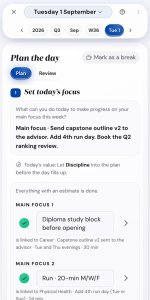
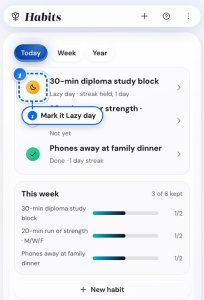
These screenshots show a real walkthrough with a running injury setback. You can see how each step builds toward the final recovery plan.


The four recovery phases your plan is built around
The tool structures your recovery into four overlapping phases. Each phase has a different purpose, and each transitions naturally into the next as your capacity rebuilds.
Phase 1: Today through day 2 (stabilize)
This phase is about one thing: doing something small enough that it counts. The bar is intentionally low because crossing it is the whole point. A ten-minute walk. Writing three sentences in a journal. Sending one email you have been avoiding. The action itself is almost irrelevant. What matters is that you broke inertia and have evidence that you can move again. Most people skip this phase and jump to phase three, which is why they cycle back to square one within a week.
Phase 2: Days 3 through 5 (re-establish rhythm)
Once you have two consecutive days of the small action, you begin rebuilding the cue-routine loop. This is not the phase for full intensity. It is the phase for consistency at a reduced level. A habit at 40% beats a plan at 100% that gets abandoned on day two. The tool will suggest a specific rhythm based on how long you were inactive. Someone who lapsed for three weeks gets a gentler re-entry curve than someone who missed four days.
Phase 3: Days 6 through 10 (rebuild confidence)
By day six, you have a small track record. The goal of this phase is to convert that track record into self-efficacy: the belief that you can actually do this. Your plan will include a progress marker you can check on day 10 to confirm you are in a stable restart rather than another false start. Confidence is not a prerequisite for action. It is a byproduct of it. This phase is where you start to believe the recovery is real.
Phase 4: Week 2 and beyond (recalibrate the goal)
The final phase revisits the original goal and asks whether it still fits. Sometimes the setback revealed something important: the goal was someone else's, the timeline was unrealistic, or circumstances have genuinely changed. Persisting toward the wrong goal is not resilience, it is stubbornness. The tool's revised goal output gives you a starting point for this conversation with yourself. You can accept it, adjust it, or use it as a prompt to set something entirely new.
The research behind recovery planner setback tools
The recovery framework draws on three overlapping bodies of research. Kristin Neff's self-compassion work shows that people who respond to failure with self-kindness rather than self-criticism are more likely to try again and persist longer. This is counterintuitive. Most people assume being hard on themselves is what keeps them accountable. The data says otherwise: self-criticism activates the threat system and reduces motivation, while self-compassion activates the care system and sustains it.
Habit relapse prevention research, originally developed in addiction recovery contexts, finds that a lapsed habit requires significantly less effort to re-establish than forming a new one. The neural pathway exists. You are not starting from zero. You are re-activating something that was already there, which changes the psychological framing of the restart entirely.
Implementation intention research by Peter Gollwitzer shows that specifying a precise "when, where, what" for a planned behavior roughly doubles follow-through. Vague intentions fail; concrete next actions stick. The 24-hour first action and 48-hour re-entry card are direct applications of this finding. The tool gives you the specific action because specificity is what converts intention into behavior.
Who gets the most from this tool
This tool works best for people who have already tried to restart and found themselves stopping again within days. If you are stuck in a loop of guilt, good intentions, and short-lived restarts, the phased structure here is designed specifically for that pattern.
It is also well suited for people who tend toward all-or-nothing thinking. If your internal rule is "I either do it perfectly or I start over," the tool actively challenges that framing and builds in explicit permission to re-enter at reduced capacity.
You will find it useful if you are recovering from any of these situations:
- A health or fitness goal interrupted by injury, illness, or burnout
- A creative or learning goal that stalled after a confidence hit
- A financial or career plan disrupted by circumstances outside your control
- A relationship or personal goal that lost momentum after a difficult period
- A work project where a missed deadline or bad outcome left you avoiding the whole area
It is less suited for people who are in genuine crisis or who need professional support. The tool addresses goal recovery, not grief, trauma, or mental health treatment. If what you are going through feels larger than a planning problem, the right next step is a conversation with someone qualified to help.
Related articles
These guides go deeper on the underlying problems this tool addresses.
- When Plans Fall Apart covers the research on why plans derail and what structured recovery actually looks like across different goal types.
- When Goal Tracking Hurts examines how measurement systems can backfire and create the shame spiral that makes restarts harder.
- Overcoming Perfectionism Guide addresses the all-or-nothing pattern at its root, with practical reframes and exercises for people who cycle through high-ambition restarts.
- Resilience burnout prevention - Explains burnout as measured depletion across three dimensions and lays out a layered defense, useful background when energy is the limiting factor in a comeback.
- Never Miss Twice - Shows why one broken streak ends habits and gives a three-state rule for bouncing back after a missed day instead of quitting.
Does the tool save my answers anywhere?
No. Everything you enter stays in your browser session. Nothing is sent to a server, stored in a database, or connected to an account. When you close the tab, the session ends. You can print or screenshot your recovery plan if you want to keep it.
What if I am not sure which emotion fits?
Pick the closest one. The tool is not diagnosing you; it is trying to calibrate its language and reframes to something in the right neighborhood. Frustrated and disappointed produce slightly different outputs, but both will give you a useful plan. If none feel accurate, choose the one that feels least wrong.
Can I use this more than once for the same goal?
Yes, and that is actually expected. Recovery rarely happens in a single straight line. If you restart, make progress, slip again, and need to re-enter, run through the tool again. Each session is independent and you may find your answers have shifted in useful ways since the last time.
What if my energy is genuinely very low right now?
Select Low and be honest about it. The tool generates a first action calibrated to that energy level, which may be as small as a two-minute task or a single decision. Meeting you at low energy is a feature, not a workaround. A plan that fits your current capacity has a real chance of working.
How is this different from just writing in a journal?
A journal captures what happened. This tool converts what happened into a structured plan with a phased timeline, specific first actions, and cognitive reframes matched to your emotional state. The structure is what makes it actionable. You can absolutely journal about your setback first and then use this tool to build the recovery path.
Will the plan work if I am recovering from something serious?
The tool is designed for goal recovery, not crisis support. If your setback involves significant loss, trauma, mental health challenges, or medical concerns, it may provide some useful framing, but it is not a substitute for professional guidance. Use it as a practical planning aid once you have the support you need.
Is my data private and secure?
Yes. All information you enter stays in your local browser storage. Nothing is shared with, processed by, or saved on the Goals and Progress servers or any third-party provider. The trade-off is that clearing your browser cache will erase your data. Some tools include a save and load function so you can export your inputs as a local file and reload them later.
Ready to build your recovery plan?
The tool is free, takes under two minutes, and requires nothing from you except honesty. The setback already happened. The only question now is what the next step looks like. Scroll back up to the tool, describe what went off track, and let the plan do the rest. You do not have to feel ready. You just have to start.