
The perfectionist’s shipping problem
You’ve spent three weeks on a project that could have shipped in five days. You’ve rewritten the same email five times. You’ve postponed launching because the timing wasn’t “perfect.” This isn’t laziness or lack of ambition. You’re caught between two incompatible goal types, and nobody’s taught you the distinction.
Progress-focused work ships incrementally better versions. Perfection-focused work chases flawless outcomes. The first compounds. The second paralyzes. A scoping review in Frontiers in Psychiatry found that maladaptive perfectionism – specifically concern over mistakes and fear of failure – is consistently associated with procrastination and task delay [1]. And Eric Ries’ Lean Startup methodology demonstrates the flip side: teams that release early and iterate based on user feedback outperform teams that polish internally before shipping [2]. The imperfect version users actually see outperforms the perfect version you never ship. The solution isn’t to lower your standards. It’s to change how you structure your goals around incremental improvement rather than flawless completion.
Progress over perfection practices are daily structural habits that replace open-ended quality pursuit with time-boxed, feedback-driven iteration cycles. Unlike growth mindset (a belief orientation) or organizational kaizen (a management system), these practices impose external stopping points – timers, shipping deadlines, feedback checkpoints – that prevent perfectionist expansion. Each practice takes less than 15 minutes to implement and coexists with real quality standards.
What you will learn
- The psychological difference between the progress not perfection mindset and perfection goals, and why it matters for overcoming perfectionism
- Five concrete daily practices you can implement under 15 minutes each to start shipping work faster
- How to identify the smallest step that still moves work forward
- Why iteration over perfection actually protects your standards long-term
- How to maintain real standards in high-stakes environments
Key takeaways
- Progress goals focus on incremental improvement; perfection goals demand flawless outcomes – only one is psychologically achievable.
- The Minimum Viable Action (MVA) practice: identify the tiniest step that advances work, set a 5-minute timer, ship it before overthinking starts.
- Time-boxing forces a completion point; perfectionism thrives in open-ended work with no deadline pressure.
- Early feedback loops prevent the isolation-perfecting trap where you refine work for hours without external input.
- Progress tracking (wins journaled daily) increases goal achievement by making accumulation visible instead of gaps.
- Quality and progress coexist when you set clear standards upfront, gather feedback during work, and ship for real-world testing.
The core distinction: progress goals vs perfection goals
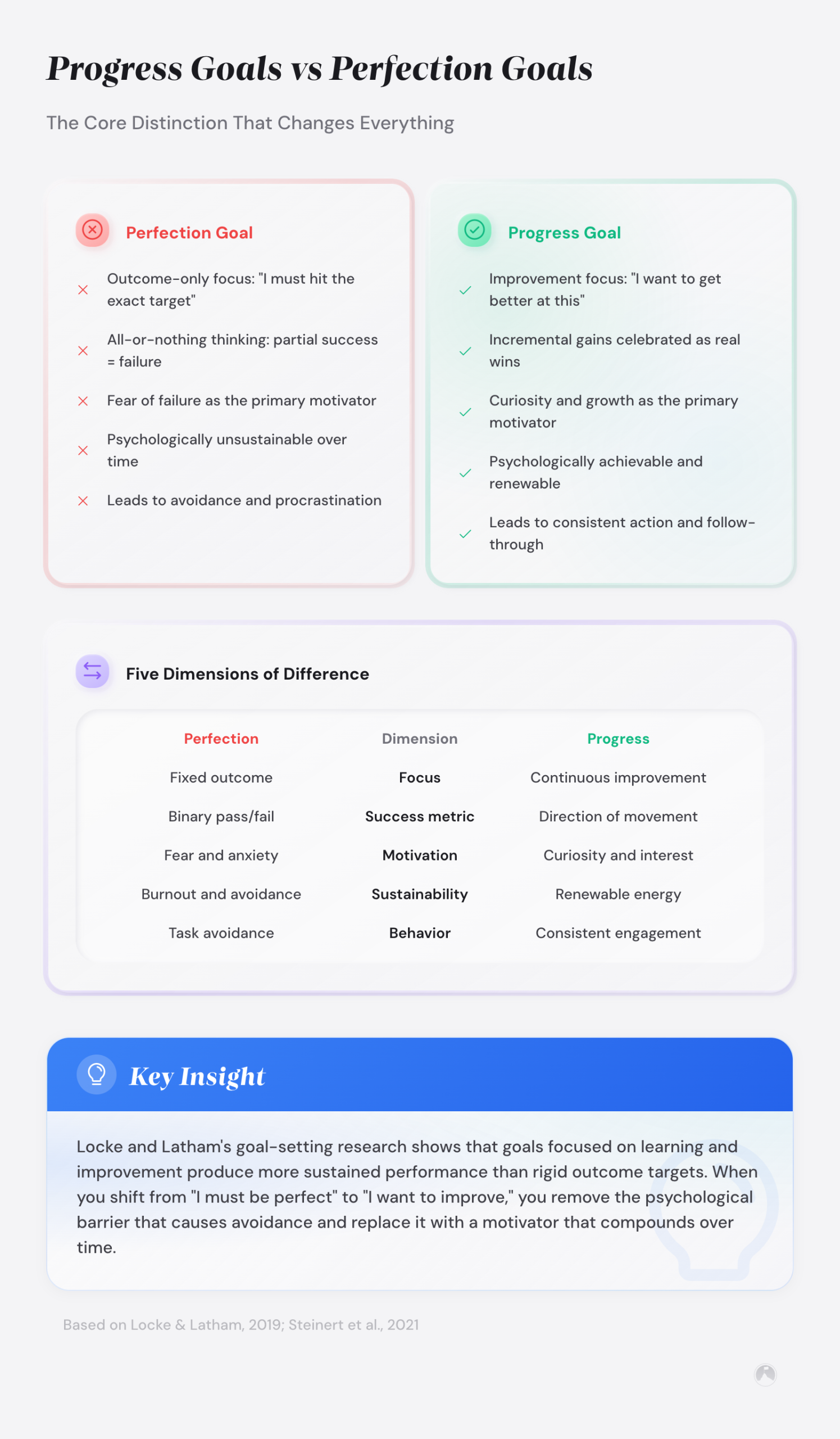
Most people use these terms interchangeably, but they’re architecturally different. A progress goal asks: “Am I better today than yesterday?” This is always answerable. A perfection goal asks: “Is this flawless?” This is rarely answerable because “flawless” is undefined and contextual.
Goal-setting research by Locke and Latham reveals why this distinction matters so much. Process goals – focused on incremental improvement – produce strong effects on performance, while outcome goals create binary success-or-failure psychology [3]. This explains why “getting to flawless” drains motivation while “incrementally improving” builds it. The stopping point is the leverage. You can set a ship date, a quality threshold, or a time-box. All external anchors that perfectionism can’t move.
Perfection goals are outcome-focused and psychologically binary: success (flawless) or failure (anything less). Research on perfectionism confirms this pattern. Maladaptive perfectionism – specifically concern over mistakes and doubt about actions – is linked to procrastination and task delay [1]. When your brain has spent weeks chasing a binary outcome, it will find every flaw and lock the ship button. The goal structure itself doesn’t permit shipping.
The practices below work because they force a progress-goal structure onto work that would otherwise follow perfection-goal logic.
The five practices: progress over perfection in action
These aren’t willpower tips or mindset affirmations. They’re architectural changes to how you work. Each one creates a stopping point that perfection can’t negotiate.
Practice 1: The Minimum Viable Action (MVA)
The Minimum Viable Action is the smallest step that advances work forward while staying in your craft domain. For writers, it’s a messy outline. For engineers, it’s a working prototype that fails gracefully. For designers, it’s a low-fi mockup. The MVA is not the final version – it’s the version that proves the direction works.
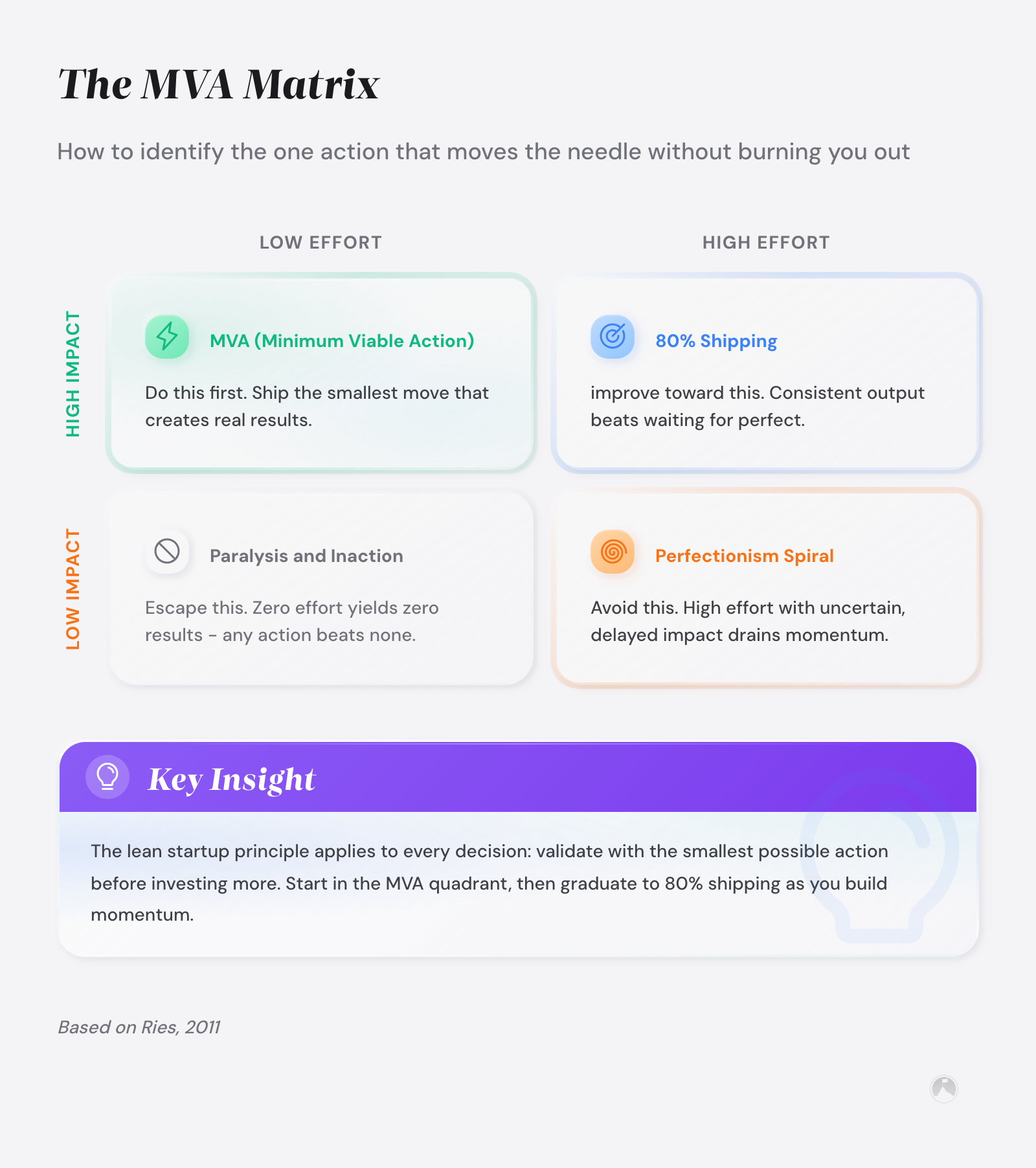
Before starting work, define your MVA explicitly. Write it down. Make it smaller than you’re comfortable with.
The instinct to expand it is perfectionism whispering that you need to do more. You don’t. You need to ship something – anything – that moves the work forward.
Set a timer for 5-15 minutes. Work only on the MVA. When the timer ends, you stop. This feels wrong because perfectionism has trained you to keep refining. You push past discomfort. You ship anyway.
This mechanism is core to the Lean Startup methodology, where teams gather maximum learning with minimum effort by releasing MVPs early and iterating based on user feedback [2]. Shipping the MVA – getting it out of your head and into the real world – generates external input that clarifies the next step better than internal polishing would. You’ve moved from solo-perfecting to feedback-iterating in 15 minutes. The messy shipped version teaches you more than the polished unshipped version.
Practice 2: Time-boxing and the 80% shipping rule
Perfectionism thrives in open-ended work. When there’s no external pressure to finish, your standards expand without limit. Time-boxing creates the pressure that forces completion, and the research on goal types explains why: process goals (like “ship at 80%”) drive performance far more than open-ended perfection goals (like “until it’s flawless”) [3]. The timer creates a process goal. The open end creates a perfection goal.
The practice is simple: set a work window (25-90 minutes depending on task complexity), commit to shipping when the timer ends regardless of perfection, and ship at 80% quality.
The 80% threshold represents the point where the work is shippable and deployable – where a reasonable colleague would say “this is ready for feedback.” It’s not “good enough to fool people.” It’s “good enough that real users can interact with it and give feedback.” You’re not lowering your standards. You’re measuring them differently – by shipability, not imagined flawlessness.
In practice: you write, edit once, check for clarity, then ship the document. You design three iterations maximum, then hand off to stakeholders. You code features, test them with users, then refine based on what breaks. This is iterative, not sloppy. And if you’re looking to build systems that beat perfectionism more broadly, time-boxing is the foundation.
Practice 3: The messy first draft ritual
Perfectionists get stuck at the beginning. The first sentence can’t be written until it’s perfect, which means it’s never written at all. The Messy First Draft ritual breaks this by separating creation from evaluation.
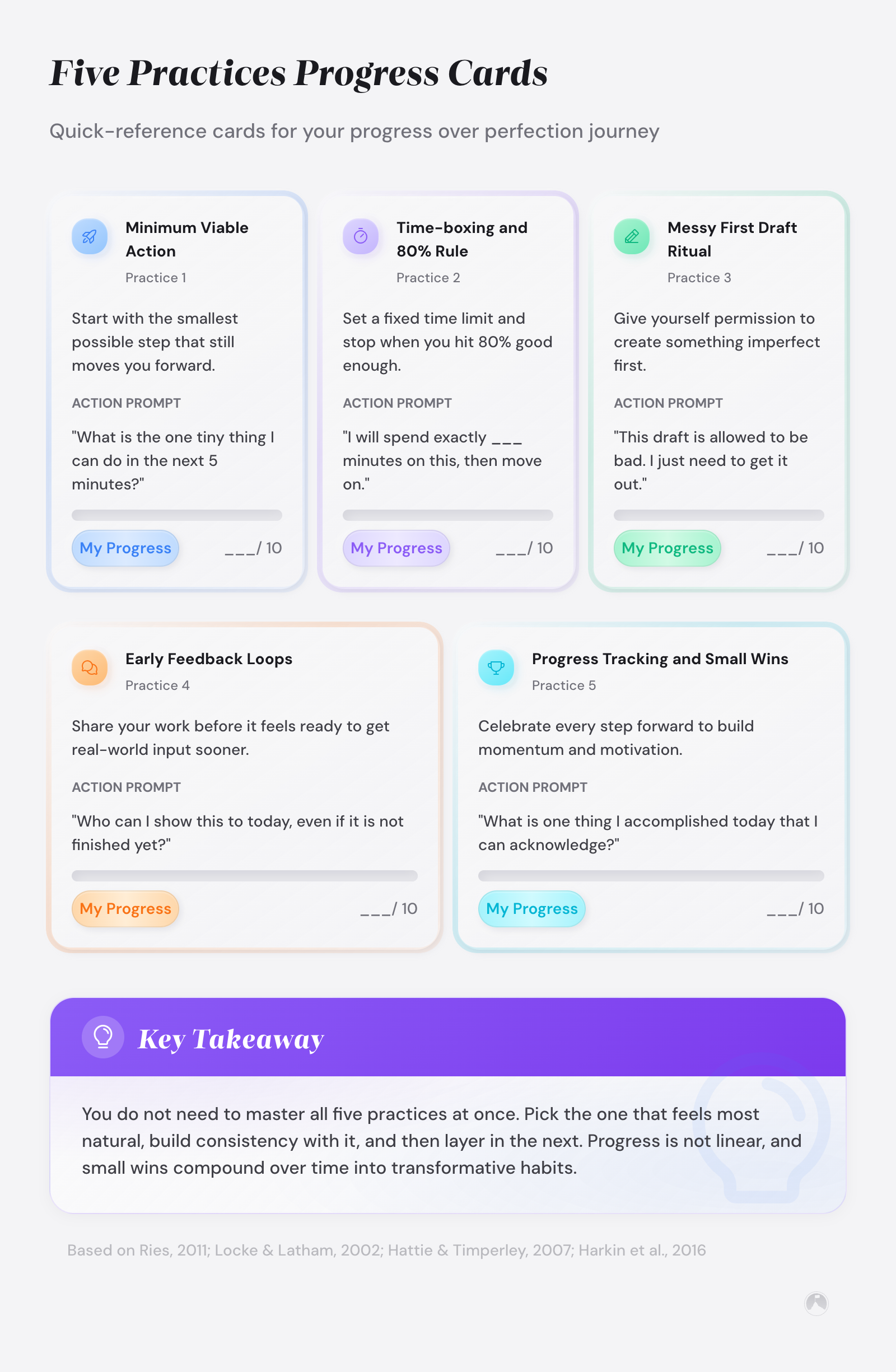
Set 15 minutes. Create with the explicit goal of being bad. Write garbage sentences. Make ugly sketches. Don’t edit. Don’t second-guess.
Quantity over quality. When time ends, you have a first draft – messy, but existent.
Research on creative process stages suggests that drafting and editing engage competing cognitive modes. When both run simultaneously, paralysis results. Separating the drafting phase from the editing phase removes the internal judge and frees generative output [4].
This works because it decouples the drafting phase (creative, fast, messy) from the editing phase (critical, slow, clean). Many creatives know this intellectually but don’t ritualize it. The 15-minute timer and the explicit “be messy” instruction give you permission to break perfectionism’s rules. Creation and criticism use different brain states. Don’t force them into the same window.
Practice 4: Early feedback loops
Perfectionism hides in isolation. You refine work alone, unobserved, until you’ve addressed every imagined flaw. A common design practice holds that sharing work while it is still directionally rough – before surface polish begins – generates more strategic feedback than sharing near-final versions. While this comes from practitioner experience rather than a single study, it aligns with Hattie and Timperley’s finding that feedback type varies meaningfully with task stage [5]. The early share gets you better information.
Early feedback loops short-circuit this by inviting input while work is still rough. Share a draft at roughly 40% completeness. Ask specific questions: “Does this direction make sense?” “What’s unclear?” Take notes. Don’t defend.
The feedback reframes your work from needing to be perfect to needing to be clear about direction.
This is the opposite of perfectionism’s isolation pattern. You go from “I’m refining this alone” to “I’m refining this together.” The moment you share, you stop being the only judge of quality. Collaboration replaces solo perfection with iteration over perfection. The feedback loop does what internal polishing can’t: it shows you what actually matters versus what you imagined mattered.
Practice 5: Progress tracking and celebrating small wins
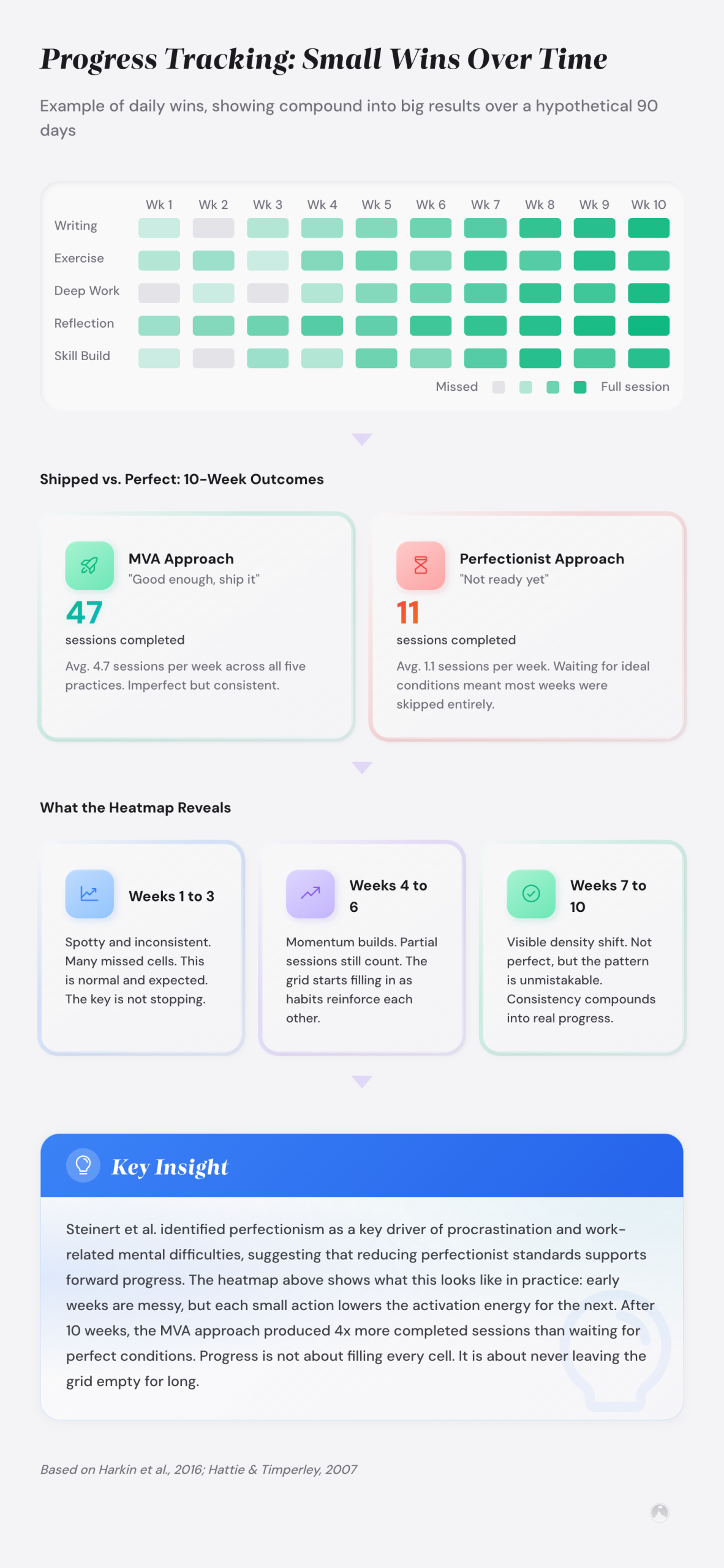
Progress-focused work requires a different measurement system. Perfectionists track gaps (“I still need to fix X”). They rarely track accumulation (“I shipped five things this week”).
Keep a Progress Journal. At the end of each day, log three wins – anything shipped, learned, or improved. Not major wins.
Tiny wins count: “Finished first draft,” “Got feedback,” “Rewrote section.” This is deliberate cognitive reframing. You’re training your attention to notice progress, not gaps.
A meta-analysis of 138 studies (N = 19,951) by Harkin and colleagues confirms that monitoring goal progress – especially when physically recorded – significantly increases goal achievement [6]. The mechanism works because progress tracking identifies discrepancies between your current state and your desired state, triggering self-regulation adjustments. Your Progress Journal makes accumulation visible. And visible accumulation builds momentum.
This journal becomes your evidence that the progress not perfection mindset works. Celebrating small wins isn’t sentimental – it’s data. The accumulation is real, but invisible unless you measure it intentionally.
“But what about quality?” – handling the high-stakes objection
You might be thinking: “This works for rough drafts, but what about work that actually matters? Medical software? Legal contracts? Design that affects thousands?” Fair question.
The answer: progress goals work even better in high-stakes environments because they replace vague standards with measurable iteration cycles. You don’t ship medical software at 80% quality with no testing. You ship 80%-complete features with real testing data that informs the next iteration. The standard isn’t lower. It’s clearer and faster.
Gawande’s research into high-reliability organizations – from aviation to surgery – demonstrates that quality comes from structured checklists and iterative monitoring, not from attempting perfection before deployment [7].
The distinction that collapses perfectionism’s objection is this: perfectionists conflate “high quality” with “no iteration.” They assume shipping means no more changes. Professional practice is the opposite. Shipping is how iteration begins with real-world feedback.
Airlines maintain quality through continuous monitoring and rapid iteration, not by grounding planes until perfect [7]. Medical teams use checklists that catch errors – not because the surgeon is imperfect, but because the work is complex enough that iteration prevents disaster.
Your work is similar. Set your quality standards upfront. Use feedback loops instead of solo refinement. Ship on schedule. Iterate based on what breaks, not what might be imperfect. For more on the research behind perfectionism psychology, including why this pattern is so hard to break, see our deep dive.
Common pitfalls: where progress-focused practice breaks down
Pitfall 1: Shipping without clear standards
The worst interpretation of “progress over perfection” is shipping garbage and calling it progress. That’s not progress. That’s laziness with a better label.
The practice that prevents this: define your acceptance criteria upfront before starting work.
“This document must answer three questions clearly.” “This feature must not crash on invalid input.” “This design must be accessible.” Clear criteria are not perfectionism. They’re just clear.
Once criteria are met at 80%, ship. Before that, the work is not at progress – it’s at incomplete. If you struggle with this distinction, the companion guide on setting realistic standards breaks it down further.
Pitfall 2: Time-boxing without real deadlines
Perfectionism senses open-ended time. If you set a 25-minute work block but you don’t actually ship when it ends, you’ve just ritualized work without changing the structure. The deadline must be real: a presentation, a deploy window, a meeting, a shared deadline with a colleague.
Pitfall 3: Early feedback that’s too early
Some work needs minimal architecture before feedback becomes useful. A complete sentence makes better feedback than three words. A working prototype gets more useful feedback than a wireframe. Share early, but not so early that you’re asking people to evaluate pre-work. Share at the point where the direction is clear enough to critique.
Ramon’s take
Perfectionism has great PR. It sounds like you care deeply. It’s just procrastination wearing a blazer. I haven’t tested the MVA method yet, but I’ve spent years testing ‘overthink until it’s worse.’ Can confirm: 10 out of 10, do not recommend.
Replace flawless with functional
Progress over perfection practices transform how your brain structures goals. Instead of pursuing the impossible (flawlessness), you pursue the achievable (incremental improvement). This isn’t about lowering standards. It’s about replacing an impossible standard with a functional one, then letting iteration and feedback handle the refinement.
The five practices work because they’re structural, not motivational. You don’t need willpower. You need time-boxes that force shipping, clarity about what 80% means, and feedback loops that replace solo perfection with collaborative iteration.
Next 10 minutes
- Write down one project where perfectionism is causing delay right now.
- Identify what 80% quality looks like for that project (what would make it shippable?).
- Set a 15-minute timer and create your Messy First Draft without editing.
This week
- Run the Minimum Viable Action practice on that project – identify the smallest step and ship it.
- Share your rough draft with one person before you think it’s ready and note what feedback surprises you.
- Start a Progress Journal entry tonight: three things you shipped, learned, or improved today.
There is more to explore
- Overcoming Perfectionism: The Complete Guide – The parent guide covering the full perfectionism landscape
- Perfectionism Paralysis Solutions – For when you are completely stuck and cannot start
- Perfectionism Recovery Approaches Compared – Side-by-side comparison of different strategies
- Signs Perfectionism Is Holding You Back – Recognize the pattern before it takes over
Related articles in this guide
- setting-realistic-standards-guide
- signs-perfectionism-holding-you-back
- breaking-free-from-perfectionism
Frequently asked questions
What does progress over perfection actually mean?
Progress over perfection means replacing an impossible, undefined standard (perfection) with a measurable, achievable one (improvement). It is often misunderstood as permission to do sloppy work – it actually means the opposite. Progress goals have clear acceptance criteria defined upfront. A perfectionist ships a presentation after three weeks of revisions; a progress-focused person ships at day five after one round of feedback, iterates based on reactions, and produces a sharper result by week three.
How can I maintain quality while choosing progress over perfection?
Quality frameworks vary by profession. For writers: draft first, edit second, publish with one proofreading pass. For developers: ship features with test coverage for core paths, not edge cases. For designers: deliver three directions at low fidelity before developing one at high fidelity. The rule for when NOT to use the 80% threshold: safety-critical systems (medical devices, aviation software, structural engineering) where errors have irreversible consequences – but iteration still applies within defined testing cycles.
What does 80% quality actually look like?
80% quality is the point where the work is shippable and deployable. Use this quick rubric: (1) Does it answer the core question or solve the primary problem? (2) Would a reasonable colleague say ‘this is ready for feedback’? (3) Are the must-have criteria met, even if nice-to-haves are missing? If yes to all three, you’re at 80%. If you’d be embarrassed to show it to anyone, you’re below 80%. If you can’t imagine what would make it better, you’re above 80% and heading into perfectionism territory.
How do I avoid shipping low-quality work?
Red flag for premature shipping: you haven’t actually met your stated acceptance criteria. Red flag for perfectionist delay: you keep adding new criteria that weren’t there at the start. A quick self-check: write down your acceptance criteria before starting work. When you think you’re done, check each criterion. If all are met, ship. If you’re adding new criteria, ask: ‘Was this always a requirement, or did I just think of it now?’ New requirements mid-project are usually perfectionism, not quality standards.
Can progress over perfection work in high-stakes environments?
Yes – and the most reliable evidence comes from industries that mastered it first. In aviation, PDCA (Plan-Do-Check-Act) cycles mean improvements are shipped incrementally after each incident review. In surgery, Gawande’s checklist research shows that standardized iteration – not pre-launch perfection – reduces errors [7]. The one domain where progress over perfection does NOT apply: truly irreversible decisions, such as decommissioning infrastructure, where a mistake cannot be corrected through another iteration.
How do I track progress without obsessing over perfection?
Keep a Progress Journal where you log three wins daily – anything shipped, learned, or improved. A meta-analysis of 138 studies confirms that monitoring goal progress, especially when physically recorded, significantly increases goal achievement [6]. Alternative tracking methods: weekly review (what shipped this week vs. last week), accountability partner check-ins (share three wins before each meeting), or a simple counter app tracking completed tasks. Common tracking mistake: logging only big wins, which creates the illusion of no progress on normal days. Tiny wins count.
What is the Minimum Viable Action and how do I use it?
The Minimum Viable Action (MVA) is the smallest step that advances work forward while staying in your craft domain – a messy outline for writers, a working prototype for engineers, a low-fi mockup for designers. Before starting, define your MVA explicitly and make it smaller than you’re comfortable with. Set a timer for 5-15 minutes and work only on the MVA. When the timer ends, stop and ship. The shipped version generates external feedback that internal polishing never could.
References
[1] Steinert, C., Heim, N., & Leichsenring, F. “Procrastination, perfectionism, and other work-related mental problems: Prevalence, types, assessment, and treatment – a scoping review.” Frontiers in Psychiatry, 2021. DOI
[2] Ries, E. The Lean Startup. Crown Business, 2011. Link
[3] Locke, E. A., & Latham, G. P. “The development of goal setting theory: A half century retrospective.” Motivation Science, 2019. DOI
[4] Psychology Today. “Five ways to wander: First draft writing advice.” Psychology Today, 2012. Link
[5] Hattie, J., & Timperley, H. “The power of feedback.” Review of Educational Research, 2007. DOI
[6] Harkin, B., Webb, T. L., Chang, B. P., Prestwich, A., Conner, M., Kellar, I., & Sheeran, P. “Does monitoring goal progress promote goal attainment? A meta-analysis of the experimental evidence.” Psychological Bulletin, 2016. DOI
[7] Gawande, A. The Checklist Manifesto: How to Get Things Right. Metropolitan Books, 2009. Link