Why You Make Plans at 9 PM That Fall Apart by 9 AM
You set the alarm for 5:30 AM. You planned the workout, laid out the clothes. And then morning arrived, and the version of you that hit snooze three times didn’t seem to care about any of it. Precommitment psychology explains this gap between intention and action – and it has less to do with willpower than most people think.
In 1997, economist David Laibson published research showing that humans systematically overvalue immediate rewards relative to future ones, a pattern he called “hyperbolic discounting” [1]. The person making plans at night and the person waking up at dawn are, in a meaningful psychological sense, not the same decision-maker. Precommitment (also written pre-commitment) psychology studies how people can restrict their own future choices to protect long-term goals from short-term impulses. This isn’t about discipline. It’s about design.
Precommitment is a self-control strategy in which a person voluntarily restricts future choices or imposes costs on undesired actions before temptation arises, making it harder to deviate from a planned course of action. Precommitment differs from willpower-based self-control by changing the decision environment rather than relying on in-the-moment resistance.
Precommitment psychology is the study of how people voluntarily restrict their future options before temptation arrives, using binding strategies like deadlines, social pledges, and environmental constraints to close the gap between long-term intentions and short-term behavior.
Key Takeaways
- Precommitment psychology works by restricting future options before temptation arrives, bypassing the need for in-the-moment willpower.
- Hyperbolic discounting causes people to overvalue immediate rewards, creating a predictable gap between long-term intentions and short-term actions.
- The Ulysses contract, named after the mythological hero, is the foundational model for voluntary self-binding in behavioral science.
- Thaler and Shefrin’s “planner-doer” model frames self-control as an internal conflict between a farsighted planner and a myopic doer.
- fMRI research shows two separate brain systems compete during intertemporal choices – a limbic system favoring immediacy and a prefrontal system supporting delayed rewards [7].
- The Binding Window – the period between goal-setting and temptation – is when precommitment strategies are most effective.
- Self-imposed deadlines reduce procrastination but are less effective than externally imposed ones, suggesting that harder constraints produce better results [5].
How does hyperbolic discounting hijack your habits?
Standard economic theory assumes that people discount future rewards at a constant rate. If you prefer $100 today over $110 tomorrow, you’d feel the same way about $100 in 30 days versus $110 in 31 days. But humans don’t work that way.
David Laibson, an economist at Harvard University, formalized what researchers call the “quasi-hyperbolic” discount model in his 1997 paper “Golden Eggs and Hyperbolic Discounting” [1]. His model shows that people apply an extra penalty to all future rewards – a parameter he labeled “beta” – on top of normal time discounting. The practical result: the gap between “now” and “any time in the future” feels disproportionately large.
Hyperbolic discounting means that small, immediate rewards routinely overpower larger future benefits in human decision-making, even when people know the math favors waiting. This is the engine behind most habit failures. You know the gym session is worth more than the extra hour of sleep. But at 5:30 AM, the calculus flips.
Ted O’Donoghue and Matthew Rabin expanded on this in their 1999 paper “Doing It Now or Later,” published in the American Economic Review [2]. They drew a line between two types of present-biased people: “sophisticates” who recognize their own bias, and “naifs” who don’t see it coming. Naive people procrastinate tasks with immediate costs and rush into activities with immediate rewards.
Sophisticates are the ones most likely to seek precommitment strategies. This distinction matters for habit formation. If you’ve ever set a goal and then watched yourself not follow through – with full awareness that you were sabotaging yourself – you’re likely a sophisticate in O’Donoghue and Rabin’s framework. And that self-awareness is the first ingredient for precommitment.
| Discount Type | Pattern | Habit Impact |
|---|---|---|
| Exponential (standard) | Consistent preference over time | Plans remain stable |
| Hyperbolic | Preference reversal as reward gets closer | Morning-you overrides evening-you |
| Quasi-hyperbolic (beta-delta) | Extra penalty for all future rewards | Every “later” feels equally distant |
The Ulysses contract: where precommitment theory began
In Homer’s Odyssey, Ulysses instructs his sailors to bind him to the mast and plug their own ears with wax before sailing past the Sirens. He wanted to hear the song but knew he’d steer the ship into the rocks if he could. So he eliminated the option.
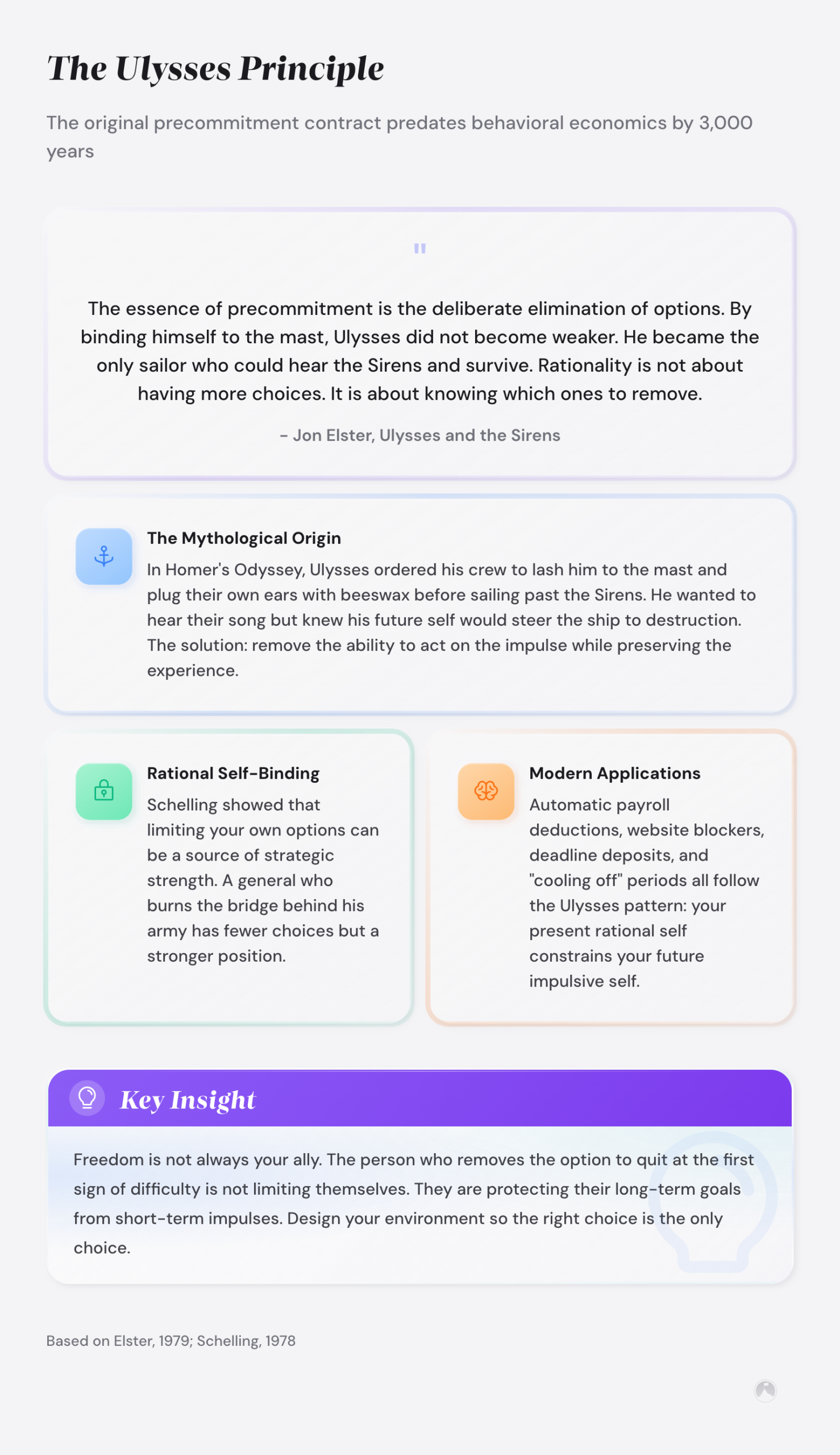
Philosopher Jon Elster seized on this story in his 1979 book Ulysses and the Sirens, turning it into a formal theory of self-binding [3]. Elster argued that precommitment is a rational response to an irrational tendency – humans can plan, but they’re prone to deviate through weakness of will. The Ulysses contract works not by strengthening willpower but by making the undesired action impossible or prohibitively costly before the moment of temptation arrives. A Ulysses contract is a voluntary, pre-arranged restriction on future choices — named after the mythological hero who had himself bound to the mast — designed to prevent predictable lapses in self-control by eliminating or penalizing the undesired option before temptation arises.
Thomas Schelling, the Nobel Prize-winning economist, independently arrived at similar ideas through game theory. Schelling described precommitments as the small tricks people play on themselves to stay on track [4]. A person who tells friends about a diet can’t quietly abandon it without social cost – the same principle that makes a general who burns bridges behind his army a more credible fighter.
Dan Ariely and Klaus Wertenbroch ran their landmark 2002 study at MIT [5]. They gave students the choice of setting their own deadlines for three papers or having all papers due on the last day of class. Only 27% of students chose the final-day option. The rest voluntarily imposed earlier deadlines on themselves, accepting grade penalties for late submission.
In Ariely and Wertenbroch’s 2002 MIT experiment, 73% of students voluntarily imposed earlier deadlines on themselves and accepted grade penalties for late submission, demonstrating that people recognize their own self-control problems and will pay real costs to counteract procrastination [5].
Ariely and Wertenbroch’s 2002 study demonstrated that people recognize their own self-control problems and will voluntarily impose costly deadlines to counteract procrastination [5]. But here’s the catch: self-imposed deadlines helped, but externally imposed, evenly spaced deadlines produced better performance. People know they need binding. They just don’t bind themselves tightly enough.
Precommitment psychology and the planner-doer war in your brain
Richard Thaler and Hersh Shefrin proposed a model in 1981 that reframed self-control as an organizational problem [6]. They described each person as containing two agents: a “planner” who thinks long-term and a “doer” who only cares about right now. The planner sets the alarm. The doer hits snooze.
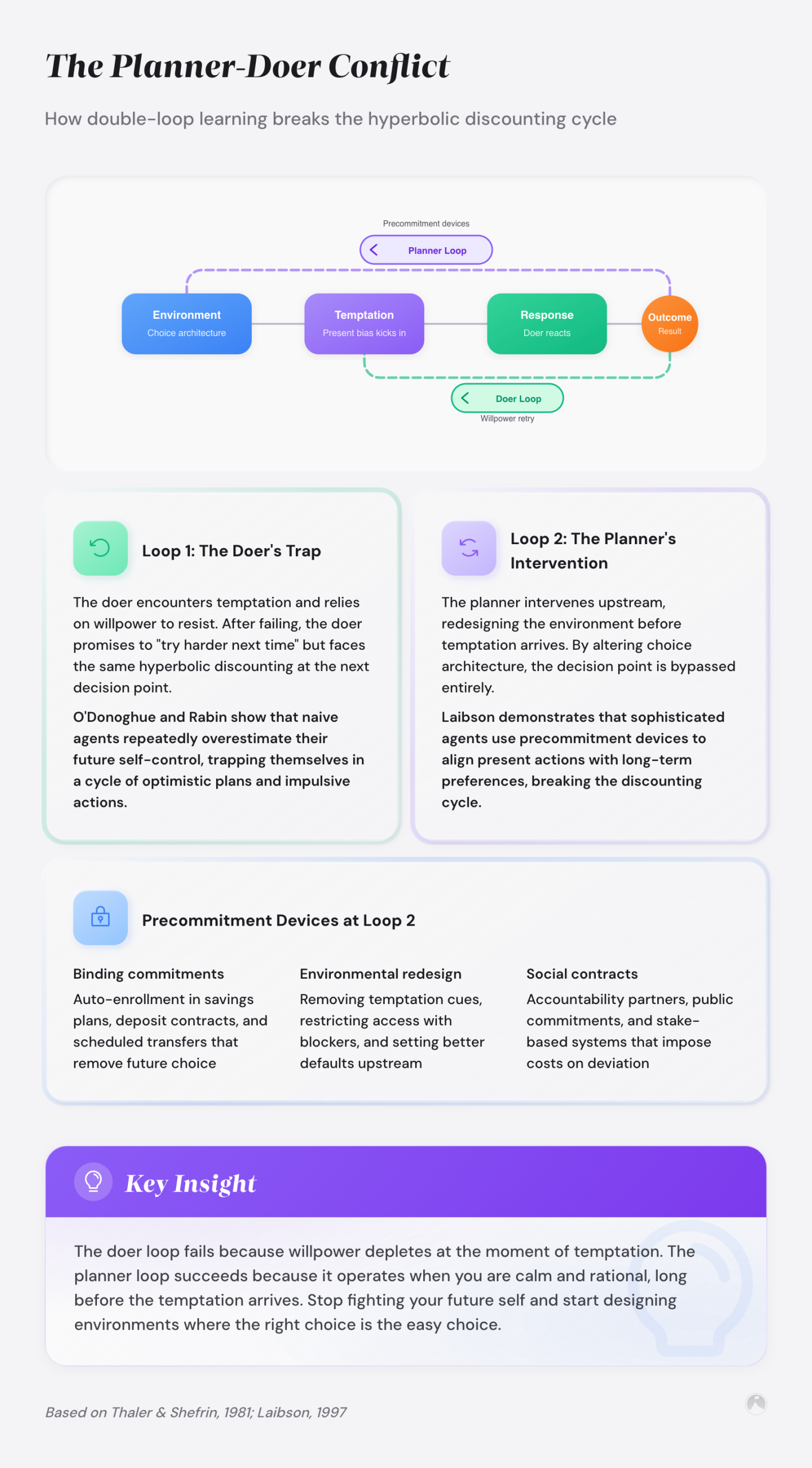
The planner-doer conflict maps onto real neural architecture. In 2004, Samuel McClure and colleagues used fMRI to show that two distinct brain systems compete during intertemporal choices [7]. The limbic system lights up when an immediate reward is on the table. A separate network centered on the lateral prefrontal cortex activates for all choices involving delayed rewards.
McClure and colleagues’ fMRI research revealed that immediate rewards activate the brain’s limbic dopamine system while delayed rewards engage the lateral prefrontal cortex, showing that self-control failures reflect one neural system outbidding another rather than a lack of character [7].
fMRI research by McClure and colleagues shows that immediate rewards activate the brain’s limbic dopamine system, creating a neurological pull toward “now” that the prefrontal cortex must override for delayed gratification [7]. When the immediate reward wins, it’s not a character flaw. It’s one brain system outbidding another.
Thaler and Shefrin drew an analogy between this internal conflict and the principal-agent problem in business [6]. A company’s owners (the planner) want long-term value; the managers (the doers) respond to short-term incentives. The solution in business is governance: contracts, oversight, rules.
The planner has two tools. First, it can modify the doer’s incentives – making the undesired action more costly. Second, it can impose rules that limit choices entirely. But research on why habits fail suggests that choice restriction tends to outperform incentive modification, especially under stress.
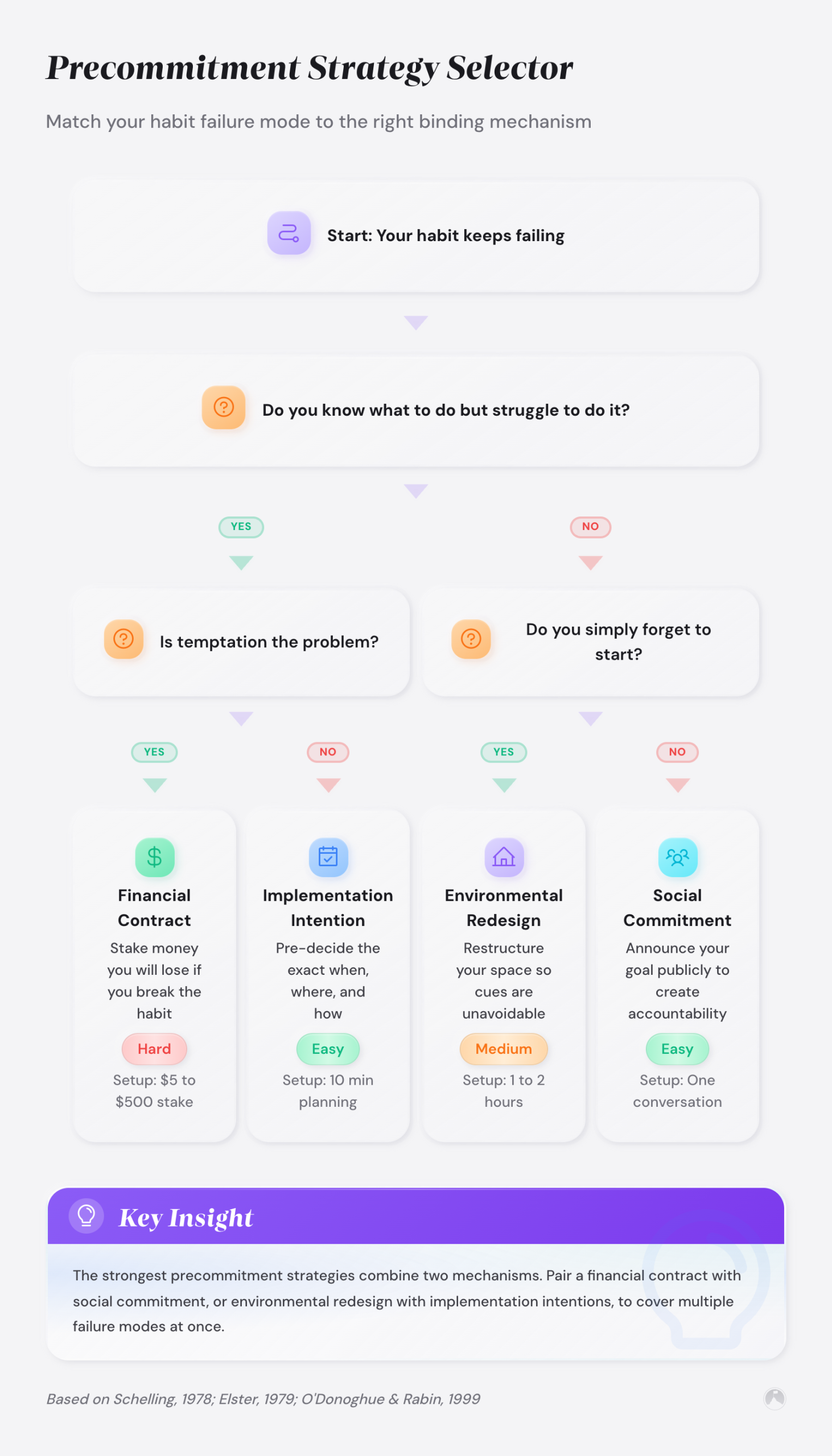
Precommitment Strategy Selector
Match your self-control challenge to the right binding approach:
| If Your Pattern Is… | Your Planner-Doer Gap | Recommended Binding Type |
|---|---|---|
| Setting goals but not starting | Doer avoids immediate costs | External deadline with penalty |
| Starting but not sustaining | Doer loses interest after novelty fades | Social accountability pledge |
| Knowing the right choice but picking the easy one | Limbic override of prefrontal planning | Remove the easy option entirely |
| Overcommitting in calm moments | Planner underestimates doer’s resistance | Graduated commitment with smaller first steps |
Why do proactive precommitment strategies outperform reactive ones?
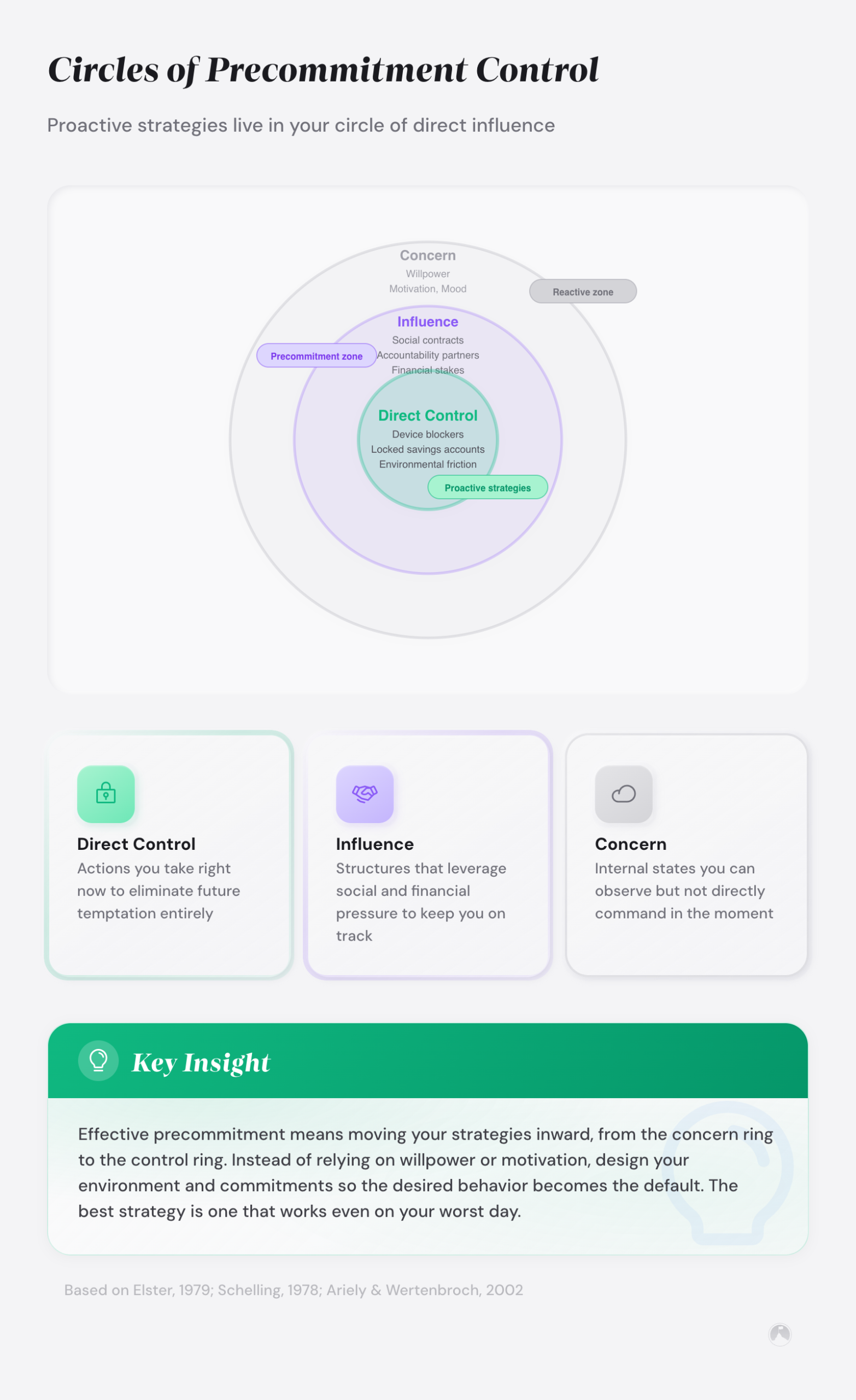
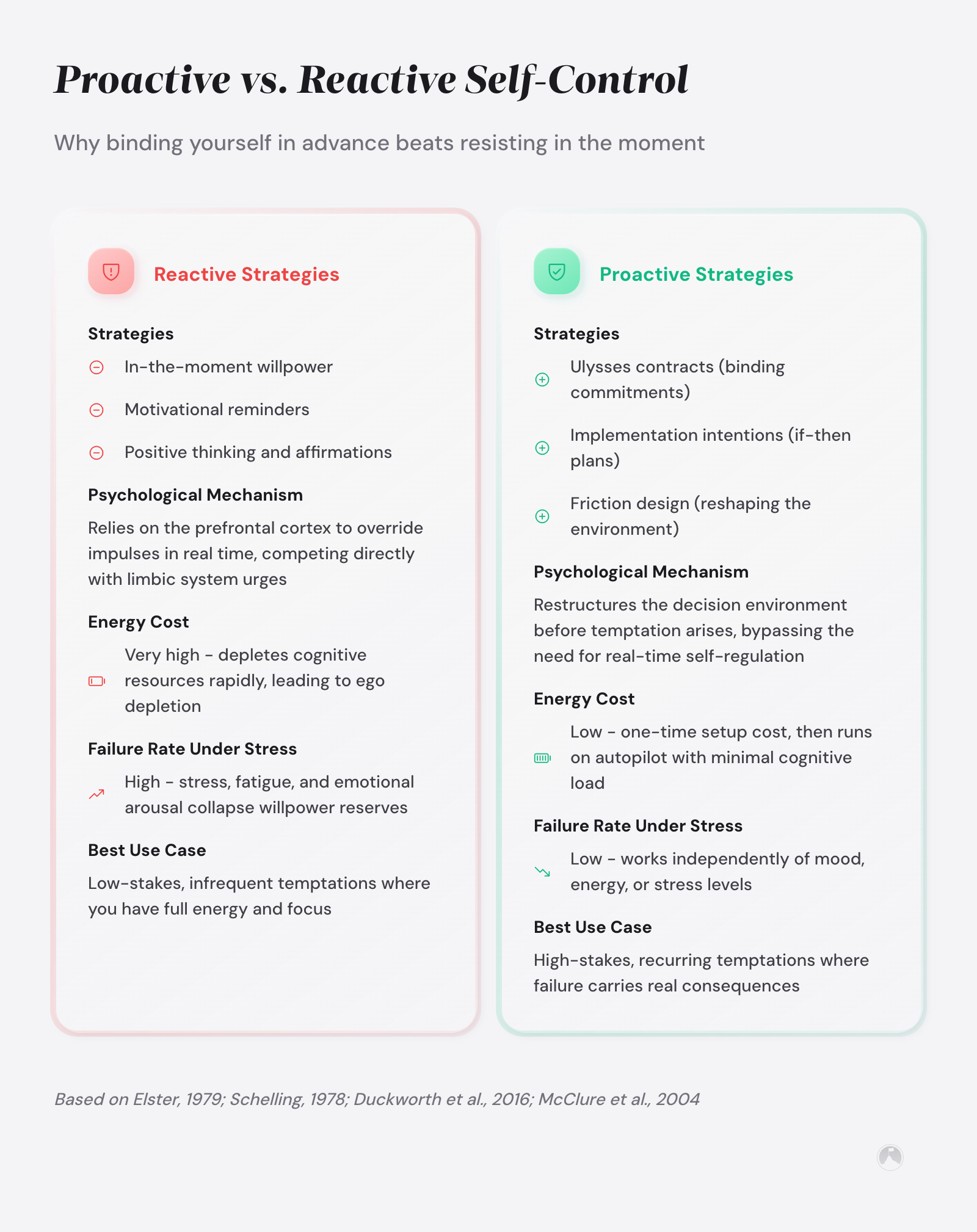
Angela Duckworth and colleagues identified a distinction in 2016 that reshapes how we think about self-control [8]. They separated self-control strategies into two categories: proactive strategies, deployed before temptation strikes, and reactive strategies, used once you’re already facing the choice. Precommitment falls squarely in the proactive camp.
The timing matters. Temptation follows a predictable escalation pattern – it starts weak and builds. A proactive strategy like scheduling a workout with a friend gets deployed during a calm moment when the planner is in charge. A reactive strategy like trying to resist the urge to skip once you’re tired operates in the doer’s territory, where the limbic system has the advantage.
Duckworth’s framework implies that early exercises of proactive self-control make future self-control easier [8]. The opposite holds, too. The proactive advantage is where pre-commitment connects directly to building habit systems – the goal isn’t to fight harder but to design the fight out of the equation.
Proactive precommitment strategies outperform reactive willpower efforts by removing the need for a decision when cognitive resources are depleted. A precommitment made during a moment of clarity carries forward into moments of weakness, functioning like a contract between your present self and your future self [4].
The Binding Window: when precommitment strategies work best
Here’s an original framework that pulls together the research above. We call this The Binding Window – the period between forming an intention and facing the temptation that could derail it. Once the window closes and temptation is active, you’re relying on reactive self-control, which the research consistently shows is the weaker approach.
The Binding Window works because decisions made in the planner’s territory — before limbic activation from temptation — carry forward as constraints into moments when the doer would otherwise override long-term goals [7].
The Binding Window has three properties that determine how effective a precommitment will be:
Length. Longer windows give the planner more time to install constraints. Setting up a morning routine for habit building the night before creates a longer window than trying to commit five minutes after waking.
Clarity. The more specific the anticipated temptation, the tighter the binding can be. “I’ll eat healthier” leaves a wide window. “I won’t order delivery on weeknights” creates a bright-line rule – what Schelling called a clear boundary that’s easy to monitor [4].
Rigidity. Harder commitments beat softer ones. Bryan, Karlan, and Nelson’s 2010 review in the Annual Review of Economics found that “hard” commitments with real penalties consistently outperformed “soft” commitments like personal pledges [9]. This tracks with Ariely’s finding that external deadlines beat self-imposed ones [5].
| Binding Window Property | Weak Version | Strong Version |
|---|---|---|
| Length | Committing moments before temptation | Committing hours or days ahead |
| Clarity | Vague intention (“be better”) | Specific bright-line rule |
| Rigidity | Private mental note | Public pledge with real stakes |
The Binding Window framework predicts that precommitment strategies are most effective when they are long, specific, and hard to reverse. This explains why some habit stacking approaches work so well. By linking a new behavior to an existing trigger, you’re pre-installing the commitment during a stable moment. The decision has already been made before the doer has a chance to negotiate.
Precommitment psychology and the sophistication paradox
O’Donoghue and Rabin’s distinction between naive and sophisticated agents creates a paradox [2]. Sophisticated people – those who understand their own present bias – are more likely to seek precommitment. But sophistication can backfire.
With tasks that carry immediate costs (like exercising or studying), sophistication helps. The sophisticated person foresees procrastination and binds themselves to act. But with activities offering immediate rewards (like impulse purchases or social media scrolling), sophistication can lead to what O’Donoghue and Rabin call “preproperation” – doing things too soon or too much, knowing that waiting would be futile.
Sophistication about present bias helps with costly-now-beneficial-later habits, but can actually worsen overconsumption of immediately rewarding activities. This is why precommitment strategies need to target both sides. You need binding against procrastination on hard tasks and binding against temptation from easy pleasures. The research on procrastination neuroscience confirms this dual challenge.
Lally and colleagues’ 2010 research on habit formation adds a time dimension [10]. Reaching automaticity takes a median of 66 days, with a range of 18 to 254 days depending on the behavior’s complexity. Precommitment strategies are most valuable during this pre-automaticity phase, when the behavior still requires active effort.
Ramon’s Take
What changed my thinking was realizing that 9pm-me and 9am-me genuinely aren’t on the same team. Not a character flaw, just an accurate description of how brains work. Does that mean future-you is basically a different person you’re negotiating with?
I’ve noticed the same pattern at work: the most reliable team members build accountability into their workflows before they need it, not after the deadline starts slipping. The Binding Window idea landed hard for me because it names something I was already doing without realizing it – making decisions in quiet moments so I wouldn’t have to make them in chaotic ones. Precommitment isn’t weakness. It’s the most honest form of self-knowledge, and once you see it that way, the question changes from “how do I get more willpower?” to “where do I need a better guardrail?”
Precommitment Psychology Conclusion: Design Over Discipline
Precommitment psychology reframes the self-control conversation from “try harder” to “design better.” The research from Laibson, Elster, Thaler, and Ariely points to a single insight: the gap between intentions and actions isn’t a character problem. It’s a predictable consequence of how brains discount future rewards. And the solution isn’t more willpower – it’s strategic self-binding during the Binding Window, when the planner-self still has the upper hand.
The person who sets the alarm and the person who hears it are playing different games. Precommitment psychology is the art of making sure the first one wins.
Next 10 Minutes
- Identify one habit you’ve been failing at and write down the specific moment where your “doer” overrides your “planner.”
- Choose one precommitment strategy from the Strategy Selector table and install it right now, before closing this page.
- Tell one person about your commitment – the social cost of backing out is one of the strongest binding mechanisms available.
This Week
- Map your Binding Windows for three recurring habits: when does the intention form, and when does the temptation peak?
- Convert one soft commitment (private intention) into a hard commitment (public pledge with stakes).
- Read about commitment devices that help you stick to goals for practical tools that put this psychology into action.
There is More to Explore
For a deeper look at the brain science behind habit loops, read our guide on the neuroscience of habit formation. If you’re curious about why your current routines keep breaking down, the habits failure diagnostic can help pinpoint where the planner-doer gap is widest. For a broader framework that connects all of these pieces, check out the complete guide to habit formation. And if you want to understand how goal-setting psychology shapes long-term follow-through, see our guide on goal tracking systems.
Related articles in this guide
Frequently Asked Questions
What is the difference between precommitment and willpower?
Precommitment changes the decision environment before temptation arises, while willpower relies on resisting temptation in the moment. Thaler and Shefrin’s planner-doer model shows that environmental constraints (precommitment) consistently outperform in-the-moment resistance (willpower), especially under stress or fatigue [6].
How long do precommitment strategies need to last for habits to stick?
Precommitment strategies are most valuable during the pre-automaticity phase of habit formation, which Lally and colleagues found takes a median of 66 days with a range of 18 to 254 days depending on the behavior [10]. During this period, keeping a visible precommitment device — such as a public calendar commitment or financial stake — can bridge the gap until the behavior runs on autopilot.
Can precommitment backfire or make things worse?
Precommitment can backfire in specific situations. O’Donoghue and Rabin found that sophisticated agents sometimes overconsume immediately rewarding activities because they know future restraint is unlikely [2]. Overly rigid commitments can trigger reactance, the psychological tendency to rebel against perceived restrictions on freedom.
What are the best examples of precommitment devices for daily habits?
Effective daily precommitment devices include scheduling workouts with a partner (social cost of canceling), using app blockers during work hours (removing the easy option), and automatic savings transfers (eliminating the spending decision). Bryan, Karlan, and Nelson’s review found that devices with real penalties outperformed soft pledges [9].
Is a Ulysses contract legally binding?
A Ulysses contract in the behavioral science sense is not a legal contract. The term refers to any voluntary self-imposed restriction designed to prevent future preference reversals. Some formal versions, like advance directives in healthcare or automatic retirement contribution escalations, do carry legal or institutional weight.
Why do self-imposed deadlines work less well than external deadlines?
Self-imposed deadlines are softer constraints because the person who set them can renegotiate with themselves, weakening the binding force. Ariely and Wertenbroch’s 2002 MIT study showed that self-imposed deadlines reduced procrastination compared to no deadlines, but externally imposed evenly spaced deadlines produced the best performance [5]. One workaround: pair a self-imposed deadline with a social commitment, converting the soft private deadline into a harder social one.
References
[1] Laibson, D. “Golden Eggs and Hyperbolic Discounting.” Quarterly Journal of Economics, 112(2), 443-478, 1997. DOI
[2] O’Donoghue, T. and Rabin, M. “Doing It Now or Later.” American Economic Review, 89(1), 103-124, 1999. DOI
[3] Elster, J. Ulysses and the Sirens: Studies in Rationality and Irrationality. Cambridge University Press, 1979. ISBN 978-0-521-26984-1.
[4] Schelling, T. “Egonomics, or the Art of Self-Management.” American Economic Review, 68(2), 290-294, 1978. Available via JSTOR.
[5] Ariely, D. and Wertenbroch, K. “Procrastination, Deadlines, and Performance: Self-Control by Precommitment.” Psychological Science, 13(3), 219-224, 2002. DOI
[6] Thaler, R. and Shefrin, H. “An Economic Theory of Self-Control.” Journal of Political Economy, 89(2), 392-406, 1981. DOI
[7] McClure, S. M., Laibson, D. I., Loewenstein, G., and Cohen, J. D. “Separate Neural Systems Value Immediate and Delayed Monetary Rewards.” Science, 306(5695), 503-507, 2004. DOI
[8] Duckworth, A. L., Gendler, T. S., and Gross, J. J. “Situational Strategies for Self-Control.” Perspectives on Psychological Science, 11(1), 35-55, 2016. DOI
[9] Bryan, G., Karlan, D., and Nelson, S. “Commitment Devices.” Annual Review of Economics, 2(1), 671-698, 2010. DOI
[10] Lally, P., van Jaarsveld, C. H. M., Potts, H. W. W., and Wardle, J. “How Are Habits Formed: Modelling Habit Formation in the Real World.” European Journal of Social Psychology, 40(6), 998-1009, 2010. DOI