Goals & Progress


A guided 5-step process that generates three draft variations from your own words
This personal mission statement builder walks you through values, strengths, impact, and method, then produces three distinct drafts you can refine and print. No account needed, nothing saved to a server.
To read finished statements before you start, see these personal mission statement examples.
Start Step 1 below and your mission statement drafts generate automatically at the end.
Craft a mission statement that actually means something to you. Not corporate jargon, but a compass for the decisions that matter.
What this tool solves
Writing a mission statement from scratch is hard for two reasons. First, the open-ended question “what is your purpose?” is almost impossible to answer directly. Second, without a structure, most people default to generic language that could describe anyone.
This personal mission statement tool solves both problems. The curated value and strength lists give you a defined vocabulary to work from, so you are selecting and refining rather than generating from nothing. The impact and method prompts push you toward specificity. Specific inputs produce drafts that actually sound like you. Generic inputs produce generic drafts, which is a useful signal in itself.
The three draft format also matters. Seeing your inputs expressed in three different voices (aspirational, functional, and personal) often surfaces which framing actually fits how you think about yourself. That is harder to find when you are staring at a single blank field.
See the Tool in Action
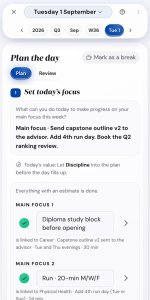
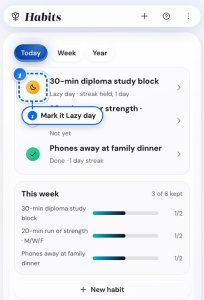
Each screenshot below shows a real example with personal goals already filled in, so you can see what the output looks like before you start.


The five steps explained
Each step does a specific job in the process. Together they build a complete picture before you ever write a single word of the final statement.
Step 1: Values
Values are the non-negotiables. They are what you protect when things get hard and what you return to when you drift. The builder offers 40 values grouped into five categories (Character, Connection, Growth, Purpose, Freedom) so you are comparing like with like rather than weighing apples against oranges. You select five. If you add a custom value that the list does not cover, it carries through to your drafts.
Step 2: Strengths
Strengths ground the statement in what you actually do rather than what you aspire to become. The four categories (Thinking, Creating, Relating, Leading) map roughly to the domains where people tend to find their natural edge. Choosing three forces a useful prioritisation: you are picking what matters most, not listing everything you are capable of.
Step 3: Impact
This is the heart of the statement. Who do you want to help, and what change do you want to create for them? The hint in the interface ("Try to be specific") is the most important instruction in the whole tool. A vague impact statement produces a vague mission statement. The more concrete your answer here, the more useful and personal your drafts will be.
Step 4: Method
Method is how you create your impact. It is your approach, your vehicle, your way of doing things. This is what distinguishes your mission from someone else's who might have identical values and a similar impact goal. Two teachers can have the same purpose and completely different methods. One runs workshops. The other writes. Your method is part of your identity, and it belongs in your statement.
Step 5: Draft variations
The builder generates three drafts from your inputs:
- Aspirational: Begins with "I exist to..." or "To live with..." Elevated, forward-looking language. Works well for personal documents, vision boards, and journalling.
- Functional: Begins with "I help... by..." or "I exist to make..." Grounded and concrete. Useful when you need to explain your purpose to someone else.
- Personal: Begins with "What drives me is..." or "What matters to me is..." Warmer and more reflective. Often the one that feels most natural to keep for yourself.
Pick the one that sounds most like you, refine it in the inline editor, and print. Your result is formatted and ready to display.
The theory behind this personal mission statement builder
The five-step structure is rooted in Stephen Covey's work in The 7 Habits of Highly Effective People, specifically Habit 2: Begin with the End in Mind. Covey argued that a personal mission statement is the most fundamental activity a person can engage in, because it creates the lens through which every other decision is made. Without it, people optimise for urgent tasks rather than meaningful ones.
The values-first design reflects how values-based decision-making research describes the architecture of lasting commitment. People who articulate their core values in writing before setting goals report stronger follow-through and higher satisfaction with their choices. Values act as a pre-commitment device: they make certain trade-offs easier because the criteria are already clear.
The three-draft format draws on the observation that people recognise authentic language more reliably than they generate it. Presenting three versions reduces the anxiety of the blank page and surfaces which voice feels genuine. Most people know immediately which draft is theirs, even if it needs editing. That recognition is itself part of the clarification process.
The print-ready output is not cosmetic. A statement you can hold, pin up, or frame is more likely to function as a daily reference than one buried in a notes app. The physical artefact matters for habitual access. That is the goal: a decision filter you actually use, not a document you wrote once and forgot.
Who gets the most from this tool
This personal mission statement tool works for anyone in a moment of transition or deliberate reinvention. That said, a few groups tend to get the clearest results:
- Career changers who need to articulate what they actually want to do, beyond the job title they are leaving. The values and strengths steps in particular surface what was missing from the previous role.
- Parents returning to the workforce who have a strong sense of what matters to them but have not put it into words for a professional context.
- Recent graduates who have spent years optimising for credentials rather than direction, and need a way to clarify what they actually care about before job hunting.
- Entrepreneurs and freelancers who make daily decisions about which clients to take, which projects to pursue, and which opportunities to decline. A mission statement makes that calculus faster and more consistent.
- Anyone mid-career who has been successful by conventional measures but has a nagging sense that success and meaning are not quite lined up. The impact prompt is particularly useful here.
The tool is also useful for people who already have a mission statement they wrote years ago and are not sure it still fits. Running back through the five steps with fresh eyes often surfaces how much has shifted.
Related articles
These articles go deeper on the research and practice behind personal mission statements and goal-setting:
- 23 Personal Mission Statement Examples for Life and Career - 23 examples across different life stages and careers, with a craft guide covering what separates good mission statements from forgettable ones.
- Goal Tracking Systems Complete Guide - Once you have your mission statement, this guide covers how to build a goal system that keeps your daily work aligned with it.
- Personal Development Strategies Guide - A broader look at the frameworks and habits that support sustained personal growth, with the mission statement as a foundation.
- From Values to Goals - A 60-minute walkthrough that ranks five core values and turns them into a one-page purpose statement and concrete goals.
Frequently asked questions
Why do I need a personal mission statement?
A personal mission statement functions as a decision filter. When you face a career opportunity, a new project, or a request on your time, your mission statement gives you a pre-built criterion for evaluating fit. Without one, you default to social pressure or short-term incentives. Research on values-based decision making shows that people who articulate their purpose in writing report higher career satisfaction and make more consistent choices over time.
How is this mission statement generator different from writing one myself?
Most people stall on a blank page and either write something generic or give up. The five-step structure breaks the task into small, answerable pieces. Instead of asking 'what is my purpose?', it asks 'which of these 40 values feel non-negotiable?' Each step narrows the problem until the drafts almost write themselves from your own language. The generator does not add anything you did not put in. It organises and expresses what you already know about yourself.
What if none of the three drafts feel right?
That is useful information. It usually means one of two things: the impact or method prompts were too vague, or you selected values that look right on paper but are not actually your core drivers. Use the inline editor to rewrite freely using the language and ideas the process surfaced. You can also go back through any step and update your inputs. The drafts are starting points, not final products.
How long should a personal mission statement be?
One to three sentences is the right range. A statement you cannot remember is a statement you will not use. The builder generates concise drafts by design: each one aims to be readable in under 30 seconds. If yours is running longer after editing, look for places where two ideas could become one, or where you are qualifying something that does not need qualifying.
How often should I update my mission statement?
Review it once a year, or at major life transitions. Core values tend to be stable, so the statement should not change dramatically. What does shift is how you express your purpose and who you are expressing it to. Running the five-step process again with updated inputs every year or two is a good practice. It usually takes less time than the first run because you already know most of your answers.
Can this tool work for teams as well as individuals?
The tool is designed for personal mission statements, but the structure transfers to small teams. Have each member complete the builder individually, then compare outputs as a group. Shared values and overlapping strengths tend to surface quickly. You can use the areas of alignment as the raw material for a collective team purpose statement, with each member contributing their own language.
Is my data private and secure?
Yes. All information you enter stays in your local browser storage. Nothing is shared with, processed by, or saved on the Goals and Progress servers or any third-party provider. The trade-off is that clearing your browser cache will erase your data. Some tools include a save and load function so you can export your inputs as a local file and reload them later.
Ready to Build Yours
The personal mission statement builder is free, requires no signup, and runs entirely in your browser. Nothing you enter is stored anywhere. Scroll back up to the tool and start with Step 1: pick the five values that feel most non-negotiable to you right now. Your statement is waiting in your own words. You just need a structured way to find it.