
Most podcast lists give you 50 shows and zero direction
You have 30 minutes in the car and thousands of personal development podcasts competing for that window. Most listicles hand you a wall of 50 names and let you figure out which ones matter.
A 2023 Pew Research Center report found that 42% of Americans ages 12 and older have listened to a podcast in the past month, with learning cited as a primary motivation [1]. But new listener retention remains a real problem – industry analytics consistently show significant listener drop-off within the first five minutes of an episode, making the opening minutes of any show a make-or-break moment.
So the gap between wanting to grow and finding the right show is a filtering problem, not a motivation problem.
This list is different. Instead of dumping every show with “personal growth” in the description, each recommendation below is selected for professionals who want evidence over hype, depth over volume, and formats that work whether you are an introvert recharging solo or an extrovert squeezing growth into a packed schedule. Walk away with two or three shows queued, not thirty more saved and never played.
Personal development podcasts for professionals are audio programs that deliver research-informed content on career growth, leadership, productivity, and self-improvement, formatted for working adults who integrate learning into commute time, exercise, or other routine activities. Unlike general self-help podcasts, professional development shows prioritize workplace-applicable strategies, cite named researchers and studies, and maintain consistent publishing schedules aligned with working professionals’ learning habits.
What you will learn
- A five-criteria filter that eliminates low-quality podcasts in under two minutes
- Which shows cover deep work and productivity with verified research behind them
- Podcasts for quiet leadership that skip the hustle talk and cite their sources
- Psychology-based shows that translate peer-reviewed research into daily practice
- A side-by-side comparison of all nine shows by format, length, depth, and development area
Key takeaways
- Podcast-based learning works best when listeners choose shows with a specific goal rather than browsing casually.
- The strongest professional development podcasts cite sources, name researchers, and avoid unverifiable success claims.
- Introverted professionals benefit from podcasts as a self-paced, solitary learning format free from group pressure.
- Two to three well-chosen shows deliver more growth than subscribing to twenty and skipping through episodes.
- Matching podcast format to your energy patterns prevents listening fatigue and increases retention.
- Each podcast below is categorized by development area so you can build a focused listening plan.
- Cal Newport’s Deep Questions and Shane Parrish’s Knowledge Project rank highest for evidence-based career content.
- According to LinkedIn’s Workplace Learning Report, 58% of professionals prefer self-paced training formats, making podcasts a natural fit for career development [2].
How to filter personal development podcasts for professionals
Before scrolling through any list, you need a filter. Researchers Jager, Schoger, and Sarmento (2024) studied 605 podcast listeners and found that self-directed learners – those who approach episodes with a specific learning goal – demonstrated stronger information retention and critical evaluation than incidental listeners [3]. And the difference was not the podcast itself. It was whether the listener chose it with a clear learning goal.
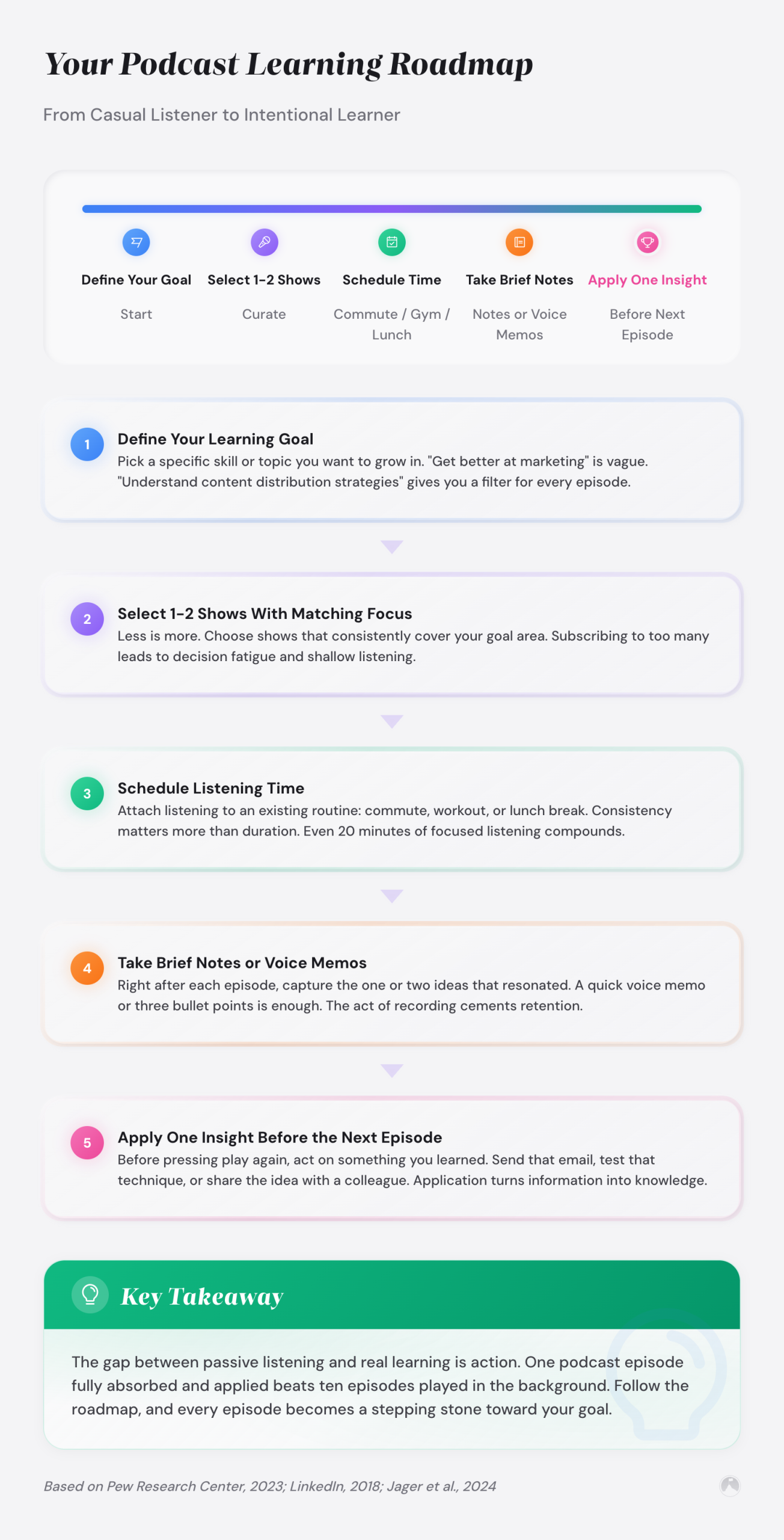
That finding changes how you should approach this list. Instead of sampling everything, pick one development area you want to improve this quarter, then select the one or two shows that directly address it. Targeted selection beats “subscribe to everything interesting” every time.
Here are five criteria for filtering professional development podcasts worth your time:
| Criterion | What to look for | Red flag |
|---|---|---|
| Evidence quality | Host names researchers, cites studies, references books with specific page numbers | Vague claims like “studies show” without naming anyone |
| Professional relevance | Episodes address workplace scenarios, career decisions, or skill gaps | Content stays abstract without connecting to professional contexts |
| Episode consistency | Published regularly in the last 6 months with a clear format | Last episode was 8 months ago or publishing is erratic |
| Introvert compatibility | Measured pacing, thoughtful interviews, no shouting or hype | Host opens every episode with “Are you fired up?” |
| Actionable takeaways | Each episode includes something you can try within a week | Heavy on inspiration, light on specifics |
A podcast that scores well on evidence quality and professional relevance will outperform a popular show with millions of downloads but no substance behind the advice.
Self-directed professional development is a learning approach in which professionals independently identify skill gaps, select targeted resources, and apply insights to their work context without relying on employer-mandated training schedules. Research by Jager and colleagues (2024) demonstrates that self-directed learners show stronger information retention and more critical evaluation of content than passive or incidental learners, making intentional podcast selection a higher-return activity than casual browsing [3].
Key statistics on podcast learning
42% of Americans ages 12 and older listened to a podcast in the past month — Pew Research Center, 2023 [1]
58% of professionals prefer self-paced training formats — LinkedIn Workplace Learning Report, 2018 [2]
Self-directed podcast listeners show stronger retention and critical evaluation than incidental listeners — Jager, Schoger, and Sarmento (2024), 605-participant study [3]
Significant listener drop-off occurs within the first five minutes of an episode, making show selection critical — industry analytics data
Deep work and productivity podcasts
If your primary development goal is getting more meaningful work done in less time, these three shows deliver the strongest research-to-practice ratio. And for professionals exploring self-paced vs structured personal development, podcasts sit firmly on the self-directed side – built around your schedule, not someone else’s curriculum.
1. Deep Questions with Cal Newport
Cal Newport, a Georgetown computer science professor and author of Deep Work, runs one of the few productivity podcasts grounded in peer-reviewed research rather than personal anecdote. His format mixes solo deep dives on focused work with listener Q&A segments that apply principles to real scenarios. Episodes run 60-90 minutes, though the core insight typically arrives in the first 20-30 minutes.
Newport’s delivery is measured and evidence-first. For introverted professionals, the show feels like a conversation with a thoughtful colleague rather than a keynote speech. And he regularly challenges mainstream productivity advice, including the idea that more tools and apps lead to better output.
Best for: Professionals who want to protect focused work time and build systems around deep concentration rather than chasing hacks.
Start with: Any episode tagged “Deep Work” or “Slow Productivity” in the show notes.
2. The Knowledge Project with Shane Parrish
Shane Parrish built Farnam Street into one of the most respected thinking-and-decision-making resources online. His podcast features long-form interviews (90-120 minutes) with researchers, CEOs, and authors who break down how they make decisions, build habits, and think about their careers. But the depth here is what separates it from surface-level interview shows.
Parrish consistently pushes guests past their talking points. He asks “How do you do that in practice?” when a guest offers generic advice, which means listeners get operational detail instead of platitudes. So if you are the kind of professional who gets frustrated by vague recommendations, this show fixes that problem.
Best for: Mid-career professionals who want to improve their thinking and decision-making frameworks rather than learn specific tactics.
Start with: Episodes featuring James Clear, Adam Grant, or Angela Duckworth for immediately applicable professional development content.
3. Beyond the To-Do List with Erik Fisher
This show sits at the intersection of productivity and personal growth, exploring how professionals balance output with well-being. Episodes are shorter (30-45 minutes), making them easier to fit into a single commute. And Fisher asks practical questions about daily routines, systems, and the real tradeoffs behind looking organized on paper.
The pacing is calm and conversational. For professionals who find high-energy content exhausting, this is a measured alternative. Research in medical education found that shorter podcast episodes are consistently preferred and had higher completion rates than longer formats [4].
Best for: Professionals who want productivity advice that acknowledges the messy reality of managing work, family, and personal goals simultaneously.
Start with: Episodes featuring guests discussing work-life integration or energy management for introverts and anyone else who needs to match listening to their natural rhythms.
Skip if: You prefer highly structured academic content – this show leans more conversational and practical than research-heavy.
Leadership and introvert professional development strategies
Not every leadership podcast is built for people who lead by example rather than volume. These three shows deliver career strategy and leadership development without assuming you want to be the loudest person in the room. And they work well for online learning introverted professionals prefer – solitary, self-paced, and pressure-free.
Research by Grant, Gino, and Hofmann found that introverted leaders outperformed extroverted leaders when working with proactive employees, suggesting that personality-congruent leadership development produces measurably better outcomes [5].
4. The Quiet and Strong Podcast with David Hall
This is one of the few shows built around introvert strengths in professional settings. David Hall interviews introverted leaders who have built successful careers without adopting extroverted behaviors. Topics include using deep thinking for strategic advantage, building confidence through competence rather than charisma, and managing energy during professional development activities.
Episodes run 30-40 minutes in an interview-driven format. The show offers practical self improvement tips introverted personalities can apply without forcing behavior change.
Best for: Introverted professionals who want career strategy that works with their personality rather than against it.
Start with: Episodes on networking alternatives and introvert leadership styles.
Listener note: Episodes are most useful when listened to with a specific career challenge in mind. Pausing after each guest answer to ask “How does this apply to my current situation?” doubles the practical value.
5. Coaching for Leaders with Dave Stachowiak
Running since 2011, this show has produced over 600 episodes covering leadership development for professionals at every career stage. Stachowiak interviews researchers and practitioners, and each episode closes with specific actions the listener can take. The tone is measured and respectful. No shouting, no hype, no “crush your goals” energy.
What sets this apart for personal development for introverts is the emphasis on one-on-one leadership skills: coaching conversations, giving feedback, building trust, and influencing without dominating. But these are the leadership skills introverted professionals often already possess and rarely see modeled in mainstream content.
Best for: Managers and aspiring leaders who want to develop their coaching and mentoring skills rather than their public speaking presence.
Start with: The foundational episodes on active listening and the coaching habit.
6. HBR IdeaCast
Harvard Business Review’s weekly podcast brings researchers and business leaders together for 25-30 minute conversations on management, strategy, and professional growth. The editorial standards of HBR apply here. Guests are vetted, claims are grounded in research, and the tone is serious without being stuffy.
For professionals building a personal development plan, HBR IdeaCast functions as a weekly briefing on the latest thinking across management, innovation, and career strategy. And the short episode length makes it easy to stack with a commute or workout.
Best for: Professionals who want a consistent, research-backed weekly update on business and leadership thinking.
Start with: Search the archive for episodes matching your current professional challenge.
Psychology-based podcasts that translate research into practice
The strongest personal development happens when you understand the science behind why certain strategies work. These three shows specialize in making behavioral psychology, neuroscience, and motivation research accessible and actionable. For anyone interested in continuous learning research and science, these podcasts are a strong starting point.
7. The Huberman Lab Podcast with Andrew Huberman
Andrew Huberman, a Stanford neuroscience professor, produces detailed episodes on how the brain and body function. The show is not strictly “personal development,” but episodes on focus, motivation, dopamine, sleep, and stress regulation directly address the biological foundations of professional performance. Episodes are long (2-3 hours), but Huberman timestamps every section so you can skip to the protocol relevant to your development goal.
The evidence density here is unmatched. Huberman cites specific studies, names mechanisms, and provides actionable protocols grounded in neuroscience. For professionals who want to understand why certain habits work at a biological level, this is the reference show.
Best for: Professionals who want science-based protocols for focus, energy management, and stress recovery.
Start with: Episodes on focus, dopamine and motivation, or optimal sleep for performance.
8. The Tim Ferriss Show
Tim Ferriss interviews high performers across sports, business, psychology, and culture about their habits, decision-making processes, and career pivots. The format is long-form conversation (60-90 minutes) with minimal editing, which means you get deep dives rather than surface coverage. And Ferriss often pushes guests on their most counterintuitive insights rather than accepting the polished narrative.
The show skews toward frameworks and systems rather than motivational storytelling. Episodes include detailed show notes with links to resources mentioned, which makes it easy to go deeper on specific topics. A podcast with strong show notes is worth twice as much as one without them.
Best for: Professionals interested in how high performers across different domains think about problems and build habits.
Start with: Episodes in the “Productivity and Performance” category or featuring someone in your industry.
9. Hidden Brain with Shankar Vedantam
NPR’s Hidden Brain explores the unconscious patterns that drive human behavior. Each episode covers a single psychological concept relevant to how we work and relate to others: decision-making biases, motivation, relationships, productivity, resilience. Episodes are short (30-45 minutes) and grounded in research but explained in plain language.
The key strength here is actionability. Vedantam does not just explain the science – he helps you understand how to apply it to your own life. So if you have ever wondered why you procrastinate on a project you care about or why feedback stings more on some days than others, this show provides the research behind those patterns. For professionals who want to understand the psychology behind their own behavior and career choices, this provides the foundation.
Best for: Professionals interested in behavioral psychology applied to work, relationships, and decision-making.
Start with: Episodes on decision-making, motivation, or procrastination.
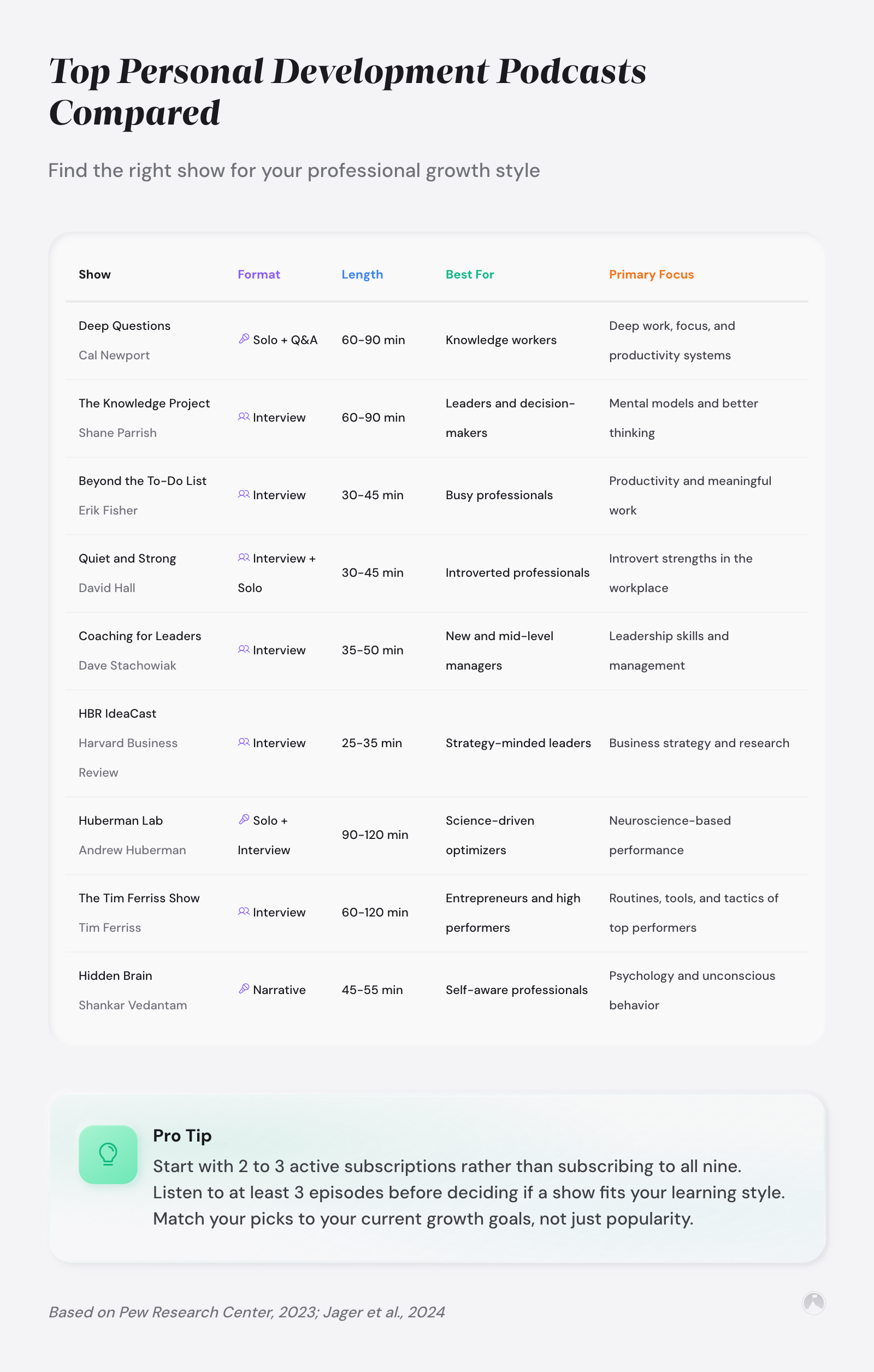
Podcast comparison table
| Podcast | Format | Episode length | Best for | Effort level | Evidence basis |
|---|---|---|---|---|---|
| Deep Questions (Cal Newport) | Solo + listener Q&A | 60-90 min | Deep work and focus | High depth | Peer-reviewed research |
| Knowledge Project (Shane Parrish) | Long-form interviews | 90-120 min | Decision-making frameworks | High depth | Named researchers as guests |
| Beyond the To-Do List (Erik Fisher) | Interviews | 30-45 min | Work-life balance | Moderate | Practitioner experience |
| Quiet and Strong (David Hall) | Interviews | 30-40 min | Introvert career strategy | Moderate | Introvert-specific focus |
| Coaching for Leaders (Dave Stachowiak) | Interviews + advice | 30-40 min | Leadership development | Moderate | Long track record (10+ years) |
| HBR IdeaCast | Interviews | 25-30 min | Weekly business updates | Light | HBR editorial standards |
| Huberman Lab (Andrew Huberman) | Solo + interviews | 120-180 min | Neuroscience protocols | Very high | Peer-reviewed research |
| Tim Ferriss Show | Long-form interviews | 60-90 min | High-performer habits | High depth | Long track record (10+ years) |
| Hidden Brain (Shankar Vedantam) | Solo narration | 30-45 min | Psychology applied to work | Moderate | Named researchers as guests |
Ramon’s podcast picks for professionals
The shows that stick are the ones where the host asks the questions you would actually ask. That is why Cal Newport and Shane Parrish made this list – they sit with hard questions instead of rushing to the next talking point. If you are an introvert, The Quiet and Strong Podcast might be the single most validating show on this list – David Hall talks about introversion as a strength rather than something to overcome.
Conclusion
Personal development podcasts for professionals work best when you treat them as tools with a purpose, not background noise. And the nine shows above cover deep work, introvert-friendly leadership, and behavioral psychology – so pick the category that matches your current growth priority.
The right show doesn’t just inform you – it changes the questions you ask about your own work.
Next 10 minutes
Open your podcast app and subscribe to one show from the list above. Choose the one that matches the skill you most want to develop this quarter. Download one episode.
This week
Listen to three episodes from your chosen show before deciding whether to keep it. Most podcast abandonment happens before a listener gives a show time to find its groove. After three episodes, you will know whether the format and host match how you want to learn. If it fits, keep it. But if not, switch to a different show from the list. The goal is two to three active subscriptions that deliver specific value – not a massive library that adds guilt and noise. For more on building a broader personal development strategy, the hub article covers how podcasts fit alongside other growth methods.
Related articles in this guide
- personal-growth-goals-that-stick
- personal-mission-statement-examples-and-how-to-craft-yours
- say-no-without-guilt
Frequently asked questions
How often should I listen to professional development podcasts?
Consistency matters more than frequency. Listening to one episode per week from one show is more effective than binge-listening to five shows sporadically. Build podcast listening into an existing routine – during your commute, during exercise, or during lunch breaks. This prevents the ‘I do not have time’ excuse and keeps engagement steady.
What should I do with insights I hear in a podcast?
Write down one actionable insight from each episode (takes 2 minutes). Apply it within 48 hours in a real work situation. This transition from listening to action is what separates passive entertainment from active learning. Without this step, most podcast learning disappears within 24 hours.
Can podcast listening replace formal training or coaching?
Podcasts are a supplement to formal learning, not a replacement. They work best alongside practice, mentoring, or formal training programs. Use podcasts to build foundational knowledge and perspective, then combine with deliberate practice to build actual skills.
How do I find podcast episodes on specific topics?
Use the show’s website or search function in your podcast app. Most professional development podcasts maintain searchable archives and show notes with detailed topics covered. Searching the archive for episodes matching your current challenge is faster than listening chronologically.
What is the best time to listen to podcasts for learning?
Listen when you can focus on content without distraction. For many professionals, the commute works well – the environment is controlled and distractions are limited. Avoid listening during cognitively demanding work. Light activities – exercising, walking, or household tasks – pair well with podcast listening.
Should I take notes while listening to podcasts?
Light note-taking works well. Jot down one actionable insight or question to explore further. Heavy note-taking during an episode is counterproductive – you will focus on writing rather than comprehending. Save detailed notes for after the episode when you can reflect on what stood out.
How do I know if a podcast is high quality?
Look for three signals that go beyond basic production quality: first, check whether the host has ever corrected a past claim or updated outdated advice – intellectual honesty is a strong quality signal. Second, review the show notes depth – quality shows include timestamps, guest credentials, and links to studies mentioned. Third, read listener reviews for patterns like ‘changed how I think about X’ rather than just ‘entertaining.’ A show that consistently updates its thinking and documents its sources is more likely to deliver durable professional value.
Can introverts benefit from podcasts as much as extroverts?
Yes. Podcasts often work better for introverts – they are a solitary, self-paced format with no social performance required. You control the pace, can pause to reflect, and can listen at times that match your energy patterns. Many of the shows on this list are particularly introvert-friendly.
References
[1] Pew Research Center. (2023). How Americans use and engage with podcasts. https://www.pewresearch.org/journalism/2023/04/18/how-americans-use-and-engage-with-podcasts/
[2] LinkedIn. (2018). Workplace Learning Report. LinkedIn Learning. https://learning.linkedin.com/blog/learning-and-development/the-2018-workplace-learning-report
[3] Jager, P. M., Schoger, J., & Sarmento, R. P. (2024). Podcasts and informal learning: Exploring knowledge acquisition and retention. Education Sciences, 14(10), 1129. DOI
[4] Cosimini, M. J., Cho, D., Liley, F., & Espinoza, J. (2017). Podcasting in medical education: How long should an educational podcast be? Journal of Graduate Medical Education, 9(3), 388-389. DOI
[5] Grant, A. M., Gino, F., & Hofmann, D. A. (2011). Reversing the extraverted leadership advantage: The role of employee proactivity. Academy of Management Journal, 54(3), 528-550. DOI