
When every self-help book adds three more items to your to-do list
You bought the books. You bookmarked the articles. You signed up for courses and wrote three pages of goals. Now instead of growing, you’re frozen.
That’s not a motivation problem. It’s a system problem. And the personal development overwhelm solutions most people reach for — more apps, more courses, more goals — only deepen the problem. Market research firm Grand View Research estimates the personal development industry at roughly 50 billion dollars globally, built on selling one idea: that you need to fix everything at once [1].
Books on habits. Courses on leadership. Podcasts on mindset. Apps for meditation. Each one promises transformation. Together, they guarantee paralysis.
Personal development overwhelm is not about taking on too much – it is about a system designed to keep you buying instead of building. The solution requires subtraction, not addition. It requires choosing what not to work on.
Personal development overwhelm is the state of paralysis that occurs when the volume of self-improvement goals, resources, and expectations exceeds an individual’s capacity to act on them. Driven by competing priorities and constant information overload, it produces stagnation and guilt rather than meaningful growth.
What you will learn about managing personal development overwhelm
- Why personal development creates the opposite of what it promises and what research reveals about cognitive limits
- A triage system that cuts your growth plan to two focused priorities
- How to budget energy for development when social demands drain you
- Why limiting personal growth objectives accelerates results instead of slowing them
- Solo development methods that replace group-based training
- How to stop consuming self-help content and start completing development goals
Key takeaways
- Personal development overwhelm is a system problem caused by having too many personal development goals simultaneously, not a discipline failure.
- The Development Triage System sorts goals into “Act Now,” “Park,” and “Release” to restore focus and reduce cognitive load.
- Limiting active development to two priorities produces more progress than spreading effort across ten goals.
- Introverts need energy budgets that account for the social costs of professional development activities.
- Self-directed learning methods match or outperform group-based training for many skill areas.
- Abandoning goals you’ve already invested in is strategic thinking, not weakness.
- Completed goals rebuild confidence faster than unfinished ones erode it.
- Curating your self-improvement information diet is as important as curating your development plan itself.
Why personal development creates overwhelm instead of growth
The personal development industry profits from making you feel insufficient across multiple dimensions at the same time. The formula is predictable: convince people they need to improve in many areas at once, then sell a product for each area.
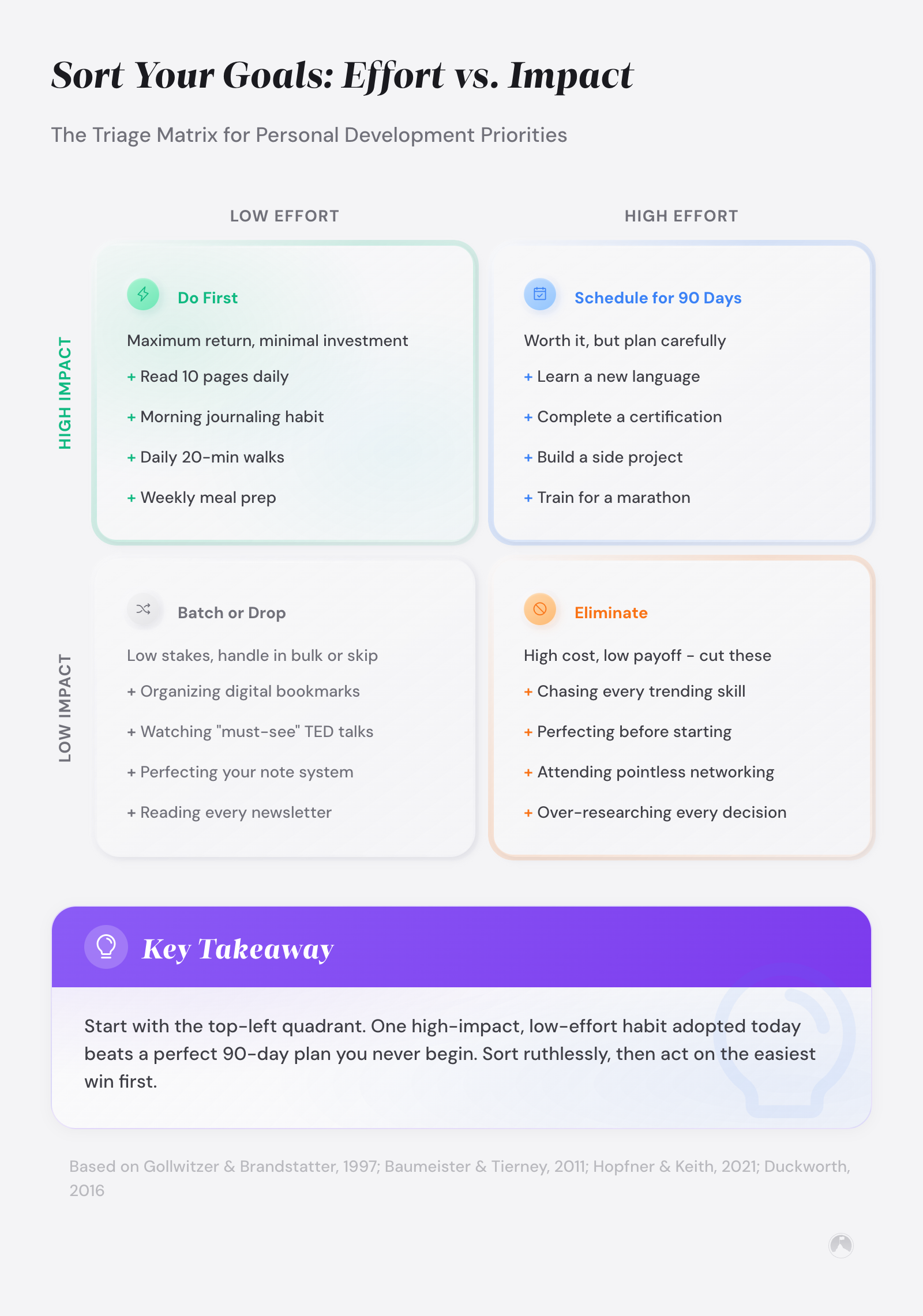
But here’s what cognitive science shows. Cognitive load theorist John Sweller found that working memory can only process a limited amount of new information at once before attention scatters across competing demands [2]. When you’re trying to build a meditation habit, learn new software, network more effectively, read two books per month, and practice journaling, your brain doesn’t distribute effort evenly across all five. It scatters.
The result is attention residue across too many goals. You start each day with a vague sense that you should be doing more. You end each day feeling guilty about what you didn’t get to. Researchers Martin Eppler and Jeanne Mengis confirmed that excessive information input reduces decision quality and increases anxiety rather than improving performance [3].
For introverts, the situation compounds. Most professional development advice assumes unlimited social energy for networking events, group workshops, and mentorship lunches. Psychologist Susan Cain’s research shows that introverts process stimuli more deeply than extroverts, which means social development activities carry a disproportionately higher cognitive and energetic cost [4]. An introvert managing five development goals that each include social components isn’t dealing with overwhelm. They’re dealing with exhaustion layered on top of overwhelm.
“When high and specific goals are failed, affect becomes more negative and self-esteem and motivation are reduced. Goal-failure can reduce motivation for future tasks.” – Hopfner and Keith [5]
Research by Hopfner and Keith on goal failure shows that when people don’t progress on too many simultaneous goals, negative emotions like guilt emerge, which paradoxically trigger more goal-setting behavior as a misguided compensation strategy [5]. This creates a self-reinforcing cycle where the initial overwhelm worsens the very conditions that created it.
The self-improvement industry sells addition. The solution to overwhelm requires subtraction.
Development overwhelm cycle is a self-reinforcing pattern where failure to progress on too many simultaneous goals triggers guilt, prompting additional goal-setting or self-help consumption, which increases overwhelm further.
The Development Triage System: three steps to focus
Emergency rooms don’t treat every patient in the order they arrive. They triage: assess urgency, allocate limited resources to where they’ll produce the most good, and accept that some cases will have to wait.
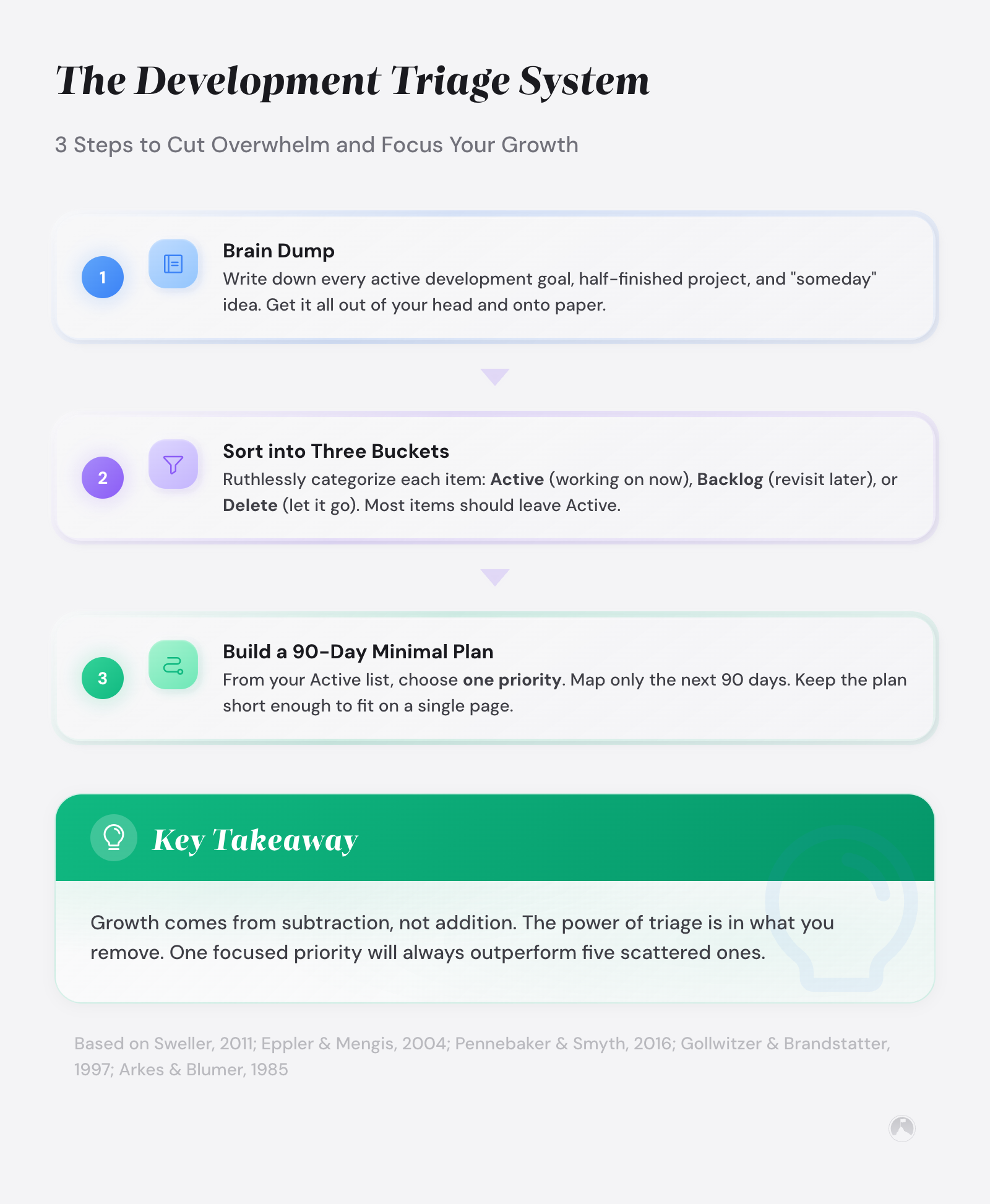
Your personal development plan needs the same approach. Built on psychologist Peter Gollwitzer’s research on implementation intentions [6] and Ryan and Deci’s self-determination theory [18], the Development Triage System forces the decision most overwhelmed people avoid: choosing what not to work on.
Step 1: the brain dump
Write down every personal and professional development goal currently occupying mental space. Courses you’ve started. Books you feel you should read. Skills you think you need. Habits you’ve been meaning to build.
Don’t filter. Don’t organize. Research by psychologist James Pennebaker on expressive writing shows that externalizing thoughts reduces their cognitive load and provides emotional relief [7].
Most people find 15 to 30 items on this list. That surprise is the point. You can’t see the overwhelm until it’s on paper.
Step 2: sort into three categories
Take each item and place it into one of three categories:
| Category | Criteria | Limit |
|---|---|---|
| Act Now | Directly connected to a current life goal or solves a problem causing real friction today | Maximum 2 items |
| Park | Genuinely valuable but not urgent; will still be relevant in 90 days | 3-5 items |
| Release | Adopted from external pressure, comparison, or “should” thinking; not connected to current priorities | Everything else |
The hard limit of two items in “Act Now” is non-negotiable. In Gollwitzer and Brandstatter’s research, participants who created specific implementation plans for their goals completed them at a 71% rate compared to 32% for those without plans [6]. And goal-setting research by Latham and Locke confirms that limiting active goals to a small number activates goal-focused regulatory states, while spreading effort across too many goals triggers a diffuse maintenance mode where effort feels high but progress stalls [16]. Two focused priorities create forward movement. Ten diluted priorities create the illusion of effort.
Step 3: build a 90-day minimal plan
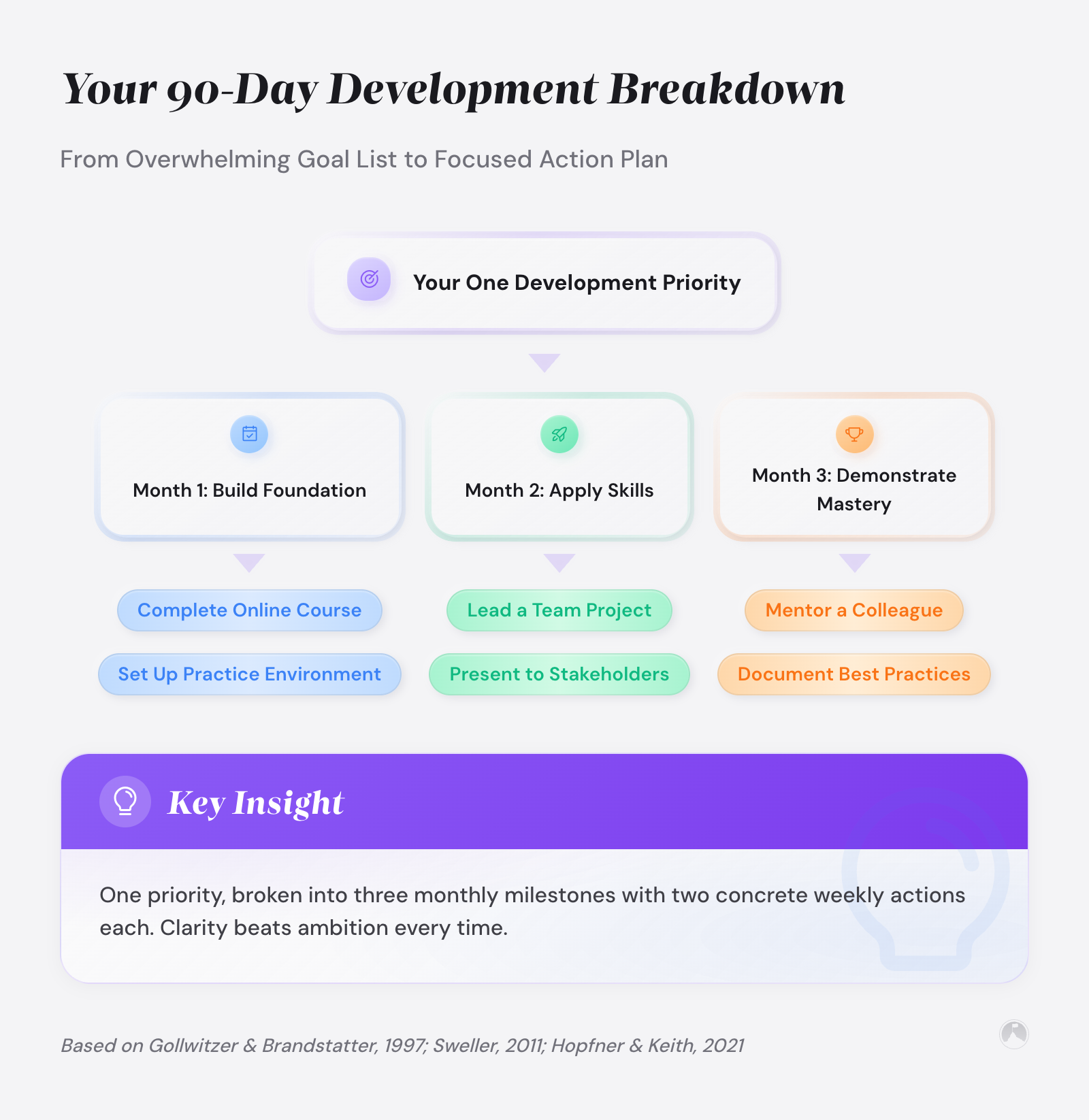
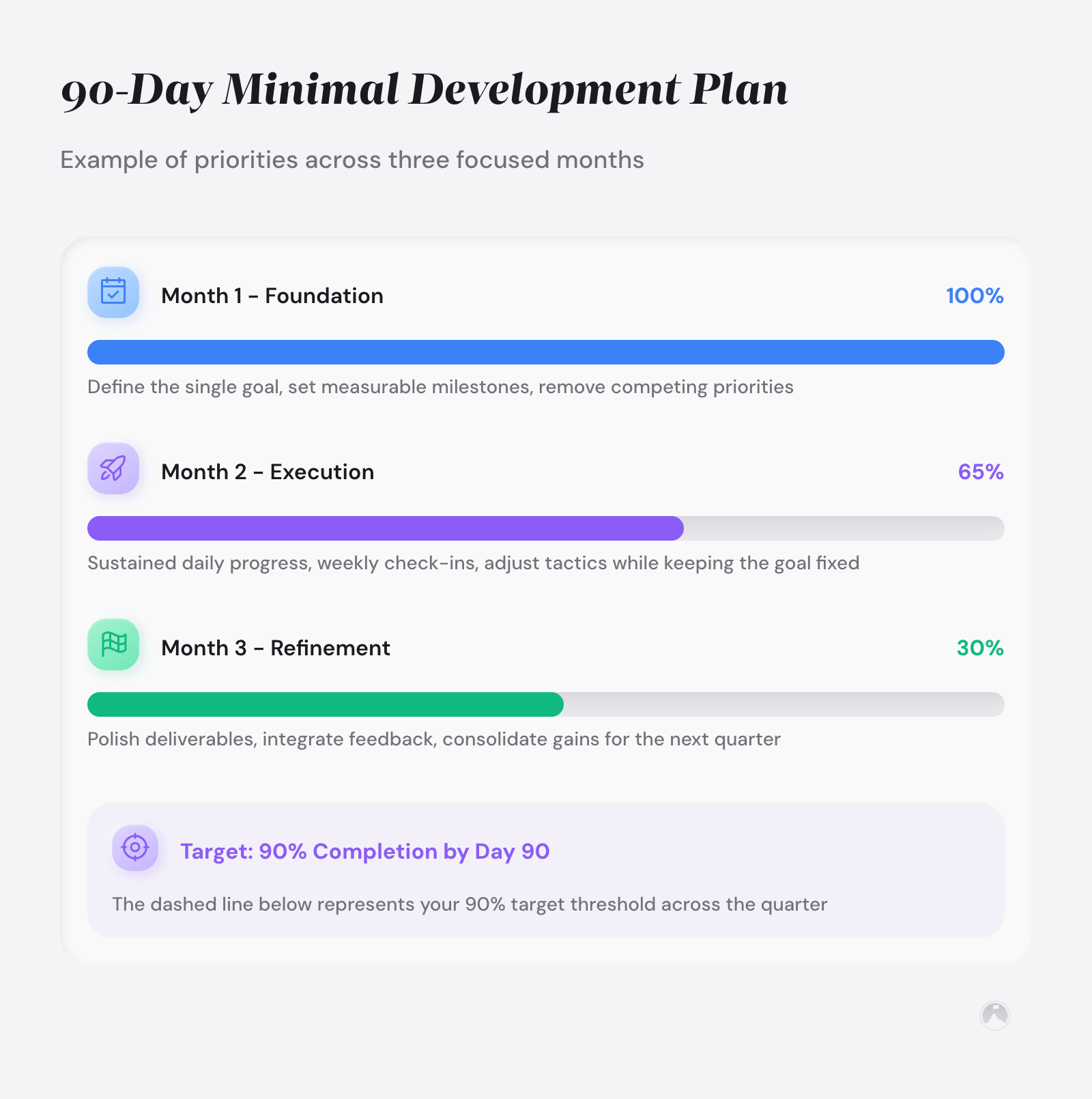
For your two “Act Now” items, define one concrete action per week. Not a system. Not an audit. One action taking 30 minutes or less.
If your priority is “improve public speaking,” your weekly action might be recording a two-minute practice talk on your phone. If it’s “learn data analysis,” your action might be completing one lesson in an online course.
The 90-day timeframe matters. It’s long enough to see genuine progress and short enough to prevent the “forever project” feeling that feeds overwhelm. At the end of 90 days, you re-triage. Something from “Park” might move to “Act Now.” Something from “Act Now” might be complete.
A development plan that fits on an index card outperforms one that fills a notebook. The index card gets executed.
Energy management for professionals: strategic allocation for introverts
Not all development activities cost the same amount of energy. Reading a book costs almost nothing for most introverts. Attending a networking event costs significantly more. Energy management for professionals means assigning an energy cost to each development activity and staying within your weekly budget – and it’s one of the most practical introvert personal development alternatives to the standard “do everything” approach.
Energy budgeting for development is a planning practice where individuals assign estimated energy costs to each personal or professional growth activity and cap their weekly total to prevent depletion and burnout.
Research by psychologist Roy Baumeister proposed that willpower and self-regulation draw from a limited daily pool, though some replication attempts have challenged the strength of this effect [8]. Regardless of the theoretical mechanism, the practical observation holds: for introverts, social activities are disproportionately draining. A two-hour workshop doesn’t cost two hours. It costs two hours plus the recovery time afterward.
Here’s a practical approach:
| Activity type | Energy cost (1-5) | Introvert adjustment |
|---|---|---|
| Solo reading or courses | 1 | No change |
| One-on-one mentorship call | 2 | +1 if new relationship |
| Small group workshop (5-10 people) | 3 | +1 for unfamiliar groups |
| Networking event | 4 | +1 for open-format events |
| Conference with full-day attendance | 5 | +1 if speaking or presenting |
If your weekly energy budget is 6 points, you might choose one solo course session (1), one mentorship call with someone you know (2), and a small team workshop (3). That leaves zero room for an unplanned networking lunch. And that’s fine.
Saying no to development opportunities that exceed your energy budget isn’t avoidance. It’s strategic boundary-setting that protects your capacity to grow. Personal development burnout solutions start with recognizing that capacity is finite and budgeting accordingly.
An introvert who manages their energy budget and finishes two goals outperforms the extrovert who says yes to everything and finishes none.
Does narrowing your focus mean falling behind?
You might be wondering whether cutting your development plan this dramatically means you’ll fall behind your peers. It’s the most common objection, and goal-setting research by Duckworth, Latham, and Locke answers it clearly.
Psychologist Angela Duckworth’s research on grit found that long-term consistency of effort toward a single direction is one of the strongest predictors of achievement [9]. Spreading effort across ten areas dilutes the consistency that drives results. Goal-setting researchers Gary Latham and Edwin Locke confirmed that goals must be specific and limited in number to activate regulatory focus – beyond three to five active goals, the brain defaults to a diffuse maintenance mode rather than a focused goal-pursuit mode [16]. The person who spends 90 days improving one skill will outperform the person who spends 90 days touching ten skills superficially.
There’s a second layer to this concern: sunk cost anxiety. You’ve already paid for the course. You already told people about the goal. Walking away feels wasteful.
But research by Arkes and Blumer on the sunk cost fallacy shows that continuing to invest in a failing plan based on past investment produces worse outcomes than cutting losses and redirecting resources [10]. Releasing a development goal you already invested in isn’t weakness. It’s the strategic thinking that separates effective leaders from busy ones.
And there’s a confidence dimension. Psychologist Carol Dweck’s work on mindset suggests that repeated experiences of incompletion reinforce fixed beliefs about capability, reducing willingness to take on future challenges [11].
Each unfinished goal erodes your belief in your ability to follow through. That erosion is more damaging than any single skill gap. When you complete two goals thoroughly over 90 days, you rebuild the evidence that you can finish what you start. That restored confidence carries into every area of your life.
“When people autonomously disengage from goals rather than feeling forced to by others, they experience less guilt and less rumination, and are more successful at reallocating effort to new priorities.” – Holding, Moore, and Hope [14]
Sunk cost anxiety in development is the reluctance to abandon a personal growth goal after investing time, money, or emotional energy, even when continuing produces diminishing returns and increases overwhelm.
Narrowing focus doesn’t mean you’re doing less growing – it means you’re doing less pretending to grow.
Solo development methods that replace group-based training
One of the biggest sources of development overwhelm for introverts is that most professional growth opportunities assume group participation. But research on self-regulated learning shows strong outcomes. A meta-analysis by Tanya Sitzmann and Kimberly Ely, covering 430 studies with over 90,000 trainees, found that self-regulated learning strategies — including goal-setting, persistence, and self-efficacy — were strong predictors of learning outcomes in work-related training [12].
Here are solo alternatives that match common group-based formats:
| Traditional format | Solo alternative | Why it works for introverts |
|---|---|---|
| Networking events | 3-5 deep one-on-one relationships maintained through scheduled calls | Depth over breadth; lower energy cost per interaction |
| Group workshops | Online self-paced courses with practice exercises | No social performance required; learn at your own speed |
| Conferences | Curated podcasts and recorded talks | Same content, zero social drain; pause and revisit anytime |
| Team brainstorming | Solo journaling and mind-mapping sessions | Psychologist Susan Cain’s research shows introverts generate higher-quality ideas in solitude because the brain’s imagination network activates during solo reflection while group settings trigger social monitoring instead [4] |
| Mentorship programs | One-on-one mentorship via email or scheduled monthly calls | Predictable energy cost; deep conversation over surface networking |
This doesn’t mean introverts should avoid all social development activities. It means choosing the social activities that deliver the highest return per energy unit spent. A monthly one-on-one with a mentor you trust will likely advance your career more than attending four networking events. Personal development for introverts works best when built around these focused, low-drain relationship investments.
The most effective personal development system is the one that matches your energy patterns, not the one that sounds most impressive on paper.
How to stop self-help content from fueling overwhelm
One of the sneakiest drivers of development overwhelm is the constant stream of self-help content itself. Every podcast episode, article, and social media post adds another “should” to your list. Researchers David Bawden and Lyn Robinson found that information overload reduces decision quality, increases anxiety, and paradoxically reduces motivation to act – what they describe as the self-help consumption paradox where more content leads to less action [13].
Here’s what an information diet for personal development looks like: pick one book or course that aligns with your two “Act Now” priorities. Unsubscribe from newsletters that don’t serve those priorities. Unfollow social media accounts that make you feel behind.
Give yourself a 90-day window where you consume only content related to your two active goals. A broader personal development strategy can guide how you select those priorities in the first place.
This feels radical. The self-improvement industry has normalized constant consumption. But you wouldn’t eat from ten restaurants simultaneously. You choose one meal, eat it, and move on.
Research by Webb and Sheeran found that when people successfully change their intentions toward a goal, they achieve meaningful behavior change, with medium-to-large effects on follow-through [17]. You haven’t given up on growth. You’ve chosen to grow in a way your brain can process.
The person consuming the least self-help content is often making the most progress. They spend their time practicing instead of planning.
Personal development overwhelm with limited time
If you’re a parent, a caregiver, or someone whose schedule is dictated by others, development overwhelm hits differently. You don’t have the luxury of blocking dedicated growth time. Any development activity competes with responsibilities that can’t be rescheduled.
The Development Triage System adapts to this reality. When your time is constrained, the “Act Now” limit might drop from two items to one. Your weekly action might shrink from 30 minutes to 15. The principles stay the same: narrow ruthlessly, protect what matters, and release the rest.
For introverted parents or professionals with ADHD, the combination of limited time, limited energy, and scattered attention makes standard development advice doubly harmful. The approach of building a tiny daily learning habit works well here. It doesn’t require a dedicated time block. Five minutes of practice during a commute or lunch break still compounds over 90 days.
The key insight: your development plan should be the most flexible part of your schedule, not the most rigid. When a sick child or an urgent deadline wipes out your planned development time, the plan bends instead of breaking. You pick it up the next day without guilt and without a backlog.
Ramon’s take
That ‘Park’ category is the one that trips me up. I don’t park things, I just quietly feel guilty about them for six months. Is naming them actually different, or is it just a nicer word for things I’m avoiding?
What I’ve learned from managing a demanding product management role, running this site, and raising a small child is that personal development overwhelm is mostly a filtering problem. The advice out there isn’t bad. There’s too much of it, and most of it assumes you have unlimited time and social energy. Neither is true for me, and I suspect it’s not true for you either.
The approach that’s worked in my own life is embarrassingly simple: I pick one professional skill and one personal area per quarter. Right now it’s delegation at work and consistent exercise at home. Everything else is parked.
When I hear about a great new framework or an interesting course, I write it on a list and move on. The list doesn’t create pressure. I’ve already decided what I’m working on this quarter.
The hardest part isn’t choosing what to focus on. It’s accepting that the goals you’re not focusing on will still be there later. They will. And you’ll be in a better position to tackle them after you’ve built momentum on the one or two priorities that matter most right now. I’d rather finish two projects well than start ten projects I’ll abandon by March.
Conclusion
Personal development overwhelm solutions don’t require another framework, another app, or another morning routine. They require you to do less, on purpose.
The Development Triage System works by acknowledging what the self-improvement industry won’t: you cannot optimize every area of your life at the same time, and attempting to do so guarantees you’ll make meaningful progress in none of them. Limiting personal growth objectives is not a compromise. It is the strategy itself.
The most productive personal development plan you’ll ever write is the one that fits on a single index card. Two priorities. One action per week for each. Ninety days of focused effort. Then re-assess. That’s it.
Next 10 minutes
- Write down every personal development goal currently taking up mental space (the brain dump)
- Sort your list into “Act Now” (maximum 2), “Park,” and “Release”
- Unsubscribe from one newsletter or unfollow one account that adds to your overwhelm
This week
- Define one concrete weekly action (under 30 minutes) for each of your two “Act Now” priorities
- Calculate your weekly energy budget and check whether your current commitments fit within it
- Set a calendar reminder for 90 days from today to re-triage your personal growth goals
There is more to explore
If your overwhelm has already progressed to burnout, our guide on personal development burnout covers recovery strategies including recognizing the warning signs and building a sustainable pace. For those ready to rebuild after triaging, how to create a personal development plan walks through structuring your two Act Now priorities into a concrete 90-day roadmap.
Related articles in this guide
- personal-development-podcasts-for-professionals
- personal-growth-goals-that-stick
- personal-mission-statement-examples-and-how-to-craft-yours
Frequently asked questions
What self-paced learning methods work best for introverted professionals?
Online courses with flexible deadlines, curated reading lists, and recorded conference talks deliver strong learning outcomes without social energy costs. A meta-analysis by Sitzmann and Ely found that self-regulated learning strategies like goal-setting and persistence were strong predictors of learning outcomes in work-related training [12]. Pair self-paced learning with a single accountability partner rather than a cohort group to add structure without overwhelm.
How can introverts prepare for required social development events to reduce anxiety?
Set a specific goal before attending, such as having two meaningful conversations rather than working the room. Arrive early when crowds are smaller and leave when your energy budget is spent rather than staying until the end. Pre-event intention-setting reduces anxiety and improves social performance for introverts.
What role does one-on-one mentorship play in introvert professional development?
One-on-one mentorship is often the highest-return development investment for introverts. It provides deep, personalized guidance at a predictable energy cost. Schedule monthly calls rather than open-ended relationships to maintain boundaries. Many successful leaders credit a single mentor relationship rather than broad networking for their career breakthroughs.
How do introverts use strengths like deep thinking for professional growth?
Deep thinking, careful analysis, and sustained concentration are competitive advantages in roles requiring complex problem-solving and strategic planning. Introverts can position these strengths by choosing development areas that reward depth over speed, such as technical expertise, written communication, and specialized knowledge that colleagues depend on.
What strategies help introverts recover energy after required social events?
Schedule at least 30 minutes of solo time immediately after social events before transitioning to other tasks. Avoid stacking social commitments on the same day. Some introverts find that brief walks, noise-cancelling headphones, or journaling for five minutes accelerates recovery. The goal is protecting the hours after an event, not pushing through with depleted energy.
How do introverts build confidence through small consistent actions?
Confidence builds from accumulated evidence of competence. Psychologist Carol Dweck’s research suggests that each small goal completed on time adds data that counters fixed beliefs about not following through [11]. Start with a weekly development action so small it feels almost trivial, then gradually increase scope after the first 30 days.
Can introverts advance professionally without forced networking?
Career advancement research shows that a small number of strong professional relationships produces better outcomes than a large network of weak ties. Focus on building three to five deep connections with people who share your professional interests. Written communication channels like email, thoughtful LinkedIn messages, and published work can substitute for in-person networking.
How much personal development is too much at one time?
Research by Latham and Locke on goal-setting found that more than three active development priorities at once typically produces diminishing returns [16]. A practical test: if you cannot name your top two development priorities without checking a list, you likely have too many. Reduce until every active goal has a specific weekly action attached to it.
References
[1] Grand View Research. “Personal Development Market Size, Share & Trends Analysis Report.” 2024. https://www.grandviewresearch.com/industry-analysis/personal-development-market
[2] Sweller, J. “Cognitive Load Theory.” Psychology of Learning and Motivation, Vol. 55, 2011. DOI
[3] Eppler, M.J. & Mengis, J. “The Concept of Information Overload: A Review of Literature.” The Information Society, 20(5), 2004. DOI
[4] Cain, S. “Quiet: The Power of Introverts in a World That Can’t Stop Talking.” Crown Publishing, 2012.
[5] Hopfner, J. & Keith, N. “Goal Missed, Self Hit: Goal-Setting, Goal-Failure, and Their Affective, Motivational, and Behavioral Consequences.” Frontiers in Psychology, 12, 704790, 2021. DOI
[6] Gollwitzer, P.M. & Brandstatter, V. “Implementation Intentions and Effective Goal Pursuit.” Journal of Personality and Social Psychology, 73(1), 1997. DOI
[7] Pennebaker, J.W. & Smyth, J.M. “Opening Up by Writing It Down.” Guilford Press, 2016.
[8] Baumeister, R.F. & Tierney, J. “Willpower: Rediscovering the Greatest Human Strength.” Penguin Press, 2011.
[9] Duckworth, A. “Grit: The Power of Passion and Perseverance.” Scribner, 2016.
[10] Arkes, H.R. & Blumer, C. “The Psychology of Sunk Cost.” Organizational Behavior and Human Decision Processes, 35(1), 1985. DOI
[11] Dweck, C.S. “Mindset: The New Psychology of Success.” Random House, 2006.
[12] Sitzmann, T. & Ely, K. “A Meta-Analysis of Self-Regulated Learning in Work-Related Training and Educational Attainment.” Personnel Psychology, 64(2), 2011. DOI
[13] Bawden, D. & Robinson, L. “The Dark Side of Information: Overload, Anxiety and Other Negative Experiences with Information.” Journal of Information Science, 35(2), 2009. DOI
[14] Holding, A.C., Moore, A., Verner-Filion, J. et al. “Choosing to Lose It: The Role of Autonomous Motivation in Goal Disengagement.” Motivation and Emotion, 46, 2022. DOI
[16] Latham, G.P. & Locke, E.A. “New Developments in and Directions for Goal-Setting Research.” European Psychologist, 12(4), 2007. DOI
[17] Webb, T.L. & Sheeran, P. “Does Changing Behavioral Intentions Engender Behavior Change? A Meta-Analysis of the Experimental Evidence.” Psychological Bulletin, 132(2), 2006. DOI
[18] Ryan, R.M. & Deci, E.L. “Self-Determination Theory and the Facilitation of Intrinsic Motivation, Social Development, and Well-Being.” American Psychologist, 55(1), 2000. DOI