
Most personal development advice was written for extroverts
You read the book. You signed up for the networking event. You lasted 40 minutes before leaving. The problem wasn’t motivation – it was the system itself.
The mainstream self-improvement industry runs on extrovert assumptions. Join groups. Find an accountability partner who calls daily. Attend conferences. Build a massive network. The advice repeats everywhere, and it fits roughly half the population at best.
Personal development for introverts works differently because introvert brains are wired differently. A 1999 PET scan study by Johnson and colleagues found that introverts display greater frontal cortex blood flow during complex mental tasks, suggesting a neurological basis for the deep reflection and careful analysis that genuine growth demands [1]. The solution isn’t trying harder at group activities. It’s building systems that channel your actual introvert strengths for personal growth instead of fighting them.
Personal development for introverts is a strengths-based approach to growth that channels introverted qualities – deep reflection, focused attention, preference for meaningful one-on-one relationships, and sustained independent practice – into systematic self-improvement, rather than forcing adaptation to extrovert-oriented methods.
What you will learn
- Why mainstream personal development consistently fails introverts and what neuroscience says about your actual advantages
- A depth-first development framework built for introverted wiring (the Quiet Momentum Method)
- How to budget social and cognitive energy so growth activities don’t drain you
- Career advancement strategies that rely on depth rather than visibility
- How to build professional relationships without draining traditional networking
- What to do when your workplace rewards extroverted behavior
Key takeaways
- Introvert brains show higher frontal cortex blood flow during complex tasks, pointing to deep reflection as a genuine biological strength for growth [1].
- The Quiet Momentum Method builds personal development around solitary input, deliberate solo practice, and selective depth-first relationships.
- Energy budgeting treats social capacity as a limited daily resource to spend strategically rather than wastefully.
- Research on mentoring approaches found that one-on-one mentorship produces stronger developmental outcomes than group-based training programs, with pronounced benefits for introverts [6].
- Written communication and strategic project selection can replace high-volume networking for career advancement.
- Grant, Gino, and Hofmann found that introverted leaders outperform extroverted leaders when managing proactive teams [4].
- Building confidence as an introvert starts with competence-based mastery rather than exposure therapy, based on Bandura’s self-efficacy research [10].
- Research on personality and environment found that quiet spaces and uninterrupted time blocks measurably improve introvert cognitive output [2].
Why mainstream personal development fails introverts
Personal development for introverts requires systems built on deep reflection, focused solo practice, and selective one-on-one relationships rather than group activities and high-volume networking. Research shows introvert brains display higher frontal cortex activity during complex tasks, making solitary learning and deliberate practice more effective than socially demanding development programs [1].
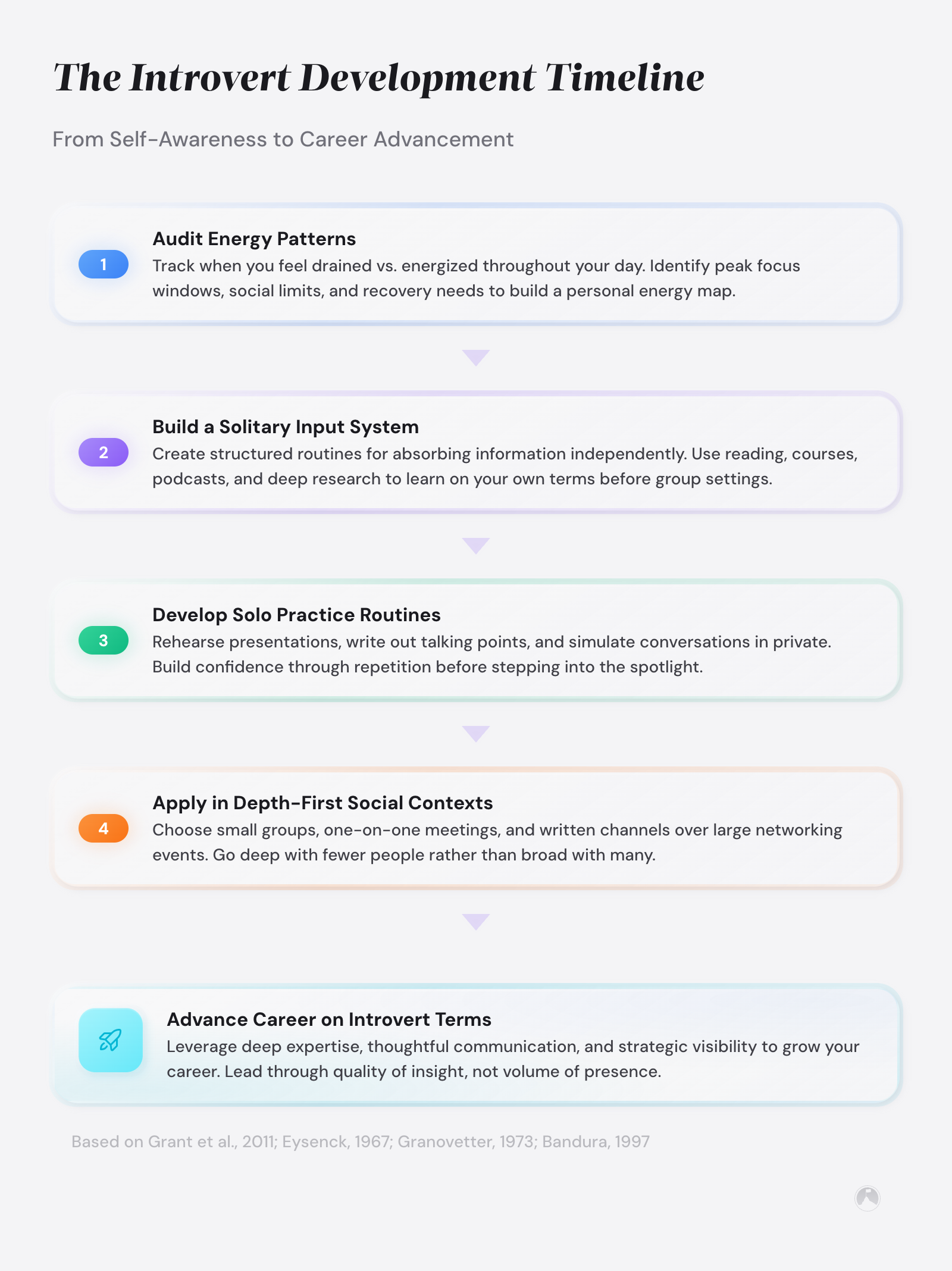
The extroversion bias in self-help runs deeper than surface-level advice. It’s embedded in the entire architecture of how development programs work.
Most systems assume that learning happens in groups, accountability means external pressure, and growth requires consistent social engagement. But a 2023 systematic review by Herbert and colleagues on personality diversity in workplace environments recommended quiet spaces and limited interruptions as direct interventions for introvert performance [2]. That principle applies to personal development too. When introverts are forced into socially demanding growth activities, the energy cost of participation often outweighs the developmental benefit.
So here’s what the neuroscience actually shows. Johnson and colleagues found that introvert brains display higher blood flow in the frontal cortex – the regions associated with complex mental activities like data integration and stored-information retrieval [1]. Introverts don’t process less. They process differently. More deeply. More carefully. With more connections between existing knowledge.
Feist’s meta-analysis of personality in scientific and artistic creativity found that openness to experience was the strongest personality predictor of creative achievement, with creative scientists and artists also scoring higher on self-confidence, autonomy, and drive [3].
The frustration isn’t lack of commitment. It’s a system mismatch. Self improvement tips for introverted personalities start with one insight: build on deep processing rather than fighting against it.
The strategies that produce real growth look nothing like what the typical self-help book prescribes. They look like journaling instead of group discussions, one mentor instead of twenty acquaintances, online learning for introverted professionals instead of weekend seminars. That’s not settling – it’s optimization.
How the Quiet Momentum Method works
Here’s a framework that keeps showing up when you look at how introverts grow most effectively: three layers, practiced in a specific sequence, each building on the one before. None require group participation.
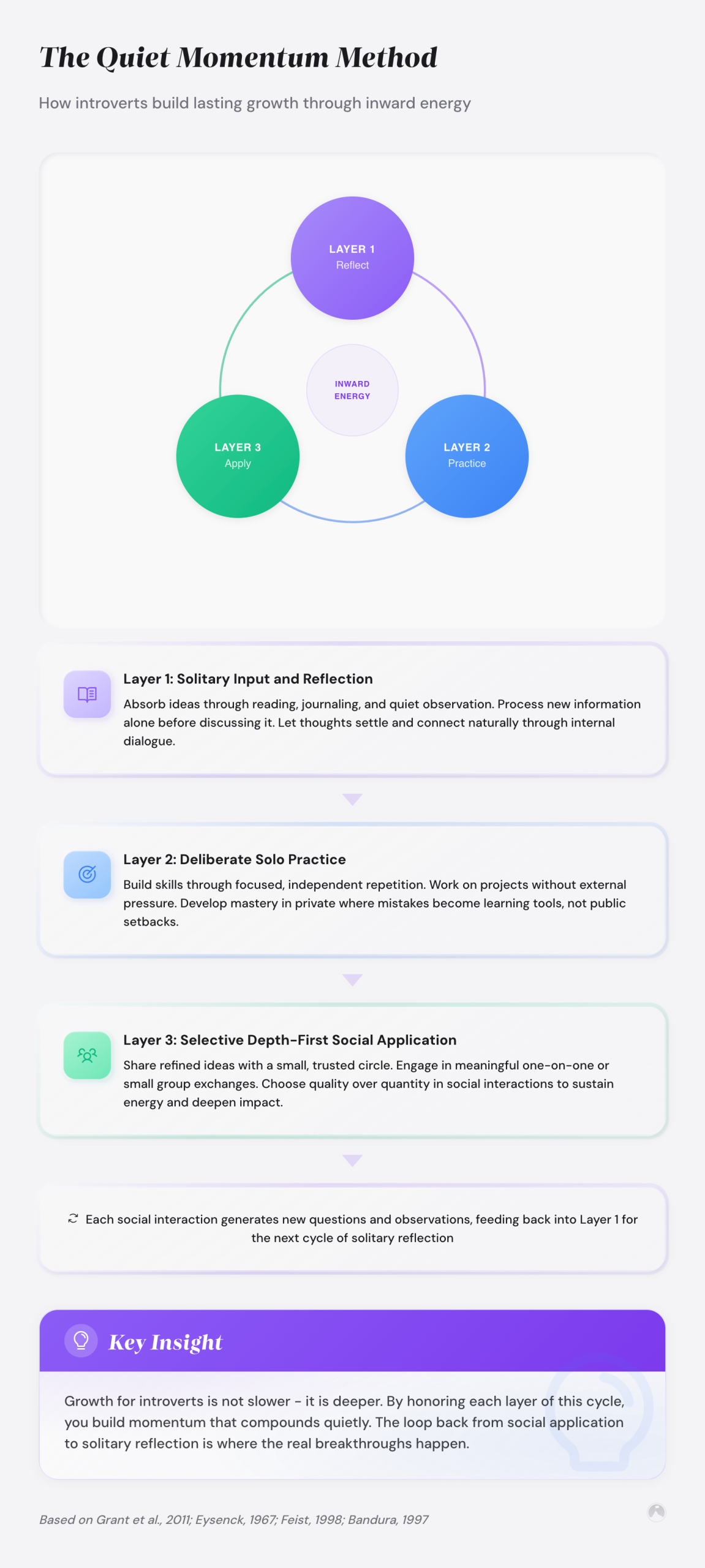
The Quiet Momentum Method is an approach to structuring personal development strategies around introverted strengths rather than working against them. Think of it less as a rigid system and more as a sequence that channels how introvert brains actually work.
Layer 1: Solitary input and reflection
Start with how you absorb information. Introverts learn most effectively through self-paced, solitary methods – reading, podcasts, online courses, journaling about what you’ve learned. This isn’t a lesser form of learning. It’s how deep-processing brains extract the most value from new information.
The practice is simple: spend 20-30 minutes daily in focused input (a chapter, a podcast episode, a course module). Then spend 5-10 minutes writing about what you learned in your own words. And that written synthesis step is what separates passive consumption from active development.
Layer 2: Deliberate solo practice
Input without practice produces knowledge without capability. So Layer 2 converts what you’ve learned into something you can actually do. If you’re developing presentation skills, practice alone in your office before testing in front of others. If you’re building strategic thinking, work through case studies independently before discussing them.
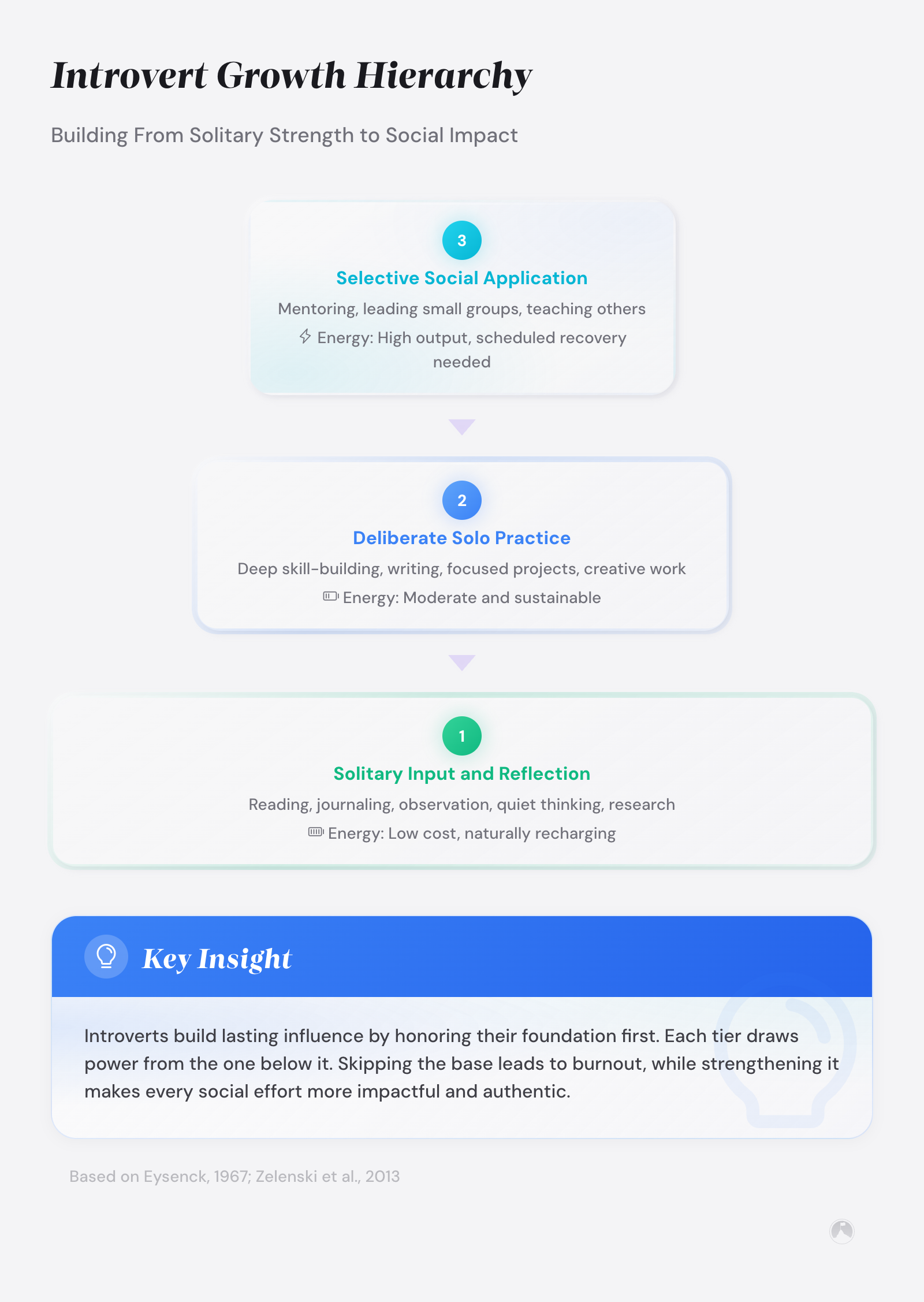
This is where the introvert advantage becomes obvious. Feist’s meta-analysis found that creative achievement correlates most strongly with openness, autonomy, and sustained independent focus – traits that align naturally with introverted working styles [3]. Solo practice isn’t a compromise. It’s the condition under which introverts develop mastery fastest.
Layer 3: Selective, depth-first social application
Growth does eventually require other people. But the Quiet Momentum Method replaces high-volume social interaction with targeted, meaningful engagement. Instead of attending a networking event and talking to 30 people, have one deep conversation with someone whose work you admire. Instead of joining a mastermind with eight strangers, find one mentor who gives you honest feedback.
Research by Grant, Gino, and Hofmann on introvert leadership found that introverted leaders are more likely to listen to and process ideas from team members, creating stronger collaborative outcomes than their extroverted counterparts [4]. While Granovetter’s foundational research demonstrates that weak ties provide critical access to novel information and opportunities [8], introverts can strategically complement this insight by building a small number of high-trust strong ties that serve as reliable sounding boards and sponsors – maximizing relationship quality within their natural social bandwidth.The Quiet Momentum Method is a three-layer personal development framework – solitary input, structured solo practice, and selective depth-first social application – designed to produce sustainable growth by working with introverted cognitive patterns rather than against them.
Here’s what it looks like in practice. An introverted marketing manager wants to develop leadership skills. She reads two leadership books and listens to a podcast series over six weeks, journaling key insights after each session (Layer 1). She practices giving feedback alone through recorded role-play scenarios, then drafts written leadership frameworks for her team (Layer 2). Over the next six months, she schedules monthly one-on-one conversations with a senior leader she respects, bringing prepared questions and specific feedback requests (Layer 3).
Six months later, she’s developed genuine leadership capability without attending a single group workshop. And the learning stuck – it matched how her brain actually works.
Energy management for introverts: the math of growth
A major reason personal development stalls for introverts is energy depletion. Research on introversion and arousal theory suggests that introverts experience higher baseline cortical arousal, making sustained social interaction more cognitively taxing. Extraverts, with lower baseline arousal, actively seek stimulation from the same activities. This isn’t preference – it’s neurological.
You finish a two-hour team meeting already exhausted, then your boss suggests a networking lunch the same day. By evening, you’re too depleted to work on your actual development plan.
What we call energy budgeting addresses this directly.
Energy budgeting is the practice of treating social and cognitive energy as a finite daily resource, deliberately allocating it across activities based on developmental priority and recovery requirements – applying the same logic as financial budgeting to cognitive capacity.
Think of your social energy like a daily budget. Some activities cost more than others. A two-hour team meeting costs more than focused solo work. A networking lunch costs more than a one-on-one coffee. Research on personality and workplace environments by Zelenski and colleagues found that introverts underpredict the hedonic benefits of acting extraverted, suggesting that personality-congruent activities feel more natural and sustainable [7]. Research on cognitive load theory demonstrates that individuals have limited capacity for high-engagement activities, and this capacity is modulated by personality-based arousal differences.
So when development activities consistently overdraw your energy account, growth stalls. Recovery takes precedence over progress. The solution isn’t doing less – it’s spending energy where the developmental return is highest. One-on-one mentorship for introverts often delivers more developmental value per unit of energy than a full-day conference requiring constant social navigation.
Here’s a practical framework for thinking about it. Rate each development activity on two dimensions: energy cost (1 = minimal drain, 5 = exhausting) and developmental value (1 = low, 5 = high). Prioritize activities where value exceeds cost. The estimates below reflect typical introvert responses – adjust based on your experience.
The pattern becomes clear when you map common development activities against their energy cost and expected return. Use this as a starting template – your personal numbers will differ, but the relative rankings hold for most introverts.
| Activity | Energy cost | Dev. value | ROI |
|---|---|---|---|
| One-on-one mentorship | 2 | 5 | 2.5x |
| Online course (solo) | 1 | 4 | 4x |
| Journaling/reflection | 1 | 4 | 4x |
| Small group workshop | 3 | 3 | 1x |
| Large networking event | 5 | 2 | 0.4x |
| Full-day conference | 5 | 3 | 0.6x |
Your action: Copy this matrix and adjust the numbers based on your own experience. Any activity where energy cost exceeds developmental value is a candidate for replacement or modification.
Notice the pattern. High-volume social activities (conferences, networking events) have poor ROI for introverts. Low-energy solitary activities (online courses, journaling) have exceptional ROI. This isn’t about being antisocial – it’s about being strategic with a resource that’s genuinely finite.
Career advancement the introvert way
Here’s an uncomfortable truth: most organizations reward visibility, and introverts tend to let their work speak for itself. The work rarely speaks loud enough.
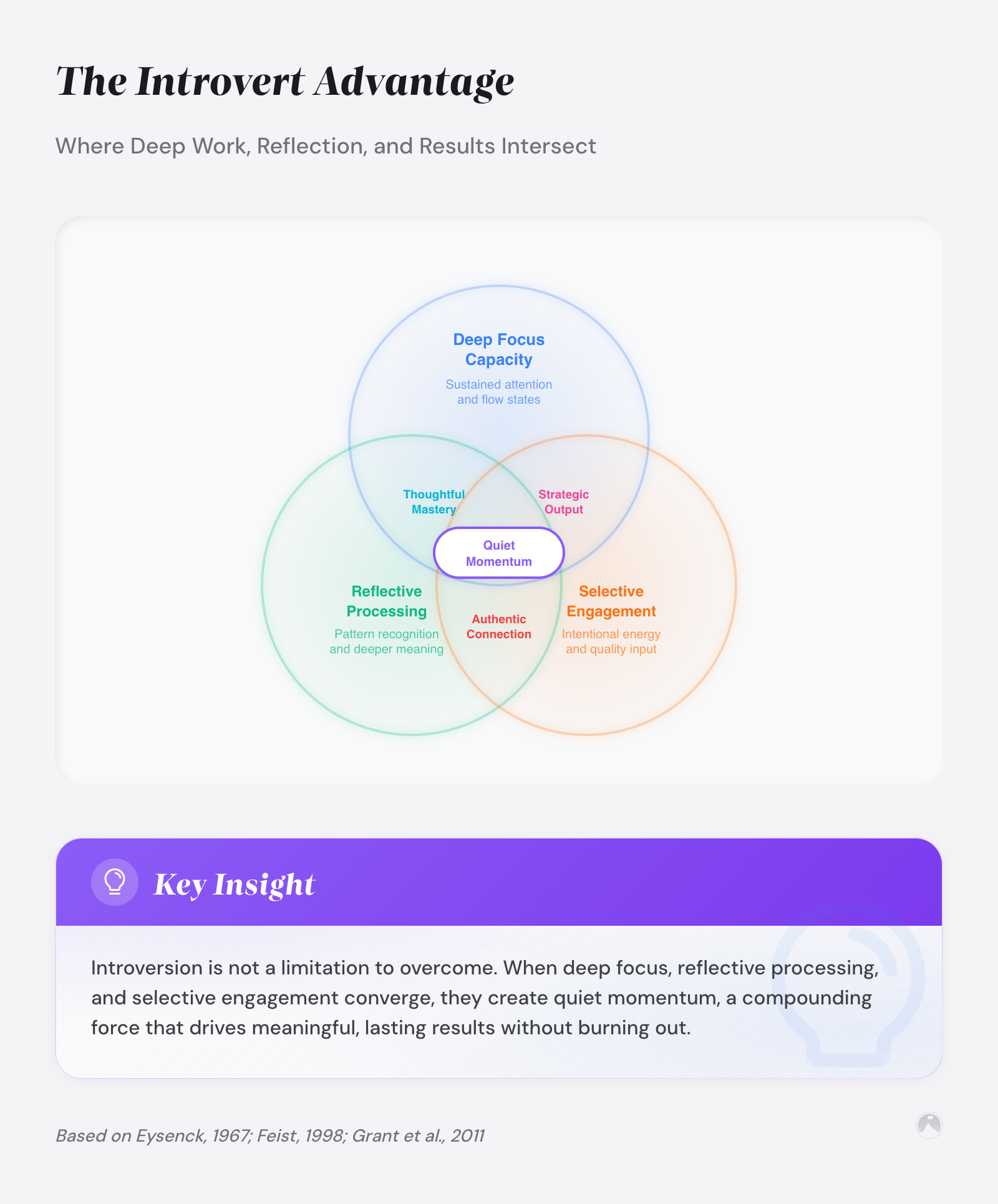
The solution isn’t faking extroversion. It’s strategic visibility – choosing a small number of high-impact ways to make your contributions visible without draining yourself. And the research backs this up.
Grant, Gino, and Hofmann found at Wharton Business School that introverted leaders can outperform extroverted leaders, particularly when managing proactive team members [4]. Introverted leaders are more likely to listen to and process ideas from their teams, leading to better collaborative outcomes. That’s not a consolation prize. And it’s a genuine competitive advantage in organizations that value results over performance.
Strategy 1: Become the deep-knowledge expert
Choose one domain within your field and go deeper than anyone else. Write internal documents. Build reference guides. Create analyses that people keep returning to. And expertise creates pull – people come to you rather than you having to seek them out.
This is how introverts build introvert professional development strategies that match their natural strengths: by finding domains where depth is valued. Consider exploring personal growth goals that align with this deep-knowledge approach.
Strategy 2: Use written communication as your stage
Introverts often express complex ideas more clearly in writing than in meetings. Write thoughtful emails. Publish internal blog posts. Document your project learnings. And written contributions create a searchable, permanent record of your thinking – something a verbal comment in a meeting never does.
Strategy 3: Build two or three sponsor relationships
Instead of networking broadly, invest in a small number of senior leaders who understand and value your work. Burt’s research on structural holes demonstrates that two or three strategic connections spanning different domains creates more competitive advantage than a large undifferentiated network [9]. Consider finding a mentor who respects your working style.
Strategy 4: Select high-impact projects strategically
Volunteer for projects that require deep work and produce visible results. A well-executed analysis, a critical problem solved, or a system designed from scratch speaks louder than months of meeting participation. And this approach works with your introvert strengths rather than against them.
Career advancement for introverts depends on choosing the right form of visibility, not maximizing total visibility. Two well-placed contributions that senior leaders remember outperform a hundred forgettable social interactions.
Building professional relationships without traditional networking
The word “networking” triggers genuine anxiety for many introverts – networking for introverts anxiety is one of the most common barriers to professional growth. And with good reason. The standard format (a room full of strangers exchanging business cards) is built entirely around extroverted social patterns. But professional relationships still matter, so the question isn’t whether to build them. It’s how.
Depth-first networking is a relationship-building strategy that prioritizes meaningful connections with a small number of carefully selected individuals through prepared one-on-one conversations, written engagement, and contribution-based reputation building.
Start with content-based relationship building. Comment thoughtfully on articles or posts by people in your field. Share their work with your own analysis added. Write something valuable and let it open doors. And when someone reaches out in response to your writing, you’ve already established credibility before the first conversation.
Move to prepared one-on-one conversations. Instead of working a room, send a specific message to one person: “I read your piece on X and had a question about Y. Would you have 20 minutes for a conversation?” Introverts perform best in focused, prepared interactions where you’ve done the thinking beforehand. This approach to social skills development for introverts produces better results than forcing yourself through unstructured networking events.
Bandura’s research on self-efficacy identifies four sources of confidence, with mastery experience – successfully completing tasks of increasing difficulty – producing the most robust and durable results [10].
Building confidence as an introvert comes from competence and preparation, not from social exposure therapy. When you’ve researched someone’s work, prepared your questions, and thought about what value you can offer, the conversation feels purposeful rather than draining. Bandura’s research on self-efficacy confirms this: competence-based mastery builds more durable confidence than repeated uncomfortable social exposure [10].
What to do when your workplace rewards extroverted behavior
I know what you’re thinking: “This all sounds nice, but my boss wants me to speak up more in meetings and be more visible.”
Fair point. Many workplaces implicitly reward extroverted behavior. The performance review system often favors people who are loud over people who are thorough.
But this doesn’t mean abandoning your introverted approach. It means communicating its value in terms your organization understands.
Translate your contributions into organizational language
Instead of hoping your deep work speaks for itself, explicitly connect it to business outcomes. “I completed the market analysis that informed the Q3 strategy” is a contribution statement. “I was busy” is not. So document your impact in writing and share it with your manager before performance reviews.
Negotiate your development path
If your company requires group training, propose alternatives: “I’d like to supplement the team workshop with a self-paced course on the same topic, where I can go deeper and share my learnings with the team afterward.” Most managers will accept this if you frame it as producing more value, not less. The research supports you – Herbert and colleagues found that workplace environments accommodating different personality types see improvements in productivity and problem-solving [2].
Choose your visibility moments carefully
You don’t need to be visible all the time. You need to be visible at the right times. Presenting a finished analysis at a quarterly review meeting (where you’ve prepared thoroughly) produces more career impact than speaking up unprepared in fifty weekly standups. So pick your moments deliberately.
The goal isn’t to become extroverted at work – it’s to make your introverted contributions legible to people who measure success differently than you do.
Personal development for introverts with ADHD or parenting constraints
If you’re an introvert with ADHD, the Quiet Momentum Method needs one modification: shorter input sessions with more frequent practice bursts. Brown’s research on ADHD executive function found that shorter focus cycles with regular breaks outperform longer sustained sessions [11]. Replace the 30-minute reading block with two 15-minute sessions. Keep the reflection journaling, but do it immediately after input when the material is fresh. But the depth-first approach still works – it just needs a different rhythm.
For introverted parents, the biggest challenge is that alone time barely exists. Introverted parents often find that integrating learning into existing routines – listening to a podcast during commute or meal prep, reading during a child’s quiet time – produces more consistent progress than waiting for dedicated blocks that rarely materialize. Use audio content instead of reading when your hands are full. For Layer 2 (practice), write during your child’s screen time or after bedtime. For Layer 3, keep your one-on-one conversations to virtual formats that fit irregular schedules.
The principle stays the same: depth over breadth, quality over quantity. If you find your growth ambitions competing with your other responsibilities, explore strategies for managing personal development burnout.
Ramon’s take
Start with the depth-first relationships piece before anything else. Pick two people at work you already respect and go deeper instead of trying to meet more people. That one shift might do more for your career than six months of forced networking.
I used to believe “getting out of your comfort zone” applied equally to everyone. Then I noticed something managing global campaigns in medtech: the colleagues with the most original strategic thinking were always the ones who spent time alone with the problem first. The brainstorm was for refinement. The real work happened in the quiet before.
The introvert advantage in personal development is patience. Extroverts often bounce from one new idea to the next – social reinforcement is immediate. Introverts sit with an idea longer, test it against existing mental models, and adopt it only when it genuinely fits. That’s slower, but it produces more durable change.
The Quiet Momentum Method isn’t something I invented – it’s a pattern I noticed across the research and in the introverted professionals I’ve worked with. The ones who grew the most didn’t try to become extroverts. They got unusually good at a small number of skills and built relationships with a small number of people who mattered.
Conclusion
Personal development for introverts doesn’t require becoming someone you’re not. It requires building systems that channel your natural strengths – deep reflection, focused attention, meaningful relationships, sustained independent practice – into focused growth.
The Quiet Momentum Method offers a three-layer approach: solitary input and reflection, structured solo practice, and selective depth-first social application. Each layer works with introverted wiring rather than against it. The most effective personal development system is the one that matches how your brain actually works.
And the research keeps pointing in the same direction: introverts who stop apologizing for needing solitude and start designing around it don’t just keep up with extroverted peers – they often surpass them in domains that reward depth over volume.
For introverts, that means depth over breadth, preparation over spontaneity, and quality over quantity in every dimension. If you’re interested in choosing between different learning formats, our comparison of self-paced vs structured personal development can help you decide which approach fits your style.
Next 10 minutes
- Identify one development goal you’ve been pursuing with extroverted methods and write down what an introvert-friendly version would look like
- Rate three upcoming development activities on the energy-cost vs. developmental-value scale
- Choose one self-paced learning resource (book, course, or podcast) to begin Layer 1 of the Quiet Momentum Method
This week
- Block 20-30 minutes daily for solitary input and 5-10 minutes for written reflection
- Identify one person for a depth-first one-on-one conversation and send them a specific, prepared message
- Decline or delegate one socially draining development activity and replace it with an energy-efficient alternative
Related frameworks for introverted growth
For a broader view of growth frameworks, explore our guide to personal development strategies. And if you want to build a consistent learning practice that works with your introverted wiring, our piece on building a daily learning habit offers a complementary approach.
Related articles in this guide
- personal-development-overwhelm-solutions
- personal-development-podcasts-for-professionals
- personal-growth-goals-that-stick
Frequently asked questions
What self-paced learning methods work best for introverted professionals?
Self-paced online courses, structured book-based learning with written synthesis, and podcast-based education with journaling produce the strongest results for introverts. The key is combining input with written processing. Reading or listening alone produces surface retention, but writing about what you learned activates the deep processing that introvert brains are built for. Platforms like Coursera, LinkedIn Learning, and MasterClass allow you to control pace and revisit material without social pressure.
How can introverts prepare for required social interactions to reduce anxiety and energy drain?
Preparation is the introvert’s secret advantage in social situations. Before any required event, research who will attend and identify two or three people you want to connect with by name. Prepare three conversation topics related to their work. Give yourself permission to leave after making those targeted connections rather than staying for the entire event. Schedule 30-60 minutes of solitude immediately afterward for recovery.
What role does one-on-one mentorship play in introvert professional development?
One-on-one mentorship is the single most energy-efficient high-impact development activity for introverts. Research on mentoring approaches found that one-on-one mentoring produces stronger outcomes than group-based development programs, particularly for individuals who need personalized attention and safe spaces to process feedback [6]. You can prepare questions in advance, process feedback afterward in writing, and build trust gradually through consistent depth. For maximum benefit, choose a mentor who respects your reflective style rather than one who pushes you toward extroverted behaviors.
How do introverts use deep thinking and empathy for professional growth?
Deep thinking enables introverts to see patterns others miss, produce more thorough analyses, and develop creative solutions through sustained focus. Empathy allows introverts to build trust quickly in one-on-one settings and understand others’ needs at a level that surface-level networkers cannot match. Position these strengths explicitly in your professional identity: become the person known for thorough analysis, thoughtful feedback, or strategic foresight rather than competing on social energy.
What are the best online versus in-person development options for introverts?
Online development options – self-paced courses, virtual mentorship, webinars with chat participation, asynchronous learning communities – consistently produce better outcomes for introverts by eliminating ambient social energy drain. In-person options work when they are small-group or one-on-one: a coaching session, a two-person study group, or a quiet workshop with structured activities rather than free-form discussion. Avoid in-person formats that rely heavily on spontaneous group interaction.
How can introverts communicate their professional value without self-promotion discomfort?
Replace verbal self-promotion with evidence-based documentation. Write project summaries that connect your work to business outcomes and share them with your manager before review cycles. Publish internal case studies of problems you solved. Let data communicate your value: an analysis you completed that informed a strategy that increased retention by 12 percent is a fact, not self-promotion. Building a portfolio of written contributions creates a permanent record of your impact.
What strategies help introverts recover energy after social professional events?
Effective recovery requires treating post-event downtime as non-negotiable rather than optional. Research on cognitive load found that sustained environmental vigilance – monitoring social cues, managing impression, tracking conversational dynamics – creates measurable cognitive fatigue [13]. Block at least 30 minutes of complete solitude immediately after high-energy events. Engage in a restorative solo activity like walking, reading, or sitting quietly. Avoid scheduling additional social obligations or mentally demanding tasks in the recovery window.
How do introverts build confidence through small consistent actions rather than dramatic leaps?
Competence-based confidence builds more durably than exposure-based confidence for introverts. Bandura’s research on self-efficacy identifies mastery experience – successfully completing increasingly difficult tasks – as the most durable confidence-building pathway [10]. Start by identifying one skill gap and closing it through solo practice until you feel genuinely capable. Then test that skill in a low-stakes one-on-one setting before expanding to larger audiences. Each successful repetition deposits confidence that compounds over time.
References
[1] Johnson, D.L., Wiebe, J.S., Gold, S.M., Andreasen, N.C., Hichwa, R.D., Watkins, G.L., & Ponto, L.L. (1999). “Cerebral blood flow and personality: A positron emission tomography study.” American Journal of Psychiatry, 156(2), 252-257. https://doi.org/10.1176/ajp.156.2.252
[2] Herbert, J., Ferri, L., Hernandez, B., Zamarripa, I., Hofer, K., & Fazeli, M.S. (2023). “Personality diversity in the workplace: A systematic literature review on introversion.” Journal of Workplace Behavioral Health, 38(2), 165-187. https://doi.org/10.1080/15555240.2023.2192504
[3] Feist, G.J. (1998). “A meta-analysis of personality in scientific and artistic creativity.” Personality and Social Psychology Review, 2(4), 290-309. https://doi.org/10.1207/s15327957pspr0204_5
[4] Grant, A.M., Gino, F., & Hofmann, D.A. (2011). “Reversing the extraverted leadership advantage: The role of employee proactivity.” Academy of Management Journal, 54(3), 528-550. https://doi.org/10.5465/amj.2011.61968043
[5] Eysenck, H.J. (1967). “The biological basis of personality.” Charles C. Thomas.
[6] Kram, K.E. (1985). “Mentoring at work: Developmental relationships in organizational life.” Scott Foresman.
[7] Zelenski, J.M., Whelan, D.C., Nealis, L.J., Besner, C.M., Santoro, M.S., & Wynn, J.E. (2013). “Personality and affective forecasting: Trait introverts underpredict the hedonic benefits of acting extraverted.” Journal of Personality and Social Psychology, 104(6), 1092-1108. https://doi.org/10.1037/a0032194
[8] Granovetter, M.S. (1973). “The strength of weak ties.” American Journal of Sociology, 78(6), 1360-1380. https://doi.org/10.1086/225469
[9] Burt, R.S. (1992). “Structural holes: The social structure of competition.” Harvard University Press.
[10] Bandura, A. (1997). “Self-efficacy: The exercise of control.” W.H. Freeman.
[11] Brown, T.E. (2013). “ADD/ADHD and impaired executive function in clinical practice.” Journal of Attention Disorders, 17(5), 393-405. https://doi.org/10.1177/1087054712454904
[13] Rubinstein, J.S., Meyer, D.E., & Evans, J.E. (2001). “Executive control of cognitive processes in task switching.” Journal of Experimental Psychology: Human Perception and Performance, 27(4), 763-797. https://doi.org/10.1037/0096-1523.27.4.763