
The career stall nobody warned you about
Personal development for remote professionals looks nothing like the advice written for people who share a building. You lost the hallway conversations, the spontaneous mentorship, the accidental visibility that comes from simply being seen. Ipsen and colleagues found in a 2021 study that remote workers had significantly fewer opportunities for informal coaching and professional development activities compared to office-based colleagues [1].
But that same isolation carries a hidden advantage: uninterrupted time, environmental control, and the freedom to grow on your own schedule. The question isn’t whether remote work makes growth harder. It’s whether you’re building a development system that works with distance instead of against it.
Personal development for remote professionals is a structured approach to building career skills, professional visibility, and personal growth when working outside a traditional office, using scheduled learning, strategic relationship-building, and visible work artifacts to replace the organic development opportunities that proximity once provided.
This article draws on peer-reviewed research from psychology and management journals, industry analyses, and professional practice insights.
What you will learn
- Why remote professional development stalls and what the research says about it
- A framework for building career visibility without performative socializing
- How to build a self-paced learning system that fits remote schedules
- The relationship-building approach that replaces traditional networking
- How to manage energy so growth activities don’t drain your best work hours
- Scripts for common objections when your company culture rewards in-person visibility
Key takeaways
- Remote work removes organic development opportunities, so you need a structured system to replace them.
- Written artifacts like internal documentation and proposals create visibility that outlasts any meeting comment.
- The Quiet Compound Method combines weekly learning blocks, written output, and strategic one-on-one relationships.
- A few deep professional relationships produce more career results than dozens of shallow networking connections.
- Online learning platforms give remote professionals flexible, self-paced development without geographical barriers.
- Schedule learning during low-energy hours and protect high-energy windows for deep work output.
- Energy management matters more than time management when planning professional development activities.
- Remote professionals who document their growth in writing build a portable career asset that follows them anywhere.
Why does personal development for remote professionals stall?
The office did something for your career that you probably didn’t notice until it was gone. It provided ambient learning – you overheard how a senior colleague handled a tough client call, absorbed management style by watching your boss navigate a tense meeting. And you built relationships by walking to the coffee machine at the same time as someone from another department.
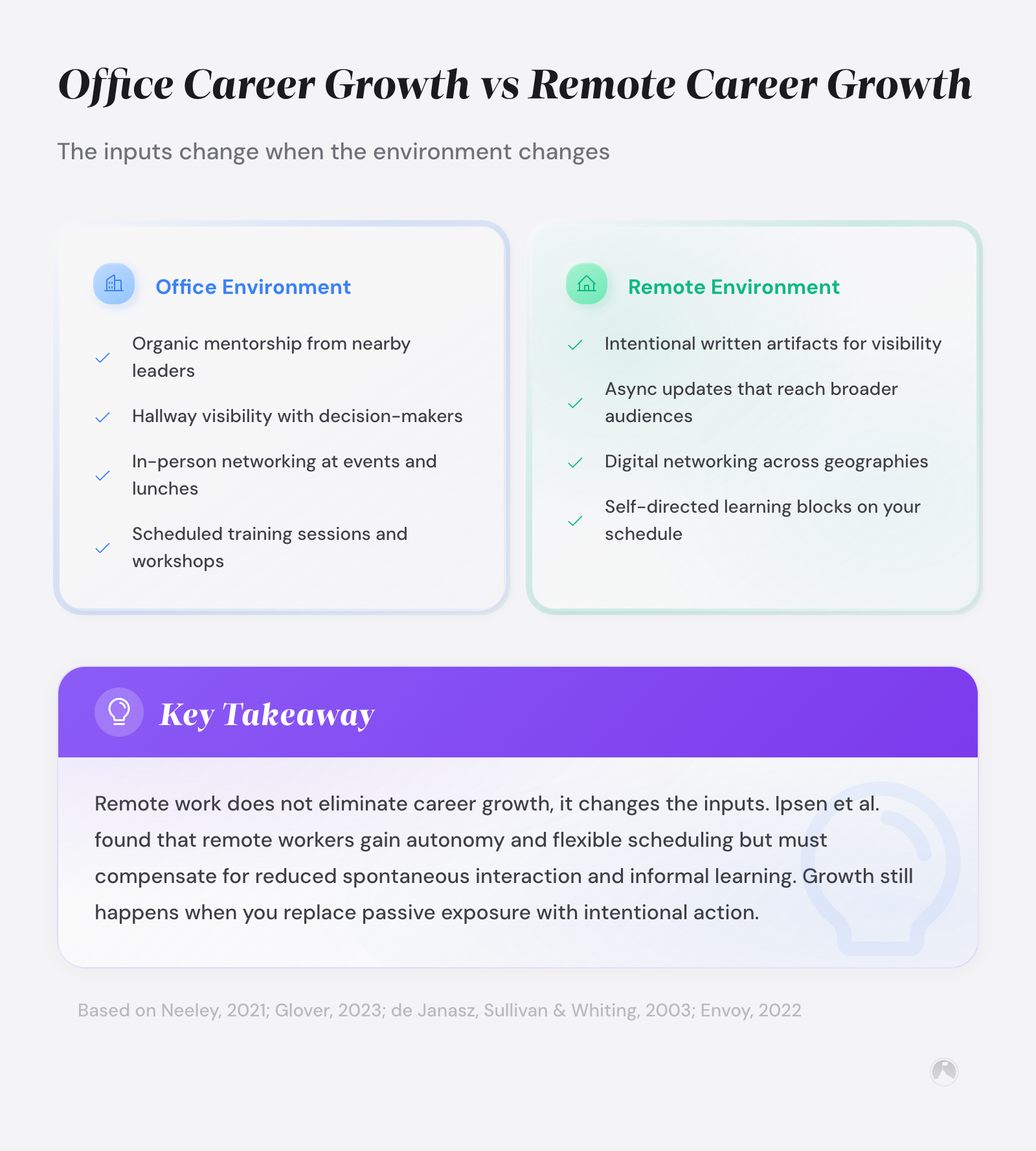
None of that transfers to remote work. And the deeper problem is invisibility – your contributions exist in silence until you make them visible. Office-based colleagues benefit from what Harvard Business Review researcher Tsedal Neeley describes as “proximity bias”, a cognitive pattern where managers rate in-office workers as more engaged even when remote workers produce equal or better output [5]. An Envoy workplace survey found that 96% of executives admit noticing office contributions more than remote ones [8]. Neeley’s analysis in Harvard Business Review explains the cognitive pattern behind this disparity [5].
This is one of the core introvert professional development strategies that most advice misses: the problem isn’t your skill level. It’s your visibility.
Ipsen and colleagues found that working from home created disadvantages including home office constraints and work uncertainties, which limited the kind of informal learning and mentorship that office environments naturally provide [1].
Remote professionals who don’t build proactive development systems default to the career trajectory that proximity bias assigns them, which is usually stagnation. The development stall has two components: fewer organic learning moments, and reduced visibility for the growth that does happen. Solving one without the other leaves you either skilled but overlooked, or visible but stagnant.
How do you build career visibility without performative socializing?
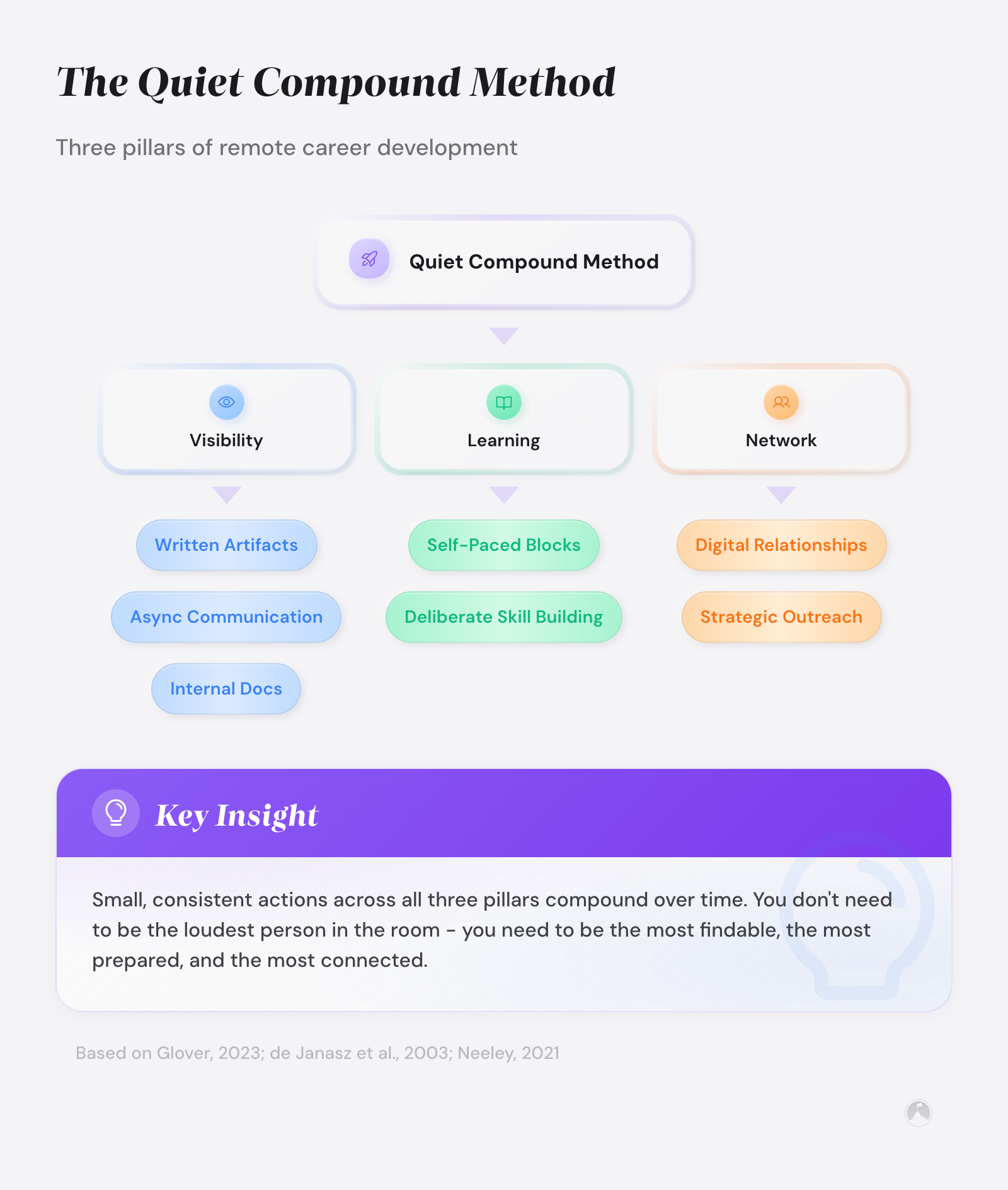
Here’s where most remote development advice falls apart. It tells you to “be more visible” without explaining what that means when you can’t walk past your manager’s desk. The answer isn’t more Zoom calls or louder participation in virtual meetings. This is the Quiet Compound Method – a framework for building professional presence through written artifacts, strategic learning, and depth-first relationships rather than surface-level networking.
The Quiet Compound Method is a framework for remote professional development that replaces spontaneous office interactions with three consistent practices: weekly learning blocks, written visibility artifacts, and strategic one-on-one relationships, producing compounding career returns through consistent small actions rather than high-energy networking events.
The method works by converting the isolation of remote work into a development advantage. Instead of competing for airtime in meetings, you create written artifacts that have a longer shelf life than any spoken comment. Internal documentation, process improvement proposals, project retrospectives, and shared learning notes all do double duty: they help the organization and they make your thinking visible to decision-makers.
An eLearning Industry analysis of remote training found that online platforms allow employees to access learning materials at their own pace, creating more flexible professional development than traditional classroom or conference formats [2]. The Quiet Compound Method builds on this flexibility by adding a visibility layer that most self-paced learning lacks. For introverted personalities, the most effective self-improvement approach in remote work comes down to systems, not charisma.
The three pillars of the Quiet Compound Method
| Pillar | What it replaces | Weekly time | Output | Visibility effect |
|---|---|---|---|---|
| Learning blocks | Informal office learning | 2-3 hours | Skill growth in one focused area | Expertise deepens over time |
| Written artifacts | Hallway conversations | 1-2 hours | Documents, proposals, or shared notes | Leadership sees your thinking |
| Strategic 1-on-1s | Coffee machine relationships | 1 hour | 2-3 deep connections per month | Sponsors who speak up for you |
Here’s a concrete example. Instead of attending a 2-hour virtual networking mixer where you make 15 forgettable introductions, you spend that time writing a process improvement document for a workflow pain point your team has been complaining about. You share it in your team channel, your manager reads it, and the VP of operations notices it two weeks later when someone forwards it. Written documentation creates visibility that works even when you’re offline – something no meeting performance can match.
How should remote professionals build a self-paced learning system?
The second pillar of the Quiet Compound Method addresses the learning gap. Without office-based training sessions and spontaneous knowledge sharing, you need a structured system for skill development. But the system needs to work with your remote schedule, not against it. Online learning platforms have removed the geographical barrier entirely [2] – you can access courses from MIT, Stanford, and industry-specific providers from your home office.
But access isn’t the bottleneck. Consistency is.
Async skill-building is a self-directed learning approach where professionals acquire new skills through on-demand resources, recorded content, and written exercises on their own schedule rather than in synchronous group settings.
Build learning blocks into your calendar
Block 2-3 hours per week for learning. Not “when I have time.” Protected, recurring calendar blocks. Pick one skill domain per quarter. But spreading attention across five courses produces the same result as starting none of them.
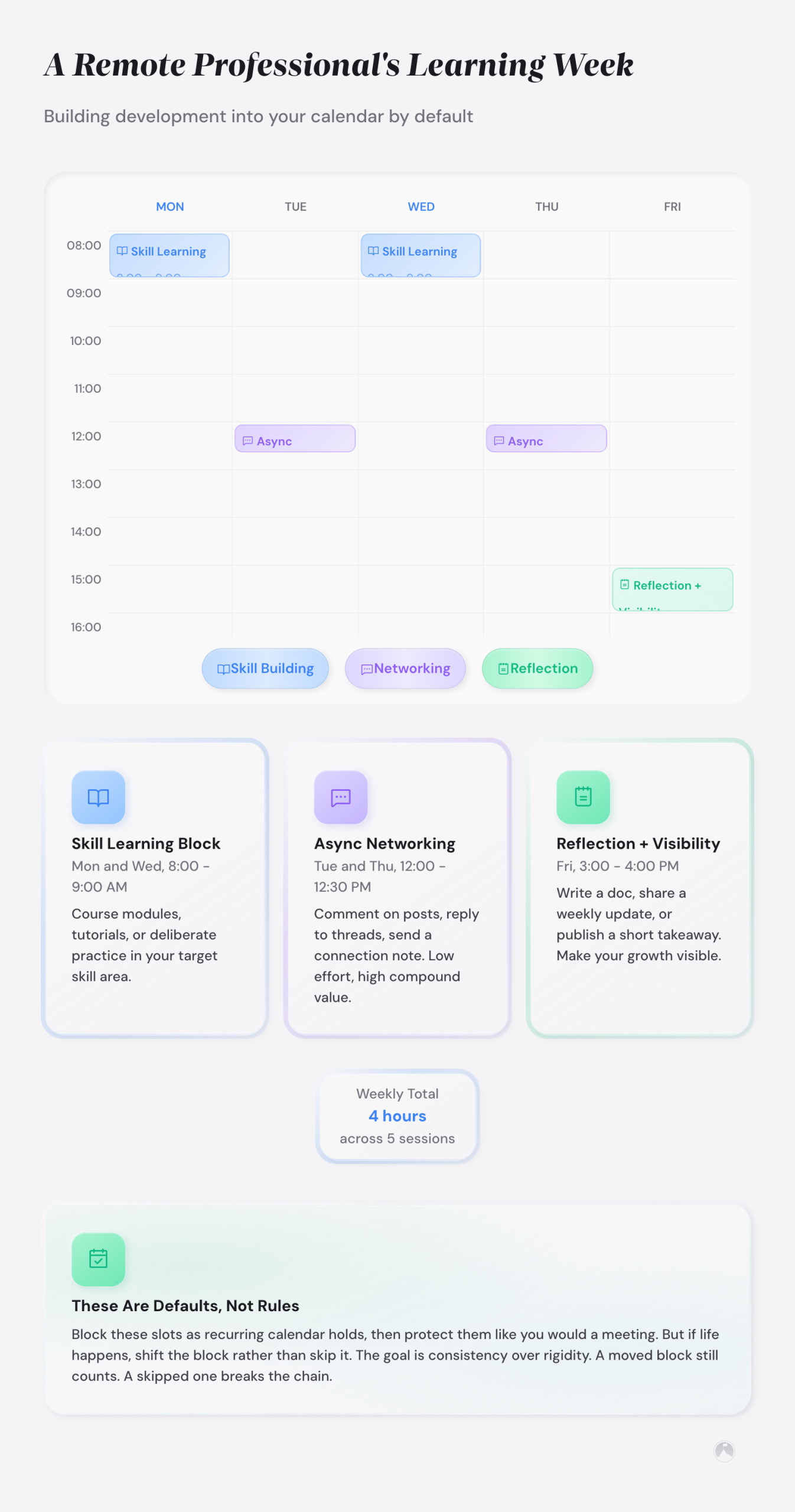
For introverts, depth beats breadth in career advancement – expertise compounds while surface-level knowledge evaporates. After each learning block, create a small written artifact: a summary of what you learned, a proposal for how it applies to your team’s work, or a short internal post sharing a useful insight.
This converts private learning into public contribution. Skill-building only advances your career when you make the learning visible through written output that others can find, reference, and share.
A daily learning habit paired with a weekly documentation practice creates a compounding effect. After three months of consistent weekly documentation, you accumulate a portfolio of written evidence – project summaries, process improvements, learning insights – that demonstrates both expertise and initiative to leadership. And that portfolio speaks louder than any self-promotion.
What replaces traditional networking for remote professionals?
Traditional networking advice fails remote professionals for one reason: it assumes proximity. “Attend industry events,” “work the room,” “follow up over coffee” – these tactics require physical co-location and, often, high social energy. If you’re a remote professional who leans introverted, this advice doesn’t land. The anxiety that introverts feel around networking is real, and pushing through it with brute force doesn’t produce lasting results.
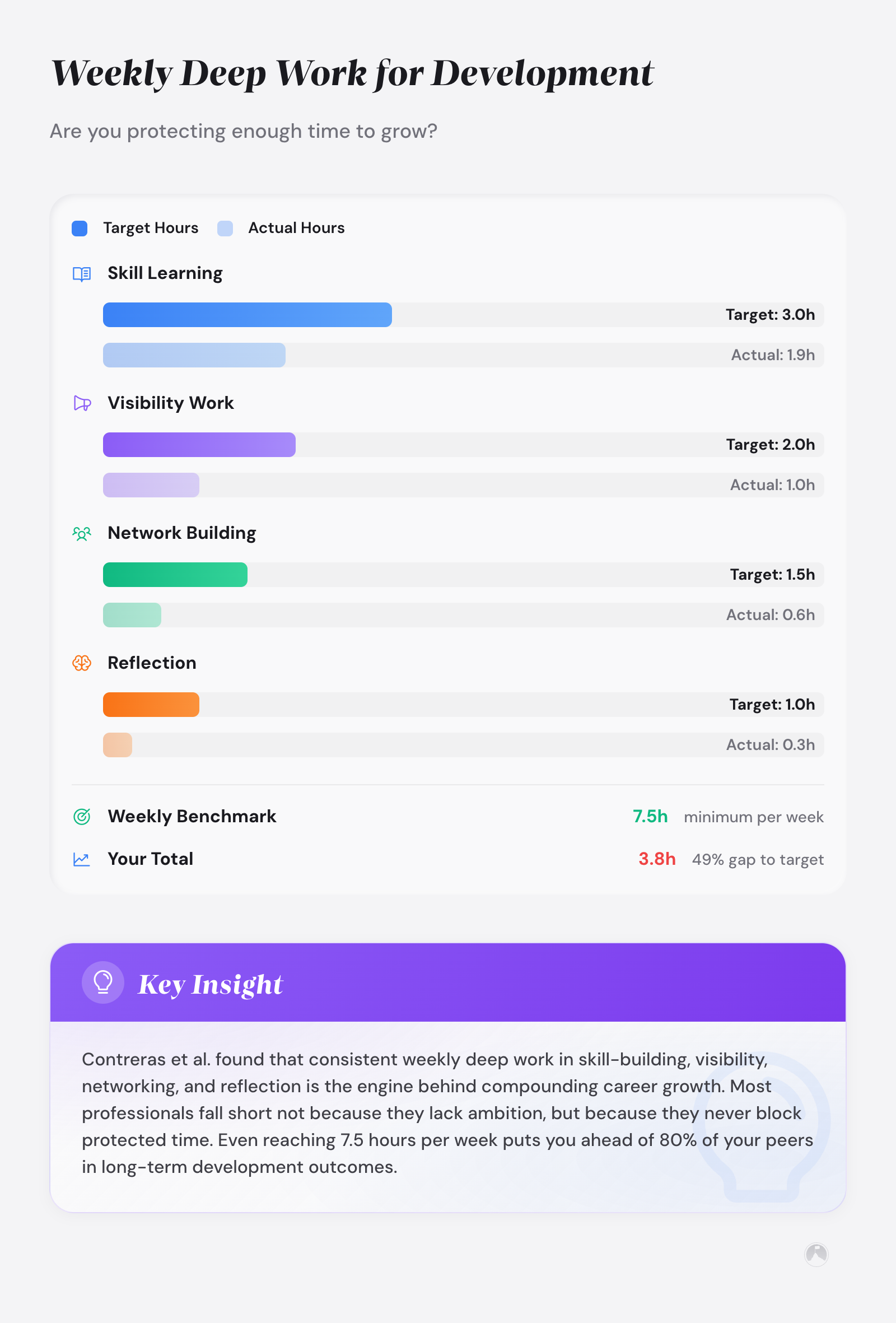
The Quiet Compound Method replaces breadth-first networking with depth-first relationship building. Contreras, Baykal, and Abid published a 2020 literature review in Frontiers in Psychology identifying formal virtual mentorship programs as one of the most effective strategies for professional development in distributed teams [4]. One consistent mentor who knows your work and goals provides more targeted career support than dozens of surface-level contacts.
Depth-first relationship building is a networking approach that prioritizes cultivating a small number of strong, trust-based professional relationships over accumulating a large volume of surface-level contacts.
Aim for 2-3 meaningful one-on-one conversations per month with people whose work you genuinely respect. Not a pitch, not a “let me pick your brain” request – real conversation about shared interests, current challenges, or a piece of their work that you found valuable. And these conversations build trust – trust is what produces referrals, sponsorship, and opportunities.
Contreras and colleagues found that key areas for growth include managing virtually and improved technology literacy at all organizational levels, with formal virtual mentorship programs emerging as a strategic solution [4].
Research on mentor networks by de Janasz, Sullivan, and Whiting confirms that deep mentorship relationships – built on trust, mutual knowledge, and personalized guidance – produce more targeted career advancement than broad networking alone [7]. For introverted remote professionals, this has a practical advantage: one 30-minute video call with someone you genuinely connect with costs far less energy than a 2-hour virtual networking event with strangers. And the career return is significantly higher.
You can build relationships asynchronously, too. Commenting thoughtfully on a colleague’s internal post, sharing relevant articles with a short note explaining why you thought of them, or offering specific help on a project that interests you. And these small investments compound. A few deep professional relationships built through consistent one-on-one engagement will advance a remote career further than dozens of shallow connections made at virtual mixers.
How do you manage energy for development without burning out?
Remote professionals face a specific energy challenge: the same environment where you work is the same environment where you’re supposed to grow. There’s no commute transition, no change of scenery between “work mode” and “development mode.” If you don’t manage your energy deliberately, development activities become one more source of screen fatigue.
Energy management matters more than time management here. You might have two free hours on a Wednesday afternoon, but if those hours follow a draining 3-hour Zoom marathon, they’re useless for learning. Research published in Frontiers in Psychology found that employees who use deliberate energy management strategies – such as organizing, prosocial engagement, and meaning-making – report better occupational well-being, with the benefits varying based on job demand levels [6]. Remote workers who intentionally match development activities to their energy patterns often find improved work-life balance and more consistent growth over time.
Match activities to energy levels
| Energy level | Best development activity | Worst fit |
|---|---|---|
| High (peak hours) | Deep work, skill practice, writing proposals | Passive video courses |
| Medium | One-on-one calls, reading, course modules | Group brainstorming sessions |
| Low (post-meeting dip) | Podcast listening, saved article reading, journaling | New skill acquisition, networking |
Protect your high-energy windows for producing visible work output. Schedule learning during medium-energy blocks. Use low-energy windows for passive absorption like professional development podcasts or saved reading. And this prevents the common trap of spending your best mental energy on consumption instead of creation.
If you find yourself drifting toward personal development burnout, that’s a signal your system needs rebalancing, not more effort. The goal is sustainable growth over months, not an intense sprint that collapses after three weeks. Energy management for development means protecting your peak hours for output and scheduling growth activities during recovery windows – not the other way around [6].
What if your company culture rewards in-person visibility?
This is the objection that stops most remote professionals from changing their approach: “My manager only notices people who are visible in meetings.” Proximity bias exists in most organizations, and remote workers do face systemic disadvantages in promotion decisions [5]. But the solution isn’t performing extroversion on Zoom. It’s strategic communication that makes your contributions impossible to overlook.
Scripts for common scenarios
When your manager says “I need you to be more visible”: “I’d like to discuss what visibility looks like in my role. I’ve been documenting my project contributions in [shared location]. Can we review those together and identify which ones I should present more broadly?”
When you feel pressured to attend optional social calls: “I appreciate the team-building intention. I contribute best through focused project work and one-on-one conversations. Can I suggest an alternative way to stay connected with the team?”
When a colleague’s in-office presence gets confused with higher productivity: Keep a brief weekly log of completed work, decisions made, and contributions delivered. Share it with your manager during your regular check-in. So data replaces assumptions.
The key principle behind all three scripts: don’t argue about the value of remote work. Instead, redirect the conversation to measurable output. If you can point to specific artifacts, completed projects, and documented contributions, you shift the evaluation criteria from “who I see” to “what got done.” The remote professionals who advance fastest aren’t the loudest voices on Zoom calls – they’re the ones whose written work circulates after the call ends.
Building confidence as an introvert in a remote environment happens through this kind of evidence-based self-advocacy. Learning to set boundaries for personal time is one of the most underrated professional development skills for remote workers. Every optional social call you skip is time you can invest in creating the kind of work that speaks for itself.
Ramon’s take
Forget building a whole system first. Just block 30 minutes this week for something you’ve been meaning to learn. That’s it. If the block survives your calendar for two weeks straight, you’ve already done more than most remote workers do all quarter.
Conclusion
Personal development for remote professionals requires a different playbook than the one written for office workers. The organic learning, casual mentorship, and ambient visibility that offices provided don’t transfer to remote environments. But the isolation that kills passive development becomes an advantage when you build a dedicated system around it. The Quiet Compound Method – combining scheduled learning, written visibility artifacts, and depth-first relationships – turns distance from a liability into a growth accelerator.
Remote growth is not a performance – it’s a practice, and the compound interest on consistent small actions eventually dwarfs any single bold move. Growth doesn’t require volume. But it does require consistency, visibility, and the discipline to invest in yourself when nobody is watching.
Next 10 minutes
- Block two hours on your calendar next week for a learning session in one specific skill area.
- Identify one person you respect professionally and draft a short message to schedule a 30-minute video call.
This week
- Write one internal document that shares something you’ve learned or a process you’ve improved.
- Audit your calendar to identify which hours are high-energy and protect them for deep work and skill practice.
- Set up a basic tracking method (spreadsheet or note) to record your weekly learning activities and written output.
There is more to explore
- Personal development strategies — broader approaches to self-improvement
- How to create a personal development plan — step-by-step planning guide
- Kaizen vs. GROW frameworks — incremental progress methods for remote schedules
- Personal growth goals that stick — building confidence through incremental growth
- Personal development for introverts — introvert-specific approaches
Related articles in this guide
- personal-development-introverts
- personal-development-overwhelm-solutions
- personal-development-podcasts-for-professionals
Frequently asked questions
What self-paced learning methods work best for remote professionals?
Structured online courses with built-in accountability milestones work better than open-ended video libraries. Research shows flexible digital platforms allow remote professionals to learn at their own pace [2]. Pair each learning module with a written summary or application exercise to convert passive consumption into active skill development.
How can remote professionals prepare for required social interactions to reduce energy drain?
Review the agenda and attendee list beforehand, prepare two to three discussion points, and set a personal time limit. Pre-planning reduces the cognitive load of spontaneous interaction. After the event, schedule 30-60 minutes of solo recovery time for processing before returning to productive work.
What role does virtual mentorship play in remote professional development?
Virtual mentorship compensates for the loss of informal coaching that office proximity once provided. A 2020 literature review identified formal virtual mentorship programs as a strategic solution for skill development in distributed teams [4]. One consistent mentor who knows your work and goals provides more targeted guidance than any number of generic training programs.
How do introverted remote workers use deep thinking as a career strength?
Deep thinking translates directly into written artifacts that demonstrate expertise – detailed analyses, thoughtful proposals, and thorough documentation. These outputs create lasting professional visibility that outlives any meeting comment. Remote introverts should channel their reflective processing into written communication, where careful thinking is an advantage.
What are the best online versus in-person development options for remote professionals?
Online options include self-paced courses, virtual coaching sessions, asynchronous peer learning groups, and recorded expert talks. In-person options retain value for immersive workshops and relationship-building retreats. The most effective approach combines online learning for skill acquisition with occasional in-person events for relationship deepening.
How can remote professionals communicate their growth to leadership without self-promotion discomfort?
Let your work speak by creating a shared document that tracks completed projects, skills developed, and contributions made. Share it during regular check-ins rather than broadcasting achievements. This shifts the dynamic from self-promotion to progress reporting and provides managers with concrete data for promotion decisions.
What strategies help remote workers recover energy after intensive group sessions?
Block 30-60 minutes of protected solo time immediately after group calls. Use this time for low-stimulation activities like walking, reading, or organizing notes. Avoid scheduling back-to-back meetings, and communicate your recovery needs to your team by marking post-meeting blocks as unavailable.
How do remote professionals build confidence through consistent small actions rather than dramatic leaps?
Start with low-risk visible actions like sharing a brief insight in a team chat or commenting thoughtfully on a colleague’s post. Each small success creates a confidence data point that accumulates over time. After four to six weeks of consistent small contributions, most professionals report a measurable shift in how comfortable they feel sharing their work.
References
[1] Ipsen, C., et al. “Six Key Advantages and Disadvantages of Working from Home in Europe during COVID-19.” International Journal of Environmental Research and Public Health, vol. 18, no. 4, article 1826, Apr. 2021. https://doi.org/10.3390/ijerph18041826
[2] “The Impact of Remote Work on Employee Training and Development.” eLearning Industry, 2024. https://elearningindustry.com/the-impact-of-remote-work-on-employee-training-and-development
[3] Glover, S. “5 Ways Personal Development Catapults Your Remote Career.” We Work Remotely, 2023. https://weworkremotely.com/5-ways-personal-development-catapults-your-remote-career-how-to-start
[4] Contreras, F., Baykal, E., and Abid, G. “E-Leadership and Teleworking in Times of COVID-19 and Beyond: What We Know and Where Do We Go.” Frontiers in Psychology, vol. 11, article 590271, Dec. 2020. https://doi.org/10.3389/fpsyg.2020.590271
[5] Neeley, T. “What Is Proximity Bias and How Can Managers Prevent It?” Harvard Business Review, Oct. 2022. https://hbr.org/2022/10/what-is-proximity-bias-and-how-can-managers-prevent-it
[6] Parker, S. L., Zacher, H., de Bloom, J., Verton, T. M., and Lentink, C. R. “Daily Use of Energy Management Strategies and Occupational Well-being: The Moderating Role of Job Demands.” Frontiers in Psychology, vol. 8, article 1477, 2017. https://doi.org/10.3389/fpsyg.2017.01477
[7] de Janasz, S. C., Sullivan, S. E., and Whiting, V. “Mentor Networks and Career Success: Lessons for Turbulent Times.” Academy of Management Executive, vol. 17, no. 4, 2003, pp. 78-93. https://journals.aom.org/doi/10.5465/ame.2003.11851850
[8] Envoy. “Proximity Bias Is Real: 96% of Leaders Notice Employee Contributions More at the Office.” Envoy At Work Survey, Sept. 2022. https://envoy.com/press-release/proximity-bias-is-real-96-of-leaders-notice-employee-contributions-more-at-the-office-envoy-at-work-survey-reveals