
The trap hiding inside your reading list
You bought the books. You took the courses. You tracked the habits, set the goals, and showed up at 5 AM. And now the exact thing you turned to for growth is draining you dry.
Personal development burnout is what happens when the pursuit of becoming better quietly becomes a source of chronic exhaustion, cynicism, and diminished results – and it follows the same clinical pattern the WHO uses to define workplace burnout [1].
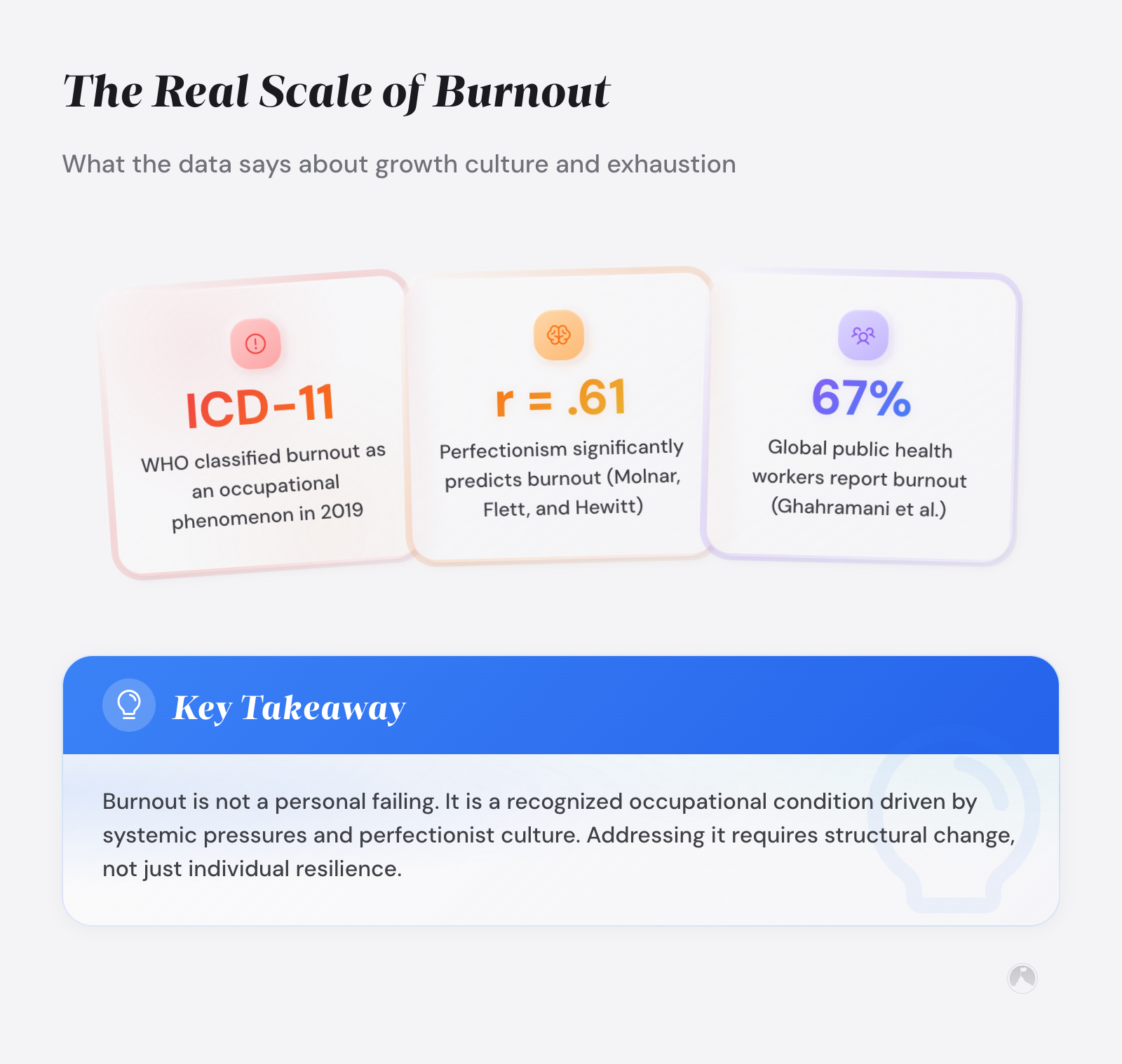
A review by Molnar, Flett, and Hewitt found that perfectionism is a consistent predictor of burnout across both occupational and non-occupational contexts [2]. The self-improvement industry runs on perfectionism. So the question worth sitting with is this: what if the system designed to help you grow is the same system burning you out?
Personal development burnout is a state of chronic exhaustion, cynicism toward growth activities, and reduced sense of progress caused by treating self-improvement as an always-on obligation rather than a selective, energy-aware practice. It mirrors the WHO’s three burnout dimensions – energy depletion, mental distance, and reduced efficacy [1] – but the source of stress is the growth process itself.
Key takeaways
- Personal development burnout results from treating growth as a never-ending obligation rather than a selective, energy-aware practice.
- The WHO classifies burnout through three markers: exhaustion, cynicism, and reduced efficacy – all of which apply to self-improvement overload [1].
- Ghahramani and colleagues found 39% burnout prevalence among public health workers, confirming burnout is a structural problem, not a personal failing [3].
- Grant, Gino, and Hofmann found that introverted leaders outperform extroverted leaders when managing proactive teams, suggesting personality-congruent development produces better outcomes [4].
- Neff and Germer’s randomized controlled trial found that self-compassion training significantly improved wellbeing and reduced stress compared to a control group, with gains maintained at follow-ups [5].
- The Sustainable Growth Filter is a three-question framework for choosing which development activities to keep and which to drop.
- Rest and boundary-setting count as growth practices, not signs of laziness or retreat.
- Sustainable development means applying what you already know before consuming anything new.
Why does personal development culture produce the burnout it promises to fix?
According to Grand View Research, the global personal development market was valued at approximately $48 billion in 2024 [6], and its core message is consistent: you are not yet enough, but you could be. That framing creates a treadmill. You finish one book, and the algorithm serves the next. You complete a course and a new certification appears.
And there’s always another weakness to fix, another version of yourself to chase.
The World Health Organization recognized burnout in its International Classification of Diseases in 2019, defining it through three dimensions: energy depletion or exhaustion, increased mental distance or feelings of negativism related to one’s activities, and reduced professional efficacy [1]. Those three dimensions map directly onto what happens when personal development tips from helpful to harmful.
The exhaustion comes from the relentless pace. The cynicism shows up as “none of this works anyway.” But reduced efficacy is the most painful part – you’re doing more self-improvement activities than ever and somehow getting less out of them. The WHO’s three burnout dimensions – exhaustion, cynicism, and reduced efficacy – map directly onto what happens when personal development tips from helpful to harmful [1].
A person chasing growth through an ever-expanding reading list, morning routine, habit tracker, journaling practice, meditation app, and weekly review is generating the same chronic stress load as an overloaded employee – except there’s no HR department to intervene.
This doesn’t mean all personal development strategies are harmful. It means the dose matters. And the current cultural default is to overdose.
Is burnout a failure of character or a failure of the model?
The standard response to feeling burned out by personal development is more personal development: try a different system, read a different book, find a different approach. Prescribing more self-improvement for self-improvement burnout is the equivalent of treating a running injury by running harder. So it addresses the symptom while deepening the underlying problem.
A 2024 systematic review by Ghahramani and colleagues examined burnout prevalence among the global public health workforce and found a pooled rate of 39% [3]. That’s roughly four in ten workers experiencing burnout in a single sector. And broader burnout research shows prevalence ranging from 25-50% depending on profession.
It’s not a character flaw. It’s a structural outcome of systems that demand unsustainable output.
“Burnout is a syndrome conceptualized as resulting from chronic workplace stress that has not been successfully managed.” – World Health Organization [1]
But what protects against burnout when the stress source is your own growth agenda? Neff and Germer’s randomized controlled trial found that self-compassion training significantly improved wellbeing and reduced stress compared to a control group, with gains maintained at 6-month and 1-year follow-ups [5]. And research by Suddarth and Slaney showed that maladaptive perfectionism – self-criticism, concern over mistakes, doubts about actions – correlates strongly with burnout across occupational contexts [7]. A 39% burnout prevalence among public health workers (Ghahramani et al., 2024) confirms the problem is systemic, not individual – and personal development culture runs on the same unsustainable mechanics.
Energy management for introverts in a burnout-prone system
Introverts face a specific burnout risk that standard self improvement tips for introverted personalities rarely address. Most mainstream professional development advice emphasizes extrovert-friendly formats: network aggressively, attend conferences, join mastermind groups, participate in team-based training. Grant, Gino, and Hofmann’s research found that introverted leaders outperformed extroverted leaders when working with proactive employees, suggesting that personality-congruent development styles produce better outcomes [4].
For introverted professionals, following standard introvert professional development strategies that don’t account for energy management means burning through reserves twice as fast – once from the development activity itself, and again from the social performance it requires. The energy cost of personality-incongruent development isn’t a preference issue – it’s a burnout accelerator.
But this is not about introversion being a limitation. A thoughtful introvert doing deep solo learning and building one-on-one mentorship relationships is growing as effectively as any networking enthusiast. Bjork and Bjork’s theory of disuse suggests that effortful, deep-processed learning produces stronger long-term memory traces than passive review [8]. So an introvert who reads one book deeply and applies its core idea grows more measurably than someone who sprints through five books at the cost of their recovery time.
Introverts who match development methods to their energy patterns – solo study, one-on-one mentorship, deep reading – build more durable skills than those who force extroverted formats (Bjork & Bjork, 1992) [8].
Energy management for introverts is not a workaround. It’s the foundation of sustainable growth. If your current personal mission statement demands you become someone fundamentally different from who you are, the mission statement is the problem.
How to grow without burning out: the Sustainable Growth Filter
Knowing the problem doesn’t solve it. The harder question is: how do you keep growing without creating the same exhaustion cycle? The answer isn’t to stop developing. It’s to change the criteria for what counts as development.
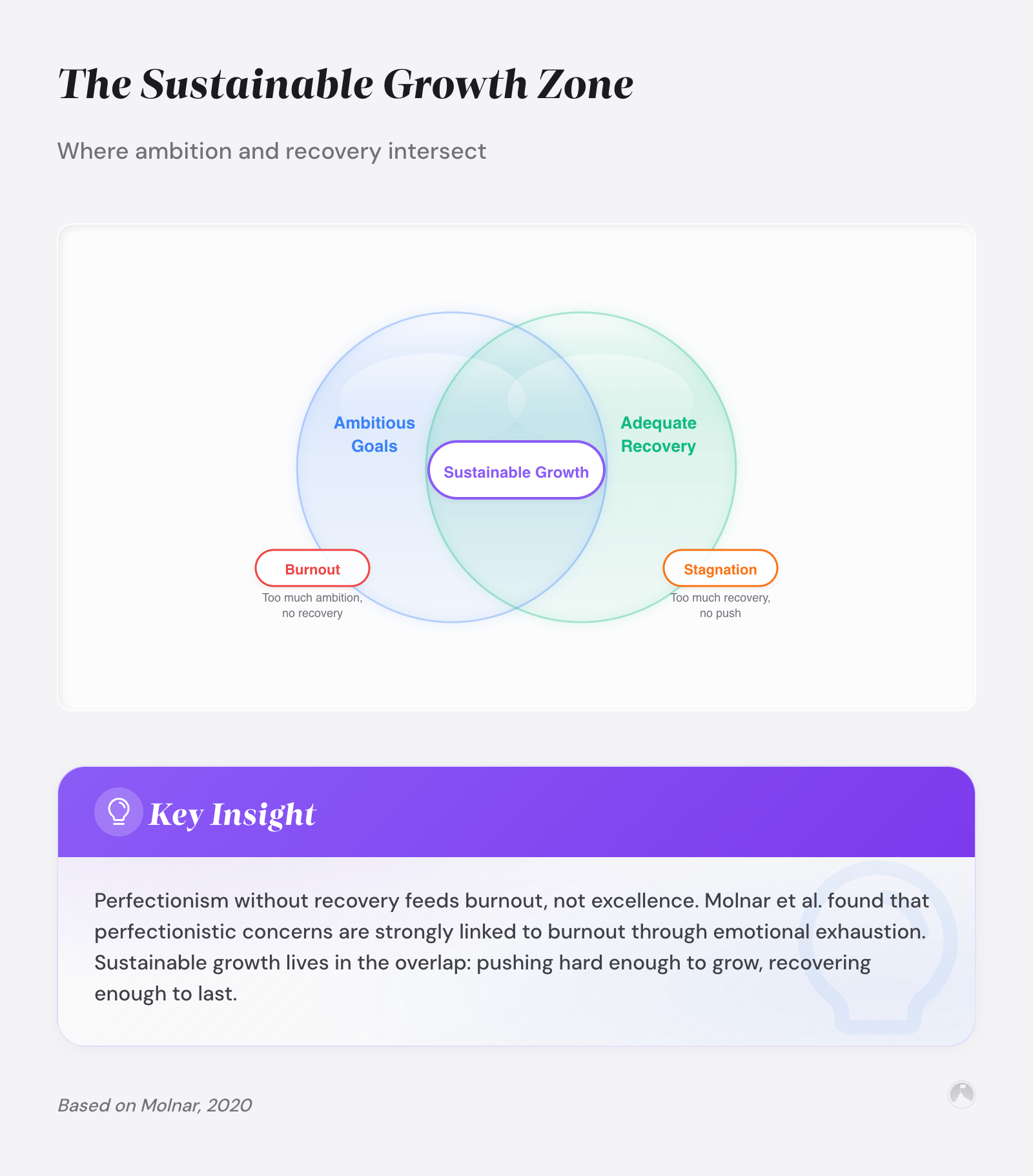
The Sustainable Growth Filter is a three-question screening tool for any personal development activity you’re considering or currently doing. Before adding anything to your growth practice – a book, a course, a new habit, a coaching program – run it through these three questions:
The Sustainable Growth Filter
Question 1: Does this address a gap I’ve identified, or am I consuming it out of habit?
If you can’t name the specific problem this development activity solves, it’s consumption disguised as growth.
Question 2: Can I apply what I already know before adding something new?
Most people have a backlog of unimplemented ideas from their last three books. New input without application is intellectual hoarding.
Question 3: Does this activity match my energy pattern, or am I forcing a format?
A conference drains an introvert. A solo deep-read energizes them. The growth value of any activity is zero if the energy cost puts you into deficit.
The Sustainable Growth Filter separates targeted development from compulsive self-improvement by testing every growth activity against three criteria: identified need, application readiness, and energy fit. Any activity that fails two of three questions gets dropped or deferred. No guilt, no explanation needed.
The filter works for the same reason burnout prevention research works. Neff and Germer’s self-compassion research [5] shows that replacing the “always more” mentality with a targeted question – is this specific thing worth my finite energy right now? – is protective. And that’s not laziness. That’s prioritization.
For introverts, Question 3 becomes the most powerful screening tool. An introvert who reads one book deeply and applies its core idea to their daily work grows more than someone who sprints through five books at the cost of their recovery time [8]. If you’re working on how to approach personal growth goals through the lens of sustainability, the filter reframes the entire calculation.
Research on goal-setting theory confirms that goals aligned with current capacity sustain engagement, while goals requiring a dramatic increase beyond current capacity produce withdrawal and exhaustion within weeks [9]. Sustainable growth is not about aiming lower – it’s about aiming at what you can actually reach and building from there.
But the filter only works if you have the energy to use it – and that requires treating recovery as a growth activity, not a guilty pleasure.
Why rest and boundaries belong in your development plan
Here’s the part that feels counterintuitive: rest is a growth practice. Not in a bumper-sticker way – in a measurable, research-supported way. Molnar, Flett, and Hewitt’s review of perfectionism and burnout shows that self-care and boundary-setting function as protective factors [2], meaning they don’t compete with growth. They enable it.
The productivity and self-improvement culture has built a false binary: you’re either growing or you’re stagnating. Rest is the condition that makes growth possible, not the absence of growth – the same way sleep is when memory consolidation happens, not when learning stops. You can’t sustain effort without recovery. And that’s physiology, not a motivation problem.
| Burnout driver | What the research says | Sustainable alternative |
|---|---|---|
| Unrealistic expectations | Strong burnout predictor across contexts (Molnar et al., 2020) [2] | Set fewer goals, make them smaller, review quarterly |
| Perfectionism | Maladaptive perfectionism correlates with burnout (Suddarth & Slaney, 2001) [7] | “Good enough” standards for growth activities |
| Lack of boundaries | Prevents recovery cycles needed for sustained effort (Molnar et al., 2020) [2] | Cap development time – 2 to 3 hours per week max |
| Neglecting self-care | Weakens the resilience buffer that prevents burnout (Molnar et al., 2020) [2] | Treat rest as a scheduled development activity |
| Self-criticism | Directly increases burnout vulnerability (Suddarth & Slaney, 2001) [7] | Replace “I should be further along” with “I’m applying what I know” |
Building confidence as an introvert doesn’t require forcing behavior that drains you. But it does require recognizing that deep thinking, selective engagement, and solo expertise are themselves development strengths – not consolation prizes for people who can’t handle crowds. Introvert-aligned personal development is about working with your wiring, not against it.
Confidence built through personality-congruent development – growing in ways that match your wiring rather than fighting it – is more durable than confidence built through constant self-override. The burnout research consistently points in the same direction: sustainability comes from working within your natural patterns [2][5][7].
Ramon’s take
Stop adding things. Seriously, just stop for 30 days. No new books, no new systems, no new podcasts. The growth you already started needs time to settle. Most burnout isn’t from doing too little, it’s from layering too much on top.
The most productive change I’ve made in years was cutting my development reading from ten books a quarter to five and spending that reclaimed time applying what I’d already read. My growth didn’t slow down. It accelerated. The bottleneck was never information – it was implementation.
Growth is a practice, not a performance
Personal development burnout is not a sign that you’re bad at self-improvement. It’s a sign that the model you’re following treats growth as an always-on obligation rather than a selective, energy-aware practice. The research is consistent: burnout comes from unrealistic expectations and perfectionism [2], and self-compassion provides stronger protection than more effort [5].
Recovery starts with permission to slow down. And sustainability starts with choosing fewer priorities and going deeper. If you’re looking for a framework that respects these limits, a personal development plan built around the Sustainable Growth Filter gives you a structure that protects against the overload most systems create.
The measure of personal development was never how much you consume. It was always how much you apply.
Next 10 minutes
- Pick one personal development activity you’re currently doing and run it through the three Sustainable Growth Filter questions.
- Identify one idea from a book or course you’ve already consumed that you haven’t implemented yet. Write it on a sticky note.
This week
- Drop or pause one development activity that fails the Sustainable Growth Filter (15 minutes to evaluate, zero minutes to pause). Replace that time with rest or with applying something you already know.
- Set a weekly cap on development consumption time – reading, courses, podcasts (5 minutes to decide, then enforce it). Two to three hours is a reasonable starting point.
- If you identify as an introvert, audit your current development activities for energy fit (20-30 minutes with a notebook). Flag anything requiring extroverted performance and look for a solo alternative.
Related articles in this guide
- personal-development-for-remote-professionals
- personal-development-introverts
- personal-development-overwhelm-solutions
References
[1] World Health Organization. “Burn-out an occupational phenomenon: International Classification of Diseases.” WHO News, 2019. https://www.who.int/news/item/28-05-2019-burn-out-an-occupational-phenomenon-international-classification-of-diseases
[2] Molnar, D. S., Flett, G. L., and Hewitt, P. L. “Perfectionism and burnout: A comprehensive review.” In The Psychology of Perfectionism: Theory, Research, Applications (pp. 204-236). Springer International Publishing, 2020. https://doi.org/10.1007/978-3-030-18969-7_9
[3] Ghahramani, S., et al. “Global estimate of burnout among the public health workforce: a systematic review and meta-analysis.” Human Resources for Health, 22, 30, 2024. https://doi.org/10.1186/s12960-024-00917-w
[4] Grant, A. M., Gino, F., and Hofmann, D. A. “Reversing the Extraverted Leadership Advantage: The Role of Employee Proactivity.” Academy of Management Journal, 54(3), 528-550, 2011. https://doi.org/10.5465/amj.2011.61968043
[5] Neff, K. D., and Germer, C. K. “A Pilot Study and Randomized Controlled Trial of the Mindful Self-Compassion Program.” Journal of Clinical Psychology, 69(1), 28-44, 2013. https://doi.org/10.1002/jclp.21923
[6] Grand View Research. Personal Development Market Size, Share and Trends Analysis Report by Course Type (Online, Offline), by Demographics, by Region, and Segment Forecasts, 2025-2030. 2025. https://www.grandviewresearch.com/industry-analysis/personal-development-market
[7] Suddarth, B. H., and Slaney, R. B. “An Investigation of the Dimensions of Perfectionism in College Students.” Measurement and Evaluation in Counseling and Development, 34(3), 157-165, 2001.
[8] Bjork, R. A., and Bjork, E. L. “A New Theory of Disuse and an Old Theory of Stimulus Fluctuation.” In A. F. Healy, S. M. Kosslyn, and R. M. Shiffrin (Eds.), From Learning Processes to Cognitive Processes: Essays in Honor of William K. Estes (Vol. 2, pp. 35-67). Lawrence Erlbaum Associates, 1992. https://doi.org/10.1037/13124-002
[9] Locke, E. A., and Latham, G. P. “Building a practically useful theory of goal setting and task motivation: A 35-year odyssey.” American Psychologist, 57(9), 705-717, 2002. https://doi.org/10.1037/0003-066X.57.9.705