
Most book lists skip the only question that matters
You read a personal development book because the reviews promised it would change you. You finished the last page feeling motivated and ready to act. Two weeks later, nothing stuck.
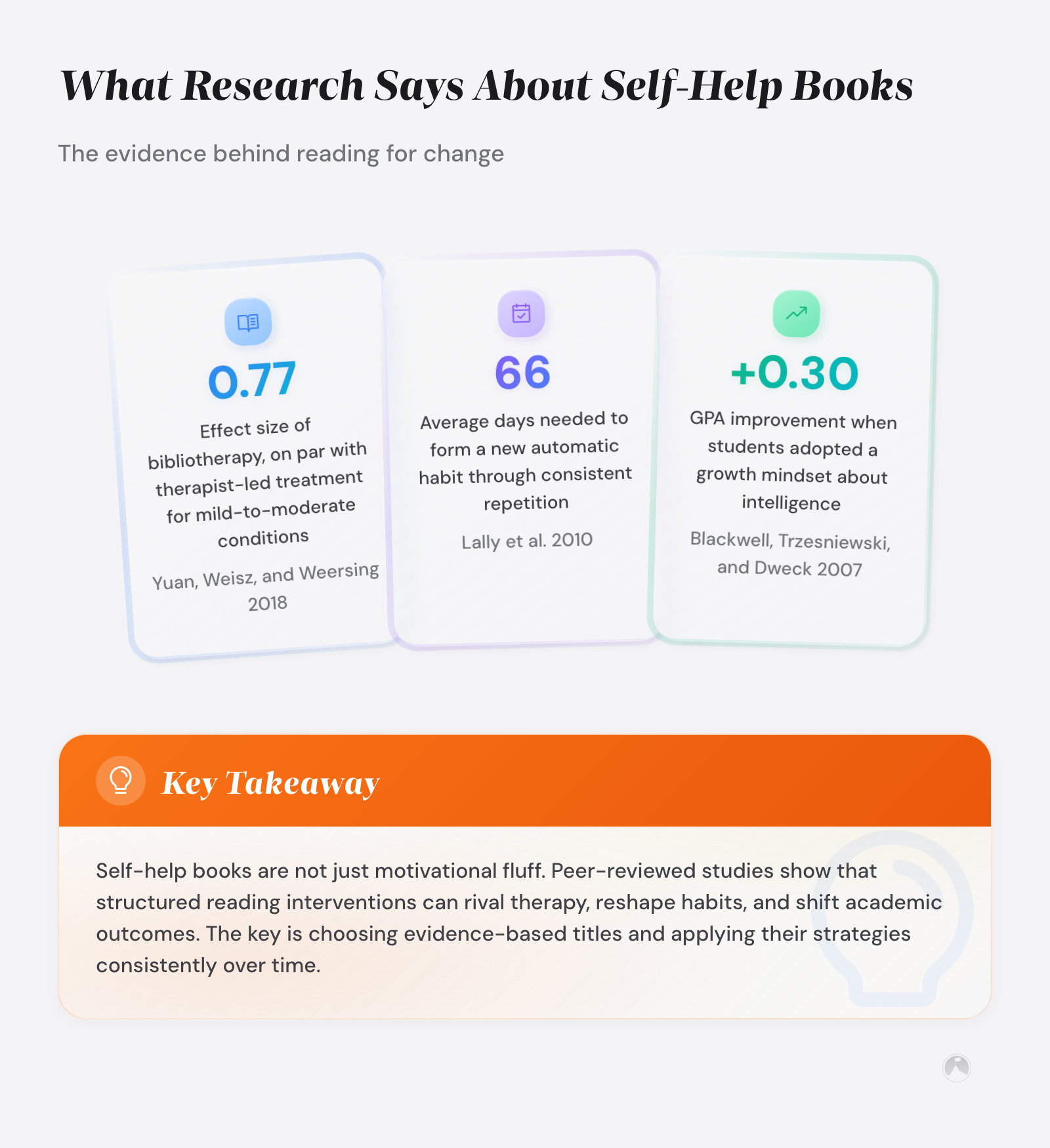
The problem isn’t the books. It’s how most people choose and use them. Researchers Yuan, Weisz, and Weersing conducted a 2018 meta-analysis of bibliotherapy – the structured use of reading for behavioral change (a practice our personal development strategies guide covers in detail) – and found that structured bibliotherapy programs produced a standardized mean difference of -0.52 compared to control conditions [1].
The bibliotherapy programs that produced this effect were structured interventions – not passive reading. They included guided exercises, worksheets, and specific application steps alongside the reading material [1]. The book alone was not the intervention. The structured program around it was.
What you will learn
- Why some books change behavior and others only change your mood for a weekend
- The 7 personal development books with the strongest evidence of real-world impact
- How to match a book to your specific development goal and personality type
- The reading method that turns passive consumption into lasting change
Key takeaways
- Books that change lives share three traits: a new mental model, a concrete first step small enough to take today, and permission to act.
- Bibliotherapy research shows structured reading programs – books paired with guided exercises – produce measurable symptom reduction compared to control conditions.
- Atomic Habits turns behavior change from a motivation problem into a system design problem.
- Mindset by Carol Dweck shifts how readers interpret failure, which changes what they attempt.
- Quiet by Susan Cain gives introverted readers language and research to build confidence on their own terms.
- Daring Greatly reframes vulnerability from weakness to the foundation of authentic connection and growth.
- Deep Work provides introverts with a career advancement strategy built around their natural strengths.
- Reading with one action per chapter produces more lasting change than reading three books passively.
Why do some personal development books change lives and others collect dust?
Personal development books that change lives share three specific traits: they provide a new mental model for reinterpreting a problem, they include a concrete first step small enough to start the same day, and they address the emotional barrier preventing change. Research on bibliotherapy confirms that structured reading programs – books paired with guided application exercises – produce measurable behavioral shifts, not just temporary motivation.
Bibliotherapy is the structured use of reading for psychological and behavioral change. The practice pairs specific books with guided application exercises to produce measurable shifts in thinking and behavior – not just temporary motivation.
The answer has less to do with writing quality or author credentials than you might expect. Yuan, Weisz, and Weersing published a 2018 meta-analysis reviewing randomized controlled trials of bibliotherapy and found that self-help reading produced a standardized mean difference of -0.52 (95% CI, -0.89 to -0.15) compared to control conditions [1]. While this research focused on clinical populations of children and adolescents, the core principle applies broadly: structured reading with application beats passive reading every time.
So the question isn’t whether books work. It’s whether you use them in a way that produces change.
Yuan, Weisz, and Weersing’s 2018 meta-analysis of randomized clinical trials found that structured bibliotherapy programs produced a standardized mean difference of -0.52 compared to control conditions, with effects particularly strong for depression in adolescents [1].
Three traits separate the personal development books that produce lasting change from those that do not. First, they give readers a new mental model – a way to reinterpret a problem they had been framing wrong. Second, they include concrete action steps small enough to start the same day. Third, they address the emotional barrier (fear, shame, identity conflict) that was preventing change.
Books that change lives give readers a new mental model, a first step small enough to take today, and permission to act on what they learn. This is why the seven books below were selected. Each one offers a distinct mental model, an actionable framework, and a specific type of shift. And for readers who are introverted or prefer self-directed learning, every book on this list works without group workshops, networking events, or coaching calls.
Which 7 personal development books have the strongest track record?
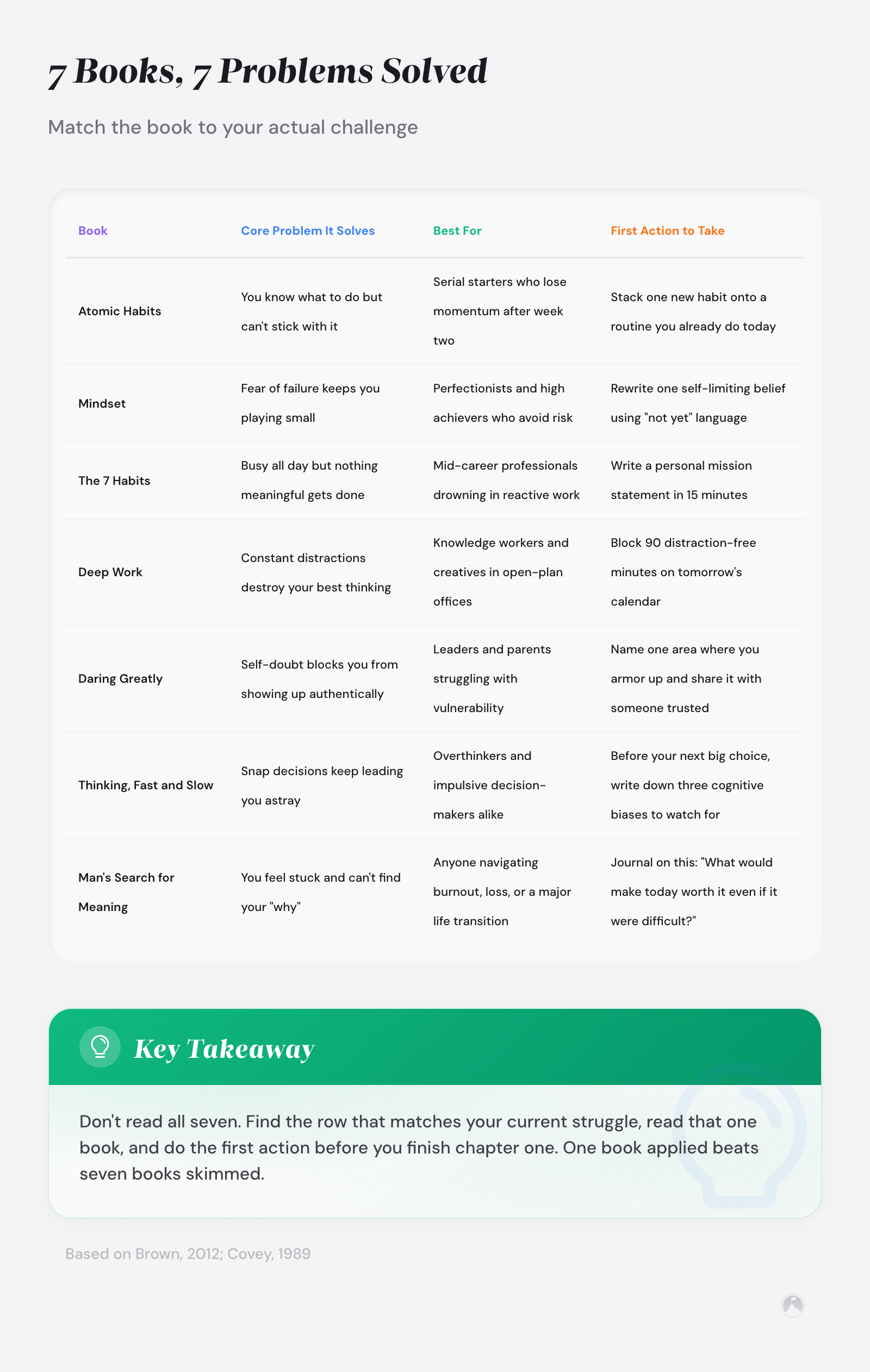
1. Atomic Habits by James Clear – For building systems that stick
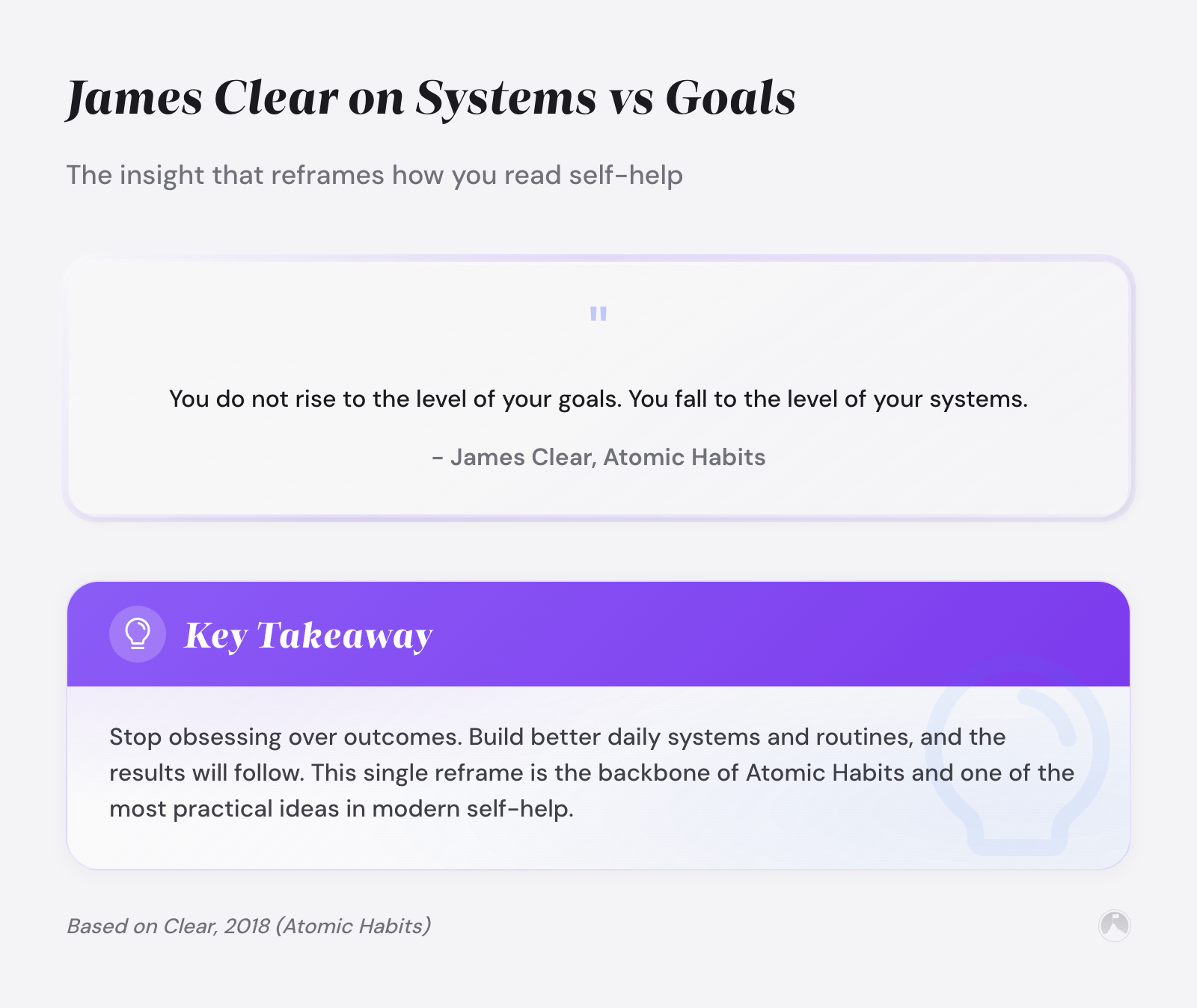
James Clear’s core argument is simple: outcomes are lagging indicators of systems. You don’t rise to the level of your goals – you fall to the level of your habits. And the book’s strength is translating habit research into four laws (make it obvious, attractive, easy, and satisfying) that function as a design checklist for any behavior change. Clear builds on peer-reviewed habit formation research, including Lally and colleagues’ 2010 study showing that new habits take an average of 66 days to become automatic – not the popular 21-day myth [2].
Atomic Habits turns behavior change from a motivation problem into a system design problem. Clear’s 1% improvement framing has been adopted by corporate teams, athletic programs, and individual readers – it removes the emotional weight from daily effort. For introverted professionals who prefer working within a structure rather than relying on social accountability, this book is a natural fit. The four laws work for building a morning routine or breaking a years-long habit pattern.
Core insight: You don’t rise to the level of your goals – you fall to the level of your habits.
Best for: anyone who has tried to build habits and failed, or who wants a repeatable framework for self improvement tips introverted personalities can apply without external pressure. Clear’s approach pairs well with a habit formation system – small daily gains compound into large results.
2. Mindset by Carol Dweck – For changing how you respond to failure
Psychologist Carol Dweck at Stanford University has spent decades researching how people interpret failure. In a longitudinal study with colleagues Blackwell and Trzesniewski, Dweck found that students who learned a growth mindset – the belief that abilities develop through effort – showed improved classroom motivation and reversed a declining grade trajectory, while students in the control group continued to decline [3].
Blackwell, Trzesniewski, and Dweck found that teaching students a growth mindset promoted positive change in classroom motivation and reversed a declining grade trajectory, while the control group continued to decline [3].
The book translates decades of controlled studies into a single framework: when you see ability as fixed, failure threatens your identity. When you see ability as malleable, failure becomes data. Mindset changes how readers interpret failure from “I’m not good enough” to “I haven’t figured this out yet.”
This shift is especially relevant for self improvement tips introverted personalities tend to need most, where internal dialogue often amplifies perceived shortcomings. Dweck’s research gives introverted readers a scientifically grounded alternative to the self-critical loop.
Best for: perfectionists, anyone who avoids challenges for fear of failing, or professionals who feel stuck at a skill plateau. If you want to go deeper on the neuroscience behind this shift, our guide to fixed vs. growth mindset neuroscience covers the brain imaging research.
3. Quiet by Susan Cain – For building confidence as an introvert
Susan Cain’s Quiet was the first mainstream book to argue – with research backing – that introverted traits like deep thinking, careful listening, and preference for one-on-one interaction are strengths, not deficits to fix. Cain draws on research from psychologist Elaine Aron, whose studies on highly sensitive persons found that roughly 70% of HSPs are introverts who process sensory input more deeply due to heightened nervous system reactivity [5]. So this isn’t a personality flaw. It’s a processing difference.
For anyone exhausted by extroverted personal development advice that doesn’t fit their personality, Quiet provides both validation and strategy. Quiet replaces the question “How do I become more outgoing?” with “How do I build a career and life that uses the strengths I already have?” It addresses building confidence as an introvert without requiring performance of extroversion – a distinction most self-help books miss entirely. And management researcher Adam Grant found that introverted leaders actually outperformed extroverted leaders when managing proactive teams, because they were more likely to let employees run with their ideas [6].
Core insight: How do I build a career and life that uses the strengths I already have?
Best for: introverted professionals, anyone struggling with networking for introverts anxiety, or leaders who influence through depth rather than volume. Our guide to personal development for introverts covers broader introvert professional development strategies beyond reading.
4. Daring Greatly by Brene Brown – For authentic growth through vulnerability
Brene Brown’s research at the University of Houston focuses on shame, courage, and human connection. In Daring Greatly, Brown argues – based on her qualitative research into vulnerability and shame resilience – that the behaviors most people avoid (asking for help, admitting uncertainty, receiving feedback) are the same behaviors that produce the deepest growth [4]. Brown defines vulnerability as emotional exposure, uncertainty, and risk. And she makes the case that willingness to be vulnerable predicts stronger relationships and greater authenticity.
Daring Greatly reframes vulnerability from a weakness to the prerequisite for meaningful connection and professional development. For introverts who prefer depth over breadth in relationships, Brown’s framework offers a path to social skills development that honors authentic interaction over performative networking. The book doesn’t ask you to become more extroverted. But it does ask you to become more honest about what you’re experiencing, which paradoxically makes you more confident in professional settings.
Best for: professionals who struggle with imposter syndrome, anyone who avoids feedback, or people who want deeper relationships without the small-talk treadmill.
5. Deep Work by Cal Newport – For career advancement the introvert way
Cal Newport argues that the ability to focus without distraction on cognitively demanding tasks is both increasingly rare and increasingly valuable. Research by Gloria Mark at UC Irvine found that knowledge workers are interrupted roughly every 11 minutes and need an average of 25 minutes to return to the original task [7]. Deep Work provides rules and rituals for protecting focused time in a world designed to fragment attention. For anyone feeling pressured to be more outgoing when they perform best through concentrated effort, this book is the counter-argument backed by productivity research.
Newport’s thesis reframes career advancement introvert way: instead of building visibility through networking, build value through the quality of output that only sustained focus produces. Deep Work gives introverted professionals a career advancement strategy built around depth, not social currency. It provides the language and the logic for defending your work style to managers who prize visibility over substance.
Key shift: Rather than trying to network more, Deep Work shows you how to become the person everyone wants on their team because of the quality of your output.
Best for: knowledge workers drowning in meetings, introverts who want career advancement without traditional networking, or anyone whose best thinking happens in silence.
6. The 7 Habits of Highly Effective People by Stephen Covey – For principled self-direction
Covey’s framework is built on a progression from dependence to independence to interdependence – and the habits that make each transition possible. Published in 1989, The 7 Habits of Highly Effective People remains one of the best-selling personal development titles in history [8]. And its longevity comes from the fact that the habits address character rather than tactics.
“Begin with the end in mind” and “Seek first to understand, then to be understood” aren’t productivity hacks. They’re operating principles.
For professionals who prefer one-on-one mentorship and self-directed learning over group training, Covey’s habit structure is particularly effective. Each habit can be practiced independently, without coaches or accountability groups. The 7 Habits provides a complete personal operating system that compounds over years rather than a set of tips that fade in weeks.
Key shift: The difference between this and most books is sustainability – readers report still using Covey’s frameworks decades after first reading the book.
Best for: anyone who wants a long-term framework rather than quick fixes, leaders building influence through integrity, or readers who prefer timeless principles over trending tactics. Covey’s approach connects well with writing a personal mission statement – one of his most cited exercises.
7. The Power of Now by Eckhart Tolle – For breaking the anxiety loop
Tolle’s book addresses a specific problem most personal development books ignore: the tendency to live in mental rehearsal of the future or rumination on the past. For introverted professionals whose rich inner world can become an anxiety engine, The Power of Now provides techniques for interrupting the spiral [9].
The book isn’t a productivity framework. It’s a reframe of the relationship between thought and identity – the idea that you are not your thoughts, and that present-moment awareness is the antidote to chronic overthinking. The Power of Now teaches readers to observe their thought patterns without being controlled by them – a skill that reduces networking for introverts anxiety and decision paralysis alike. So for overthinkers, this book often produces immediate relief because it validates the experience while offering concrete techniques to interrupt rumination.
Best for: overthinkers, anyone whose anxiety about the future prevents action in the present, or professionals who want to manage energy rather than manage time alone.
Which book matches your development goal?
Choosing the right book matters more than reading more books. The table below maps each title to the specific transformation it produces, the personality type it serves best, and whether it delivers mainly mindset shifts or concrete techniques.
| Book | Primary transformation | Best for personality | Mindset or technique | Reading difficulty | Ramon’s verdict |
|---|---|---|---|---|---|
| Atomic Habits | Build lasting behavior change | System-builders, any personality | Technique-heavy | Easy | Start here if you’ve struggled with consistency |
| Mindset | Reframe failure as learning | Perfectionists, self-critical thinkers | Mindset-first | Easy | Read this if self-doubt drives avoidance |
| Quiet | Leverage introvert strengths | Introverts, quiet professionals | Both | Moderate | Finally gives introverts permission to stop performing extroversion |
| Daring Greatly | Build authentic connections | Avoiders, imposter syndrome | Mindset-first | Moderate | Powerful but requires emotional honesty |
| Deep Work | Career growth through focus | Knowledge workers, introverts | Technique-heavy | Moderate | The book I recommend most to knowledge workers |
| The 7 Habits | Principled self-direction | Long-term thinkers, leaders | Both | Moderate | Denser than others but worth the effort |
| The Power of Now | Break the anxiety-overthinking loop | Overthinkers, anxious planners | Mindset-first | Challenging | Not for everyone, but life-altering for overthinkers |
If you’re unsure where to start, ask yourself one question: is your current bottleneck a system problem (you know what to do but can’t stick with it), a mindset problem (your beliefs about yourself limit what you attempt), or an environment problem (your work style clashes with your workplace)? Start with Atomic Habits for systems, Mindset for beliefs, and Deep Work or Quiet for environment. And if you’re interested in introvert professional development strategies more broadly, our personal development strategies guide covers additional frameworks beyond books.
How do you read for lasting change instead of information alone?
Owning the right books is not the same as being changed by them. And the bibliotherapy research from Yuan and colleagues is clear: structured reading programs that include guided application produce measurable behavioral change – a standardized mean difference of -0.52 compared to controls [1]. The difference is structured application. Here’s a direct method that turns any book on this list into a working development tool.
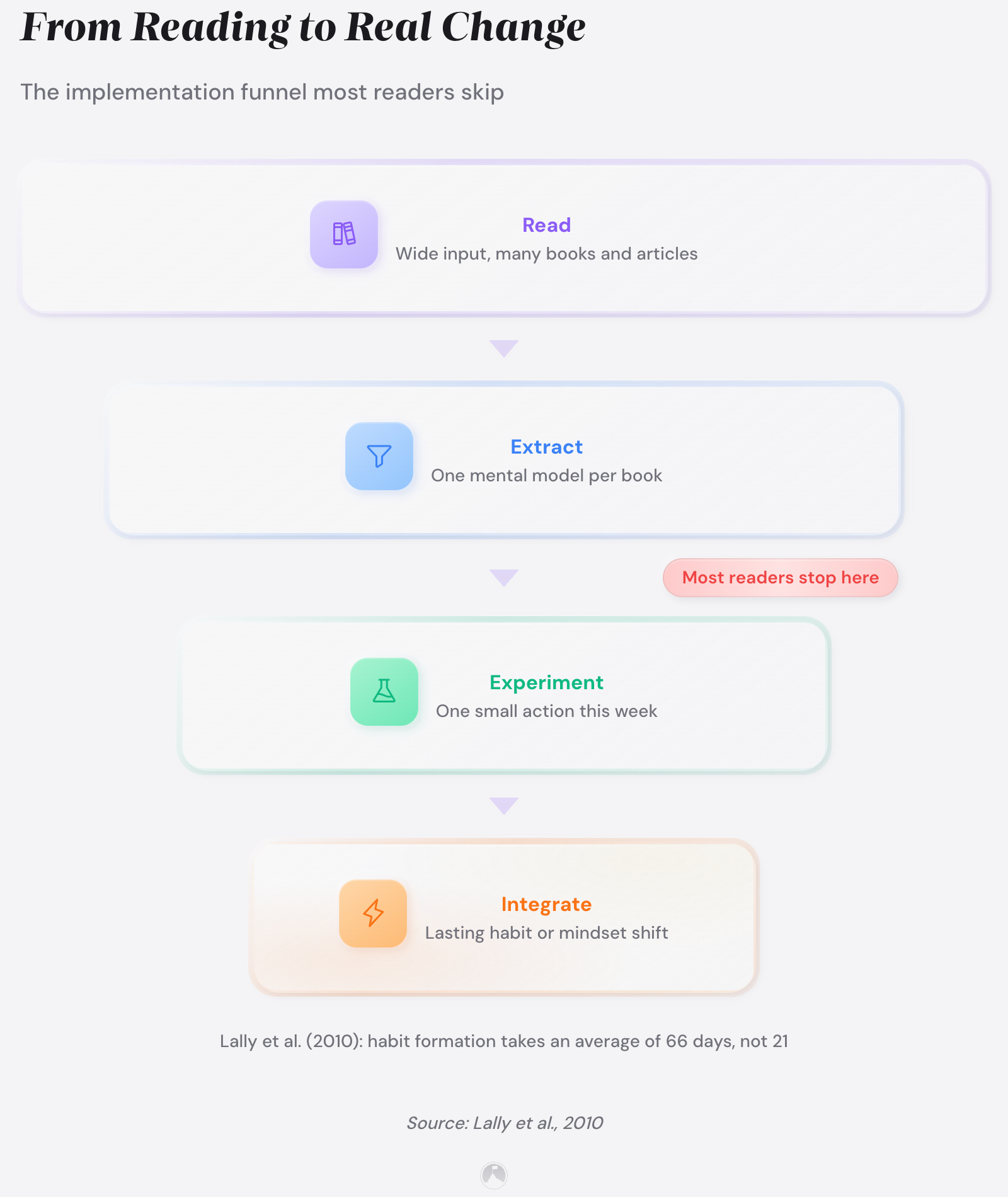
Read one chapter at a time. After each chapter, write down one single action you can take in the next 48 hours that applies what you read. Do that action before reading the next chapter. This is slower than binge-reading, and that’s the point.
Reading one personal development book with one action per chapter produces more lasting change than reading five books cover-to-cover with no application. For introverted professionals who prefer self-paced learning, this method respects your energy and your process. And no book clubs, no discussion groups, no accountability partners required. The book and the action are the system.
If you want a structured approach to tracking this kind of growth, our personal development strategies framework ties your reading to measurable outcomes. The daily learning habit approach pairs well with this reading method – you don’t need long study sessions, only consistent 20-minute blocks.
Quick-start reading plan
Week 1-2: Pick the one book from the table above that matches your current bottleneck.
Week 3-6: Read one chapter per sitting. Write one action per chapter. Do the action before reading the next chapter.
Week 7-8: Review your action log. Identify which changes stuck and which faded. Pick your next book based on the gap that remains.
Ramon’s take
Skip the list and just grab the one book whose title made you pause. That hesitation is usually your gut already knowing what you need. One book, one week, one thing you try. That’s the whole system.
One book, one action, real change
Personal development books that changed lives share a pattern: they reframe the problem, provide a concrete tool, and address the emotional barrier that kept the reader stuck. The seven books on this list cover the full spectrum – from habit architecture to mindset shifts to introvert-specific career strategies. But the research on bibliotherapy makes one thing clear: the book does not do the work. The structured application does.
Pick one book. Read it slowly. Act on it daily. That’s the entire formula.
Next 10 minutes
- Identify your current bottleneck: system, mindset, or environment
- Choose one book from the comparison table that matches that bottleneck
This week
- Get the book (library, audiobook, or purchase) and read the first chapter
- Write down one action from that chapter and complete it before reading chapter two
- Set a recurring 20-minute reading block on your calendar for the next four weeks
Related articles in this guide
- personal-development-burnout
- personal-development-for-remote-professionals
- personal-development-introverts
Frequently asked questions
What personal development books work best for introverted professionals?
Quiet by Susan Cain and Deep Work by Cal Newport are the two strongest picks for introverted professionals. Quiet provides research-backed language for using introvert strengths in the workplace, and Deep Work offers a career advancement strategy built around focused output rather than social visibility. Both books work as self-paced reading without group exercises.
How can reading personal development books help with networking anxiety?
Books like Daring Greatly by Brene Brown reframe networking from performative socializing to authentic vulnerability, which reduces anxiety for many readers. The Power of Now by Eckhart Tolle offers techniques for managing the thought spirals that fuel networking dread. Neither book asks you to force extroverted behavior – they change the internal experience instead.
How many personal development books should you read per year to see real change?
Research on bibliotherapy suggests that one book read with structured application exercises produces more behavioral change than multiple books read passively [1]. Aim for 3-4 books per year with the one-action-per-chapter method rather than racing through a dozen titles. Depth of application matters more than volume of reading.
Can personal development books replace therapy or professional coaching?
Bibliotherapy research shows that self-help books produce measurable symptom reduction in clinical settings [1]. For clinical conditions or severe distress, books are a supplement to professional support rather than a replacement. Books work best as a self-directed development tool for readers who want structured growth outside of clinical settings.
What is the best first personal development book for someone who has never read one?
Atomic Habits by James Clear is the strongest starting point for new readers. The writing is accessible, the framework is immediately actionable, and the 1% improvement model removes the pressure of dramatic overnight transformation. Start there, apply the four laws to one habit using a framework for behavior change, then choose your next book based on whichever gap remains.
How do introverts build confidence through reading instead of group workshops?
Books provide introverts with the private processing time that group workshops deny. Mindset by Carol Dweck builds confidence by changing how readers interpret setbacks, and Quiet by Susan Cain builds confidence by reframing introversion as a strength [3]. The one-action-per-chapter reading method turns each book into a self-paced confidence-building program with no social performance required.
Are older personal development books like The 7 Habits still worth reading?
The 7 Habits of Highly Effective People (1989) has remained one of the best-selling personal development titles for over three decades because it addresses character principles rather than era-specific tactics [8]. The habits around proactivity, prioritization, and empathic listening are as relevant now as they were in 1989. Consider pairing it with a personal mission statement exercise, which Covey popularized. Older books that address fundamentals often outperform newer books that address trends.
What strategies help introverts recover energy after implementing book advice that requires social interaction?
Deep Work by Cal Newport recommends scheduling planned recovery periods after cognitively demanding tasks, and this principle extends to social exertion. After applying advice that requires interpersonal effort, block 30-60 minutes of solo time for processing and recharging. Pair socially demanding book exercises with the energy management strategies described in introvert-focused titles like Quiet.
References
[1] Yuan, S., Weisz, J. R., & Weersing, V. R. (2018). Comparative efficacy and acceptability of bibliotherapy for depression and anxiety disorders in children and adolescents: A meta-analysis of randomized clinical trials. Neuropsychiatric Disease and Treatment, 14, 353-365. https://doi.org/10.2147/NDT.S152747
[2] Lally, P., van Jaarsveld, C. H. M., Potts, H. W. W., & Wardle, J. (2010). How are habits formed: Modelling habit formation in the real world. European Journal of Social Psychology, 40(6), 998-1009. https://doi.org/10.1002/ejsp.674
[3] Blackwell, L. S., Trzesniewski, K. H., & Dweck, C. S. (2007). Implicit theories of intelligence predict achievement across an adolescent transition: A longitudinal study and an intervention. Child Development, 78(1), 246-263. https://doi.org/10.1111/j.1467-8624.2007.00995.x
[4] Brown, B. (2012). Daring Greatly: How the Courage to Be Vulnerable Transforms the Way We Live, Love, Parent, and Lead. Gotham Books.
[5] Aron, E. N., & Aron, A. (1997). Sensory-processing sensitivity and its relation to introversion and emotionality. Journal of Personality and Social Psychology, 73(2), 345-368. https://doi.org/10.1037/0022-3514.73.2.345
[6] Grant, A. M., Gino, F., & Hofmann, D. A. (2011). Reversing the extraverted leadership advantage: The role of employee proactivity. Academy of Management Journal, 54(3), 528-550. https://doi.org/10.5465/amj.2011.61968043
[7] Mark, G., Gonzalez, V. M., & Harris, J. (2005). No task left behind? Examining the nature of fragmented work. Proceedings of the SIGCHI Conference on Human Factors in Computing Systems, 321-330. https://doi.org/10.1145/1054972.1055017
[8] Covey, S. R. (1989). The 7 Habits of Highly Effective People: Powerful Lessons in Personal Change. Free Press.
[9] Tolle, E. (2004). The Power of Now: A Guide to Spiritual Enlightenment. New World Library.