
Why your child’s anxiety might be coming from your perfect standards
You want the best for your kids. You maintain high standards in your work and home. You expect excellence from yourself and the people you love. What you probably don’t see is the cost. Understanding how perfectionism in relationships and parenting operates is the first step toward breaking the cycle of perfectionism.
According to a meta-analysis by Limburg, Watson, Hagger, and Egan (2017), perfectionist standards are strongly associated with anxiety, depression, and obsessive-compulsive symptoms [1]. The key distinction here is not about the level of expectations. It is about the emotional message underneath those expectations — whether love is conditional (based on performance) or unconditional (based on who they are).
The intergenerational cycle of perfectionism transmits not through DNA but through modeling and emotional messaging: children learn that mistakes mean failure, that their worth is tied to outcomes, and that love depends on achievement [2][3].
Conditional approval vs. unconditional acceptance: Conditional approval means a parent’s warmth and emotional availability depend on the child’s performance — love is earned through achievement. Unconditional acceptance means love remains constant regardless of outcomes. Standards still exist, but love is the foundation, not the reward.
Key takeaways
- Perfectionism in parenting differs from high standards because it ties love and approval to flawless outcomes rather than effort and inherent worth.
- Children of perfectionist parents internalize self-criticism and develop anxiety or depression at significantly higher rates than peers.
- Conditional approval (love based on performance) is how perfectionism transmits from parent to child across generations.
- Perfectionism strains romantic partnerships by creating criticism-based family dynamics, emotional distance, and competing standards.
- Acceptance-based parenting requires four shifts: unconditional love, modeling self-compassion, celebrating effort over outcomes, and creating a mistake-friendly culture.
- High standards and healthy achievement are compatible with unconditional love when expectations are developmentally appropriate and effort-focused.
How perfectionist parenting creates anxious, self-critical children
When you make your approval contingent on flawless performance, children learn that their worth fluctuates with their results. They develop hypervigilance about potential failure. They catastrophize minor mistakes. Your daughter gets a B+ and immediately assumes she’s failed. Your son refuses to try out for the soccer team because he’s not sure he’d make the starting lineup.
In adulthood, this manifests as the anxiety-perfectionism feedback loop: perfectionist standards trigger anxiety about not meeting them, which triggers avoidance or paralysis, which triggers shame for not trying.
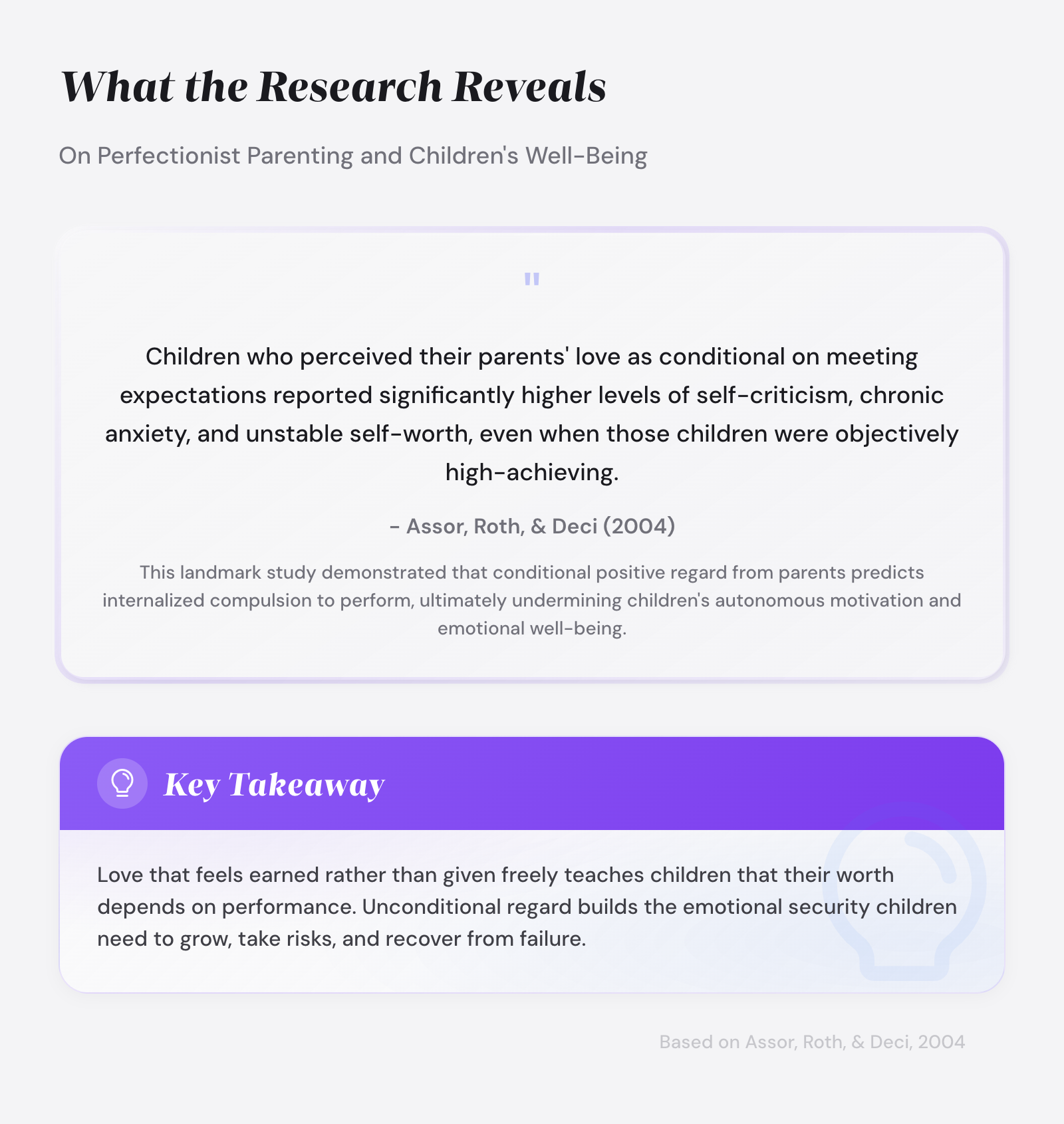
The mechanism is straightforward: children who experience conditional approval internalize the belief that mistakes signal a loss of love [4]. According to Assor, Roth, and Deci’s research on conditional parental regard, when parents’ warmth and praise depend on performance, children develop performance-contingent self-worth — anxiety about anything that might go wrong, because going wrong means losing connection [4].
The distinction between healthy striving and perfectionism is not about having high expectations. It’s about the emotional message underneath.
“I love you when you get an A” is fundamentally different from “I love you. I’m curious about what you learned from this grade.”
Research distinguishes between two parental approaches. One parent maintains high standards while offering unconditional acceptance: “I expect you to try your best and learn from mistakes. Your mistakes don’t change how much I value you.” The other parent merges standards with conditional approval: “Your value depends on how well you perform.” The second approach creates anxious, self-critical children. The first creates resilient kids who recover from setbacks.
Children don’t become perfectionists because their parents expected too much. They become perfectionists because their parents’ love felt like something that could be lost [4].
Social learning research shows that children acquire self-criticism patterns by watching how their parents treat themselves [2]. If you respond to your own mistakes with harsh internal dialogue, your children learn to respond to their mistakes the same way. By adolescence, their internal critic sounds exactly like your external one – not through genetics, but through observation and modeling.
The intergenerational cycle: how perfectionism gets passed down
Intergenerational perfectionism is the transmission of perfectionist standards and self-critical patterns from parent to child through modeling, conditional feedback, and identification — not through genetics. The cycle persists because perfectionist parenting behaviors feel like expressions of care, making them difficult for parents to recognize and interrupt.
You likely inherited perfectionism from your parents or guardians. They inherited it from theirs. The pattern persists because it feels like care. Pushing your child harder seems like an expression of how much you value their future. Setting impossible standards feels like protection against complacency.
Perfectionist parenting is learned, not innate. According to Smith, Vidovic, and colleagues’ meta-analysis of 46 studies, both social expectations and social learning models explain how perfectionism transmits across generations [2]. The transmission happens through three pathways:
Modeling: Children watch how you respond to your own mistakes. If you catastrophize a burned dinner or shame-spiral over a work setback, they internalize that response pattern.
Conditional feedback: They learn that your approval fluctuates with their performance, so they chase approval through achievement.
Identification: Children adopt your standards as part of their identity to maintain emotional connection with you [2][3].
Research on intergenerational perfectionism found that psychological control (conditional approval) mediates the relationship between a perfectionist mother’s or perfectionist father’s standards and their child’s perfectionism [3]. Translation: it’s not that perfectionist parents create perfectionist kids directly. It’s that the conditional approval style is the transmission mechanism.
Breaking this cycle requires recognizing that your perfectionist parenting likely came from somewhere. Your parents probably meant well. They probably believed that pushing you hard was how you’d succeed in a competitive world. Understanding this doesn’t excuse the impact, but it creates space for compassion and change. You can acknowledge that their intentions were good while recognizing that their methods transmitted parenting anxiety, not resilience.
The shift happens when you choose a different message: “You are valuable independent of your performance.”
The perfectionism you inherited from your parents doesn’t only shape how you raise your children. It also restructures how you relate to your partner — and that relational dynamic feeds back into your family’s perfectionism cycle.
How perfectionism strains romantic relationships: perfectionism and marriage
Your perfectionism doesn’t only affect your children. It reshapes your partnership. When you merge love with performance standards, both partners live under constant evaluation.
Clinical research on perfectionism’s psychological patterns shows that partners of people with perfectionist tendencies commonly report feeling chronically evaluated, criticized, and unable to relax even in intimate moments [5]. This dynamic creates emotional distance because true intimacy requires vulnerability – and vulnerability feels unsafe when someone is constantly measuring performance against standards.
Perfectionism in relationships creates specific patterns. You offer feedback on how your partner loaded the dishwasher. They interpret it as criticism, because it is. You struggle to delegate because “if you want it done right, do it yourself.” You withdraw emotionally when your partner falls short of your expectations. Over time, intimacy erodes because your partner doesn’t feel safe being imperfect around you.
If you’re co-parenting with a perfectionist partner, the family dynamics become more complex. One partner pushes for higher performance; the other advocates for self-compassion. The children sense the conflict and internalize the message that they’re a source of marital stress. They increase their efforts to reduce tension, further entrenching perfectionist patterns.
Research by Trub and colleagues on perfectionism and relationship satisfaction found that parenting perfectionism predicts lower relationship satisfaction – but this effect diminishes when partners practice unconditional acceptance [6]. Couples who shift their foundation from performance evaluation to acceptance-based support report higher satisfaction and less conflict, even under the normal stress of raising kids.
Perfectionism doesn’t protect relationships from disappointment. It guarantees disappointment by making love conditional on an outcome nobody can consistently deliver [6].
The shift: how to stop being a perfectionist parent
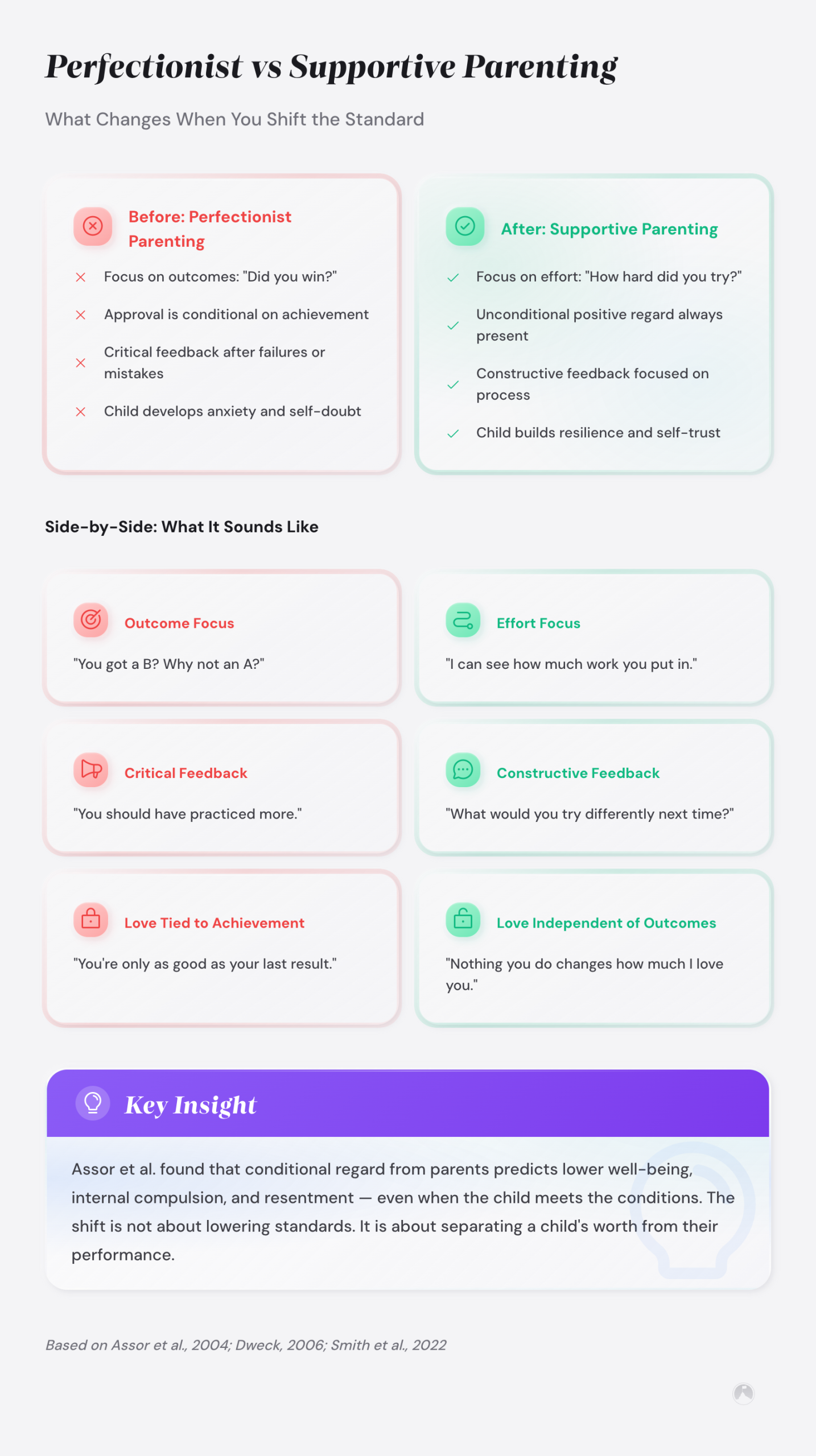
Acceptance-based parenting is a parenting approach that maintains high standards while ensuring love and emotional availability remain unconditional regardless of the child’s performance outcomes. Unlike permissive parenting, acceptance-based parenting still sets expectations — but decouples those expectations from the child’s sense of worth and belonging.
Changing your perfectionist patterns requires distinguishing between healthy striving and destructive perfectionism. Healthy striving maintains high standards while offering unconditional love. It sounds like: “I expect you to put effort into your work. I’m proud of your effort regardless of the outcome. Mistakes are learning opportunities.”
Destructive perfectionism merges standards with conditional worth. It sounds like: “You should be able to do better. I’m disappointed in your performance. Mistakes mean you’re not trying hard enough.”
We call this the Acceptance Foundations Framework — a four-part framework for shifting from conditional perfectionism to acceptance-based parenting. The practical shift has four components.
| Behavior | Perfectionist Parenting | Acceptance-Based Parenting |
|---|---|---|
| Response to mistakes | Criticism or disappointment | Curiosity and learning focus |
| Praise style | Outcome-focused (“You got an A!”) | Effort-focused (“You worked hard on that”) |
| Emotional availability | Conditional on performance | Consistent regardless of results |
| Risk-taking attitude | Discouraged (failure is threatening) | Encouraged (failure is data) |
| Self-talk modeling | Harsh self-criticism after errors | Self-compassion and growth language |
First, practice unconditional acceptance. Separate your child’s worth from their performance. Notice when your approval becomes conditional and consciously reconnect to acceptance. When your child brings home a disappointing grade, your first internal response might be disappointment. Your first external response should be curiosity: “Tell me what happened. What did you learn? How can I support you?”
Second, model self-compassion. Your children watch how you treat yourself when you make mistakes. If you catastrophize, shame-spiral, or engage in harsh self-criticism, they learn that pattern [2]. Instead, practice saying things like: “I made a mistake. I’ll learn from it. This doesn’t define me.” Your modeling of self-compassion is more powerful parenting than any lecture about self-esteem.
Third, celebrate effort over outcomes. Create a family culture where effort is noticed and appreciated regardless of results. “You worked really hard on that project” is more developmentally useful than “You got an A.” Effort is within your child’s control. Outcomes often depend on factors beyond it. Over-praising outcomes teaches children to chase external validation. Praising effort teaches them to value the process and build realistic standards they can actually sustain.
Fourth, create a mistake-friendly environment. Carol Dweck’s research on growth mindset shows that when families treat mistakes as learning opportunities rather than failures, children develop resilience [7]. They learn to extract information from mistakes instead of internalizing shame. If your family treats mistakes as things to be hidden, children stop taking intellectual risks. Instead, develop a culture where mistakes are anticipated and discussed: “What did we learn from this? How could we approach it differently next time?”
These shifts don’t require lowering your standards. They require shifting the foundation they’re built on – from conditional love to unconditional acceptance, from outcome obsession to effort recognition, from performance evaluation to growth partnership. That’s not lowering the bar. It’s moving the bar from “be perfect” to “keep growing.”
Ramon’s take
Perfectionism sneaks in disguised as ‘I just want the best for them.’ Mine showed up as correcting my son’s Lego builds. His Lego builds. If that’s not a sign you might want to read this twice, I don’t know what is.
Here’s what shifted my thinking: “unconditional love” and “accepting mediocrity” are not the same thing. You can maintain high standards while completely disconnecting worth from outcomes. Unconditional love creates the psychological safety that allows people to take risks, learn from failure, and develop genuine resilience.
Breaking the perfectionism cycle
Your high standards didn’t create your child’s anxiety. Your conditional approval did. The distinction matters because it means you can maintain excellence while fundamentally shifting the emotional foundation your family stands on.
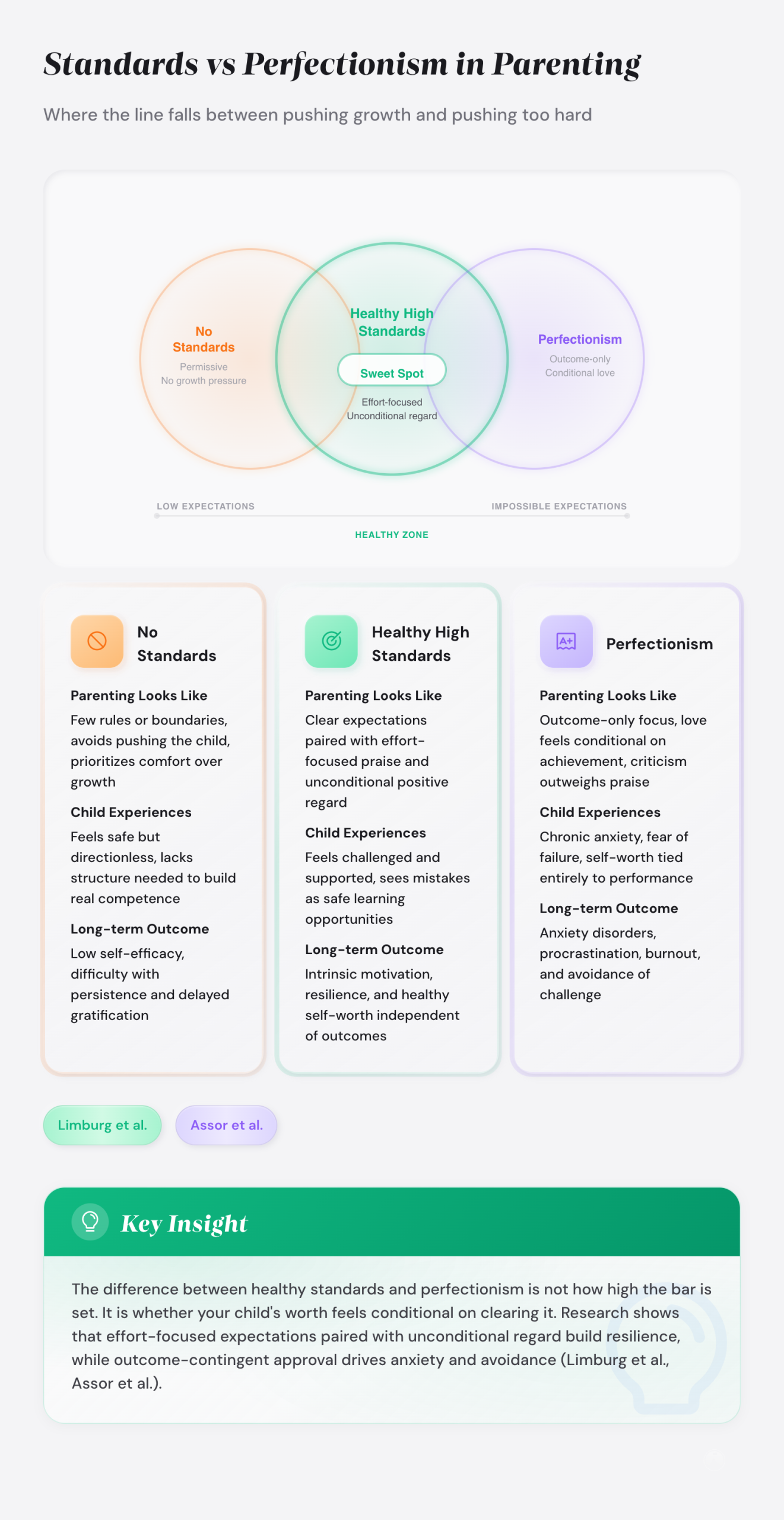
Breaking the perfectionism cycle requires one core shift: unconditional love and high standards aren’t opposites. They’re partners. You expect effort. You celebrate progress. And you communicate, consistently, that none of this changes how much your child is worth. Your worth – and theirs – is never on the line.
The work of making this shift is internal first. It requires examining your own relationship with mistakes and self-criticism. It requires building self-compassion so you can genuinely offer it to your children. And it requires accepting that you’ll fall back into perfectionist patterns sometimes – and that this too is a learning opportunity, not a failure.
This isn’t about being a perfect parent. It’s about being a parent who models that perfection isn’t the goal.
Next 10 minutes
- Identify one area where you notice your approval becoming conditional on your child’s performance (grades, sports, appearance, behavior). Notice the pattern without judgment.
- Write down what unconditional acceptance would sound like in that specific situation. What would you say if you separated the outcome from your love?
This week
- Practice one instance of naming effort instead of outcome. When your child does something, notice the work: “You really focused on that” or “You kept trying even when it got hard.”
- Reflect on one mistake you made this week. Instead of your usual self-criticism, practice the self-compassion response you want your children to learn: acknowledge the mistake, identify what you learned, move forward.
There is more to explore
For deeper work on perfectionism’s roots and recovery, see the guide on overcoming perfectionism. If you’re interested in the research behind these patterns, perfectionism psychology research covers the clinical foundations. For practical tools, perfectionism recovery approaches compares the methods that work. And if perfectionism is showing up in your work as well as your family, perfectionism and high achievers and signs perfectionism is holding you back are worth reading.
Related articles in this guide
- progress-over-perfection-practices
- setting-realistic-standards-guide
- signs-perfectionism-holding-you-back
Frequently asked questions
Is it harmful to have high standards for my children?
High standards are not harmful when paired with unconditional love. The key is how you communicate expectations at different ages. For elementary-age children: ‘Let’s practice this together until it clicks.’ For middle schoolers: ‘What’s your plan for improving this? I’m here to help.’ For teens: ‘I trust you to figure this out. I’m available if you want to talk through it.’ The harm comes when approval fluctuates with performance, not when expectations are high.
How can I tell if my parenting is perfectionist?
Ask yourself: does my child feel safe failing? Do they risk trying new things even when they might not succeed? Or do they avoid challenges and show anxiety about mistakes? If children avoid risk-taking and fear mistakes, conditional approval is likely present. The test isn’t whether you have high standards – it’s whether your child believes your love depends on meeting them.
Can perfectionist parenting cause mental health problems?
Yes. Beyond the anxiety and depression associations documented in meta-analyses, perfectionist parenting is linked to specific clinical presentations in children and adolescents: social anxiety driven by fear of evaluation, avoidant attachment patterns that persist into adult relationships, and disordered eating connected to body-image perfectionism. The mechanism is conditional approval — children internalize the belief that their worth depends on performance, creating chronic vigilance about potential failure.
Is it possible to change perfectionist parenting patterns?
Yes. It requires awareness of where your perfectionism came from (usually inherited from your own parents), self-compassion for the patterns you’ve replicated, and consistent practice of unconditional acceptance. The Acceptance Foundations Framework covers unconditional acceptance, modeling self-compassion, celebrating effort, and creating a mistake-friendly environment.
How do perfectionism and parenting affect romantic relationships?
Partners of perfectionists report feeling constantly evaluated, criticized, and unable to relax. Perfectionism in relationships creates criticism-based dynamics and erodes intimacy because intimacy requires vulnerability and the safety of unconditional acceptance. Research shows couples who shift to unconditional acceptance report higher relationship satisfaction.
Can perfectionism pass from parents to children?
Yes. Research shows transmission is most impactful during ages 4-12, when children are most actively modeling parental behaviors and internalizing approval patterns. Adoptive family studies confirm the mechanism is environmental, not genetic — adopted children develop perfectionism patterns matching their adoptive parents, not their biological parents. Single-parent households may show intensified transmission because the child has fewer models for alternative self-evaluation styles.
How long does it take to shift from conditional to unconditional parenting?
Awareness is the first shift and can happen immediately. Consistent behavioral change in parenting style typically takes several weeks of deliberate practice. Your own internal shift — genuinely decoupling self-worth from performance — is ongoing and may take months or years of self-compassion work.
What if my partner has perfectionist parenting patterns but I don’t?
Co-parenting with different standards creates confusion for children but is manageable. The key is alignment on values, not uniformity on rules. Agree on the core message: unconditional love combined with high expectations. Discuss perfectionist conflicts privately so children don’t perceive them as sources of marital stress.
References
[1] Limburg, K., Watson, H. J., Hagger, M. S., & Egan, S. J. (2017). The relationship between perfectionism and psychopathology: A meta-analysis. Journal of Clinical Psychology, 73(10), 1301-1326. https://doi.org/10.1002/jclp.22435
[2] Smith, M. M., Vidovic, V., Cripps, A., & Sherry, S. B. (2022). Parenting behaviours and trait perfectionism: A meta-analytic test of the social expectations and social learning models. Journal of Research in Personality, 96, 154-182. https://doi.org/10.1016/j.jrp.2021.104182
[3] Soenens, B., Vansteenkiste, M., Luyten, P., Duriez, B., & Goossens, L. (2005). Maladaptive perfectionistic self-representations: The mediational link between psychological control and adjustment. Personality and Individual Differences, 38(2), 487-498. https://doi.org/10.1016/j.paid.2004.05.008
[4] Assor, A., Roth, G., & Deci, E. L. (2004). The emotional costs of parents’ conditional regard: A self-determination theory analysis. Journal of Personality, 72(1), 47-88. https://doi.org/10.1111/j.0022-3506.2004.00256.x
[5] Egan, S. J., Wade, T. D., & Shafran, R. (2011). Perfectionism as a transdiagnostic process: A clinical review. Clinical Psychology Review, 31(2), 203-212. https://doi.org/10.1016/j.cpr.2010.04.006
[6] Trub, L., Powell, J., Biscardi, K., & Rosenthal, L. (2018). The “Good Enough” Parent: Perfectionism and relationship satisfaction among parents and nonparents. Journal of Family Issues, 39(10), 2862-2882. https://doi.org/10.1177/0192513X18763226
[7] Dweck, C. S. (2006). Mindset: The New Psychology of Success. Random House. https://doi.org/10.1037/10605-000