
Why the wrong recovery approach will leave you stuck
You’ve tried one recovery approach and it didn’t stick. Maybe therapy felt too abstract. Maybe a self-help book inspired you for a week then gathered dust. Now you’re wondering if something different would work better – and whether the problem is you or the method.
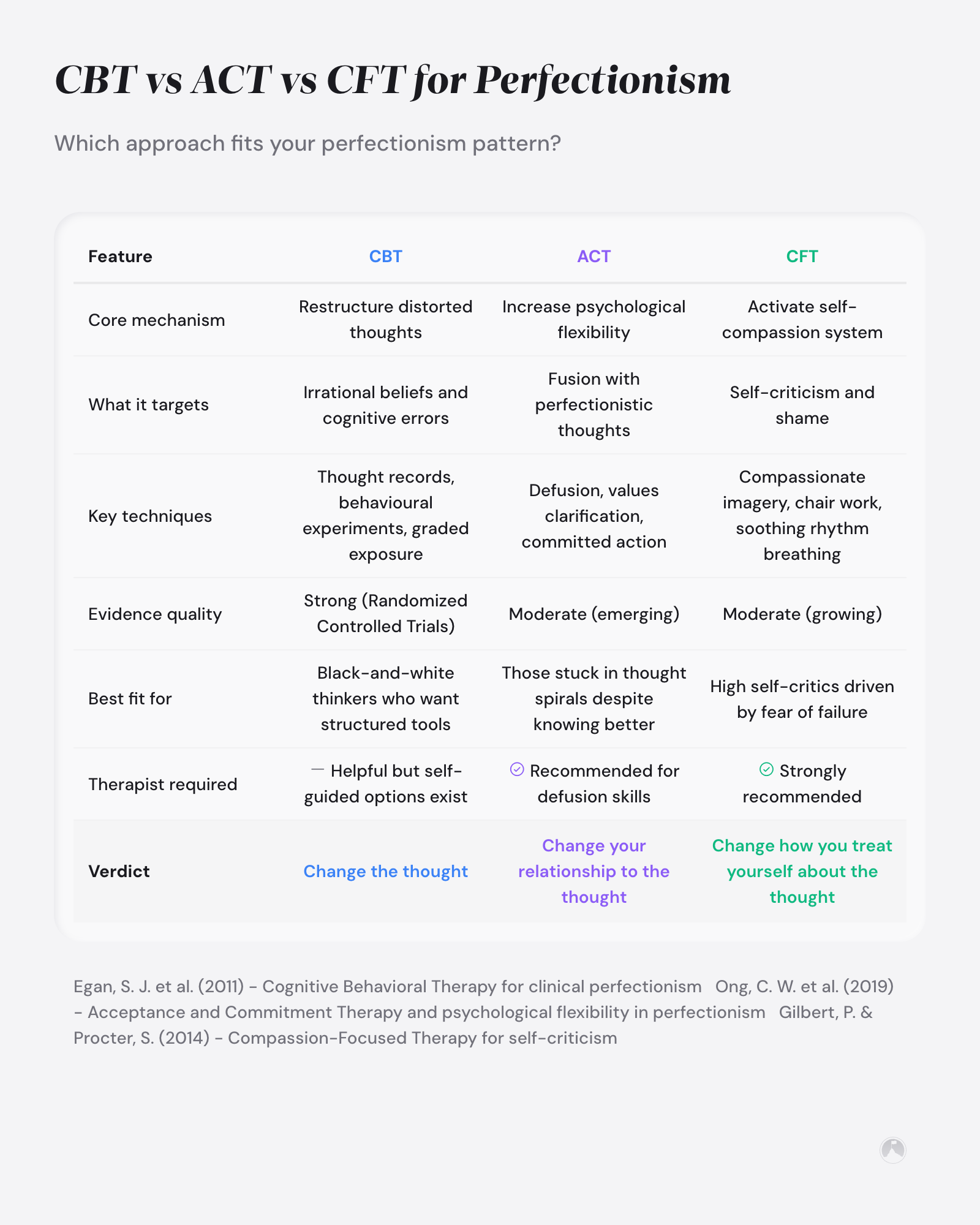
When you look at perfectionism recovery approaches compared side by side, one thing becomes clear: CBT and ACT aren’t interchangeable. Self-help books don’t work the same way perfectionism workbooks do. Some perfectionism recovery methods target shame. Different approaches target fear of failure. This perfectionism treatment comparison matters because the stakes are real.
Picking the wrong recovery method is not just inefficient – it can convince you that recovery itself is impossible. You’re not broken. The approach was mismatched to how you think, what you can access, and where your perfectionism actually comes from.
This article compares the major evidence-based approaches. You’ll see how each one works, which types of perfectionism they address best, and what a 2014 systematic review by Egan and colleagues across CBT, ACT, CFT, and self-help modalities actually shows about speed and effectiveness [5]. By the end, you’ll have a decision framework for choosing your path forward.
The most effective perfectionism recovery approach is the one that matches your perfectionism type and that you sustain for at least six weeks.
Perfectionism recovery is the process of reducing perfectionism-driven anxiety and building realistic standards through evidence-based therapy (such as CBT, ACT, or compassion-focused therapy) or structured self-help practice. Recovery doesn’t mean eliminating high standards – it means unhooking your self-worth from whether you meet them.
What you will learn
- How CBT, ACT, and compassion-focused therapy differ in mechanism – and what research shows about each one
- Which approach works best for your specific type of perfectionism
- A side-by-side comparison of all major perfectionism recovery methods with cost, evidence level, and time commitment
- The Fit Factors Framework – how to match an approach to your personality and constraints
- Whether combining approaches actually accelerates recovery
Key takeaways
- CBT and ACT produce comparable outcomes for perfectionism recovery. The difference is mechanism and personal fit [5].
- Self-help books build understanding in 2-4 weeks; workbooks with exercises produce behavior change faster.
- Therapy modalities show faster change than self-help alone; guided self-help shows meaningful improvement in roughly 40-60% of consistent users [4].
- Perfectionism type (fear-of-failure, socially-prescribed, or shame-based) predicts which approach will feel natural and sustainable.
- Combining approaches may accelerate recovery based on clinical experience, though head-to-head RCTs remain limited.
How these approaches compare
The fastest way to understand your options is a direct comparison. Read the table below for quick answers. The sections after it dig into each approach with research details.
| Approach | How it works | Best for | Evidence | Cost | Timeline |
|---|---|---|---|---|---|
| CBT therapy | Identify perfectionistic thoughts, test their accuracy, build realistic standards | Fear-of-failure perfectionism, catastrophic thinking | 15 RCTs; meta-analysis shows medium-to-large effect sizes (g = 0.87 for clinical perfectionism) [5] | $100-200/session (US typical) | 8-16 weeks |
| ACT therapy | Accept perfectionistic thoughts without fighting them; clarify values; take aligned action | Perfectionism causing anxiety or paralysis | 8 RCTs; effect sizes comparable to CBT (d = 0.85 in Ong 2019 trial) [2] | $100-200/session (US typical) | 10-16 weeks |
| CFT (compassion-focused) | Build self-compassion; reduce shame and self-criticism | Shame-based perfectionism, harsh inner critic | 3 RCTs + pilot studies; growing evidence base [3][9] | $100-200/session (US typical) | 12-20 weeks |
| Self-help books | Read frameworks; understand perfectionism psychology; shift perspective | People who learn through understanding, budget constraints | Varies by book; evidence-based options available (Shafran, Egan, and Wade 2016) [6] | $15-30 per book | 2-4 weeks understanding; slower behavior change |
| Perfectionism workbooks | Guided worksheets, thought records, behavioral experiments | People who learn by doing; want accountability structure | 2024 RCT shows measurable change within 8-12 weeks [4] | $20-45 per workbook | 8-12 weeks measurable change |
CBT: challenge the perfectionistic thought itself
CBT for perfectionism works by identifying the catastrophic thoughts that drive perfectionistic behavior, testing whether those thoughts hold up against evidence, and building more realistic standards. If you believe that “one mistake means I’m a failure,” CBT helps you gather evidence against that belief and rebuild a standard that distinguishes between making a mistake and being a failure.
The mechanism is direct. Perfectionism is maintained by core beliefs like “anything less than perfect is unacceptable” or “if I’m not the best, I’m worthless.” These thoughts usually form early – from critical parents, competitive schooling, or early perfectionism that “worked” in achieving success. CBT doesn’t say these thoughts are wrong. It says the evidence doesn’t support them.
Egan, Wade, and Shafran’s 2011 meta-analysis of CBT for perfectionism found large effect sizes on perfectionism measures, with anxiety and depression also declining significantly [1]. A broader 2014 systematic review by Egan and colleagues confirmed that CBT produces measurable perfectionism reduction within 8-16 weekly sessions for most participants, with the Galloway et al. 2021 update reporting effect sizes of g = 0.87 for clinical perfectionism and g = 0.89 for concern over mistakes [5].
Best for: People whose perfectionism is driven by catastrophic thinking (“if I’m not perfect, everything falls apart”). Works particularly well for fear-of-failure perfectionism and perfectionism tied to specific domains like work or academics. And if you’re analytical and like the idea of “testing” your thoughts, the CBT process will feel intuitive.
Key limitation: If your perfectionism is rooted in shame rather than fear, or if you’ve already tried cognitive approaches and they felt intellectually hollow, CBT may feel incomplete. Understanding a thought is irrational and actually believing that are two different cognitive events.
ACT: accept the perfectionist mind and move toward what matters
ACT for clinical perfectionism — perfectionism that causes significant distress or functional impairment — takes a different path: instead of fighting perfectionistic thoughts, you learn to have them without being controlled by them. You identify what actually matters to you (your values), then take action aligned with those values even while the perfectionist voice in your head keeps chattering.
The ACT approach assumes that you can’t eliminate perfectionistic thoughts through willpower or logic. They’re part of how your brain was wired. But you can change your relationship with those thoughts. Instead of “I must be perfect” controlling your behavior, you notice the thought and ask: “Is this getting me closer to what I actually care about?” Often the answer is no – perfectionism is sabotaging your values. That mismatch is your opening for change.
Ong and colleagues’ 2019 randomized controlled trial of ACT for clinical perfectionism found that ACT significantly reduced perfectionism (effect size d = 0.85), with gains maintained at four-month follow-up [2]. The 2014 systematic review by Egan and colleagues found ACT effect sizes comparable to CBT, with no statistically significant difference between the two approaches [5]. The difference lies in mechanism and patient preference, not outcomes.
Best for: People whose perfectionism creates paralysis or anxiety (rather than just high standards). People who’ve tried cognitive restructuring and found it overly intellectual, or who naturally resist the idea that they “should” change their thoughts. ACT also works well for perfectionism intertwined with procrastination – the values clarity often unsticks avoidance that cognitive work alone doesn’t resolve.
Key limitation: ACT requires you to practice having uncomfortable thoughts and feelings without reacting. For some people in early recovery, this feels like “giving up” on perfection. ACT’s benefits also compound over time – the first 2-3 weeks may feel less impactful than CBT’s more immediate cognitive shifts. The paradox of ACT is that you have to stop trying to fix your thoughts before they actually change.
CFT (compassion-focused therapy): heal the inner critic
Compassion-focused therapy approaches perfectionism by addressing the shame and self-criticism underneath it, rather than targeting the thoughts or values directly. CFT builds self-compassion and soothes the threat system that perfectionism tries to regulate.
Many perfectionists have a cruel inner critic – a voice that sounds like a disappointed parent or a relentless judge. The inner critic often became “protective” early in life: “If I criticize myself harshly first, nobody else can hurt me.” Perfectionism becomes a way to avoid that inner critic’s attacks.
CFT doesn’t ask you to change the critic’s thoughts. It builds a compassionate inner voice strong enough to soothe and protect you without needing perfectionism as a defense.
Gilbert and Procter’s 2006 pilot study of compassionate mind training demonstrated significant reductions in shame and self-criticism, with participants reporting increased ability to self-soothe [3]. Subsequent research, including Ashworth and colleagues’ 2015 evaluation of compassion-focused therapy in community mental health settings, has expanded the evidence base for CFT-based approaches [9].
Clinical experience suggests that shame-based perfectionism – the type most common in people with perfectionist parents or highly critical environments – may respond well to compassion and acceptance approaches, though direct comparison trials between CFT and CBT for shame-based presentations remain limited.
Best for: Perfectionism driven by shame or harsh self-criticism (common in high-achieving women and in people with perfectionist parents). Also effective for socially-prescribed perfectionism – the feeling that you must be perfect to be accepted by others. People who resonate emotionally with compassion and who recognize their perfectionism as a form of self-protection.
Key limitation: CFT is less available than CBT or ACT – fewer therapists are trained in it. It can take longer to show measurable results (12-20 weeks typical based on protocol lengths in published studies [9]). CFT asks you to be kind to yourself, which is the single hardest thing for a perfectionist to do.
Self-help books: the insight path to recovery
Self-help books perfectionism resources work through a different mechanism than therapy: they build understanding and perspective shifts. You read frameworks that explain your perfectionism, recognize yourself in case examples, and gradually shift how you think about what “good enough” means.
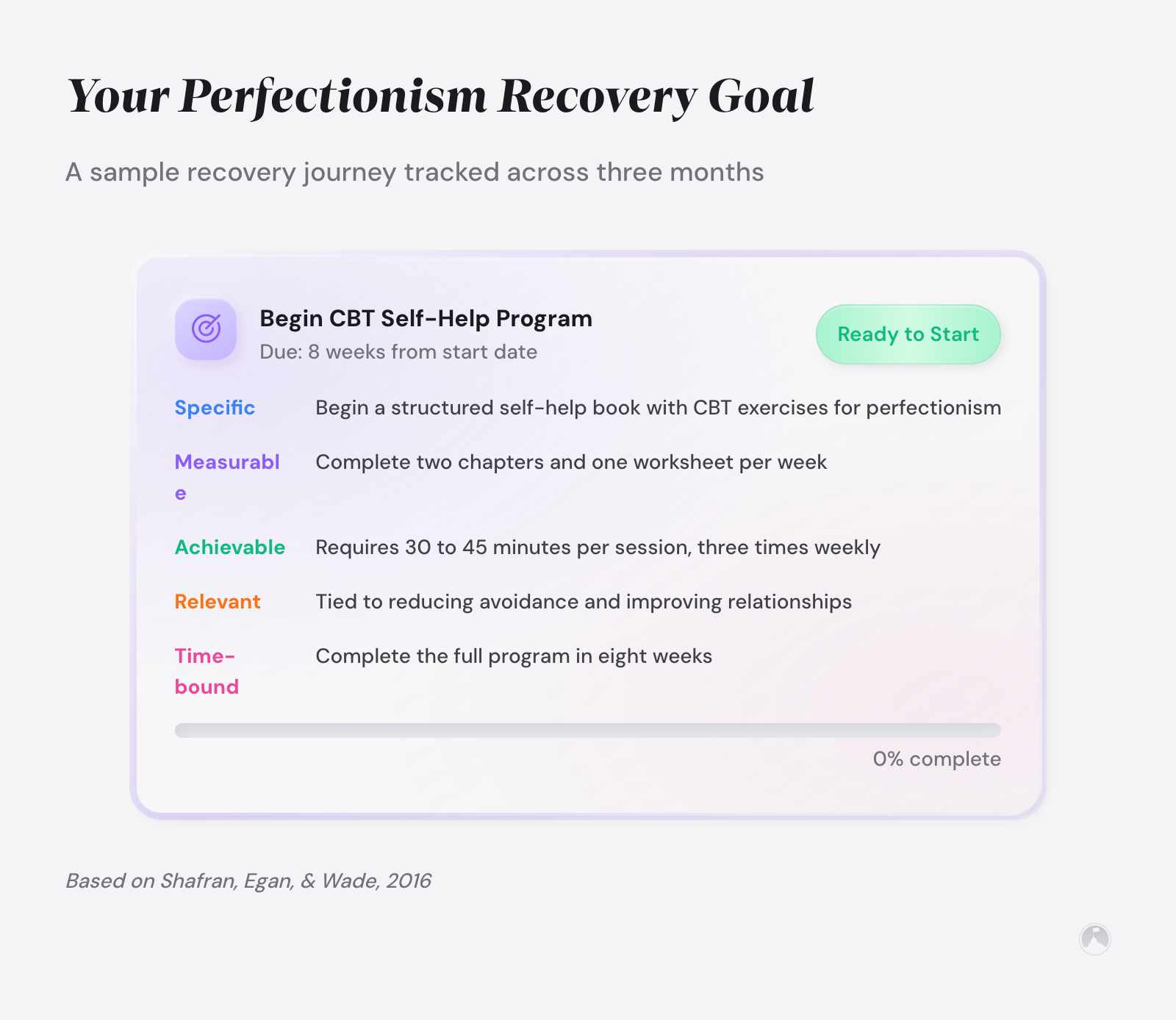
The most evidence-supported book in this category is Shafran, Egan, and Wade’s “Overcoming Perfectionism,” which applies scientifically supported CBT techniques in a self-help format [6]. Brene Brown’s “The Gifts of Imperfection,” based on her research on shame and vulnerability at the University of Houston, provides a self-help framework built around shame-driven perfectionism [7]. Most self-help books perfectionism readers reach for combine elements of CBT, self-compassion, or behavioral change. The mechanism of change isn’t therapy – it’s “I didn’t realize my perfectionism came from this, and now that I see it, I can act differently.”
Research on self-help books for perfectionism is mixed. Evidence-based self-help books show meaningful improvements in perfectionism scores over 8-12 weeks of consistent reading and reflection, though behavior change typically lags behind understanding [6]. You “get it” intellectually before you actually change the pattern.
Best for: People who prefer to understand before they act. People on a budget or without access to therapy (geographic barriers, wait lists, cost constraints). If you’re exploring recovery and looking for a first step, a well-chosen book can provide that confirmation. Books work best as a complement to therapy or as a stepping stone before committing to more intensive work.
Key limitation: Understanding alone doesn’t guarantee behavior change. Many people read something that resonates, feel inspired for a week, then revert to old patterns. Reading about recovery and doing recovery are related but separate activities.
Perfectionism workbooks and guided exercises: the active practice path
Perfectionism workbooks differ from self-help books in one important way: they demand active practice. Instead of reading about perfectionism, you’re filling out thought records, running behavioral experiments, rating your perfectionism daily, and practicing specific techniques. Active engagement with exercises is what creates behavior change.
Popular perfectionism workbooks include Shafran, Egan, and Wade’s “Overcoming Perfectionism” (CBT-based with structured exercises) and various ACT-based workbooks that focus on values and acceptance practice [6]. Many therapists recommend starting with a workbook before formal therapy or using one alongside therapy sessions for between-session practice.
Rozental and colleagues’ 2024 randomized controlled trial of internet-based self-help CBT for perfectionism found that participants using guided workbook exercises showed measurable reductions in both perfectionism and anxiety [4]. Guided workbook programs (workbook combined with periodic therapist check-ins) show meaningful improvement rates of roughly 40-60% for consistent users, though unguided self-help alone shows lower completion and persistence rates.
Digital therapy platforms and app-based CBT programs are emerging as accessible alternatives for perfectionism recovery. These tools bridge the gap between self-help books and traditional therapy by providing structured exercises with some level of guided support. However, most digital platforms have not been tested specifically for perfectionism in randomized controlled trials, so their evidence base for this condition remains limited compared to therapist-delivered and workbook-based approaches.
Best for: People who are action-oriented (“just tell me what to do”). Those who want therapy-level change but can’t access or afford therapy. People who know their perfectionism type and want focused practice on that specific pattern. Perfectionism workbooks also work well as a stepping stone – trying a workbook first shows you whether the underlying approach (CBT vs. ACT) resonates with you before investing in therapy.
Key limitation: Workbooks require discipline and consistent practice. Missing a week or skipping exercises undermines effectiveness. Without therapist guidance, it’s easy to misunderstand instructions or get stuck on difficult concepts. Some people benefit from a hybrid: workbook plus periodic coaching or therapy for clarification.
The Fit Factors Framework: how to choose your approach
Each of these approaches has proven effective for different people. The question is which one fits your specific situation.
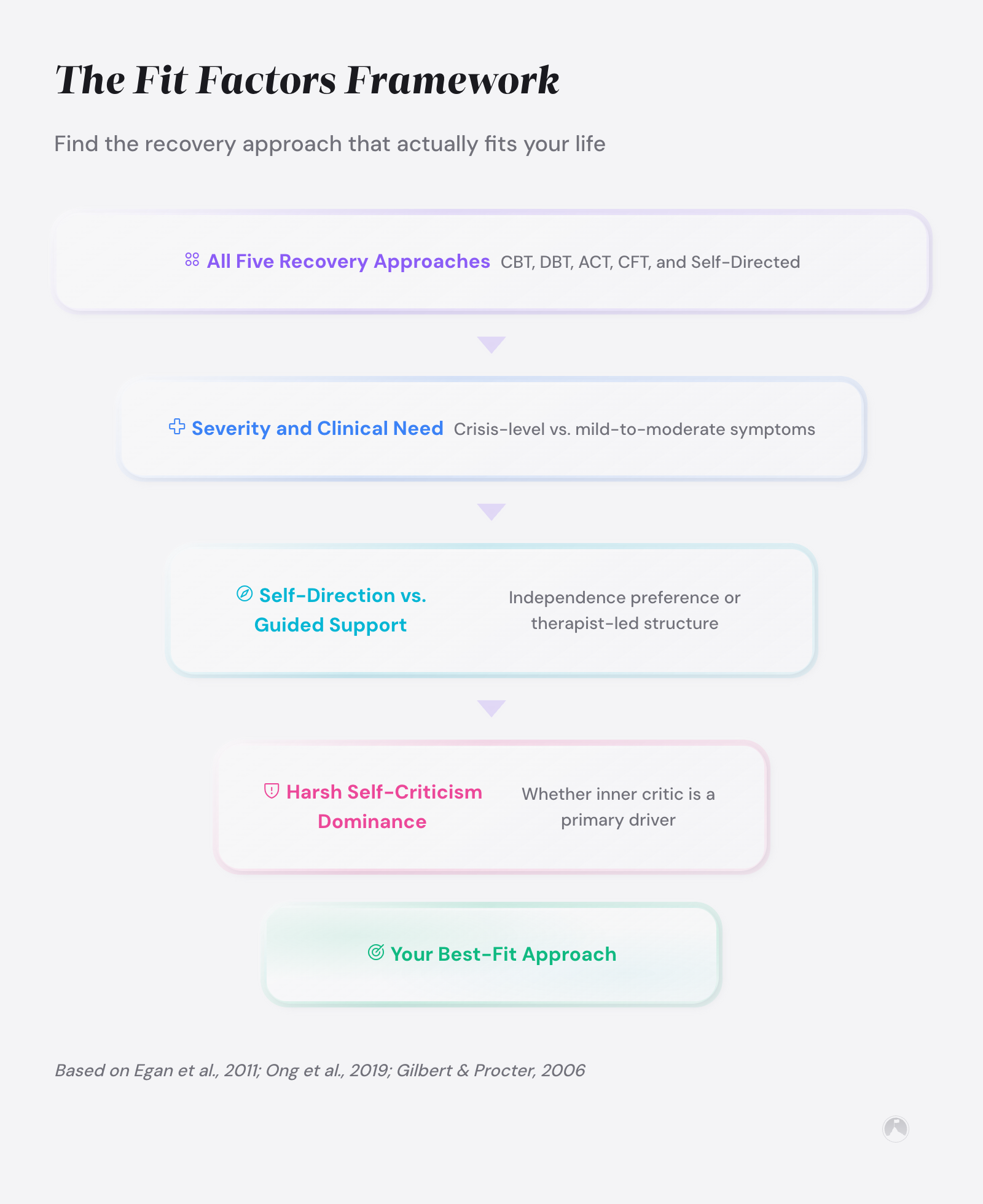
The 2014 systematic review shows no single approach is universally “best” – CBT and ACT produce comparable outcomes, with personal fit predicting who sticks with treatment [5]. The data shows there is no single best therapy for perfectionism – personal fit predicts adherence more than modality does. We call the decision framework below the Fit Factors Framework. Score each approach on four dimensions, and the highest total score is your best starting point.
1. Evidence level. All approaches have research behind them. The 2014 review by Egan and colleagues identified 15 CBT trials and 8 ACT trials, with 3 CFT trials [5]. Self-help books vary widely in evidence support. If research strength is your priority, CBT or ACT wins.
2. Engagement type. Books are primarily passive (you absorb). Perfectionism workbooks are active (you practice). Therapy is interactive (therapist feedback shapes practice). Active approaches produce faster change. If you commit to consistent practice, workbooks or therapy wins. If you have limited time or energy, books are more realistic.
3. Accessibility. Books cost $15-30 and are instantly accessible. Workbooks cost $20-45. Therapy costs $100-200 per session in the US and requires finding a trained therapist (wait lists can stretch for months). If cost is the barrier, books or workbooks. If you need support and can invest, therapy wins.
4. Perfectionism-type fit. The broader multidimensional perfectionism literature [10] shows that perfectionism types respond differently to different approaches. Fear-of-failure perfectionism often responds fastest to CBT for perfectionism. Shame-based perfectionism responds well to CFT or compassion-based approaches. Perfectionism causing paralysis responds well to ACT for perfectionism. Perfectionism you’ve never fully understood responds well to books first. Match the approach to your type.
Score each approach 1-5 on each dimension based on your situation. The approach with the highest total score is the one most likely to stick. The best perfectionism recovery method is whichever one you’ll actually use for six weeks straight.
How to choose your perfectionism recovery approach in 4 steps:
- Rate evidence strength for your needs (CBT and ACT have the deepest research base).
- Match your engagement style: passive (books), active (workbooks), or interactive (therapy).
- Check accessibility constraints: cost, location, and wait times.
- Identify your perfectionism type and match it to the approach that targets it.
Can you combine these approaches?
Yes. Many therapists recommend combining approaches – for example, CBT or ACT therapy paired with a self-help book or workbook for between-session practice. While controlled trials comparing combined to single-method approaches are limited, clinical experience suggests this may accelerate change. The therapy provides guided practice with a trained person. The book or workbook deepens your understanding and gives you structured homework.
Another effective combination is CBT therapy plus compassion-building practices. You challenge the perfectionist thoughts (CBT), then build compassion for the part of you that feels threatened without those thoughts (CFT). This combination addresses both the cognitive distortions and the emotional roots.
The least effective combination is multiple books without active practice. Understanding perfectionism from five different angles doesn’t change perfectionism – practice does. But combining a book (understanding) plus a workbook (practice) plus optional therapy support is a well-supported path to change.
Ramon’s take
Three approaches, all legit, and the hardest part is still just choosing one. That’s extremely on-brand for perfectionism. Start anywhere. The method you actually commit to beats the perfect one you’re still researching.
Choosing your path forward
Perfectionism recovery approaches aren’t one-size-fits-all. CBT challenges the thoughts driving perfectionism. ACT reorients you toward values even while those thoughts persist. CFT builds self-compassion to counter shame. Books build understanding. Workbooks build practice. Each works – the question is which works for your situation, budget, and how your brain processes change. Use the Fit Factors Framework to identify the best match. Start there. Give it 6-8 weeks of genuine commitment. Then adjust if needed.
For a deeper look at the psychology behind perfectionism and practical tools, see our overcoming perfectionism guide.
Next 10 minutes
- Identify your perfectionism type: fear of failure, socially prescribed, or shame-based.
- Score your situation on the Fit Factors (evidence, engagement, access, type-fit).
- Pick the top-scoring approach.
This week
- If you chose a book or workbook: order it or check your library.
- If you chose therapy: make a list of 3 therapists in your area trained in your chosen approach (CBT, ACT, or CFT).
- Commit to trying your chosen approach for 6-8 weeks before deciding whether to adjust.
There is more to explore
For deeper exploration of perfectionism recovery, see our guides on overcoming perfectionism, perfectionism paralysis solutions, perfectionism for high achievers, building systems to beat perfectionism, and perfectionism management tools and worksheets.
Related articles in this guide
- perfectionism-relationships-parenting
- progress-over-perfection-practices
- setting-realistic-standards-guide
Frequently asked questions
What is the most effective approach for perfectionism recovery?
CBT and ACT are equally effective based on meta-analytic data, but the best choice depends on your perfectionism type. Beyond modality choice, therapist skill and the strength of the therapeutic alliance also predict outcomes significantly. For fear-of-failure perfectionism, CBT often works faster. For anxiety-driven perfectionism, ACT. For shame-driven perfectionism, CFT.
Can I recover from perfectionism using only self-help books?
Yes, but recovery through books alone is typically slower than therapy-supported approaches. Self-help books build understanding within 2-4 weeks. Behavior change takes longer – typically 8-12 weeks of consistent reading and reflection. Books work better when paired with journaling or a workbook. Guided self-help workbook programs show meaningful improvement in roughly 40-60% of consistent users, though unguided book reading alone shows lower rates.
How long does perfectionism recovery typically take?
Most people notice measurable shifts within 8-16 weeks of consistent practice. With therapy (CBT or ACT): 8-16 weeks based on published trial protocols. With CFT: 12-20 weeks. With workbooks: 8-12 weeks of consistent practice per Rozental and colleagues’ 2024 trial. ‘Measurable improvement’ in practice means reduced avoidance, fewer self-critical episodes, and greater willingness to submit imperfect work.
Should I try therapy or start with a self-help book?
Start with a self-help book if cost is a barrier, you want to understand perfectionism first, or you have never explored recovery. Start with therapy if you have been struggling for years, your perfectionism significantly limits your life, or you prefer guided practice. Many people do both – book first, then therapy.
Can I combine CBT with other approaches like self-compassion?
Yes. Many therapists recommend combining CBT (thought challenging) with compassion-based practices. This combination addresses both the cognitive distortions driving perfectionism and the shame or self-criticism that maintains it. While head-to-head RCTs comparing combined to single approaches are limited, clinical experience supports the combination.
Are there free resources for perfectionism recovery?
Yes. Many libraries carry perfectionism self-help books. Free online CBT and ACT resources exist through university research sites. Some therapists offer sliding-scale fees. Workbooks can be found at libraries, though evidence-based books from established publishers are more reliable than unsourced worksheets.
Which approach is best for perfectionism in creative work?
For creative perfectionism, ACT often works well because it addresses the procrastination and fear-of-judgment that block creative output. CFT (compassion-focused therapy) also works well for the shame many creatives carry about not being good enough. CBT works but may feel overly intellectual for some creative minds.
How do I know if an approach is not working?
Give any approach 6-8 weeks of consistent use before deciding. You should see small shifts (less self-criticism, attempting challenging tasks, reduced avoidance) by week 4-6. If you see no shifts after 8 weeks of genuine effort, try a different approach. Lack of progress suggests a mismatch between the approach and your perfectionism type, not failure on your part.
References
[1] Egan, S. J., Wade, T. D., & Shafran, R. (2011). Cognitive-behavioral treatment of perfectionism: A systematic review and meta-analysis. Clinical Psychology Review, 31(2), 203-212. https://doi.org/10.1016/j.cpr.2011.03.003
[2] Ong, C. W., Lee, E. B., Krafft, J., & Levin, M. E. (2019). A randomized controlled trial of acceptance and commitment therapy for clinical perfectionism. Journal of Contextual Behavioral Science, 14, 59-66. https://doi.org/10.1016/j.jcbs.2019.09.005
[3] Gilbert, P., & Procter, S. (2006). Compassionate mind training for people with chronic shame: Overview and pilot study of a group therapy approach. Clinical Psychology & Psychotherapy, 13(6), 353-379. https://doi.org/10.1002/cpp.507
[4] Rozental, A., Shafran, R., Johansson, F., Forstrom, D., Jovicic, F., Gelberg, O., Molin, K., Carlbring, P., Andersson, G., & Buhrman, M. (2024). Treating perfectionism via the Internet: a randomized controlled trial comparing cognitive behavior therapy to unified protocol. Cognitive Behaviour Therapy, Online First. https://doi.org/10.1080/16506073.2024.2327339
[5] Egan, S. J., Wade, T. D., Shafran, R., & Somers, J. M. (2014). Psychological treatments for perfectionism: A systematic review and meta-analysis. Clinical Psychology Review, 34(2), 98-111. https://doi.org/10.1016/j.cpr.2013.12.001
[6] Shafran, R., Egan, S. J., & Wade, T. D. (2016). Overcoming perfectionism: A self-help guide using scientifically supported cognitive behavioral techniques (2nd ed.). Routledge. ISBN: 978-1-47214-056-2
[7] Brown, B. (2010). The Gifts of Imperfection: Let Go of Who You Think You’re Supposed to Be and Embrace Who You Are. Hazelden. ISBN: 9780061205163
[8] Gilbert, P. (2014). The origins and nature of compassion focused therapy. British Journal of Clinical Psychology, 53(1), 6-41. https://doi.org/10.1111/bjc.12043
[9] Ashworth, F., Clarke, A., Jones, L., Jennings, C., & Longley, M. (2015). An evaluation of compassion-focused therapy following dissemination in community mental health services. Journal of Behavior Therapy and Experimental Psychiatry, 48, 152-157. https://doi.org/10.1016/j.jbtep.2015.03.009
[10] Hewitt, P. L., Flett, G. L., Turnbull-Donovan, W., & Mikail, S. F. (1991). The Multidimensional Perfectionism Scale: Reliability, validity, and psychometric properties in psychiatric samples. Psychological Assessment, 3(3), 464-468. https://doi.org/10.1037/1040-3590.3.3.464