
Perfectionism and mental health: the paradox nobody wants to admit
You’d think perfectionism would make you happier. Higher standards, more control, better outcomes. But the research tells a different story.
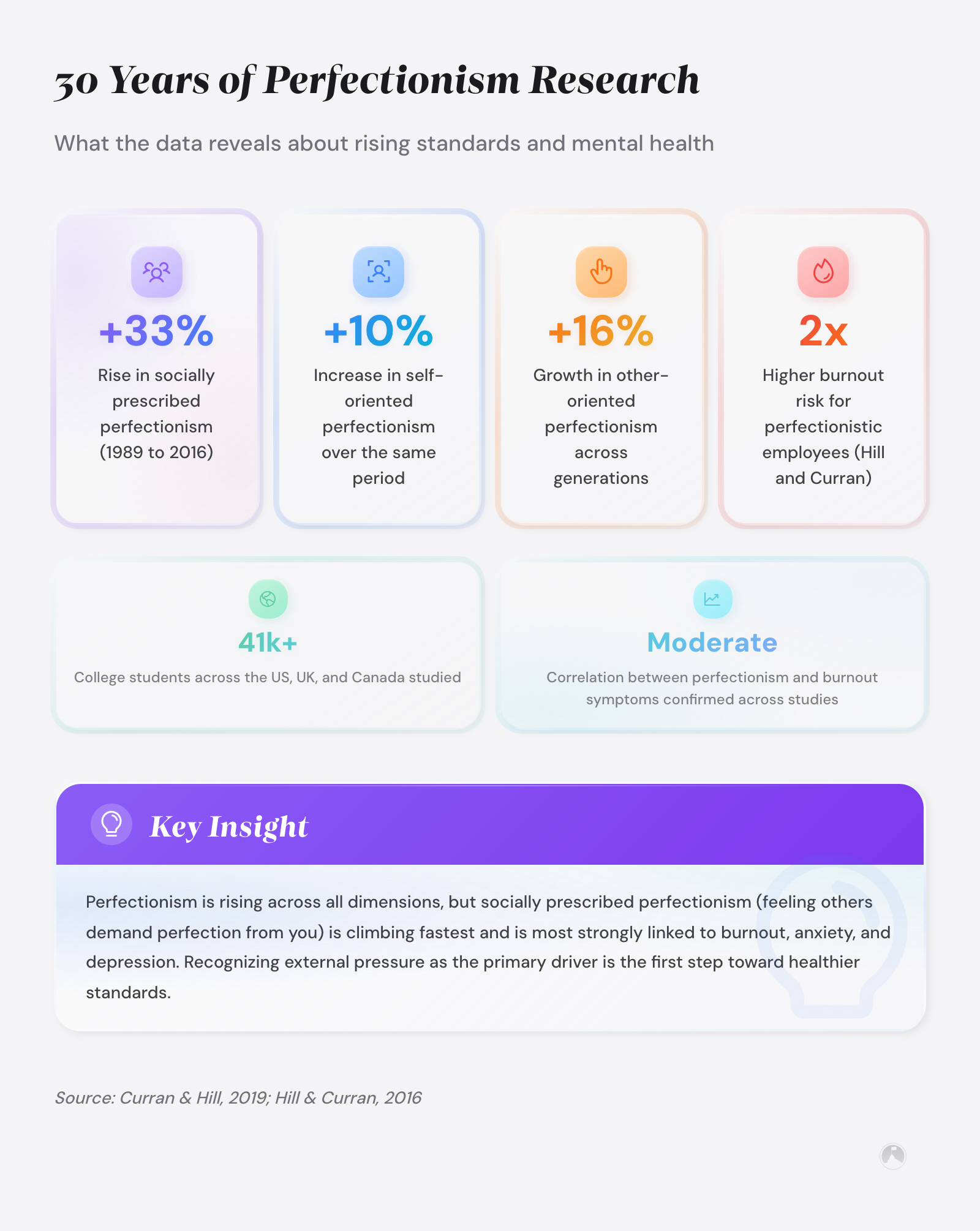
Curran and Hill’s landmark meta-analysis of birth cohort data found that perfectionism scores among young people rose significantly between 1989 and 2019 across Western nations — with socially prescribed perfectionism showing the steepest increase at 33%, while self-oriented perfectionism rose 10% and other-oriented perfectionism rose 16% [1]. During that same window, anxiety and depression in young adults climbed steeply alongside it. The relationship isn’t what most people assume.
Perfectionism psychology research reveals a painful truth: the drive to be perfect is making us less happy, not more.
If perfectionism really produced better performance and results, rising perfectionism should predict rising well-being. Instead, the data points the opposite direction. And the explanation turns out to be more nuanced than “perfectionism is bad.” Not all perfectionism is the same. The kind that burns people out is surprisingly different from the kind that builds excellence – and most people can’t tell the difference from the inside.
This guide synthesizes three decades of perfectionism research to answer the questions that matter: What does the science actually say about perfectionism and burnout? Which types predict mental health problems? And can you maintain high standards without the self-destruction?
What you will learn
- How socially prescribed perfectionism has increased 33% over 30 years while mental health problems have worsened
- The surprising distinction between perfectionistic striving (which doesn’t harm you) and perfectionistic concerns (which does)
- Why the brain’s threat-detection system treats perfectionist self-criticism as chronic stress
- How excellencism (high standards without fear) outperforms perfectionism on both performance and well-being
- What the two-factor model reveals about adaptive versus maladaptive perfectionism
- Concrete research findings on which types of perfectionism correlate with burnout, anxiety, and depression
- What CBT, ACT, and self-compassion research says about treating maladaptive perfectionism
Key takeaways
- Socially prescribed perfectionism increased 33% over 30 years while mental health declined, with self-oriented (+10%) and other-oriented (+16%) dimensions also rising [1].
- Perfectionistic concerns (fear of failure, self-criticism) predict burnout and mental health disorders, while perfectionistic striving shows minimal negative effects [2].
- Adaptive perfectionism (striving without fear) and maladaptive perfectionism (self-evaluative concerns) activate different stress pathways and produce opposite outcomes [5].
- Perfectionistic concerns are associated with sustained HPA axis activation, keeping cortisol chronically elevated and damaging cognitive function over time [5] [6].
- Excellencism – pursuing high standards without fear-based self-judgment – produces better grades and lower anxiety than perfectionism [3].
- CBT targeting perfectionistic concerns (not standards) reduces anxiety and depression while preserving ambition for excellence [8].
- The burnout mechanism in perfectionism isn’t the effort or ambition. It’s the fear underneath the effort.
The perfectionism paradox: why rising standards haven’t improved our mental health
Perfectionism psychology research is the empirical scientific study of perfectionist personality dimensions, the mental health consequences of perfectionist trait patterns, and the neurobiological mechanisms connecting perfectionist cognitions to anxiety, depression, and burnout — distinguished from clinical treatment manuals and pop psychology in its reliance on validated measurement instruments and evidence-based causal models.
The data starts with a puzzle. Between 1989 and 2019, perfectionism increased dramatically across Western nations. Curran and Hill’s meta-analysis of 164 samples and over 41,000 participants found that socially prescribed perfectionism — the most harmful dimension — rose 33% over three decades, while self-oriented and other-oriented perfectionism rose 10% and 16% respectively [1]. This surge happened in a world obsessed with self-improvement, optimization, and high achievement.
If perfectionism were a path to success and fulfillment, you’d expect rising perfectionism to correlate with rising happiness. Instead, the opposite happened. During the same period when perfectionism climbed, rates of anxiety and depression in young adults also climbed steeply.
Burnout in professional settings became endemic. The relationship between perfectionism and mental health wasn’t what conventional wisdom suggested. The problem wasn’t the rise in perfectionism itself – it was that researchers had been measuring the wrong thing.
Researchers began to suspect that “perfectionism” was too crude a term. Some perfectionists seemed fine. Others were anxious, exhausted, unable to function. The same trait was producing opposite outcomes in different people.
If you’ve noticed signs perfectionism is holding you back in your own life – the paralysis, the constant self-doubt – you’re seeing this split in action. That observation led to the key insight: there are at least two distinct types of perfectionism operating in the data, and they affect people completely differently.
The breakthrough: perfectionistic concerns versus perfectionistic striving
Perfectionism striving vs concerns: what the data shows
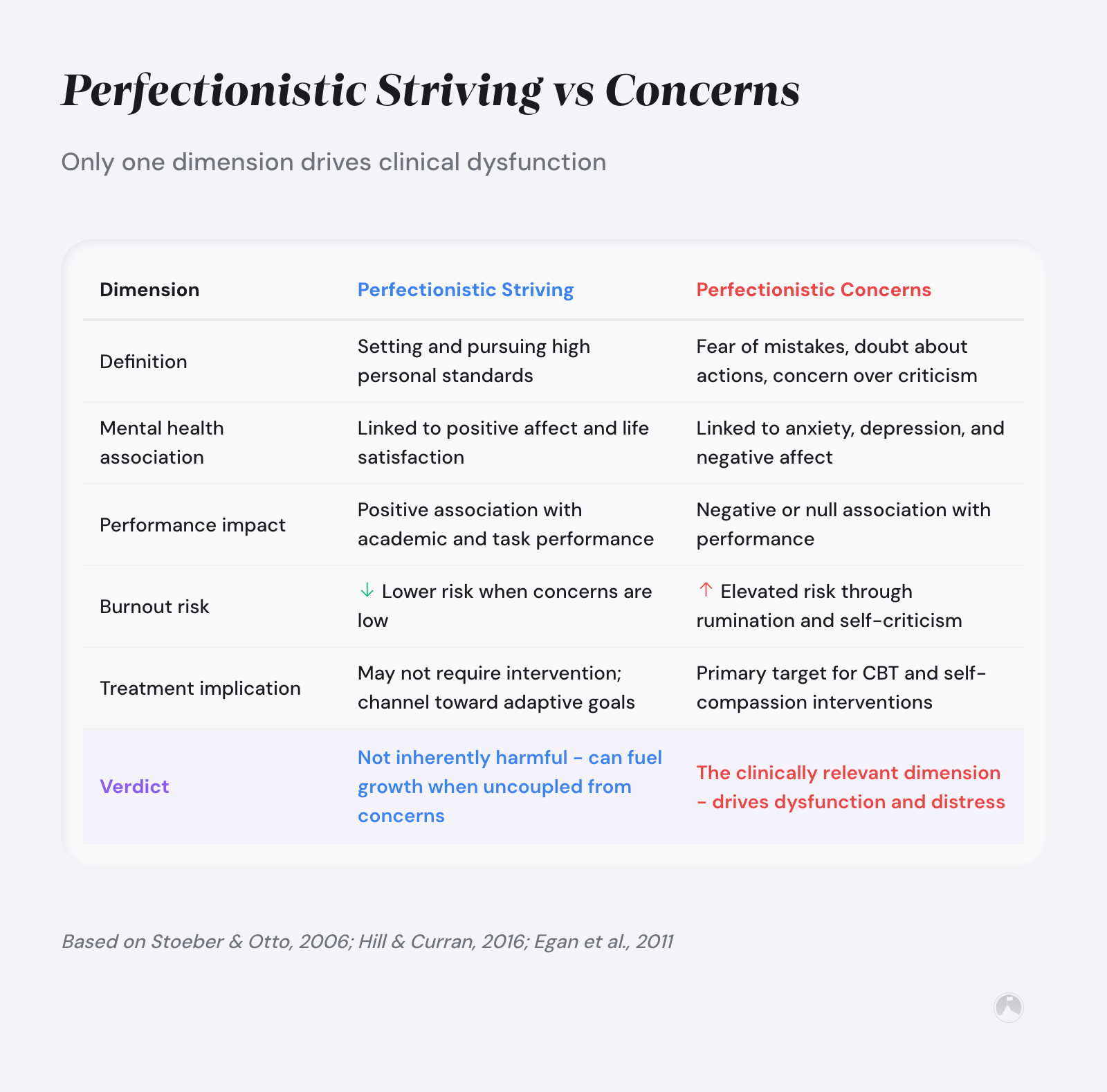
The breakthrough came from more careful measurement. Hill and Curran’s 2016 meta-analysis of 43 studies and 9,838 participants separated perfectionism into two distinct dimensions [2].
The first is perfectionistic striving – the drive to achieve high standards, to excel, to accomplish ambitious goals. The second is perfectionistic concerns – the fear of failure, the self-critical evaluation, the worry about what others think, the sense that mistakes are unacceptable.
Here’s what the data showed: perfectionistic striving showed almost no correlation with anxiety, depression, or burnout. It wasn’t the problem. Perfectionistic concerns, on the other hand, showed strong positive correlations with every mental health disorder studied [2].
“Perfectionistic striving alone shows minimal harm. Perfectionistic concerns predict nearly all the damage.” – Synthesis of Hill & Curran, 2016, Personality and Social Psychology Review [2]
The worry. The internal critic that never approves of anything you do. That’s where the damage lives.
This finding reframes everything. You can have high standards without the mental health cost. The cost comes only when those standards are entangled with fear and self-criticism. The distinction matters for anyone breaking free from perfectionism – the goal isn’t to lower your standards but to change the emotional engine driving them.
Gaudreau’s 2022 research in the Journal of Personality and Social Psychology introduced what researchers call “excellencism” — the pursuit of high standards without the fear-based component [3]. Students with excellencism had higher GPAs and significantly lower anxiety than both perfectionists and non-strivers.
Same effort. Different internal pressure. Better results. The ambition didn’t need to go. The dread did.
The two-factor model: adaptive versus maladaptive perfectionism
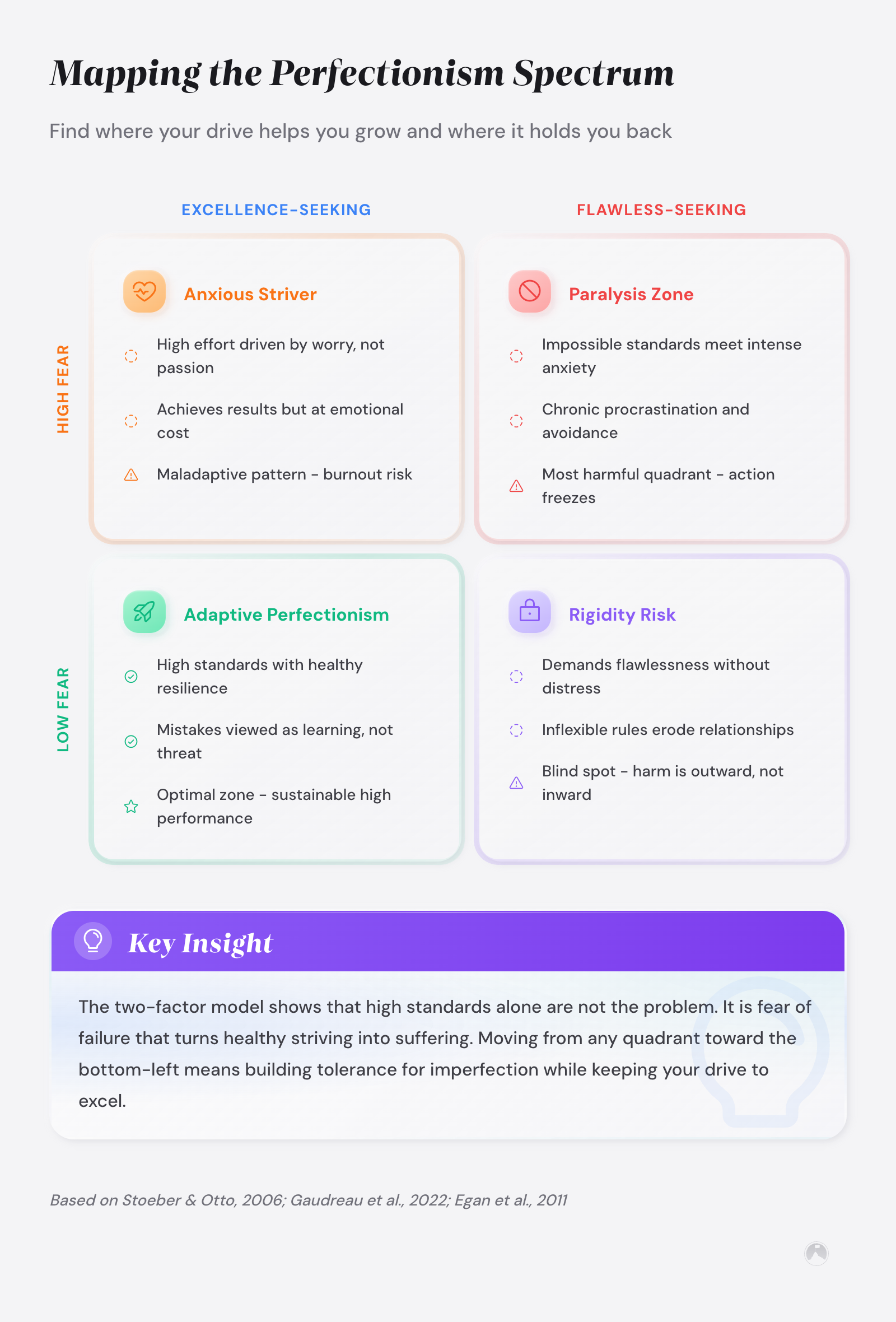
The most useful framework from modern perfectionism research is what researchers call the two-factor model, which separates perfectionism into its adaptive and maladaptive forms [4]. Stoeber and Otto’s foundational review established that perfectionism contains genuinely positive dimensions – not just “less bad” ones [4]. Understanding this distinction is the foundation of every effective perfectionism recovery approach.
Perfectionistic striving (adaptive)
Goal-directed and performance-focused. It asks: “What’s my best possible work?” It’s adaptive because the goal is achievable – you can get better, you can improve, you can hit higher targets.
When you do well, it feels good. When you don’t, it’s data for improvement, not evidence of personal failure. You’re pursuing excellence, not protecting your self-image.
Hill and Curran’s meta-analysis found this type of perfectionism shows no correlation with burnout or mental health problems [2]. The effort is sustainable because it’s driven by growth, not fear.
Perfectionistic concerns (maladaptive)
Self-evaluative and fear-based. It asks: “What if I fail? What will people think? Am I good enough?” It’s maladaptive because the goal – being flawless in the eyes of the self and others – is unachievable.
You can always find something to criticize. Someone will always judge you. The result is a system that can never be satisfied, never be “done.” This is the type that predicts burnout, anxiety, and depression in virtually every research study [2]. It’s also the type most likely to produce perfectionism paralysis – the inability to start or finish because nothing feels good enough.
You can move from one to the other. A person with high standards and ambition doesn’t have to operate from perfectionistic concerns. Research on CBT interventions shows that targeting self-critical perfectionism while maintaining striving for excellence reduces anxiety and depression without lowering performance [8]. The goal itself isn’t the problem. The fear and self-judgment wrapped around it is.
The neurobiological cost: how perfectionism activates chronic stress
The research on the mechanisms underlying perfectionism explains why perfectionistic concerns are so exhausting. When you operate from a base of “my standards must be perfect and I’m likely to fail,” your brain interprets this as a chronic threat.
Egan, Wade, and Shafran’s systematic review of perfectionism as a transdiagnostic process found that perfectionistic concerns (but not striving) are associated with sustained activation of the hypothalamic-pituitary-adrenal (HPA) axis [5]. This means the brain’s threat-detection system stays switched on, triggering the release of cortisol in a pattern similar to chronic threat exposure. Unlike the temporary stress response to a real danger, perfectionist self-criticism keeps that system activated all day, every day.
“Perfectionistic concerns are associated with sustained cortisol elevation that, over time, alters brain structure and function — reducing prefrontal regulation while amplifying threat detection.” – Synthesis of Egan et al., 2011, Clinical Psychology Review [5] and McEwen & Morrison, 2013 [6]
McEwen and Morrison’s research on chronic stress neurobiology, published in The Lancet, documents what happens next: chronic cortisol elevation reduces prefrontal cortex connectivity (the region responsible for planning, decision-making, and emotional regulation) and increases amygdala reactivity [6]. The brain shifts toward threat-detection and away from deliberate decision-making.
Molnar and colleagues found that socially prescribed perfectionism is associated with higher perceived stress levels and poorer physical health, even after controlling for other variables [7].
This isn’t weakness or lack of motivation. It’s the neurological consequence of a thinking pattern that treats imperfection as danger. The body and mind are responding exactly as designed – by protecting you from what they perceive as constant threat.
By contrast, striving for excellence without the fear component doesn’t activate this threat response. The brain processes the high standard as a goal to pursue, not a threat to defend against.
This is why excellencism shows none of the mental health consequences of perfectionism [3]. The burnout mechanism isn’t the effort. It’s the fear underneath the effort.
What the research says about perfectionism and burnout
The perfectionism burnout research tells a consistent story across populations. Meta-analyses show that perfectionistic concerns correlate with [2] [11]:
- Anxiety disorders
- Depression and depressive symptoms
- Burnout (emotional exhaustion and depersonalization)
- Sleep disturbances and chronic fatigue
- Eating disorder behaviors
- Procrastination and paralysis
Perfectionistic striving, by itself, shows minimal or no correlation with these outcomes [2].
Limburg and colleagues’ meta-analysis of 284 studies on perfectionism and psychopathology found consistent medium-to-large correlations between perfectionistic concerns and anxiety across diverse populations and settings [11]. The mechanism involves heightened threat perception combined with weakened prefrontal regulation – a brain state associated with chronic threat processing.
“Perfectionistic concerns consistently predict anxiety across populations, domains, and measurement methods. Perfectionistic striving does not.” – Synthesis of Limburg, Watson, Hagger, & Egan, 2017, Journal of Clinical Psychology [11]
The distinction matters for treatment and self-understanding. A therapist working with a burned-out perfectionist isn’t trying to lower your standards. They’re trying to separate your standards from your self-worth. The goal remains – excellence remains desirable. The fear-component gets addressed.
This is why effective perfectionism management tools and worksheets focus on the concerns dimension, not the striving dimension. And it’s why perfectionism burnout research consistently finds that interventions work best when they target the self-critical voice rather than the ambitious goals.
What works: treatment approaches backed by research
The perfectionism mental health research doesn’t just identify the problem – it points toward solutions. Three evidence-based approaches show promise for reducing maladaptive perfectionism while preserving high standards.
Cognitive-behavioral therapy (CBT) targets the thinking patterns that drive perfectionistic concerns. Egan and colleagues’ RCT found that CBT targeting perfectionist concerns (not the standards themselves) produced significant reductions in anxiety and depression [8]. Participants maintained their ambition for excellence while reducing the self-critical evaluation that caused distress.
Acceptance and commitment therapy (ACT) takes a different angle. Rather than challenging perfectionist standards directly, ACT teaches individuals to hold those standards while accepting that mistakes and imperfect outcomes are inevitable. Glover and colleagues’ randomized controlled trial found large effect sizes for reducing perfectionism-related distress (d = 0.94) while participants maintained their goal-directed performance [9].
Self-compassion interventions address the shame engine behind perfectionism. Neff and Vonk’s research found that self-compassion – treating oneself with kindness rather than critical judgment – is associated with lower perfectionism, anxiety, and depression compared to self-esteem-based approaches [10].
All three approaches share a common principle: the target isn’t the standard. It’s the relationship between the standard and the self. For a comparison of how these recovery approaches work in practice, see our guide to perfectionism recovery approaches compared.
Ramon’s take
Thirty years of research and the takeaway is: chasing good is fine, chasing perfect because you’re scared isn’t. I keep wondering how much of my ‘high standards’ are actually fear wearing a productivity costume. Is there even a clean way to tell the difference?
Conclusion
Perfectionism psychology research over the past 30 years reveals a clear pattern: the problem isn’t pursuing excellence. The problem is fearing failure while you pursue it.
The rise in perfectionism — particularly socially prescribed perfectionism, which climbed 33% — has corresponded with a rise in mental health problems, not because high standards are inherently damaging, but because perfectionistic concerns — the self-critical, fear-based component — are associated with chronic stress pathways in the brain [5] [6].
When separated into its two distinct forms, perfectionistic striving predicts accomplishment without the mental health cost. Perfectionistic concerns predict burnout, anxiety, and depression [2].
The research also shows that effective interventions exist. CBT, ACT, and self-compassion approaches all reduce the harmful dimensions of perfectionism while preserving ambition [8] [9] [10]. Emerging research is beginning to examine how digital environments and social media metrics may amplify socially prescribed perfectionism — a direction that could reshape both the measurement and treatment of maladaptive perfectionism. The question isn’t whether to pursue excellence – it’s whether you pursue it from a place of striving or from a place of dread. The outcomes, and your well-being, depend on that distinction.
Next 10 minutes
- Identify one area where you hold high standards (work, parenting, creative output, fitness). Notice whether you pursue it because you want the excellence or because you fear what will happen if you fail.
- Write down that distinction. What’s the goal versus what’s the fear wrapped around it? Just naming it changes how you think about your perfectionism.
This week
- Choose one high-standard project and complete it intentionally from striving rather than fear. Keep the excellence. Release the self-judgment about whether it’s “perfect enough.”
- Track how your stress level and output quality compare when you approach the same work from ambition versus from anxiety. The research predicts you’ll actually do better work when you’re less focused on perfection and more focused on excellence.
- Explore the overcoming perfectionism guide for practical systems that maintain high standards while preventing burnout.
Apply the research: guides for your specific challenge
Understanding the research is one half of the equation. Applying it is the other. Here’s where to go next depending on your situation:
- If you’re a high achiever dealing with perfectionist tendencies, see perfectionism for high achievers for targeted strategies.
- If perfectionism is affecting your creative work, our guide on perfectionism in creative professionals addresses the unique challenges of producing creative output under perfectionist pressure.
- For practical exercises and frameworks you can use today, see perfectionism management tools and worksheets.
- If you’re stuck in a cycle of procrastination and avoidance, perfectionism paralysis solutions addresses how to break through.
- To understand how perfectionism affects your closest relationships, explore perfectionism in relationships and parenting.
- For building sustainable systems that channel high standards productively, see building systems to beat perfectionism.
- If you want to shift from perfection to progress, progress over perfection practices offers a concrete framework.
- For calibrating your standards to be ambitious without being destructive, see setting realistic standards guide.
Related articles in this guide
- perfectionism-recovery-approaches-compared
- perfectionism-relationships-parenting
- progress-over-perfection-practices
Frequently asked questions
What does perfectionism psychology research show about burnout?
Meta-analyses show that perfectionistic concerns (fear of failure, self-criticism) predict burnout, anxiety, and depression. Perfectionistic striving (ambition for excellence) shows minimal negative effects [2]. The burnout link is strongest in high-demand professions: studies in the Hill & Curran meta-analysis [2] include healthcare workers, elite athletes, and academics — populations where output quality is central to identity and external evaluation.
What is the difference between adaptive and maladaptive perfectionism?
Adaptive perfectionism (perfectionistic striving) is goal-directed, performance-focused ambition without fear. Maladaptive perfectionism (perfectionistic concerns) is self-evaluative and fear-based. Adaptive perfectionism correlates with achievement and well-being. Maladaptive perfectionism correlates with burnout and mental health disorders [2]. Both are distinguished within the two-factor model [4].
Has perfectionism increased over time?
Yes. Curran and Hill’s 30-year meta-analysis found that socially prescribed perfectionism — the dimension most strongly linked to mental health harm — rose 33% from 1989 to 2019. Self-oriented perfectionism rose 10% and other-oriented perfectionism rose 16% [1]. Socially prescribed perfectionism’s outsized rise is particularly significant because this dimension shows the strongest correlations with anxiety and depression.
What is excellencism and how does it differ from perfectionism?
Excellencism is pursuit of high standards without fear-based self-judgment. It maintains ambition for excellence while removing the anxiety component of perfectionism. Gaudreau’s 2022 research shows students with excellencism have higher GPAs and lower anxiety than perfectionists [3]. The effort is the same; the internal pressure is different.
Why does perfectionism activate chronic stress?
Perfectionistic concerns are associated with sustained activation of the brain’s threat-detection system through the HPA axis, keeping cortisol chronically elevated [5]. Unlike temporary stress from real threats, perfectionist self-criticism is linked to sustained activation, which chronic stress neurobiology research shows can reduce prefrontal cortex connectivity and increase amygdala reactivity over time [6]. This is why perfectionism feels exhausting rather than motivating.
Can you maintain high standards without perfectionism?
Yes. Research shows you can pursue excellence through perfectionistic striving (goal-directed ambition) without perfectionistic concerns (fear-based self-judgment). The standard remains high; the emotional mechanism changes. This produces better outcomes with lower stress and better mental health [2] [3].
What treatments are effective for maladaptive perfectionism?
CBT, ACT, and self-compassion each address different aspects of perfectionistic concerns. CBT is most established and works best when concerns are cognitive (rumination, all-or-nothing thinking). ACT is effective when perfectionism feels tied to identity and values. Self-compassion works best when shame and self-criticism are central. Brief CBT interventions (8-12 sessions) are documented as effective for outpatient populations [8]. All three approaches target concerns, not striving.
Do perfectionists actually perform better?
No. Meta-analyses show perfectionistic striving alone doesn’t improve performance beyond regular high standards. When perfectionistic concerns are added, performance often declines due to anxiety, procrastination, and paralysis [2]. Excellencism (high standards without fear) outperforms perfectionism on both performance and well-being measures [3].
Glossary of related terms
- Perfectionistic striving: Goal-directed pursuit of high standards without fear-based self-judgment. Correlates with achievement and well-being in meta-analyses [2].
- Perfectionistic concerns: Fear of failure and self-critical evaluation tied to high standards. Predicts burnout, anxiety, and depression across research populations [2].
- Excellencism: Pursuit of high standards without the fear-based component of perfectionism. Produces better outcomes than perfectionism without the mental health costs [3].
- Adaptive perfectionism: Perfectionism supporting performance and well-being through striving without self-evaluative concerns. Distinguished from maladaptive perfectionism within the two-factor model [4].
- Maladaptive perfectionism: Perfectionism harming performance and well-being through chronic anxiety and self-criticism. Distinguished from adaptive perfectionism within the two-factor model [4].
- Two-factor model: Research framework distinguishing perfectionistic striving from perfectionistic concerns, showing their opposite effects on mental health and performance outcomes.
- HPA axis: The hypothalamic-pituitary-adrenal axis, the brain’s primary stress response system. Perfectionistic concerns are associated with sustained HPA activation, producing chronically elevated cortisol [5].
- Transdiagnostic process: A psychological mechanism that contributes to multiple disorders simultaneously. Perfectionism functions as a transdiagnostic process, driving anxiety, depression, eating disorders, and burnout through a shared fear-based mechanism [5].
References
[1] Curran, T., & Hill, A. P. (2019). Perfectionism is increasing over time: A meta-analysis of birth cohort differences from 1989 to 2016. Psychological Bulletin, 145(4), 410-429. https://doi.org/10.1037/bul0000138
[2] Hill, A. P., & Curran, T. (2016). Multidimensional perfectionism and burnout: A meta-analysis. Personality and Social Psychology Review, 20(3), 269-288. https://doi.org/10.1177/1088868315596286
[3] Gaudreau, P., Franche, V., & Kljajic, K. (2022). Because excellencism is more than good enough: On the need to distinguish the pursuit of excellence from the pursuit of perfection. Journal of Personality and Social Psychology, 122(5), 1127-1145. https://doi.org/10.1037/pspp0000411
[4] Stoeber, J., & Otto, K. (2006). Positive conceptions of perfectionism: Approaches, evidence, challenges. Personality and Social Psychology Review, 10(4), 295-319. https://doi.org/10.1207/s15327957pspr1004_2
[5] Egan, S. J., Wade, T. D., & Shafran, R. (2011). Perfectionism as a transdiagnostic process: A clinical review. Clinical Psychology Review, 31(2), 203-212. https://doi.org/10.1016/j.cpr.2010.04.009
[6] McEwen, B. S., & Morrison, J. H. (2013). The brain on stress: Vulnerability and plasticity of the prefrontal cortex over the life course. Neuron, 79(1), 16-29. https://doi.org/10.1016/j.neuron.2013.06.028
[7] Molnar, D. S., Sadava, S. W., Flett, G. L., & Colautti, J. (2012). Perfectionism and health: A mediational analysis of the roles of stress, social support and health-related behaviours. Psychology & Health, 27(7), 846-864. https://doi.org/10.1080/08870446.2011.630735
[8] Egan, S. J., van Noort, E., Chee, A., Kane, R. T., Hoiles, K. J., Shafran, R., & Wade, T. D. (2014). A randomised controlled trial of face to face versus pure online self-help cognitive behavioural treatment for perfectionism. Behaviour Research and Therapy, 63, 107-113. https://doi.org/10.1016/j.brat.2014.09.009
[9] Ong, C. W., Lee, E. B., Krafft, J., Terry, C. L., Barrett, T. S., Levin, M. E., & Twohig, M. P. (2019). A randomized controlled trial of acceptance and commitment therapy for clinical perfectionism. Journal of Obsessive-Compulsive and Related Disorders, 22, 100444. https://doi.org/10.1016/j.jocrd.2019.100444
[10] Neff, K. D., & Vonk, R. (2009). Self-compassion versus global self-esteem: Two different ways of relating to oneself. Journal of Personality, 77(1), 23-50. https://doi.org/10.1111/j.1467-6494.2008.00537.x
[11] Limburg, K., Watson, H. J., Hagger, M. S., & Egan, S. J. (2017). The relationship between perfectionism and psychopathology: A meta-analysis. Journal of Clinical Psychology, 73(10), 1301-1326. https://doi.org/10.1002/jclp.22435