
What is perfectionism paralysis? A working definition
You sit with a half-finished project. You know exactly what needs fixing. But you can’t make yourself start. The standard you set is clear – sharp, unforgiving, impossible. Everything you’ve done falls short. So you wait. For clarity that won’t come, for inspiration that won’t save you, for the moment when you’ll somehow become capable of meeting the bar you’ve set.
Days pass. The deadline approaches. The panic grows. But the paralysis doesn’t lift.
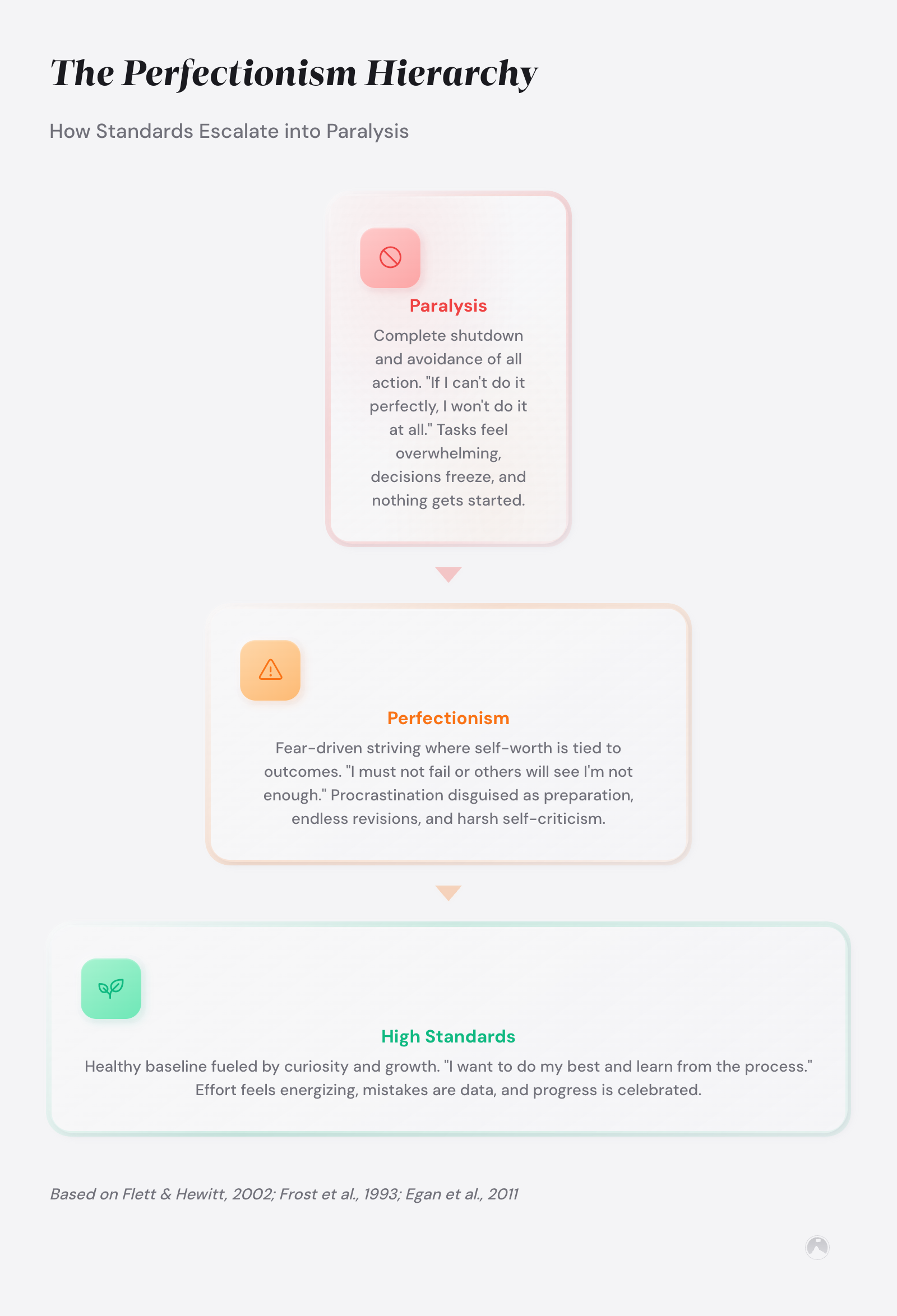
This is different from procrastination. This is different from having high standards. Perfectionism paralysis is a state of complete inaction driven by the conviction that anything short of flawless is unacceptable – and because flawlessness is impossible, starting becomes impossible. Psychologist Randy Frost’s research on perfectionism identifies this core mechanism: what he calls “concern over mistakes” combined with persistent doubts about whether your actions will meet your own standards, creating a state where avoidance becomes the rational response [1]. The fear isn’t failure. The fear is that you’ll create something imperfect and that imperfection will expose the truth about you. So you freeze.
The gap between the vision in your head and anything you could actually produce feels unbridgeable. And so you do nothing.
What you will learn
- What perfectionism paralysis actually is (and how it differs from procrastination or high standards)
- The 3 Ps cycle: how the perfectionism procrastination paralysis cycle feeds itself in a self-reinforcing loop
- Why awareness alone doesn’t break the cycle (and what actually does)
- Three concrete interruption points where you can stop analysis paralysis perfectionism in real time
- How to recognize perfectionism paralysis before it locks you down completely
Key takeaways
- Perfectionism paralysis is driven by the fear that imperfection reveals inadequacy – not by having high standards.
- The 3 Ps cycle creates a feedback loop: impossible standards trigger avoidance, avoidance triggers guilt, guilt reinforces the belief that you can’t meet your own standards.
- Recognition means noticing all-or-nothing thinking: “not perfect” equals “failure” [2].
- You can interrupt the cycle at three points: lower the initial standard, set a completion deadline separate from the real one, or force a rough first draft to exist.
- Breaking paralysis requires action, not insight. Small forward movement breaks the freeze faster than thinking about breaking it.
- The amygdala triggers a freeze response when imperfection is anticipated, overriding the prefrontal cortex [3]. Willpower alone fails.
- Moving from paralysis to healthy striving requires separating self-worth from outcomes. When imperfection can’t destroy you, you can finally move.
Why your standards became a prison
You probably started with something reasonable. High standards. Attention to detail. The desire to do good work. But somewhere, the equation shifted. The standard became not just “do this well” but “do this perfectly or don’t do it at all.” Perfect or worthless. There’s no middle ground.
This isn’t healthy ambition. Healthy ambition says: “I want to do excellent work and I’m willing to do it imperfectly to get it done.” Perfectionism says: “My work must be flawless or I have failed.” Frost’s multidimensional research on perfectionism confirms this distinction – the pathological version isn’t higher standards, it’s the catastrophic interpretation of falling short of them [1]. One drives achievement. The other stops it cold.
And the pattern is becoming more common – a meta-analysis of over 41,000 college students found that perfectionism has increased significantly across generations [7].
The standard meant to guarantee quality becomes the mechanism that prevents completion. Projects stay half-finished. Presentations don’t get delivered. Emails never get sent. The work stays locked in your mind where it’s perfect, untested, unexposed to the reality that imperfection isn’t the same as failure.
If you’re starting to recognize this pattern, you might also see it showing up in how perfectionism holds you back across areas you hadn’t considered.
The perfectionism procrastination paralysis cycle: how the 3 Ps feed each other
A framework we call the 3 Ps cycle describes how perfectionism, procrastination, and paralysis create a self-reinforcing loop. Each stage creates the conditions for the next, and the cycle accelerates with every repetition.
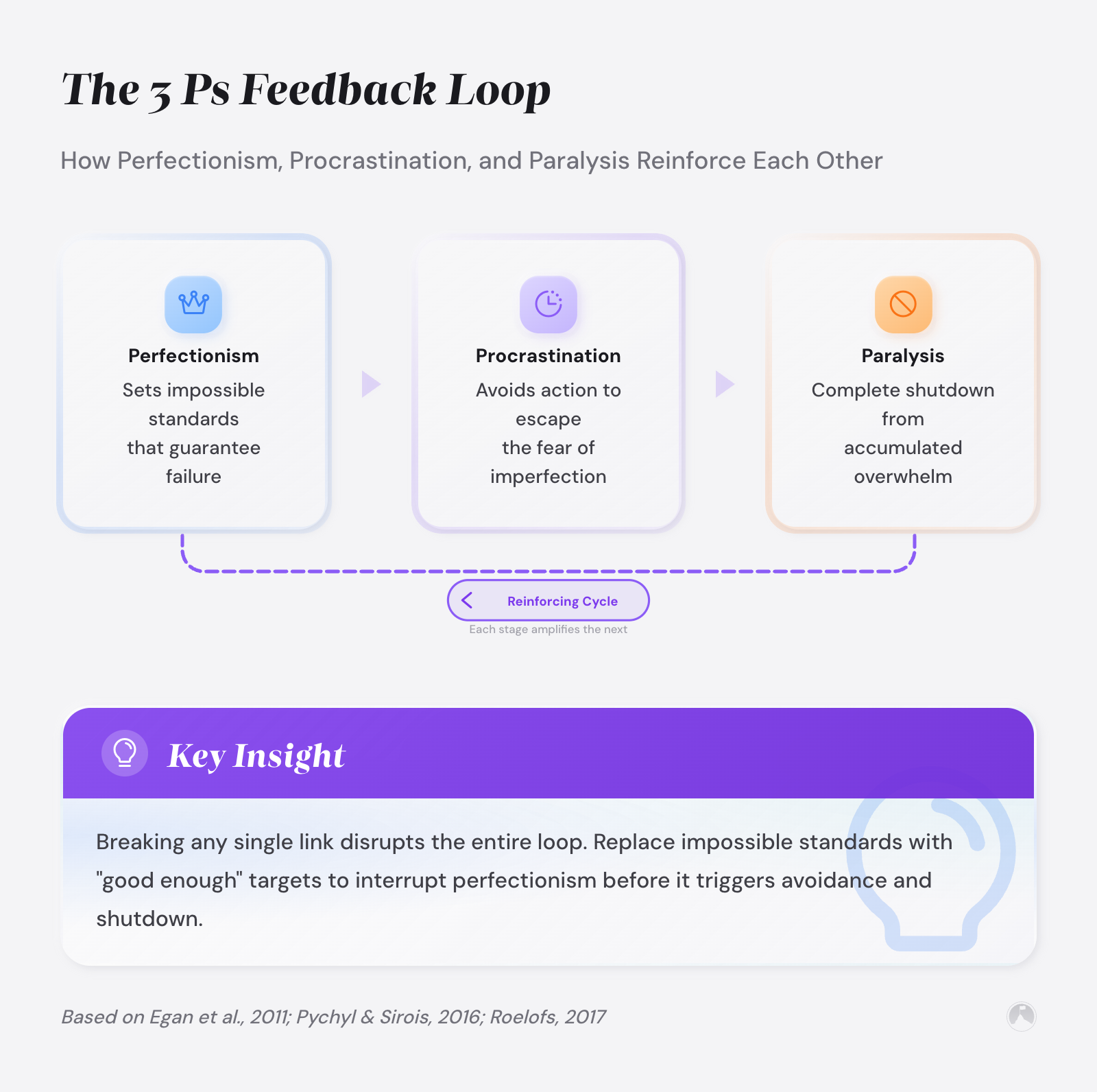
Understanding how these three feed each other is the first step to breaking free from perfectionism.
Perfectionism (the impossible standard)
You set a standard that assumes flawlessness. Not excellence – flawlessness. The bar is set so high that achieving it would require conditions that don’t exist: infinite time, infinite skill, zero fatigue, zero uncertainty. The standard isn’t based on what would actually succeed in the real world. It’s based on the fear of being seen as anything less than exceptional.

Procrastination (the avoidance)
Because the standard is impossible, your brain recognizes this on some level. So it avoids. You don’t sit down to start. You do other things first. You wait for the right mood, the right environment, the right moment when you’ll magically have clarity to meet the standard.
This isn’t laziness. Procrastination researcher Timothy Pychyl found that procrastination in perfectionist populations is driven not by poor time management but by emotion regulation – the avoidance attempts to manage the negative emotion triggered by the impossible standard [4].
“Procrastination is an emotion-regulation problem, not a time management problem.” – Timothy Pychyl [4]
The nervous system responds with avoidance: the standard feels unmeetable, so effort feels pointless. That’s a different problem than a scheduling issue, and it’s why standard procrastination strategies often miss the mark for perfectionists.
Paralysis (the complete shutdown)
As the deadline approaches, avoidance becomes impossible. You can’t procrastinate anymore. But you also can’t begin. The standard hasn’t lowered. Your capability hasn’t risen. So you freeze.
This isn’t a choice. It’s a neurological response. Roelofs’s research demonstrates that the freeze response is not a failure of willpower but a coordinated neurobiological mechanism – threat processing in the amygdala overrides the prefrontal cortex’s ability to initiate voluntary action [3].
As neuroscientist Joseph LeDoux explains in his work on threat perception, the brain treats anticipated judgment the same way it treats physical danger [5]. You’re not being lazy. Your brain is physically preventing you from moving.
And then the cycle reinforces itself. The paralysis creates guilt. The guilt says: “See? You can’t even start. You’re incapable.” This confirms the original fear – that you are inadequate. Next time you face a task, the standard gets slightly higher, the fear slightly stronger, the paralysis slightly deeper.
This is the 3 Ps cycle. Each creates conditions for the next. And the cycle runs on fuel that awareness alone can’t stop: the belief that your worth is tied to your performance.
Recognizing perfectionist overthinking and analysis paralysis
Paralysis doesn’t feel like procrastination. Procrastination feels like avoidance – you’re doing other things, staying busy, telling yourself you’ll start tomorrow. Paralysis feels like being stuck in concrete. You’re looking at the task. You want to start. But you can’t move.
| Dimension | Procrastination | Perfectionism Paralysis |
|---|---|---|
| What it feels like | Restless, distracted, busy elsewhere | Frozen, helpless, unable to move |
| What you’re doing | Avoiding by doing other things | Staring at the task, unable to start |
| Underlying driver | Emotion management (avoiding discomfort) | Threat response to anticipated failure |
| Emotional signature | Mild guilt, busy-ness | Dread mixed with helplessness |
| What breaks it | Starting anywhere, external accountability | Action that lowers the perceived stakes |
| Relationship to task | Keeping busy to avoid it | Locked onto it, unable to engage |
Here are the patterns that reveal perfectionism paralysis:
Black-or-white thinking about the output. A clinical review of the perfectionism literature found that all-or-nothing thinking is a core cognitive distortion in perfectionism – perfectionists view outcomes as falling into only two categories, perfect or failure, with no acceptable middle ground [2]. Your internal monologue sounds like: “This has to be perfect or it’s garbage.” “If I can’t do this excellently, there’s no point doing it at all.” “This is either going to be great or it’s going to humiliate me.”
Revising before you finish. You complete 30 percent and immediately loop back to revise the first part. You can’t move forward until what’s behind you is flawless. Progress stalls in endless revision loops.
Inability to define done. A perfect version doesn’t have a finish line. You can’t articulate what “good enough” looks like because you’ve never given yourself permission to be good enough. You only know “not yet perfect.” (This is where learning to set realistic standards changes the game.)
The emotional signature. Paralysis comes with a specific feeling: not just stress or pressure, but dread mixed with helplessness. You’re aware you should be working. You’re aware the deadline is coming. But you’re also convinced you can’t meet your own standard, so what’s the point of beginning?
Perfectionist overthinking as rumination. Perfectionism researchers Hewitt and Flett documented that perfectionists exhibit elevated cognitive rumination – repetitive mental rehearsal of how they “should” perform a task – that can persist longer than the actual work would take [6]. You spend more time thinking about how you would do the work than actually doing it. The thinking feels productive. The action never happens.
If you notice three or more of these patterns, you’re not dealing with garden-variety procrastination. You’re dealing with perfectionism paralysis. And the fix is different.
Breaking the paralysis: three interruption points
The cycle must be interrupted through action, not analysis. The paralyzing belief (that your worth depends on flawless performance) is stronger than logic. There are three points where small actions break the pattern.
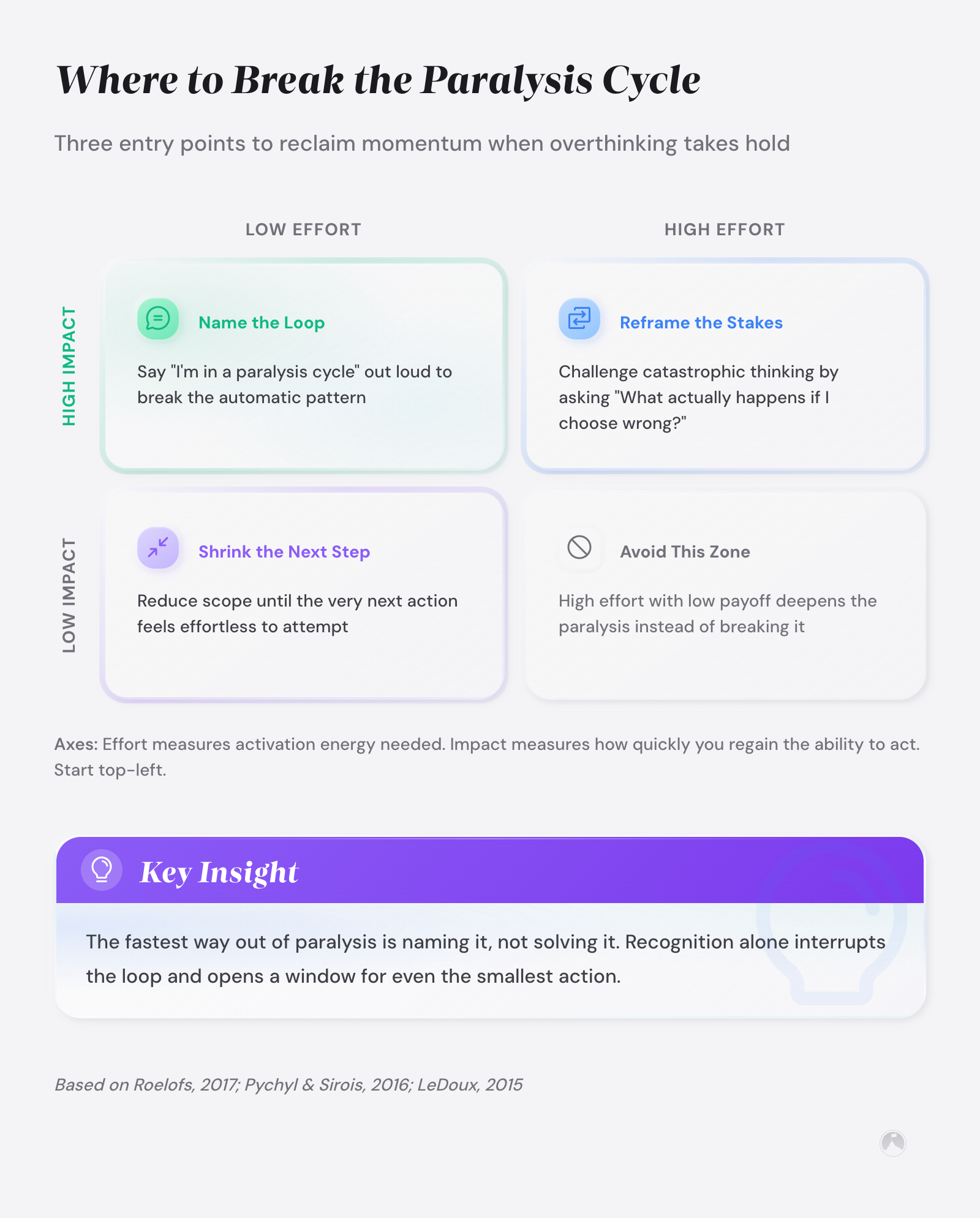
Point 1: Lower the initial standard
Before you start, explicitly define what “good enough” looks like for this specific work. Not good. Not excellent. Good enough. What is the minimum acceptable version?
This is harder than it sounds because your brain will resist. It will say, “That’s too low.” Trust that resistance is a sign you’re in the right direction.
Goal-setting research consistently shows that specific, achievable standards produce better outcomes than vague or extreme ones [8].
For a presentation: “Good enough is: clear slides, no typos, delivered without stammering. It doesn’t need to be entertaining or perfect.”
For a creative project: “Good enough is: finished, coherent, reflects the central idea. It doesn’t need to be my best work ever.”
For an email: “Good enough is: clear, professional, accomplishes the goal. It doesn’t need to be perfectly written prose.”
Write this definition down. Post it where you can see it while working. Refer to it when paralysis starts. If you want a structured approach, perfectionism management worksheets can help you formalize this process.
Point 2: Set a completion deadline (different from the real deadline)
Give yourself a hard stop date that is before the actual deadline. This isn’t procrastination fodder – it’s a psychological boundary. Your job is to finish a workable version by this date, not to deliver perfection by the real deadline.
Set this deadline close enough that it forces a choice between done and perfect. You can’t have both. The deadline makes that trade explicit.
Point 3: Do the imperfect first draft
This is the most effective single intervention. Set a timer for 25 minutes (or 50, depending on task size). Your job isn’t to create something good. Your job is to create something finished. It should be rough. Placeholder text is fine. Incomplete sections are fine.
The point is to break the paralysis through forward motion. Once something exists – once you’ve moved from blank to something, no matter how rough – the emotional quality shifts. You’re no longer creating from nothing. You’re editing, refining, improving. Those are less emotionally loaded than creating.
Done is a better starting point than perfect. Don’t show this draft to anyone. Don’t judge it. Just finish it. Then walk away.
Ramon’s take
My worst stalls weren’t about caring too much. They were about deciding that failing quietly was safer than failing publicly. That reframe hit harder than any tip in this piece. But does knowing that actually change anything for you?
So I ran an experiment. I gave myself permission to treat everything as “important but not perfect.” Set explicit finish dates. Wrote rough first drafts and called them done. Within a month, my actual output quality went up. Not down. Up. Because I was finishing things, getting feedback, and iterating rather than perfecting in isolation. The real insight: perfectionism doesn’t make you better at what matters. It makes you slow.
The cycle breaks when you move
Perfectionism paralysis isn’t a character flaw. It’s a specific pattern where impossible standards trigger avoidance, which triggers paralysis, which reinforces the belief that you can’t meet those standards. The cycle runs on the fear that imperfection reveals inadequacy.
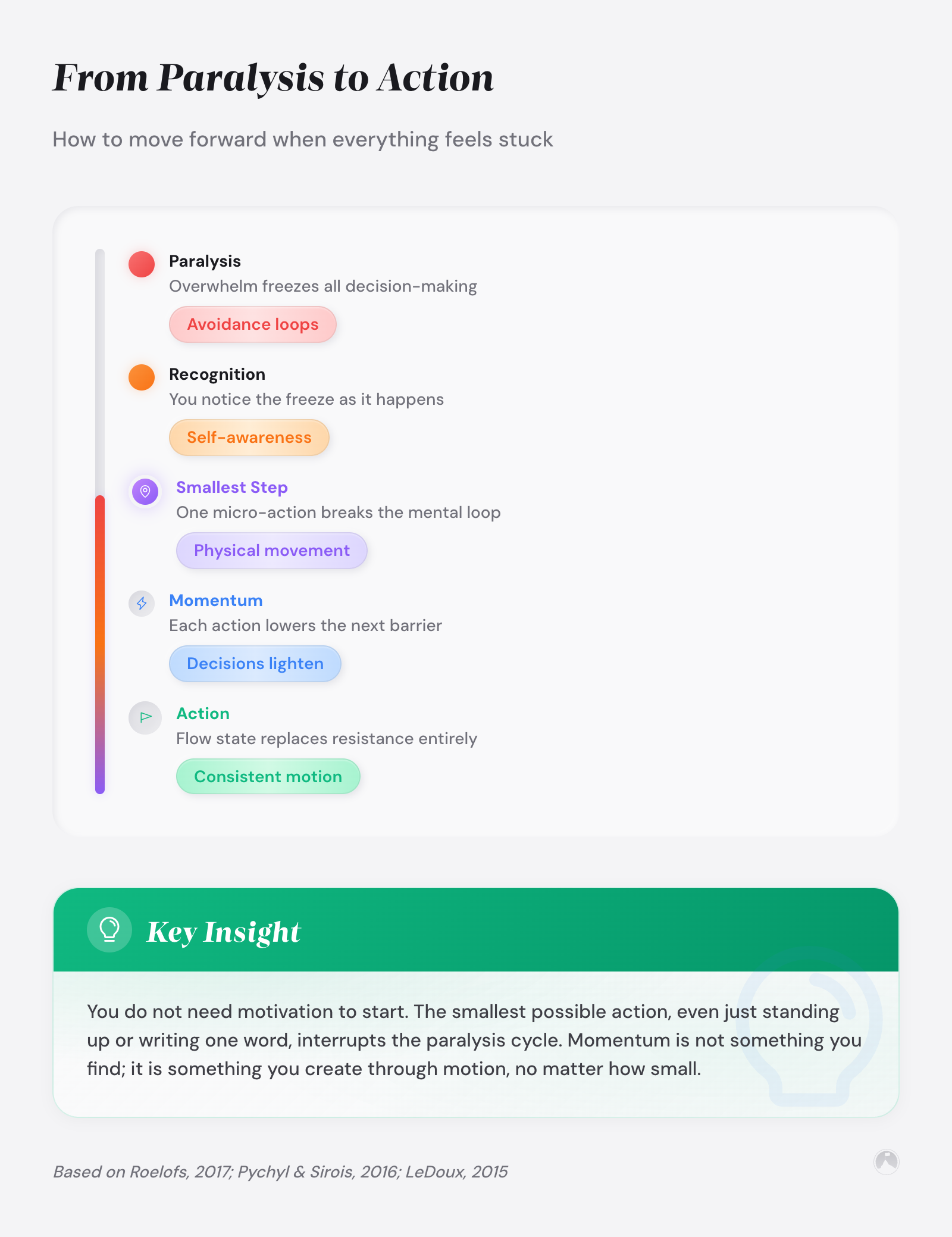
Breaking it requires three things: lowering your definition of acceptable, setting a completion deadline that forces a choice, and taking action on an imperfect version. These aren’t motivational ideas. They are circuit breakers. They interrupt the neurological loop that is freezing you.
You won’t feel ready. You won’t feel confident. The internal voice that says “this isn’t good enough” will still be there. Start anyway. Motion breaks paralysis faster than insight.
This article is part of our overcoming perfectionism guide, which covers the full picture. For a deeper look at the research behind why perfectionism operates this way, the perfectionism psychology and clinical research page covers the clinical frameworks in more detail. And if you’re wondering whether your perfectionism has started affecting your energy, the perfectionism burnout connection is worth reading.
Next 10 minutes
- Write down the current project that has you paralyzed. Next to it, write one sentence: what is “good enough” for this project?
- Set a completion date that is one week before the actual deadline. Put it in your calendar.
- Commit to a 25-minute session where your only job is to create a rough first draft. Don’t judge it.
This week
- Complete one first draft using the rough-draft method, even if it feels unfinished.
- Review it not for perfection, but for whether it accomplishes the core purpose.
- Share it with one trusted person for feedback (imperfect version, not perfect).
- Notice how the quality of feedback changes when you ask for input on real work rather than waiting for perfection.
Related articles in this guide
- perfectionism-psychology-research
- perfectionism-recovery-approaches-compared
- perfectionism-relationships-parenting
Frequently asked questions
What is perfectionism paralysis?
Perfectionism paralysis is a state of complete inaction driven by the conviction that anything short of flawless is unacceptable. Because flawlessness is impossible, the paralyzed person can’t begin. Unlike procrastination (doing other things), paralysis is being frozen while looking at the task. Research suggests it is most common among high-achievers in academic, creative, and professional settings where output quality is closely tied to identity.
How does the perfectionism procrastination paralysis cycle work?
Perfectionism sets an impossible standard. Procrastination avoids starting because the standard feels unmeetable. Paralysis occurs when avoidance becomes impossible and action also feels impossible. Guilt from paralysis reinforces the belief in inadequacy, raising standards further and deepening the cycle [4]. Each cycle repetition typically deepens the pattern, with many people reporting that the paralysis worsens over months or years without intervention.
Is perfectionism paralysis the same as procrastination?
No. Procrastination is avoiding the task by doing other things. Paralysis is being unable to move toward or away from the task. Procrastinators are busy. Paralyzed people are frozen. Both are patterns, but they feel and look different. Research shows perfectionist procrastination is driven by emotion regulation, not time management [4].
Why doesn’t awareness break the paralysis?
Awareness alone doesn’t work because the paralysis is driven by a neurological threat response. Research shows the amygdala triggers a coordinated freeze response when imperfection is anticipated [3][5], and the deep belief that imperfection reveals inadequacy is stronger than logic. You have to interrupt the cycle through action, not insight.
What are the three interruption points for perfectionism paralysis?
The three points work by progressively reducing the amygdala’s threat signal. Point 1 (lower the standard) removes the impossible target that triggers freeze. Point 2 (set an early deadline) forces a choice that bypasses avoidance. Point 3 (rough first draft) generates momentum that overrides the freeze response neurologically. If you can only do one, start with Point 3 — the rough draft is the single most effective intervention. All three combined produce the fastest results.
How do I recognize perfectionism paralysis?
Look for: black-or-white thinking about output [2], revising before finishing, inability to define done, feeling dread mixed with helplessness, and spending more time thinking about work than doing it (perfectionist overthinking) [6]. Paralysis feels like being stuck in concrete, not like choosing to do other things.
Can rough drafts actually be good enough?
Yes. Rough drafts force the paralyzed person to move from blank to something, which shifts the emotional quality. Once something exists, editing and refining feel less threatening than creating from scratch. Rough drafts typically contain most of the final content structure – what changes in revision is refinement, not rebuilding.
What role does self-worth play in perfectionism paralysis?
The core belief driving perfectionism paralysis is that imperfection reveals inadequacy [1]. As long as self-worth is tied to flawless performance, paralysis will recur. Breaking the pattern requires separating self-worth from outcomes so that imperfection doesn’t feel like a threat to identity.
References
[1] Frost, R. O., Heimberg, R. G., Holt, C. S., Mattia, J. I., & Neubauer, A. L. (1993). A comparison of two measures of perfectionism. Personality and Individual Differences, 14(1), 119-126. DOI
[2] Egan, S. J., Wade, T. D., & Shafran, R. (2011). Perfectionism as a transdiagnostic process: A clinical review. Clinical Psychology Review, 31(2), 203-212. DOI
[3] Roelofs, K. (2017). Freeze for action: neurobiological mechanisms in animal and human freezing. Philosophical Transactions of the Royal Society B: Biological Sciences, 372(1718), 20160206. DOI
[4] Pychyl, T. A., & Sirois, F. M. (2016). Procrastination, emotion regulation, and well-being. In F. M. Sirois & T. A. Pychyl (Eds.), Procrastination, health, and well-being (pp. 163-188). Academic Press. DOI
[5] LeDoux, J. (2015). Anxious: Using the brain to understand and treat fear and anxiety. Viking.
[6] Flett, G. L., & Hewitt, P. L. (2002). Perfectionism and maladjustment: A review of the research. In G. L. Flett & P. L. Hewitt (Eds.), Perfectionism: Theory, research, and treatment (pp. 5-31). American Psychological Association. DOI
[7] Curran, T., & Hill, A. P. (2019). Perfectionism is increasing over time: A meta-analysis of birth cohort differences from 1989 to 2016. Psychological Bulletin, 145(4), 410-429. DOI
[8] Locke, E. A., & Latham, G. P. (2002). Building a practically useful theory of goal setting and task motivation. American Psychologist, 57(9), 705-717. DOI