
The worksheets therapists actually recommend
You’ve rewritten the same paragraph five times. Your presentation is already solid, but it still doesn’t feel “right.” You’ve missed the deadline because nothing felt good enough to submit. Perfectionism isn’t about high standards anymore – it’s preventing you from finishing, starting, or celebrating what you’ve accomplished.
The good news: perfectionism responds to structured intervention. A transdiagnostic process is a psychological mechanism that contributes to and maintains multiple disorders simultaneously, meaning interventions targeting the process can improve symptoms across diagnoses. Research shows perfectionism functions as a transdiagnostic process across anxiety, depression, and eating disorders – which means the same core patterns show up everywhere, and the same tools can address them [1]. Clinicians and researchers have outlined that the most effective perfectionism management tools and worksheets combine multiple approaches: validated assessments to establish your baseline, cognitive worksheets to challenge perfectionist thinking, and behavioral experiments to test your predictions against reality [2].
This guide walks you through 12 resources – from quick perfectionism assessment tools to full-length overcoming perfectionism workbooks – so you can match the right tool to your situation.
What you will learn
- How perfectionism assessment tools measure different dimensions and help you track whether you’re actually improving
- Why CBT perfectionism resources like thought records interrupt perfectionism differently than motivation or willpower
- Where to find free, evidence-based perfectionism worksheets therapy professionals use that you can download today
- Which overcoming perfectionism workbooks provide structured week-by-week guidance without needing a therapist
- When self-help tools are enough and when therapist support becomes necessary
- How different therapeutic approaches (CBT, ACT, self-compassion) address perfectionism therapy exercises differently
Key takeaways
- Start with validated assessments (MPTS, PCI, APS-R) to establish your perfectionism baseline and identify which dimensions need attention
- CBT worksheets interrupt perfectionist thoughts by building realistic alternatives grounded in evidence rather than fear
- Centre for Clinical Interventions offers free 8-12 week modules; Psychology Tools provides professional-grade materials; Mind Remake Project curates free options
- The APS-R takes 5 minutes and shows whether you struggle with high standards or the distress gap between standards and reality
- Behavioral experiments test perfectionist fears in real life – small experiments gather evidence that contradicts catastrophic predictions
- Self-help resources work best for mild-to-moderate perfectionism; seek therapist support if perfectionism significantly impairs functioning or coexists with anxiety, depression, or eating disorders [1]
- A meta-analysis of 27 RCTs found self-compassion practices reduce self-criticism with medium effect sizes, making them a strong complement to CBT [7]
Perfectionism management tools are structured, evidence-based resources – including validated assessments, CBT worksheets, behavioral experiment templates, and self-compassion exercises – designed to help people identify, measure, and reduce maladaptive perfectionist patterns. They range from 5-minute screening scales to complete 8-12 week programs.
1. Multidimensional Perfectionism Scale (MPTS): The detailed assessment
The Multidimensional Perfectionism Scale (MPTS), developed by Frost and colleagues in 1990, is a validated assessment that measures perfectionism across six dimensions: concern over mistakes, personal standards, parental expectations, parental criticism, doubts about actions, and organization. It takes 30-40 minutes and distinguishes adaptive from maladaptive perfectionism patterns.
Maladaptive perfectionism is a pattern characterized by excessive concern over mistakes, fear of negative evaluation, and distress caused by the gap between personal standards and perceived performance – distinguished from adaptive perfectionism, which involves high standards without accompanying emotional suffering.
Frost and colleagues developed the Multidimensional Perfectionism Scale to measure perfectionism across six distinct dimensions: concern over mistakes, personal standards, parental expectations, parental criticism, doubts about actions, and organization [3]. This isn’t a personality quiz. It’s a detailed profile showing which aspects of perfectionism affect you most.
Most self-assessments ask “Are you a perfectionist?” The MPTS separates adaptive perfectionism (high standards you actively pursue) from maladaptive perfectionism (concern over mistakes and fear-driven behavior) [3]. Having high standards is healthy. Suffering from the gap between standards and reality is the problem.
When you take the MPTS, you get individual scores for each dimension. Some people have sky-high personal standards but low concern over mistakes (healthy strivers). Others score high on both (perfectionists who are also suffering). Knowing your specific profile lets you choose targeted interventions instead of treating all perfectionism the same way.
Therapists may readminister the MPTS monthly or quarterly to track progress. The same scale taken weeks apart shows whether your perfectionism is actually shifting.
Time investment: 30-40 minutes. Cost: $0-20 depending on source. Best for: People who want a detailed, research-backed understanding of their perfectionism before choosing interventions.
2. Perfectionism Cognitions Inventory (PCI): The quick cognitive assessment
Flett and colleagues developed the Perfectionism Cognitions Inventory (PCI) to measure the automatic thoughts that maintain perfectionism – thoughts like “I must be perfect” and “Anything less than perfect is unacceptable” [4]. Rather than measuring perfectionism as a personality trait, the PCI captures the specific mental patterns you’re experiencing right now.
“The PCI is unidimensional with high internal consistency and captures the frequency of automatic perfectionistic thoughts rather than measuring perfectionism as a trait.” – Flett, Hewitt, Blankstein, and Gray (1998) [4]
Where the MPTS measures your personality tendency toward perfectionism, the PCI measures the perfectionist thoughts running in your head today. One person’s perfectionism is fueled by fear of failure. Another’s is fueled by fear of judgment. A third is driven by need for control.
The PCI identifies which cognitive patterns are most active, enabling targeted intervention with CBT perfectionism resources. At 25 items, it’s shorter and more focused than the MPTS.
Time investment: 10-15 minutes. Cost: Free-$5. Best for: People who want to understand their specific perfectionist thinking patterns without a full personality profile.
With your baseline established through assessment, the next step is active intervention. The following tools help you change perfectionist patterns, not just measure them.
3. Thought record worksheet (CBT): The core intervention tool
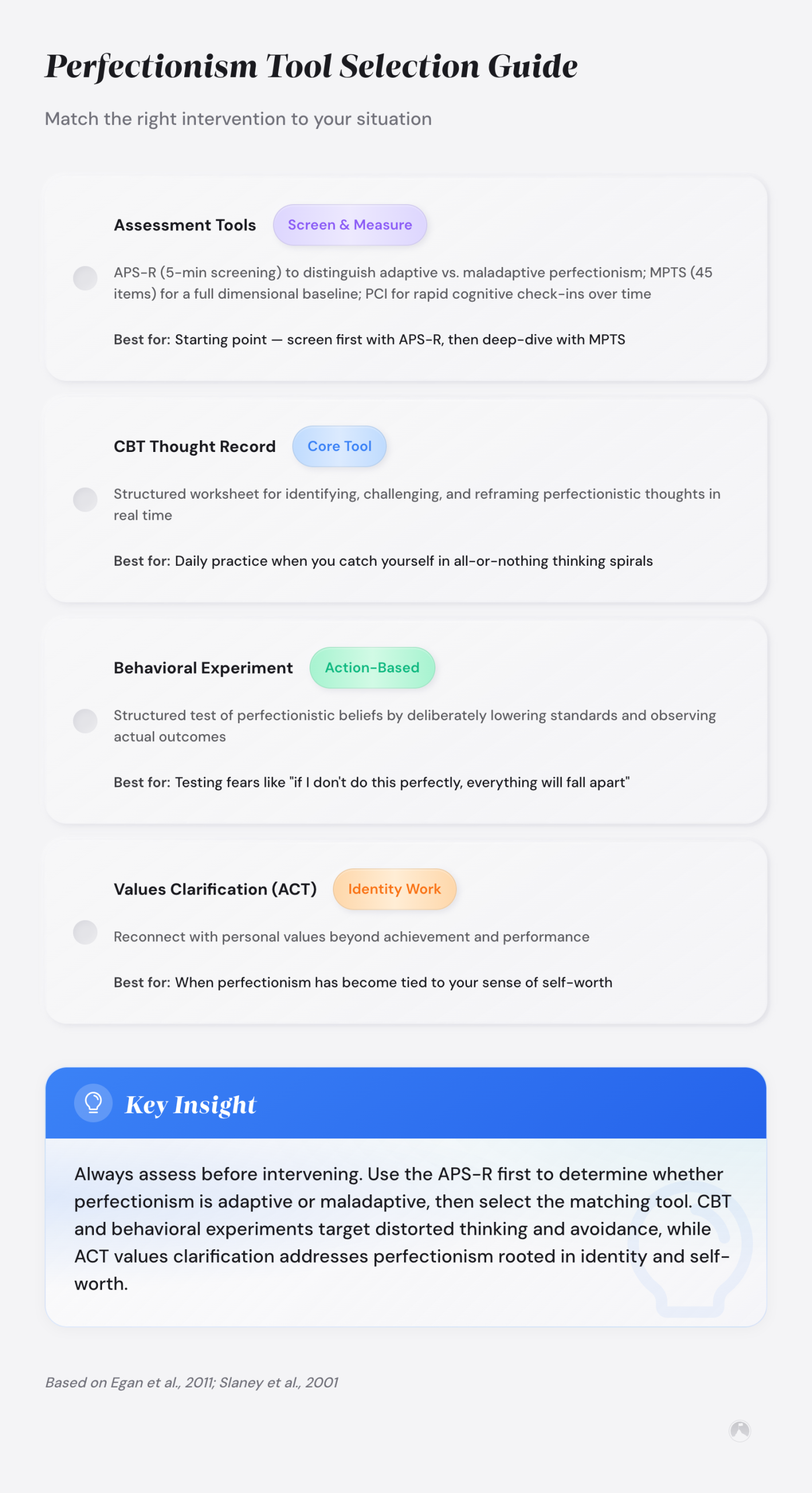
A thought record is a CBT worksheet that captures the moment perfectionism activates, documenting the situation, automatic thought, emotion, and evidence-based alternative.
A thought record captures the moment perfectionism hijacks your thinking. You write the situation (I finished my project), the automatic thought (This isn’t good enough), the emotion (anxiety), and then challenge the thought with evidence.
The evidence section is where change happens. You list what you know is true: My colleague said it exceeded expectations. I’ve completed this task successfully 15 times. I’ve improved three aspects since the last draft. These aren’t positive affirmations. They’re facts that contradict the perfectionist thought.
Then you develop a realistic alternative thought grounded in actual evidence: “My work is good enough given the time and resources available” is more credible than “This is perfect.” Research on randomized controlled trials demonstrates that cognitive-behavioral therapy reduces perfectionism by interrupting the automatic thought-emotion cycle – when people learn to identify perfectionist thoughts and gather evidence against them, they experience measurable reductions in perfectionism and associated anxiety [2].
The thought record targets specific cognitive distortions common in perfectionism – particularly all-or-nothing thinking and “should statements” – that drive the gap between perceived reality and impossible standards.
The pattern compounds. Consistent completion of thought records – even at modest frequency of one per day – produces measurable changes in automatic thoughts and emotional distress over the course of treatment [2]. You notice the perfectionist thought starting, but instead of spiraling into anxiety, you have evidence to stand on.
Psychology Tools and Centre for Clinical Interventions both offer free, printable thought record templates. If perfectionism also drives procrastination for you, thought records can address both patterns simultaneously.
Time investment: 5-10 minutes per record. Cost: Free. Best for: Anyone ready for active intervention on perfectionist thoughts in real time.
4. Behavioral experiment template (CBT): Testing your fears against reality
A behavioral experiment in CBT is a structured activity in which a person tests a specific feared prediction against real-world outcomes, gathering evidence that either supports or contradicts the belief.
Perfectionism lives on untested fears: “If I don’t meet this standard, people will judge me.” “If I show incomplete work, I’ll be rejected.” “If I’m not perfect, I’m worthless.” A behavioral experiment lets you test these predictions in real life, in small, manageable ways [6].
You design an experiment: “I’ll submit my project on time – it’s not perfect – and notice what actually happens.” Or: “I’ll tell one person my work isn’t complete and observe their reaction.” The goal isn’t to prove yourself wrong. It’s to gather evidence from your actual life about what happens when you do things imperfectly.
Write down your prediction (People will think less of me), what you’ll do (Turn in project without final edits), and what actually happened (One colleague gave feedback, one didn’t comment, boss approved it).
“Behavioral experiments are among the most effective methods for belief change in CBT for perfectionism – they help people gather evidence that contradicts catastrophic predictions.” – Egan, Wade, Shafran, and Antony (2014) [2]
Over time, the data from behavioral experiments directly contradicts the catastrophic predictions perfectionism generates. Perfectionism’s grip loosens through evidence from lived experience, not through motivation or positive thinking. Behavioral experiments are among the most powerful perfectionism therapy exercises because they produce belief change, not just intellectual understanding.
Time investment: Varies by experiment (20 minutes planning + time for the experiment itself). Cost: Free. Best for: People who understand intellectually that perfectionism is a problem but don’t believe alternatives yet.
5. Values clarification exercise (ACT): Reframing perfectionism at the identity level
Acceptance and Commitment Therapy approaches perfectionism differently than CBT [8]. Instead of challenging the perfectionist thought, ACT asks: “What do you actually care about? Is perfectionism serving that or blocking it?”
Write down your core values: being present with family, creating meaningful work, contributing to others. Then notice whether perfectionism helps or prevents you from living those values. If you value connection but perfectionism keeps you working late on details nobody will notice, your perfectionism is misaligned with your actual values.
ACT suggests moving toward what you value even as perfectionism comes along. You feel the anxiety but do the thing anyway. ACT reframing shifts perfectionism from “I must be perfect at everything” to “I must be good enough at what matters.” For people whose perfectionism feels tied to their identity as a high achiever, values work can be more effective than cognitive restructuring alone.
Time investment: 15-20 minutes. Cost: Free. Best for: People who’ve tried thought records but still feel trapped by perfectionism because it feels like part of their identity.
6. Almost Perfect Scale-Revised (APS-R): The 5-minute self-screening
The Almost Perfect Scale-Revised (APS-R) is a 23-item perfectionism assessment tool created by Slaney and Rice that measures three dimensions: high standards, discrepancy (the gap between standards and performance), and order. It takes 5 minutes and is freely available online.
Slaney, Rice, and colleagues created the APS-R measuring three dimensions: high personal standards (which can be healthy), discrepancy – the gap between your standards and your actual performance, which drives distress – and order. Unlike longer assessments, the APS-R takes 5 minutes and gives you clear, actionable scores.
The insight: You might score high on both dimensions (perfectionist – high standards plus suffering about the gap) or high on standards but low on discrepancy (healthy striver). Research administering the APS-R in community samples shows that roughly one-third of people are adaptive perfectionists (high standards but low distress), and another third experience maladaptive perfectionism (high standards plus suffering about the gap) [9]. Many people find they have reasonable standards but intense distress about not meeting them – that’s the real problem, not the standards themselves.
The APS-R is freely available through several psychology education websites and university research centers. Among perfectionism assessment tools, it’s the fastest entry point.
Time investment: 5 minutes. Cost: Free. Best for: Quick self-screening before deciding whether you need a full assessment or targeted intervention. If you’re not sure whether perfectionism is holding you back, start here.
Individual assessments and worksheets work, but finding quality resources matters. These libraries and platforms curate evidence-based materials in one place.
7. Mind Remake Project’s perfectionism worksheets library: Dozens of free resources
The Mind Remake Project is a volunteer-run collection of psychology and self-help worksheets. Their perfectionism library includes thought records, behavioral experiment templates, self-compassion exercises, procrastination worksheets, and detailed handouts on perfectionism types [1]. All are downloadable PDFs, printable, and created with input from mental health professionals.
Unlike generic worksheets found on random blogs, Mind Remake materials are grounded in cognitive-behavioral and acceptance-based approaches. You can download just the thought record template or work through the entire perfectionism series sequentially. The site is non-commercial and updated regularly.
For free access, visit mindremakeproject.org and navigate to the perfectionism section.
Time investment: Pick and choose your own. Cost: Free. Best for: People on a budget who want diverse perfectionism worksheets therapy professionals recommend without long-term commitment. Download what appeals to you and try it.
8. Psychology Tools perfectionism collection: Professional-grade library
Psychology Tools curates a library of downloadable resources focused on perfectionism. These include client information sheets (explaining what perfectionism is and why it persists), worksheets (thought records, behavioral experiments), therapist guides, and multi-session treatment plans. Many are available in multiple languages.
The materials are built on evidence from clinical perfectionism research, particularly the work of Roz Shafran and colleagues at Oxford University. Each resource explains the mechanism (“Here’s why this exercise works”) alongside the exercise itself. If you work with a therapist, they may already use Psychology Tools materials. Individual PDFs are available at low cost and are thorough enough to work standalone.
Time investment: Varies by resource. Cost: Low-cost per resource (pricing varies). Best for: Serious self-help practitioners or people planning to work with a therapist who uses evidence-based treatment.
9. Centre for Clinical Interventions perfectionism modules: The structured program
The Centre for Clinical Interventions (CCI) at the University of Western Australia offers a series of sequential modules on perfectionism, each with downloadable workbooks, worksheets, and handouts. The free CCI perfectionism modules progress logically: understanding perfectionism, identifying triggers, thought records, behavioral experiments, exposure exercises, self-compassion, and relapse prevention.
What makes CCI exceptional is the structure. Rather than a loose collection of worksheets, you have a complete 8-12 week program with clear weekly progression. Complete Module 1, then Module 2. Each module builds on the previous one. This creates accountability and momentum – you’re not choosing randomly but following a tested sequence.
All modules are free, printable, and designed for self-guided use. CCI provides the most comprehensive free overcoming perfectionism workbooks experience available.
Time investment: 3-4 hours per week for 8-12 weeks. Cost: Free. Best for: People who want a complete program with clear weekly steps and don’t need real-time therapist support.
10. CleverMemo CBT worksheets: The digital-first option
CleverMemo offers CBT worksheets for perfectionism, available as interactive PDFs and web-based tools. The worksheets cover thought records, behavioral experiments, worry trees, values clarification, and cognitive distortion identification. You can fill them digitally (typing directly into the PDF) or print them.
The digital format means you can complete worksheets on your phone or computer without printing. Worksheets save automatically so you can return to them later. The interface guides you through each step – you’re less likely to get stuck or skip sections.
Time investment: Varies by worksheet. Cost: Free-$15 (mostly free). Best for: People who prefer digital tools over paper or who want perfectionism therapy exercises accessible anywhere.
CBT tools address perfectionist thinking directly. The following resources address the emotional layer beneath perfectionism – shame, self-criticism, and identity.
11. Self-compassion exercises for perfectionism: The shame antidote
Self-compassion is a psychological practice comprising three components – mindfulness of suffering, recognition of shared human experience, and self-directed kindness – developed by Kristin Neff as an alternative to self-criticism.
Self-compassion interventions address the shame and self-criticism underlying perfectionism. When perfectionism fails – and it always eventually does – most people respond with harsh self-judgment: “I’m an idiot.” “I should have known better.” Self-compassion practices replace that inner critic with realistic kindness.
Kristin Neff’s self-compassion framework identifies three components: mindfulness (noticing pain without judgment), common humanity (recognizing others struggle too), and self-kindness (responding to yourself as you’d respond to a friend). Exercises include writing yourself a compassionate letter after a perfectionist slip-up, the self-compassion break (a 2-minute practice when you’re struggling), and loving-kindness meditation adapted for perfectionism.
A simple exercise: When you notice perfectionist self-criticism, pause and ask yourself, “What would I say to a friend in this situation?” Then say that to yourself. This isn’t about making excuses. It’s about responding to difficulty with realistic perspective rather than punishment.
Ferrari, Hunt, Harrysunker, Abbott, Beath, and Einstein’s meta-analysis of 27 randomized controlled trials found that self-compassion interventions produce significant improvements across psychosocial outcomes, with large effect sizes for reducing rumination (g = 1.37) and moderate reductions in self-criticism (g = 0.56) [7]. Self-compassion complements CBT by handling the emotional debris that perfectionism leaves behind. For people whose perfectionism is connected to burnout patterns, self-compassion exercises can address both.
Time investment: 5-10 minutes per practice. Cost: Free or $10-20 for workbooks. Best for: People whose perfectionism is wrapped in shame and self-criticism. Works alongside CBT and ACT, not instead of them.
12. Structured self-help workbooks: Essential perfectionism management tools for week-by-week guidance
Full-length overcoming perfectionism workbooks walk you through 8-12 weeks of exercises with explanations, examples, and progression. Unlike scattered worksheets, workbooks provide narrative, rationale, and clear structure.
Recommended titles include “Overcoming Perfectionism” by Shafran, Egan, and Wade (Robinson, 2010), and “When Perfect Isn’t Good Enough” by Antony and Swinson (New Harbinger, 2009) – both grounded in CBT research and designed for self-guided use.
Workbooks typically cost $15-30 and are available through Amazon, psychology publishers, or your library. The advantage is you’re not designing your own recovery path – you’re following a tested sequence. The trade-off: less personalization than therapy, harder to verify you’re doing exercises correctly, and no support if you get stuck.
Workbooks are the middle ground between free worksheets and paid therapy – more structure than the first, less cost than the second.
Time investment: 1-2 hours per week for 8-12 weeks. Cost: $15-30. Best for: Motivated self-help practitioners who want structured guidance without real-time therapist support. Works best for mild-to-moderate perfectionism.
Perfectionism management tools comparison table
Quick picks:
- Fastest assessment: APS-R (5 minutes, free online)
- Best free program: CCI Modules (8-12 weeks, structured)
- Best for active intervention: Thought records + behavioral experiments (CBT)
- Best for shame-driven perfectionism: Self-compassion exercises
- Best digital option: CleverMemo (fill on phone/computer)
| Tool | Type | Approach | Time | Cost | Evidence Level |
|---|---|---|---|---|---|
| MPTS | Assessment | Diagnostic | 30-40 min | $0-20 | Strong |
| PCI | Assessment | Diagnostic | 10-15 min | $0-5 | Strong |
| Thought record | Worksheet | CBT | 5-10 min/use | Free | Strong |
| Behavioral experiment | Worksheet | CBT | Varies | Free | Strong |
| Values clarification | Worksheet | ACT | 15-20 min | Free | Moderate |
| APS-R | Assessment | Diagnostic | 5 min | Free | Strong |
| Mind Remake Project | Library | CBT/ACT | Pick and choose | Free | Moderate |
| Psychology Tools | Professional | CBT/Evidence | Varies | Low-cost each | Expert-recommended |
| CCI Modules | Program | CBT | 3-4 hrs/wk (8-12 wks) | Free | Expert-recommended |
| CleverMemo | Digital | CBT | Varies | $0-15 | Moderate |
| Self-compassion | Practice | Acceptance | 5-10 min | Free or $10-20 | Strong |
| Workbooks | Complete | CBT/Multi | 1-2 hrs/wk (8-12 wks) | $15-30 | Strong |
Ramon’s take
Something that makes me wonder: the assessment tools feel like the kind of thing you fill out, feel seen, and then do nothing with. I’ve read about them but never actually finished one. Maybe the self-screening is just procrastination dressed up as preparation?
Note: Self-assessments are screening tools, not diagnostic instruments. A clinician should interpret results for clinical decision-making when perfectionism is severe or coexists with other disorders.
Conclusion
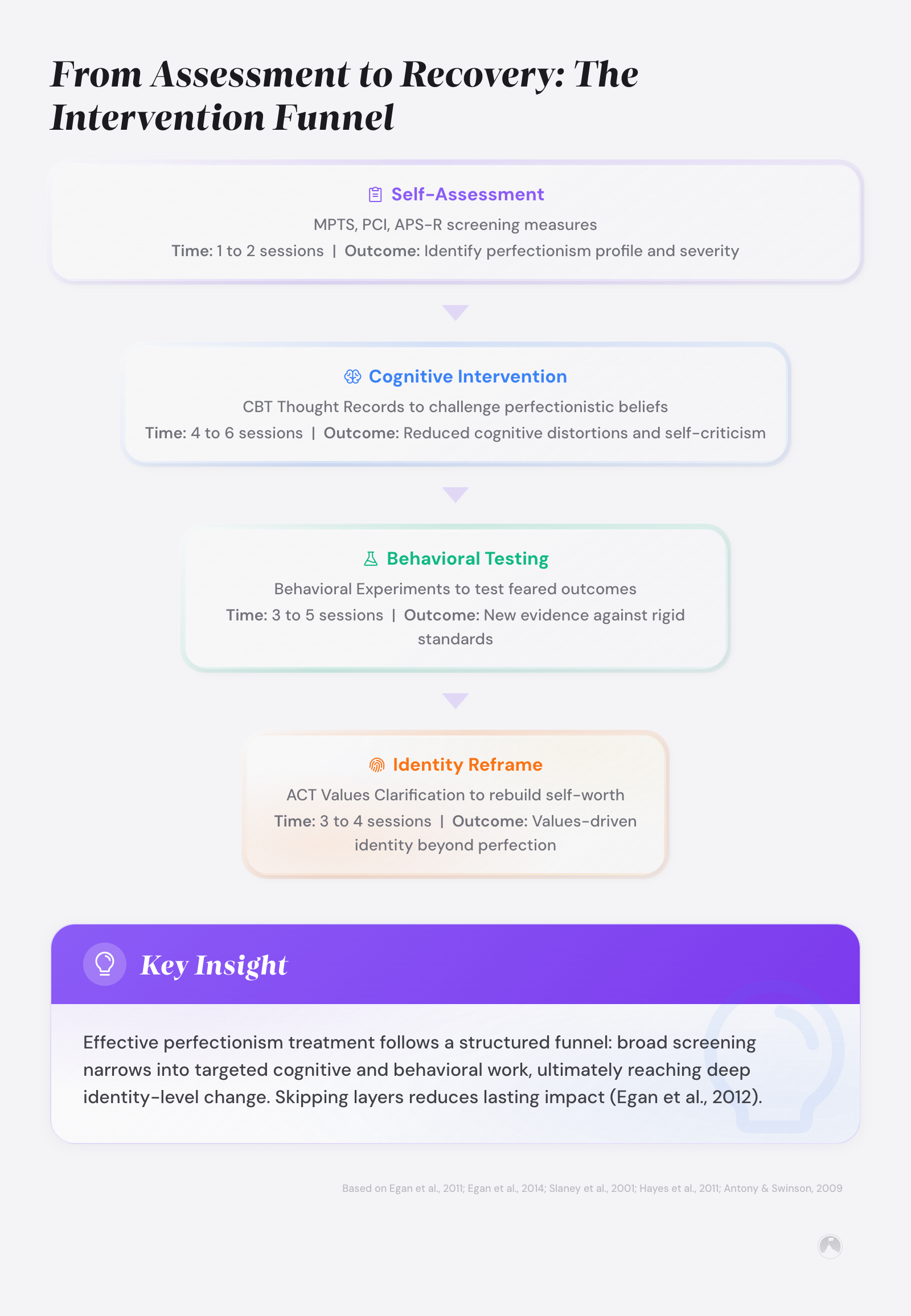
Perfectionism management tools and worksheets span from quick assessments (5 minutes) to full programs (8-12 weeks). The right tool depends on your situation: Can’t interrupt automatic thoughts? Start with thought records. Understand the problem intellectually but can’t stop the pattern? Try behavioral experiments. Need structure and accountability? The CCI modules provide a free 8-12 week program.
Most people benefit from combining tools. Assess your baseline (APS-R or MPTS), work through CBT thought records for two weeks, add behavioral experiments in week three, and include self-compassion practices alongside. This progression addresses perfectionism from multiple angles simultaneously. For a broader view of recovery approaches, comparing CBT, ACT, and self-compassion side by side can help you decide where to start.
One clear boundary: research shows self-help CBT is effective for mild-to-moderate perfectionism but may be insufficient when perfectionism is severe or comorbid with other disorders [1]. If perfectionism coexists with significant anxiety, depression, or eating disorders, or is severely impairing your work and relationships, a therapist can tailor treatment and provide real-time support when self-help tools aren’t enough.
Next 10 minutes
Take the APS-R (5 minutes, free online). Score it and note whether your distress comes from high standards or from the gap between standards and reality.
This week
Based on your APS-R results, download one thought record template from CCI or Mind Remake Project. Complete one thought record per day for seven days. Don’t aim for perfect entries – the point is consistency, not quality.
There is more to explore
- The complete overcoming perfectionism guide covers the full research picture and treatment options
- Perfectionism psychology research goes deeper into the science behind the tools in this article
- Setting realistic standards addresses what to do when your standards themselves need recalibrating
- Progress over perfection practices offers daily habits that shift your relationship with “good enough”
Related articles in this guide
- perfectionism-paralysis-solutions
- perfectionism-psychology-research
- perfectionism-recovery-approaches-compared
Frequently asked questions
What are the best worksheets for overcoming perfectionism?
The most effective perfectionism worksheets therapy professionals recommend are thought records (CBT) and behavioral experiment templates because they create evidence from your own life rather than relying on motivation. Start with thought records to identify patterns, then design behavioral experiments to test perfectionist fears against reality. The 7-column thought record is the most commonly recommended format, as it systematically walks through evidence gathering for and against perfectionist beliefs.
How do CBT worksheets address perfectionist thinking?
CBT worksheets interrupt the automatic thought-emotion cycle. A thought record captures your perfectionist thought (this isn’t good enough), asks you to identify evidence for and against it, and guides you to a more realistic alternative thought grounded in actual evidence rather than fear. Research shows consistent use produces measurable shifts within two to four weeks. Thought records specifically target all-or-nothing thinking and should statements – the two cognitive distortions most characteristic of perfectionist patterns.
What assessment tools measure perfectionism levels?
The Multidimensional Perfectionism Scale (MPTS) measures six dimensions and takes 30-40 minutes. The Perfectionism Cognitions Inventory (PCI) focuses on automatic thoughts and takes 15 minutes. The Almost Perfect Scale-Revised (APS-R) is brief (5 minutes) and distinguishes personal standards from distress. All three are validated perfectionism assessment tools. Self-assessments are screening tools, not diagnostic instruments – a clinician should interpret results when perfectionism is severe or coexists with other conditions.
Can self-help resources effectively treat perfectionism?
Self-help resources work for mild-to-moderate perfectionism, especially when combined (assessments plus worksheets plus structured programs). Research indicates they are less effective when perfectionism is severe, coexists with anxiety or depression, or significantly impairs functioning. Therapist-guided treatment is recommended in those cases.
What is included in perfectionism workbooks?
Full-length overcoming perfectionism workbooks include 8-12 weeks of guided exercises with explanations, examples, thought records, behavioral experiments, self-compassion practices, exposure exercises, and relapse prevention. They provide structure and progression without requiring therapist support. Two widely recommended titles are Overcoming Perfectionism by Shafran, Egan, and Wade (2010) and When Perfect Isn’t Good Enough by Antony and Swinson (2009).
Are there free perfectionism resources available?
Yes. Mind Remake Project offers dozens of free worksheets. The Centre for Clinical Interventions provides complete free modules with workbooks and handouts. The Almost Perfect Scale-Revised is free online. Most thought record and behavioral experiment templates are free through psychology education sites. Anxiety Canada and Therapist Aid also offer free perfectionism PDFs and worksheets not covered in the main article sections.
How do I use perfectionism worksheets effectively?
Consistency matters more than intensity. One thought record daily for two weeks creates more change than five in one day. Follow the worksheet steps exactly rather than adapting them. If a worksheet isn’t helping after two weeks, try a different approach (ACT instead of CBT, self-compassion instead of cognitive challenging).
What professional tools do therapists use for perfectionism?
Therapists typically use the MPTS or PCI for assessment, thought records and behavioral experiments for CBT, values clarification for ACT, and self-compassion practices for emotion regulation. Many use CBT perfectionism resources from Psychology Tools or Centre for Clinical Interventions as part of structured perfectionism therapy exercises.
References
[1] Egan, S. J., Wade, T. D., & Shafran, R. (2011). Perfectionism as a transdiagnostic process: A clinical review. Clinical Psychology Review, 31(3), 203-212. DOI
[2] Egan, S. J., van Noort, E., Chee, A., Kane, R. T., Hoiles, K. J., Shafran, R., & Wade, T. D. (2014). A randomised controlled trial of face to face versus pure online self-help cognitive behavioural treatment for perfectionism. Behaviour Research and Therapy, 63, 107-113. DOI
[3] Frost, R. O., Marten, P., Lahart, C., & Rosenblate, R. (1990). The dimensions of perfectionism. Cognitive Therapy and Research, 14(5), 449-468. DOI
[4] Flett, G. L., Hewitt, P. L., Blankstein, K. R., & Gray, L. (1998). Psychological distress and the frequency of perfectionistic thinking. Journal of Personality and Social Psychology, 75(5), 1363-1381. DOI
[5] Egan, S. J., Wade, T. D., Shafran, R., & Antony, M. M. (2014). Cognitive-behavioral treatment of perfectionism. New York: Guilford Press.
[6] Antony, M. M., & Swinson, R. P. (2009). When perfect isn’t good enough: Strategies for coping with perfectionism (2nd ed.). Oakland, CA: New Harbinger Publications.
[7] Ferrari, M., Hunt, C., Harrysunker, A., Abbott, M. J., Beath, A. P., & Einstein, D. A. (2019). Self-compassion interventions and psychosocial outcomes: A meta-analysis of RCTs. Mindfulness, 10(8), 1455-1473. DOI
[8] Hayes, S. C., Strosahl, K. D., & Wilson, K. G. (2011). Acceptance and Commitment Therapy: The process and practice of mindful change (2nd ed.). New York: Guilford Press.
[9] Slaney, R. B., Rice, K. G., Mobley, M., Trippi, J., & Ashby, J. S. (2001). The Revised Almost Perfect Scale. Measurement and Evaluation in Counseling and Development, 34(3), 130-145. DOI
[10] Centre for Clinical Interventions. (n.d.). Perfectionism self-help resources. Government of Western Australia, Department of Health. Link
[11] Neff, K. D. (2003). Self-compassion: An alternative conceptualization of a healthy attitude toward oneself. Self and Identity, 2(2), 85-101. DOI