
The achievement paradox
You hit every target. Your projects ship on time. Your standards are impossibly high, and people know it. But here’s the disorienting part: you’re working harder than your peers while feeling less satisfied, and you respond to any suggestion that there might be a different way with immediate defensiveness.
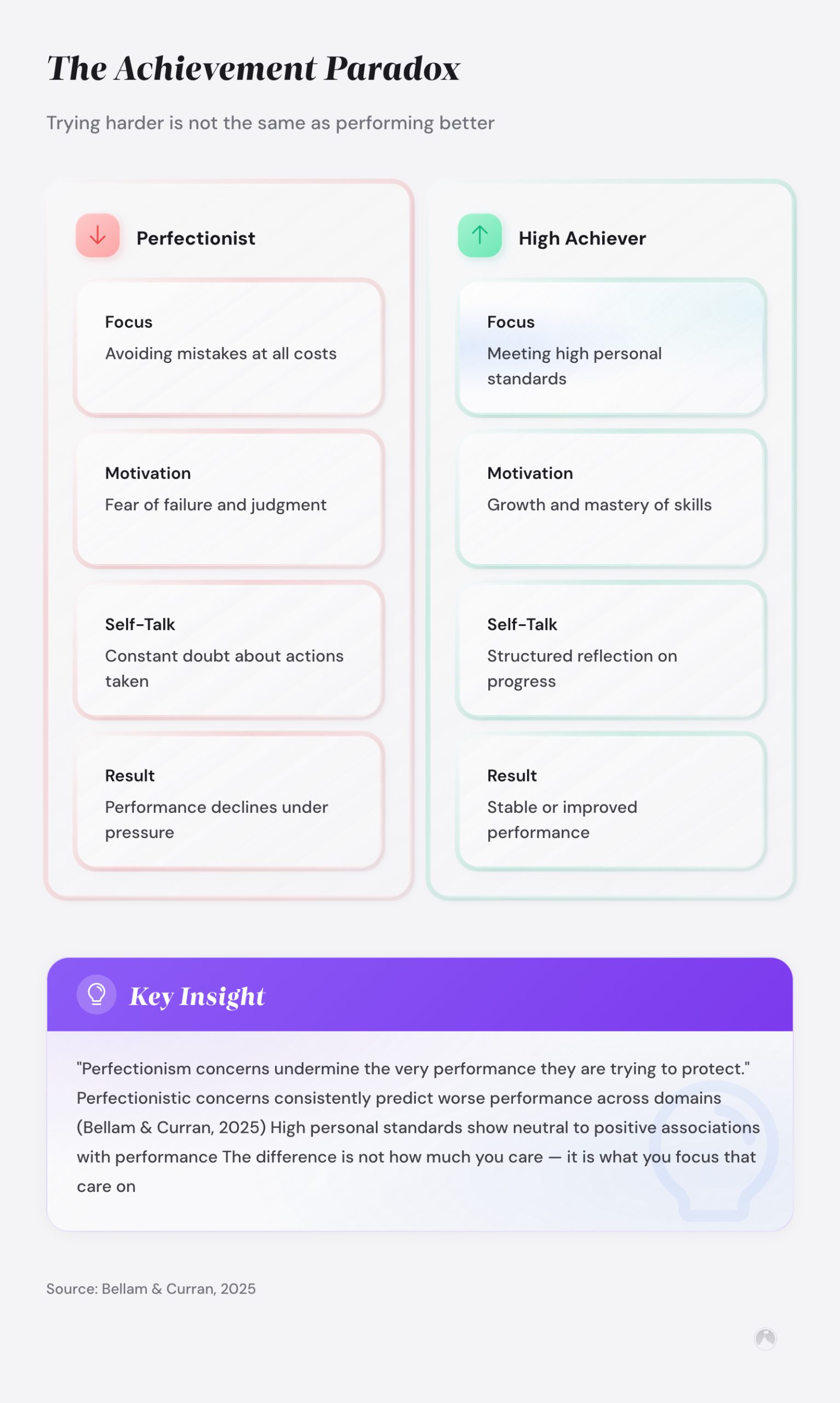
That’s not ambition. That’s perfectionism disguised as achievement.
And it looks identical from the outside. This is the trap. Bellam and Curran’s 2025 meta-analysis of 9,560 workers across 28 studies found that perfectionistic concerns – fear of failure and excessive self-criticism – actually undermine work performance. When perfectionistic strivings and concerns combine, the concerns cancel out any performance gains from striving [1]. High achievers pursue challenging but realistic goals, welcome feedback as information, and iterate toward excellence rather than waiting for flawlessness.
The goal here isn’t to lower your standards. It’s to redirect your drive toward growth instead of anxiety-reduction, so you actually produce better work without the isolation and burnout.
What you will learn
- How perfectionism for high achievers differs from healthy achievement on dimensions that determine long-term success
- Why the high achiever vs perfectionist distinction comes down to how each group responds to feedback
- Three specific practices for managing perfectionist tendencies while maintaining excellence
- How to recognize your personal perfectionist triggers and interrupt them in the moment
Key takeaways
- What we call fear-driven vs goal-driven achievement determines everything: perfectionistic concerns undermine the very performance they’re trying to protect, while growth-based motivation sustains it [1].
- Perfectionists see feedback as threat to identity; high achievers see it as information. This single difference determines long-term trajectory [2].
- The deepest difference: perfectionists pursue impossible standards seeking emotional relief; high achievers pursue challenging standards seeking skill development and mastery.
- Self-compassion doesn’t undermine performance. Neff’s research found that self-compassionate people maintain high standards while using adaptive coping strategies after setbacks [3].
- Time-limited revisions and iteration budgets replace endless perfecting, maintaining quality while preventing paralysis.
Perfectionism versus high achievement: the critical distinction
Perfectionism for high achievers is the tendency to set impossibly high standards driven by fear of failure and to seek emotional relief through flawless outcomes – distinguished from healthy high achievement by defensive responses to feedback, isolation from support, and the inability to recognize when work meets its purpose.
Both groups appear successful on paper. Both care deeply about quality. But the internal experience and long-term trajectory diverge sharply.
Consider what happens when a perfectionist receives critical feedback. They experience it as a threat to identity. The feedback triggers a cascade: “If this isn’t perfect, I’m not good enough. If people see my flaws, they’ll find out I can’t actually do this.” Hewitt and Flett’s foundational research documented that perfectionism is driven by fear of inadequacy or social judgment – not by genuine commitment to excellence. This makes feedback emotionally threatening because it’s not information about the work, it’s a threat to the identity structure they’ve built around flawlessness [2].
A high achiever receives the same feedback as data. They ask: “What specifically needs improvement? How does this change my approach?” High achievers separate their self-worth from their work quality, making feedback safely processable. They can improve the work without it feeling like a judgment of their capability.
How do perfectionists and high achievers compare?
| Dimension | Perfectionist | High Achiever |
|---|---|---|
| Core Driver | Fear of failure, need for relief | Growth and mastery |
| Standards Type | Impossible to maintain | Challenging but achievable |
| Feedback Response | Defensive, dismissive | Curious, information-seeking |
| What Failure Means | Proof of inadequacy | Data for improvement |
| Revision Pattern | Endless, anxiety-driven | Time-limited, intentional |
| Relationships | Isolated, protective | Collaborative, peer-based |
| Long-term Outcome | Burnout, anxiety, stagnation | Sustainable excellence, growth |
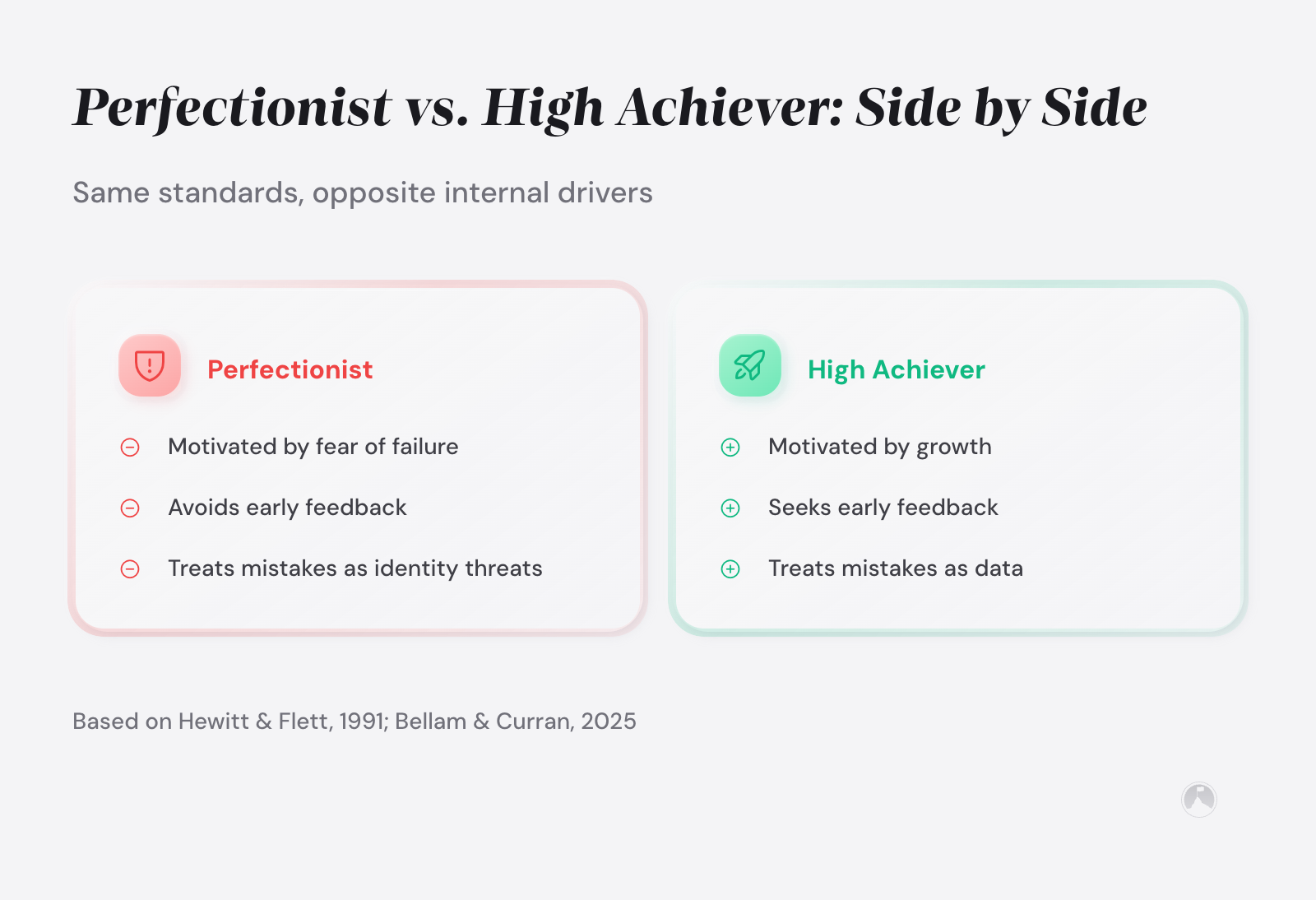
The feedback response row matters most. That single difference – whether feedback feels like threat or information – determines whether someone builds momentum or gets stuck in defensive loops. If you’re asking yourself “am I a perfectionist or high achiever?” – your honest answer about how you respond to criticism is the clearest indicator.
Why perfectionism works as a trap
Perfectionism is an anxiety-reduction strategy disguised as a quality standard. The logic is clean: “If everything I produce is flawless, no one can criticize me. If no one criticizes me, I’m safe.”
It works temporarily. When the work is perfect (or close enough), the anxiety drops. But there’s no perfect. So the perfectionist pushes harder, seeks higher standards, works longer hours. The anxiety only returns faster and stronger. Smith and colleagues’ meta-analysis of 11 longitudinal studies documented that perfectionism predicts escalating anxiety even after accounting for baseline levels – suggesting a pattern of chronic stress reactivity rather than the anxiety prevention perfectionists hope for [4]. If this pattern sounds familiar, perfectionism and burnout research explores where this trajectory leads.
As the research consistently demonstrates:
Self-criticism promises anxiety reduction. It delivers anxiety escalation. The mechanism works backwards. [4]
Feedback is particularly threatening because it says: “This isn’t perfect.” For a perfectionist, that’s not information. That’s a system failure. So they defend against it – by rationalizing, dismissing, or even attacking the person giving feedback [2].
High achievers don’t rely on flawlessness for emotional regulation. They accept that good work is imperfect, that excellence is iterative, that mistakes contain information. Feedback is welcome because it prevents the bigger problems that emerge when someone perfects in isolation for weeks.
This is where fear-driven vs goal-driven achievement diverges operationally: early feedback prevents the bigger problems. Late perfecting creates them.
Practice 1: Seek feedback early, not late
Perfectionists work in isolation until they feel ready to show work. By that point, they’ve often traveled far down the wrong path. A perfectionist designer spends two weeks refining a layout before showing the stakeholder, only to learn the stakeholder wanted something completely different.
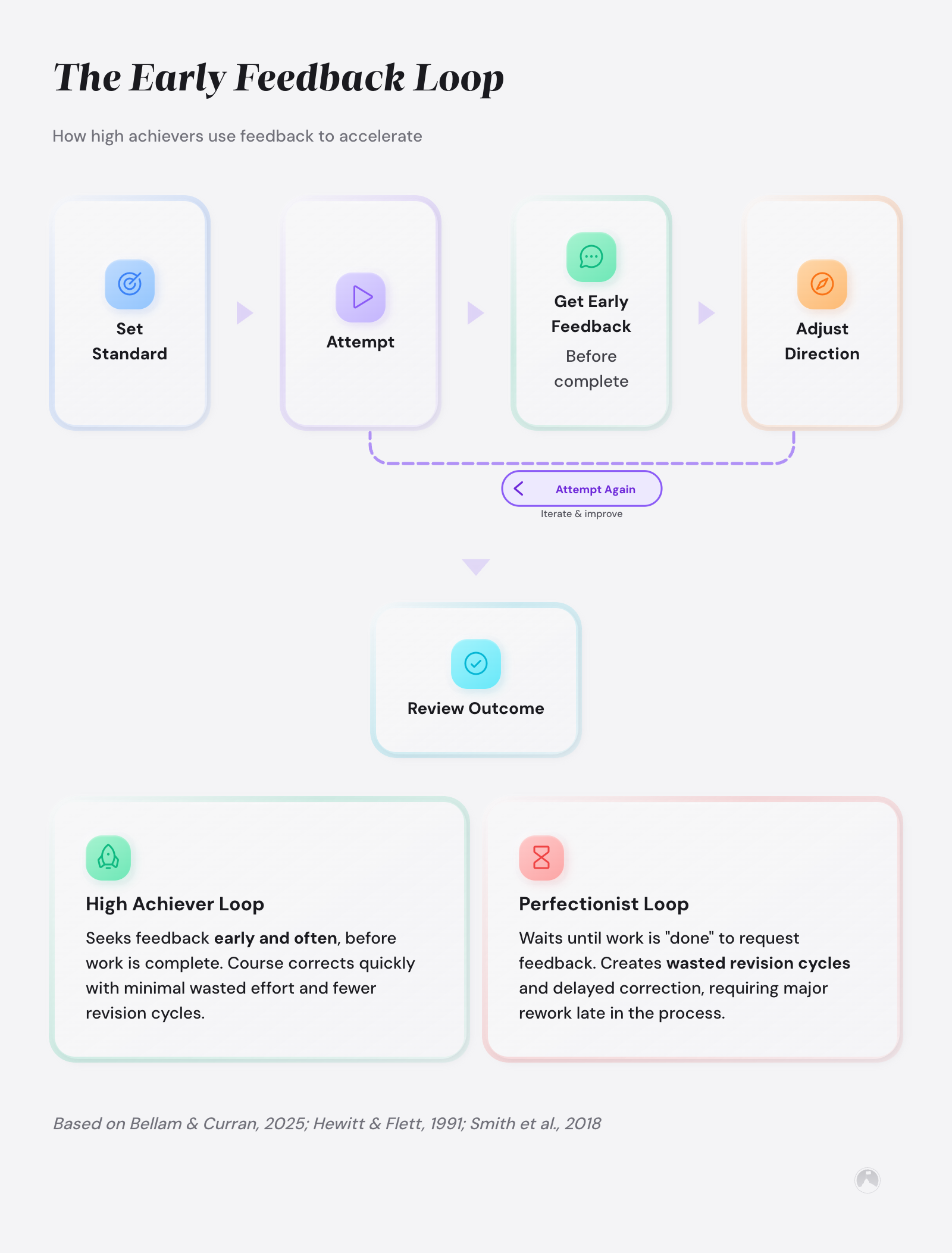
High achievers show work at multiple checkpoints. Not to get approval, but to collect information. A high-achiever designer shows a rough sketch after one hour, gathers input, and redirects before investing heavily. The emotional charge is different: “Help me think through this direction” instead of “Here’s my finished work. Please like it.” Learning how to stop being a perfectionist at work often starts with this single shift – sharing earlier, not later.
This removes the identity threat. Early feedback is collaborative, not evaluative.
Implementation: Before starting a significant project, identify your feedback checkpoints. Set a rule: you’ll show work-in-progress to a trusted colleague before you spend more than 25 percent of your planned time.
If you find yourself saying “It’s not ready yet,” that’s perfectionism talking. Ready means someone else has eyes on it and you’re aligned on direction. Not that it’s perfect.
Practice 2: Set time boundaries for revision
Perfectionism thrives in unlimited time. There’s always one more thing to tweak. The revision cycle never ends because it’s driven by anxiety, not quality requirements.
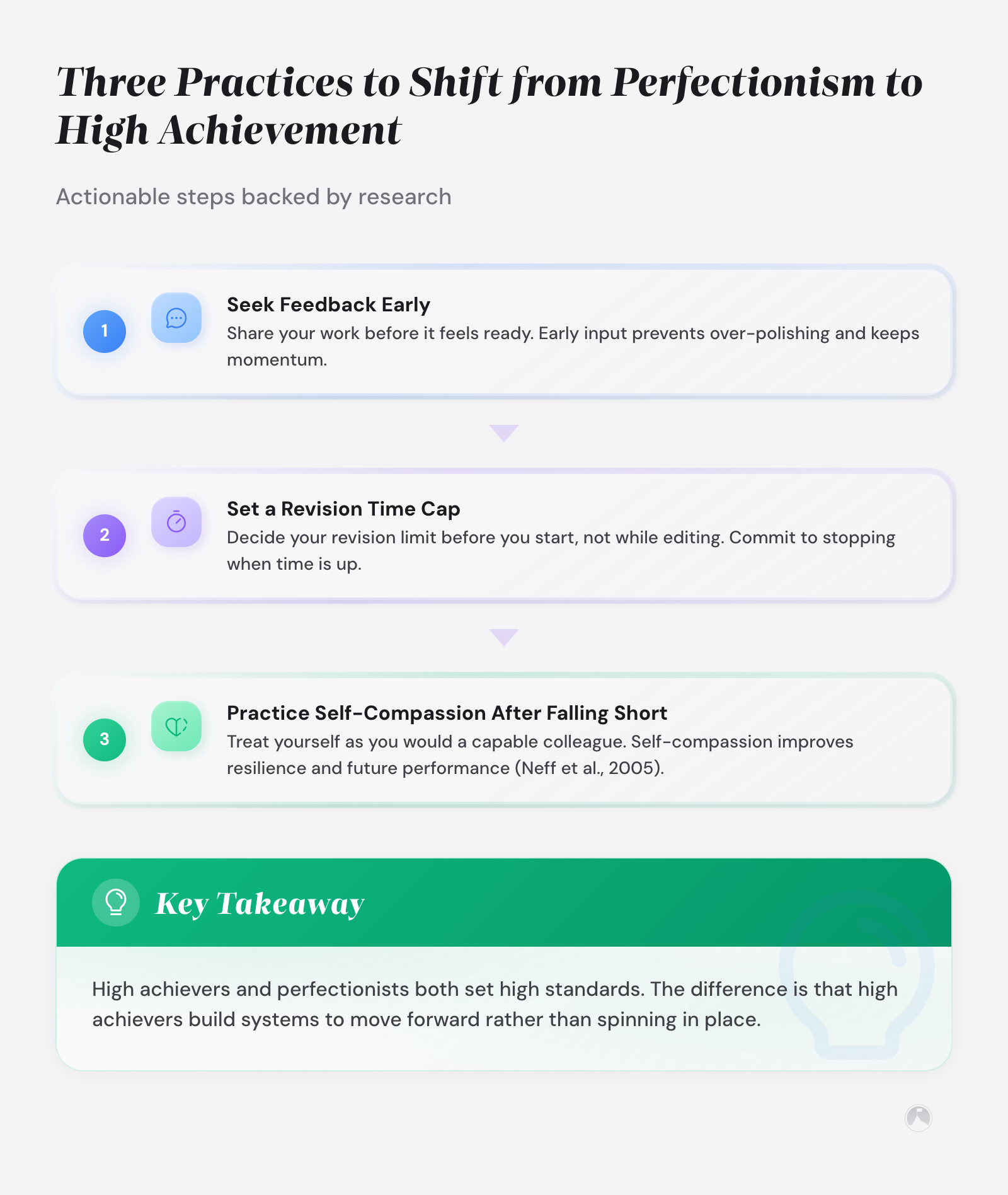
High achievers set explicit revision budgets. “This document gets two rounds. This design gets three iterations. This proposal gets one hour of final polish.” The boundary is time or iteration count, not perfectness.
This forces prioritization. With boundaries, you make intentional choices about what to refine. You can’t refine everything, so you allocate effort to what actually matters rather than what your anxiety fixates on.
Here’s what’s counterintuitive: work shipped after intentional revision limits usually performs well. You ship it, you learn what real users care about, and you improve based on actual feedback rather than imagined concerns. In practice, people regret over-engineering far more often than they regret shipping and iterating. These are among the most effective perfectionism tips for overachievers: constrain revision, ship, and iterate based on real data.
Implementation: Set a revision budget for your next project. After the limit, ship it. Notice what actually matters versus what you were anxious about.
The perfectionist’s revision cycle has no endpoint because its goal is anxiety relief, not quality. Quality has a standard. Anxiety doesn’t.
Practice 3: Practice self-compassion when standards aren’t met
The deepest lie perfectionism tells is that harsh self-criticism drives better performance. In reality, it drives anxiety, defensiveness, and creative paralysis [4].
Kristin Neff’s research at the University of Texas at Austin with hundreds of students found that self-compassionate people maintain high performance standards while experiencing less anxiety. The key difference is motivation – they’re driven by growth rather than fear of failure. When they miss a target, they respond with curiosity rather than shame, which removes the anxiety penalty from mistakes [3]. Neff’s comprehensive review in the Annual Review of Psychology – drawing on a field that now encompasses over 4,000 publications – confirmed this pattern: self-compassion is negatively associated with anxiety, depression, and perfectionism while supporting (not undermining) sustained high achievement [5]. For the science behind why this works, perfectionism psychology research covers the clinical frameworks in detail.
Self-compassion doesn’t lower your standards. It changes the fuel source from fear to growth – and growth is a better engine. [3]
When you miss a standard, you can think: “This didn’t meet my goal. What can I learn?” instead of “This is proof I’m inadequate.” That distinction matters because it removes the anxiety penalty from mistakes. You can take creative risks, try new approaches, and iterate faster when failure isn’t an identity threat.
Implementation: When you fall short of a standard this week, pause and practice the self-compassion break. First, acknowledge the difficulty: “This is a moment of struggle.” Second, recognize commonality: “Everyone who pursues high standards faces setbacks.” Third, offer yourself kindness: “May I be kind to myself right now.” Then ask: “What can I learn from this?”
This isn’t weakness. It’s the strategy that enables the performance you want.
Recognizing your perfectionist triggers
Not every perfectionist trigger looks the same. Some high achievers are perfectionists only in specific domains. Others have triggers in particular emotional states or under particular pressures. Managing perfectionist tendencies starts with knowing which situations activate them.
Do you become more perfectionist when stressed? When managing people? When working on visible projects? When you’ve failed before? When someone is watching?
| Trigger Context | Warning Signal | Planned Response |
|---|---|---|
| Visible projects | Over-research, endless revisions | Seek feedback earlier, set stricter time boundary |
| Post-failure | Procrastination, avoidance of similar tasks | Practice self-compassion break, lower initial standard |
| Time pressure | Body tension, inability to start | Set a 25-minute rough draft timer |
| Being observed | Over-editing, second-guessing decisions | Share early drafts to normalize imperfection |
| Managing others | Micromanaging, reluctance to delegate | Define “good enough” for delegated work in advance |
Once you identify the trigger, you can plan your response in advance. If your trigger is visible projects, decide now that you’ll seek feedback earlier and set time boundaries more explicitly. If your trigger is post-failure, plan your self-compassion practice proactively. For structured exercises to formalize this process, perfectionism management worksheets provide step-by-step templates.
The goal isn’t to eliminate the perfectionist impulse. It’s to notice it, understand what’s driving it, and choose a different response. Healthy achievement vs perfectionism isn’t about who cares more about quality – it’s about whether the caring is driven by fear or by growth.
Ramon’s take
Somehow we spent 12 years in school getting graded on right answers, then wonder why feedback feels like a personal attack. That’s really all this is about. Which, when you say it out loud, is kind of hilarious.
I still feel the anxiety when my first draft isn’t good enough. I’ve shipped enough work now to know that “good enough” at iteration three is almost always sufficient, yet my nervous system still wants to keep refining. What changed was understanding that my perfectionism was running on an outdated fear – that if I shipped anything imperfect, I’d be exposed as a fraud.
My actual experience has been the opposite. Shipping imperfect work and iterating based on real feedback built more trust than waiting for flawlessness ever did. People respect someone who ships and improves over someone who disappears to perfect endlessly.
What made the shift stick: I realized perfectionism was trying to reduce anxiety through an ineffective method. Self-compassion reduces anxiety better. Early feedback reduces anxiety better. Intentional revision budgets reduce anxiety better. Once I found the better anxiety-reduction strategy, perfectionism lost its grip.
Your standards are the asset; fear is the liability
The transition from perfectionism to high achievement isn’t about settling for mediocre work. It’s about maintaining your commitment to excellence while removing the fear-driven patterns that create anxiety, isolation, and paradoxically worse performance.
Your ambition is an asset. Your high standards are valuable. What needs to change is the emotional engine – from fear to growth, from isolation to collaboration, from endless revision to intentional iteration. When you make that shift, you’ll produce better work with less stress and less burnout.
Next 10 minutes
- Identify one piece of your current work and note where perfectionist anxiety is driving decisions versus where genuine quality standards are
- Choose one project and set an explicit revision boundary (number of rounds or time limit) before you start
This week
- Seek feedback on work-in-progress from a trusted colleague instead of waiting until it feels finished
- Practice the self-compassion break once when you notice you’re being harsh on yourself about work quality
- Notice the pattern of when and where your perfectionist impulses activate most strongly
There is more to explore
If you’re working through perfectionism, our guide on overcoming perfectionism covers the full picture. For the science behind why perfectionism backfires, see our piece on perfectionism psychology research. If perfectionism is creating burnout in your work, perfectionism and burnout research goes deeper on that connection.
For creative professionals dealing with these patterns, perfectionism for creative professionals addresses domain-specific challenges. And if you need structured exercises for the practices in this article, the perfectionism management worksheets provide step-by-step templates.
Related articles in this guide
- perfectionism-management-tools-worksheets
- perfectionism-paralysis-solutions
- perfectionism-psychology-research
Frequently asked questions
What distinguishes perfectionism from high achievement?
Ask yourself how you respond when a colleague gives critical feedback on your best work. If you feel defensive or threatened, that’s perfectionism operating. If you feel curious and ready to improve, that’s high achievement. The key diagnostic is whether feedback feels like a threat to identity or like useful information for getting better.
Do perfectionists actually perform better?
Not in the long run. While perfectionistic strivings can boost short-term output, perfectionistic concerns (fear of failure, self-criticism) erode performance over time through anxiety, avoidance, and burnout. A 2025 meta-analysis found that when strivings and concerns coexist, the concerns cancel out performance gains from striving [1].
Why do perfectionists respond defensively to feedback?
Perfectionists use perfectionism to manage anxiety about their adequacy. Feedback threatens their anxiety-reduction strategy by pointing out imperfections. They experience feedback as a threat to identity rather than as neutral information. Separating self-worth from work quality changes this response.
Can you maintain excellence without perfectionism?
Yes. High achievers maintain higher quality through growth-oriented practices like early feedback-seeking, time-limited revisions, and iterative improvement. These practices actually deliver better performance than perfectionism without the anxiety and isolation.
What is the difference between fear-driven and goal-driven achievement?
Fear-driven achievement (perfectionism) is motivated by avoiding failure and criticism. Goal-driven achievement is motivated by growth, skill development, and mastery. The internal driver determines how someone responds to challenges, feedback, and failures – and whether they sustain performance long-term.
How does perfectionism affect long-term success?
Perfectionism leads to burnout through chronic anxiety, defensive patterns, and isolation. A meta-analysis of 11 longitudinal studies found that perfectionism predicts escalating anxiety over time. Long-term success comes from growth-oriented motivation and the ability to learn from feedback.
Can therapy help with perfectionism?
Yes. Cognitive-behavioral therapy, acceptance-commitment therapy, and self-compassion interventions all show effectiveness for perfectionism. The key is reframing failure as data rather than identity threat and building self-worth independent of performance outcomes.
What is the relationship between perfectionism and fear?
Perfectionism is fundamentally a fear-management strategy. The perfectionist’s logic: If I’m perfect, no one can criticize me, and I’ll be safe. This creates anxiety when perfection isn’t achieved and prevents the psychological flexibility needed to grow and adapt.
References
[1] Bellam, S., & Curran, T. (2025). Perfectionism and work performance: A meta-analysis. Journal of Occupational and Organizational Psychology, 98(1). DOI
[2] Hewitt, P. L., & Flett, G. L. (1991). Perfectionism in the self and social contexts: Conceptualization, assessment, and association with psychopathology. Journal of Personality and Social Psychology, 60(3), 456-470. DOI
[3] Neff, K. D., Hsieh, Y., & Dejitterat, K. (2005). Self-compassion, achievement goals, and coping with academic failure. Self and Identity, 4(3), 263-287. DOI
[4] Smith, M. M., Sherry, S. B., Vidovic, V., et al. (2018). Are perfectionism dimensions risk factors for anxiety symptoms? A meta-analysis of 11 longitudinal studies. Anxiety, Stress, & Coping, 31(1), 4-20. DOI
[5] Neff, K. D. (2023). Self-compassion: Theory, method, research, and intervention. Annual Review of Psychology, 74, 193-218. DOI