
The blank page that never gets filled
Forty-seven Photoshop layers deep, and none of them right. Perfectionism for creative professionals is the gap between your vision and what you’re willing to ship. And for most creatives, that gap is where projects go to die.
You know exactly what you want to create. The vision is clear, vivid, almost unbearably specific in your mind. But when you sit down to make it real, something shifts.
The first draft feels rough. The sketch looks amateurish. The opening paragraph doesn’t capture what you intended. So you start again. And again. Weeks pass. The project sits half-finished while you revise the first section for the fifteenth time.
Perfectionism for creative professionals is the self-critical tendency to set impossibly high standards for creative work, define anything short of flawless as failure, and abandon projects when they fall short of idealized visions. Unlike healthy craft standards (which guide improvement), creative perfectionism prevents output because the work never feels “ready” to show.
This isn’t writer’s block. This isn’t lack of ideas. Researchers Goulet-Pelletier, Gaudreau, and Cousineau found that perfectionists generate fewer original ideas than excellence-seekers, not because they’re less creative but because they abandon promising concepts too early, convinced they won’t meet impossible standards [1]. For creative professionals, perfectionism doesn’t drive quality. It prevents completion.
The paradox runs deeper: perfectionism blocking creativity is often most intense in fields where standards genuinely matter. Writers care about language. Designers care about visual communication. Musicians care about precision. This is why the solution isn’t to lower your standards. It’s to understand what’s actually blocking your work and rebuild your creative process to maintain excellence while shipping regularly.
What you will learn
- Why perfectionism blocks creative work even when your standards are legitimate
- The Version 1.0 Framework: how successful creatives distinguish between craft standards and perfectionist paralysis
- How to structure your creative process in phases that satisfy quality standards without endless revision
- Specific strategies for managing perfectionism when clients, deadlines, or audience expectations are involved
Key takeaways
- Fear-based perfectionism and growth-based excellence feel similar but produce opposite results – one prevents output, the other enables it.
- The Version 1.0 Framework separates creation from editing, lets imperfect work exist temporarily, and builds iteration into the process.
- Time-boxing each creative phase prevents the endless revision trap that kills productivity.
- Early feedback from trusted sources becomes information for improvement rather than evidence of inadequacy.
- Shipping imperfect work is how every successful creative maintains output. They got better at managing the anxiety.
- Your craft standards can stay high while your internal critic gets quieter by redirecting critical energy toward post-ship iteration.
- Different creative fields (writing, design, music, visual art) have different perfectionism triggers. Identify yours to interrupt faster.
Why perfectionism blocks creative work (and excellence doesn’t)
The critical distinction isn’t between high standards and low standards. It’s between two psychological mechanisms driving those standards: fear versus growth.
Someone pursuing excellence has a clear vision for quality and adjusts their work toward that vision. They ask: “Does this work serve the intended purpose?” When it doesn’t, they fix it. Excellence is feedback-responsive. They accept critique as information because their goal is the work getting better, not feeling adequate. They also know when to stop. Once work serves its purpose, more revision becomes procrastination.
A perfectionist, by contrast, is driven by fear: fear of falling short, fear of being exposed as inadequate, fear that this piece will prove they’re not “really” talented. So the question becomes: “Is this work flawless?” And because nothing is ever truly flawless, the answer is always no. Perfectionism is never satisfied. More revision always seems like it might finally get you there, so you keep trying. And never ship.
| Dimension | Excellence (Growth-Driven) | Perfectionism (Fear-Driven) |
|---|---|---|
| Driving motivation | Growth and mastery | Fear of inadequacy |
| Response to feedback | Welcomed as useful information | Experienced as threat |
| Relationship to completion | Ships when purpose is served | Never feels finished |
| Internal question asked | “Does this serve its purpose?” | “Is this flawless?” |
| Effect on creative output | More projects, more iteration | Fewer projects, endless revision |
| Stopping point | When work meets its goal | Never (goalpost keeps moving) |
This difference produces measurable creative outcomes. Goulet-Pelletier, Gaudreau, and Cousineau’s research in the British Journal of Psychology found that participants pursuing excellence generated significantly more novel ideas than those pursuing perfection, and their ideas were rated as more original by independent judges [1].
How? Because excellence-seekers finish more projects, get more feedback, iterate more, and develop craft through cycles of creation-feedback-revision. Perfectionists stay stuck in endless revision of single pieces.
Research on musicians confirms a similar pattern. Stoeber and Eismann found that musicians who strived for excellence showed higher intrinsic motivation and higher achievement, while those driven by negative reactions to imperfection experienced more distress and less creative output [2]. The mechanism matters more than the standard.
Every shipped work teaches more than every perfect work imagined but never created. – Ramon Landes
The Version 1.0 Framework: finishing is better than flawless
Successful creatives across writing, design, music, and illustration operate from an unstated principle that we call the Version 1.0 Framework: version 1.0 is a legitimate starting point, not a failure state. Every published author had a first draft they thought was terrible. Every designer shipped a design they knew had refinements left. Every musician recorded takes that weren’t perfect. They didn’t overcome perfectionism paralysis by lowering their standards. They overcame it by building a process where imperfect work can exist temporarily.
The Version 1.0 Framework rests on three practices:
1. Separate creation from editing
Most creative professionals mix creation and criticism in real-time, which means the internal editor is active while you’re trying to generate new material. This creates decision paralysis. Your brain is simultaneously trying to produce AND evaluate, and evaluation usually wins, killing creative flow.
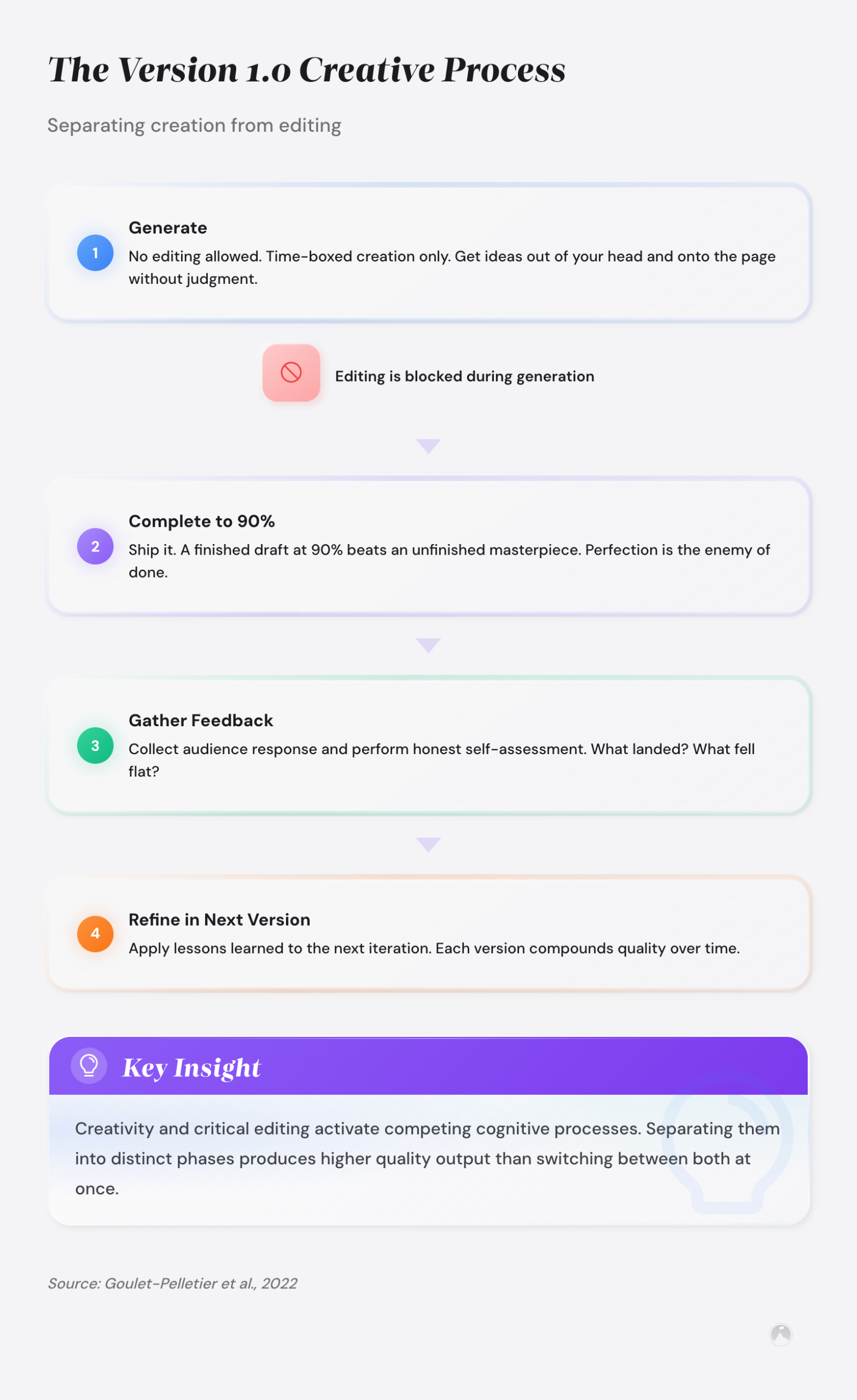
Neuroscience research by Dolan, Sajda, and Hughes confirms that idea generation and idea evaluation activate different neural systems [3]. Mixing these modes during creative work increases cognitive load and slows output. By separating them – generating first, evaluating later – you reduce interference and complete work faster.
The fix: treat creation and editing as separate, sequential phases with different goals. During creation, your only goal is to get ideas out – first drafts, rough sketches, initial recordings – without editorial judgment. The internal editor stays offline. Mistakes, weird phrasings, awkward angles: all fine. You’re capturing ideas, not refining them.
Only after you have a complete first draft do you shift into editing mode. Now the critical faculties come online. Now you refine, tighten, improve. But this phase has a different tone. You’re not judging whether work is flawless. You’re identifying specific improvements that serve your intended purpose.
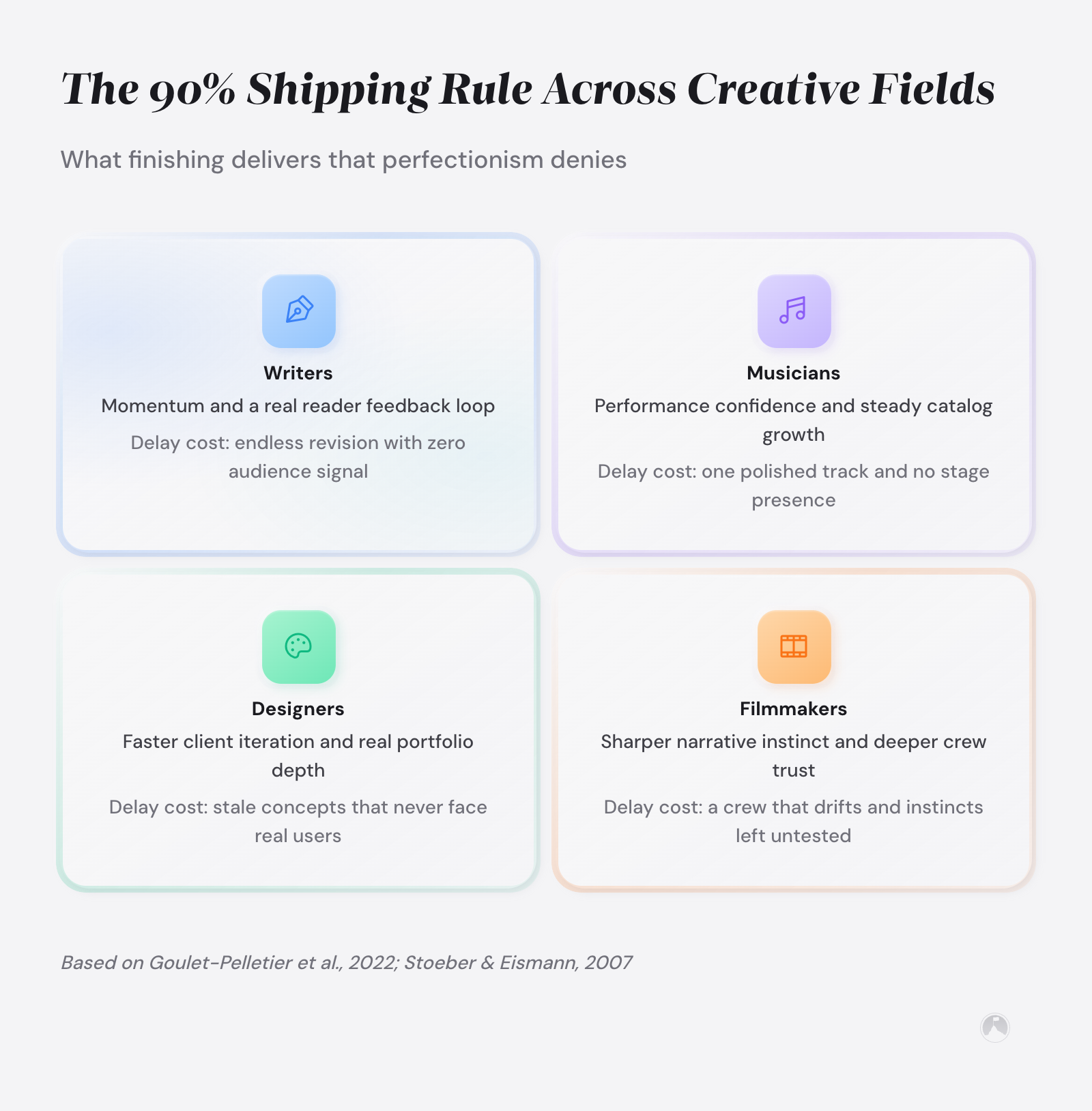
2. Adopt the 90% shipping rule
One of the clearest patterns in creative industries: professionals ship work at 90% rather than waiting for 100%. This isn’t because they’re settling. It’s because they understand the widely observed pattern sometimes called the Pareto principle – where roughly 80% of quality comes from 20% of effort, and the remaining polish requires disproportionately more time for diminishing quality gains.
A common refrain in design studios captures this logic: spending two more hours perfecting a shadow is less valuable than shipping the design, getting client feedback on what actually matters, and improving the final version based on real information instead of assumptions. That logic extends across creative fields. The final revision always feels like the most important one. But rarely is it.
Set an explicit shipping threshold: when does this work meet its core purpose? That’s 90%. Anything beyond that can be iteration. This isn’t permission to ship incomplete work. It’s permission to ship complete work that isn’t perfect.
3. Build iteration into the process
Version 1.0 thinking only works if there actually is a version 2.0. Build feedback loops into your creative workflow before you ship, not as punishment after. This means:
- Get feedback from trusted collaborators early, while you’re still working – not at the very end when feedback feels like judgment. Research on creative collaboration in higher education settings shows that feedback during development feels collaborative, while feedback on finished work feels like critique.
- Expect imperfection and plan for it. When you ship, you’re also committing to a revision phase.
- Separate “feedback for this specific version” from “am I a capable creator?” (The second question is what perfectionism asks. It’s the wrong question.)
This reframes the entire process. You’re not shipping because work is flawless. You’re shipping because it’s complete enough to improve through real-world response. Completion is the vehicle for quality, not the enemy of it.
Where perfectionism hides in different creative fields
Writing. The trap is infinite revision of sentences and word choice. The prose never feels precise enough, so writers loop through the same paragraphs endlessly. The reframe: first drafts capture ideas; editing refines them. These are separate jobs.
Design. The trap is pixel-level polish on details the end user will never notice. Hours disappear into shadow adjustments and micro-alignments. The reframe: ship the layout, iterate on the details after real feedback arrives.
Music. The trap is re-recording single passages while the full composition remains unfinished. Stoeber and Eismann’s research found that musicians driven by negative reactions to imperfection experience elevated distress and reduced creative output [2]. The reframe: a complete rough recording teaches more than a perfect isolated section.
Visual art. The trap is overworking a piece past its peak, adding layers that subtract rather than add. The reframe: learn to recognize when adding more subtracts. Step back before the instinct to refine destroys what already works.
How to structure your creative process in phases
The Version 1.0 Framework becomes actionable through what we call the Creative Shipping Cycle – a structured approach to each creative project. Here’s how it works:
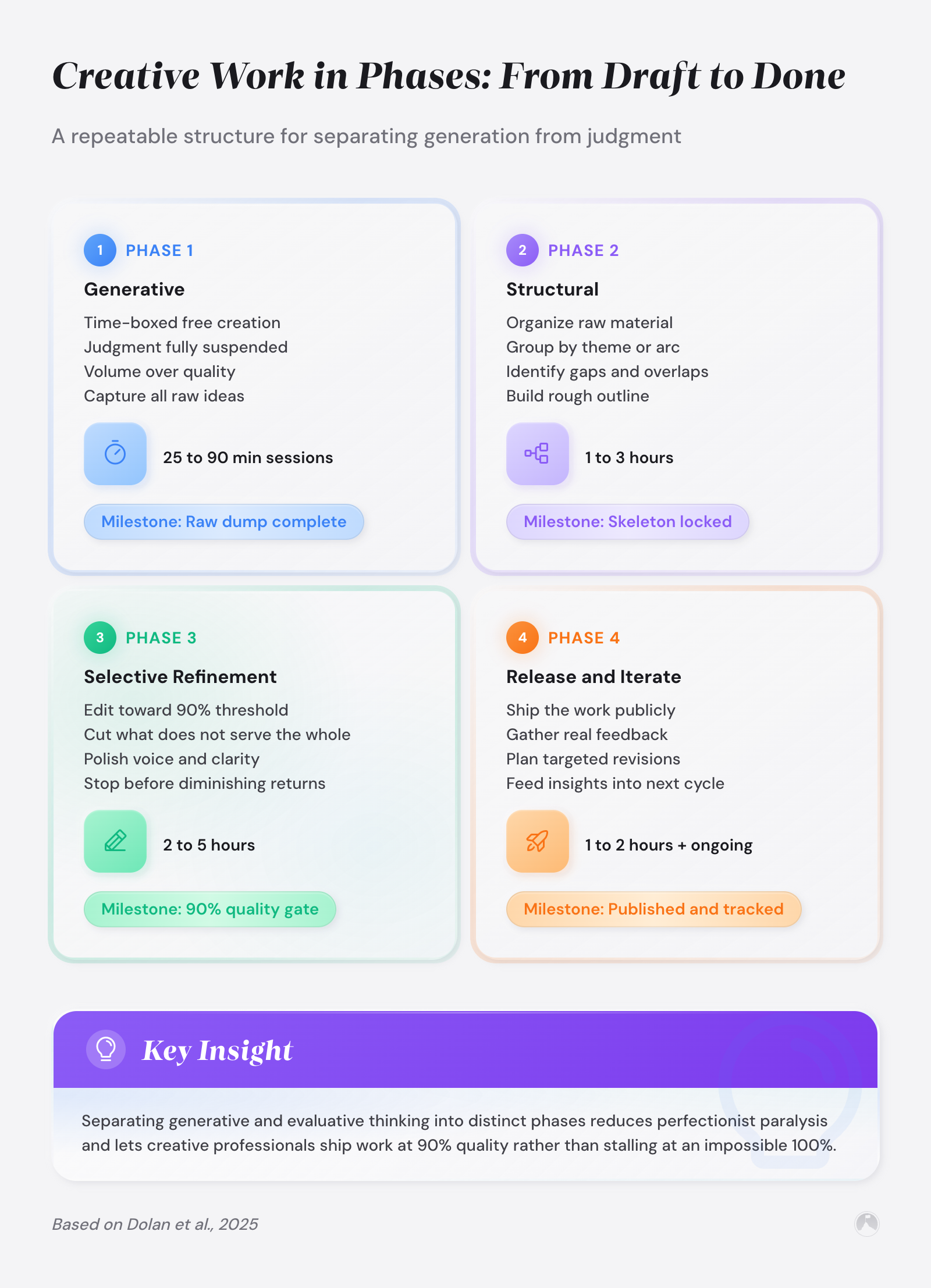
- Exploration – generate material without judgment in bounded time
- Direction – pick the one direction that pulls you most
- Development – complete the work in rough form
- Integration – get targeted feedback from trusted sources
- Refinement – revise once based on specific feedback
- Shipping – send it out on a fixed deadline
Phase 1: Exploration (bounded time)
Set a fixed time period – one week for a short story, one day for a design concept, three hours for a song idea. Your job: generate material without judgment. Quantity over quality. Multiple directions. Rough ideas. Your internal critic is not invited. You’re exploring what exists, not evaluating it.
Phase 2: Direction (one choice)
Look at what you explored. Pick the direction that most interests you or serves your purpose. Not the one that feels safest. The one that actually pulls you. This should take a single session, not days of deliberation. Deliberation is how creative paralysis from perfectionism stalls you.
Phase 3: Development (completion-focused)
Flesh out your chosen direction until it’s complete. Not polished. Complete. For a writer, this is the full first draft. For a designer, the complete layout. For a musician, the full composition. This phase has a clear endpoint: “finished in rough form.” It does not have an endpoint of “polished enough to share,” because that goalpost moves infinitely. If you need structured approaches to maintain completion focus, building systems to beat perfectionism offers frameworks specifically designed for this.
Phase 4: Integration (targeted feedback)
Show your rough version to one or two trusted people and ask specific questions: “Does this convey what I intended?” “Where’s the energy dropping?” “What feels unclear?” Avoid vague feedback requests. You’re looking for information to improve, not validation. You’re not looking for whether it’s “good enough.”
Phase 5: Refinement (iteration)
Use the feedback to improve. Now your internal critic is useful – you’re refining toward something specific, not trying to achieve perfection. Decide what feedback you use and what you ignore. This is usually one revision cycle for most creative work. Not seven. One.
Phase 6: Shipping (the hard part)
Send it out. Publish it. Share it. Submit it. This is where perfectionism usually strikes hardest, so make it a practice: you ship on a fixed deadline, not when it feels ready. Ready never comes. The deadline comes.
By structuring creative work this way, you’re not lowering standards. You’re directing them. Quality no longer lives in “endless revision.” It lives in the choices you make during exploration and development, and in the feedback you integrate. And the work actually ships.
Managing perfectionism when clients or deadlines push back
The Version 1.0 Framework works well when you control the deadline. But many creative professionals work with client demands, audience expectations, or real-world timelines that don’t feel negotiable. How do you maintain craft standards when you’re also managing someone else’s idea of “perfect”?
Clarify what “done” actually means
Most perfectionism impasses happen because “done” is undefined. A client says “perfect,” but perfect means different things to different people. Have an explicit conversation about what success looks like: responsiveness to the brief, audience connection, technical execution, visual coherence. Once criteria are clear, you have something to improve toward instead of something impossible to chase.
Build revision into the timeline
If perfectionism stems from feeling unfinished, acknowledge that upfront. Tell clients: “I’ll deliver a complete draft by [date] for feedback. I’ll incorporate revisions by [second date].” This removes the pressure of delivering the “perfect” version on first attempt. Everyone relaxes. And paradoxically, the first version is usually better because you’re not performing under the weight of finality.
Separate your standards from their feedback
Here’s what matters: client feedback is not evidence about your capability. It’s information about their preferences. You can honor both your craft standards and their feedback. Sometimes they ask for something and you think, “That’s actually an improvement.” Other times they ask for something that conflicts with your vision and you respectfully decline. Both are fine. The trap is treating their feedback as a referendum on your adequacy. If you find your emotional reaction to feedback feels disproportionate, it’s worth exploring whether perfectionism is holding you back in ways beyond your creative work.
Researcher Brene Brown has described perfectionism as a shield we hide behind, preventing others from seeing our actual work and development [4]. The moment you ship imperfect work, you become vulnerable – which is exactly when authentic feedback becomes possible.
Ramon’s take
Reading about this, I keep getting stuck on one thing. The 90% shipping rule makes sense if your standards were always too high. But what if they weren’t? What if the work genuinely needed more time?
Perfectionism for creative professionals: what to do next
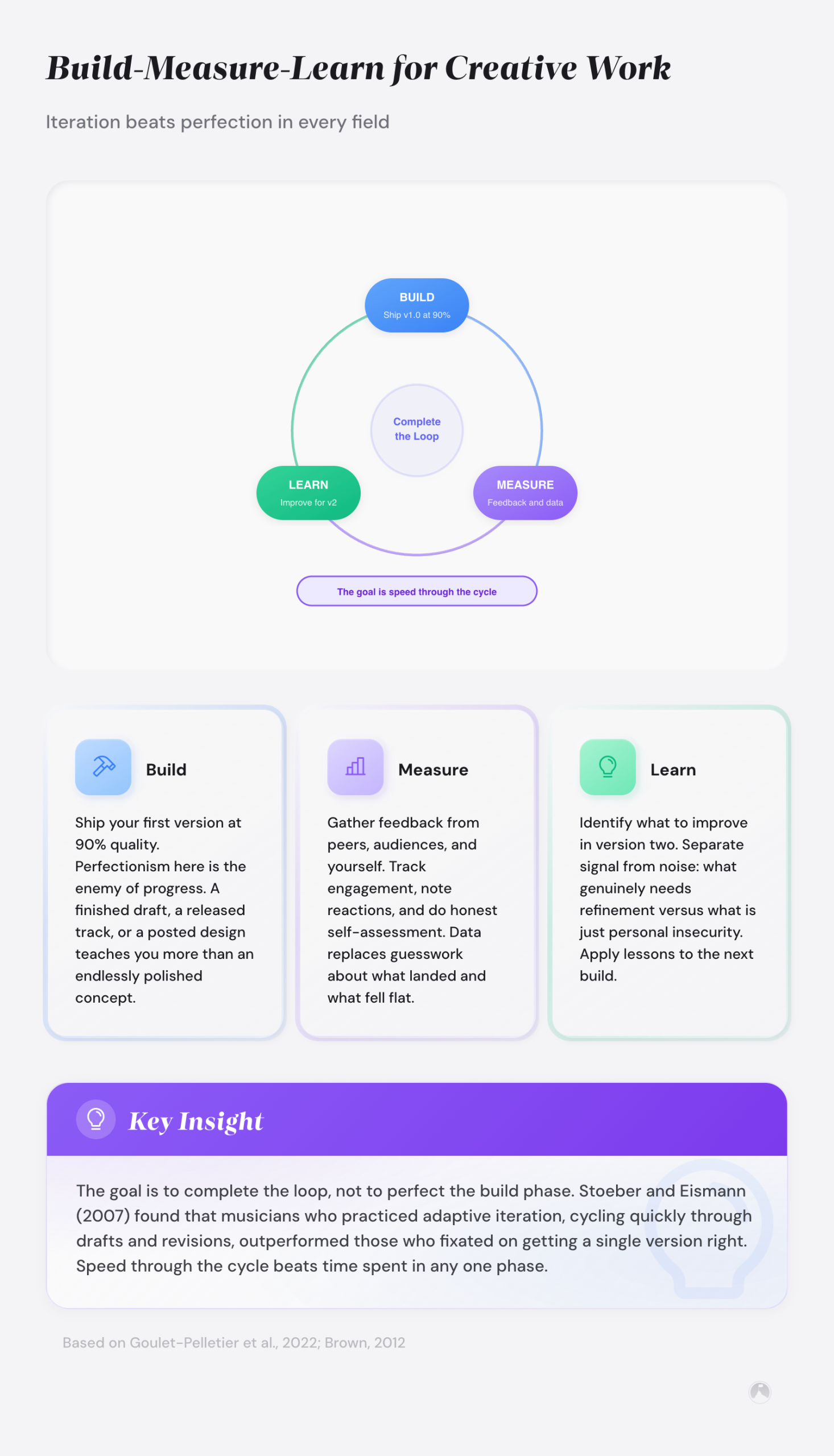
Perfectionism isn’t the same as standards. For creative professionals, perfectionism killing artistic process often masquerades as “caring about quality” while quietly preventing the feedback cycles and iteration that actually develop craft. The solution isn’t lower standards. It’s distinguishing between excellence (feedback-responsive improvement) and perfectionism (fear-driven paralysis), then building a creative process that enables the first and interrupts the second.
Your finished work matters more than your idealized work.
Next 10 minutes
- Identify one creative project you’ve abandoned or endlessly revised. Ask yourself: Am I still improving it, or am I revising it because it doesn’t feel flawless?
- Set a shipping deadline for this week that feels slightly scary – sooner than feels comfortable. This is your permission practice.
This week
- Apply the Version 1.0 Framework to one small creative project. Explore, pick a direction, develop it to completion, get one feedback conversation, refine, and ship.
- Notice what happens to your anxiety when you commit to a deadline. Perfectionism thrives in open-ended time. Deadlines force decisions.
- Track how much time you spend revising versus creating. If revision takes more than 30% of your project time, your perfectionism threshold might be set too high.
There is more to explore
- Overcoming perfectionism guide – the complete framework for breaking perfectionist patterns
- Perfectionism paralysis solutions – breaking the freeze-and-restart cycle
- Breaking free from perfectionism – long-term strategies for shifting your default
- Building systems to beat perfectionism – structural approaches that make shipping automatic
- Signs perfectionism is holding you back – recognizing the patterns beyond your creative work
Related articles in this guide
- perfectionism-high-achievers
- perfectionism-management-tools-worksheets
- perfectionism-paralysis-solutions
Frequently asked questions
Why does perfectionism block the creative process?
Perfectionism blocks creativity because it focuses on fear of inadequacy rather than growth through feedback. Research by Goulet-Pelletier, Gaudreau, and Cousineau (2022) found that perfectionists generate fewer original ideas than excellence-seekers because they abandon concepts too early. Excellence-seekers finish projects faster because they’re responsive to feedback and know when work meets its purpose.
How do professional creatives manage perfectionist tendencies?
Professional creatives manage perfectionism by separating creation from editing phases, shipping at 90% rather than waiting for perfection, and building iteration into the process beforehand. They clarify what success looks like upfront and view feedback as information for improvement, not evidence of inadequacy.
Can you be both a perfectionist and a productive creative?
You can be productive with high standards, but not with perfectionism. The difference is psychological. Perfectionism is fear-driven self-criticism that prevents completion. High standards paired with feedback-responsiveness and clear stopping points allows both quality and output.
What is the Version 1.0 Framework?
The Version 1.0 Framework is a creative process that separates creation from editing, ships work at 90% completion, and builds feedback and iteration into the workflow. Neuroscience research supports this approach by showing that idea generation and evaluation activate different neural systems, making separation more efficient.
How does perfectionism affect different creative disciplines?
Perfectionism manifests differently across fields. Writers struggle with revision cycles and word choice. Designers get stuck polishing details. Musicians experience distress from negative reactions to imperfection, as Stoeber and Eismann (2007) documented. The trigger varies, but the pattern is the same: endless revision prevents shipping.
What strategies help creatives ship work despite perfectionist urges?
Effective strategies include time-boxing each creative phase, setting a shipping deadline that feels slightly scary, getting feedback early from trusted sources, and clarifying upfront what success looks like. Treat shipping as a scheduled event, not something that happens when you feel ready.
Is shipping imperfect work damaging to your reputation?
Shipping slightly imperfect work is how every successful creative maintains output and improves. The perception of imperfection usually matters less than what the audience actually needs from the work. Receiving feedback from actual readers or clients often shows which revisions truly matter and which are perfectionist noise.
How do I know if perfectionism is blocking my creativity?
Signals include endlessly revising the same project, abandoned half-finished work, telling yourself ‘one more revision’ for weeks, difficulty sharing work with feedback sources, and feeling that your creative output is lower than you expect. If you’re spending more time revising than creating, perfectionism is likely the bottleneck.
References
[1] Goulet-Pelletier, J.-C., Gaudreau, P., & Cousineau, D. (2022). Is perfectionism a killer of creative thinking? A test of the model of excellencism and perfectionism. British Journal of Psychology, 113(1), 176-207. DOI
[2] Stoeber, J., & Eismann, U. (2007). Perfectionism in young musicians: Relations with motivation, effort, achievement, and distress. Personality and Individual Differences, 43(8), 2182-2192. DOI
[3] Dolan, R. J., Sajda, P., & Hughes, B. L. (2025). Neural dynamics during the generation and evaluation of creative and non-creative ideas. Communications Biology, 8, 40. DOI
[4] Brown, B. (2012). Daring Greatly: How the Courage to Be Vulnerable Transforms the Way We Live, Love, Parent, and Lead. Gotham Books.