
The paradox nobody talks about
You can be intensely driven and still be healthy. You can be intensely driven and be burning out. The difference isn’t obvious to most people.
For years, we’ve treated all perfectionism as one thing. It’s not. And that distinction changes everything about the perfectionism burnout correlation.
Hill and Curran’s 2016 meta-analysis in Personality and Social Psychology Review examined 43 studies spanning nearly 10,000 participants and found a stark divide [1]. One form protects you. The other depletes you. And most people can’t tell which one they have.
The central finding across decades of perfectionism and burnout research is that fear of falling short – not the pursuit of high standards – is the active ingredient in burnout.
Perfectionism and burnout research shows that perfectionistic concerns – fear of mistakes, worry about judgment, and self-critical rumination – predict burnout, while perfectionistic strivings do not. A meta-analysis of 43 studies confirmed this split, finding medium-to-large burnout effects for concerns and small or non-significant effects for strivings [1].
Key takeaways
- Perfectionism has two forms: strivings (adaptive) and concerns (maladaptive). Only concerns consistently predict burnout [1].
- A meta-analysis of 43 studies found perfectionistic concerns had medium-to-large burnout relationships. Strivings did not [1].
- Fear of falling short – not ambition – drives chronic stress perfectionism and eventual exhaustion [1][2].
- Workplace perfectionism burnout hits hardest in healthcare, academia, and knowledge work [3][8].
- Self-compassion after mistakes is among the strongest protective factors against perfectionistic concerns exhaustion [7].
- You can keep high standards. The fix is removing the fear, not lowering the bar.
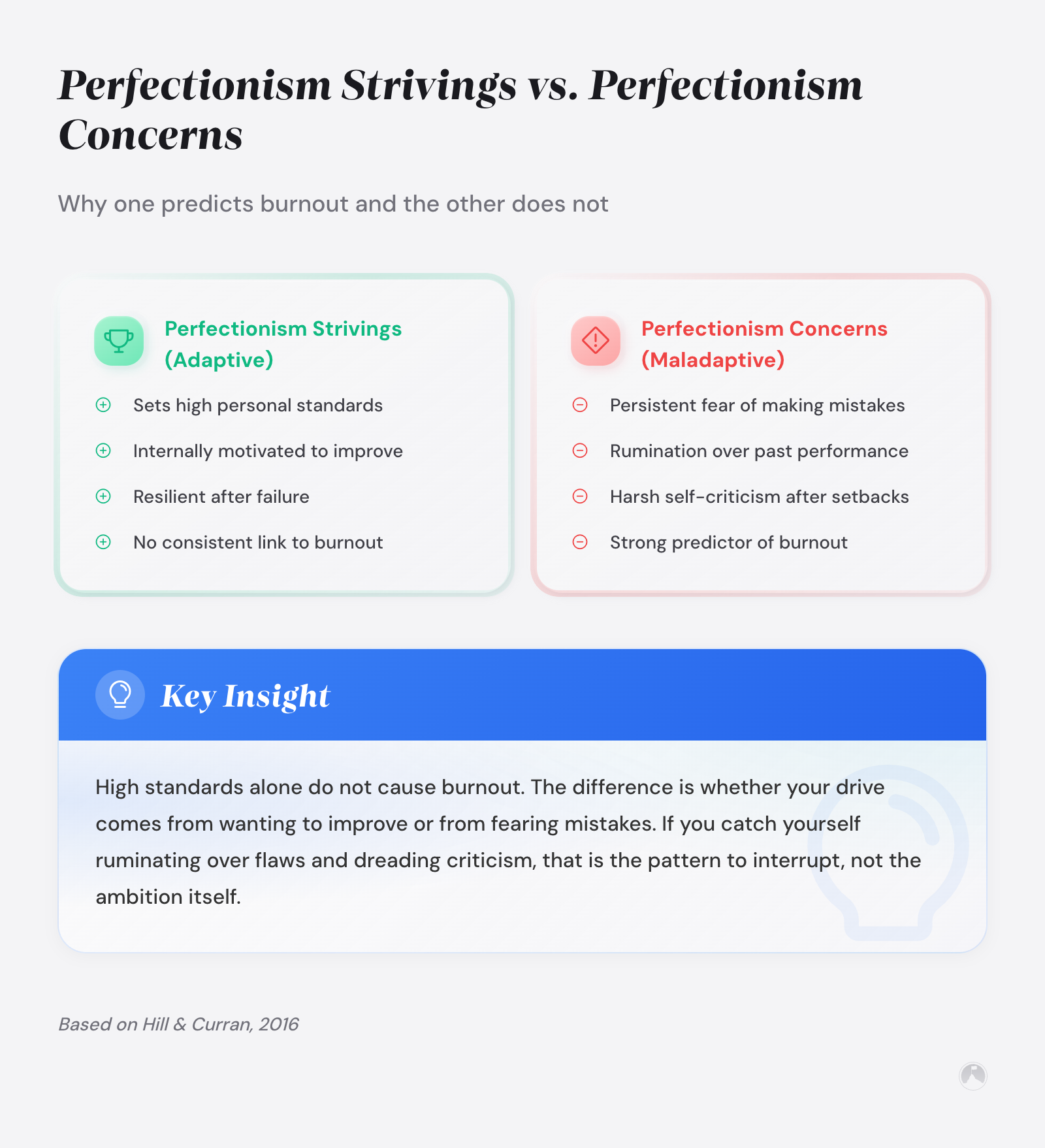
Perfectionism is a multidimensional personality trait involving two distinct components: perfectionistic strivings (the self-motivated pursuit of high standards, associated with positive outcomes) and perfectionistic concerns (the fear of mistakes, worry about judgment, and self-critical rumination, associated with burnout, anxiety, and depression). The adaptive vs maladaptive perfectionism distinction is central to modern research on the topic [1].
What happens when research splits perfectionism in two?
Perfectionistic strivings are the pursuit of high standards through self-motivation and goal-setting. Hill and Curran’s meta-analysis found this form is associated with better performance, lower procrastination, and positive outcomes [1]. This is adaptive perfectionism – it doesn’t predict burnout.
Perfectionistic concerns involve the fear of making mistakes, worry about what others think, and self-critical rumination when you fall short. The research links this form most strongly to burnout, anxiety, and depression [1]. This is maladaptive perfectionism – the active ingredient in the burnout equation.
| Dimension | Perfectionistic Strivings | Perfectionistic Concerns |
|---|---|---|
| Core drive | Self-motivated pursuit of high standards | Fear of mistakes and judgment from others |
| Relationship to burnout | Small negative or non-significant [1] | Medium-to-large positive [1] |
| Motivation type | Intrinsic (mastery, growth) [6] | Extrinsic (approval, avoidance) [6] |
| Associated outcomes | Better performance, lower procrastination | Anxiety, depression, emotional exhaustion |
| Intervention target | No change needed | Reduce fear component, build self-compassion |
The distinction changes your intervention. If your issue were high standards, lowering them would help. But the research shows you can have intense standards and stay healthy, or moderate standards and burn out. The variable isn’t ambition. It’s fear. That difference separates people who thrive under pressure from people who slowly unravel (for more on recognizing which side you’re on, see signs perfectionism is holding you back).
Perfectionism and burnout research: what longitudinal studies show
Spagnoli and colleagues published a two-wave cross-lagged study in Frontiers in Psychology (2021) following 191 Italian professionals during COVID-19 lockdowns. Participants high in perfectionistic concerns showed significantly higher increases in burnout symptoms – particularly emotional exhaustion and reduced accomplishment [2]. Emotional exhaustion is the feeling of being emotionally depleted and drained by one’s work, representing the core energy-depletion component of burnout syndrome.
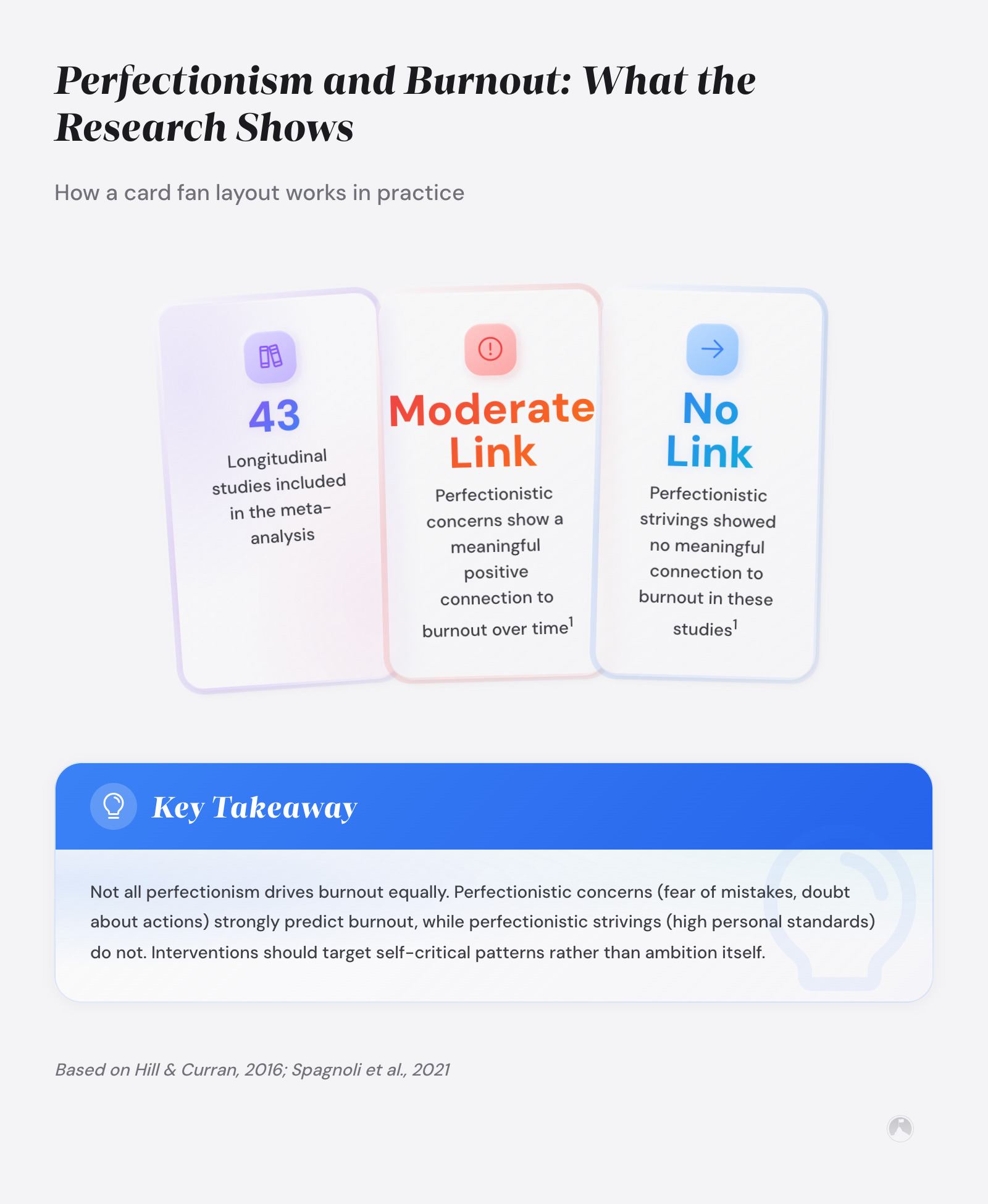
It was perfectionistic concerns, not strivings, that predicted burnout trajectories over time.
Martin and colleagues found similar patterns in a 2022 physician study in BMC Health Services Research [3]. Among 69 physicians assessed, 42% reported high emotional exhaustion or depersonalization. Self-critical perfectionism uniquely predicted both burnout dimensions; strivings did not. The fear component is the active ingredient in the burnout equation, not the ambition.
Research by Wirtz and colleagues at the University of Zurich (2007) shows perfectionism accounts for roughly 18% of the variance in cortisol elevation during psychosocial stress [4]. When your brain interprets mistakes as identity threats, it triggers sustained cortisol elevation that depletes the neurotransmitters regulating mood, motivation, and resilience [5]. Perfectionistic burnout is not insufficient willpower. Perfectionistic burnout is a biological stress response that never turns off. If you’re dealing with chronic stress perfectionism, the problem runs at the level of your nervous system (stress management techniques can help).
Three mechanisms that connect perfectionism to burnout
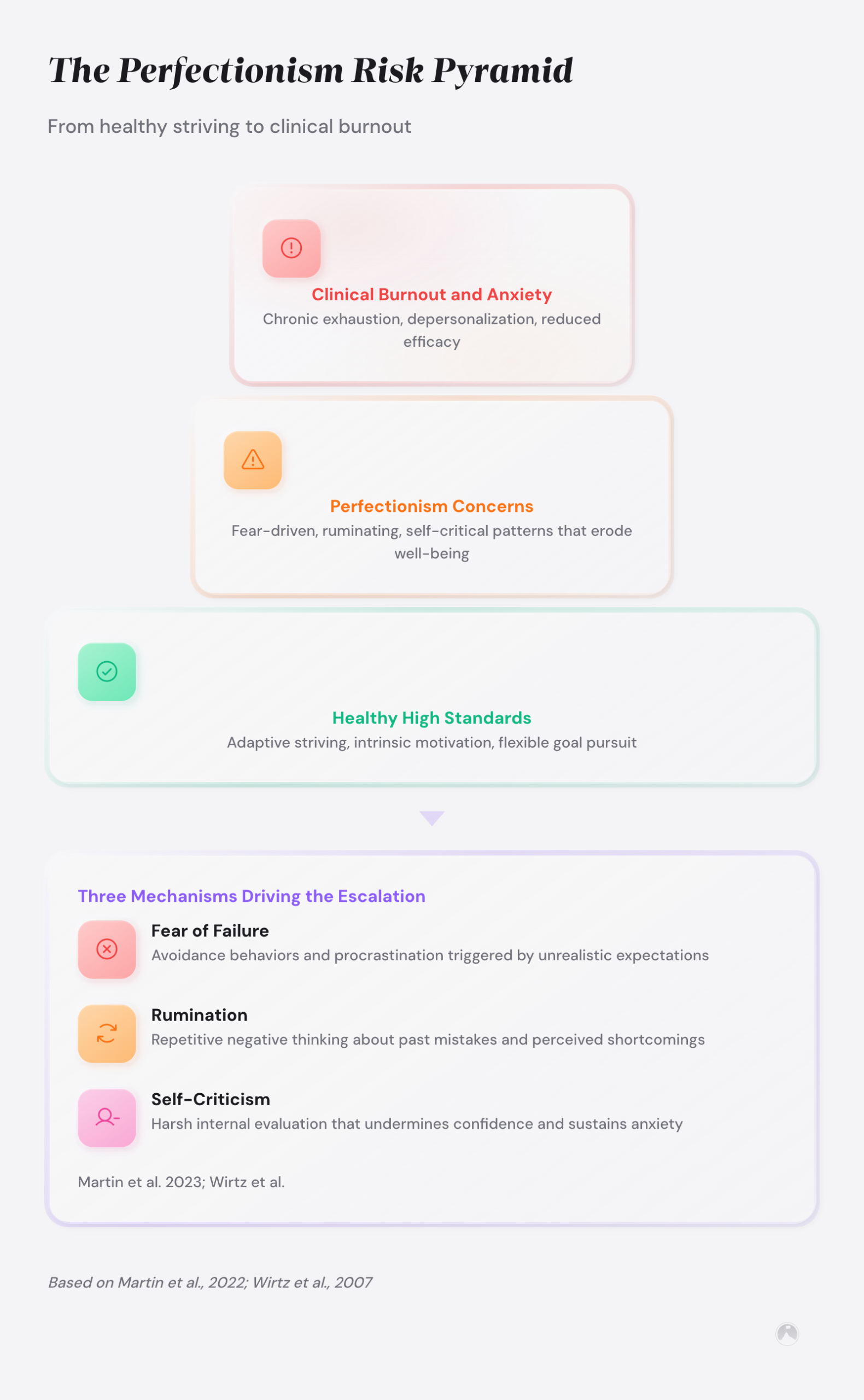
Research identifies three mechanisms through which the perfectionism burnout correlation operates:
The exhaustion pathway. High standards combined with fear of failure produce sustained effort with no recovery built in. Perfectionistic individuals often work longer hours, skip breaks, and ruminate after hours. Hill and Curran’s meta-analysis found perfectionistic concerns predicted all three burnout dimensions: emotional exhaustion, depersonalization, and reduced personal accomplishment [1].
The concern component extended the stress cycle because work became about proving sufficiency, not completing tasks. Building in strategic breaks is one way to interrupt this cycle.
The meaning erosion pathway. When perfectionism becomes about avoiding judgment rather than pursuing mastery, work loses intrinsic meaning. Adaptive perfectionism (strivings) is driven by intrinsic goals like mastery and growth, which protects against burnout [6].
Maladaptive perfectionism (concerns) is driven by extrinsic goals like approval and judgment avoidance, which elevates burnout risk [6]. A person pursuing mastery gets energized by improvement. A person pursuing judgment avoidance experiences work as a constant threat assessment. This shift from approach to avoidance motivation predicts loss of purpose, central to burnout syndrome.
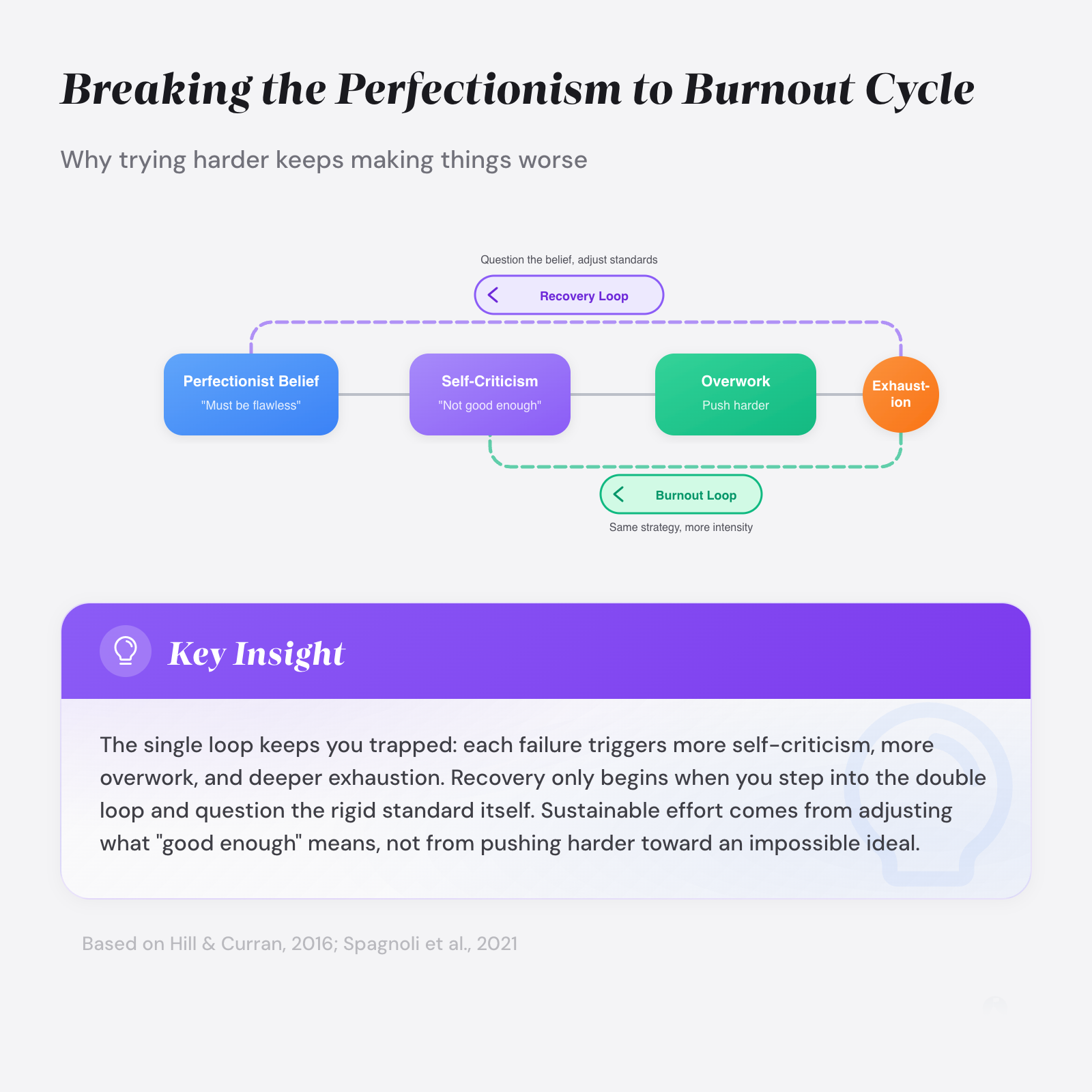
The adaptation shutdown pathway. Perfectionistic concerns impair the ability to adapt and recover. A healthy response to setbacks is course-correction and self-compassion. The perfectionistic-concern response is rumination, self-blame, and doubled effort without self-kindness.
Self-compassion is treating oneself with the same kindness during failure or difficulty that one would offer a close friend, distinct from self-esteem in that it does not require positive self-evaluation.
Ferrari and colleagues demonstrated in a 2018 PLoS ONE study that self-compassion significantly moderates the relationship between perfectionism and psychological distress [7]. People who practice self-compassion after mistakes recover faster and avoid the rumination cycle that drives burnout. Without this capacity, perfectionistic-concern individuals lack the flexibility to bounce back (for practical approaches, see breaking free from perfectionism).
“Perfectionistic concerns displayed medium-to-large positive relationships with overall burnout and burnout symptoms, whereas perfectionistic strivings displayed small negative or non-significant relationships.” – Hill & Curran (2016), Personality and Social Psychology Review [1]
Where workplace perfectionism burnout hits hardest
Perfectionism-burnout links vary significantly by field and demographic.
Healthcare workers show the strongest perfectionism burnout correlation. Martin et al. (2022) found self-critical perfectionism uniquely predicted emotional exhaustion and depersonalization in physicians – adaptive strivings did not [3]. A Polish study by Wlodarczyk and Obacz (2013) on operating suite nurses found the same pattern: maladaptive perfectionism predicted both disengagement and exhaustion, while adaptive perfectionism was associated with better work engagement [8]. Academic settings show parallel results, with student burnout correlating strongly with concerns but not strivings [2].
Knowledge work – software development, consulting, creative fields – shows elevated perfectionist-concern burnout, likely because output quality is ambiguous and open to rumination. If you’re a creative professional dealing with perfectionism, this ambiguity puts you at higher risk.
“Perfectionism accounted for approximately 18% of the variance in cortisol elevation during psychosocial stress, indicating that perfectionistic self-presentation significantly amplifies the biological stress response.” – Wirtz et al. (2007), Psychosomatic Medicine [4]
Research consistently shows women report slightly higher rates of perfectionistic concerns than men, though effect sizes are small. A Norwegian study of 10,217 adolescents found girls scored higher on socially prescribed perfectionism, with significantly more girls among high scorers at the 90th percentile [9]. Younger professionals report higher burnout from perfectionistic concerns, possibly because they haven’t yet developed stress-management strategies [10].
Why does this change your options?
If burnout were caused by high standards, the only solution would be lowering them. But the research doesn’t support that prescription. The solution is to maintain your standards while removing the fear component. This is the core insight behind overcoming perfectionism as a practice rather than a single decision.
Healthy high achievers set ambitious goals. They also:
- Distinguish between effort and outcome (they control effort; outcomes depend on factors beyond control)
- Practice self-compassion when they fall short (failure is information, not identity threat)
- Take breaks and trust recovery (they don’t equate rest with mediocrity)
- Seek feedback without defensiveness (to improve, not prove sufficiency)
- Build meaning beyond performance (values separate from achievement)
Protecting yourself from perfectionist burnout means separating your self-worth from your output, not reducing your ambition. Pursue excellence as an intrinsic goal – mastery, growth, contribution – rather than an extrinsic goal – approval, avoidance of judgment, identity protection [6]. For specific approaches, progress over perfection practices breaks down the daily habits that support this shift.
Ramon’s take
Reading through the research, what stuck with me was how long people walk around thinking their fear is ambition. Like, years. That’s not a small mix-up. I wonder how many people are calling it ‘high standards’ right now and won’t figure that out for another decade.
Conclusion
The research is clear: perfectionism and burnout are linked, but the link runs through fear, rumination, and self-criticism – not ambition. The distinction between adaptive vs maladaptive perfectionism has moved from academic nuance to practical necessity for anyone trying to achieve at a high level without burning out.
For a complete guide to overcoming perfectionism and building healthier achievement patterns, start with understanding which type of drive you currently rely on.
The research points to one uncomfortable conclusion: the part of perfectionism that feels most like dedication is often the part most likely to destroy it.
Next 10 minutes
- Identify one area where you notice yourself ruminating after a mistake versus another area where you stay solution-focused. Notice the difference in how your body feels.
- Write down three of your highest standards. For each, ask: “Am I pursuing this because I want to or because I’m afraid of what happens if I don’t?”
This week
- Pick one perfectionist concern (fear of judgment, fear of mistakes in a specific domain, need to prove sufficiency) and track when it appears. Notice the trigger.
- Practice one small self-compassion response the next time you make a mistake in that domain. Notice whether it changes how quickly you move to problem-solving.
Related articles in this guide
- perfectionism-creative-professionals
- perfectionism-high-achievers
- perfectionism-management-tools-worksheets
Frequently asked questions
Can you have both perfectionistic strivings and concerns at the same time?
Yes. Strivings and concerns are independent dimensions, not opposite ends of a single scale. Hill and Curran’s meta-analysis found that controlling for the other dimension changed effect sizes, meaning the ratio between your strivings and concerns matters more than the absolute level of either one [1]. High strivings with low concerns is the healthiest profile.
How long does it take for perfectionistic concerns to lead to burnout?
There is no fixed timeline. Spagnoli and colleagues found significant burnout increases over several months during COVID-19 lockdowns [2]. Chronic low-level perfectionistic concerns may take years to manifest as full burnout. The speed depends on workload, recovery opportunities, and protective factors like self-compassion.
Is perfectionism a personality trait or a learned behavior?
Research treats perfectionism as a multidimensional personality disposition with both genetic and environmental components. Parenting styles and early achievement experiences shape its expression. Perfectionism levels can shift with targeted interventions like cognitive behavioral therapy and self-compassion training [7].
Can therapy reduce perfectionistic concerns without lowering standards?
Yes. Cognitive behavioral therapy targeting perfectionistic concerns reduces the fear and rumination component while preserving strivings. Self-compassion interventions also moderate the perfectionism-distress link without requiring people to abandon high standards [7].
Does perfectionism affect sleep quality?
Perfectionistic concerns are associated with poorer sleep quality through rumination pathways. The inability to disengage from self-evaluation at night connects to the sustained cortisol mechanisms Wirtz and colleagues identified [4]. Poor sleep then impairs emotional regulation, creating a feedback loop that accelerates burnout.
Which professions show the highest perfectionism burnout correlation?
Healthcare workers, academic researchers, and knowledge workers in ambiguous output fields show the strongest correlations. Martin et al. (2022) documented that self-critical perfectionism uniquely predicted emotional exhaustion and depersonalization in physicians [3]. Nurses, software engineers, and consultants also show elevated risk because output quality is difficult to objectively measure, leaving room for rumination.
What is the difference between burnout and chronic perfectionism fatigue?
Burnout is a clinical syndrome with three dimensions: emotional exhaustion, depersonalization, and reduced personal accomplishment. Perfectionism fatigue is the daily drain from sustained self-critical rumination and impossible standards. Perfectionism fatigue can precede full burnout, acting as a warning signal that the fear-based cycle is accelerating.
References
[1] Hill, A.P., & Curran, T. (2016). Multidimensional perfectionism and burnout: A meta-analysis. Personality and Social Psychology Review, 20(3), 269-288. DOI
[2] Spagnoli, P., Buono, C., Kovalchuk, L.S., Cordasco, G., & Esposito, A. (2021). Perfectionism and burnout during the COVID-19 crisis: A two-wave cross-lagged study. Frontiers in Psychology, 11, 631994. DOI
[3] Martin, S.R., Fortier, M.A., Heyming, T.W., Ahn, K., Nichols, W., Golden, C., Saadat, H., & Kain, Z.N. (2022). Perfectionism as a predictor of physician burnout. BMC Health Services Research, 22, 1425. DOI
[4] Wirtz, P.H., Elsenbruch, S., Emini, L., Rudisuli, K., Groessbauer, S., & Ehlert, U. (2007). Perfectionism and the cortisol response to psychosocial stress in men. Psychosomatic Medicine, 69(3), 249-255. DOI
[5] McEwen, B.S., & Stellar, E. (1993). Stress and the individual: Mechanisms leading to disease. Archives of Internal Medicine, 153(18), 2093-2101. DOI
[6] Childs, J.H., & Stoeber, J. (2012). Do you want me to be perfect? Two longitudinal studies on socially prescribed perfectionism, stress and burnout in the workplace. Work & Stress, 26(4), 347-364. DOI
[7] Ferrari, M., Yap, K., Scott, N., Einstein, D.A., & Ciarrochi, J. (2018). Self-compassion moderates the perfectionism and depression link in both adolescence and adulthood. PLoS ONE, 13(2), e0192022. DOI
[8] Wlodarczyk, D., & Obacz, W. (2013). Perfectionism, selected demographic and job characteristics as predictors of burnout in operating suite nurses. Medycyna Pracy, 64(6), 761-773. DOI
[9] Sand, L., Boe, T., Shafran, R., Stormark, K.M., & Hysing, M. (2021). Perfectionism in adolescence: Associations with gender, age, and socioeconomic status in a Norwegian sample. Frontiers in Public Health, 9, 688811. DOI
[10] Simionato, G.K., & Simpson, S. (2018). Personal risk factors associated with burnout among psychotherapists: A systematic review of the literature. Journal of Clinical Psychology, 74(9), 1431-1456. DOI