The planning tool you keep abandoning might be the wrong medium, not the wrong system
You set up a digital planner on Sunday night. By Wednesday, you miss the scratch of pen on paper. So you buy a notebook, transfer your tasks, and feel productive for two weeks. Then you miss the reminders, the search function, the sync across devices. Sound familiar? This cycle has less to do with discipline and more to do with forcing one medium to do everything.
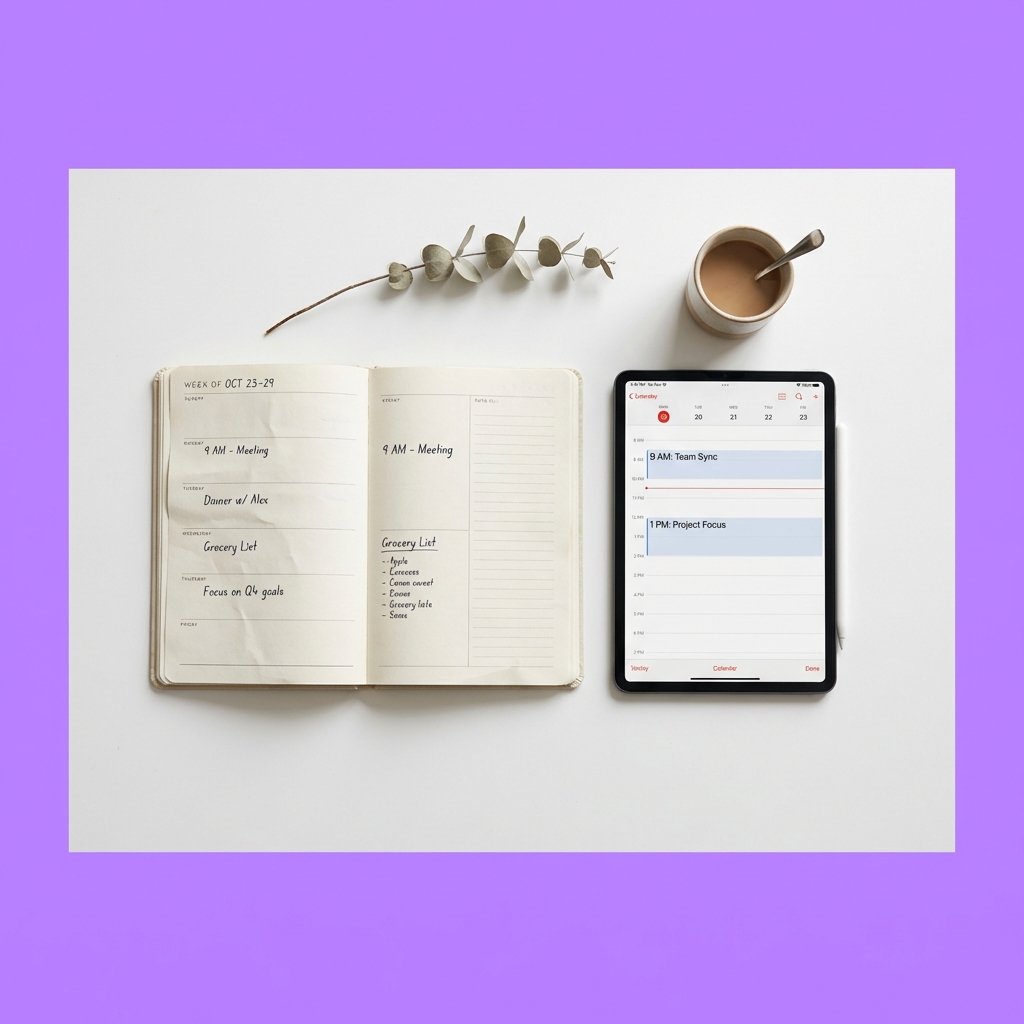
Paper planner vs digital planner The paper planner vs digital planner debate compares two planning mediums across cognitive encoding, retrieval speed, portability, and automation to determine which format best supports different types of planning work.
Analog planning system An analog planning system is planning work done entirely on paper, where memory and habit replace reminders and automation. Analog systems trade retrieval speed for deeper cognitive encoding during the writing process.
Medium-Match Method The Medium-Match Method is a framework that assigns each planning function to paper or digital based on three criteria – encoding depth, retrieval frequency, and time sensitivity – rather than personal preference or habit.
Hybrid planning approach A hybrid planning approach uses paper for functions requiring deep encoding and digital for functions requiring retrieval speed and automation, without duplicating work between the two systems.
Paper planners strengthen cognitive encoding through handwriting, while digital planners excel at retrieval, automation, and portability. The Medium-Match Method assigns each planning function to the medium where it performs best based on encoding depth, retrieval frequency, and time sensitivity.
Mueller and Oppenheimer’s 2014 research at Princeton and UCLA found that students who took notes by hand showed stronger conceptual understanding than those who typed, even when laptops were used strictly for note-taking [1]. That finding applies directly to planning – the medium you use shapes how deeply you process your own intentions.
But a 2019 replication by Morehead, Dunlosky, and Rawson found no significant difference in conceptual understanding, though handwriting did show an advantage for factual recall [2]. A meta-analysis of similar studies revealed small, nonsignificant overall effects, suggesting the original encoding advantage may be weaker than initially reported. Though studied in student populations, the underlying mechanism – that slower handwriting forces deliberate processing rather than verbatim transcription – is consistent with what productivity researchers and professional organizers observe about planning behavior.
So paper doesn’t win across the board. And digital doesn’t either.
The real question is not paper or digital. It’s paper for what, and digital for what.
What you will learn
- How paper and digital planners compare across eight dimensions that affect daily planning
- Why handwriting vs typing plans changes how your brain encodes goals, and where the research stands
- What digital planner advantages paper fundamentally cannot match
- How to assign each planning function to the right medium using the Medium-Match Method
- A decision framework for choosing paper, digital, or hybrid based on your constraints
Key takeaways
- Handwriting plans activates deeper cognitive processing than typing, though the effect size is debated across replication studies [1] [2]
- Digital planners offer retrieval, automation, and portability advantages that are built into platform design
- The Medium-Match Method assigns each planning function to the medium where cognitive fit is strongest [1]
- Hybrid systems avoid doubling your workload when functions are divided rather than duplicated across mediums
- Paper supports brainstorming, daily intention-setting, and reflective journaling through slower, more deliberate encoding [1]
- Digital planning tools handle calendar management, recurring task automation, reminders, and cross-device synchronization
- Most planning system failures come from forcing one medium to handle every function
How do paper and digital planners compare on what matters?
Before looking at each method, here is a side-by-side comparison across the eight dimensions that affect your daily planning experience:
| Dimension | Paper planner | Digital planner | Verdict |
|---|---|---|---|
| Memory retention planning | Stronger encoding through handwriting [1] | Weaker encoding but faster retrieval | Paper for goals; digital for tasks |
| Accessibility | One physical location only | Any device, anywhere, anytime | Digital wins |
| Annual cost | $10-35 per planner (1-2 per year)* | $0-120 per year depending on app tier** | Roughly equal |
| Customization | Unlimited freeform layouts | Template-based with constraints | Paper for creativity; digital for consistency |
| Collaboration | Not shareable | Real-time sharing and delegation | Digital wins |
| Reminders | None (relies on habit) | Automated notifications | Digital wins |
| Backup and search | No backup; no search | Cloud backup; full-text search | Digital wins |
| Screen time planning | Zero additional screen time | Adds to daily screen exposure | Paper wins |
*Cost estimate based on typical planner prices. Premium planners (Moleskine, Leuchtturm1917) skew higher; generic notebooks skew lower.
**Based on popular free and mid-tier apps. Google Calendar is free; Todoist Pro runs approximately $48/year; Notion Plus runs approximately $96/year.
If you noticed digital winning more categories, that tracks. Digital planners have clear functional advantages. But the two categories where paper wins – memory retention and screen time – affect something digital cannot replicate: how deeply you think about your own plans.
Most comparisons list pros and cons without a decision framework. The Medium-Match Method below gives you a structured way to assign each planning function to the right medium.
The best planning system is not the one with the most features. It is the one that matches each function to the right medium.
What are the real paper planner benefits beyond nostalgia?
Paper planning is not about being old-fashioned. The cognitive science behind handwriting shows measurable differences in how the brain processes written versus typed information.
Mueller and Oppenheimer’s 2014 research demonstrated that handwriting forces the brain to process and rephrase information rather than transcribe it verbatim [1]. When you write a goal by hand, you are making decisions about what matters enough to write down. That filtering process strengthens commitment to the plan.
“Even when laptops are used solely to take notes, they may still be impairing learning because their use results in shallower processing.” – Mueller and Oppenheimer, 2014 [1]
That said, a 2019 replication by Morehead, Dunlosky, and Rawson found that the conceptual understanding advantage did not hold up, though handwriting did produce better factual recall [2]. The encoding benefit appears real but more modest than the original study suggested.
This pattern aligns with the generation effect in cognitive psychology: people remember information better when they produce it themselves rather than passively receive it [6]. Handwriting a plan is generation; typing often becomes transcription.
Beyond memory retention planning, paper planners offer practical advantages that digital tools struggle to match. They eliminate the distraction layer – opening a paper planner never triggers a notification, a social media tab, or an email preview. And they support freeform creativity: sketching a mind map, drawing arrows between connected goals, or using color in ways that feel natural on paper requires clunky workarounds on most apps.
For anyone working on short and long-term planning, the physical act of writing forces slower, more deliberate processing. Paper planners create friction that works in your favor by forcing you to slow down and think before you write. That friction is a feature, not a bug.
As Julie Morgenstern, a professional organizer with over 30 years of experience, argues, paper forces deeper strategic thinking precisely because writing on paper creates a necessary screen break for strategy and decision making [3]. The limitations are real, though. Paper planners offer no backup, no reminders, and no way to search three months of entries for that one task you wrote down somewhere. If your planning needs include heavy scheduling, recurring tasks, or collaboration, paper alone will leave gaps.
When it comes to handwriting vs typing plans, handwriting wins on encoding depth. Typing wins on speed and retrieval. Neither wins on every planning function.
What digital planner advantages does paper simply lack?
Digital planners solve problems that paper cannot address (regardless of how beautiful your handwriting is). The advantages cluster around four capabilities: automation, retrieval, portability, and integration.
Automation means recurring tasks appear without you rewriting them. Your weekly review prompt shows up every Friday at 3 PM. Your quarterly goal check-in populates automatically. Tools like Todoist handle recurring task creation natively. For anyone managing a daily planning method with repeating elements, digital removes the manual labor of copying the same items day after day.
Retrieval is where digital pulls ahead permanently. Need to find what you planned for a meeting six weeks ago? Notion’s full-text search returns it in seconds. Need to see every deep work session this quarter? Filter by tag. Paper forces you to flip through pages hoping you marked the right one. Digital planners trade the encoding advantage of handwriting for the retrieval advantage of searchable records across months or years of planning data.
Portability matters when your planning is not confined to a single desk. Google Calendar syncs across phone, tablet, and laptop. If you have ever left your paper planner at home and spent the day unable to check your plan, you understand the problem. For working parents moving between office, home, and school pickup, a planning app vs notebook debate is settled quickly: the planner that lives on a phone is always within reach.
Integration connects your planner to your calendar, email, and task management tools. When a digital planner can pull meeting times from Google Calendar, flag overdue tasks from Todoist, and link workflows through Zapier, it creates a planning ecosystem – the interconnected system of calendar, task management, and communication tools that share data across platforms to create unified planning infrastructure. Paper cannot replicate this. The best planning apps and tools roundup covers what is available now.
The trade-off? According to Bureau of Labor Statistics data, professional and office workers spend the majority of their working hours in occupations that are predominantly screen-based [4]. Every minute spent in a digital planner adds to that exposure. For people already feeling screen fatigue, adding planning to the digital stack means one more reason to stare at a backlit rectangle.
Digital planner advantages are undeniable for logistics. But logistics is only half of what planning does.
How does the Medium-Match Method end the paper vs digital debate?
Here is a simple filter that keeps showing up when you look at the research on planning effectiveness. Three questions, asked for each planning function, tell you which medium to use. None of these questions are new, but asking them together produces clearer results than any single planning recommendation.
This is what we call the Medium-Match Method – a framework that synthesizes research on cognitive encoding [1], retrieval efficiency, and task automation to assign planning functions to the medium where they perform best. It evaluates each planning function against three criteria: encoding depth, retrieval frequency, and time sensitivity.
- Does this function benefit from deep encoding? If you need to truly internalize something (a quarterly goal, a values reflection, a creative brainstorm), handwriting increases how deeply your brain processes it [1]. Paper wins here.
- Will you need to find this information again quickly? If you will search for it, filter it, or share it with someone else, digital wins. Paper has no search bar.
- Is this function time-sensitive or recurring? If you need reminders, notifications, or automatic population of recurring items, digital wins. Paper cannot buzz your phone at 2 PM.
Here is how the Medium-Match Method maps common planning functions:
| Planning function | Key criteria | Best medium |
|---|---|---|
| Quarterly goal setting | High encoding; low retrieval; not time-sensitive | Paper |
| Daily intention writing | High encoding; low retrieval; not time-sensitive | Paper |
| Brainstorming and mind mapping | High encoding; low retrieval; not time-sensitive | Paper |
| Weekly reflection | High encoding; medium retrieval; not time-sensitive | Paper |
| Calendar and scheduling | Low encoding; high retrieval; time-sensitive | Digital |
| Recurring task management | Low encoding; high retrieval; time-sensitive | Digital |
| Project tracking | Medium encoding; high retrieval; time-sensitive | Digital |
| Meeting notes capture | High encoding; medium retrieval; not time-sensitive | Paper (then photograph) |
Notice that the hybrid planning approach does not double your workload. Paper handles the thinking-heavy functions where encoding matters. Digital handles the logistics-heavy functions where retrieval and automation matter. The Medium-Match Method works by assigning each planning function to one medium, not both – eliminating the duplication that makes hybrid systems feel like twice the work.
As a concrete example: you write your three daily intentions in a pocket notebook each morning (two minutes, paper). Your calendar, meeting schedule, and recurring tasks live in a digital planning system that syncs across devices. The two systems never overlap, so there is nothing to transfer.
Sample Medium-Match setup in practice
Here is a copy-pasteable template for splitting your planning functions:
**Paper notebook (morning, 5 minutes):**
- Write 3 daily intentions for the day
- Sketch any creative brainstorm or mind map
- Jot a one-sentence reflection from yesterday
**Digital app (ongoing, as-needed):**
- Calendar events and meeting times
- Recurring task reminders (weekly review, monthly goals check)
- Shared project tasks with collaborators
**Weekly sync (Sunday, 5 minutes):**
- Review paper notes from the week
- Confirm digital calendar covers the week ahead
- Archive or photograph any paper notes worth keeping
This approach works well for people exploring planning strategies for ADHD and creative thinkers. An ADDitude Magazine reader survey – noting that self-selected online surveys may not represent all adults with ADHD – found that 61% preferred physical planners, citing the tangible engagement of handwriting and reduced distraction compared to digital tools [5]. A hybrid approach combines that encoding benefit with digital reminders to prevent forgotten tasks.
When should you use paper vs digital planning?
If you are still unsure which direction to go, your answer depends on two factors: how much of your planning is reflective versus logistical, and how much you move between locations during the day.
Choose paper-only for reflective planning from a single location. Choose digital-only for logistical planning across multiple locations. Choose hybrid for a mix of both planning types.
Quick decision guide: paper, digital, or hybrid?
Choose paper-only if: Most of your planning is reflective (goal setting, journaling, brainstorming), you work primarily from one location, and you want to reduce screen time planning exposure.
Choose digital-only if: Most of your planning is logistical (scheduling, task management, delegation), you move between multiple locations, and you need cross-device access and collaboration.
Choose hybrid if: Your planning includes both reflective and logistical functions, you want the cognitive benefits of handwriting without losing digital convenience, and you are willing to assign each function to a single medium rather than duplicating.
Most people reading this article will land on hybrid. And that is fine. The key is making the hybrid system clean: paper for the functions where encoding matters, digital for the functions where retrieval and time sensitivity matter, and zero overlap between them.
The fear that hybrid systems create fragmentation is valid but solvable. A weekly alignment check (five minutes every Sunday) where you review your paper notes and confirm your digital calendar covers the week ahead is enough to keep the two systems synchronized. If you already do a structured weekly planning session, adding the alignment check takes almost no extra time.
As Julie Morgenstern argues, paper planning forces a kind of strategic thinking that screen-based tools often bypass because writing on paper creates a necessary screen break for deeper decision making [3].
Choosing between paper and digital planning is a design decision about cognitive fit, not a personality quiz about whether you prefer technology or tradition.
Ramon’s take
From managing product launches where people typed directly into shared documents, I have noticed something consistent: the notes were thorough but shallow. In meetings where people wrote on paper first, the follow-up actions tended to be sharper, more specific, and more realistic in their time estimates. I use a primarily paper-based system for planning – a pocket notebook for daily intentions and a digital calendar for everything with a time stamp. The research on handwriting and encoding is messier than the headlines suggest [2], but the pattern I keep seeing in practice points in the same direction: when people slow down to write, they plan better.
Conclusion
The paper planner vs digital planner debate misses the point. The question is not which medium is better for planning. It is which medium is better for each type of planning you do.
Handwriting deepens encoding for goals and reflections [1]. Digital automation handles scheduling, reminders, and retrieval. A hybrid planning approach that assigns functions to the right medium captures the benefits of both without the duplication that makes mixed systems collapse.
The planning system that survives is not the one you admire most. It is the one where every function lives in the medium that fits it best. The most effective planning system looks incomplete: paper for the thinking, digital for the logistics, nothing for the ego that wants one perfect tool.
If you want ready-made structures to plug into this approach, the planning templates and frameworks roundup covers eight systems worth testing.
In the next 10 minutes
- List every planning function you currently do (scheduling, goal setting, daily tasks, brainstorming, reflection)
- Run each function through the three Medium-Match questions: encoding depth, retrieval need, time sensitivity
- Note which functions land on paper and which land on digital
This week
- Set up your paper system (a notebook or planner) for the functions that need deep encoding
- Set up your digital system for scheduling, reminders, and recurring tasks
- Schedule a five-minute Sunday alignment check to review paper notes and confirm the digital calendar for the coming week
Related articles in this guide
- planning-for-working-parents
- planning-strategies-for-adhd-creatives
- planning-templates-and-frameworks-roundup
Frequently asked questions
How do I decide between a planning app vs notebook?
Run each planning function through three questions: does it need deep encoding (paper wins), will you need to retrieve it quickly (digital wins), and is it time-sensitive or recurring (digital wins). Most people find that goal setting and reflection belong on paper while scheduling and task tracking belong on digital. The Medium-Match Method provides a structured way to make this decision for every planning function you do.
What does the research say about handwriting vs typing plans?
Mueller and Oppenheimer’s 2014 Princeton-UCLA study found that handwriting activates deeper cognitive processing because the brain must rephrase and filter information rather than transcribe verbatim [1]. A 2019 replication by Morehead, Dunlosky, and Rawson found no significant difference on conceptual understanding but did find an advantage for factual recall [2]. The encoding advantage appears real but more modest than the original study suggested.
Can I switch between digital and paper planning without losing productivity?
Switching between methods works when functions are divided rather than duplicated. Assign reflective planning (goals, brainstorming, journaling) to paper and logistical planning (calendar, reminders, recurring tasks) to digital. A five-minute weekly alignment check prevents information from falling between the two systems. The key is that each function lives in exactly one medium.
Which method is better for long-term goal tracking?
Paper is better for setting and encoding long-term goals because handwriting strengthens commitment to the plan [1]. Digital is better for tracking progress against those goals over time given searchability, data visualization, and historical records. A useful benchmark is to use paper to define the goal and digital to monitor milestones and deadlines.
Does paper planning take too much time compared to digital?
Paper planning takes longer per entry because handwriting is slower than typing. But that slowness serves a purpose – it forces deliberate processing rather than reflexive entry [1]. For reflective functions like daily intention-setting, the extra time produces better focus throughout the day. The time investment also tends to reduce planning anxiety – the worry that you missed something – because handwritten goals feel more committed and concrete. For high-volume task entry, digital is faster and more appropriate.
Is a hybrid planning approach the best solution for most people?
A hybrid planning approach works best for people whose planning includes both reflective and logistical components, which describes most knowledge workers. The key is assigning each function to one medium only, never both. This prevents the double-entry problem that makes hybrid systems feel like twice the work. An ADDitude Magazine reader survey found that 61% preferred physical planners for reflective tasks while still relying on digital tools for reminders [5].
References
[1] Mueller, P. A., & Oppenheimer, D. M. (2014). “The Pen Is Mightier Than the Keyboard: Advantages of Longhand Over Laptop Note Taking.” Psychological Science, 25(6), 1159-1168. https://doi.org/10.1177/0956797614524581
[2] Morehead, K., Dunlosky, J., & Rawson, K. A. (2019). “How Much Mightier Is the Pen than the Keyboard for Note-Taking? A Replication and Extension of Mueller and Oppenheimer (2014).” Educational Psychology Review, 31(3), 753-780. https://doi.org/10.1007/s10648-019-09468-2
[3] Morgenstern, J. (2024). “The Advantages of Paper vs Digital Planning.” Julie Morgenstern Tips and Tools. https://www.juliemorgenstern.com/tips-tools-blog/paper-vs-digital-planning
[4] U.S. Bureau of Labor Statistics. (2023). “American Time Use Survey – 2023 Results.” Table A-1: Time spent in detailed primary activities. https://www.bls.gov/tus/
[5] Tuckman, A. (2024). “Best Planners for ADHD Brains: Paper vs. Digital Organization Tools.” ADDitude Magazine. https://www.additudemag.com/best-planners-adhd-brains-paper-digital/
[6] Slamecka, N. J., & Graf, P. (1978). “The Generation Effect: Delineation of a Phenomenon.” Journal of Experimental Psychology: Human Learning and Memory, 4(6), 592-604. https://doi.org/10.1037/0278-7393.4.6.592