
Why perfectionism is rising and what you can do about it
You spend three hours on a task that should take one. You rewrite the same email four times. You can’t start a project because the conditions aren’t right. And underneath it all, a voice keeps insisting that the standard you’re chasing is just “high standards,” not a problem.
This guide is part of our Growth collection.
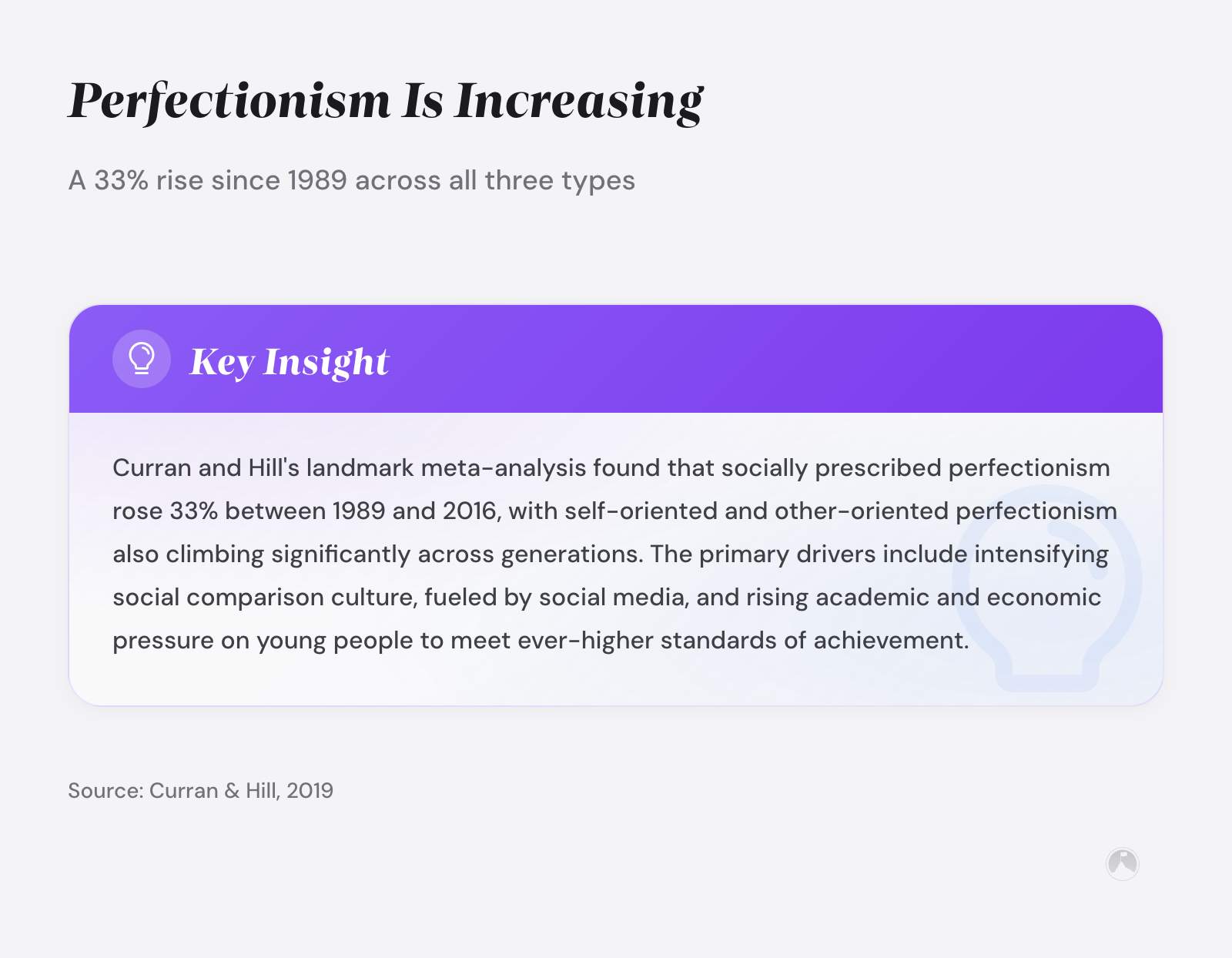
Except perfectionism is rising, and it’s not a personal quirk. In their 2019 meta-analysis of 41,641 college students across multiple cohorts, Thomas Curran and Andrew Hill found that socially prescribed perfectionism increased 33% between 1989 and 2016 [1]. That’s a measurable psychological trend with real consequences for productivity, burnout, and relationships.
Here’s what matters: overcoming perfectionism doesn’t mean lowering your standards. It means learning to distinguish between the standards actually serving you and the ones holding you hostage. If you’re not sure whether perfectionism is the problem, our guide on signs perfectionism is holding you back can help you figure that out.
Overcoming perfectionism requires three shifts: identifying which type of perfectionism drives your behavior, auditing your standards for flexibility and proportionality, and replacing self-criticism with evidence-based strategies like CBT and self-compassion. Research shows CBT produces medium-to-large reductions in perfectionism across randomized controlled trials [3].
Perfectionism is a personality trait where you set excessively high standards, judge yourself harshly when you fall short, and worry about others’ evaluations [7]. Unlike healthy striving – which adjusts effort based on context and makes peace with “good enough” – perfectionism treats anything below flawless as failure.
What you will learn
- The three types of perfectionism and which one drives your behavior
- Why perfectionism causes procrastination instead of preventing it
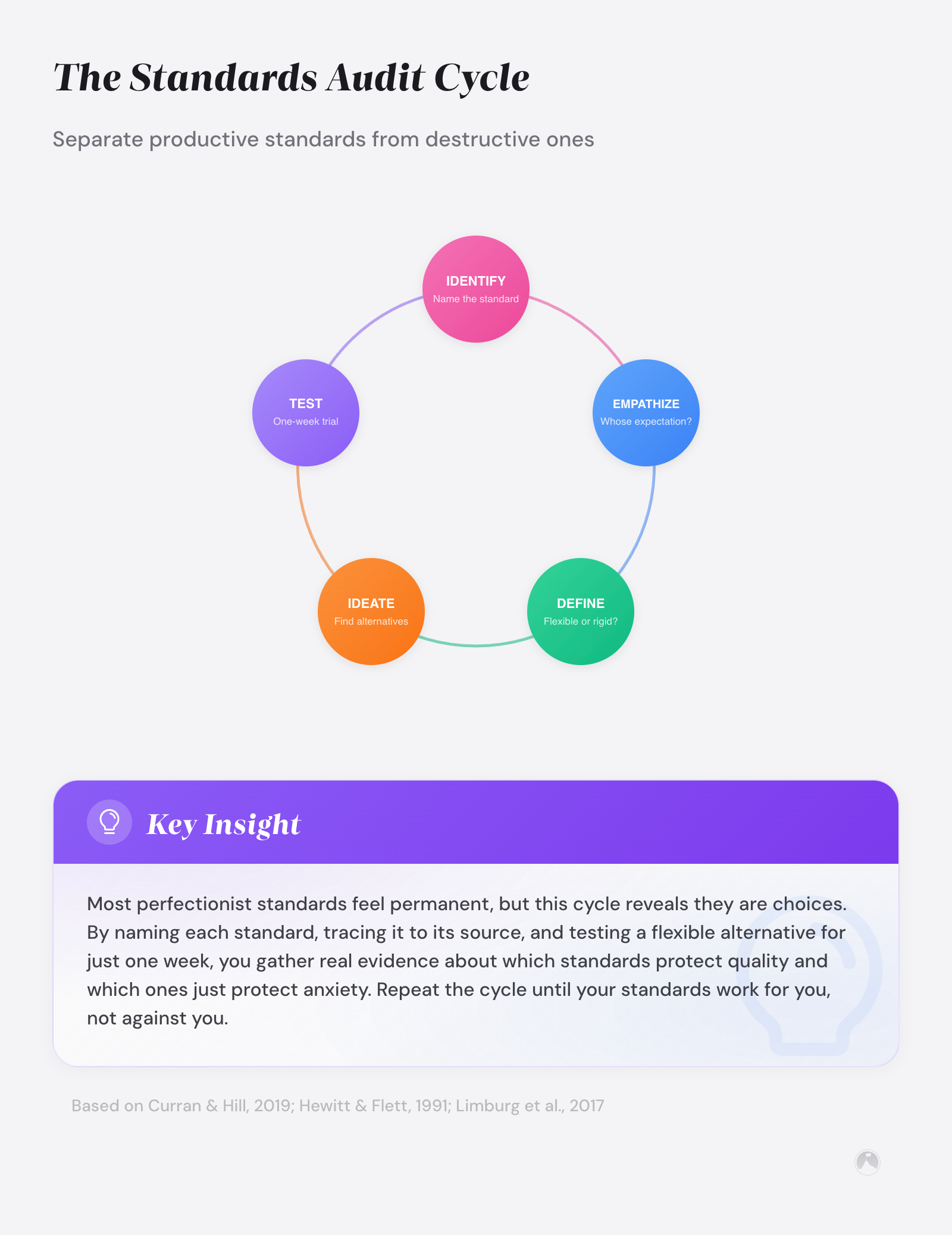
- The Standards Audit Method: separating productive standards from destructive ones
- CBT and self-compassion research that actually works for overcoming perfectionism
- How perfectionism shows up differently at work, in creative projects, and with parenting
- Which treatment approaches work best
- A concrete action plan you can start today
Key takeaways
- Socially prescribed perfectionism rose 33% since 1989, driven by social media and academic pressure [1].
- Three types exist – self-oriented, other-oriented, socially prescribed – and each requires different perfectionism strategies.
- Perfectionism significantly predicts procrastination, not despite high standards but because of them [2].
- The Standards Audit Method uses three criteria – flexibility, proportionality, recovery cost – to sort productive from destructive standards.
- CBT produces medium-to-large effect sizes (g = 0.57 to 0.89) for reducing perfectionism [3].
- Self-compassion inversely correlates with self-criticism, the engine of maladaptive perfectionism [4].
- Perfectionism acts as a transdiagnostic risk factor linked to depression, anxiety, eating disorders, and OCD [5].
- Perfectionism and burnout share a significant positive correlation, with perfectionistic concerns showing medium-to-large effects [6].
What are the three types of perfectionism?
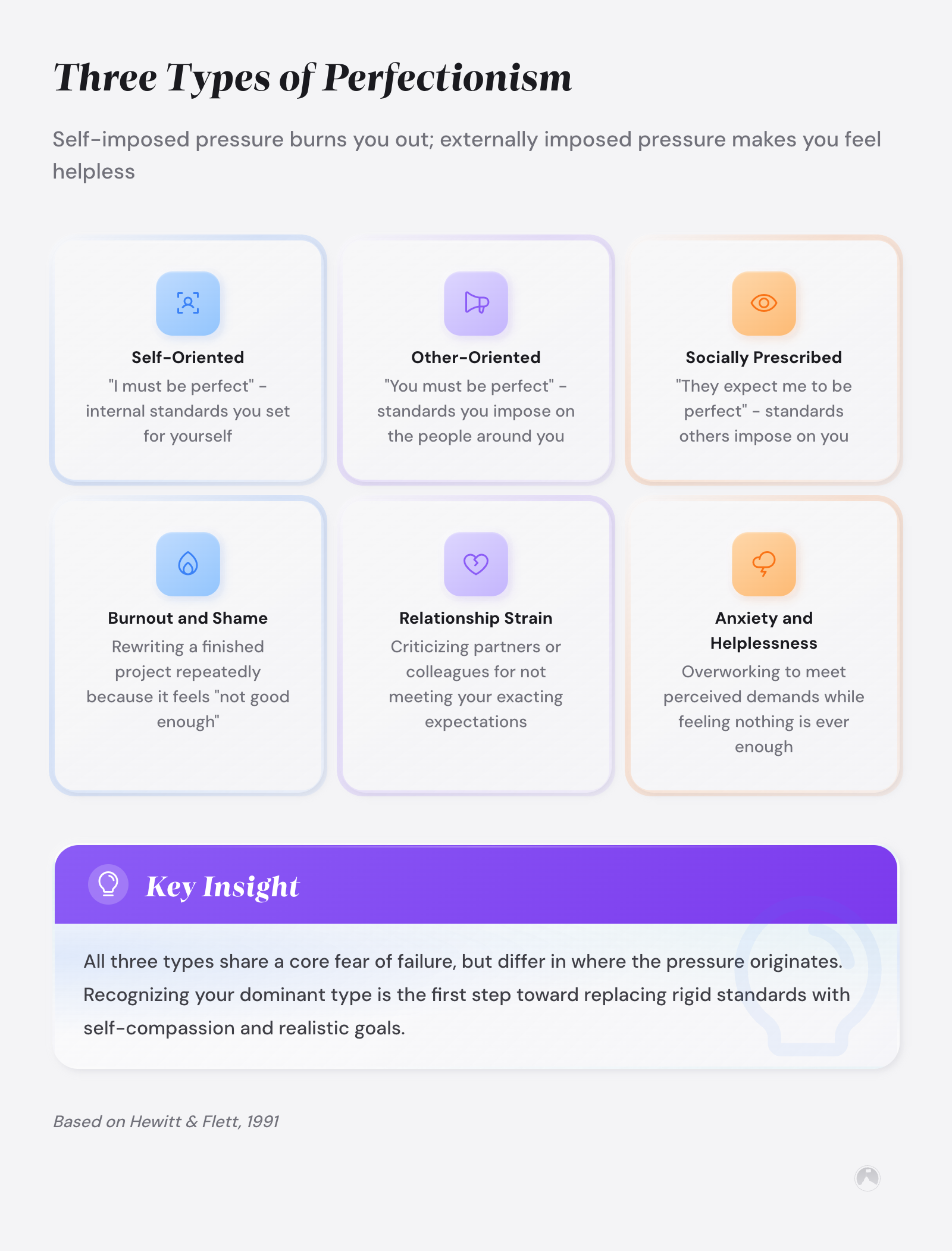
In 1991, psychologists Paul Hewitt and Gordon Flett published research that changed how we understand perfectionism [7]. Instead of treating it as a single trait, they identified three distinct dimensions. Each one has different triggers, different consequences, and different solutions.
Most people carry elements of all three. But one usually dominates. Knowing which one drives you is the first step toward actually overcoming perfectionism.
Self-oriented perfectionism
You set the standard. Nobody imposed it. Self-oriented perfectionists rewrite reports six times, can’t delegate because “nobody will do it right,” and feel crushed when results fall short of their internal bar. The standard comes from within.
People sometimes call this the “adaptive” type because it can drive achievement. That label is misleading. Self-oriented perfectionism fuels accomplishments while draining you through chronic self-criticism and an inability to enjoy what you’ve accomplished. The wins never feel like wins because “good enough” doesn’t exist in your vocabulary. For strategies tailored to high-performing perfectionists, see our guide on perfectionism in high achievers.
Other-oriented perfectionism
Other-oriented perfectionism is a trait where you impose unrealistically high standards on the people around you – partners, colleagues, children – and evaluate them harshly when they fall short, distinct from self-oriented perfectionism because the criticism targets others rather than yourself. The micromanaging manager. The parent who redoes their child’s art project. The partner who critiques how dinner was cooked.
This one damages relationships. When you hold others to standards they never agreed to, resentment follows. You see carelessness. They see impossible expectations. It’s a reliable path to relationship friction and team dysfunction. Our article on perfectionism in relationships and parenting covers this in detail.
Socially prescribed perfectionism
You believe other people demand perfection from you. It doesn’t matter if those demands are real or imagined. You feel like approval, love, or success depends on flawless performance. The standard originates from outside – or at least, that’s how it feels.
Socially prescribed perfectionism increased 33% between 1989 and 2016, making it the fastest-growing type across generations, according to Curran and Hill’s meta-analysis [1]. This rise is likely fueled by social media, academic pressure, and competitive job markets. You feel watched. You feel judged.
| Type | Standard comes from | Core fear and primary damage |
|---|---|---|
| Self-oriented | Inside you | “I’m not good enough” – burnout, chronic self-criticism |
| Other-oriented | Projected onto others | “They’re not good enough” – damaged relationships |
| Socially prescribed | Perceived external pressure | “They’ll reject me if I fail” – anxiety, depression |
Want a deeper look at the psychology behind these patterns? Our guide on perfectionism psychology research breaks down the Hewitt-Flett model in detail.
Why perfectionism causes procrastination
It’s counterintuitive. How can someone demanding flawless performance also be someone who can’t start? Yet the data is clear. Sirois, Molnar, and Hirsch’s 2017 meta-analysis of 43 studies with over 10,000 participants found a significant positive correlation between perfectionism and procrastination (r = .23), confirming the paradox that high standards can paralyze action [2].
The mechanism is straightforward. Perfectionism raises the perceived cost of failure [2]. When failure feels catastrophic, starting feels dangerous. So you delay. You wait for the right time, the right conditions, enough information to guarantee success. That guarantee never comes.
Perfectionism-driven procrastination operates through fear of failure, not laziness, making willpower-based solutions ineffective. Telling a perfectionist to “just start” ignores the threat their brain is responding to. The bar is set so high that beginning feels like volunteering for failure.
This creates a vicious cycle. Delay increases time pressure. Time pressure reduces output quality. Reduced quality confirms the fear that you’re not good enough. The cycle repeats. If you’re caught in this pattern, our guide on overcoming procrastination breaks down specific intervention strategies, and our article on perfectionism paralysis solutions targets the freeze response directly.
The Standards Audit Method: separating productive standards from destructive ones
Most advice on how to overcome perfectionism says “lower your standards.” That fails because it treats all standards the same. Some standards genuinely serve you. A surgeon can have high standards about precision while accepting that complex cases require good-enough decisions under pressure – that’s flexibility, not mediocrity. A financial analyst should check their numbers. The problem isn’t high standards. The problem is standards that lost their connection to purpose, context, or reality.
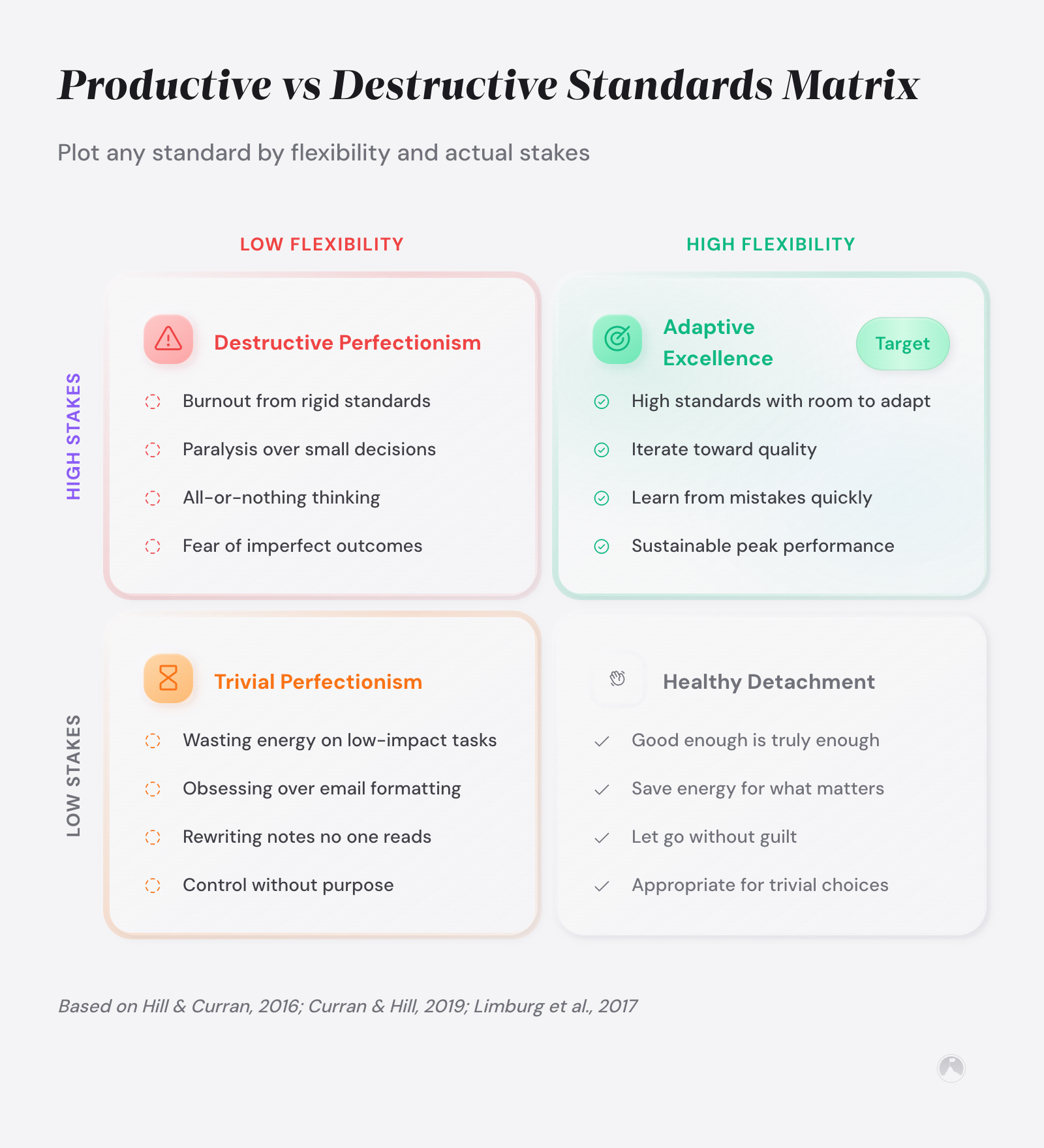
The Standards Audit Method uses three criteria – flexibility, proportionality, and recovery cost – to separate productive standards from destructive standards that create unnecessary suffering. We developed this framework by translating the principles behind CBT for perfectionism – the emphasis on flexibility, proportionality, and accurate assessment of consequences – into practical decision rules. For any standard you hold, test it against all three:
Criterion 1: Flexibility
A productive standard bends based on context. “I produce high-quality work” is flexible. “Every email must be perfectly written” is rigid. Ask: does this standard adjust when circumstances change, or does it stay locked regardless of stakes, timeline, or audience?
Rigid standards treat a casual Slack message and a board presentation with identical scrutiny. That’s not quality control. That’s inefficiency disguised as professionalism. For a structured approach to resetting your defaults, see our setting realistic standards guide.
Criterion 2: Proportionality
A productive standard matches effort to actual impact. Spending an hour formatting a meeting agenda that five people glance at for thirty seconds fails this test. Ask: is the time and energy I’m investing proportional to the actual outcome this task produces?
Criterion 3: Recovery cost
A productive standard accounts for what happens when it’s not met. Missing a medical safety standard causes harm. Missing a standard on a blog post means awkward phrasing. Ask: what actually happens if this isn’t perfect?
The goal of overcoming perfectionism isn’t to care less but to care more strategically. You direct your highest effort where it actually matters. For practical tools to conduct this audit, see our guide on perfectionism management tools and worksheets.
| Flexibility | Would I adjust this standard if the deadline were cut in half? | Yes / No |
| Proportionality | Is the time I’m spending proportional to what this task actually delivers? | Yes / No |
| Recovery Cost | What actually happens if this isn’t perfect? | Low / High |
Quick perfectionism self-check
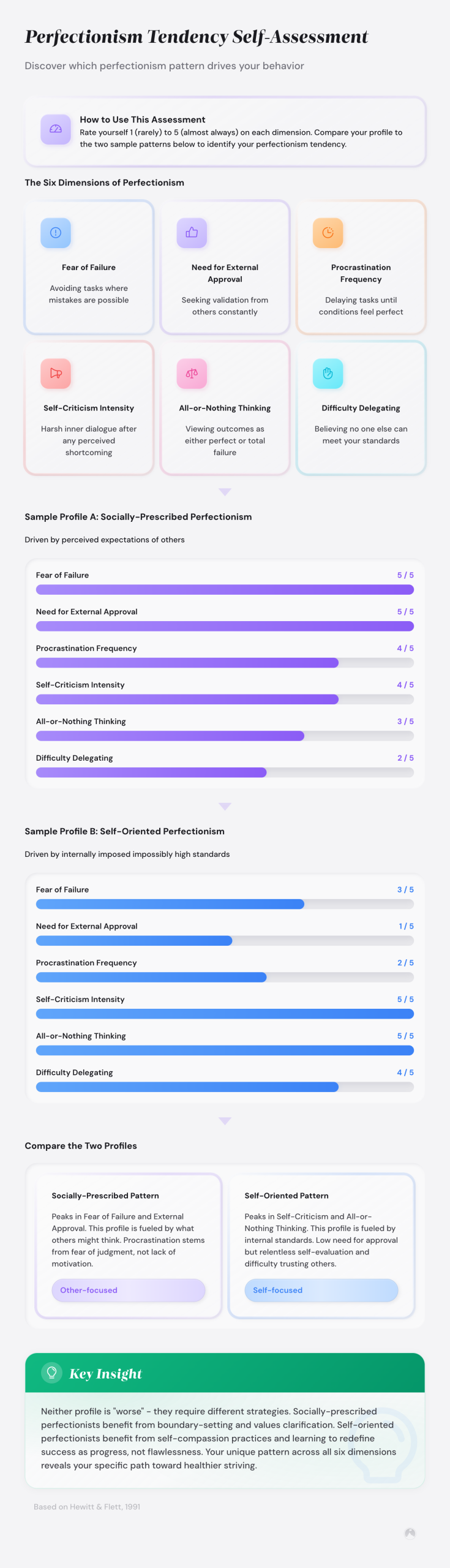
Before diving into strategies, identify which patterns apply to you. Answer yes or no to each question:
- Do you set standards for yourself that you’d never impose on a friend? (Self-oriented)
- Do you frequently redo other people’s work because it doesn’t meet your expectations? (Other-oriented)
- Do you feel like people will think less of you if your work has any flaws? (Socially prescribed)
- Do you delay starting tasks because you’re not sure you can do them well enough?
- Do you spend significantly more time on low-stakes tasks than the outcome warrants?
- Do you struggle to feel satisfied even when others praise your results?
If you answered yes to three or more, the strategies in this guide apply to you. The first three questions map to the three perfectionism types above – notice which ones triggered the strongest reaction.
Evidence-based strategies for overcoming perfectionism
Research points to two primary approaches for dealing with perfectionism: cognitive behavioral therapy (CBT) and self-compassion training. Both have solid evidence. Both work through different mechanisms. Both matter.
Cognitive behavioral therapy for perfectionism
Galloway, Watson, Greene, Shafran, and Egan’s 2022 systematic review and meta-analysis of randomized controlled trials found that CBT produces medium-to-large reductions in perfectionism: g = 0.57 for personal standards, g = 0.89 for concern over mistakes, and g = 0.87 for clinical perfectionism [3]. For context, most psychological interventions consider g = 0.50 medium and g = 0.80 large.
CBT works by identifying and restructuring the distorted thought patterns that maintain perfectionism. Specifically, it targets:
- All-or-nothing thinking: “If it’s not perfect, it’s a failure.” CBT teaches you to see the spectrum where most outcomes actually exist.
- Catastrophizing: “If I make one mistake, my career is over.” CBT asks you to test this belief against actual evidence.
- Should statements: “I should do this flawlessly.” CBT helps replace rigid rules with flexible preferences.
- Discounting positives: “That went well, but it was easy, so it doesn’t count.” CBT trains you to give positive outcomes equal weight.
One particularly effective technique: behavioral experiments. Instead of arguing with perfectionist thoughts, you test them. Submit work at 80% polish instead of your usual standard. Before submitting, write your feared outcome. After, write what actually happened. The gap between what you feared and what occurred becomes the evidence that rewires the belief.
Self-compassion as an antidote to perfectionism
Kristin Neff’s research on self-compassion found it inversely correlates with self-criticism, the core engine of maladaptive perfectionism [4]. Self-compassion doesn’t mean letting yourself off the hook. It means treating yourself with the same kindness you’d offer a friend who just made a mistake.
Self-compassion reduces perfectionism by interrupting the self-criticism cycle, not by lowering achievement motivation. Her framework has three components:
- Self-kindness over self-judgment: responding to failure with understanding instead of punishment
- Common humanity over isolation: recognizing that imperfection is universal, not a personal deficiency
- Mindfulness over over-identification: noticing negative feelings without being consumed by them
When perfectionists respond to mistakes with self-compassion instead of self-punishment, they recover faster, maintain motivation better, and are more likely to try again. Fear-based motivation is fragile. Compassion-based motivation sustains effort over time. For strategies built on this research, check out progress over perfection practices.
“Self-compassion was inversely associated with self-criticism and positively associated with mastery goals and adaptive coping, suggesting it sustains achievement motivation through a different pathway than perfectionism.” – Kristin Neff, 2005 [4]
CBT vs. self-compassion: how they compare
| Dimension | CBT | Self-compassion |
|---|---|---|
| Primary mechanism | Restructure distorted thoughts | Change your relationship to self-criticism |
| Targets | Specific beliefs and behaviors | Emotional response to failure |
| Works best for | All-or-nothing thinking, catastrophizing | Harsh self-judgment, shame spirals |
| Evidence strength | Medium-to-large effect sizes (g = 0.57-0.89) [3] | Strong inverse correlation with self-criticism [4] |
| Self-guided potential | Moderate (structured exercises help) | High (meditation and journaling work) |
| Speed of results | Typically 4-12 weeks based on standard CBT protocol length | Gradual, cumulative over months |
The most effective approach combines both. CBT gives you tools to catch and restructure perfectionist thoughts in the moment. Self-compassion gives you a healthier response when those thoughts break through anyway. For a full breakdown, see our comparison of perfectionism recovery approaches.
Is perfectionism a mental health issue?
Perfectionism itself isn’t a standalone disorder. But it functions as a transdiagnostic risk factor – meaning it increases vulnerability across multiple conditions. Limburg, Watson, Hagger, and Egan’s 2017 meta-analysis of 284 studies found significant associations between perfectionism and depression, anxiety, eating disorders, and OCD [5]. The strongest links appeared with what researchers call “perfectionistic concerns” – the fear of mistakes, doubt about actions, concern about others’ judgment.
Perfectionism functions as a transdiagnostic risk factor, increasing vulnerability to depression, anxiety, eating disorders, and OCD rather than being a standalone diagnosis [5]. This matters clinically. Treating the surface condition without addressing underlying perfectionism often leads to relapse. Someone recovers from anxiety, then the perfectionism drives a different condition later.
The burnout connection is equally strong. Hill and Curran’s 2016 meta-analysis of 43 studies with nearly 10,000 participants found significant positive relationships between perfectionism and burnout, with perfectionistic concerns displaying medium-to-large positive correlations with burnout symptoms [6]. The pattern is simple: set impossible standards, work excessively to meet them, fail, feel inadequate, work even harder. It’s a formula for exhaustion. Learn more in our article on perfectionism and burnout research.
Overcoming perfectionist tendencies in specific contexts
Generic advice on how to stop being a perfectionist misses because perfectionism shows up differently depending on where you are. The following strategies draw from the CBT and self-compassion principles covered above, applied to the three domains where perfectionism causes the most friction.
Each domain triggers different perfectionism patterns – workplace perfectionism requires different strategies than creative block or parenting guilt.
Perfectionism at work
Workplace perfectionism typically looks like: over-preparation for meetings, inability to delegate, excessive time on low-stakes work, difficulty declaring things “done.” The environment can reinforce it because sometimes perfectionism does get rewarded in the short term.
Practical approaches:
- Apply the proportionality test before starting tasks. What effort level does this task actually warrant – 100%, 80%, or 60%?
- Set “done” criteria before beginning. “This email is complete when it conveys three key points in under 200 words.”
- Practice version-one thinking. The first output is a draft, not final. Ship it and iterate from feedback.
- Track time spent vs. value delivered for one week. The data usually reveals massive disproportionality.
Perfectionism in creative work
Creative perfectionism shows up as endless revisions, inability to publish or share work, constant comparison to other creators, and the belief that your work isn’t “ready” yet. This blocks output entirely. Our guide on perfectionism in creative professionals covers this in depth.
Practical approaches:
- Set a revision limit. “This gets two revision passes, then it goes out.”
- Compare your work to where you were six months ago, not to established creators.
- Publish deliberately imperfect work. A published rough draft beats a perfect draft that never ships.
- Track what happens when you release “imperfect” work. Usually the consequences are minimal.
Perfectionism in parenting
Parenting perfectionism manifests as rigid rules, over-involvement in children’s tasks, difficulty letting them fail, and guilt about not being “enough.” It’s often fueled by socially prescribed perfectionism – the sense that others are judging your parenting.
Practical approaches:
- Let them fail at low-stakes things. A messy art project or a forgotten homework assignment teaches more than perfection.
- Distinguish your standards from others’ expectations. You’re parenting your child, not someone else’s imaginary judgment.
- Notice when you’re parenting from guilt instead of intention. The distinction changes everything.
- Model self-compassion when you make mistakes. “I got frustrated just now, and that’s human. I’ll try differently next time.”
What therapy is best for managing perfectionism?
CBT, self-compassion training, and acceptance-commitment therapy all show effectiveness for managing perfectionism. CBT has the strongest evidence base with medium-to-large effect sizes [3], while self-compassion training works best for those driven by harsh self-judgment [4]. The best choice depends on what resonates with you.
If you think in patterns and respond to logic, CBT’s structured approach to thought patterns often clicks. If you respond to emotion and kindness, self-compassion practices take hold faster. Many people benefit from a combination.
Acceptance and commitment therapy (ACT) takes a different route from CBT. Rather than restructuring perfectionist thoughts, ACT teaches you to notice those thoughts without fusing with them – a technique called cognitive defusion – while redirecting energy toward values-based action. ACT focuses on accepting uncomfortable thoughts rather than debating them, which can be particularly effective when perfectionist beliefs feel deeply entrenched.
Working with a therapist who specializes in perfectionism beats trying to self-diagnose which approach fits. For a side-by-side breakdown of all major options, see our perfectionism recovery approaches compared.
How do you build systems that beat perfectionism?
The most effective systems make perfectionism harder by default. Instead of relying on willpower or self-talk, you change the structure. Our guide on building systems to beat perfectionism goes deeper on each of these.
- Time-box your work. Set a deadline and stop when it arrives, not when it’s perfect.
- Build in “done” milestones. “Draft version” exists separate from “final version” – and draft ships first.
- Create accountability that values action over perfection. Share rough work in progress, not polished final versions.
- Separate creation from editing. Draft without judging. Edit without creating. The modes don’t mix.
Ramon’s take
Perfectionists procrastinate because starting means risking imperfection. Which means the pile of undone stuff on your desk isn’t laziness. It’s basically a trophy for caring too much. Genuinely not sure if that’s comforting or just a nicer way to feel bad about the pile.
Conclusion
Overcoming perfectionism is not about becoming careless. It’s about redirecting your standards toward what actually matters – and building the self-awareness to recognize when a standard has stopped serving you. Remember: overcoming perfectionism doesn’t mean abandoning high standards. A perfectionist surgeon agonizes over every decision and second-guesses outcomes. A high-standards surgeon is precise where it counts and decisive when conditions demand it. The research is clear: perfectionism is treatable, manageable, and not a life sentence. The perfectionism self-help strategies in this guide – from the Standards Audit Method to CBT techniques to self-compassion practices – give you a concrete toolkit.
Next 10 minutes
Identify which type of perfectionism dominates for you: self-oriented, other-oriented, or socially prescribed. How does it show up? What triggers it? Write it down.
This week
Run one current task through the Standards Audit. Is it flexible? Proportional? What’s the actual recovery cost if it’s not perfect? Then deliberately do it at 80% instead of your usual standard. Track what happens.
There is more to explore
- Perfectionism psychology research – the Hewitt-Flett model explained
- Breaking free from perfectionism – a practical action guide
- Perfectionism and burnout – why they’re linked
- Perfectionism in high achievers – when high standards become harmful
- Perfectionism management tools and worksheets
- Signs perfectionism is holding you back
- Perfectionism in creative professionals
- Progress over perfection practices
Take the next step
Pick one domain where perfectionism costs you most – work, creative projects, or parenting – and apply the proportionality test to your next task. The gap between what you feared and what actually happened is where perfectionism loses its power.
Frequently asked questions
What is the difference between perfectionism and high standards?
Try adjusting a standard downward and notice your emotional reaction. If lowering the standard triggers anxiety, shame, or a sense of lost identity, that standard is perfectionist. If you can adjust without distress, it’s a high standard.
Can perfectionism be helpful?
Self-oriented perfectionism can drive achievement, but at significant cost – chronic self-criticism, burnout, and inability to enjoy accomplishments. The helpful label is misleading. Achievement at that cost isn’t actually helpful.
How long does it take to overcome perfectionism?
CBT typically shows noticeable changes in 4-12 weeks. Self-compassion practices build gradually over months. Behavioral shifts can start immediately.
Is perfectionism genetic?
Research suggests both genetic and environmental factors contribute. Family patterns, socialization, and cultural values all play roles. Regardless of origin, CBT, self-compassion, and systems change all work.
Should I see a therapist for perfectionism?
If perfectionism is significantly affecting your mental health, relationships, or productivity, a therapist specializing in perfectionism can accelerate change. Self-directed approaches work, but professional guidance often works faster.
Can you have healthy perfectionism?
If by healthy you mean high standards that adjust based on context with proportional effort and realistic recovery costs, that’s not really perfectionism – it’s having high standards. Perfectionism, by definition, is rigid.
Why do perfectionists procrastinate?
Perfectionism creates a ‘start cost’ where beginning a task triggers evaluation anxiety. The bigger the task, the higher the start cost. Breaking tasks into 15-minute low-stakes increments bypasses this by keeping the perceived evaluation threshold below the fear trigger.
What is the Standards Audit Method?
Run any task through three filters: Would I adjust this standard if the deadline halved? (flexibility). Is my effort proportional to the outcome? (proportionality). What actually happens if this isn’t perfect? (recovery cost). If a standard fails all three, it’s a perfectionist standard worth releasing.
Glossary of related terms
- Transdiagnostic risk factor: A trait that increases vulnerability to multiple mental health conditions rather than causing one specific disorder.
- Self-compassion: Treating yourself with the same kindness and understanding you’d offer a friend, especially in moments of failure or difficulty.
- Cognitive behavioral therapy (CBT): A therapeutic approach that identifies and restructures distorted thinking patterns that maintain psychological problems.
- All-or-nothing thinking: Viewing situations in extreme categories with no middle ground – either perfect success or complete failure.
- Catastrophizing: Assuming the worst possible outcome will occur and that it will be unbearable.
- Behavioral experiments: Testing feared thoughts by intentionally engaging in an activity and observing what actually happens versus what was feared.
- Procrastination paradox: The counterintuitive pattern where perfectionism – which aims for completion – actually delays action.
- Adaptive vs. maladaptive perfectionism: Adaptive refers to high standards that improve performance; maladaptive refers to rigid standards that cause psychological distress.
References
[1] Curran, T., & Hill, A. P. (2019). Perfectionism is increasing over time: A meta-analysis of birth cohort differences from 1989 to 2016. Psychological Bulletin, 145(4), 410-429. https://doi.org/10.1037/bul0000138
[2] Sirois, F. M., Molnar, D. S., & Hirsch, J. K. (2017). A meta-analytic and conceptual update on the associations between procrastination and multidimensional perfectionism. European Journal of Personality, 31(2), 137-159. https://doi.org/10.1002/per.2098
[3] Galloway, R., Watson, H. J., Greene, D., Shafran, R., & Egan, S. J. (2022). The efficacy of randomised controlled trials of cognitive behaviour therapy for perfectionism: A systematic review and meta-analysis. Cognitive Behaviour Therapy, 51(2), 170-184. https://doi.org/10.1080/16506073.2021.1987614
[4] Neff, K. D., Hsieh, Y. P., & Dejitterat, K. (2005). Self-compassion, achievement goals, and coping with academic failure. Self and Identity, 4(3), 263-287. https://doi.org/10.1080/15298860400533971
[5] Limburg, K., Watson, H. J., Hagger, M. S., & Egan, S. J. (2017). The relationship between perfectionism and psychopathology: A meta-analysis. Journal of Clinical Psychology, 73(10), 1301-1326. https://doi.org/10.1002/jclp.22435
[6] Hill, A. P., & Curran, T. (2016). Multidimensional perfectionism and burnout: A meta-analysis. Personality and Social Psychology Review, 20(3), 269-288. https://doi.org/10.1177/1088868315596286
[7] Hewitt, P. L., & Flett, G. L. (1991). Perfectionism in the self and social contexts: Conceptualization, assessment, and association with psychopathology. Journal of Personality and Social Psychology, 60(3), 456-470. https://doi.org/10.1037/0022-3514.60.3.456