The harder you try, the more stuck you get
Overcoming creative blocks in learning seems like it should require more effort. You hit a wall, so you grind through it. But a 2022 analysis of writer’s block published in the Creativity Research Journal found that the most commonly reported effective strategies had little to do with raw effort [1].
Ahmed and Guss surveyed 146 writers and found that taking breaks, switching to a different project, and discussing ideas with others all ranked among the top approaches. Forcing output was also reported as useful, but in a different format or direction – not by repeating the same approach harder.
The finding that effort-reduction strategies outperform repetition maps onto a broader pattern in creativity research. When Benedek and colleagues studied how executive functions relate to creative output, they found that creative blocks reflect an imbalance between idea generation and idea evaluation [2]. Too much top-down control produces paralysis. Too little cognitive flexibility produces fixation. The problem isn’t effort. It’s the kind of mental processing you’re stuck in.
If you’ve been grinding at the same skill for months with nothing to show for it, the issue likely isn’t your commitment. Your brain has locked into a pattern, and adding more hours inside that pattern typically deepens the rut rather than breaking it.
Creative blocks are temporary barriers to creative output where the brain’s habitual retrieval pathways suppress alternative connections. They are diagnostic signals pointing to specific root causes – not indicators of lost talent.
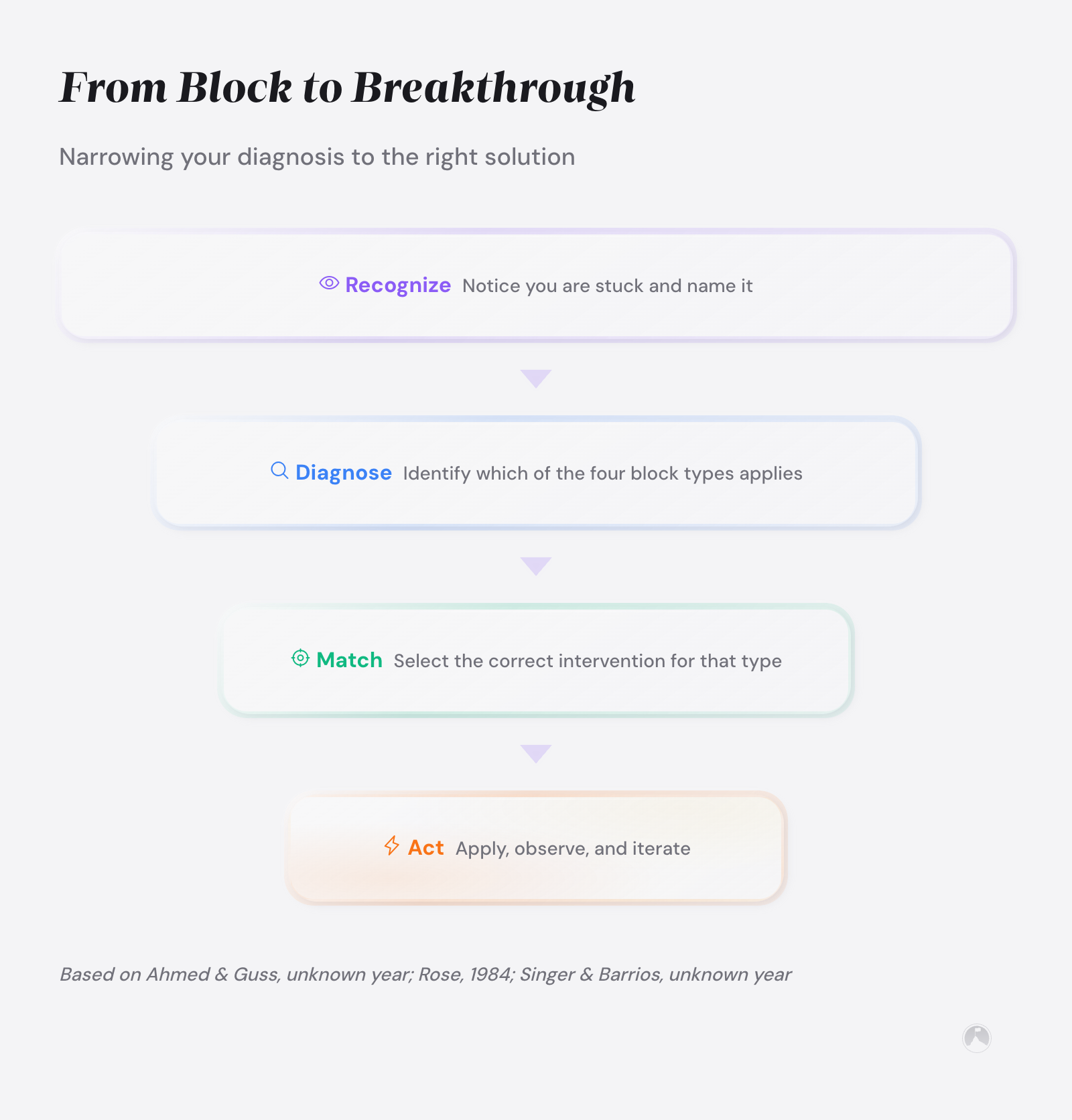
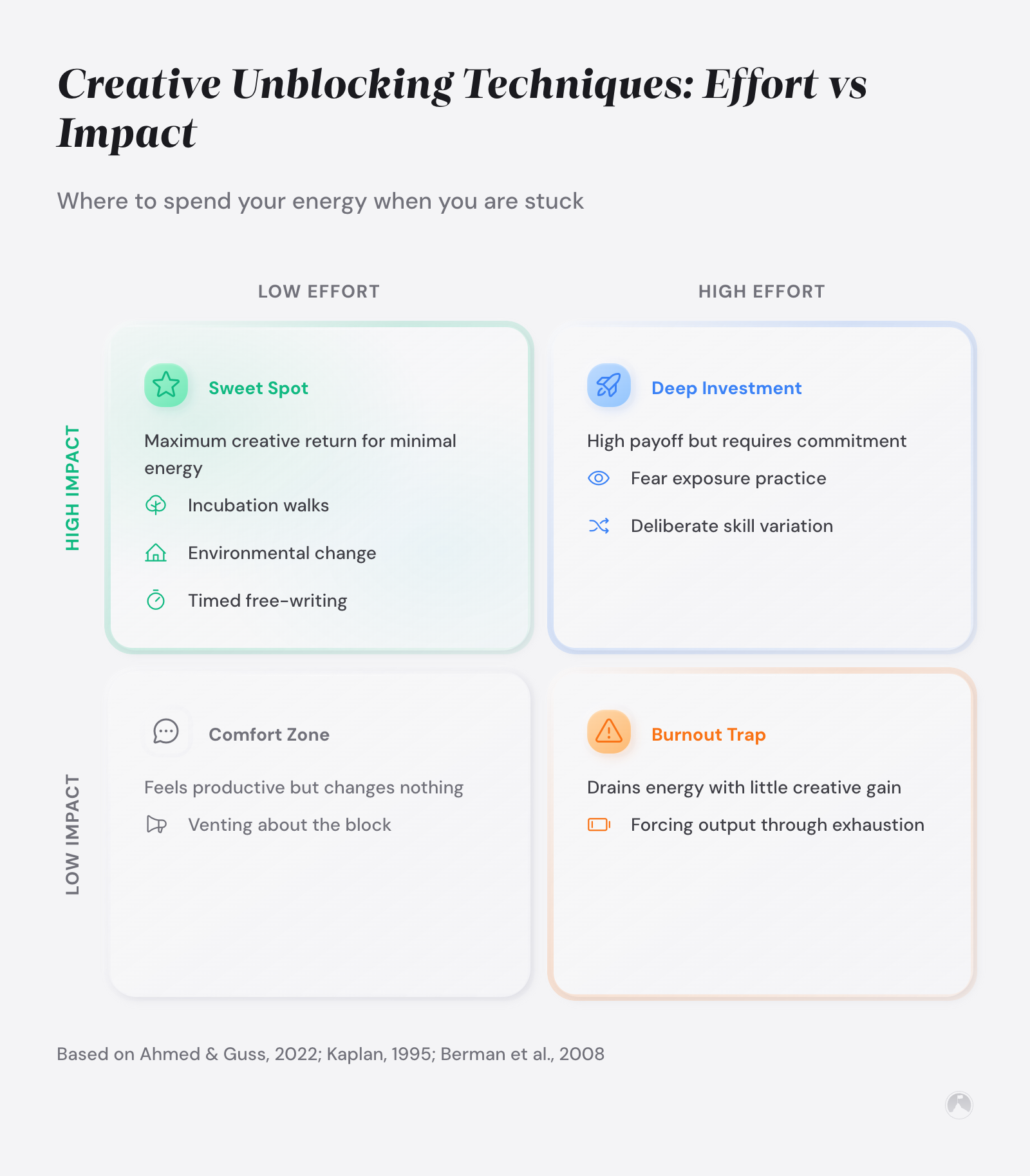
To overcome creative blocks in learning, first diagnose which of the four block types you face: fixation, fear, fatigue, or plateau. Then apply the matched intervention — cross-domain input for fixation, stake reduction for fear, strategic rest for fatigue, or method switching for plateaus. The Block-Type Diagnostic provides a systematic decision framework.
Key takeaways
- Creative blocks are diagnostic signals, not signs of talent loss – each type points to a specific solution.
- Cognitive fixation locks the brain into existing patterns. The longer you push within the same approach, the deeper you get stuck.
- The Block-Type Diagnostic matches four block types (fixation, fear, fatigue, plateau) to their most effective interventions.
- Passive creativity techniques like walking and rest activate the default mode network [6], allowing insight to surface without conscious effort.
- Switching learning methods breaks fixation faster than repeating the same approach with more intensity.
- Fear blocks respond to stake reduction, not motivation – intentionally producing bad work breaks the paralysis cycle.
Why does overcoming creative blocks in learning require a different approach?
Creative blocks emerge from a specific cognitive mechanism. When you study or practice a skill intensely, your brain builds strong associations between related concepts. That’s helpful for recall. But those same strong associations can produce cognitive fixation – a state where high-frequency associations dominate retrieval and block access to creative alternatives.
Nijstad and Stroebe’s cognitive model of idea generation describes this as a retrieval bottleneck: the strongest associations get activated first and repeatedly, leaving novel combinations inaccessible [3].
Cognitive fixation is a state where the strongest associations in semantic memory dominate retrieval, preventing access to novel or alternative ideas. It explains why the same solutions keep surfacing regardless of how long someone spends on a problem.
This fixation operates at the level of semantic memory networks. Zhang and colleagues demonstrated that when people hit an impasse during divergent thinking tasks, word recommendations drawn from distant semantic categories helped them escape the loop [4]. The word-recommendation intervention worked because distant semantic categories introduced associations the brain wouldn’t have retrieved on its own. Your neural pathways default to what’s familiar, and unfamiliar input is what breaks the cycle.
Creative blocks are not failures of effort but failures of pattern. The solution is changing the pattern, not intensifying it.
Mike Rose’s foundational research on writer’s block identified that these fixation patterns often stem from rigid rules and inflexible plans that writers adopt early in their process [5]. A rule like “I must fully understand concept A before moving to concept B” creates blocks at every transition point. The block isn’t about ability. It’s about the structure the learner has imposed on themselves. And while Rose studied writers specifically, Benedek’s work on executive functions and creativity confirms the same dynamic plays out across creative domains [2].
The four block types and how to diagnose them
Not all blocks respond to the same intervention. A learner paralyzed by perfectionism needs a completely different strategy than someone experiencing information overload. Treating every creative block the same way is like taking aspirin for every medical symptom – sometimes it helps, sometimes it makes things worse.
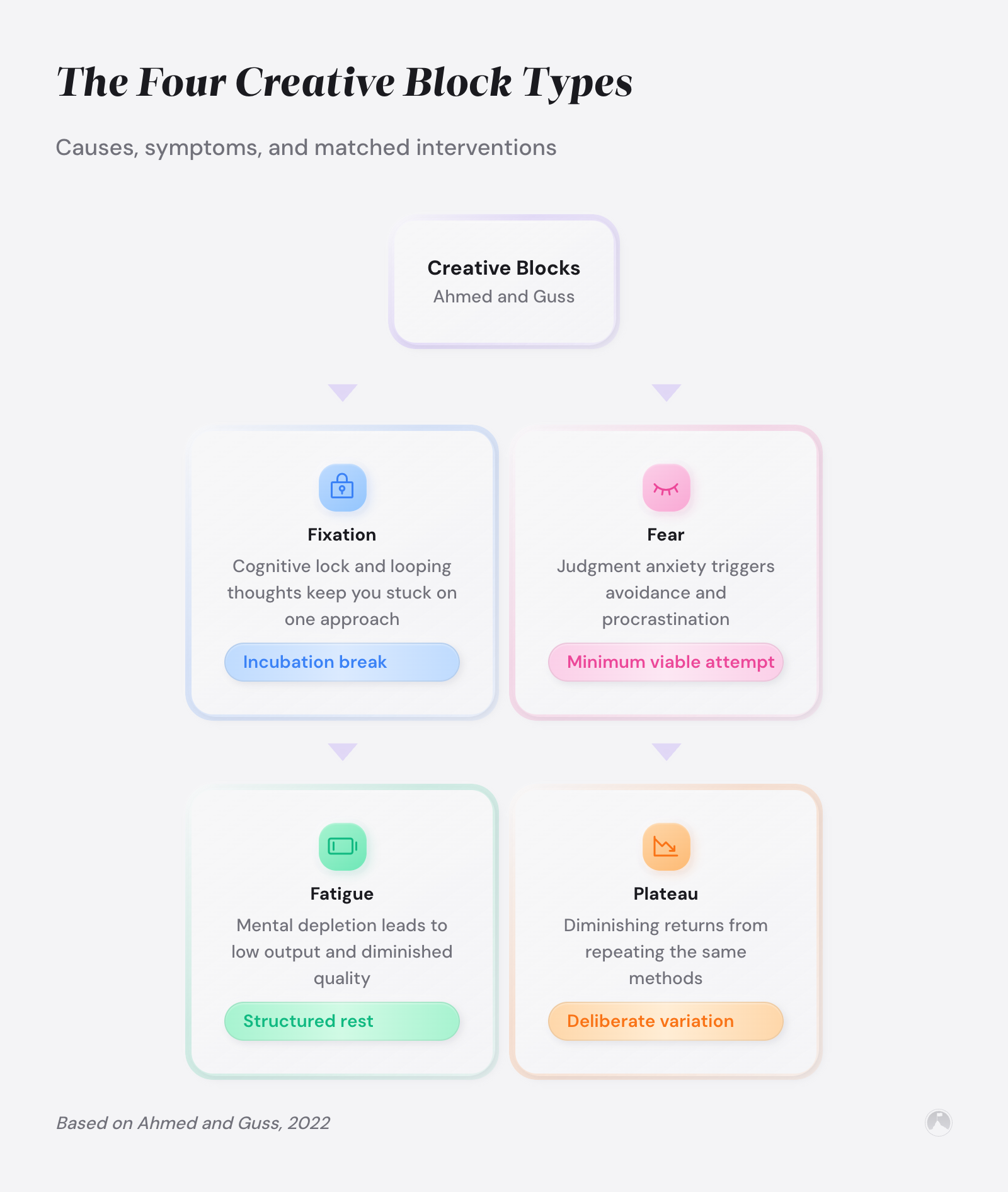
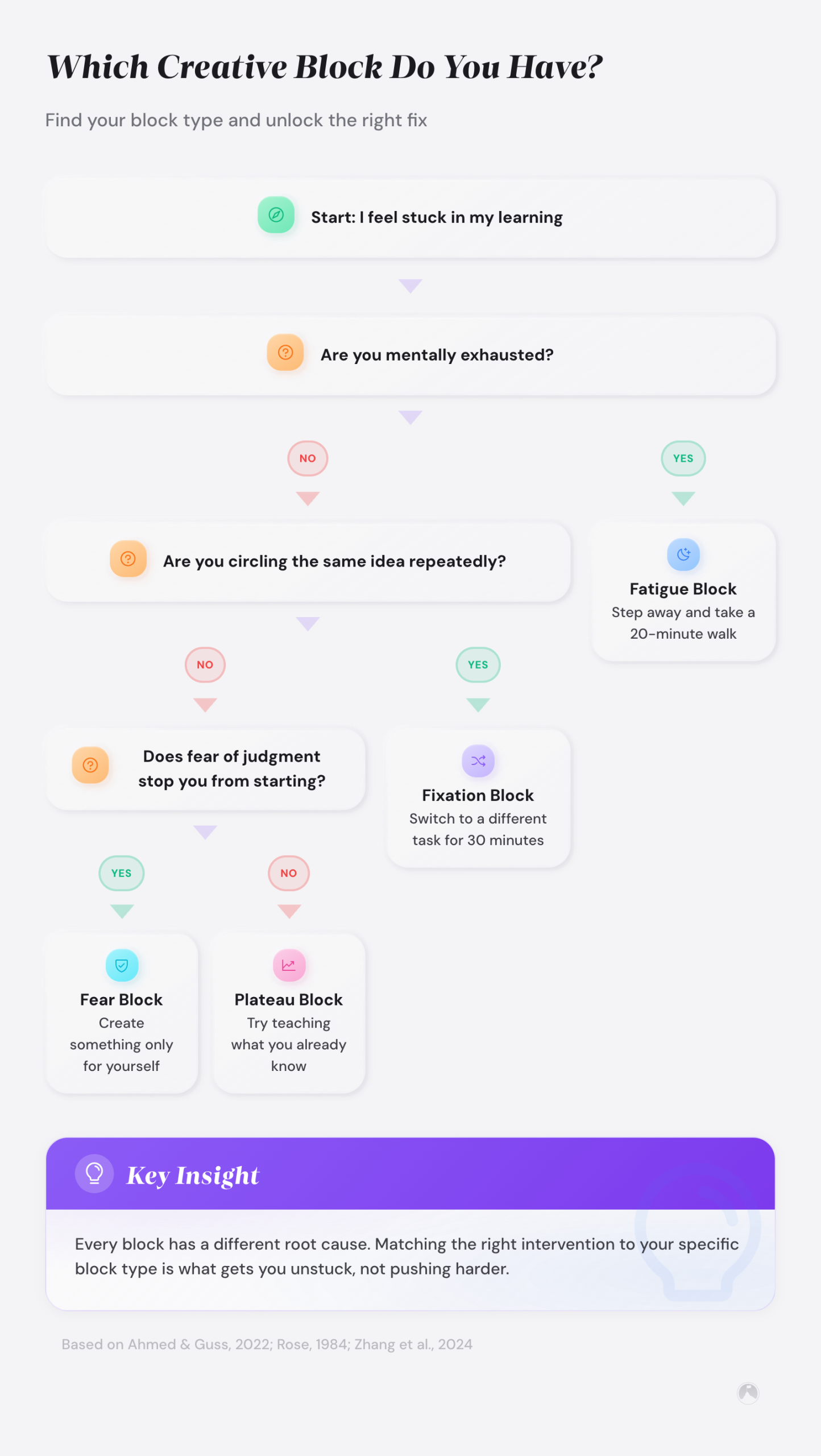
We developed what we call the Block-Type Diagnostic — an original framework that categorizes creative blocks into four types and maps each to its most effective intervention, drawing on the research cited throughout this article. This is the core strategy for overcoming creative blocks in learning — matching cause to cure.
| Block type | What it looks like | What to do |
|---|---|---|
| Fixation block | Same ideas recur because the brain locks onto familiar patterns | Cross-domain input and interleaving (hours to days) |
| Fear block | Paralysis before starting or after mistakes, driven by perfectionism | Lowered stakes and rough-draft practice (days to weeks) |
| Fatigue block | Declining quality from cognitive resource depletion | Strategic rest and passive creativity (hours to days) |
| Plateau block | Months of practice with no visible progress from routine stagnation | Difficulty scaling and method switching (weeks to months) |
To diagnose your block, ask these four questions in order:
Am I recycling the same ideas? (Fixation.) Am I afraid to produce bad work? (Fear.) Am I exhausted from sustained effort? (Fatigue.) Have I been doing the same practice for months without improvement? (Plateau.)
The first “yes” identifies your primary block type.
The Block-Type Diagnostic works by matching the root cause of a creative block to the intervention most likely to resolve it. The matching works because each block type involves a distinct cognitive failure — fixation is a retrieval problem, fear is an evaluation problem, fatigue is a resource problem, and plateau is a practice-design problem — and effective interventions target the specific failure rather than applying generic creative advice.
Consider someone learning digital illustration who keeps producing the same style regardless of tutorials. That’s a fixation block. The intervention isn’t more tutorials in the same medium. It’s exposure to completely unrelated creative input: architecture, music, nature photography. The cross-domain input disrupts the fixed retrieval pattern and opens new possibilities. For a broader set of creative breakthrough techniques, our guide on creative thinking techniques covers several complementary methods.
How passive creativity breaks fixation blocks
The most counterintuitive approach to overcoming creative blocks in learning is doing less. When you step away from a problem, your brain doesn’t stop working. The default mode network – brain regions first identified by Raichle and colleagues that activate during rest and mind-wandering – continues processing information below conscious awareness [6]. This network shows increased metabolic activity precisely when you stop trying to focus, forming associative connections that executive control suppresses.
Singer and Barrios’s research on blocked writers (in Kaufman and Kaufman’s edited volume) found that natural imagery and relaxation interventions helped participants recover creative output [7]. Writers who used guided imagery reported increased access to associative thinking and reduced fixation on rigid compositional rules. The mechanism aligns with what Kaplan describes as attention restoration theory: natural environments create “soft fascination” that captures attention without cognitive demand, giving the default mode network room to operate [8].
Default mode network activation during low-demand activity is the science behind nature walks for creative insight. A walk doesn’t feel productive. But the combination of mild physical activity, visual novelty, and reduced cognitive demand creates ideal conditions for the default mode network to surface connections your conscious mind missed. So does a shower, a commute, or staring out a window. Berman and colleagues found experimentally that even brief nature exposure improved attentional control and creative problem-solving [9].
Passive creativity techniques work by shifting processing from executive control to associative thinking – a shift that cannot happen under cognitive pressure.
Journaling for creative blocks operates on a similar principle. Freewriting without structure or judgment creates a low-stakes channel for your brain to dump associations without the filtering that causes fixation. The goal isn’t good writing. It’s volume. You’re flushing stale ideas so fresher ones can surface. For the neurological basis of why these strategies work, see neuroplasticity and learning science.
What separates a learning plateau from a permanent ceiling?
Overcoming creative blocks in learning requires distinguishing a temporary plateau from a genuine ceiling. You’ve practiced for months, and the improvement curve is flat. This is where most people quit, concluding they’ve hit their natural limit.
But evidence suggests plateau blocks are typically structural rather than biological. Anders Ericsson’s research on deliberate practice found that performance plateaus occur when practitioners stop engaging in deliberate practice and revert to comfortable repetition [10]. The stagnation isn’t about ability limits – it’s about practice design.
The most common patterns causing plateaus include: you’re practicing skills you’ve already mastered (comfortable repetition), you’re avoiding uncomfortable aspects of the skill (selective practice), or you’re missing a foundational gap that compounds as complexity increases [10]. Each requires a different intervention.
Comfortable repetition needs difficulty scaling – intentionally increasing challenge beyond your comfort zone. Selective practice needs honest assessment of which subskills you’re avoiding. Foundational gaps need a temporary step backward to fill the hole before moving forward.
Learning plateaus are structural problems disguised as talent limits. Changing the structure of practice matters more than increasing its quantity.
Changing learning approaches is one of the most effective learning plateau solutions. If you’ve been learning through reading, switch to teaching. If you’ve been practicing alone, find a study partner or group. If you’ve been following a linear curriculum, try interleaving topics.
Rohrer and Taylor’s research on interleaving showed that students who mixed different types of problems during practice developed better ability to choose appropriate solution methods on transfer tests [11]. Interleaving impairs initial performance – it feels harder in the moment. But it produces superior retention and creative transfer compared to blocked practice where one task type is repeated to completion before switching.
For more on how different approaches compare, see our guide on learning methods compared. And if speed matters, learning new skills quickly covers evidence-based acceleration techniques.
How fear blocks creative learning before it starts
Fear blocks are the most psychologically complex. They show up as procrastination, excessive planning, constant revision, or inability to start a new project. The root is almost always the same: the learner has tied their identity to their output’s quality, making every attempt feel like a referendum on their worth.
Perfectionism is the most common driver. Rose’s research on writer’s block identified that writers who internalized rigid compositional rules experienced significantly more blocks than those who treated rules as flexible guidelines [5]. The rule isn’t always “it must be perfect.” Sometimes it’s “I must understand everything before I begin” or “my first attempt should demonstrate competence.”
These invisible rules create impossible standards that guarantee paralysis.
The intervention is lowering the stakes until the fear response stops triggering. Write the worst possible version on purpose. Sketch with your non-dominant hand. Code something intentionally ugly.
Creative play activities work here precisely by removing the evaluation component that feeds the fear. When nothing is judged, the fear has nothing to attach to. And cross-domain hobbies can serve the same function – leveraging hobbies for a creativity boost explores how unrelated activities lower psychological stakes while rebuilding creative confidence.
Perfectionism-driven blocks respond to stake reduction, not motivation. The fastest creative flow recovery comes from intentionally producing work you know isn’t good.
Carol Dweck’s research on mindset offers a complementary lens. Blackwell, Trzesniewski, and Dweck found that adolescents with a fixed mindset – viewing intelligence as unchangeable – showed declining achievement when they encountered difficulty [12], though subsequent meta-analyses found modest average effect sizes for mindset interventions, with the strongest benefits among academically at-risk students [14]. Those with a growth mindset viewed the same challenges as development opportunities. For more on this, see cultivating a growth mindset for lifelong learning.
What keeps motivation alive through idea generation during stuck periods?
There’s a predictable dip in motivation roughly midway through any long-term skill development effort. The initial excitement has faded. Competence hasn’t arrived yet. You’re stuck in the “messy middle,” where effort feels high and visible progress feels nonexistent.
This isn’t a personal failing. It’s a structural feature of skill acquisition. Fitts and Posner’s three-stage model of motor learning describes this pattern: early learning produces rapid visible gains as you move from the cognitive stage to the associative stage, but the transition to the autonomous stage involves consolidation and refinement that feel like stagnation from the inside even though real progress is happening beneath the surface [13].
Three structural solutions help. First, intermediate milestones that create small wins between big ones. If you’re learning a language, celebrate your first full conversation instead of waiting for fluency. Second, progress visualization through journals or logs that let you see how far you’ve come. Third, cross-pollinate your learning with activities that feel playful rather than obligatory.
Motivation loss in the middle of learning is predictable and structural. It responds to system changes, not willpower.
For a complete framework on how creative strategies integrate throughout the learning process, see the parent guide on creativity and learning strategies.
Ramon’s take
The research basically confirms what every stuck person already suspects: grinding harder is making it worse. So next time you’re spinning your wheels, that walk you keep putting off isn’t procrastination. It’s the plan.
Conclusion: overcoming creative blocks in learning starts with diagnosis
Overcoming creative blocks in learning requires diagnosis before action. Identify whether you face a fixation, fear, fatigue, or plateau block, then apply the matched intervention: cross-domain input, stake reduction, strategic rest, or method switching.
The Block-Type Diagnostic gives you a systematic way to read these signals and respond with the right intervention instead of repeating the same exhausting strategy that created the block.
The learners who move past creative stagnation aren’t the ones who push hardest. They’re the ones who learn to diagnose what’s happening and match their response to the cause. Sometimes the most productive thing you can do is stop producing.
Next 10 minutes
- Run through the four diagnostic questions (fixation, fear, fatigue, plateau) and identify which block type you’re facing right now.
- If the answer is fixation or fatigue, close your learning materials and take a 15-minute walk without your phone.
- If the answer is fear, write the worst possible version of whatever you’re stuck on. Give yourself two minutes.
This week
- Schedule two 20-minute “passive creativity” blocks into your calendar with no agenda beyond walking, journaling, or doing something unrelated to your current focus.
- If you’re on a plateau, change one variable in your practice routine: the method, the time of day, the difficulty level, or the format.
- Try one cross-domain input session where you spend 30 minutes engaging with a creative field completely unrelated to what you’re learning.
Related articles in this guide
Frequently asked questions
What are the four types of creative blocks?
The four types are fixation, fear, fatigue, and plateau. A programmer hitting a fixation block might keep refactoring the same module without progress. A musician with a fear block might avoid recording sessions altogether. Each type has a distinct root cause and requires a different intervention, from cross-domain input to strategic rest to method switching.
How do you know if you have a fixation block versus a plateau block?
Fixation blocks show up as repeated ideas or approaches even with continued effort – the problem is pattern-locked thinking over hours or days. Plateau blocks show up as months of consistent practice with no visible improvement – the problem is that your practice routine has stopped providing new challenge. Fixation needs cross-domain input to break the retrieval loop. Plateau needs method switching or difficulty scaling to restart growth.
Does working harder actually make creative blocks worse?
It depends on the type of block. When the block stems from cognitive fixation, additional effort strengthens the exact pathways keeping you stuck. However, when the block is actually a knowledge gap rather than a creativity problem, targeted study of the missing information can help. The key is diagnosing whether you need novel input or foundational knowledge before deciding your approach.
What is cognitive fixation and how does it create blocks?
Cognitive fixation locks the brain into dominant retrieval patterns. You can recognize it in real-time when the same three or four ideas keep surfacing despite sustained effort, creating a sensation of going in circles. The fix involves introducing input from semantically distant domains — like studying architecture when stuck on a writing problem — to activate retrieval pathways the brain cannot reach on its own.
How does the default mode network help overcome creative blocks?
The default mode network is a set of brain regions that activate during rest and mind-wandering. First identified by Raichle and colleagues, this network allows the brain to form associative connections below conscious awareness – connections that executive control suppresses during focused work. Passive creativity techniques like nature walks, rest, and mind-wandering activate this network and surface insights that focused effort failed to generate.
Can perfectionism-driven blocks be overcome?
Yes. Perfectionism blocks respond to stake reduction, not increased motivation. The intervention is intentionally producing work you know is not good – writing the worst version on purpose, sketching with your non-dominant hand, coding something intentionally ugly. By removing the evaluation component that feeds perfectionism anxiety, you break the paralysis cycle and restore creative flow.
What should you do when you hit a learning plateau?
Learning plateaus are typically structural, not biological. Look for comfortable repetition (practicing skills you have already mastered), selective practice (avoiding uncomfortable aspects of the skill), or foundational gaps (missing prerequisites that compound at higher levels). Solutions include difficulty scaling, honest assessment of avoided subskills, or stepping backward temporarily to fill gaps. Changing your learning method often works fastest.
Is the motivation dip in the middle of learning normal?
Yes. The motivation dip roughly midway through learning is predictable and structural. Early learning produces rapid visible gains as you move from zero to basic competence. Intermediate learning involves consolidation and refinement, which feels like stagnation from the inside even though real progress is happening. Solutions include setting intermediate milestones, using progress visualization through journals or logs, and cross-pollinating with playful activities.
References
[1] Ahmed, S. J. and Guss, C. D. “An analysis of writer’s block: causes and solutions.” Creativity Research Journal, 2022, 34(3): 339-354. DOI
[2] Benedek, M., Jauk, E., Sommer, M., Arendasy, M., and Neubauer, A. C. “Intelligence, creativity, and cognitive control: the common and differential involvement of executive functions in intelligence and creativity.” Intelligence, 2014, 46: 73-83. DOI
[3] Nijstad, B. A. and Stroebe, W. “How the group affects the mind: a cognitive model of idea generation in groups.” Personality and Social Psychology Review, 2006, 10(3): 186-213. DOI
[4] Zhang, Y. et al. “Sparking creativity through automatically generated word recommendations to overcome fixation.” Behavior Research Methods, 2024. Link
[5] Rose, M. Writer’s Block: The Cognitive Dimension. Southern Illinois University Press, 1984. Link
[6] Raichle, M. E., MacLeod, A. M., Snyder, A. Z., et al. “A default mode of brain function.” Proceedings of the National Academy of Sciences, 2001, 98(2): 676-682. DOI
[7] Singer, J. L. and Barrios, M. V. “Writer’s block and blocked writers: using natural imagery to enhance creativity.” In S. B. Kaufman and J. C. Kaufman (eds.), The Psychology of Creative Writing. Cambridge University Press, 2009, pp. 225-246.
[8] Kaplan, S. “The restorative benefits of nature: toward an integrative framework.” Journal of Environmental Psychology, 1995, 15(3): 169-182. DOI
[9] Berman, M. G., Jonides, J., and Kaplan, S. “The cognitive benefits of interacting with nature.” Psychological Science, 2008, 19(12): 1207-1212. DOI
[10] Ericsson, A. K. “Acquisition and maintenance of medical expertise: a perspective from the expert-performance approach with deliberate practice.” Academic Medicine, 2015, 90(11): 1471-1486. DOI
[11] Rohrer, D. and Taylor, K. “The shuffling of mathematics problems improves learning.” Instructional Science, 2007, 35(6): 481-498. DOI
[12] Blackwell, L. S., Trzesniewski, K. H., and Dweck, C. S. “Implicit theories of intelligence predict achievement across an adolescent transition.” Child Development, 2007, 78(1): 246-263. DOI
[13] Fitts, P. M. and Posner, M. I. Human Performance. Brooks/Cole, 1967.
[14] Sisk, V. F., Burgoyne, A. P., Sun, J., Butler, J. L., and Macnamara, B. N. “To what extent and under what circumstances are growth mind-sets important to academic achievement? Two meta-analyses.” Psychological Science, 2018, 29(4): 549-571. DOI