The myth that kills your ability to learn
Your brain is not finished. The claim that adult brains are fixed – that learning gets harder every year after your twenties – is one of the most damaging myths in popular neuroscience.
A 2017 review by Voss, Thomas, Cisneros-Franco, and de Villers-Sidani in Frontiers in Psychology found that adult brains continue to reorganize neural circuits in response to experience throughout the lifespan [1]. The circuits you build today didn’t exist yesterday. The ones you’ll build next month depend on what you do between now and then.
Neuroplasticity is the brain’s ability to modify its own structure and function in response to experience, learning, and environmental demands. It operates through four interconnected biological processes – synaptic plasticity, structural plasticity, neurogenesis, and functional reorganization – that allow learning-induced brain changes at every scale, from individual synapses to entire cortical maps.
Key takeaways
- Neuroplasticity operates through four core processes: synaptic plasticity, structural plasticity, neurogenesis, and functional reorganization.
- Adult brains remain plastic throughout life, though adult learning requires more intentional conditions than childhood learning.
- Sleep consolidates learning by replaying neural patterns and strengthening synaptic connections formed during waking hours.
- The Rewiring Window, a three-part protocol introduced in this article, combines effort, rest, and spacing to trigger neuroplastic change.
- Neuroplasticity is triggered by cognitive challenge and novelty, not by passive repetition.
What happens inside your brain when you learn?
Neuroplasticity drives learning through four interconnected biological processes: synaptic plasticity strengthens connections between active neurons, structural plasticity physically reshapes brain tissue, neurogenesis creates new neurons in the hippocampus, and functional reorganization reassigns cortical territory. Together, these mechanisms allow the brain to rebuild itself in response to practice and experience.
A 2025 review led by Gazerani in Brain Research confirmed that these four processes drive learning-induced brain changes, each playing a distinct role in how learning reshapes the brain at a physical level [2].
Synaptic plasticity is the most studied form of brain plasticity mechanisms. When you practice a skill or study new material, neurons fire in sequence. Repeated activation strengthens the connections between them – a principle neuroscientists summarize as “neurons that fire together wire together.” Long-term potentiation, the strengthening of repeatedly activated neural connections, increases signal transmission efficiency across synapses and forms the cellular basis of memory [2].
Structural plasticity goes deeper. Over weeks and months of sustained practice, the brain physically changes. Dendrites grow new branches and myelin sheaths thicken around frequently used pathways, speeding signal conduction. Mateos-Aparicio and Rodriguez-Moreno documented in a 2019 review that these structural modifications are observable at the synaptic level and represent a fundamental property of neural circuits [3]. Maguire and colleagues demonstrated this vividly: London taxi drivers had measurably larger posterior hippocampi than controls, with volume correlating to years of navigating the city [10]. Draganski and colleagues found that even three months of juggling practice produced visible gray matter increases in visual-motor areas [11].
Neurogenesis – the creation of entirely new neurons – was once thought impossible in adult brains. We now know it happens primarily in the hippocampus, the region most associated with memory formation. Research by Kempermann, Gage, and colleagues confirmed that this process continues throughout life and supports learning and memory flexibility [4].
Adult-born neurons enable the brain to form new memories and discriminate between similar experiences, adding a layer of flexibility that existing neurons alone cannot provide.
Functional reorganization means the brain can reassign cortical territory. If one area is damaged or underused, neighboring regions can take over its responsibilities. Neuroscientist Randolph Nudo’s research demonstrates that stroke survivors can recover lost functions through intensive rehabilitation by activating this remapping mechanism [5].
These four processes work as a coordinated system. Synaptic strengthening through learning comes first; structural changes follow weeks later. Sleep consolidates both. New neurons integrate into existing circuits. The whole system is designed for continuous brain adaptation to learning.
The brain doesn’t change because you want it to. It changes because you give it no choice.
Can adult brains actually rewire?
Yes, but with an important caveat: adult plasticity works differently than childhood plasticity.
During childhood, the brain operates in “critical periods” – windows of heightened sensitivity where massive neural reorganization happens with little effort. Children absorb languages, motor patterns, and social behaviors at speeds adults can’t match. After these windows close, the brain shifts to slower, more intentional refinement of existing networks [1].
But slower doesn’t mean stopped. Kleim and Jones identified ten evidence-based principles of neuroplasticity that apply across the lifespan, including that plasticity requires sufficient repetition, intensity, and specificity [6]. Adult brains don’t rewire in response to casual exposure. They rewire through focused, challenging, repeated engagement that pushes beyond current competence.
The difference between childhood and adult plasticity matters for anyone who has tried to learn a new language at 45 and felt frustrated by the pace. The frustration isn’t evidence that your brain can’t change. It’s evidence that adult brain rewiring demands more intentional conditions. Our guide to learning methods compared breaks down effective approaches for structuring intentional practice. For non-traditional attention patterns, our guide on creative learning ADHD strategies adapts these principles for ADHD learners.
What changes with age, and what doesn’t
Some types of plasticity decline. The speed of forming entirely new synaptic connections slows. Working memory capacity may decrease slightly. But pattern recognition, contextual reasoning, and the ability to integrate new information with existing knowledge remain strong and often improve with age [1].
| Capacity | Childhood | Adulthood (40+) |
|---|---|---|
| New synapse formation | Rapid, effortless | Slower, more intentional |
| Pattern recognition | Still developing | Strong and improving |
| Working memory | Growing | Slight decline possible |
| Myelination efficiency | High | Moderate |
| Contextual integration | Limited by experience | Your strongest advantage |
The practical takeaway: adults don’t need to learn like children. Adults need more spaced repetition for synapse formation but learn faster from analogies and frameworks. Consistent practice matters more than session length, and connecting new material to existing knowledge leverages your strongest cognitive advantage.
As Voss and colleagues’ research suggests: Adult neuroplasticity isn’t diminished. It’s a different operating mode that trades speed for depth. [1]
How does sleep drive neuroplasticity?
Sleep isn’t downtime. It’s an active phase of neural maintenance that determines whether what you learned today becomes permanent or fades by next week.
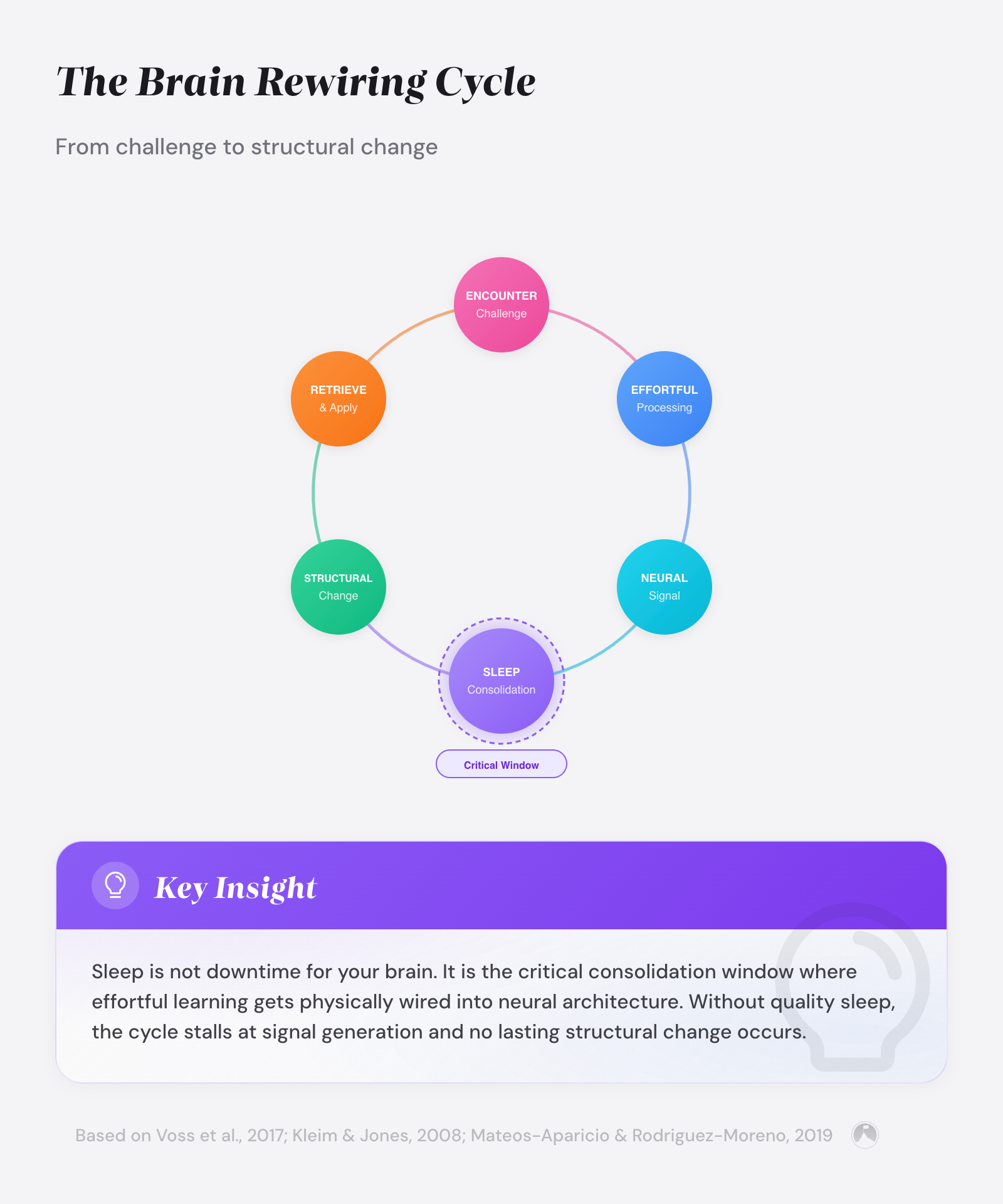
During slow-wave sleep, the brain replays neural firing patterns from the day’s learning at compressed speeds. Gazerani’s review found that this replay strengthens synaptic connections and transfers memories from the hippocampus to the neocortex for long-term storage [2]. Sleep spindles, brief bursts of oscillatory activity during stage 2 sleep, play a gatekeeping role in this memory consolidation neuroscience has only recently begun to map.
The synaptic homeostasis hypothesis adds another layer. During waking hours, learning causes a net increase in synaptic strength throughout the brain. If unchecked, the brain would become saturated. Deep sleep renormalizes synaptic strength, selectively weakening less important connections while preserving the ones reinforced through meaningful learning [2].
The role of sleep in consolidation has a concrete implication. Studying for three hours, then sleeping, then reviewing produces stronger neural pathway formation than six hours of consecutive study. The research on sleep and neuroplasticity consistently shows that sleep between learning sessions is a multiplier, not a luxury.
The research leads to a clear conclusion: Sleep doesn’t preserve memories passively. Sleep is the mechanism that separates signal from noise in everything your brain absorbed during the day. [2]
The rewiring window: a practical protocol
Knowing the brain is plastic doesn’t tell you how to make it change. Most learning advice stops at “practice more” or “get enough sleep” without specifying how, when, or how often.
Here’s a framework that combines what the research tells us about triggering neuroplastic change. We call it the Rewiring Window. The Rewiring Window is a framework we developed that identifies three conditions required to trigger neuroplastic change: effort at the edge of current ability, rest for consolidation, and spacing between practice sessions. Miss those conditions and the brain defaults to existing patterns. Hit them and it starts laying down new circuitry.
Effort: the struggle is the signal
Neuroplasticity isn’t triggered by comfortable review. It’s triggered by cognitive challenge – the state where you’re reaching beyond current ability and making errors. Kleim and Jones’s principle of “sufficient challenge” states that the training experience must be demanding enough to promote reorganization [6]. If you’re breezing through practice, the brain has no reason to rewire.
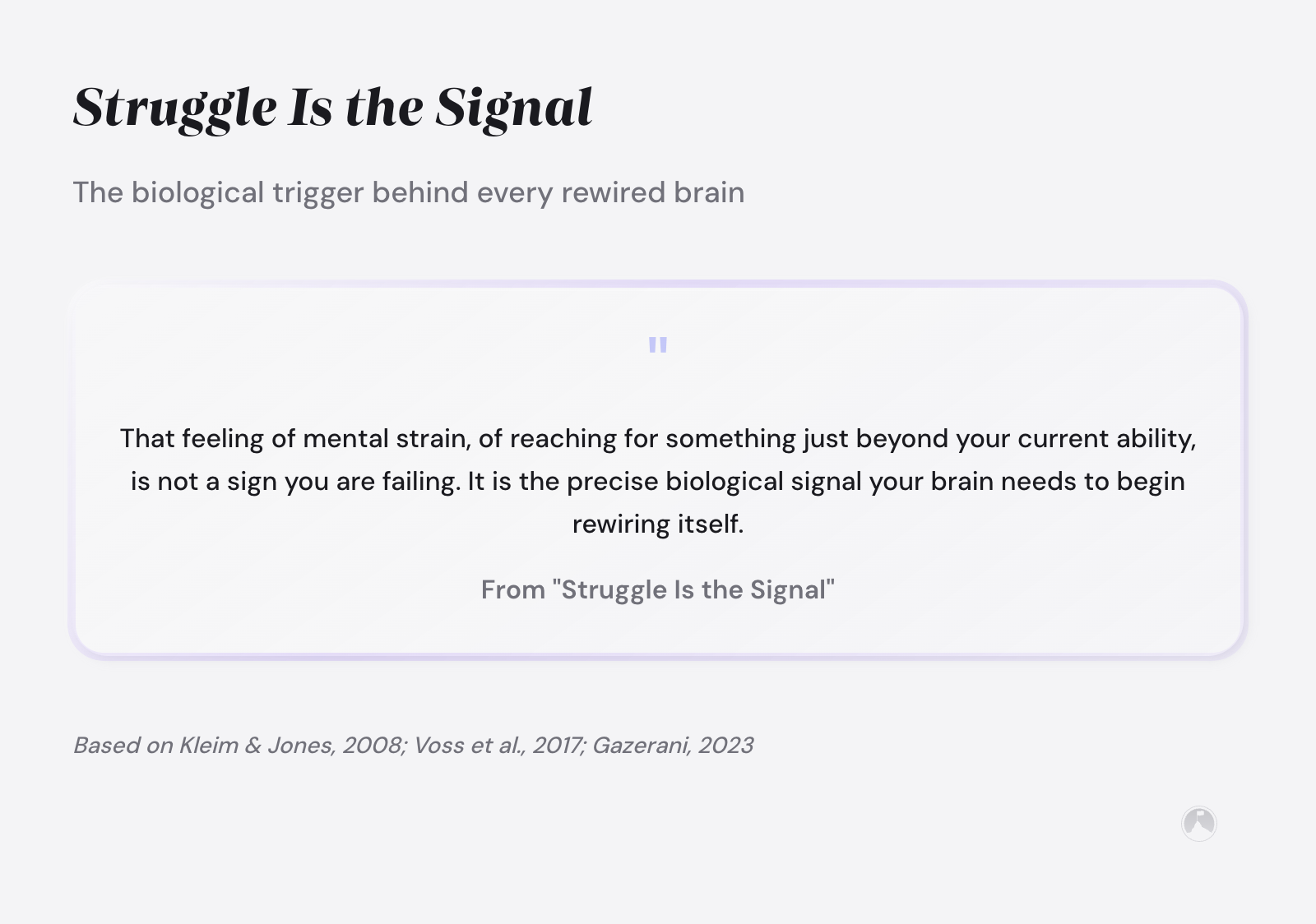
The principle that challenge triggers neuroplasticity aligns with Robert Bjork’s concept of “desirable difficulty” — conditions that make initial learning harder produce stronger long-term retention than comfortable review [12]. The feeling of struggle isn’t failure. It’s a sign that neuroplasticity is being activated.
If learning feels easy, it probably isn’t working.
Rest: the consolidation window
After a focused learning session, the brain needs time to consolidate what it absorbed. This means sleep, but also waking rest. Research by Xue and colleagues found that spaced repetition of learning material, compared to massed repetition, reduced neural repetition suppression and improved subsequent recognition memory [7].
Cotman and Berchtold’s research on exercise fits here too. Aerobic activity increases brain-derived neurotrophic factor (BDNF), the primary protein responsible for strengthening and preserving new synaptic connections formed during learning [8]. A session of moderate cardio before or after learning creates a chemical environment more receptive to synaptic strengthening. Think of BDNF as fertilizer for new neural connections.
Rest isn’t the opposite of effort. It’s the second half of the same process.
Spacing: the repetition rhythm
Massed practice (cramming) produces short-term performance gains that decay rapidly. Spaced practice, where review sessions are distributed across days and weeks, produces durable neural pathway formation. Each review session triggers a new round of consolidation [3]. For more on how to build effective systems around these principles, see our guide to learning new skills quickly.
The best spacing interval depends on your target retention period. For material you need to remember for a week, reviewing after one day works. For material you need to remember for a year, reviewing after one month is more effective. Spaced retrieval practice is the strongest known countermeasure to the forgetting curve.
Spaced practice works not by preventing forgetting. It works by using controlled forgetting as a trigger for deeper reconsolidation.
Growth mindset isn’t positive thinking
The relationship between neuroplasticity and growth mindset is real, but it runs deeper than typical “believe you can change and you will” framing.
Blackwell, Trzesniewski, and Dweck found that seventh-graders taught that intelligence is malleable showed measurable improvements in both motivation and academic performance [9]. The students weren’t given better study strategies. They were given different beliefs about what their brains could do.
But here’s what gets lost in popularization: the mindset shift worked by changing behavior. Students who believed their brains could grow spent more time on difficult problems instead of giving up. They sought feedback instead of avoiding it. They interpreted struggle as normal rather than evidence of low ability.
The belief changed the behavior, and the behavior triggered the neuroplasticity.
It is worth noting that growth mindset research has faced scrutiny. A 2018 meta-analysis by Sisk and colleagues found that the average effect of mindset interventions on academic achievement was small (d = .08), and subsequent meta-analyses have produced mixed results [13]. The broader claim that mindset interventions reliably improve outcomes is debated. What appears most robust is the behavioral mechanism: believing capability is malleable leads to persistence, and persistence triggers neuroplastic change.
If you approach a new skill believing your brain is past its prime, you’ll quit at the first difficulty. If you approach it knowing that struggle is the mechanism through which your brain rewires, you’ll persist. And persistence is what neuroplasticity requires above all else.
Mindset alone doesn’t rewire your brain. But the right mindset makes you take the actions that do.
For a broader perspective on building this mindset, explore cultivating a growth mindset for lifelong learning.
Neuroplasticity and learning in practice: what exercises work
Brain-training apps and games claim to boost cognitive function. Large-scale studies show they improve performance on those specific games but don’t transfer to general cognitive ability [2].
What does work is learning that is novel, complex, and sustained over time. The brain doesn’t rewire itself in response to easy repetition. It rewires in response to genuine challenge.
| Activity | Why it triggers neuroplasticity | Research-backed frequency |
|---|---|---|
| Learning a musical instrument | Uses motor, auditory, and executive networks simultaneously | 30+ minutes, 3-5 days per week |
| Learning a new language | Activates broad cortical networks, strengthens working memory and cognitive flexibility | Daily practice with spaced review |
| Aerobic exercise | Increases BDNF, improves hippocampal volume | 150 minutes per week moderate intensity |
| Retrieval practice (self-testing) | Forces brain to reconstruct knowledge, strengthening pathways | After every learning session |
| Learning a new physical skill | Requires constant error correction, driving motor cortex reorganization | 2-3 sessions per week with rest days |
The common thread is novelty and challenge. Doing crossword puzzles for the 10,000th time isn’t cognitive flexibility training. Learning to play chess when you’ve never played is. The brain adapts to demands it hasn’t encountered, not to demands it has already solved.
If you want to apply this to creative pursuits, leveraging hobbies for a creativity boost connects neuroplasticity to broader creative development.
Ramon’s take
Adult brains still rewire. That’s genuinely good news. The bad news is you have to actually sleep, which is the one thing you’ve been treating as optional since 2015.
I know the research on spaced practice. I know that cramming is inferior to distributed review. I know sleep consolidation is non-negotiable. And yet when I’m under deadline pressure, my first instinct is still to marathon the material in one sitting.
The gap between knowing the neuroscience and restructuring my learning around it is real.
What shifted my behavior is framing the struggle differently. When I was learning content strategy for this site, I hit a wall around month two where nothing seemed to stick. Before learning about neuroplasticity, I would have interpreted that as either “push harder” or “give up.”
Now I recognize that wall as the inflection point where the brain is doing its heaviest rewiring work, right before connections solidify. That reframe didn’t make the struggle feel good. It made it feel purposeful.
The one practical change that has stuck: I never study anything important after 9 PM. Not out of discipline, but because I’ve seen the measurable difference in retention when I give my brain a proper consolidation window versus cramming before bed. The evidence is clear enough that I trust it over my own urge to “get more done.”
Neuroplasticity is conditional — and that’s the point
Neuroplasticity and learning aren’t separate topics. They’re two descriptions of the same reality: the brain is a system that physically rebuilds itself in response to what you ask it to do.
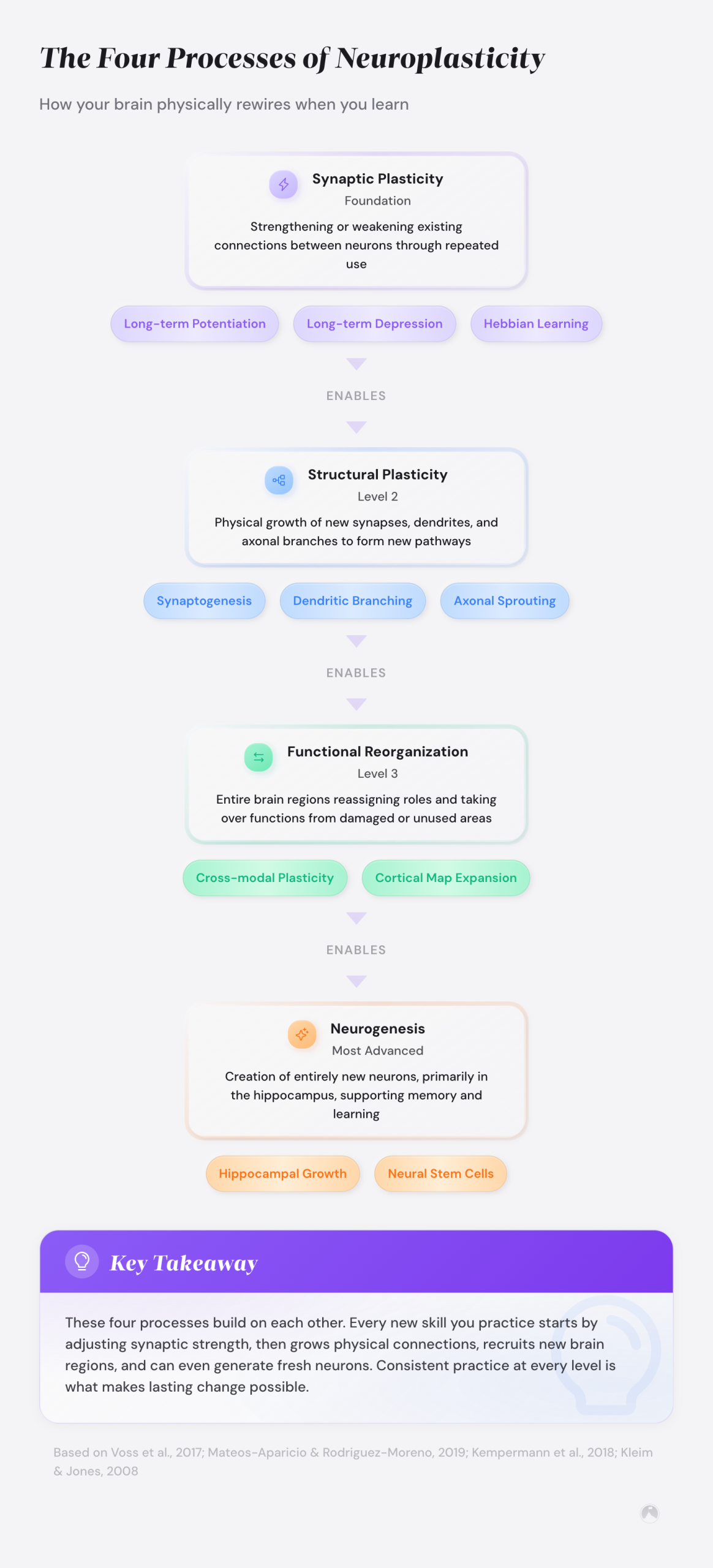
The mechanisms are well-documented. Synaptic strengthening through practice. Structural changes through sustained engagement. Memory consolidation through sleep. New neuron creation in the hippocampus. All work together to make learning possible at any age.
But neuroplasticity is conditional. It requires challenge, not comfort. Rest, not grinding. Spacing, not cramming.
The Rewiring Window framework captures these conditions in three words: effort, rest, spacing. Miss any one and the brain defaults to existing wiring.
The brain you have tomorrow is being built by what you do today. That’s either motivating or terrifying, depending on whether you’re creating the conditions for it to grow.
For deeper exploration of how these principles connect to your broader learning strategy, start with our creativity and learning strategies guide.
Next 10 minutes
- Pick one thing you’re currently learning and schedule your next practice session for tomorrow instead of today.
- Set a “no new learning after 9 PM” boundary for this week to protect your sleep consolidation window.
This week
- Add one 20-minute aerobic exercise session before a learning block to increase BDNF availability.
- Replace one cramming session with two shorter, spaced sessions separated by at least 24 hours.
- Try one retrieval practice test on material you studied earlier this week instead of re-reading it.
Related articles in this guide
Frequently asked questions
How does neuroplasticity work at the neural level?
Neuroplastic changes operate on different timescales depending on the mechanism involved. Synaptic plasticity — the strengthening of connections between neurons — begins within minutes to hours of focused practice. Structural plasticity, including dendrite growth and myelination, unfolds over weeks to months of sustained engagement. Neurogenesis in the hippocampus takes months before new neurons fully integrate into existing circuits, while functional reorganization of cortical territory can span months to years depending on intensity.
Can adult brains rewire as well as child brains?
Adult brains remain plastic throughout life, but adult learning operates differently. Children’s brains change rapidly with minimal effort during critical periods. Adult brains require more intentional conditions: focused challenge, adequate rest, and spaced practice. Adults gain advantages in pattern recognition and contextual integration that children do not have.
How does sleep affect learning and neuroplasticity?
For optimal learning consolidation, aim for 7-9 hours of sleep, with the most critical memory processing occurring during slow-wave sleep in the first half of the night. A 20-minute nap within four hours of a learning session can boost retention without disrupting nighttime sleep. Avoid novel stimulation and blue-light screens in the hour before bed, as both can interfere with the brain’s transition into the slow-wave stages where memory replay occurs.
What is the Rewiring Window and how does it work?
The Rewiring Window is a framework combining three conditions for triggering neuroplasticity: effort (practicing at the edge of ability where errors occur), rest (sleep and quiet reflection after learning), and spacing (distributing practice across days rather than cramming). Missing any one condition allows the brain to default to existing patterns instead of rewiring.
Is spaced practice really better than cramming?
Spaced practice consistently outperforms cramming across decades of research. For a test one week away, review material at day one and day four. For a certification exam in three months, space reviews at one week, three weeks, and two months. For long-term skill retention measured in years, review at one month, three months, and six months after initial learning. Each review triggers a fresh round of memory consolidation that massed practice cannot replicate.
How does growth mindset connect to neuroplasticity?
Growth mindset is often confused with positive self-talk or affirmations, but the research identifies a specific behavioral mechanism. People with a growth mindset persist longer on difficult tasks, actively seek corrective feedback, and treat errors as information rather than threats. These behaviors — not the belief itself — are what trigger neuroplastic change. Recent meta-analyses have found that the overall effect of mindset interventions on academic outcomes is smaller than initially reported, but the behavioral persistence pathway remains the most supported link between mindset and brain change.
What is the role of BDNF in neuroplasticity and learning?
Brain-derived neurotrophic factor (BDNF) is a protein that supports synaptic growth and survival. Aerobic exercise increases BDNF levels, creating a chemical environment in the brain more receptive to synaptic strengthening. Exercise before or after learning acts like fertilizer for new neural connections, enhancing the brain’s capacity to rewire itself.
Do brain-training games and apps actually work?
Brain-training games improve performance on those specific games but do not transfer to general cognitive ability, according to large-scale studies. What does work is learning that is novel, complex, and sustained over time. The brain rewires in response to genuine challenge, not easy repetition. Learning languages, musical instruments, new physical skills, and retrieval practice all trigger real neuroplasticity.
References
[1] Voss, P., Thomas, M.E., Cisneros-Franco, J.M., and de Villers-Sidani, E. “Dynamic Brains and the Changing Rules of Neuroplasticity: Implications for Learning and Recovery.” Frontiers in Psychology, vol. 8, 2017, article 1657. DOI
[2] Gazerani, P. “The neuroplastic brain: current breakthroughs and emerging frontiers.” Brain Research, vol. 1858, 2025, article 149643. DOI
[3] Mateos-Aparicio, P. and Rodriguez-Moreno, A. “The Impact of Studying Brain Plasticity.” Frontiers in Cellular Neuroscience, vol. 13, 2019, article 66. DOI
[4] Kempermann, G., Gage, F.H., Aigner, L., et al. “Human Adult Neurogenesis: Evidence and Remaining Questions.” Cell Stem Cell, vol. 23, no. 1, pp. 25-30, Jul. 2018. DOI
[5] Nudo, R.J. “Recovery after brain injury: mechanisms and principles.” Frontiers in Human Neuroscience, vol. 7, 2013, article 887. DOI
[6] Kleim, J.A. and Jones, T.A. “Principles of Experience-Dependent Neural Plasticity: Implications for Rehabilitation After Brain Damage.” Journal of Speech, Language, and Hearing Research, vol. 51, no. 2, pp. S225-S239, Feb. 2008. DOI
[7] Xue, G., Mei, L., Chen, C., et al. “Spaced Learning Enhances Subsequent Recognition Memory by Reducing Neural Repetition Suppression.” Journal of Cognitive Neuroscience, vol. 23, no. 7, pp. 1624-1633, 2011. DOI
[8] Cotman, C.W. and Berchtold, N.C. “Exercise: A behavioral intervention to enhance brain health and plasticity.” Trends in Neurosciences, vol. 25, no. 6, pp. 295-301, Jun. 2002. DOI
[9] Blackwell, L.S., Trzesniewski, K.H., and Dweck, C.S. “Implicit Theories of Intelligence Predict Achievement Across an Adolescent Transition: A Longitudinal Study and an Intervention.” Child Development, vol. 78, no. 1, pp. 246-263, Jan.-Feb. 2007. DOI
[10] Maguire, E.A., Gadian, D.G., Johnsrude, I.S., et al. “Navigation-related structural change in the hippocampi of taxi drivers.” Proceedings of the National Academy of Sciences, vol. 97, no. 8, pp. 4398-4403, Apr. 2000. DOI
[11] Draganski, B., Gaser, C., Busch, V., et al. “Neuroplasticity: Changes in grey matter induced by training.” Nature, vol. 427, no. 6972, pp. 311-312, Jan. 2004. DOI
[12] Bjork, R.A. “Memory and Metamemory Considerations in the Training of Human Beings.” In Metcalfe, J. and Shimamura, A. (Eds.), Metacognition: Knowing about Knowing, pp. 185-205. Cambridge, MA: MIT Press, 1994.
[13] Sisk, V.F., Burgoyne, A.P., Sun, J., Butler, J.L., and Macnamara, B.N. “To What Extent and Under Which Circumstances Are Growth Mind-Sets Important to Academic Achievement? Two Meta-Analyses.” Psychological Science, vol. 29, no. 4, pp. 549-571, 2018. DOI