When everything you make feels like a copy
You sit down to create, and every idea feels recycled. The well is dry. This isn’t because you’ve lost your creativity. It’s because your brain is starved for novelty.
Conner and colleagues tracked 658 young adults over 13 days and found that people who spent time on creative activities reported higher levels of flourishing and positive affect the next day [1]. Your creative stagnation isn’t a talent problem. It’s an input problem. Your daily routine has optimized itself into a narrow groove.
Hobbies for creativity work because they break that groove. But not just any hobby. The specific hobby you choose matters far more than the fact that you choose one.
Creative hobbies are activities chosen specifically to develop creative cognitive skills (like divergent thinking, pattern recognition, and constraint-based problem-solving) rather than to entertain. They introduce your brain to experiences and challenges your daily work doesn’t, which forces it to build new associative pathways.
What you will learn
- Why hobbies boost creativity through three distinct mechanisms at the neurological level
- How to match a hobby to the specific creative skill gap in your work
- Five hobby categories with research backing, organized by the skill each one develops
- A practical framework for starting in small time increments without perfectionism tripping you up
- Why most adults quit creative hobbies within four weeks, and how to build the system that prevents that
Key takeaways
- Your creative stagnation is a novelty deficit, not a talent shortage.
- The best hobby for you isn’t the one you’d pick for fun – it’s the one your brain needs most.
- The Creativity Cross-Training Method matches your weakest creative skill to a hobby from an unrelated domain.
- Hobbies boost creativity through cross-domain transfer, default mode activation, and cortisol reduction.
- Starting with 20-minute weekly sessions produces more sustained practice than ambitious daily plans.
- The hobby that feels least comfortable often delivers the strongest creative benefits.
Why do hobbies actually work?
Most people assume hobbies work because they “relax you” and relaxation “frees your mind.” That’s incomplete. The real story involves three mechanisms that researchers have documented over the past two decades.
Cross-domain transfer. Cross-domain transfer occurs when neural connections built through practice in one skill area activate during unrelated tasks, producing creative insights the practitioner did not deliberately seek. Eschleman and colleagues at San Francisco State University found that employees with creative hobbies showed significant improvements in creative problem-solving and performance outcomes at work [2].
The hobbies weren’t related to their jobs. The transfer happened at the cognitive level, not because the skills directly overlap.
Default mode network activation. Your brain has a system called the default mode network – the one responsible for spontaneous thinking and unexpected connections. Neuroscientist Marcus Raichle’s foundational research demonstrated that this system becomes most active during low-demand activities where your hands stay busy but your mind roams freely [5]. A hobby like knitting, gardening, or woodworking creates exactly those conditions. Researchers associate this activation pattern with the moment before insight hits.
Stress reduction through creative flow. Kaimal and colleagues at Drexel University found that 45 minutes of creative activity reduced cortisol in 75% of participants, regardless of whether they had any artistic experience [3]. Lower cortisol is associated with improved cognitive flexibility. Cognitive flexibility is the ability to shift between different mental approaches to a problem rather than persisting with a single strategy. Research by Liston and colleagues at Weill Cornell Medical College demonstrates that elevated stress hormones impair the prefrontal brain regions responsible for mental flexibility, while stress reduction restores that capacity [6].
“Participants’ cortisol levels were significantly lower after making art, even though they had never made art before,” the Drexel researchers noted [3].
Creative hobbies don’t work through magic — they work by forcing your brain to build new connections instead of deepening old grooves.
How do you match a hobby to what you actually need?
Not all creative hobbies produce the same benefits. A hobby that trains divergent thinking operates through different neural pathways than one training convergent thinking. Divergent thinking is the cognitive process of generating multiple possible solutions to an open-ended problem. Convergent thinking is the process of evaluating many options to identify the single best solution based on defined criteria.
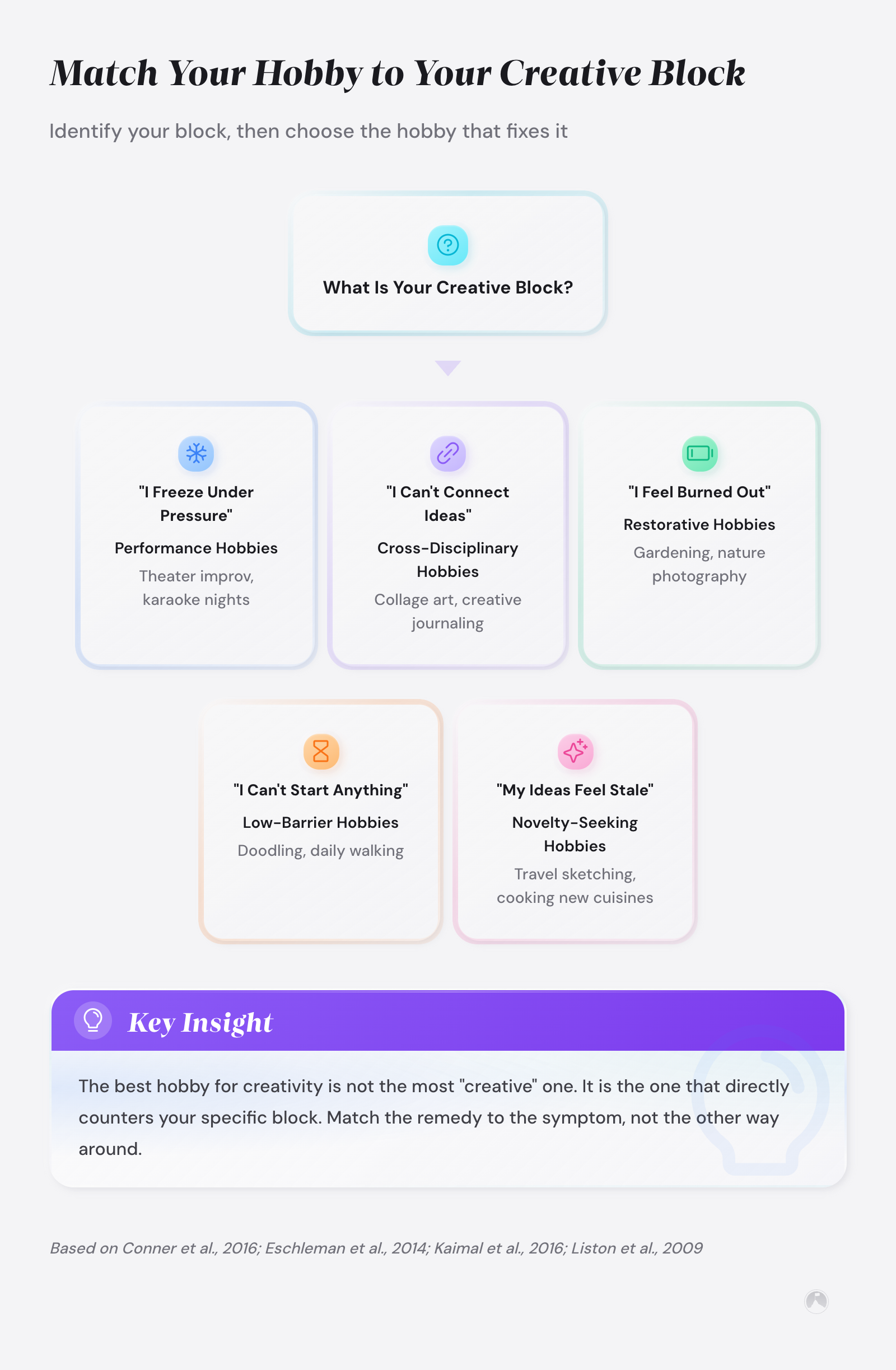
The key is matching the hobby to the specific creative skill your work is starving for.
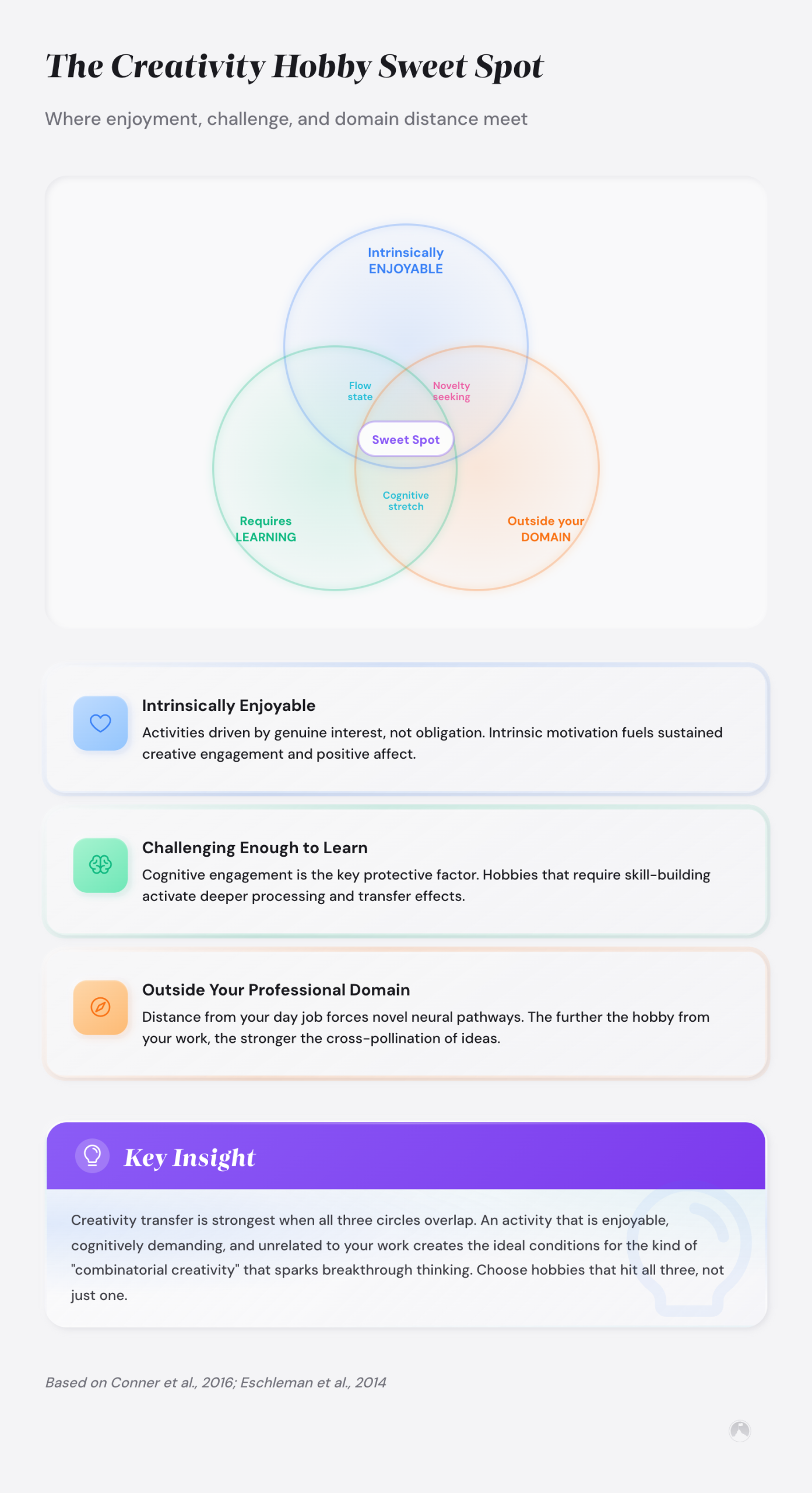
Here’s a simple framework that keeps showing up across the research on creative hobbies for adults. The logic mirrors physical cross-training: a runner doesn’t get faster by running more. They get faster by adding strength work, flexibility training, and activities that build complementary systems. Your creative practice works the same way. We call this framework the Creativity Cross-Training Method — our term for selecting hobbies from unrelated domains that target your weakest creative skill.
Here’s how it works: identify your weakest creative skill, then select a hobby from a completely different domain that targets that skill. If your work demands constant idea generation but execution is your bottleneck, a craft hobby like woodworking or ceramics trains the completion pathway your creative process is missing.
A graphic designer stuck in visual cliches might benefit more from improv comedy (training spontaneous idea generation under constraints) than from another visual art form. The further the hobby sits from your work domain, the more it forces your brain to build new associative connections. For a deeper look at how these neural connections form, our guide on neuroplasticity and learning science covers the brain mechanics.
The best creative hobby is rarely the one you’d pick for entertainment but the one that trains the creative skill your job neglects.
Hobbies for creativity: five categories with proven benefits
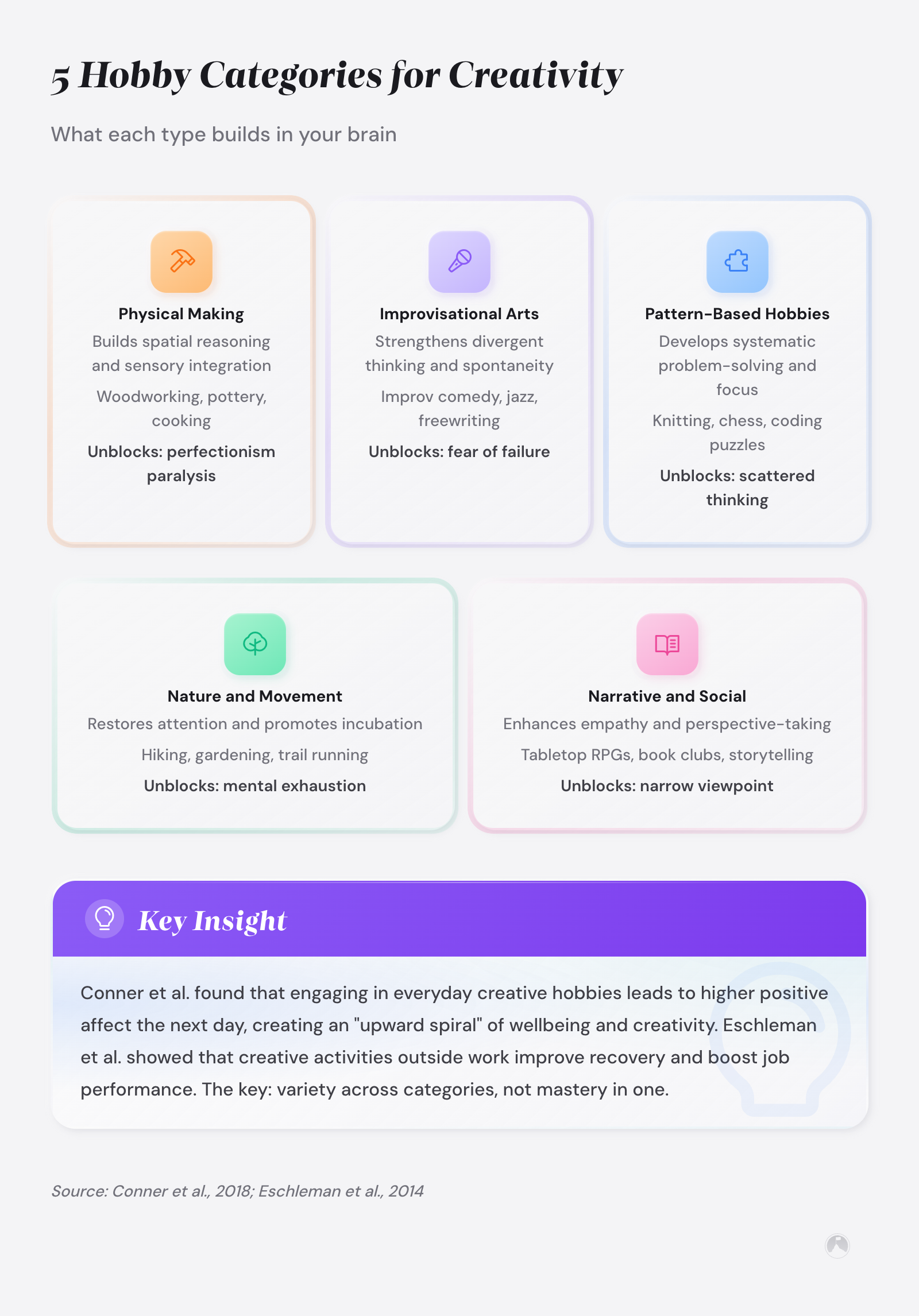
Rather than listing the 50 best hobbies for creative people with a sentence each, these five categories are organized by the creative skill each develops. Pick the category that addresses your biggest creative gap, then choose one hobby within it.
| Hobby category | Creative skill trained | Example hobbies | Best for |
|---|---|---|---|
| Physical making (hands-on) | Constraint-based creativity | Pottery, woodworking, cooking from scratch | People who overthink and under-produce |
| Improvisational arts | Spontaneous idea generation | Improv comedy, jazz, freestyle dance | People who freeze under creative pressure |
| Pattern-based hobbies | Pattern recognition and sequencing | Chess, music composition, coding puzzles | People who struggle connecting disparate ideas |
| Nature and movement | Default mode network activation | Hiking, gardening, birdwatching | People whose best ideas arrive during walks or showers |
| Narrative hobbies | Perspective-taking and empathy | Creative writing, tabletop RPGs, photography | People who need fresh viewpoints for their work |
Physical making: when you need to stop planning and start producing
Pottery, woodworking, and cooking — starting at just 20 minutes a week — share something digital work lacks: immediate, irreversible feedback. You can’t undo a collapsed clay pot. This forces real-time adaptation, a form of constraint-based creativity that makes these creative activities for personal growth rather than just recreation. Most materials cost under $20 to start.
Roberts and colleagues at Mayo Clinic found that adults who engaged in artistic activities such as painting, drawing, and sculpture in both middle and old age were 73% less likely to develop mild cognitive impairment [4]. The researchers attributed this to the multi-sensory engagement these activities demand.
Improvisational arts: when you freeze under creative pressure
Improv comedy, jazz improvisation, and freestyle dance all train the same skill: generating ideas without a net. One class per week is enough to start. For professionals who need to think on their feet — during presentations, brainstorming, client meetings — improvisational hobbies build comfort with unscripted creative output.
The “yes, and” principle from improv, where you accept what’s offered and build on it, is a core technique in brainstorming and creative collaboration across many organizations. A local improv class is one of the lowest-barrier entry points for adults who feel creatively blocked, typically costing $50-100 for a beginner series. If you’re looking for more structured approaches to idea generation, our guide on creative thinking techniques covers several research-backed methods.
Pattern-based hobbies: when you can’t connect the dots
Pattern-based hobbies train your brain to detect structure within complex systems and predict outcomes from incomplete information. Chess, music theory, and programming puzzles all build this capacity, and many are free or under $20 to start with 15 minutes a day. For professionals whose creative work depends on synthesis — connecting information from different fields — pattern-based hobbies strengthen that neural capacity through the same cross-domain transfer mechanism documented in the Eschleman study [2].
Nature and movement: when your best ideas come walking
If your most creative moments happen during walks, showers, or mundane tasks, your default mode network is doing heavy lifting. Nature-based hobbies and movement — hiking, gardening, birdwatching, all free or nearly free with 30 minutes a week — deliberately create more of those conditions.
Conner, DeYoung, and Silvia’s study found that creative activity one day predicted higher positive affect and flourishing the next, which in turn predicted more creative activity [1]. The cycle feeds itself once you start it.
“Creative behavior leads to increases in well-being the next day, and this increased well-being is likely to fuel creative activity on the same day,” the researchers reported [1].
Narrative hobbies: when you need fresh perspectives
Creative writing, tabletop role-playing games, and documentary photography force you to see the world from viewpoints other than your own. Most require 20 minutes a week and minimal startup cost. Research on fiction exposure suggests that sustained narrative engagement strengthens perspective-taking ability and social cognition [7], which may translate to understanding audiences better in marketing, design, or product development.
A writer benefits from photography not through visual skills but through the practice of noticing — training their eye to find stories in ordinary moments. The cross-pollination effect is strongest when the domains feel unrelated on the surface. And if you’ve been avoiding creative projects altogether, you might find useful strategies in our piece on overcoming creative blocks in learning.
The hobby that feels least comfortable often produces the strongest creative gains.
How to start when you barely have time
The biggest barrier to finding hobbies to improve creative thinking isn’t the right activity. It’s the gap between wanting to start and taking the first step. Most people set ambitious plans (“I will practice guitar every evening”) and abandon them within three weeks.
A better approach borrows from habit research: start small. Twenty minutes once a week is enough to begin building the cognitive patterns documented in the research. A single 45-minute creative session was enough to produce measurable cortisol reduction in the Kaimal study [3], suggesting that even brief creative periods have real physiological effects. You’re not training to become a professional. You’re feeding your brain the novelty it needs to generate better ideas in your actual work. For broader context on how adults pick up new skills, our guide on learning new skills quickly breaks down the research on skill acquisition.
The 4-week creative hobby start plan
- Week 1: Choose one hobby from the category that addresses your biggest creative gap. Spend 20 minutes trying it once. No judgment. No goals beyond showing up.
- Week 2: Same hobby, same 20 minutes. Notice what felt absorbing and what felt forced. Adjust if needed, but don’t switch hobbies yet.
- Week 3: Increase to 30 minutes if week 2 felt too short. If it felt like a chore, try one hobby from the same category instead.
- Week 4: Reflect: did you notice any new ideas, perspectives, or energy in your non-hobby life? If yes, you’ve found your match. If no, try the next category on your list.
The key insight: creative hobbies don’t need to feel productive. In fact, accepting that the early stages of any new skill feel clumsy is part of cultivating a growth mindset for lifelong learning. That discomfort signals your brain building new connections.
Consistency at a low dose beats intensity at an unsustainable one.
Why do adults quit creative hobbies so quickly?
Four obstacles kill most adult creative hobbies before they deliver real benefits. Knowing them in advance makes survival much more likely.
Perfectionism. Adults compare their beginner work to expert work and feel embarrassed. But the creativity benefit comes from the process of making, not from quality. The Drexel study found that cortisol reduction was identical regardless of artistic skill level [3]. Your first terrible pot delivers the same cognitive benefit as a professional ceramicist’s masterpiece.
Time pressure. “I don’t have time for a hobby” is the most common objection. And it’s often true. But research shows a single 45-minute session produced measurable stress reduction [3] — less time than most people spend scrolling social media on a single evening.
Self-consciousness. Many adults haven’t tried anything creative since childhood and feel vulnerable about starting in front of others. Solo hobbies (gardening, cooking, sketching, writing) remove this entirely. You don’t need a class or group. You need a kitchen table and 20 minutes.
Sustainability. Novelty wears off, life gets busy, and the hobby slips. The fix is structural: attach the hobby to an existing routine. Sunday morning pottery before grocery shopping. Wednesday evening sketching during your child’s practice. Anchoring creative time to fixed events in your week dramatically increases the odds you’ll keep going.
For a broader look at how different learning methods compare when building new skills, that guide covers tradeoffs between structured and self-directed approaches.
Adults who sustain creative hobbies succeed not through talent or discipline but because their schedules make the hobby happen without a decision.
Ramon’s take
What got me is the idea that I’ve been treating hobbies like rewards instead of tools. I’m not sure that reframe actually helps. Does turning leisure into a strategy just make it feel like more work?
Conclusion
Hobbies for creativity aren’t a luxury. They’re cognitive cross-training that builds specific skills your daily routine leaves undeveloped. The research is consistent: creative leisure activities boost professional creative performance [2], reduce stress hormones [3], create upward spirals of well-being [1], and protect against cognitive decline [4]. But the benefit depends on choosing a hobby that targets the creative skill you need, not the one that sounds most appealing.
The Creativity Cross-Training Method gives you a framework for that choice. Identify your weakest creative skill. Find a hobby from an unrelated domain that trains it. Commit to 20 minutes a week. That’s the whole system.
The irony of creativity is that it rarely improves when you try harder at the same thing. It improves when you go do something completely different.
Next 10 minutes
- Review the five hobby categories in the table above and identify which creative skill gap matches your current situation best.
- Pick one specific hobby from that category and write it down.
- Choose a 20-minute window this week when you could try it for the first time.
This week
- Complete your first 20-minute session with zero expectations for quality.
- After the session, jot down one sentence about how it felt. Did your mind wander to interesting places?
- Schedule the same 20-minute block for next week before motivation fades.
There is more to explore
For more strategies on building creative skills and learning well, check out our guides on creativity and learning strategies and cultivating a growth mindset for lifelong learning. If you’re interested in how ADHD intersects with creative learning, our guide on creative learning ADHD strategies covers practical adaptations.
Frequently asked questions
What hobbies increase creativity the most?
The strongest creative gains come from hobbies that maximize novelty distance from your daily work. Evaluate any hobby by three factors: how different its sensory modality is from your job, how much constraint it imposes on your process, and how far removed its domain is from your professional field. A quick self-assessment — listing what your workday involves most (screens, sitting, logic, repetition) and choosing the opposite — often points to the highest-impact starting hobby.
How do hobbies boost creativity at the neurological level?
Hobbies boost creativity through three documented mechanisms: cross-domain transfer (neural connections built in one area that fire in unrelated contexts), default mode network activation (conditions for spontaneous insight, as documented in Raichle’s foundational neuroscience research [5]), and stress reduction through creative flow (lower cortisol improves cognitive flexibility) [3]. These mechanisms operate regardless of artistic talent or prior experience.
Can hobbies improve creative thinking at work?
Employees with creative hobbies show significant improvements in creative problem-solving and job performance, according to research by Eschleman and colleagues [2]. The timeline for noticing work-related creative benefits varies widely between individuals — the study documented effects without specifying a minimum practice duration. Some practitioners report shifts within weeks, while for others the transfer is gradual and cumulative over months.
What are easy creative hobbies for beginners?
Cooking without recipes, gardening, daily sketching, and nature photography all require minimal equipment and no prior training. Solo hobbies remove the self-consciousness that stops many adult beginners from starting. The key is choosing something with low setup cost so the barrier between wanting to start and taking that first step stays small. A 20-minute cooking experiment without a recipe is one of the lowest-barrier starting points — it requires only ingredients you already have.
How much time should you spend on creative hobbies each week?
The minimum effective dose is around 20 minutes per session, which is enough to engage the cognitive mechanisms that drive creative transfer. A single 45-minute session produced measurable cortisol reduction in the Kaimal study [3]. Multiple shorter sessions spread across the week tend to outperform one long weekend session because they create more frequent cognitive resets and maintain the novelty signal your brain needs.
Why do adults lose creativity and how can hobbies help?
Adults don’t lose creativity; they lose exposure to novel experiences. Adult routines optimize for efficiency, which narrows cognitive inputs available for creative thinking. Creative hobbies reverse this by introducing unfamiliar challenges and sensory experiences that force the brain to build new pathways rather than relying on established patterns.
Are creative hobbies good for mental health?
Creative hobbies appear to reduce stress through a specific anxiety-reduction pathway: absorptive creative activity interrupts rumination cycles and redirects cognitive resources away from worry. This makes creative hobbies particularly beneficial for high-stress professionals whose work involves sustained mental pressure. Regular creative practice is also associated with lower risk of cognitive decline in later life [4], suggesting compounding mental health benefits over time.
What is the best creative hobby for someone stuck in a routine?
Hobbies involving different senses and physical movement break routines with the most force. If your daily work is screen-based and sedentary, a hands-on hobby like pottery or cooking, where the smell, texture, and physical effort create sensory experiences your screen-based day never provides, disrupts established neural patterns most effectively. The further the hobby sits from your normal pattern, the stronger its pattern-disrupting effect on creative thinking.
References
[1] Conner, T. S., DeYoung, C. G., and Silvia, P. J. “Everyday creative activity as a path to flourishing.” The Journal of Positive Psychology, 2018, Vol. 13, No. 2, pp. 181-189. https://doi.org/10.1080/17439760.2016.1257049
[2] Eschleman, K. J., Madsen, J., Alarcon, G., and Barelka, A. “Benefiting from creative activity: The positive relationships between creative activity, recovery experiences, and performance-related outcomes.” Journal of Occupational and Organizational Psychology, 2014, Vol. 87, No. 3, pp. 579-598. https://doi.org/10.1111/joop.12064
[3] Kaimal, G., Ray, K., and Muniz, J. “Reduction of Cortisol Levels and Participants’ Responses Following Art Making.” Art Therapy, 2016, Vol. 33, No. 2, pp. 74-80. https://doi.org/10.1080/07421656.2016.1166832
[4] Roberts, R. O., Cha, R. H., Mielke, M. M., et al. “Risk and protective factors for cognitive impairment in persons aged 85 years and older.” Neurology, 2015, Vol. 84, No. 18, pp. 1854-1861. https://doi.org/10.1212/WNL.0000000000001537
[5] Raichle, M. E., MacLeod, A. M., Snyder, A. Z., et al. “A default mode of brain function.” Proceedings of the National Academy of Sciences, 2001, Vol. 98, No. 2, pp. 676-682. https://doi.org/10.1073/pnas.98.2.676
[6] Liston, C., McEwen, B. S., and Casey, B. J. “Psychosocial stress reversibly disrupts prefrontal processing and attentional control.” Proceedings of the National Academy of Sciences, 2009, Vol. 106, No. 3, pp. 912-917. https://doi.org/10.1073/pnas.0807041106
[7] Mar, R. A., Oatley, K., Hirsh, J., de la Paz, J., and Peterson, J. B. “Bookworms versus nerds: Exposure to fiction versus non-fiction, divergent associations with social ability, and the simulation of fictional social worlds.” Journal of Research in Personality, 2006, Vol. 40, No. 5, pp. 694-712. https://doi.org/10.1016/j.jrp.2005.08.002