
Your toddler does not care about your morning routine
You set an alarm for 5:45 AM. You planned to journal, stretch, drink water. Then your three-year-old wandered in at 5:20, crying about a dream, and your morning routine for working parents died before it started. A 2024 Maven Clinic survey found that 92% of working parents report feeling burnt out from balancing career and family responsibilities [1]. Most habit advice assumes a life you don’t have: predictable mornings, uninterrupted evenings, energy reserves that don’t exist after a day of meetings and diaper changes.
Habits for working parents require flexibility over rigidity. Three-tier routines handle disruption without failure, micro-habits fit into existing parenting moments, boundary rituals protect work-family separation, and realistic parental self-care habits prevent burnout. The system works because it expects interruption rather than hoping to avoid it.
The real question isn’t whether you can build habits. It’s whether you’re using a framework designed for your actual constraints.
Habits for working parents are recurring behavioral patterns designed to function within the competing demands of professional obligations and childcare responsibilities, requiring flexibility rather than rigidity to survive the unpredictability of family life.
What you will learn
- Why standard habit advice fails parents and what to use instead
- How to stack micro-habits onto parenting moments you already have
- Boundary setting practices that protect both your work and your family time
- Self-care habits that take under five minutes and require zero setup
- Shared responsibility systems that turn habit-building into a team effort
Key takeaways
- Habits built for predictable lives break in unpredictable ones; habits built for disruption flex and survive.
- The three-tier routine system gives every habit an ideal-day, reduced, and survival version so parents always have an executable option.
- Gardner’s 2024 review confirms that flexible habit variations maintain adherence better than rigid single-pathway routines [2].
- Boundary setting for working parents succeeds through environmental design, not through willpower during exhausting evenings.
- Two-minute habits attached to existing working parent routines produce higher long-term adherence than ambitious standalone routines [4].
- Brief daily self-care deposits produce more sustained well-being improvements for parents than infrequent longer sessions [7].
- Coordinated coparenting communication reduces stress cascades and prevents parental burnout escalation [9].
Why do habits for working parents break so easily?
Habits for working parents break easily because standard habit advice assumes schedule predictability that parents do not have. A baby’s fever, a canceled babysitter, or a school snow day can cascade through your entire week. Standard habit formation advice assumes something most parents don’t have: control over their own schedule. And research from Ohio State University found that the pressure to be “perfect parents” is itself associated with higher rates of parental burnout [3]. When you layer perfectionist habit-building onto already impossible expectations, the system collapses under its own weight.
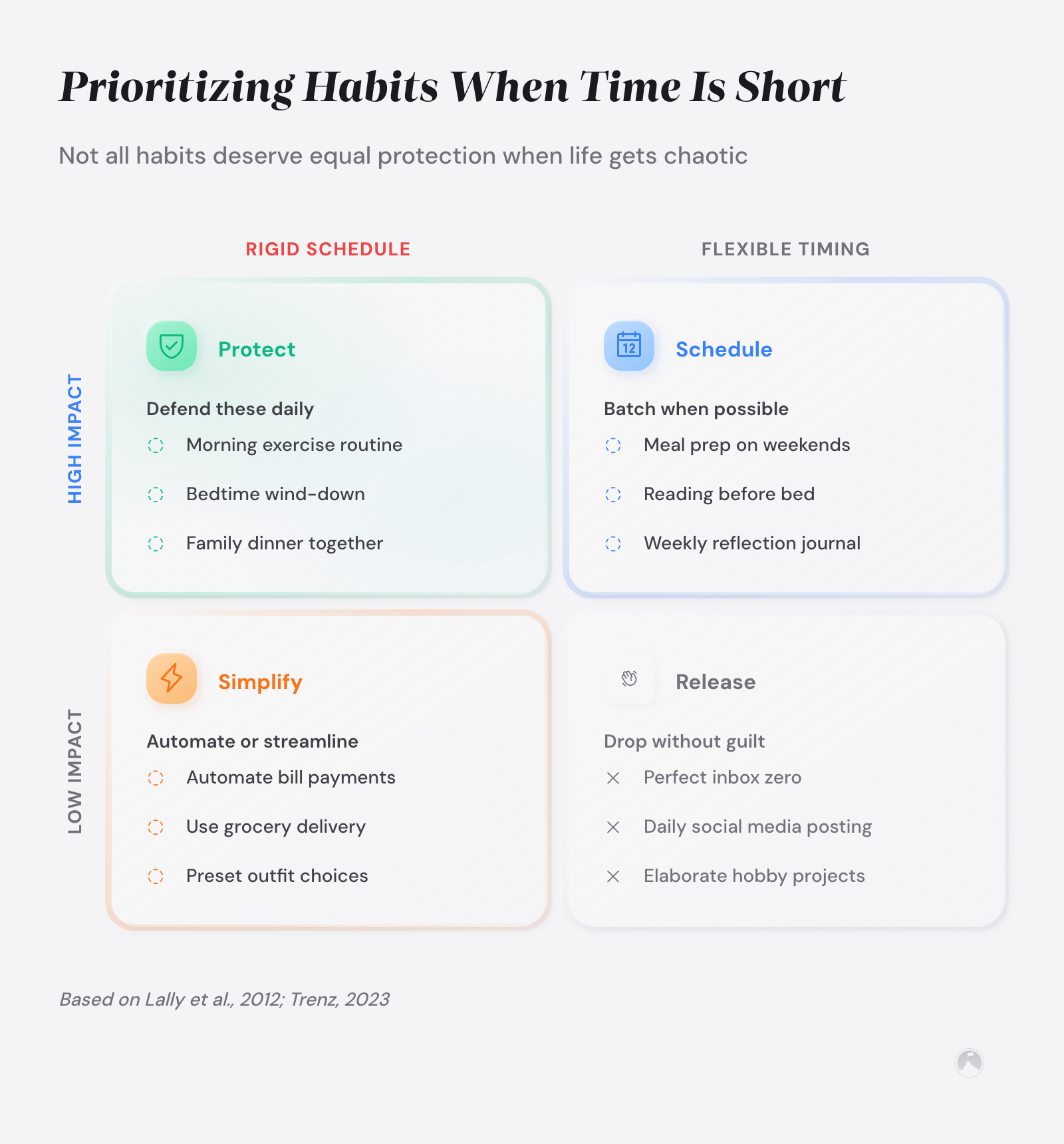
Habits built for predictable lives break in unpredictable ones; habits built for disruption flex and survive.
Benjamin Gardner’s 2024 review of habit formation in real-world contexts explains why: rigid single-pathway habits fail under disruption, while flexible variations on the same habit maintain long-term adherence [2]. This is the scientific basis for the three-tier approach. The three-tier approach we use at Goals and Progress adapts Gardner’s flexibility principle into a practical daily system. Rather than designing one perfect routine and hoping life doesn’t interrupt it, you design three versions of the same routine from the start. Each accounts for a different level of available time and energy.
The disruption-proof routine: three tiers for real life
Every habit gets three pre-planned versions, so there’s always a version you can execute regardless of how the day unfolds.
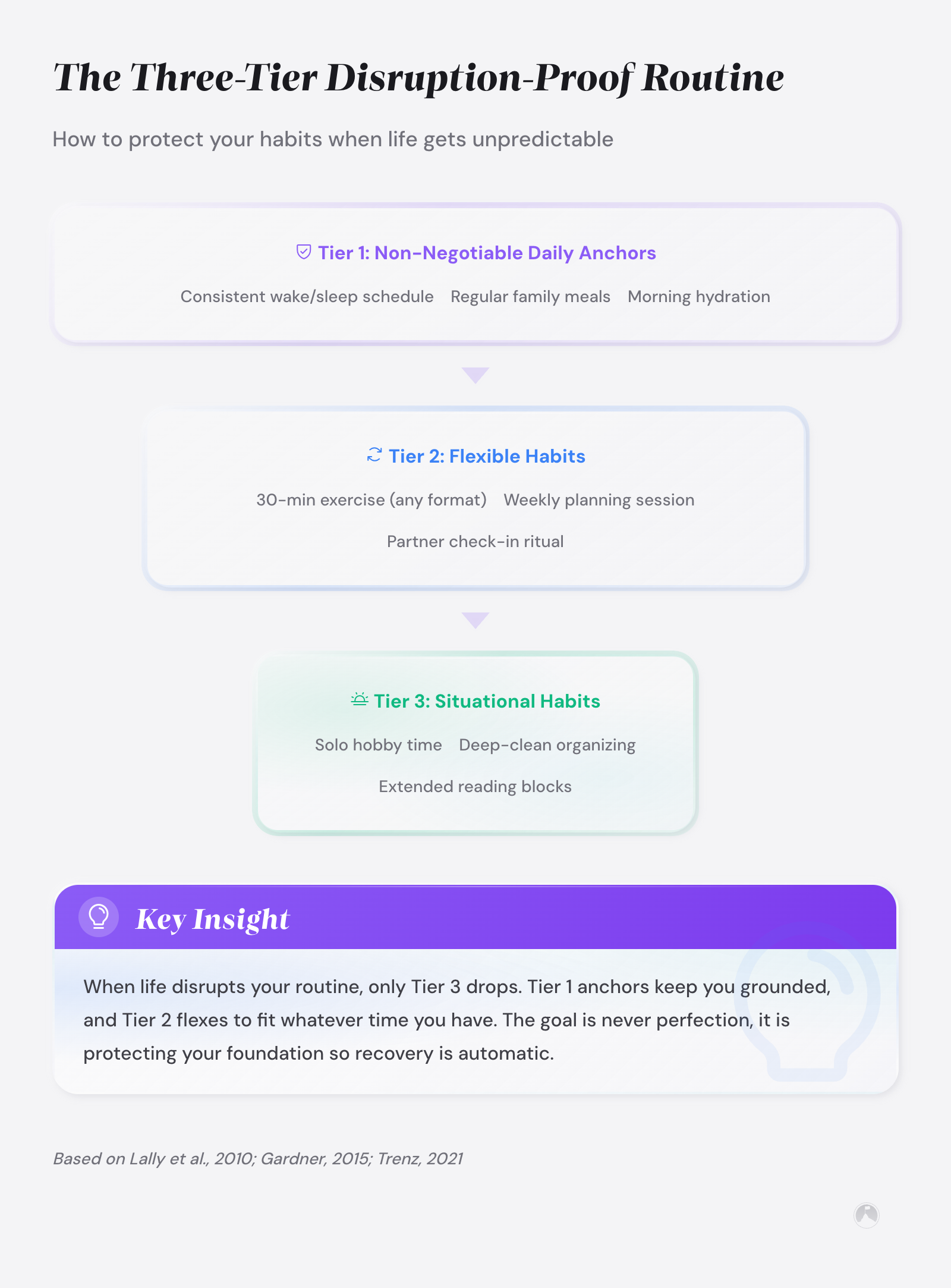
Three-tier routine is a habit design system that pre-plans three versions of the same routine at different time commitments — ideal-day, reduced, and survival — ensuring a version is always executable regardless of disruption level.
| Tier | When to use (time needed) | Example: morning routine working parents |
|---|---|---|
| Ideal day | Both parents available, no crises (20-30 min) | 10-min stretch, journaling, coffee ritual |
| Reduced | One disruption: bad night, early wake-up (10 min) | 5-min stretch, set one priority |
| Survival | Multiple disruptions: sick kid, no sleep (2 min) | One glass of water, name one task |
Each night, you spend 60 seconds deciding which tier fits tomorrow. That single decision eliminates the morning negotiation with yourself about what you “should” be doing. You already know.
And here’s the part that matters most: running the survival tier counts. Phillippa Lally’s research at University College London found that habit formation depends on repetition frequency, not perfection of execution [4]. A two-minute survival routine executed five days in a row builds more momentum than an ideal-day routine abandoned after Tuesday. Consistency in time management habits for parents comes from frequency of repetition, not from perfection of each individual session.
How can parents stack micro-habits onto moments they already have?
Finding new time is nearly impossible when you’re a working parent. But repurposing existing time is surprisingly practical. Habit stacking pairs a new behavior with an existing routine, using the neural pathway of the anchor habit to carry the new one forward. For parents, the anchor habits are already there: school drop-off, bath time, the commute, the bedtime story.
The trick is keeping the stacked habit under two minutes. Keeping stacked habits under two minutes prevents them from competing with the anchor habit for your attention. When a new behavior is short enough to feel effortless, it does not create the cognitive load that causes both habits to collapse. Two-minute habits attached to existing parenting routines produce higher long-term adherence than ambitious standalone routines.
These micro-habits integrate into existing working parent routines without demanding new time blocks. If you want to go deeper on this technique, our guide to mastering habit stacking covers the full method. But for working parent routines, the table below is enough to get started.
| Anchor moment | Stacked micro-habit (under 2 min) |
|---|---|
| Waiting in school drop-off line | Three deep breaths + set one intention |
| Running bath water for kids | Two minutes of stretching |
| Kids’ bedtime story finished | Write tomorrow’s top priority on a sticky note |
| Morning coffee brewing | Wipe down one kitchen surface |
| Evening routine families: after kids are in bed | 60-second tier decision for tomorrow’s morning routine |
What boundary setting practices protect both work and family time?
The most effective boundary setting practice for working parents is a shutdown ritual that physically signals the transition from work mode to family mode. The guilt of working parents flows in both directions. At work, you’re thinking about the school play you’ll miss. At home, you’re checking Slack under the dinner table. Research on parental burnout shows that reduced social connectedness and lower spousal support amplify the relationship between parenting stress and burnout [6]. This mental switching is the real exhaustion.
Boundary setting practices for working parents need a physical or behavioral marker that signals “I’m switching modes now.” Without one, the roles bleed into each other and neither gets your full attention. And a 2025 diary study published in Work and Stress found that summarizing accomplishments and planning the next day significantly reduced work rumination carrying into family time [8]. These work-life balance practices depend on consistent environmental cues rather than willpower alone.
The shutdown ritual for work-life balance
Cal Newport, a Georgetown computer science professor, developed the concept of a shutdown ritual in his book Deep Work [10]. For working parents, a modified version works like this: review your task list and note the first task for tomorrow, close all work applications, say a verbal phrase like “shutdown complete,” then switch into parent mode by physically changing something (taking off your watch, changing shoes, or walking to a different room).
Shutdown ritual is an end-of-workday sequence of task review, next-day planning, and environmental change that signals the brain to disengage from work mode and transition into family time, reducing evening rumination.
Cal Newport argues in Deep Work that a shutdown ritual works because it gives you confidence that every task has been reviewed and tomorrow has a plan, freeing your mind to be present in the evening [10].
Here’s what this looks like in practice. Sarah, a project manager with two kids under five, finishes her last meeting at 5:15. She spends three minutes reviewing her task list, writes “email vendor re: contract” as tomorrow’s first task, closes her laptop, says “shutdown complete,” and changes from her work shoes to slippers. By the time she walks to the kitchen, the mental loop has closed. She’s not perfect at it (some nights Slack pulls her back), but the ritual gives her a fighting chance at quality time habits with her kids. After a shutdown ritual, quality time habits become possible because the mental residue of the workday has a clear endpoint.
Boundary setting for working parents succeeds through environmental design, not through willpower during exhausting evenings.
Parental self-care habits that fit reality
Parental self-care habits that work are micro-deposits: restorative practices under five minutes requiring zero preparation. Self-care advice for parents usually sounds like it was written by someone without children. Hour-long baths. Weekend retreats. 6 AM yoga classes. Meanwhile, you haven’t slept more than five consecutive hours in a month.
Research published in Women and Birth confirms what exhausted parents already suspect: without brief daily restoration practices, parents approach burnout thresholds rapidly during high-demand phases [11]. Parental self-care isn’t a nice-to-have. It’s a structural requirement for sustainable work-life balance practices.
What works for parents is what I call “micro-deposits” – self-care habits so small they don’t compete with anything on your plate.
Micro-deposits are self-care habits requiring under five minutes and zero preparation, designed to accumulate restorative benefit through daily repetition rather than through occasional large time investments.
- 90 seconds of deep breathing during school pick-up
- A two-minute stretch routine right after putting the kids to bed
- Five minutes of a podcast during the commute (dedicated as “my time”)
- One minute of mindful coffee drinking before anyone else wakes up
None of these require a calendar block. None require permission from anyone. Cheung et al.’s research on parental well-being found that brief daily mindfulness practices of just 10-15 minutes improved well-being and reduced anxiety symptoms after 21 days, with daily consistency driving the results [7].
Cheung et al.’s research found that frequency of practice matters more than duration — brief daily mindfulness sessions produced cumulative protective effects against stress [7].
Brief daily self-care deposits produce more sustained well-being improvements for parents than infrequent longer sessions.
Shared responsibility systems: making habits a team effort
If one parent carries the mental load of scheduling, meal planning, school communications, and household logistics, no amount of personal habit-building will prevent burnout. Tastekin’s 2025 research in Family Relations shows why this matters: when both parents actively share responsibilities, each experiences reduced cognitive load and feels more confident managing parenting challenges [9]. Shared responsibility systems distribute that load so that neither person’s habits depend entirely on their own capacity.
The highest-leverage practice: a 10-minute Sunday sync meeting between co-parents. Tastekin’s 2025 research on parental stress found that coordinated coparenting communication at the week’s start prevents stress cascade effects during high-demand moments, making proactive planning far more effective than reactive problem-solving [9].
What a Sunday sync looks like in practice
Sunday sync is a 10-minute weekly planning conversation between co-parents that assigns task ownership, identifies potential disruptions, and protects each parent’s personal habit goals for the upcoming week.
You sit down Sunday evening with your partner. You review the week: Monday has two early meetings, Wednesday has a school conference. Your partner notes they’re traveling Thursday-Friday. You assign: you handle meal prep this week, they handle school drop-off coordination for the days they’re home. One 10-minute conversation prevents three days of reactive problem-solving.
Here’s a sample agenda you can copy and use right away:
- Review each parent’s work commitments for the week (2 min)
- Flag school events, appointments, or kid obligations (2 min)
- Assign task ownership: meals, drop-offs, pick-ups, bedtime (3 min)
- Identify one potential disruption and name the backup plan (2 min)
- Each parent names one personal habit they want to protect this week (1 min)
That last item matters more than it looks. When you tell your partner “I want to keep my Tuesday evening run,” they can plan around it. Without that conversation, your run competes silently with everything else. If your habits keep failing and you can’t figure out why, you might also want to explore our guide on why habits fail for a broader diagnostic.
The parent who coordinates with a partner builds more sustainable habits than the one who tries to optimize alone.
Quick assessment: Is your habit system parent-proof?
- Do you have a survival-tier version of your most important habit?
- Is at least one micro-habit stacked onto an existing parenting moment?
- Do you have a shutdown ritual between work and family time?
- Have you scheduled a weekly sync with your co-parent?
If you answered no to two or more, start with the first “no” on the list.
Ramon’s take
Reading the research made me realize I’ve been blaming myself for habit failures that were actually just bad design. That’s a weird feeling. Like, was I the problem, or was the plan always broken for someone with my schedule?
Conclusion
Habits for working parents don’t fail from lack of effort. They fail from a design problem. When the framework assumes a life without interruptions, every sick day and schedule change feels like a personal shortcoming. The disruption-proof routine flips that assumption: disruption is the input, not the obstacle. Three tiers of the same routine mean you always have a version to execute. Micro-deposits of self-care prevent burnout without demanding time you don’t have. And shared responsibility systems turn habit-building from a solo effort into a household operating system.
The parent who runs the survival-tier routine five days straight is building more momentum than the one who executes a perfect morning once and then abandons it.
In the next 10 minutes
- Pick one habit you want to build. Write three tiers: ideal-day, reduced, and survival versions.
- Identify your three most reliable parenting anchor moments (drop-off, bath time, bedtime) and write one micro-habit you could stack onto each.
This week
- Run the three-tier system for your morning routine for five days and track which tier you use each day.
- Schedule a 10-minute Sunday sync with your co-parent using the agenda from this article. At the end, each name one personal habit to protect.
There is more to explore
For more strategies on building sustainable habits, explore our complete guide to habit formation. If mornings are your biggest struggle, our guide on morning routines for habit building goes deeper on the first hour of your day. And if you’re curious about the neuroscience behind why some habits stick and others don’t, check out the neuroscience of habit formation.
Related articles in this guide
Frequently asked questions
What are the most effective habits for working parents to develop first?
Start with a shutdown ritual between work and family modes and a 10-minute Sunday sync with a co-parent. These two target the structural causes of parental overwhelm (blurred boundaries and uncoordinated logistics) rather than adding more to your plate. Research shows 92% of working parents feel burnt out [1], and these habits address root causes rather than symptoms. Once those are stable, add one micro-deposit self-care habit to prevent burnout.
How can working parents create sustainable morning routines?
Start by identifying your most frequent disruption type. Parents with unpredictable work schedules should build their tier decision into the night-before bedtime routine. Parents with unpredictable children’s sleep should build a 60-second morning assessment: check energy level, check child status, select tier. Lally’s research found habit formation depends on repetition frequency, not perfection [4], making even the survival tier a genuine building block.
Do parental self-care habits actually reduce burnout?
Parents who feel guilt about self-care are the ones who need it most. Research confirms that brief daily practices build cumulative protective effects [7], but the psychological barrier is often permission, not time. Reframe self-care as maintenance: you would not skip charging your phone and expect it to work all day. The same principle applies to your cognitive reserves.
What boundary setting practices prevent work-family conflict?
A shutdown ritual at the end of your work day is the single most effective boundary practice. Close your task list, write tomorrow’s first task, say a trigger phrase like ‘shutdown complete,’ and physically change something about your environment. A 2025 diary study found these end-of-day rituals significantly reduced work rumination carrying into family time [8], which helps protect quality time habits with your children.
How should working parents handle evening routines for families?
Evening routine families benefit most from a two-part approach. First, use the shutdown ritual to close the work day mentally. Second, stack micro-habits onto existing evening anchor moments: a two-minute stretch after bedtime stories, the 60-second tier decision during evening cleanup, or five minutes of reading before sleep. Keep each stacked habit under two minutes so it doesn’t compete with parenting tasks or your already depleted energy.
Can habit stacking work for parents who have no spare time?
If your stacked habit keeps failing, the anchor moment is probably too unstable. School drop-off works as an anchor because it happens at a fixed time. Bath time works because it follows a predictable sequence. But ‘after dinner’ fails if dinner time varies by an hour each night. Choose anchors with the smallest time variance in your schedule.
References
[1] Maven Clinic. “State of Working Parents Report.” Maven Clinic, 2024. https://www.mavenclinic.com/reports/state-of-working-families
[2] Gardner, B. “What is habit and how can it be used to change real-world behaviour? Narrowing the theory-reality gap.” Social and Personality Psychology Compass, 2024. https://doi.org/10.1111/spc3.12975
[3] Ohio State University College of Nursing. “Pressure to be ‘perfect’ causing burnout for parents.” Ohio State University, 2024. https://nursing.osu.edu/news/2024/05/08/perfect-parent-study
[4] Lally, P., van Jaarsveld, C. H. M., Potts, H. W. W., and Wardle, J. “How are habits formed: Modelling habit formation in the real world.” European Journal of Social Psychology, 40(6), 998-1009, 2010. https://doi.org/10.1002/ejsp.674
[5] Trenz, N. “Promoting new habits at work through implementation intentions.” Journal of Occupational and Organizational Psychology, 2024. https://doi.org/10.1111/joop.12540
[6] “Mediating Role of Social Connectedness in Parental Burnout.” SAGE Open, 2025. https://doi.org/10.1177/21582440251378391
[7] Cheung, R. Y. M., Chan, S. K. C., Chui, H., Chan, W. M., and Ngai, S. Y. S. “Enhancing Parental Well-being: Initial Efficacy of a 21-Day Online Self-help Mindfulness-Based Intervention for Parents.” Mindfulness, 2022. https://doi.org/10.1007/s12671-022-01998-1
[8] “The relevance of work-related rumination and boundary control for spillover effects from work to home: results from a diary study.” Work and Stress, 2025. https://doi.org/10.1080/02678373.2025.2553651
[9] Tastekin, E. “Coparenting and mindful parenting partially mediate the relationship between mothers’ stress and parental burnout.” Family Relations, 2025. https://doi.org/10.1111/fare.70027
[10] Newport, C. Deep Work: Rules for Focused Success in a Distracted World. Grand Central Publishing, 2016.
[11] “Self-care in early motherhood: A qualitative exploration of sleep, exercise, and making time for oneself.” Women and Birth, 2025. https://doi.org/10.1016/j.wombi.2025.101234